

Samsung has outlined a new foldable-display structure called Flex Titanium, which it says will debut in its next Galaxy foldables at the company’s July 22 Galaxy Unpacked event in London.
According to Samsung’s announcement, Flex Titanium combines a titanium-alloy film beneath the OLED panel with a titanium support plate below it. The company says the combination is intended to improve shock resistance, maintain flexibility through repeated folds, and make the fold crease less visible.
The titanium-alloy film supports the display from within, replacing a role normally handled by thinner plastic-based layers. Samsung says the film has substantially higher mechanical stiffness while remaining extremely thin. Beneath it, a micro-patterned titanium plate is designed to support the display module while allowing the hinge area to bend.
Samsung Display executive Kyung-Jin Yoo said the plate’s patterned folding section is intended to preserve flexibility without sacrificing structural durability. The company is also pairing the hardware changes with new OLED materials it says should improve power efficiency.
The important qualifier: Samsung is promising reduced crease visibility, not an invisible crease. That distinction matters. Foldable panels still need a flexible section where the screen bends, and the visual and tactile crease remains one of the format’s most persistent compromises.
That leaves several practical questions unanswered. Titanium can improve the strength of supporting layers, but real-world durability will depend on the cover material, hinge design, dust resistance, adhesive construction, and repairability—not just the display stack. Samsung also has not said whether Flex Titanium affects panel replacement costs, battery life, device weight, or thickness.
For Windows users, the news is mostly relevant to the broader mobile hardware ecosystem rather than Windows itself. Android foldables can already serve as companion devices for Phone Link, Microsoft 365, OneDrive, Remote Desktop, and cloud-PC workflows, but Samsung’s announcement does not include a new Windows integration feature.
Samsung will need to provide independent durability figures and shipping-device details on July 22 before Flex Titanium’s practical value can be judged.
According to Samsung’s announcement, Flex Titanium combines a titanium-alloy film beneath the OLED panel with a titanium support plate below it. The company says the combination is intended to improve shock resistance, maintain flexibility through repeated folds, and make the fold crease less visible.
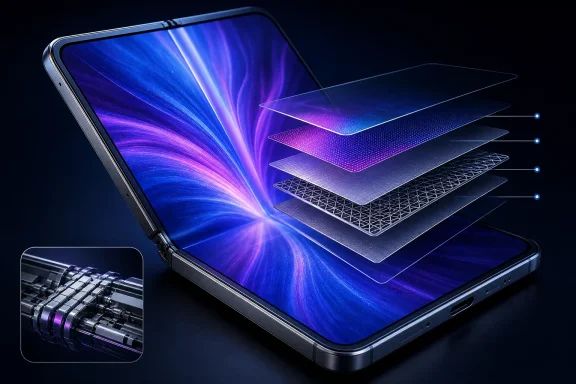 What Samsung is changing
The titanium-alloy film supports the display from within, replacing a role normally handled by thinner plastic-based layers. Samsung says the film has substantially higher mechanical stiffness while remaining extremely thin. Beneath it, a micro-patterned titanium plate is designed to support the display module while allowing the hinge area to bend.Samsung Display executive Kyung-Jin Yoo said the plate’s patterned folding section is intended to preserve flexibility without sacrificing structural durability. The company is also pairing the hardware changes with new OLED materials it says should improve power efficiency.
The important qualifier: Samsung is promising reduced crease visibility, not an invisible crease. That distinction matters. Foldable panels still need a flexible section where the screen bends, and the visual and tactile crease remains one of the format’s most persistent compromises.
Expected devices
Thurrott.com and other outlets expect the technology to arrive in the Galaxy Z Fold 8 and Galaxy Z Flip 8, both widely anticipated for the July 22 event. Samsung has not yet published final device specifications, durability ratings, pricing, or regional availability.That leaves several practical questions unanswered. Titanium can improve the strength of supporting layers, but real-world durability will depend on the cover material, hinge design, dust resistance, adhesive construction, and repairability—not just the display stack. Samsung also has not said whether Flex Titanium affects panel replacement costs, battery life, device weight, or thickness.
Why it matters
For foldable buyers, the crease and concerns about long-term display reliability have remained the core trade-offs against conventional slab phones. A less noticeable crease would improve the experience for reading, productivity, video, and remote-desktop use, while stronger backing layers could address the vulnerability that comes with repeatedly bending an OLED panel.For Windows users, the news is mostly relevant to the broader mobile hardware ecosystem rather than Windows itself. Android foldables can already serve as companion devices for Phone Link, Microsoft 365, OneDrive, Remote Desktop, and cloud-PC workflows, but Samsung’s announcement does not include a new Windows integration feature.
Samsung will need to provide independent durability figures and shipping-device details on July 22 before Flex Titanium’s practical value can be judged.
