

Samsung announced the Galaxy A37 5G and Galaxy A57 5G on March 25, 2026, with U.S. availability beginning April 9 and starting prices of $449 and $549, positioning both phones below the Galaxy S26 line while borrowing display, durability, software, and AI features from Samsung’s premium playbook. The launch is not just another annual A-series refresh. It is Samsung’s answer to a market where flagship phones have become financially absurd for many buyers, but where cheap phones can no longer feel disposable. The company is betting that “good enough” has to look, last, and think more like “premium enough.”
For years, the Galaxy A series has carried an implicit compromise: you bought it because you wanted Samsung’s ecosystem, a big screen, and reasonable battery life without paying Galaxy S money. That bargain still exists, but the A37 and A57 suggest Samsung understands that the psychology of midrange phones has changed. A $449 or $549 handset is not a casual purchase anymore; it is a device many people expect to keep for years.
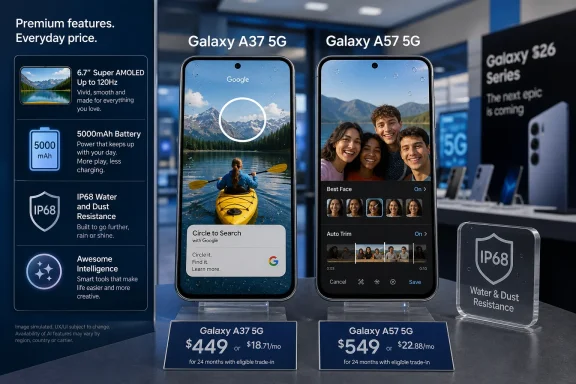
That is why the most important thing about these phones is not one spec but the way the spec sheet is arranged. A 6.7-inch Super AMOLED display with a refresh rate up to 120Hz used to be a flagship-feeling feature. A 5,000mAh battery is now table stakes, but still meaningful. IP68 dust and water resistance, newly extended to these midrange models, is the sort of practical premium feature that matters more in the real world than another synthetic benchmark win.
Samsung is also making a more subtle argument: if AI is going to be part of the smartphone sales pitch, it cannot stay locked behind $1,000 devices. The A57 gets Samsung’s more complete set of AI photo-editing toys, including Best Face and Auto Trim, while the A37 still gets access to broader tools such as Circle to Search and other AI editing features. That split keeps the upsell alive, but it also acknowledges that midrange buyers now expect the software story to be current.
This is the new shape of the Android middle class. Buyers are not necessarily demanding foldable screens, titanium frames, or 200-megapixel camera modules. They are demanding that the phone they can afford not feel abandoned by the industry’s future.
The compromises are visible, but not catastrophic. The ultrawide camera steps down to 8 megapixels, compared with 12 megapixels on the A57. The macro camera remains a 5-megapixel module, the kind of spec that helps a camera bump look fuller on a product page but rarely transforms actual photography. The selfie camera is 12 megapixels, matching the A57 on paper.
The more interesting detail is that Samsung is using the A37 to normalize a baseline experience that would have sounded unusually generous in a midrange phone not long ago. Android 16 out of the box means buyers are not starting behind the curve. IP68 means the phone is better prepared for accidents. The large AMOLED display gives Samsung one of its strongest advantages in a price tier where screens are often the first place manufacturers try to hide savings.
That matters because the A37 will probably be judged less by reviewers than by people upgrading from three- or four-year-old phones. For them, the question is not whether it beats the S26 Ultra. It is whether it feels modern after the monthly bill, the trade-in math, and the family-plan discounts have all done their work.
The A57’s case is not built on raw power alone. It is thinner and lighter than the A37, reportedly by 0.5mm and 27g, and that is the kind of difference that can matter more than it sounds. Phone spec sheets rarely capture ergonomics well, but a lighter large-screen phone is easier to live with, especially when the screen is 6.7 inches and the device is likely to be used one-handed more often than anyone recommends.
Samsung also gives the A57 a few software perks, most notably Best Face and Auto Trim. Those features are not essential, but they are revealing. The company is using AI as a segmentation tool, offering enough intelligence on the A37 to make it feel current while reserving some of the more marketable tricks for the A57.
That is a familiar Samsung move, but the gap between the two phones appears deliberately restrained. The A57 is better, but not dramatically different. Samsung seems to know that in this price band, charging $100 more requires polish rather than spectacle.
That distinction matters in 2026 because the flagship phone market is increasingly defined by inflationary pressure. Components are expensive, AI features demand more memory and compute, and manufacturers have every incentive to push buyers toward higher-margin models. The result is a top end that can feel less like aspiration and more like exclusion.
The A37 and A57 turn that pressure into an argument for restraint. A 120Hz AMOLED display, a large battery, water resistance, current Android software, and Samsung’s AI layer are enough phone for a large majority of people. The absence of flagship camera hardware, wireless charging, and the very fastest silicon will matter to some buyers, but not to everyone.
This is where Samsung’s scale becomes a strategic weapon. The company can take features that were once premium differentiators and move them downmarket without making the products feel experimental. It does not need the A37 or A57 to be revolutionary. It needs them to make a $1,000 flagship look optional.
The photo tools are more complicated. Best Face and Auto Trim sound useful, but they also show how AI is becoming a way to carve up product tiers. The A57 gets more of the experience, the A37 gets enough to avoid looking obsolete, and the S26 line still gets to be the full-fat showcase.
For users, the risk is not that these tools exist. The risk is that phone buying becomes increasingly opaque, with features depending less on whether the hardware can run them and more on whether the vendor decides a given tier deserves them. We have already seen this pattern across the industry: software becomes the product, and the product becomes a subscription-shaped promise even when no subscription is involved.
Still, it would be too cynical to dismiss the feature set outright. Midrange buyers benefit when useful tools trickle down. If Samsung can deliver AI editing and search features without turning the A37 into a sluggish demo kiosk, then the company will have done something more meaningful than invent another branding phrase.
Midrange phones have historically asked buyers to accept that accident protection lives higher up the product stack. That never made much sense. People who buy cheaper phones are not less likely to drop them, spill on them, or use them in bad weather. If anything, they are more likely to care about repair costs because the device was bought with tighter financial margins in mind.
By bringing IP68 to these models, Samsung is acknowledging that durability is not a luxury feature. It is a trust feature. It tells the buyer that the phone is not just cheaper at checkout but more defensible over time.
That is especially important for families, younger users, field workers, and anyone who buys through carrier promotions and then lives with the same handset until the next contract cycle. The best midrange phone is not the one with the flashiest launch-day spec. It is the one that survives ordinary life without turning every accident into a repair bill.
That is a clever move because Google’s advantage has never been merely price. It has been clarity. Pixel A phones usually promise a clean Android experience, strong computational photography, and features borrowed from more expensive Pixels. Samsung’s phones, by contrast, have sometimes felt more commercially complicated: more models, more carrier variants, more preloaded services, more Samsung-specific behavior.
The A37 and A57 do not erase that complexity, but they improve Samsung’s argument. If the display is better, the battery is large, the durability rating is higher, and the AI features are close enough for mainstream use, many buyers will not care that the Pixel is theoretically purer. They will care which phone feels better in hand, looks better on a store shelf, and comes with the most persuasive promotion.
Samsung also has the advantage of ecosystem gravity. Galaxy watches, earbuds, tablets, Windows integration, SmartThings devices, and carrier retail relationships all reinforce the phone purchase. Google has improved its hardware ecosystem, but Samsung still knows how to occupy the mainstream Android aisle like no one else.
This is where RAM configuration matters. The A37’s 6GB base option may be adequate today, but it is the one spec that could age fastest as Android, One UI, and AI-adjacent features become heavier. Buyers who plan to keep the device for several years should think carefully about stepping up to 8GB if the price difference is reasonable.
Storage is another long-term pressure point. A 128GB phone can still be workable, especially with cloud storage and disciplined app management, but 256GB is the safer choice for anyone who shoots a lot of video or keeps years of photos locally. Samsung’s midrange value equation becomes much stronger when the phone is configured for longevity rather than simply bought at the lowest advertised price.
There is also the matter of update quality. Shipping with Android 16 is good, but the pace and polish of updates will determine whether these devices feel respected after the launch campaign fades. Samsung has become one of Android’s stronger update vendors, but midrange buyers have learned to be skeptical until the patches arrive consistently.
The 5-megapixel macro camera is less convincing. Smartphone makers continue to include low-end macro modules because they help round out a triple-camera spec sheet, even when the real-world value is limited. Buyers should treat it as a bonus, not a reason to choose either phone.
The more important camera distinction may be software. Best Face and Auto Trim on the A57 are designed for social photography and quick edits, not professional capture. That fits the market. Most people do not want a phone that can replace a dedicated camera; they want a phone that can rescue a group shot, clean up a clip, and make sharing easier.
This is why Samsung’s midrange camera strategy is less about photography purists and more about default behavior. If the phone reliably produces a pleasing shot without fiddling, it wins. If it stumbles in low light or overprocesses skin tones, the megapixel count will not save it.
Samsung knows this terrain better than almost anyone. The company’s midrange phones often thrive because they are available everywhere, recognizable to non-enthusiasts, and easy for sales reps to explain. “It has a big Samsung screen, good battery, water resistance, and some of the AI features from the expensive phones” is a stronger pitch than a dense recital of chipset details.
This is also where the A57’s thinner and lighter design could matter. In a store, people pick up phones. They compare weight, color, screen brightness, camera bumps, and how premium the device feels. If the A57 feels meaningfully nicer in hand, Samsung may win upgrades that would not be obvious from the spec sheet alone.
The A37, meanwhile, is positioned to be the practical default. It is the phone a parent buys for a teenager, an adult buys after deciding the flagship is too much, or a carrier promotes as a sensible Android upgrade. Samsung does not need it to excite enthusiasts. It needs it to avoid disappointing everyone else.
Giving the cheaper phone more colors could help it stand out in retail environments and online listings. It also gives buyers a sense of choice even when the device itself is the value model. The A57, by contrast, appears to be styled as the more mature, understated option.
Samsung’s “Awesome” naming remains painfully Samsung, but the broader design language is doing something intentional. The company wants these phones to be recognizable as Galaxy devices, not budget alternatives wearing a different costume. That continuity helps Samsung preserve brand value even as it sells cheaper hardware.
The downside is sameness. Many buyers will struggle to distinguish A-series models at a glance, and Samsung’s crowded lineup can blur into itself. But sameness can also reassure. In the midrange, looking like the expensive phone is often half the battle.
That tension creates an opening for midrange devices with fewer obvious weaknesses. A cheap phone that feels cheap is a risk; a midrange phone that feels premium enough is a rational hedge. Samsung is trying to make the A37 and A57 feel like devices chosen by careful buyers rather than compromised ones.
The RAM shortage and broader component-cost pressure sharpen the point. If high-end devices continue climbing in price, the middle of the market becomes more strategically valuable. Consumers who might once have stretched for a flagship may instead ask whether the extra money buys daily benefits or just bragging rights.
Samsung’s answer is embedded in these phones: most people can live without the Ultra, but not without a bright display, decent cameras, long battery life, durability, and modern software. That is not a glamorous thesis. It is a commercially powerful one.
 Samsung’s Midrange Pitch Is No Longer About Settling
For years, the Galaxy A series has carried an implicit compromise: you bought it because you wanted Samsung’s ecosystem, a big screen, and reasonable battery life without paying Galaxy S money. That bargain still exists, but the A37 and A57 suggest Samsung understands that the psychology of midrange phones has changed. A $449 or $549 handset is not a casual purchase anymore; it is a device many people expect to keep for years.That is why the most important thing about these phones is not one spec but the way the spec sheet is arranged. A 6.7-inch Super AMOLED display with a refresh rate up to 120Hz used to be a flagship-feeling feature. A 5,000mAh battery is now table stakes, but still meaningful. IP68 dust and water resistance, newly extended to these midrange models, is the sort of practical premium feature that matters more in the real world than another synthetic benchmark win.
Samsung is also making a more subtle argument: if AI is going to be part of the smartphone sales pitch, it cannot stay locked behind $1,000 devices. The A57 gets Samsung’s more complete set of AI photo-editing toys, including Best Face and Auto Trim, while the A37 still gets access to broader tools such as Circle to Search and other AI editing features. That split keeps the upsell alive, but it also acknowledges that midrange buyers now expect the software story to be current.
This is the new shape of the Android middle class. Buyers are not necessarily demanding foldable screens, titanium frames, or 200-megapixel camera modules. They are demanding that the phone they can afford not feel abandoned by the industry’s future.
The A37 Is the Floor Samsung Can No Longer Afford to Lower
The Galaxy A37 is the cheaper device, but Samsung has not treated it like a throwaway. It has the same 6.7-inch Super AMOLED panel size as the A57, the same up-to-120Hz refresh rate class, the same 5,000mAh battery capacity, and a triple-camera system anchored by a 50-megapixel wide camera. Buyers can configure it with 6GB or 8GB of RAM and 128GB or 256GB of storage, which keeps the model flexible enough for both carrier-store shoppers and more deliberate buyers.The compromises are visible, but not catastrophic. The ultrawide camera steps down to 8 megapixels, compared with 12 megapixels on the A57. The macro camera remains a 5-megapixel module, the kind of spec that helps a camera bump look fuller on a product page but rarely transforms actual photography. The selfie camera is 12 megapixels, matching the A57 on paper.
The more interesting detail is that Samsung is using the A37 to normalize a baseline experience that would have sounded unusually generous in a midrange phone not long ago. Android 16 out of the box means buyers are not starting behind the curve. IP68 means the phone is better prepared for accidents. The large AMOLED display gives Samsung one of its strongest advantages in a price tier where screens are often the first place manufacturers try to hide savings.
That matters because the A37 will probably be judged less by reviewers than by people upgrading from three- or four-year-old phones. For them, the question is not whether it beats the S26 Ultra. It is whether it feels modern after the monthly bill, the trade-in math, and the family-plan discounts have all done their work.
The A57 Is the Upsell, but the Upsell Is Getting Narrower
The Galaxy A57 is the more polished of the pair, and Samsung clearly wants it to feel like the model for people who almost bought a flagship but came to their senses. It starts with 8GB of RAM, offers the same 128GB or 256GB storage options, and keeps the same 5,000mAh battery. The camera system improves modestly with a 12-megapixel ultrawide camera, while the 50-megapixel main camera and 5-megapixel macro remain familiar.The A57’s case is not built on raw power alone. It is thinner and lighter than the A37, reportedly by 0.5mm and 27g, and that is the kind of difference that can matter more than it sounds. Phone spec sheets rarely capture ergonomics well, but a lighter large-screen phone is easier to live with, especially when the screen is 6.7 inches and the device is likely to be used one-handed more often than anyone recommends.
Samsung also gives the A57 a few software perks, most notably Best Face and Auto Trim. Those features are not essential, but they are revealing. The company is using AI as a segmentation tool, offering enough intelligence on the A37 to make it feel current while reserving some of the more marketable tricks for the A57.
That is a familiar Samsung move, but the gap between the two phones appears deliberately restrained. The A57 is better, but not dramatically different. Samsung seems to know that in this price band, charging $100 more requires polish rather than spectacle.
The Flagship Shadow Makes the A-Series Look More Rational
The Galaxy S26 line gives Samsung its halo, but the A37 and A57 may be the more economically honest products. Premium phones have become showcases for everything manufacturers can technically accomplish and financially justify. Midrange phones are where those companies reveal what they think customers actually need.That distinction matters in 2026 because the flagship phone market is increasingly defined by inflationary pressure. Components are expensive, AI features demand more memory and compute, and manufacturers have every incentive to push buyers toward higher-margin models. The result is a top end that can feel less like aspiration and more like exclusion.
The A37 and A57 turn that pressure into an argument for restraint. A 120Hz AMOLED display, a large battery, water resistance, current Android software, and Samsung’s AI layer are enough phone for a large majority of people. The absence of flagship camera hardware, wireless charging, and the very fastest silicon will matter to some buyers, but not to everyone.
This is where Samsung’s scale becomes a strategic weapon. The company can take features that were once premium differentiators and move them downmarket without making the products feel experimental. It does not need the A37 or A57 to be revolutionary. It needs them to make a $1,000 flagship look optional.
AI Is Becoming the New Carrier Bloatware, but Also the New Differentiator
Samsung’s “Awesome Intelligence” framing is marketing fluff, but the underlying move is important. The company is not merely adding AI features to midrange phones; it is training buyers to expect them everywhere. Circle to Search is the easiest example because it is practical, visible, and easy to demonstrate in a store or advertisement.The photo tools are more complicated. Best Face and Auto Trim sound useful, but they also show how AI is becoming a way to carve up product tiers. The A57 gets more of the experience, the A37 gets enough to avoid looking obsolete, and the S26 line still gets to be the full-fat showcase.
For users, the risk is not that these tools exist. The risk is that phone buying becomes increasingly opaque, with features depending less on whether the hardware can run them and more on whether the vendor decides a given tier deserves them. We have already seen this pattern across the industry: software becomes the product, and the product becomes a subscription-shaped promise even when no subscription is involved.
Still, it would be too cynical to dismiss the feature set outright. Midrange buyers benefit when useful tools trickle down. If Samsung can deliver AI editing and search features without turning the A37 into a sluggish demo kiosk, then the company will have done something more meaningful than invent another branding phrase.
Durability Is the Quiet Premium Feature That Actually Matters
IP68 dust and water resistance may be the most consequential upgrade here. It is not glamorous, and it will not sell as many phones in a thirty-second ad as an AI photo trick. But for buyers trying to stretch a phone over three, four, or five years, durability is the difference between value and false economy.Midrange phones have historically asked buyers to accept that accident protection lives higher up the product stack. That never made much sense. People who buy cheaper phones are not less likely to drop them, spill on them, or use them in bad weather. If anything, they are more likely to care about repair costs because the device was bought with tighter financial margins in mind.
By bringing IP68 to these models, Samsung is acknowledging that durability is not a luxury feature. It is a trust feature. It tells the buyer that the phone is not just cheaper at checkout but more defensible over time.
That is especially important for families, younger users, field workers, and anyone who buys through carrier promotions and then lives with the same handset until the next contract cycle. The best midrange phone is not the one with the flashiest launch-day spec. It is the one that survives ordinary life without turning every accident into a repair bill.
The Pixel Comparison Is the Fight Samsung Wants
Google’s Pixel A-series has long been the default recommendation for buyers who wanted a cheaper Android phone with smart software and strong photography. Samsung has often countered with better displays, broader retail availability, and a more familiar brand presence. With the A37 and A57, Samsung is pushing harder into Google’s territory by making AI and software currency central to the pitch.That is a clever move because Google’s advantage has never been merely price. It has been clarity. Pixel A phones usually promise a clean Android experience, strong computational photography, and features borrowed from more expensive Pixels. Samsung’s phones, by contrast, have sometimes felt more commercially complicated: more models, more carrier variants, more preloaded services, more Samsung-specific behavior.
The A37 and A57 do not erase that complexity, but they improve Samsung’s argument. If the display is better, the battery is large, the durability rating is higher, and the AI features are close enough for mainstream use, many buyers will not care that the Pixel is theoretically purer. They will care which phone feels better in hand, looks better on a store shelf, and comes with the most persuasive promotion.
Samsung also has the advantage of ecosystem gravity. Galaxy watches, earbuds, tablets, Windows integration, SmartThings devices, and carrier retail relationships all reinforce the phone purchase. Google has improved its hardware ecosystem, but Samsung still knows how to occupy the mainstream Android aisle like no one else.
The Spec Sheet Hides the Real Question: How Fast Will These Phones Age?
The big unknown is performance over time. Both phones use Exynos chipsets, and early hands-on impressions suggest apps load quickly and smoothly. That is encouraging, but midrange phones are not judged only on launch-day responsiveness. They are judged by how they behave after two years of app updates, OS upgrades, background services, photos, cached media, and all the grime of real use.This is where RAM configuration matters. The A37’s 6GB base option may be adequate today, but it is the one spec that could age fastest as Android, One UI, and AI-adjacent features become heavier. Buyers who plan to keep the device for several years should think carefully about stepping up to 8GB if the price difference is reasonable.
Storage is another long-term pressure point. A 128GB phone can still be workable, especially with cloud storage and disciplined app management, but 256GB is the safer choice for anyone who shoots a lot of video or keeps years of photos locally. Samsung’s midrange value equation becomes much stronger when the phone is configured for longevity rather than simply bought at the lowest advertised price.
There is also the matter of update quality. Shipping with Android 16 is good, but the pace and polish of updates will determine whether these devices feel respected after the launch campaign fades. Samsung has become one of Android’s stronger update vendors, but midrange buyers have learned to be skeptical until the patches arrive consistently.
The Camera Story Is Sensible, Not Magical
The camera hardware on the A37 and A57 is exactly what a mature midrange strategy looks like. Both phones rely on a 50-megapixel main camera, and that is where most users will get their best results. The ultrawide difference gives the A57 a legitimate edge, but the gap is unlikely to matter as much as Samsung’s image processing in ordinary daylight and indoor scenes.The 5-megapixel macro camera is less convincing. Smartphone makers continue to include low-end macro modules because they help round out a triple-camera spec sheet, even when the real-world value is limited. Buyers should treat it as a bonus, not a reason to choose either phone.
The more important camera distinction may be software. Best Face and Auto Trim on the A57 are designed for social photography and quick edits, not professional capture. That fits the market. Most people do not want a phone that can replace a dedicated camera; they want a phone that can rescue a group shot, clean up a clip, and make sharing easier.
This is why Samsung’s midrange camera strategy is less about photography purists and more about default behavior. If the phone reliably produces a pleasing shot without fiddling, it wins. If it stumbles in low light or overprocesses skin tones, the megapixel count will not save it.
The Carrier Store Is Where This Battle Will Be Won
The A37 and A57 are not just phones; they are carrier-store instruments. Their list prices matter, but many buyers will encounter them through monthly payment plans, trade-in credits, prepaid offers, and family-account upgrades. In that environment, a $100 difference between models can become psychologically smaller or larger depending on how the promotion is framed.Samsung knows this terrain better than almost anyone. The company’s midrange phones often thrive because they are available everywhere, recognizable to non-enthusiasts, and easy for sales reps to explain. “It has a big Samsung screen, good battery, water resistance, and some of the AI features from the expensive phones” is a stronger pitch than a dense recital of chipset details.
This is also where the A57’s thinner and lighter design could matter. In a store, people pick up phones. They compare weight, color, screen brightness, camera bumps, and how premium the device feels. If the A57 feels meaningfully nicer in hand, Samsung may win upgrades that would not be obvious from the spec sheet alone.
The A37, meanwhile, is positioned to be the practical default. It is the phone a parent buys for a teenager, an adult buys after deciding the flagship is too much, or a carrier promotes as a sensible Android upgrade. Samsung does not need it to excite enthusiasts. It needs it to avoid disappointing everyone else.
Samsung’s Color Strategy Says More Than It Seems
The A57’s single U.S. color, Awesome Navy, is oddly restrained for a phone in a series that has historically leaned into playful branding. The A37 gets more visible variety: Awesome Charcoal, Awesome Lavender, Graygreen, and Awesome White. That distribution may seem superficial, but color is one of the few emotional levers left in a market where most phones look like black rectangles with camera islands.Giving the cheaper phone more colors could help it stand out in retail environments and online listings. It also gives buyers a sense of choice even when the device itself is the value model. The A57, by contrast, appears to be styled as the more mature, understated option.
Samsung’s “Awesome” naming remains painfully Samsung, but the broader design language is doing something intentional. The company wants these phones to be recognizable as Galaxy devices, not budget alternatives wearing a different costume. That continuity helps Samsung preserve brand value even as it sells cheaper hardware.
The downside is sameness. Many buyers will struggle to distinguish A-series models at a glance, and Samsung’s crowded lineup can blur into itself. But sameness can also reassure. In the midrange, looking like the expensive phone is often half the battle.
The Economic Moment Gives the A37 and A57 Their Opening
The broader smartphone market has reached an awkward point. Flagship prices remain high, upgrade cycles have lengthened, and many users no longer feel a burning need to replace a phone every two years. At the same time, phones are more central than ever to banking, work authentication, messaging, photography, navigation, and entertainment.That tension creates an opening for midrange devices with fewer obvious weaknesses. A cheap phone that feels cheap is a risk; a midrange phone that feels premium enough is a rational hedge. Samsung is trying to make the A37 and A57 feel like devices chosen by careful buyers rather than compromised ones.
The RAM shortage and broader component-cost pressure sharpen the point. If high-end devices continue climbing in price, the middle of the market becomes more strategically valuable. Consumers who might once have stretched for a flagship may instead ask whether the extra money buys daily benefits or just bragging rights.
Samsung’s answer is embedded in these phones: most people can live without the Ultra, but not without a bright display, decent cameras, long battery life, durability, and modern software. That is not a glamorous thesis. It is a commercially powerful one.
The Real Upgrade Is the Disappearance of Obvious Regret
The A37 and A57 are not revolutionary phones, and that is the point. Their success will depend on whether Samsung has removed enough friction from the midrange experience that buyers do not spend the next three years wishing they had paid more. The strongest arguments are practical, not theatrical.- The Galaxy A37 gives buyers the core Samsung experience at $449, with a large AMOLED display, 120Hz refresh class, a 5,000mAh battery, Android 16, IP68 protection, and a 50-megapixel main camera.
- The Galaxy A57 uses its $549 price to add a lighter and thinner body, more base RAM, a better ultrawide camera, and extra AI photo-editing features.
- The addition of IP68 protection to Samsung’s midrange lineup is more important than it looks because durability directly affects long-term value.
- The A37’s 6GB RAM configuration may be the version most likely to show its age, so long-term buyers should treat 8GB as the safer floor.
- Samsung’s AI rollout is both useful and strategic, giving midrange buyers modern tools while still reserving some features for higher tiers.
- The strongest competitor is not only Google’s Pixel A-series but the buyer’s own reluctance to spend flagship money in a more expensive world.
References
- Primary source: Mashable
Published: 2026-06-15T22:50:10.496952
Samsung's A37 and A57 are midrange phones with some premium features | Mashable
Samsung's newest midrange handsets don't come with all the bells and whistles, but for the price, they feel premium enough.mashable.com - Related coverage: techradar.com
Samsung Galaxy A57 vs Samsung Galaxy A37: which mid-range phone is for you? | TechRadar
What a difference a '20' makeswww.techradar.com - Related coverage: phonearena.com
New Galaxy A37 and A57 renders reveal Samsung's mid-range phones still look the same - PhoneArena
Don’t expect a visual revolution – these mid-range phones stick to what works.www.phonearena.com - Related coverage: techadvisor.com
Samsung Galaxy A57 and A37 Renders Leak - Tech Advisor
Official-looking renders of the Samsung Galaxy A57 and A37, and one particular design decision stands outwww.techadvisor.com - Related coverage: notebookcheck.net
Samsung Galaxy A57 5G and Galaxy A37 5G launched with new 4nm Exynos SoCs and promise of better low-light photos - Notebookcheck News
Samsung has unveiled the Galaxy A57 5G and the Galaxy A37 5G mid-range smartphones. Both phones come with new 4 nm Exynos SoCs, a new Image Signal Processor (ISP) for better photos, and in the case of the Galaxy A57 5G, a smaller overall footprint. www.notebookcheck.net
- Related coverage: megamobilecontent.com
- Related coverage: news.samsung.com
Samsung Unveils Galaxy A57 5G and Galaxy A37 5G, Packing Pro-Level Features at Awesome Price
Galaxy A57 5G and A37 5G feature a sleek design, powerful camera, and upgraded Awesome Intelligence to give users the confidence for everyday usenews.samsung.com
- Related coverage: abs-cbn.com
Samsung launches new A series phones for the midrange market | ABS-CBN News
Samsung on Wednesday announced the launch of the Galaxy A57 5G and A37 5G, which the company says bring the latest AI features to mid-range consumers.www.abs-cbn.com - Related coverage: the-independent.com
Samsung launches Galaxy A57 and A37 mid-range phones | The Independent
Samsung's latest affordable phones boast upgraded processors, tougher water resistance and a heavy dose of artificial intelligence. Here's where to buy.www.the-independent.com - Related coverage: androidcentral.com
Best cheap Samsung phones | Android Central
As cool as the latest flagship Samsung phones are, not everyone can afford them. So, why not check out Samsung phones that are top quality and cheap too?www.androidcentral.com - Related coverage: tomsguide.com
Samsung Galaxy A57 review: A surprisingly premium phone for budget shoppers | Tom's Guide
Samsung's cheaper phones continue to offer great value with more of a premium design, but it can't hide the fact that there aren't many meaningful upgrades this year.www.tomsguide.com
