

Samsung’s Galaxy Unpacked event on July 22, 2026 could become the company’s most consequential mobile launch in years—not simply because new Galaxy Z Fold and Galaxy Z Flip models are expected, but because Samsung appears ready to challenge its own definition of a foldable phone. A shorter, wider book-style Galaxy device would give the company a direct answer to the form factor widely associated with Apple’s rumored first foldable iPhone, potentially arriving later this year. Samsung helped create the modern foldable category and spent seven years shaping its conventions, but Apple’s looming entry means refinement alone is no longer enough. Samsung must prove that it can still lead the market it built, rather than merely react to the competitor most capable of making foldables mainstream.
Samsung’s foldable journey began as an audacious attempt to break the smartphone industry out of the glass-slab template. The original Galaxy Fold reached consumers in 2019 after a difficult launch period involving delayed shipments, display failures, and a redesign intended to protect the fragile folding panel.
Those problems could have ended the experiment. Instead, Samsung treated the first generation as an expensive public prototype and continued investing in hinges, ultra-thin glass, flexible OLED production, water resistance, software adaptation, and repair infrastructure.
That distinction gave shoppers an understandable choice:
Competitors experimented with wider proportions. Oppo’s early Find N models and Google’s first Pixel Fold offered cover screens that looked more like conventional smartphones, while Microsoft pushed the idea further with the dual-screen Surface Duo. Yet Samsung’s vertically oriented design became the most visible version of the category, influencing app layouts, accessories, and consumer expectations.
That history makes the expected change in 2026 particularly significant. Samsung may now be preparing to move toward a shape that it previously declined to embrace.
A shorter, wider Galaxy Fold could therefore represent a fundamental reconsideration of how owners are expected to use the device.
Samsung has gradually improved that experience by widening the chassis and reducing bezels. A purpose-built wide model could go further, offering a cover screen that behaves like an ordinary premium smartphone rather than a secondary interface attached to a tablet.
That could solve one of the category’s central contradictions. Consumers want the large internal display, but they do not necessarily want to unfold the phone every time they reply to a message, check a map, approve a sign-in request, or take a quick photograph.
Apple does not need to invent the foldable phone. It needs only to release one polished enough for millions of iPhone owners to consider the category legitimate.
Such forecasts remain estimates, and Apple has not publicly confirmed the final product, launch date, specifications, or even the foldable iPhone name. Nevertheless, the strategic implications are clear: Apple could rapidly expand public awareness of foldables even if its first device does not lead the market by volume.
Samsung would benefit from a larger addressable market, but it could also lose its privileged position within that market. The company would no longer be competing mainly against other Android manufacturers for adventurous buyers. It would be defending premium customers from an ecosystem rival with unusually high retention rates.
If Apple’s foldable launches with a wider shape, consumers may quickly treat that shape as the obvious configuration. Samsung cannot risk reaching that moment with no comparable device.
Launching a wider Galaxy first would allow Samsung to argue that it anticipated the direction of the category. More importantly, it would give Samsung real customer feedback, application telemetry, repair data, and manufacturing experience before Apple’s product reaches scale.
The expected 2026 lineup suggests a portfolio strategy rather than a one-design-fits-all approach.
If the broader reports are accurate, Samsung could structure its range around three distinct use cases:
Price segmentation could provide the answer, but that creates another risk. A wide model positioned as the new flagship could make the conventional Fold appear outdated, while aggressive pricing could reduce margins or undermine sales of Samsung’s premium Galaxy S Ultra phones.
Samsung will also need to support more screen dimensions across One UI, DeX, first-party applications, cases, replacement components, diagnostic procedures, and repair channels. Portfolio expansion is useful only if each device has a durable role rather than a one-generation marketing purpose.
It was technologically impressive, but its commercial life was unusually brief.
Its short availability does not necessarily prove that the concept failed. Limited quantities reportedly sold quickly, and an experimental device can generate valuable engineering knowledge even without becoming a mass-market product.
The episode does show that spectacle cannot substitute for a sustainable value proposition. A phone can unfold into a remarkable screen and still struggle if it costs more than a premium handset and tablet combined.
Samsung must convince buyers that experimental Galaxy products will receive dependable long-term support. Otherwise, each rapidly retired model trains consumers to wait for the second generation—or avoid the concept entirely.
A wider Fold should be simpler to manufacture and maintain than a dual-hinge TriFold. Even so, Samsung needs to present it as a stable branch of the Galaxy family, not another limited demonstration whose future depends on first-quarter sales.
The Galaxy Z Fold 7 and Galaxy Z Flip 7 represented important responses, delivering more complete designs and eliminating several long-standing ergonomic complaints. The pressure has not disappeared.
Yet the pursuit of thinness can produce serious compromises:
The meaningful tests will involve more than appearance under showroom lighting. Reviewers and buyers should examine touch consistency across the fold, reflections, stylus behavior, long-term deformation, cold-weather performance, dust intrusion, and resistance to localized pressure.
Samsung does not need to make the crease physically nonexistent. It does need to make it irrelevant to the ownership experience.
That experience needs to become visible to users rather than remaining an engineering achievement hidden behind basic continuity.
The next step is reducing friction. Users should not have to memorize gestures or navigate obscure settings to take advantage of a premium device.
An effective workflow could operate as follows:
Samsung can compensate with compatibility modes, but forced scaling is not the same as native adaptation. The company should provide strong developer guidance, testing tools, reference layouts, and commercial incentives for applications that make intelligent use of the new aspect ratio.
Apple could become unexpectedly helpful here. If a foldable iPhone encourages major developers to design flexible two-pane interfaces, comparable Android versions may improve as well. A rising tide could lift the software ecosystem even when the hardware companies remain direct competitors.
The wider design could make the phone a more credible companion for mobile work, but Samsung must avoid overstating it as a laptop replacement.
Potential enterprise uses include:
Enterprise buyers value continuity more than novelty. Samsung should publish clear support policies, maintain compatibility with managed peripherals, and avoid abruptly changing DeX behavior between One UI releases.
Security will be equally important. Knox management, hardware-backed credential protection, work profiles, remote policy enforcement, and predictable update schedules could differentiate Samsung from smaller foldable vendors even when those rivals offer more aggressive hardware specifications.
Samsung needs to answer a simple question: What does this device let an ordinary person do better every day?
Samsung should emphasize a broader set of benefits: comfortable reading, easier photo comparison, improved travel planning, side-by-side messaging, larger camera previews, better editing controls, and a cover screen that does not feel compromised.
The most persuasive demonstrations will involve frequent tasks completed with fewer steps. Consumers rarely purchase complex hardware because it can theoretically run three applications at once; they purchase it because a specific daily annoyance disappears.
A very high list price followed by immediate discounts may frustrate early buyers and weaken resale values. Samsung should pursue a price structure that supports long-term confidence rather than depending entirely on launch incentives.
Repair pricing will also matter. Consumers need transparent information about display replacement, hinge service, battery replacement, insurance deductibles, and what happens when protective layers become damaged outside warranty coverage.
The lesson is not that Samsung should stop experimenting. It is that matching a competitor’s expected design does not automatically create customer demand.
A wide foldable has a stronger functional argument because its dimensions affect how software and content appear. Even so, Samsung must prove that the change is based on observed behavior rather than an attempt to pre-empt Apple.
If the device exists mainly so Samsung can say it had the shape first, it may repeat the same strategic error. If it exists because the wider body produces a better cover screen, more useful multitasking, superior video, and stronger PC integration, it has a defensible reason to remain in the lineup.
Trying to behave exactly like Apple would surrender that advantage. Samsung should instead make experimentation sustainable by sharing components, guaranteeing software support, collecting transparent feedback, and retaining successful ideas across generations.
A new aspect ratio changes several of those variables simultaneously.
That dual position is powerful but complicated. Improvements developed for major customers may eventually spread across the industry, reducing the uniqueness of Samsung’s own devices.
The mobile division must therefore differentiate through the complete product: hinge design, software, camera integration, serviceability, ecosystem features, enterprise management, and retail support. A panel advantage alone is no longer sufficient.
The company can reduce that risk by sharing processors, camera modules, storage configurations, wireless hardware, and software foundations across the Fold family. Modular engineering may not be glamorous, but it determines whether an experimental shape can survive beyond its first year.
The expected wider model could turn those assets into a stronger defense against Apple.
Several risks deserve close attention.
Several details will determine whether Samsung is making a serious long-term move.
Watch for whether Samsung describes the device as an experiment, an Ultra-tier flagship, a replacement for the existing Fold, or the beginning of a separate family. Regional availability will also indicate expected scale.
The strongest presentation would connect the wider display to adaptive One UI layouts, Windows integration, DeX, content creation, communication, and practical multitasking. If the software looks identical to the standard Fold with more empty space, the hardware argument will be weakened.
Buyers should also examine warranty language and repair pricing. A durable product is not merely one that survives a laboratory folding machine; it is one that can be economically maintained over several years.
If Apple unveils a similarly wide device, comparisons will be immediate. Samsung’s advantage will depend on whether its head start produces better software, broader availability, lower pricing, and proven reliability rather than simply an earlier announcement.
Samsung no longer has the luxury of treating foldables as a category it can shape through market presence alone. Competitors have caught up in hardware, Android’s large-screen ecosystem is becoming more important, and Apple’s expected arrival threatens to reset consumer expectations in a single launch cycle. A wider Galaxy Fold is therefore both a defensive maneuver and an opportunity to rediscover the ambition that created the category. Playing safe would preserve Samsung’s current position only until someone else changes the rules; taking a disciplined risk gives it a chance to write the next set itself.
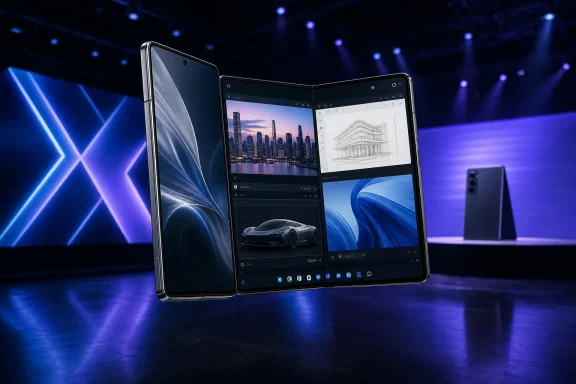 Background
Samsung’s foldable journey began as an audacious attempt to break the smartphone industry out of the glass-slab template. The original Galaxy Fold reached consumers in 2019 after a difficult launch period involving delayed shipments, display failures, and a redesign intended to protect the fragile folding panel.Those problems could have ended the experiment. Instead, Samsung treated the first generation as an expensive public prototype and continued investing in hinges, ultra-thin glass, flexible OLED production, water resistance, software adaptation, and repair infrastructure.
From technical demonstration to product family
Samsung eventually divided its foldable strategy into two recognizable categories. The Galaxy Z Flip became the compact, fashion-oriented model, while the Galaxy Z Fold targeted power users who wanted a phone capable of opening into a small tablet.That distinction gave shoppers an understandable choice:
- The Flip prioritized portability, style, and a familiar smartphone experience.
- The Fold emphasized productivity, multitasking, media consumption, and a larger canvas.
Samsung established the default shape
The tall and narrow outer display of early Galaxy Z Fold models was controversial, but Samsung’s market power helped make it seem normal. When opened, the device provided a nearly square internal workspace suited to split-screen apps and document viewing.Competitors experimented with wider proportions. Oppo’s early Find N models and Google’s first Pixel Fold offered cover screens that looked more like conventional smartphones, while Microsoft pushed the idea further with the dual-screen Surface Duo. Yet Samsung’s vertically oriented design became the most visible version of the category, influencing app layouts, accessories, and consumer expectations.
That history makes the expected change in 2026 particularly significant. Samsung may now be preparing to move toward a shape that it previously declined to embrace.
Why the Wider Form Factor Matters
A foldable phone’s dimensions determine much more than how it looks. Aspect ratio affects typing, video playback, multitasking, camera framing, app compatibility, weight distribution, pocketability, and whether the device feels useful while closed.A shorter, wider Galaxy Fold could therefore represent a fundamental reconsideration of how owners are expected to use the device.
A more conventional cover screen
The most persistent criticism of Samsung’s early Fold models concerned the narrow outer display. It was functional, but typing could feel cramped, interface elements appeared compressed, and some applications never looked entirely comfortable.Samsung has gradually improved that experience by widening the chassis and reducing bezels. A purpose-built wide model could go further, offering a cover screen that behaves like an ordinary premium smartphone rather than a secondary interface attached to a tablet.
That could solve one of the category’s central contradictions. Consumers want the large internal display, but they do not necessarily want to unfold the phone every time they reply to a message, check a map, approve a sign-in request, or take a quick photograph.
The internal display changes too
Widening the phone while reducing its height would produce a more landscape-oriented inner panel. That could improve several common activities:- Video would occupy more of the available display instead of appearing inside a square surrounded by large black areas.
- Two apps could sit side by side with more natural proportions.
- Web pages and desktop-style interfaces could gain additional horizontal room.
- Virtual keyboards could provide larger keys without consuming excessive vertical space.
- Remote desktop sessions could better match the widescreen monitors used by most Windows PCs.
Apple Changes the Competitive Equation
Samsung has faced technically sophisticated foldable rivals for years, including Huawei, Honor, Oppo, Vivo, Motorola, and Google. None, however, carries Apple’s combination of brand loyalty, global developer influence, retail reach, accessory support, and control over a tightly integrated hardware-software ecosystem.Apple does not need to invent the foldable phone. It needs only to release one polished enough for millions of iPhone owners to consider the category legitimate.
A mainstream validation event
Industry forecasts have repeatedly treated Apple’s anticipated entrance as a potential turning point. IDC has projected that Apple could secure roughly 22 percent of foldable unit shipments and 34 percent of the category’s value during its first year, reflecting expectations of premium pricing and substantial demand.Such forecasts remain estimates, and Apple has not publicly confirmed the final product, launch date, specifications, or even the foldable iPhone name. Nevertheless, the strategic implications are clear: Apple could rapidly expand public awareness of foldables even if its first device does not lead the market by volume.
Samsung would benefit from a larger addressable market, but it could also lose its privileged position within that market. The company would no longer be competing mainly against other Android manufacturers for adventurous buyers. It would be defending premium customers from an ecosystem rival with unusually high retention rates.
Apple can redefine expectations overnight
Samsung spent years normalizing compromises such as display creases, thick bodies, high prices, unusual aspect ratios, and more complicated repairs. Apple may enter only after deciding that it can present those compromises as adequately resolved—or at least sufficiently hidden by design, software, and marketing.If Apple’s foldable launches with a wider shape, consumers may quickly treat that shape as the obvious configuration. Samsung cannot risk reaching that moment with no comparable device.
Launching a wider Galaxy first would allow Samsung to argue that it anticipated the direction of the category. More importantly, it would give Samsung real customer feedback, application telemetry, repair data, and manufacturing experience before Apple’s product reaches scale.
Samsung’s Expanding Foldable Portfolio
For several years, Samsung’s foldable lineup was admirably simple: one Flip and one Fold. That clarity helped consumers understand two unfamiliar products, but it also constrained Samsung as the market diversified.The expected 2026 lineup suggests a portfolio strategy rather than a one-design-fits-all approach.
Three shapes for different customers
Samsung is expected to update its conventional Fold and Flip while introducing a wider book-style model. Final branding remains uncertain ahead of the July 22 event, and leaked names should not be treated as confirmed product identities.If the broader reports are accurate, Samsung could structure its range around three distinct use cases:
- The Galaxy Z Flip would remain the compact and comparatively accessible foldable.
- The conventional Galaxy Z Fold would preserve the tall design familiar to existing owners.
- The wider Fold would emphasize landscape content, productivity, and a conventional outer-screen experience.
Choice introduces complexity
More models also mean more difficult purchasing decisions. If the standard Fold and wide Fold use similar processors, cameras, memory configurations, and materials, Samsung must explain why both deserve to exist.Price segmentation could provide the answer, but that creates another risk. A wide model positioned as the new flagship could make the conventional Fold appear outdated, while aggressive pricing could reduce margins or undermine sales of Samsung’s premium Galaxy S Ultra phones.
Samsung will also need to support more screen dimensions across One UI, DeX, first-party applications, cases, replacement components, diagnostic procedures, and repair channels. Portfolio expansion is useful only if each device has a durable role rather than a one-generation marketing purpose.
Lessons from the Galaxy Z TriFold
Samsung has already demonstrated its willingness to explore beyond the familiar two-panel design. The Galaxy Z TriFold used two hinges and three sections to transform into a roughly 10-inch display, creating a device that sat somewhere between a phone and a full-size tablet.It was technologically impressive, but its commercial life was unusually brief.
Innovation without a sustainable market
The TriFold reached the United States in early 2026 at approximately $2,899, placing it far beyond the price of most flagship phones and even many premium laptops. Samsung subsequently ended the limited run after only a few months, with manufacturing complexity reportedly contributing to uncertainty over a successor.Its short availability does not necessarily prove that the concept failed. Limited quantities reportedly sold quickly, and an experimental device can generate valuable engineering knowledge even without becoming a mass-market product.
The episode does show that spectacle cannot substitute for a sustainable value proposition. A phone can unfold into a remarkable screen and still struggle if it costs more than a premium handset and tablet combined.
Support obligations outlast sales
The TriFold also highlights a challenge that matters to enthusiasts and enterprise buyers: discontinued hardware does not disappear when inventory sells out. Owners still require security updates, replacement displays, batteries, hinge components, warranty service, and application compatibility.Samsung must convince buyers that experimental Galaxy products will receive dependable long-term support. Otherwise, each rapidly retired model trains consumers to wait for the second generation—or avoid the concept entirely.
A wider Fold should be simpler to manufacture and maintain than a dual-hinge TriFold. Even so, Samsung needs to present it as a stable branch of the Galaxy family, not another limited demonstration whose future depends on first-quarter sales.
Hardware Innovation Can No Longer Be Incremental
Samsung’s early engineering lead allowed it to define the baseline for foldable durability. More recently, competitors have introduced thinner bodies, larger batteries, subtler creases, lighter frames, improved dust protection, and more usable outer displays.The Galaxy Z Fold 7 and Galaxy Z Flip 7 represented important responses, delivering more complete designs and eliminating several long-standing ergonomic complaints. The pressure has not disappeared.
Thinness is necessary but insufficient
A foldable must feel like a normal phone when closed. Excessive thickness makes it uncomfortable in a pocket, complicates car mounts, reduces accessory compatibility, and reminds owners that they are carrying two halves stacked together.Yet the pursuit of thinness can produce serious compromises:
- Battery capacity may stagnate even as display area increases.
- Camera hardware may remain behind conventional flagship phones.
- Heat dissipation can become more difficult under sustained workloads.
- The frame may offer less room to absorb impacts.
- Repair procedures may become more adhesive-heavy and labor-intensive.
The crease remains symbolic
Foldable display creases are often less distracting in everyday use than they appear in photographs, but they remain a visible symbol of compromise. Reports surrounding Samsung’s next generation point to further changes in display reinforcement and hinge construction, including new titanium-layer techniques intended to improve structural behavior.The meaningful tests will involve more than appearance under showroom lighting. Reviewers and buyers should examine touch consistency across the fold, reflections, stylus behavior, long-term deformation, cold-weather performance, dust intrusion, and resistance to localized pressure.
Samsung does not need to make the crease physically nonexistent. It does need to make it irrelevant to the ownership experience.
Software Will Decide Whether the Shape Works
Samsung’s largest advantage over a new foldable entrant may not be display manufacturing. It is the company’s accumulated experience adapting Android and One UI to screens that change size while an application is running.That experience needs to become visible to users rather than remaining an engineering achievement hidden behind basic continuity.
Multitasking should feel intentional
A wider internal display naturally invites side-by-side applications. Samsung already supports multiwindow layouts, floating windows, taskbar shortcuts, drag-and-drop operations, saved app combinations, and Flex Mode controls.The next step is reducing friction. Users should not have to memorize gestures or navigate obscure settings to take advantage of a premium device.
An effective workflow could operate as follows:
- The user opens an email or Teams message on the cover screen.
- Unfolding the device preserves the current application and reveals a contextual multitasking suggestion.
- A linked document or web page opens beside the message rather than replacing it.
- Text, images, or files can be dragged between the two applications.
- The layout can be saved as a reusable workspace or transferred to a Windows PC.
Developers still matter
Android’s adaptive-layout tools have improved, and Google has spent years encouraging developers to support tablets, foldables, resizable windows, and changing postures. Results remain uneven, particularly among applications designed primarily around narrow portrait screens.Samsung can compensate with compatibility modes, but forced scaling is not the same as native adaptation. The company should provide strong developer guidance, testing tools, reference layouts, and commercial incentives for applications that make intelligent use of the new aspect ratio.
Apple could become unexpectedly helpful here. If a foldable iPhone encourages major developers to design flexible two-pane interfaces, comparable Android versions may improve as well. A rising tide could lift the software ecosystem even when the hardware companies remain direct competitors.
The Windows and Enterprise Opportunity
A wide foldable Galaxy has particular relevance to Windows users. Samsung has cultivated one of Android’s strongest PC integration stories through Link to Windows, Quick Share, Samsung Notes synchronization, Galaxy Book features, and its DeX desktop environment.The wider design could make the phone a more credible companion for mobile work, but Samsung must avoid overstating it as a laptop replacement.
Better remote and hybrid workflows
Remote Desktop, Windows 365, Azure Virtual Desktop, browser-based business tools, and remote support applications benefit from horizontal space. A short, wide internal display should map more naturally to a PC desktop than the nearly square panels used by many existing foldables.Potential enterprise uses include:
- An administrator could monitor a dashboard while responding to an incident in Teams.
- A field technician could view a manual beside a service-ticket application.
- A salesperson could annotate a presentation without carrying a tablet.
- A manager could approve documents while referencing data in a second window.
- A support engineer could access a Windows session for urgent work away from a laptop.
DeX needs renewed clarity
Samsung DeX remains one of the company’s most distinctive features, but its strategic role has sometimes appeared uncertain. A premium wide Fold gives Samsung an opportunity to clarify whether DeX is primarily an external-monitor interface, an on-device desktop mode, or a bridge between Android mobility and Windows productivity.Enterprise buyers value continuity more than novelty. Samsung should publish clear support policies, maintain compatibility with managed peripherals, and avoid abruptly changing DeX behavior between One UI releases.
Security will be equally important. Knox management, hardware-backed credential protection, work profiles, remote policy enforcement, and predictable update schedules could differentiate Samsung from smaller foldable vendors even when those rivals offer more aggressive hardware specifications.
The Consumer Value Problem
Foldables have improved dramatically, but they remain expensive products in a mature smartphone market. A novel shape alone will not persuade mainstream buyers to accept a higher price, greater repair anxiety, and uncertain resale value.Samsung needs to answer a simple question: What does this device let an ordinary person do better every day?
Entertainment is not enough
A wider internal display should improve video playback and gaming, but those benefits face practical limits. Many films and streaming programs still will not fill the entire panel, while game interfaces may require specific optimization.Samsung should emphasize a broader set of benefits: comfortable reading, easier photo comparison, improved travel planning, side-by-side messaging, larger camera previews, better editing controls, and a cover screen that does not feel compromised.
The most persuasive demonstrations will involve frequent tasks completed with fewer steps. Consumers rarely purchase complex hardware because it can theoretically run three applications at once; they purchase it because a specific daily annoyance disappears.
Pricing and trade-ins will shape adoption
Samsung has traditionally used substantial trade-in credits, preorder storage upgrades, bundles, carrier financing, and promotional discounts to reduce the apparent cost of foldables. Those programs help adoption, but they can also obscure the real market value of the hardware.A very high list price followed by immediate discounts may frustrate early buyers and weaken resale values. Samsung should pursue a price structure that supports long-term confidence rather than depending entirely on launch incentives.
Repair pricing will also matter. Consumers need transparent information about display replacement, hinge service, battery replacement, insurance deductibles, and what happens when protective layers become damaged outside warranty coverage.
Avoiding the Galaxy S25 Edge Trap
Samsung has recent experience with the danger of building hardware around an anticipated industry trend. The Galaxy S25 Edge arrived as a remarkably thin flagship shortly before Apple launched its own slim iPhone Air concept, but the broader market response to ultra-thin phones reportedly fell short of the most optimistic expectations.The lesson is not that Samsung should stop experimenting. It is that matching a competitor’s expected design does not automatically create customer demand.
Form factor must follow a use case
Thin phones demonstrated the difficulty of marketing a physical attribute that can weaken battery life, thermal behavior, camera capability, or durability. Consumers may admire the engineering without wanting to own the compromise.A wide foldable has a stronger functional argument because its dimensions affect how software and content appear. Even so, Samsung must prove that the change is based on observed behavior rather than an attempt to pre-empt Apple.
If the device exists mainly so Samsung can say it had the shape first, it may repeat the same strategic error. If it exists because the wider body produces a better cover screen, more useful multitasking, superior video, and stronger PC integration, it has a defensible reason to remain in the lineup.
Samsung should not imitate Apple’s timing
Apple is known for entering categories after competitors and then presenting a tightly controlled interpretation. Samsung’s strength is different: it can move faster, test more designs, manufacture displays internally, and serve a broader range of prices and geographies.Trying to behave exactly like Apple would surrender that advantage. Samsung should instead make experimentation sustainable by sharing components, guaranteeing software support, collecting transparent feedback, and retaining successful ideas across generations.
Manufacturing and Supply-Chain Stakes
Foldables remain unusually demanding products to manufacture at scale. Flexible OLED yield, ultra-thin glass handling, hinge tolerances, adhesive consistency, dust management, frame machining, and final calibration all affect reliability and cost.A new aspect ratio changes several of those variables simultaneously.
Samsung Display is a strategic asset
Samsung’s display expertise gives the mobile division access to advanced panel research and large-scale manufacturing knowledge. That relationship becomes even more important if Apple enters the foldable market, because Samsung could potentially benefit as both a device competitor and a component supplier somewhere within the broader supply chain.That dual position is powerful but complicated. Improvements developed for major customers may eventually spread across the industry, reducing the uniqueness of Samsung’s own devices.
The mobile division must therefore differentiate through the complete product: hinge design, software, camera integration, serviceability, ecosystem features, enterprise management, and retail support. A panel advantage alone is no longer sufficient.
More models can weaken economies of scale
Adding a wide Fold creates another set of frames, displays, cases, batteries, packaging, repair parts, and production forecasts. If demand is misjudged, Samsung could face excess inventory or constrained availability.The company can reduce that risk by sharing processors, camera modules, storage configurations, wireless hardware, and software foundations across the Fold family. Modular engineering may not be glamorous, but it determines whether an experimental shape can survive beyond its first year.
Strengths and Opportunities
Samsung enters this transition with advantages that no other Android foldable manufacturer can fully replicate. It has global reach, mature software, display expertise, established carrier relationships, and years of real-world reliability data.The expected wider model could turn those assets into a stronger defense against Apple.
- Samsung can launch before Apple and establish practical experience with the wider format.
- A diversified lineup allows customers to choose between compact, tall-book, and wide-book designs.
- One UI already contains mature multitasking and continuity features that can exploit a larger display.
- Galaxy integration with Windows PCs provides a credible productivity story beyond entertainment.
- Samsung’s retail and carrier presence makes hands-on demonstrations available to mainstream consumers.
- Knox, enterprise management, and long support commitments can make foldables safer corporate purchases.
- Component sharing across the Galaxy portfolio could lower the cost of supporting multiple designs.
- Apple’s entry could expand foldable awareness, indirectly increasing demand for Samsung devices at several price levels.
Risks and Concerns
Expanding the foldable family is not automatically a sign of strategic confidence. It could also create confusion, expose weak demand, and leave customers uncertain about which experimental devices Samsung will continue supporting.Several risks deserve close attention.
- A wider Fold could cannibalize the standard Fold without materially increasing total sales.
- Premium pricing could confine the new model to enthusiasts rather than expanding the category.
- Poorly adapted Android applications may undermine the benefits of the wider internal screen.
- Thinness targets could compromise battery capacity, cameras, thermal management, or durability.
- Another short-lived model could damage trust after the limited Galaxy Z TriFold run.
- Complex repairs and high replacement costs could discourage consumers and enterprise fleets.
- Apple could deliver a more coherent hardware-software experience despite entering the category later.
- Samsung may appear reactive if its marketing focuses excessively on beating Apple rather than solving customer problems.
What to Watch Next
The July 22 Galaxy Unpacked presentation will reveal whether Samsung’s “new shape” is a central pillar of its mobile strategy or a specialized addition with limited distribution. Branding, pricing, availability, and support commitments may prove more important than the initial specification sheet.Several details will determine whether Samsung is making a serious long-term move.
Product positioning
Samsung must explain how the wider Fold differs from the conventional model. If both remain available, buyers need clear guidance on ergonomics, multitasking, cameras, battery life, stylus support, weight, and durability.Watch for whether Samsung describes the device as an experiment, an Ultra-tier flagship, a replacement for the existing Fold, or the beginning of a separate family. Regional availability will also indicate expected scale.
Software demonstrations
Prepared demonstrations often reveal what a manufacturer believes a product is for. Samsung should show genuine cross-application workflows rather than relying on abstract claims about productivity and artificial intelligence.The strongest presentation would connect the wider display to adaptive One UI layouts, Windows integration, DeX, content creation, communication, and practical multitasking. If the software looks identical to the standard Fold with more empty space, the hardware argument will be weakened.
Durability and repairability
Samsung is likely to emphasize hinge testing, display reinforcement, water resistance, and reduced creasing. Independent testing must determine whether those claims hold up under dust, drops, pressure, temperature changes, and repeated folding.Buyers should also examine warranty language and repair pricing. A durable product is not merely one that survives a laboratory folding machine; it is one that can be economically maintained over several years.
Apple’s eventual response
Apple’s first foldable remains unannounced as of July 21, 2026, despite extensive reporting and analyst expectations surrounding a possible introduction later this year. Its final dimensions, price, hinge design, display supplier, camera system, durability strategy, and software behavior remain uncertain.If Apple unveils a similarly wide device, comparisons will be immediate. Samsung’s advantage will depend on whether its head start produces better software, broader availability, lower pricing, and proven reliability rather than simply an earlier announcement.
Samsung no longer has the luxury of treating foldables as a category it can shape through market presence alone. Competitors have caught up in hardware, Android’s large-screen ecosystem is becoming more important, and Apple’s expected arrival threatens to reset consumer expectations in a single launch cycle. A wider Galaxy Fold is therefore both a defensive maneuver and an opportunity to rediscover the ambition that created the category. Playing safe would preserve Samsung’s current position only until someone else changes the rules; taking a disciplined risk gives it a chance to write the next set itself.
References
- Primary source: The Verge
Published: 2026-07-21T15:20:33+00:00
Loading…
www.theverge.com - Related coverage: techradar.com
Inside Samsung Display's secret labs, where it builds and stress-tests next-gen displays — and says it's ready for Apple to launch a foldable: 'We mean it, we love other companies to join this market' | TechRadar
How Samsung builds, tests, and innovates its displays — and a big hint of what's to come.www.techradar.com - Related coverage: digitalcameraworld.com
Samsung turns to titanium to help banish the crease on its next foldable phone screens | Digital Camera World
It should also help improve strength and durabilitywww.digitalcameraworld.com - Related coverage: quanchu.com.cn
844061098
Calling in smart phone. Business and success concept. Young adult ginger man working outdoor.www.quanchu.com.cn