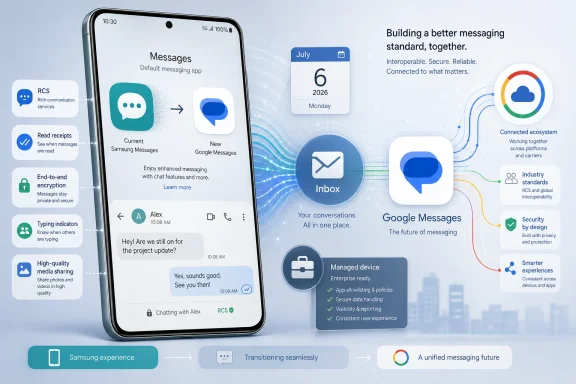
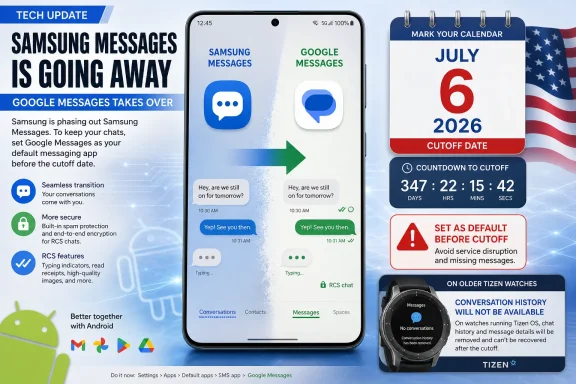
Samsung will discontinue Samsung Messages for U.S. Galaxy users on July 6, 2026, forcing remaining holdouts to make Google Messages their default SMS, MMS, and RCS app if they want normal texting to continue after the cutoff. The deadline is not just another app migration nag; it is the end of Samsung’s attempt to maintain a parallel messaging identity on Android. For users, the immediate job is mundane: switch apps, verify message history, and make sure watches or secondary devices still behave. For the Android ecosystem, the larger story is consolidation — Google’s messaging stack has finally become the default even on Samsung’s home turf.
For years, Samsung Messages existed as both a convenience and a contradiction. It was the familiar blue-and-white texting app on Galaxy phones, deeply integrated into Samsung’s skin, themes, and habits. But it lived beside Google Messages, which increasingly became the real home of Android’s modern messaging ambitions: RCS, better media handling, read receipts, typing indicators, encryption features, and cross-platform improvements with iPhone users.
That duality could survive only while texting remained mostly SMS and MMS with cosmetic differences on top. Once RCS became the battleground, the duplication became harder to justify. Samsung could either keep investing in a messaging client that depended heavily on carrier support and fragmented implementation, or it could align with Google’s more centralized RCS push.
The company has chosen alignment. Samsung’s support materials now point users away from Samsung Messages and toward Google Messages, presenting the move as a path to richer features rather than an admission that maintaining two messaging clients no longer makes sense. That is vendor diplomacy, but the reality is simpler: Samsung’s app lost the strategic argument.
The July 6 date gives the decision a hard edge. This is not merely Samsung making Google Messages the default on new phones, which it had already been doing on recent Galaxy flagships. It is a shutdown for users still relying on the old app, and that means inertia is no longer an option.
That is why the one-week countdown matters. Samsung says large message histories can take time to transfer, and users who wait until the cutoff may discover that “switching apps” is not always the same as “everything is immediately where I expect it to be.” The safe move is to migrate early, open Google Messages, allow it to become the default, and check the threads that actually matter before July 6 arrives.
The process should be simple for most people. Google Messages is already installed on many Galaxy devices, and if it is not, users can get it from the Play Store. On first launch, it will ask to become the default texting app; once approved, it should pick up the device’s existing SMS and MMS database and begin organizing conversations inside Google’s interface.
But “should” is doing real work there. Messaging migrations have a way of exposing edge cases: very large histories, old media attachments, carrier-specific RCS states, blocked-number lists, archived conversations, notification preferences, dual-SIM behavior, and wearables that depended on Samsung’s own app. Anyone who treats July 6 as a casual reminder rather than a deadline is volunteering to troubleshoot under pressure.
The trouble was that Android’s openness made messaging messy. Different phone makers shipped different clients. Carriers had their own ideas. Feature availability could vary depending on region, network, handset, and app. Samsung Messages could support RCS in some contexts, but the center of gravity increasingly moved to Google Messages because Google could operate the app, the service layer, and the Android-level integration in a more coherent way.
Samsung’s retreat acknowledges that coherence matters more than brand ownership here. If Android users are to have a reasonably predictable RCS experience — especially as Apple’s support for RCS changes the tone of Android-iPhone messaging — Google Messages is the obvious place to consolidate. It is not necessarily the most emotionally satisfying answer for Galaxy loyalists, but it is the most operationally plausible one.
That is the bargain users are being asked to accept. They lose a Samsung-flavored interface and some Galaxy-specific familiarity, but they gain the app Google is actually building around the future of Android messaging. For many users, that trade will be invisible after a week. For the people who chose Samsung partly because they preferred Samsung’s software layer, it will feel like another piece of Galaxy identity being sanded down.
Messaging is apparently no longer worth defending. That is a striking concession because texting is one of the most frequently used phone experiences. It sits on the home screen, generates lock-screen notifications, and mediates daily social life. If there is a place where a manufacturer might want its own user experience, messaging would seem to be it.
But the economics and politics of messaging are different from notes or a browser. A notes app can be excellent in isolation. A messaging app is only as strong as the network, standards, interoperability, spam protection, encryption model, and ecosystem support behind it. Samsung could continue styling the front end, but Google controls the more important direction of travel.
This is why some Galaxy users are reacting with a blunt complaint: if the default apps keep becoming Google apps, why not just buy a Pixel? That argument is emotionally understandable but strategically incomplete. Samsung still differentiates on hardware breadth, displays, cameras, foldables, retail presence, trade-in programs, and One UI’s system-level features. Still, every retired Samsung app narrows the distance between “Galaxy” and “Google’s Android, customized.”
Samsung appears willing to make that trade where the alternative is maintaining a weaker parallel service. It is a rational decision. It is also one that makes the Galaxy software experience feel less sovereign than Samsung’s marketing would prefer.
That does not mean every older watch becomes useless for texting. Basic sending and reading may still work in limited ways. But losing the full conversation view is exactly the sort of degradation that feels arbitrary to users because the watch hardware has not suddenly failed. The service relationship around it has changed.
This is the hidden cost of app consolidation. When a vendor retires an app, it is not only removing an icon from a phone. It is changing assumptions across accessories, backups, notification pipelines, automations, and habits formed over years. A phone migration may be easy; the surrounding ecosystem is where the rough edges show.
For IT departments, this is familiar territory. Consumer platforms increasingly behave like enterprise SaaS: features are deprecated, defaults move, APIs shift, and users wake up to discover that “supported yesterday” does not mean “supported tomorrow.” The difference is that messaging is personal infrastructure. Users may not think of it as a service dependency until a support notice tells them it is one.
The part users should not skip is validation. Open several important conversations. Check whether older attachments appear. Confirm that group chats are intact. Look at notification sounds and lock-screen behavior. If a watch, tablet, car system, or desktop pairing matters, test those too.
It is also wise to make a backup before changing anything. Android’s built-in backup mechanisms and Samsung’s tools can preserve much of the device state, but users with important message archives may want an additional SMS backup utility before the switch. This is not because the migration is expected to fail at scale; it is because the value of message history is often discovered only after it goes missing.
Dual-SIM users should pay particular attention. Default texting behavior, SIM-specific threads, and RCS registration can be more complicated when two numbers are involved. The same is true for users who changed carriers recently or who have moved the same number across multiple devices. The more unusual the setup, the less comforting “just tap the prompt” becomes.
Google Messages is not merely an app. It is part of a larger Google strategy around identity, spam filtering, RCS infrastructure, AI-assisted replies, media handling, and eventually more conversational services. Moving millions of Samsung users into that app strengthens Google’s leverage over what “default Android messaging” means.
There are benefits to that centralization. Spam protection can improve. Feature rollout can be more consistent. RCS becomes less dependent on carrier enthusiasm. Android-to-iPhone messaging gets a stronger advocate. Users who want modern messaging features are more likely to get them in Google Messages than in a legacy Samsung client nearing retirement.
But there is a cost. Android’s old promise was that manufacturers and users could swap defaults and still preserve meaningful diversity. In practice, core communication services tend to collapse toward whichever company can coordinate the most infrastructure. On Android, that company is Google.
Security-minded users will see both sides. Google Messages can offer stronger modern messaging features than plain SMS, and Google has invested heavily in spam detection and encrypted RCS conversations in supported cases. At the same time, consolidating communication metadata and behavior inside Google’s ecosystem raises the usual questions about platform concentration, user profiling, and how much of daily life should run through one account provider.
That work is expensive, and the payoff is questionable if users still expect Google-grade RCS compatibility. Samsung can spend engineering resources elsewhere while letting Google absorb the messaging roadmap. The company can then focus on hardware, One UI, camera software, AI features, and services where it believes it can still differentiate.
The risk is that users do not experience this as efficient resource allocation. They experience it as Samsung taking away something that worked for them. Even if Google Messages is technically superior for most use cases, forced migrations rarely produce gratitude.
This is especially true because Samsung has spent years cultivating the idea that Galaxy phones are not generic Android devices. When the company removes a core Samsung app and tells users to use Google’s version instead, it implicitly weakens that story. The decision may be right; it is still a visible retreat.
The immediate enterprise concern is not whether Google Messages is good enough. It is whether users know the change is coming, whether they have switched before the deadline, and whether authentication workflows still work. Any organization that uses SMS as a fallback for identity verification should assume that a few users will wait too long or misconfigure defaults.
There is also a training issue. Google Messages handles categories, search, spam filtering, archives, and RCS settings differently from Samsung Messages. Users who are not technically confident may interpret a different interface as lost data. Help desks should be ready with plain instructions and screenshots, especially for older Galaxy models still in circulation.
For admins with managed Android fleets, the move is another reminder that default-app assumptions should be documented, not guessed. If messaging matters to a workflow, specify the supported client. If SMS backups matter, define the process. If watches or companion devices are deployed, verify the supported messaging path before users discover a broken one in the field.
RCS is supposed to modernize that foundation, but RCS itself has depended on a messy alliance of carriers, handset makers, and platform owners. Google’s push has made it more usable, but the standard still carries the baggage of telecom-era coordination. The result is a transition that feels simultaneously overdue and unfinished.
Samsung Messages was a product of the old arrangement. It fit a world where carriers mattered more, handset vendors could ship their own texting apps, and “messages” mostly meant SMS with better visuals. Google Messages fits the new arrangement, where the app is a gateway to a richer, cloud-influenced communication layer with AI features, spam intelligence, and cross-device ambitions.
Users do not need to care about any of that to be affected by it. They just need their texts to work on July 7. But the reason they have to switch is that the industry finally decided the old fragmentation was more costly than the resentment caused by consolidation.
The migration should not require users to abandon Android or Samsung, and it does not mean every Galaxy device will suddenly behave like a Pixel. But it does mean one more daily experience is moving under Google’s roof. The people most likely to have a smooth transition are the ones who treat it as maintenance rather than a surprise.
The practical migration path appears to be the same one Samsung had previewed: the “Switch now” button opens Google Messages or sends users to Google Play if it is not installed. Droid Life says opening Google Messages and making it the default should be enough for message history to appear, with Samsung’s prompt claiming that all message history will be transferred.
The new wrinkle is Samsung’s support-page language: the shutdown applies in the U.S. starting July 6, 2026, for devices running Android 12 or newer. That narrows the affected-device scope more precisely than the earlier general warnings and gives admins a clearer minimum OS marker when checking Galaxy fleets.
Users who already made Google Messages their default are seeing a different Samsung Messages screen confirming that Google Messages is now the default app and offering an “Open Google Messages” path instead. For holdouts, the deadline is no longer theoretical: Samsung’s own app is now steering them out.
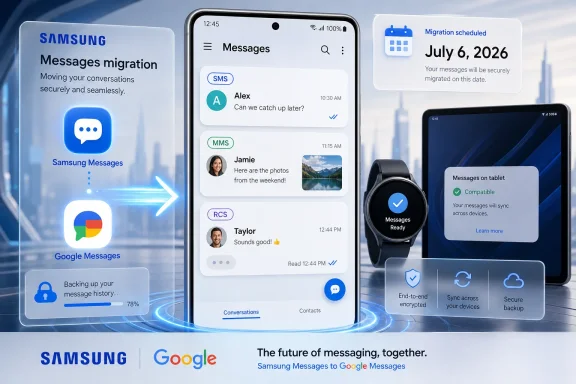 Samsung Finally Stops Pretending There Are Two Android Messaging Futures
For years, Samsung Messages existed as both a convenience and a contradiction. It was the familiar blue-and-white texting app on Galaxy phones, deeply integrated into Samsung’s skin, themes, and habits. But it lived beside Google Messages, which increasingly became the real home of Android’s modern messaging ambitions: RCS, better media handling, read receipts, typing indicators, encryption features, and cross-platform improvements with iPhone users.That duality could survive only while texting remained mostly SMS and MMS with cosmetic differences on top. Once RCS became the battleground, the duplication became harder to justify. Samsung could either keep investing in a messaging client that depended heavily on carrier support and fragmented implementation, or it could align with Google’s more centralized RCS push.
The company has chosen alignment. Samsung’s support materials now point users away from Samsung Messages and toward Google Messages, presenting the move as a path to richer features rather than an admission that maintaining two messaging clients no longer makes sense. That is vendor diplomacy, but the reality is simpler: Samsung’s app lost the strategic argument.
The July 6 date gives the decision a hard edge. This is not merely Samsung making Google Messages the default on new phones, which it had already been doing on recent Galaxy flagships. It is a shutdown for users still relying on the old app, and that means inertia is no longer an option.
The One-Week Warning Turns a Product Strategy Into a Household Chore
The most practical part of the story is also the easiest to underestimate. A messaging app is not like a weather widget or calculator; it is one of the few places where ordinary users keep years of personal history, business confirmations, two-factor codes, family photos, appointment reminders, and proof that someone did or did not say something.That is why the one-week countdown matters. Samsung says large message histories can take time to transfer, and users who wait until the cutoff may discover that “switching apps” is not always the same as “everything is immediately where I expect it to be.” The safe move is to migrate early, open Google Messages, allow it to become the default, and check the threads that actually matter before July 6 arrives.
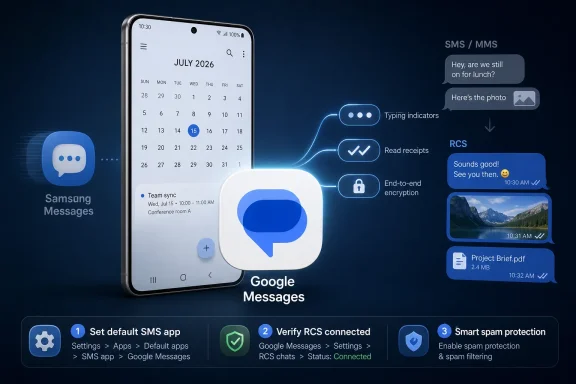
The process should be simple for most people. Google Messages is already installed on many Galaxy devices, and if it is not, users can get it from the Play Store. On first launch, it will ask to become the default texting app; once approved, it should pick up the device’s existing SMS and MMS database and begin organizing conversations inside Google’s interface.
But “should” is doing real work there. Messaging migrations have a way of exposing edge cases: very large histories, old media attachments, carrier-specific RCS states, blocked-number lists, archived conversations, notification preferences, dual-SIM behavior, and wearables that depended on Samsung’s own app. Anyone who treats July 6 as a casual reminder rather than a deadline is volunteering to troubleshoot under pressure.
Google Messages Wins Because RCS Needed a Single Center of Gravity
The case for Google Messages is strongest when viewed through RCS. Android messaging has spent years trying to escape the limitations of SMS: low-quality media, no typing indicators, unreliable group behavior, weak modern identity features, and a miserable experience when conversations cross between Android and iPhone. RCS does not solve every messaging problem, but it gives carriers, handset makers, and platform owners a shared upgrade path.The trouble was that Android’s openness made messaging messy. Different phone makers shipped different clients. Carriers had their own ideas. Feature availability could vary depending on region, network, handset, and app. Samsung Messages could support RCS in some contexts, but the center of gravity increasingly moved to Google Messages because Google could operate the app, the service layer, and the Android-level integration in a more coherent way.
Samsung’s retreat acknowledges that coherence matters more than brand ownership here. If Android users are to have a reasonably predictable RCS experience — especially as Apple’s support for RCS changes the tone of Android-iPhone messaging — Google Messages is the obvious place to consolidate. It is not necessarily the most emotionally satisfying answer for Galaxy loyalists, but it is the most operationally plausible one.
That is the bargain users are being asked to accept. They lose a Samsung-flavored interface and some Galaxy-specific familiarity, but they gain the app Google is actually building around the future of Android messaging. For many users, that trade will be invisible after a week. For the people who chose Samsung partly because they preferred Samsung’s software layer, it will feel like another piece of Galaxy identity being sanded down.
The Galaxy Phone Is Becoming Less Samsung in the Places Users Touch Most
Samsung has long sold more than hardware. A Galaxy phone is not just an Android phone with a Samsung logo; it is One UI, Samsung Health, Galaxy Store, SmartThings, Samsung Internet, Samsung Keyboard, Samsung Wallet, Samsung Notes, and a library of defaults that make the device feel distinct from a Pixel. The company’s challenge is deciding which of those defaults are worth defending and which are now redundant.Messaging is apparently no longer worth defending. That is a striking concession because texting is one of the most frequently used phone experiences. It sits on the home screen, generates lock-screen notifications, and mediates daily social life. If there is a place where a manufacturer might want its own user experience, messaging would seem to be it.
But the economics and politics of messaging are different from notes or a browser. A notes app can be excellent in isolation. A messaging app is only as strong as the network, standards, interoperability, spam protection, encryption model, and ecosystem support behind it. Samsung could continue styling the front end, but Google controls the more important direction of travel.
This is why some Galaxy users are reacting with a blunt complaint: if the default apps keep becoming Google apps, why not just buy a Pixel? That argument is emotionally understandable but strategically incomplete. Samsung still differentiates on hardware breadth, displays, cameras, foldables, retail presence, trade-in programs, and One UI’s system-level features. Still, every retired Samsung app narrows the distance between “Galaxy” and “Google’s Android, customized.”
Samsung appears willing to make that trade where the alternative is maintaining a weaker parallel service. It is a rational decision. It is also one that makes the Galaxy software experience feel less sovereign than Samsung’s marketing would prefer.
The Watch Problem Shows Why App Shutdowns Are Never Just App Shutdowns
The most visible losers are not necessarily phone users. They are people with older Samsung watches, especially Tizen-based models released before the Galaxy Watch4 generation. Samsung has warned that those watches cannot support Google Messages in the same way newer Wear OS models can, meaning they may lose access to full conversation history after Samsung Messages is retired.That does not mean every older watch becomes useless for texting. Basic sending and reading may still work in limited ways. But losing the full conversation view is exactly the sort of degradation that feels arbitrary to users because the watch hardware has not suddenly failed. The service relationship around it has changed.
This is the hidden cost of app consolidation. When a vendor retires an app, it is not only removing an icon from a phone. It is changing assumptions across accessories, backups, notification pipelines, automations, and habits formed over years. A phone migration may be easy; the surrounding ecosystem is where the rough edges show.
For IT departments, this is familiar territory. Consumer platforms increasingly behave like enterprise SaaS: features are deprecated, defaults move, APIs shift, and users wake up to discover that “supported yesterday” does not mean “supported tomorrow.” The difference is that messaging is personal infrastructure. Users may not think of it as a service dependency until a support notice tells them it is one.
The Switch Is Simple Until It Isn’t
Most Galaxy owners can handle the migration in a few minutes. Open Google Messages, accept the prompt to make it the default SMS app, wait for conversations to appear, and send a test message. If RCS is enabled, Google Messages should guide the user through setup and verification. If the app is missing, installing it from Google Play is straightforward.The part users should not skip is validation. Open several important conversations. Check whether older attachments appear. Confirm that group chats are intact. Look at notification sounds and lock-screen behavior. If a watch, tablet, car system, or desktop pairing matters, test those too.
It is also wise to make a backup before changing anything. Android’s built-in backup mechanisms and Samsung’s tools can preserve much of the device state, but users with important message archives may want an additional SMS backup utility before the switch. This is not because the migration is expected to fail at scale; it is because the value of message history is often discovered only after it goes missing.
Dual-SIM users should pay particular attention. Default texting behavior, SIM-specific threads, and RCS registration can be more complicated when two numbers are involved. The same is true for users who changed carriers recently or who have moved the same number across multiple devices. The more unusual the setup, the less comforting “just tap the prompt” becomes.
The Privacy Argument Is Real, Even If It Is Not the Whole Story
Some resistance to the change is aesthetic. Users like Samsung Messages. They like its layout, categories, theme integration, or the way it fit into the rest of One UI. That frustration is legitimate, but the deeper objection is about Google’s growing role as the broker of Android communication.Google Messages is not merely an app. It is part of a larger Google strategy around identity, spam filtering, RCS infrastructure, AI-assisted replies, media handling, and eventually more conversational services. Moving millions of Samsung users into that app strengthens Google’s leverage over what “default Android messaging” means.
There are benefits to that centralization. Spam protection can improve. Feature rollout can be more consistent. RCS becomes less dependent on carrier enthusiasm. Android-to-iPhone messaging gets a stronger advocate. Users who want modern messaging features are more likely to get them in Google Messages than in a legacy Samsung client nearing retirement.
But there is a cost. Android’s old promise was that manufacturers and users could swap defaults and still preserve meaningful diversity. In practice, core communication services tend to collapse toward whichever company can coordinate the most infrastructure. On Android, that company is Google.
Security-minded users will see both sides. Google Messages can offer stronger modern messaging features than plain SMS, and Google has invested heavily in spam detection and encrypted RCS conversations in supported cases. At the same time, consolidating communication metadata and behavior inside Google’s ecosystem raises the usual questions about platform concentration, user profiling, and how much of daily life should run through one account provider.
Samsung Is Trading Control for Relief
From Samsung’s perspective, retiring Messages removes a burden. Maintaining a messaging app is not just a matter of drawing bubbles and adding emoji reactions. It requires constant work against spam, carrier quirks, protocol changes, regulatory expectations, device synchronization, accessibility standards, wearables, foldables, backup flows, and increasingly AI-adjacent features.That work is expensive, and the payoff is questionable if users still expect Google-grade RCS compatibility. Samsung can spend engineering resources elsewhere while letting Google absorb the messaging roadmap. The company can then focus on hardware, One UI, camera software, AI features, and services where it believes it can still differentiate.
The risk is that users do not experience this as efficient resource allocation. They experience it as Samsung taking away something that worked for them. Even if Google Messages is technically superior for most use cases, forced migrations rarely produce gratitude.
This is especially true because Samsung has spent years cultivating the idea that Galaxy phones are not generic Android devices. When the company removes a core Samsung app and tells users to use Google’s version instead, it implicitly weakens that story. The decision may be right; it is still a visible retreat.
For IT Pros, the Deadline Is a Small But Useful Test of Mobile Hygiene
In managed environments, this change is unlikely to be a catastrophe, but it is exactly the kind of consumer-facing platform shift that creates support tickets. Employees may use Galaxy phones under bring-your-own-device policies. Field workers may rely on SMS for customer confirmations. Smaller organizations may have no formal mobile device management but still depend on phones for two-factor authentication, dispatch, and scheduling.The immediate enterprise concern is not whether Google Messages is good enough. It is whether users know the change is coming, whether they have switched before the deadline, and whether authentication workflows still work. Any organization that uses SMS as a fallback for identity verification should assume that a few users will wait too long or misconfigure defaults.
There is also a training issue. Google Messages handles categories, search, spam filtering, archives, and RCS settings differently from Samsung Messages. Users who are not technically confident may interpret a different interface as lost data. Help desks should be ready with plain instructions and screenshots, especially for older Galaxy models still in circulation.
For admins with managed Android fleets, the move is another reminder that default-app assumptions should be documented, not guessed. If messaging matters to a workflow, specify the supported client. If SMS backups matter, define the process. If watches or companion devices are deployed, verify the supported messaging path before users discover a broken one in the field.
The Deadline Also Exposes the Poverty of SMS as Infrastructure
There is an irony in all of this: the app migration is happening because SMS is both too important and not good enough. It remains the fallback channel for banks, clinics, schools, delivery services, emergency alerts, family coordination, and account recovery. Yet it was never designed for the role it now plays.RCS is supposed to modernize that foundation, but RCS itself has depended on a messy alliance of carriers, handset makers, and platform owners. Google’s push has made it more usable, but the standard still carries the baggage of telecom-era coordination. The result is a transition that feels simultaneously overdue and unfinished.
Samsung Messages was a product of the old arrangement. It fit a world where carriers mattered more, handset vendors could ship their own texting apps, and “messages” mostly meant SMS with better visuals. Google Messages fits the new arrangement, where the app is a gateway to a richer, cloud-influenced communication layer with AI features, spam intelligence, and cross-device ambitions.
Users do not need to care about any of that to be affected by it. They just need their texts to work on July 7. But the reason they have to switch is that the industry finally decided the old fragmentation was more costly than the resentment caused by consolidation.
The July 6 Cutoff Rewards the Users Who Move Before the Crowd
The sensible advice is boring, which is usually the best kind of advice before a deadline. Switch now, not on July 6. Confirm that old conversations appear. Send and receive a few messages. Check RCS status. Test any watch or tablet that mirrors messages. Back up anything irreplaceable.The migration should not require users to abandon Android or Samsung, and it does not mean every Galaxy device will suddenly behave like a Pixel. But it does mean one more daily experience is moving under Google’s roof. The people most likely to have a smooth transition are the ones who treat it as maintenance rather than a surprise.
The Practical Survival Guide for the End of Samsung Messages
The central fact is simple: Samsung Messages is no longer the app Samsung wants Galaxy users to depend on. Everything else flows from that, including the need to switch early, verify history, and understand that some older companion devices will not carry over perfectly.- Samsung Messages is scheduled to stop working for affected U.S. Galaxy users on July 6, 2026.
- Google Messages is the replacement Samsung is directing users to adopt for SMS, MMS, and RCS messaging.
- Users should switch before the deadline because large message histories and unusual device setups may need time to settle.
- Older Tizen-based Galaxy watches may lose full conversation-history support after Samsung Messages is retired.
- Anyone with important message archives should back up first and verify that key conversations, attachments, and group chats appear after the switch.
- IT teams should treat the change as a user-readiness issue, especially where SMS is used for authentication, field operations, or customer communication.
Update: Samsung Messages shutdown is now active for U.S. Android 12-and-newer devices (July 7, 2026)
Droid Life reports that Samsung Messages has now actually begun showing U.S. Galaxy users the discontinuation prompt, confirming that the July 6, 2026 cutoff has moved from warning to active enforcement. The in-app notice tells users that Samsung Messages “will be discontinued on Jul 6 2026” and directs them to switch to Google Messages for RCS and future messaging.The practical migration path appears to be the same one Samsung had previewed: the “Switch now” button opens Google Messages or sends users to Google Play if it is not installed. Droid Life says opening Google Messages and making it the default should be enough for message history to appear, with Samsung’s prompt claiming that all message history will be transferred.
The new wrinkle is Samsung’s support-page language: the shutdown applies in the U.S. starting July 6, 2026, for devices running Android 12 or newer. That narrows the affected-device scope more precisely than the earlier general warnings and gives admins a clearer minimum OS marker when checking Galaxy fleets.
Users who already made Google Messages their default are seeing a different Samsung Messages screen confirming that Google Messages is now the default app and offering an “Open Google Messages” path instead. For holdouts, the deadline is no longer theoretical: Samsung’s own app is now steering them out.
References
- Primary source: How-To Geek
Published: Mon, 29 Jun 2026 15:29:57 GMT
You have one week to switch from Samsung Messages to Google Messages
Time is almost up. www.howtogeek.com
- Independent coverage: Techlicious
Published: Mon, 29 Jun 2026 17:01:52 GMT
Samsung Messages stops working July 6: how to switch
Samsung is discontinuing its Messages app on July 6 for US Galaxy users. Here's what stops working and how to make the switch in 2 minutes.www.techlicious.com - Related coverage: techspot.com
Samsung Messages is officially on the way out, pushing users to Google Messages | TechSpot
The confirmation comes from an End-of-Service notice on Samsung's US website, which says the app will be discontinued in July 2026. It advises users to move to...www.techspot.com - Related coverage: techradar.com
Samsung Messages is officially shutting down for good — here's what you need to know | TechRadar
It all ends in July 2026www.techradar.com - Related coverage: samsung.com
Samsung Messages Discontinued | Switch to Google Messages | Samsung US
Samsung Messages is being discontinued. Learn how to switch to Google Messages and upgrade your messaging experience with RCS, AI features, and better connectivity.www.samsung.com - Related coverage: androidcentral.com
Samsung's Messages app is shutting down in 2026: Here's what you need to do | Android Central
Samsung Messages will shut down in July 2026 as users are asked to switch to Google Messages.www.androidcentral.com
- Related coverage: samsung.gadgethacks.com
Samsung Messages Shutting Down July 2026: How to Switch Apps << Samsung :: Gadget Hacks
Samsung Messages is being discontinued in the US market in July 2026 for devices running Android 12 or later. Samsung has not confirmed whether the... samsung.gadgethacks.com
- Related coverage: phonearena.com
Samsung Messages dies in July, and its Google replacement isn't a clean swap - PhoneArena
You unlock better RCS and encryption, but trade away some real conveniences.www.phonearena.com - Related coverage: tomsguide.com
Samsung is killing Messages for millions of users | Tom's Guide
Samsung is replacing Messages with Google Messages, here's how to make the switch.www.tomsguide.com - Related coverage: kiplinger.com
Samsung Users: Your Texting App Is Changing | Kiplinger
If you use Samsung Messages, you may need to switch soon. Here’s what to know before the app stops working.www.kiplinger.com - Related coverage: cincodias.elpais.com
Samsung Mensajes desaparece: así puedes cambiar a Mensajes de Google | Smartphones | Smartlife | Cinco Días
Esto permite no perder absolutamente nada en lo que tiene que ver con la información antes del final del servicio de la firma coreana.cincodias.elpais.com - Related coverage: techxplore.com
- Related coverage: image-us.samsung.com
Last edited: