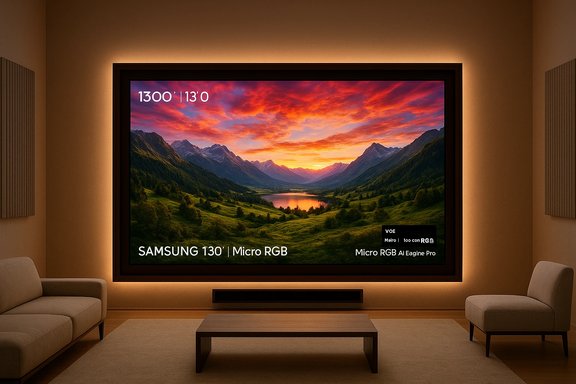
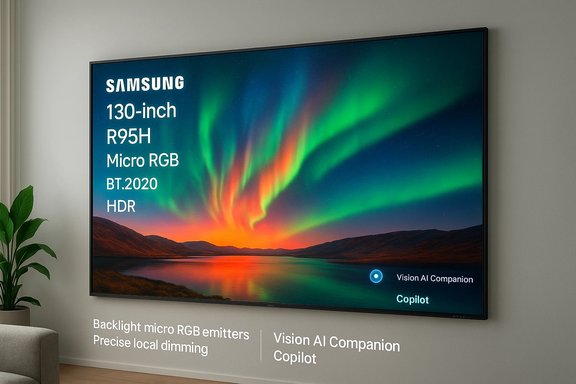
• Thread Author
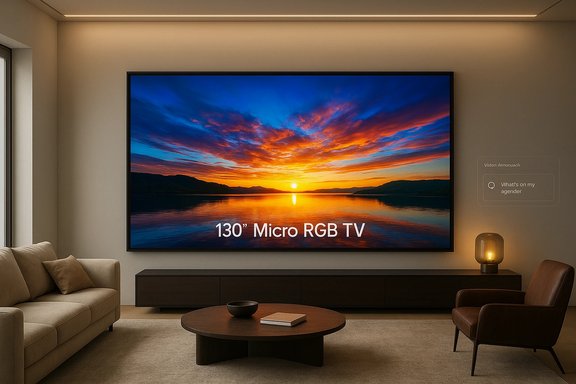
Samsung has formally introduced what it calls the world’s first 130‑inch Micro RGB TV — the R95H — at CES 2026, positioning a vast new flagship around a radical backlight architecture, a refreshed “Timeless Frame” gallery aesthetic, and an expanded suite of AI picture and sound features intended to move high‑end LCD performance closer to the color volume benefits of self‑emissive displays.

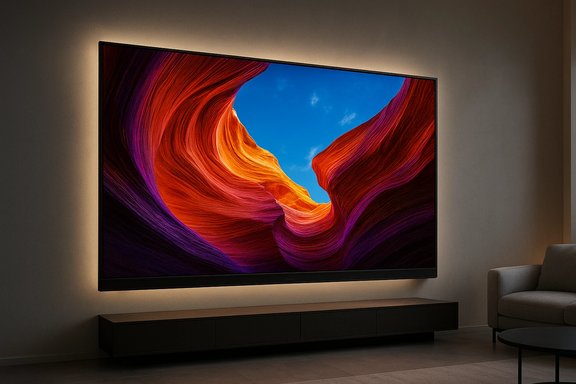
A large wall-mounted screen shows a vibrant city skyline under a starry night sky.Background / Overview​

Samsung’s R95H announcement is the headline act in a broader strategy to commercialize Micro RGB backlighting at living‑room sizes. The company says the 130‑inch model uses arrays of microscopic red, green and blue LEDs in the backlight plane, paired with an AI‑driven Micro RGB image pipeline (Micro RGB AI Engine Pro, Micro RGB Color Booster Pro, Micro RGB HDR Pro) and a certified color platform Samsung calls Micro RGB Precision Color 100 (VDE‑verified 100% BT.2020 coverage). The set also introduces a gallery‑style Timeless Frame design and integrated audio systems tuned to the panel scale. Samsung’s press materials present the launch as both a design statement and a technical pivot: Micro RGB is framed as a way to achieve higher color volume and very high sustained brightness while remaining compatible with established LCD manufacturing flows — unlike tiled self‑emissive microLED walls. That positioning ties into Samsung’s broader Vision AI Companion features (on‑device vision, Copilot/Perplexity retrieval, Live Translate, and dedicated sports/audio modes) and new HDR / audio integrations such as HDR10+ ADVANCED and Eclipsa Audio.

What Micro RGB actually is — a technical primer​

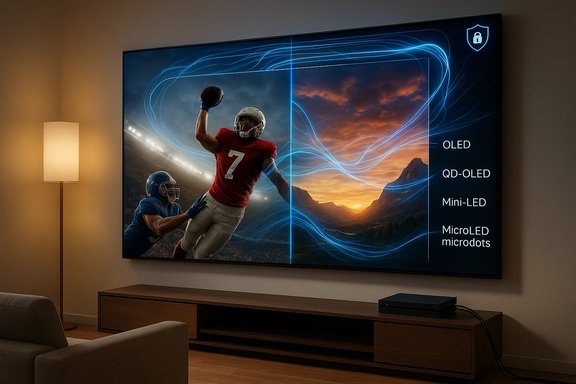
Micro RGB vs. Mini‑LED vs. microLED​

Micro RGB is a hybrid architecture that replaces the more traditional white (or blue) LED backlight + quantum dot / filter stack with micro‑scale red, green and blue emitters in the backlight plane. This differs from:
  • Mini‑LED: lots of white LEDs (or blue LEDs with QD layers) with zonal local dimming.
  • microLED (self‑emissive): tiny RGB microLEDs acting as independent pixels (no LCD layer).
  • Micro RGB: microscopic RGB emitters as a backlight beneath an LCD stack that still uses liquid crystals for modulation.
The practical result is that Micro RGB lets the backlight itself contribute color information and very fine luminance control, which can expand perceptual color volume and enable brighter specular highlights without relying entirely on broader zone dimming. However, because the display still uses an LCD modulation layer, absolute black levels tend to remain behind true self‑emissive pixels unless driving algorithms and optical stacks are tightly optimized.

The key hardware claims Samsung has made​

  • 130‑inch R95H flagship introduced at CES 2026, framed as the world’s first 130‑inch Micro RGB TV.
  • Sub‑100 μm emitters: Samsung advertises “sub‑100 micrometer” RGB emitters for Micro RGB; this claim is central to how the company explains the improved locality of control. Independent lab verification of emitter pitch/density and addressing scheme is still required to quantify the effect in practice.
  • Micro RGB Precision Color 100 — VDE‑verified 100% BT.2020: Samsung states VDE verification for the 100% BT.2020 color container on the Micro RGB platform, a headline technical milestone that signals very wide color capability on paper. Buyers should note that BT.2020 is a very broad container and most consumer content today is not authored to fully exploit it.
  • Advanced processing: Micro RGB AI Engine Pro plus specialized subfeatures for upscaling, HDR tone mapping and color control. Effective driving firmware is crucial to realize the hardware’s potential.
These claims are well documented in Samsung’s official announcement and in the wider pre‑CES coverage, but independent, instrumented measurements will be the decisive proof for buyers and reviewers.

Design and fit‑and‑finish: the Timeless Frame and integrated audio​

Samsung is making the 130‑inch R95H as much an interior design statement as a display product. The LED array sits behind a refined Timeless Frame that’s intended to make the screen read as a gallery‑style “window” rather than a conventional TV, and audio is integrated into the frame to maintain coherence between picture scale and soundstage. The set also includes Samsung’s Glare Free coating to reduce reflections on an ultra‑large surface. Audio has been treated as a first‑class concern: the R95H supports Eclipsa Audio, Dolby Atmos and features like AI Sound Controller Pro, and Samsung highlights Q‑Symphony compatibility for deeper soundstage integration with ecosystem speakers. For very large displays, speaker design and room acoustics are as consequential as the panel itself; Samsung’s move to tune audio to the frame is sensible but must be validated in room measurements and listening tests.

Processing, AI and the role of firmware​

Micro RGB flips more of the burden for picture quality onto software than many previous display advances. Samsung packages Micro RGB with a suite of image engines — Micro RGB AI Engine Pro, Micro RGB Color Booster Pro, Micro RGB HDR Pro — and the company explicitly markets on‑device perceptual features alongside cloud agents inside Vision AI Companion. That pairing is a double‑edged sword:
  • Benefits: AI engines can perform per‑frame tone mapping, correct local emitter variability, manage temporal behavior and preserve creative intent while exploiting greater color volume. These functions are the difference between a neat prototype and a consistently excellent product.
  • Risks: aggressive tone mapping, poor temporal filtering, or over‑enthusiastic color boosting can produce visual artifacts, color shifts at different brightness levels, or “AI hallucinations” in motion. Firmware tuning quality and update longevity will determine whether Micro RGB’s benefits hold up across content, apps and firmware revisions.
Samsung’s Vision AI Companion bundles on‑device features (Live Translate, object recognition, quick search) with cloud agents like Microsoft Copilot and retrieval apps such as Perplexity. The hybrid architecture improves latency‑sensitive tasks but raises ordinary privacy and telemetry questions: what’s processed locally, what’s sent to the cloud, and what retention or opt‑out controls exist? Samsung references Knox protection and a multi‑year update commitment in broader materials, but buyers are right to request concrete privacy controls and data‑handling documentation before enabling deep Vision AI features at home.

Color claims, standards and the content ecosystem​

Samsung’s VDE‑verified 100% BT.2020 claim is audacious and meaningful on paper: BT.2020 defines a much larger theoretical color container than DCI‑P3. If a consumer display genuinely reproduces the published BT.2020 primaries across brightness, that points to remarkable color volume potential. However, the practical value today is constrained by several realities:
  • Most streaming, broadcast and Blu‑ray content is mastered in DCI‑P3 (or narrower) and not authored to fully leverage BT.2020.
  • HDR standards are splintering: HDR10+, Dolby Vision 2, vendor tone mapping, and the newly promoted HDR10+ ADVANCED all present inconsistent tone‑mapping environments. This makes cross‑app behavior unpredictable until studios and streaming services converge on workflows for very wide color media.
In short: wide color readiness ≠ immediate consumer benefit. The value is future‑proofing and richer rendition of saturated hues today, but widespread, perceptible gains will depend on studios and streaming platforms adopting wider mastering targets over time.

What to test on the show floor or in early reviews​

When evaluating Micro RGB demos — at Samsung’s CES exhibits or in early review units — separate spectacle from measurable performance. Prioritise these checks:
  • Verify color gamut coverage using standardized test patches (BT.2020, DCI‑P3, Adobe RGB) and examine delta‑E and greyscale tracking across multiple luminance points.
  • Watch real HDR scenes with small specular highlights (night city, star fields) and check for haloing/blooming around highlights. Micro RGB promises finer locality; verify whether algorithms suppress artifacts without crushing shadow detail.
  • Measure peak nit performance for small highlights and sustained brightness for large scenes. Distinguish between specular peaks and sustained panel output.
  • Test motion handling and temporal stability with low‑bitrate streaming and camera pans to look for stutter, temporal artifacts or upscaler “hallucination” effects.
  • Confirm HDR format behavior across physical sources and apps (HDR10+, Dolby Vision variants, Ultra HD Blu‑ray) and compare creative intent preservation with Filmmaker Mode or equivalent profiles.
  • Probe privacy settings for Vision AI features and ask specifically which functions require cloud calls, how voice/image snippets are retained, and whether data can be deleted.

Market implications and pricing reality​

Samsung’s decision to bring Micro RGB to an enormous 130‑inch flagship — alongside the previously announced 55–115‑inch expansion for 2026 — signals a serious bet that RGB backlighting can become a mainstream premium category. If Micro RGB delivers measurable gains, premium TV tiers could split into three clear choices: OLED for absolute blacks and emissive pixels, Micro RGB for color‑centric, high‑brightness displays, and Mini‑LED/QNED for price/performance balance.
However, early Micro RGB implementations are expected to be premium. Tiny RGB emitters, dense addressing electronics, and the yield complexity that comes with micro‑manufacturing raise costs. Historical precedents suggest initial SKUs carry significant premiums; trickle‑down to affordable sizes will determine real consumer adoption speed. Samsung’s press materials do not publish global retail pricing at announcement; regionally staggered MSRPs and staged preorders are likely.

Strengths — what Samsung gets right​

  • Color ambition: The Micro RGB approach tackles color volume at a hardware level rather than just relying on software saturation boosts. When matched with good driving algorithms, this can materially improve saturated hues and highlight rendition.
  • Scale and design: A 130‑inch gallery design with integrated audio acknowledges that very large displays are as much furniture and interior statement as electronics. Samsung’s Timeless Frame and Glare Free coating are logical design responses to that reality.
  • Processing and platform: Bundling Micro RGB with a robust AI engine and a multi‑year update promise positions the product as a living platform rather than a static TV purchase — provided firmware quality and update cadence live up to the promise.
  • Third‑party verification: Citing a VDE verification for 100% BT.2020 coverage demonstrates Samsung is attempting to back its headline claims with independent tests rather than pure marketing. That reduces—but does not remove—the need for further lab validation.

Risks and unknowns — where scrutiny matters​

  • Still an LCD stack: Because Micro RGB remains an LCD architecture, absolute black levels and the risk of haloing remain real trade‑offs versus emissive OLED/microLED. The question is how close Micro RGB can approach OLED contrast without losing brightness advantages.
  • Algorithmic dependence: The hardware’s promise depends heavily on tone mapping, micro‑dimming, temporal filtering and color management. Poor tuning could lead to color shifts, crushed shadows or temporal artifacts. Firmware matters as much as panel hardware here.
  • Content readiness and standards fragmentation: Widespread benefits from BT.2020 require content and distribution pipelines to adopt wider mastering targets — a multi‑year process. HDR format fragmentation (HDR10+, Dolby Vision 2, HDR10+ ADVANCED) complicates consistent experience across apps.
  • Yield and price pressure: Manufacturing dense RGB emitter arrays at scale is nontrivial; early prices will reflect yield and complexity premiums. That could limit adoption to affluent early adopters and commercial installations initially.
  • Privacy & cloud dependencies: Vision AI Companion’s hybrid edge/cloud architecture adds convenience but raises practical questions about telemetry, data retention, and local control — all points that buyers should verify on release units.

Verification status and claims that need third‑party confirmation​

Samsung’s public claims can be verified only with independent lab work and longer‑term usage:
  • The sub‑100 μm emitter pitch and the effective addressable emitter count per square inch — these are central engineering metrics that are not fully specified in consumer press material and need instrumented confirmation.
  • Real‑world BT.2020 performance across brightness: VDE verification of color primaries is meaningful, but reviewers should measure delta‑E, color volume at multiple luminance levels, and greyscale tracking to confirm practical performance.
  • Haloing and black‑level behavior under mixed scenes: Objective measurement of local contrast, blooming metrics and temporal stability will determine whether Micro RGB strikes a usable trade‑off versus OLED.
  • HDR format handling and tone mapping fidelity across apps and physical sources: Confirm how the R95H handles Dolby Vision variants, HDR10+/HDR10+ ADVANCED and Ultra HD Blu‑ray content.
If credible reviewers and labs (DisplayMate, RTINGS, independent calibration labs) publish instrumented test results, the buyer community will gain the evidence necessary to move from vendor claims to purchasing decisions.

A practical checklist for WindowsForum readers and prosumers​

  • On the CES show floor (or in first‑look reviews), confirm the vendor’s measurement patches and ask for raw delta‑E / color‑volume numbers.
  • Run night‑scene HDR tests and look closely for haloing around small highlights. Compare with an OLED or top Mini‑LED reference.
  • Verify HDR behavior across Netflix, Prime Video, AppleTV+, and Ultra HD Blu‑ray to detect inconsistent tone mapping.
  • Stress test motion with low bitrate streams and fast pans to check for temporal artifacts from AI upscalers.
  • Inspect privacy controls for Vision AI Companion: ask which features use cloud agents, whether voice/image data can be deleted, and how group profiles are isolated.
  • Demand clarity on firmware/update promises and calibration options (3D LUT support, service menus, professional profiles).

Final assessment — why this matters for the TV market​

Samsung’s 130‑inch Micro RGB R95H is a consequential product announcement because it crystallizes a multi‑vendor trend: the industry is experimenting with direct RGB backlighting as a way to combine high brightness and wider color volume in large‑format displays while still leveraging LCD manufacturing scale. If Micro RGB proves out in independent testing and Samsung delivers durable firmware updates and clear privacy controls, the technology could create a third, hybrid premium category distinct from OLED and high‑end Mini‑LED. That would reshape how studios, streaming services and pro colorists think about mastering targets and could push consumer expectation toward higher color volume in living‑room displays.
Conversely, if the implementation leans too heavily on marketing claims while leaving haloing, tone‑mapping, or firmware instability unresolved, Micro RGB will be remembered as an ambitious but imperfect transitional architecture that buyers paid a premium to evaluate. The next steps to move from promise to practical benefit are straightforward: independent lab validation, transparent firmware release notes and responsible privacy/telemetry disclosures.
The immediate takeaway for WindowsForum readers: the Samsung R95H and the Micro RGB family are an important signal that display engineering is entering a new phase where sub‑millimeter emitter control, advanced AI engines, and design integration determine flagship differentiation. Approach early reviews and show‑floor demos armed with the objective tests above, and treat vendor claims — however audacious — as starting points for verification rather than purchase justification on their own.

Source: Bleeding Cool News Samsung Unveils World’s First 130-Inch Micro RGB TV For CES 2026
Source: samsung.com https://news.samsung.com/global/sam...ng-next-generation-color-and-bold-new-design/
 

Samsung’s CES 2026 unveiling of a 130‑inch Micro RGB flagship (model R95H) is a deliberate, theater‑grade statement: the company is pushing a hybrid micro‑LED backlight architecture, heavy AI image processing, and a gallery‑style industrial design into a single living‑room‑scale product that blurs the line between home cinema and in‑room IMAX.

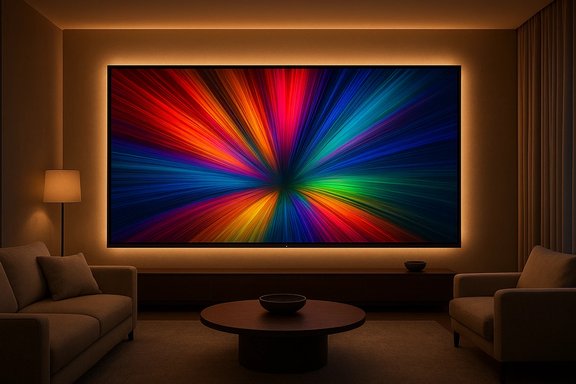
A cozy living room with a large, vibrant rainbow radial artwork on a wall-mounted screen.Background / Overview​

Samsung showcased the R95H at its CES 2026 exhibition as the largest Micro RGB consumer display the company has produced to date. The R95H bundles a new hardware foundation Samsung calls Micro RGB — a backlight layer of microscopic red, green and blue emitters — with a trio of AI processing blocks (Micro RGB AI Engine Pro, Micro RGB Color Booster Pro, Micro RGB HDR Pro) and a refreshed gallery aesthetic labeled the Timeless Frame. The company positions the set as a flagship showcase for next‑generation color, high luminance HDR, and an AI‑centric TV platform. Key vendor claims repeated across Samsung’s materials and early press coverage include:
  • A 130‑inch diagonal Micro RGB panel (model R95H) — Samsung’s largest Micro RGB consumer model so far.
  • Micro RGB Precision Colour 100: marketed as VDE‑verified 100% coverage of the BT.2020 color gamut.
  • A set of AI image engines (Micro RGB AI Engine Pro, Color Booster Pro, HDR Pro) designed for per‑frame tone mapping and color refinement.
  • Glare Free anti‑reflection coating and Eclipsa Audio, with speakers integrated into the Timeless Frame.
  • Support for HDR10+ ADVANCED and an expanded smart layer — Vision AI Companion — with conversational search and integrations such as Microsoft Copilot and other agents.
Samsung’s own press materials present the R95H as both a technical and design milestone; independent outlets recaptured the headline claims in their CES coverage but also cautioned that instrumented third‑party testing will be required to validate real‑world performance.

What Micro RGB actually is — the technical primer​

The hardware architecture in plain English​

Micro RGB is not the same as tiled, self‑emissive microLED nor is it the same as conventional Mini‑LED/Neo QLED. Instead, Micro RGB places microscopic red, green and blue LED emitters in the backlight plane beneath an LCD modulation layer. Because the backlight itself produces color at very small scales (Samsung describes sub‑100 µm emitters in its materials), the backlight can contribute color and localized luminance control directly instead of relying purely on a white backlight plus color filters. That increases theoretical color purity and color volume at high brightness levels.

How Micro RGB compares to the alternatives​

  • Mini‑LED / Neo QLED: uses many white (or blue) LEDs + quantum dots and color filters, with zonal local dimming. Good brightness, but color originates after filtering.
  • OLED / QD‑OLED: self‑emissive pixels that provide true pixel‑level blacks and excellent off‑axis color.
  • microLED (true microLED): per‑pixel RGB emitters without an LCD layer — ultimate brightness/color but costly to scale.
  • Micro RGB: hybrid — color‑capable RGB emitters + LCD layer. A pragmatic attempt to capture much of the color volume and highlight performance of emissive tech while retaining more familiar LCD manufacturing and cost structures.

What this means practically​

Micro RGB can expand color volume (saturated color at higher luminance) and create very bright, saturated highlights without relying on coarse zonal dimming. However, because an LCD modulation stack remains, absolute pixel‑level black and the native emissivity advantages of OLED or true microLED may still be superior in very dark scenes. Software and driving algorithms — the AI engines Samsung highlights — become the crucial bridge between raw emitter density and the final image viewers perceive.

Design and sound: Timeless Frame and Eclipsa Audio​

Samsung made the Timeless Frame a central part of the pitch: rather than presenting a hulking black rectangle, the R95H is wrapped in a gallery‑style frame intended to make the panel feel like a large architectural window or piece of wall art. The frame also houses speakers, a structural decision that reduces the visual separation between the massive picture and its soundstage. Samsung brands that integrated audio approach Eclipsa Audio, describing it as spatially tuned to the 130‑inch canvas. Practical points about the design:
  • The Glare Free surface treatment is specifically targeted at very large screens that will often live in bright, multi‑purpose rooms. Anti‑reflection measures matter more as diagonal increases.
  • Frame‑integrated speakers are convenient and reduce initial installation cost for buyers who don’t want an external sound system immediately, but audiophiles will still evaluate whether the built‑in array can match a dedicated AV stack.

Smart features and AI: Vision AI Companion and ecosystem integrations​

Samsung is pairing the hardware with an expanded software vision. The R95H ships with Vision AI Companion (VAC), positioned as a conversational, proactive assistant that ties into on‑device and cloud capabilities. VAC is reported to support:
  • Conversational search and proactive recommendations.
  • Specialized content modes such as AI Football Mode Pro and AI Sound Controller Pro (content‑aware tuning for sports and multi‑source audio control).
  • Live Translate, Generative Wallpaper, and third‑party agent access (Microsoft Copilot, Perplexity) for enhanced discovery and productivity features on the TV surface.
Those integrations underline Samsung’s strategy: make the TV a shared, AI‑enabled surface rather than just a passive display. That expands the product’s utility but also raises questions about update policies, privacy, and long‑term support for AI services. Samsung has said some models will receive up to seven years of Tizen OS updates — a notable commitment if sustained.

Performance claims: what’s auditable and what still needs proof​

Samsung and multiple outlets repeated a series of measurable claims at CES. These are the load‑bearing assertions buyers and reviewers should verify:
  • 100% BT.2020 coverage (Micro RGB Precision Colour 100) — Samsung states the panel is VDE‑verified to cover the BT.2020 container. That is an ambitious claim because BT.2020 is a very wide color space; achieving full coverage across brightness levels is difficult for consumer panels. Independent labs and reviewers will need to publish color‑volume charts and delta‑E maps across luminance to confirm how the panel performs in practice. Samsung’s verification adds credibility but does not replace independent instrumented testing under standardized conditions.
  • Sub‑100 µm emitter pitch — Samsung describes microscopic RGB emitters in the backlight plane. Sub‑100 µm scale would deliver very fine locality of control; again, independent review equipment (optical microscopy and radiometric measurements) will be required to corroborate the effective emitter density and uniformity across the 130‑inch surface.
  • Frame‑integrated audio performance (Eclipsa Audio) — Samsung claims acoustic tuning for the 130‑inch scale. The proof of this claim is subjective listening and technical audio measurements (frequency response, imaging accuracy, latency) compared to similarly priced external sound systems.
  • AI image processing benefits — Samsung’s Micro RGB AI Engine Pro and Color Booster Pro promise clearer detail, refined contrast and expanded color saturation. Those are algorithmic claims: users should watch for overprocessing (unnatural saturation or contrast clipping) in blind comparisons. Independent controlled side‑by‑side viewing and test patterns will show the real impact.
Short version: manufacturer claims are consistent and repeated by multiple outlets, but objective validation is downstream work for labs and reviewers. Treat headline numbers (100% BT.2020, sub‑100 µm) as manufacturer‑stated, credible but pending independent instrumented confirmation.

Practical considerations for buyers and integrators​

A 130‑inch TV changes the buying checklist entirely. The R95H is clearly targeted at premium residential installs, luxury home cinemas, and spaces where scale is both practical and desirable.
Architectural and installation issues:
  • Room sizing and sightlines: ensure a suitable seating distance and viewing angles for a 130‑inch diagonal. Typical living rooms may not be deep enough to make full use of the canvas without moving viewers uncomfortably close.
  • Wall reinforcement and professional mounting: at this scale the TV will often demand dedicated mounting hardware and possible wall reinforcement or a freestanding stand engineered for the weight and torque. Samsung’s Timeless Frame and included stands may mitigate some needs, but plan for professional installation.
  • Ambient light control: despite Glare Free treatment, large screens benefit from controlled lighting to preserve perceived contrast and black levels. Consider window treatments and lighting design when planning placement.
Connectivity, ecosystem and long‑term use:
  • Expect extensive smart features that depend on cloud AI services. Confirm regional availability for VAC features and voice languages. Samsung’s promotional copy indicates certain features vary by region and may require additional accessories or remote models.
  • Warranty and service: for a product at this scale, confirm on‑site service terms, panel replacement policies and whether Samsung offers installation packages. These are often negotiated separately for flagship showroom pieces.

How the R95H stacks up against alternatives (short competitive guide)​

  • Against OLED / QD‑OLED: OLEDs still hold an advantage in absolute black and pixel‑level emissivity. Micro RGB aims to outclass many LED approaches in color volume and sustained peak brightness, but real‑world dark‑scene performance and haloing will decide parity versus high‑end OLED.
  • Against tiled microLED: true microLED walls are fully emissive and the gold standard for brightness and color. They remain costly and complex to install. Micro RGB tries to capture the color/brightness benefits while lowering cost and easing installation. The tradeoff is that Micro RGB is not truly pixel‑emissive.
  • Against high‑end Mini‑LED (Neo QLED): Micro RGB promises higher color purity and color volume by moving color origin into RGB emitters. If Samsung’s emitter density and processing are realized, Micro RGB could markedly reduce haloing and boost highlight saturation compared to the best Mini‑LED implementations. Independent testing will show how big that gap is in practice.

Risks, limitations and open questions​

  • Unproven long‑term performance: Micro RGB is still early in the product lifecycle. Long‑term color stability, yield‑related uniformity across such a large panel, and serviceability are valid concerns for buyers. Independent stress testing and multi‑week burn‑in reports will be informative.
  • Overreliance on AI processing: the advertised AI engines can deliver clear benefits, but aggressive processing risks altering artistic intent. Balanced, user‑tunable presets and professional calibration options will be essential for enthusiasts and home‑theater purists.
  • Price and channel availability: Samsung demonstrated the R95H as a CES showpiece; at announcement there were no final MSRP or shipping windows. Expect premium pricing and limited initial availability, with pro‑grade logistics.
  • Content ecosystem fit: while BT.2020 coverage is promising, mainstream HDR content today is still widely authored for DCI‑P3/Rec.2020 containers in constrained ways. The practical benefit of 100% BT.2020 depends on content mastering and delivery chains; not every video source will take full advantage of the expanded gamut immediately.

How to evaluate the R95H once it reaches reviewers and showrooms​

  • Check independent color‑volume charts: demand color‑volume vs luminance graphs and delta‑E accuracy across the range. Manufacturer specs are necessary but not sufficient.
  • Inspect uniformity and emitter density: reviewers should use microscopy and photometric scans to verify emitter pitch, uniformity and edge behavior across the 130‑inch surface.
  • Test dark‑scene behavior and haloing: compare with top OLED/QD‑OLED models on representative HDR movie scenes to understand the practical black‑level tradeoffs.
  • Evaluate integrated audio vs discrete systems: measure frequency response and imaging, and test latency when using external soundbars/AVRs with Q‑Symphony or similar features.
  • Exercise AI modes with neutral side‑by‑side comparisons: watch source material in both AI off and AI on modes to spot color shifts, oversharpening, or unnatural contrast gains.
  • Confirm installation and after‑sales support: get hard answers on on‑site service, panel swap policies and warranty coverage for such a large, high‑value device.

Conclusion — a landmark showpiece, not yet a mass market certitude​

Samsung’s 130‑inch Micro RGB R95H is a bold, category‑defining showpiece that crystallizes several industry trends: wider color containers, AI‑driven image pipelines, and design that treats the television as an architectural object. The company’s claims — VDE‑verified 100% BT.2020 coverage, sub‑100 µm RGB emitters, HDR10+ ADVANCED support, and an integrated Eclipsa Audio system — are impressive on paper and have been widely repeated in CES coverage. At the same time, the R95H’s real significance depends on independent, instrumented validation: color‑volume behavior across luminance, emitter density and uniformity across the giant panel, long‑term stability, and whether the AI processing delivers tasteful improvements rather than aggressive reprocessing. For prospective buyers, the R95H is currently a premium, design‑first statement that will require careful planning, likely professional installation, and a readiness to wait for detailed lab reviews before committing.
Samsung has unmistakably raised the bar on spectacle and ambition for consumer displays at CES 2026. The immediate next step is measured scrutiny: when hands‑on reviews, laboratory plots, and in‑home install reports arrive, they will determine whether Micro RGB at this scale is the practical leap forward Samsung promises — or an impressive, high‑cost milestone whose true value will be proven only over time.
Source: TweakTown Samsung unveils gigantic 130-inch Micro RGB TV at CES 2026: near IMAX feels, but at home
 

Samsung’s CES 2026 reveal of a 130‑inch Micro RGB TV (model R95H) is a theatrical, gallery‑grade statement that pushes Samsung’s Micro RGB programme to its largest consumer diagonal yet while marrying aggressive color claims, a refreshed design language, and a suite of AI features that aim to reposition the television as both a centerpiece and an intelligent living‑room surface.

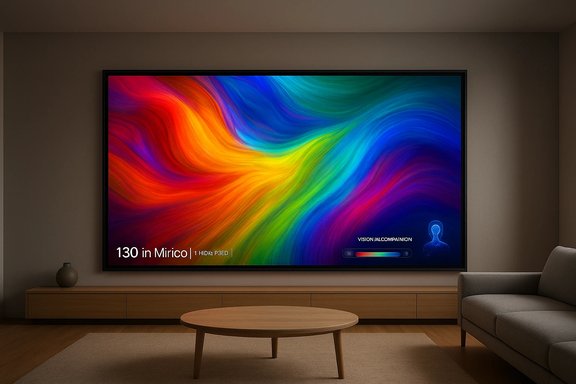
A large flat-screen TV displays a vivid multicolored abstract swirl in a modern living room.Background / Overview​

Samsung announced the R95H at CES 2026 as the company’s largest Micro RGB display to date, presenting it as a flagship showcase for what Samsung calls Micro RGB Precision Colour 100 — a platform-level claim of 100% coverage of the BT.2020 wide color gamut, certified by the Verband der Elektrotechnik (VDE). The set pairs the hardware with a trio of AI processing blocks branded Micro RGB AI Engine Pro, Micro RGB Colour Booster Pro, and Micro RGB HDR Pro, and it introduces a gallery‑inspired industrial design Samsung calls the Timeless Frame. Multiple independent outlets attending the show repeated Samsung’s headline claims — the 130‑inch diagonal, the VDE‑verified BT.2020 claim, and platform features such as HDR10+ ADVANCED support, Eclipsa Audio, and the Vision AI Companion suite — but noted that third‑party, instrumented measurements will be required to validate real‑world performance.

What Samsung says: headline features and claims​

  • A 130‑inch Micro RGB panel (model R95H) — marketed as the world’s first 130‑inch Micro RGB TV.
  • Micro RGB Precision Colour 100 — claimed 100% BT.2020 coverage with VDE verification.
  • AI image pipeline: Micro RGB AI Engine Pro, Micro RGB Colour Booster Pro, and Micro RGB HDR Pro for dynamic, per‑frame tone mapping and color refinement.
  • Next‑generation HDR support via HDR10+ ADVANCED on selected 2026 models including R95H.
  • A gallery‑style industrial design called Timeless Frame with Glare Free surface treatment and frame‑integrated speakers (branded Eclipsa Audio).
  • Smart / AI features: Vision AI Companion with conversational search, proactive recommendations, Live Translate, Generative Wallpaper, Microsoft Copilot, Perplexity integration and content modes such as AI Football Mode Pro.
These are Samsung’s official claims and were repeated widely in CES coverage; they form the basis of any technical or buying analysis going forward.

Technical primer: what Micro RGB means​

Micro RGB in the display ecosystem​

Micro RGB is a hybrid approach that places arrays of microscopic red, green and blue emitters in the backlight plane beneath an LCD modulation layer. Unlike Mini‑LED (which uses many white or blue LEDs and relies on downstream color conversion) or true self‑emissive microLED (where each pixel is an RGB emitter and no LCD layer is used), Micro RGB lets the backlight itself contribute color at a very fine spatial scale while still retaining an LCD panel for modulation. The practical result is potentially greater color purity and higher color volume at bright luminance levels than conventional LED‑backlit LCDs, while avoiding some of the extreme manufacturing complexity of tiled microLED walls.

The engineering tradeoffs​

Micro RGB promises finer locality of control and richer color volume, particularly for saturated hues at high brightness. However, because the architecture still uses an LCD layer for modulation, absolute black levels and pixel‑level emissivity remain behind true self‑emissive technologies (OLED and microLED) unless software/optical engineering closes the gap. That means haloing and black‑floor artifacts are still engineering problems that the Micro RGB stack must mitigate through optical design and aggressive processing. Independent instrumented measurements will tell whether Samsung’s stack meaningfully narrows those gaps in real‑world content.

Design and user experience​

Timeless Frame: gallery aesthetic at scale​

Samsung frames the R95H as an architectural window, not a black slab. The Timeless Frame is a deliberate design pivot intended to make an enormous 130‑inch panel feel curated and domestic — less appliance, more artwork. The company also stressed a Glare Free coating to reduce reflections on such a large surface, and an included kick‑stand option for free‑standing placement if wall mount is impractical. These choices show Samsung’s intent to sell the TV as interior design as much as as home cinema.

Eclipsa Audio: integrated sound for frame‑scale visuals​

To solve the mismatch between a massive screen and separate speaker placements, Samsung integrated speakers into the frame itself and tuned the audio system (Eclipsa Audio) to the panel’s size. This is a pragmatic move for buyers who prefer an all‑in‑one look, but audiophiles and dedicated home‑theatre installations will still likely pair the R95H with external audio systems for full bandwidth and power.

Vision AI Companion: conversational TV, with caveats​

Samsung’s Vision AI Companion extends beyond simple voice control into conversational search, generative wallpaper, Live Translate and access to third‑party agents (Microsoft Copilot, Perplexity). While powerful, this raises practical questions about where compute happens (on‑device vs cloud), data handling, privacy, and the user experience when latency or internet access is constrained. Samsung’s press notes acknowledge some features are region‑ and model‑dependent; buyers should confirm exactly which Vision AI features will be available in their region and under what terms.

Critical analysis: strengths and where the R95H could stumble​

Notable strengths​

  • Scale and ambition. A single 130‑inch panel is an undeniable showpiece and expands the practical ceiling for Micro RGB in a consumer chassis. Samsung has built an attention‑grabbing flagship that will push integrators and designers to rethink room scale.
  • Color container claim. The marketing of Micro RGB Precision Colour 100 and VDE verification of BT.2020 coverage is a substantive step in framing the product around measurable color capability rather than just peak brightness. On paper, 100% BT.2020 coverage is an impressive engineering target.
  • Integration of AI and software. Pairing hardware novelty with a broad AI platform sets Samsung’s product thinking squarely in the era of smart, evolving displays. If executed well, software can materially improve perceived image quality over time.

Real risks and open questions​

  • Measurement vs marketing. Manufacturer claims — even with a VDE mention — should be validated. The context of the VDE certification (measurement method, APL levels, colorimetric windows) matters. Buyers should request the VDE report and wait for independent delta‑E, gamut volume, and color‑volume measurements under realistic APLs. Until instrumented reviews appear, the claims remain manufacturer‑led.
  • Black levels and haloing. Because Micro RGB still uses an LCD layer, absolute blacks and micro‑contrast will depend on optical stacks and software. Small bright objects on dark backgrounds remain the most revealing tests for bloom and haloing. Expect reviewers to focus on real‑world scenes (streetlights, specular highlights) to evaluate whether Micro RGB meaningfully closes the gap to self‑emissive displays.
  • Complexity of repair and longevity. A 130‑inch panel with microscopic RGB emitters raises questions about long‑term reliability, local emitter failures, and BLU (backlight unit) repair processes. Samsung has not published repair/field‑service details at launch; prospective buyers should ask for warranty specifics and BLU service plans.
  • Price and target market. Samsung did not announce pricing or ship dates at CES. A 130‑inch flagship with advanced micro‑LED backlighting and a premium design finish will be priced at the top of the market and targeted at affluent buyers, integrators, and luxury projects. Expect significant installation costs and potential lead times.
  • Privacy and cloud dependence. Vision AI Companion and third‑party agents imply cloud interactions for some features. Users should verify privacy, data retention, and opt‑out mechanisms prior to purchase.

What to check before buying or specifying a 130‑inch Micro RGB TV​

  • Request the VDE certification documentation and ask for the measurement conditions used to claim 100% BT.2020 (APL, measurement patch sizes, and colorimetric standards).
  • Book an in‑person demo with calibrated content: HDR test patterns, small‑object HDR scenes, and calibrated color check sequences. This lets you judge haloing, highlight behavior and real‑world color rendering.
  • Confirm warranty coverage for the Micro RGB backlight assembly and obtain details on repair timelines and BLU replacement procedures.
  • Ask which Vision AI Companion features are local vs cloud‑dependent and request the company’s privacy/data handling documentation.
  • Budget for professional install: wall reinforcement, routing for power and AV, acoustic treatment, and a potential external audio system if you want true home‑theater fidelity.

How Micro RGB compares to current premium alternatives​

vs. Neo QLED / Mini‑LED​

Micro RGB moves color generation closer to the light source by using RGB emitters in the backlight rather than white LEDs and quantum‑dot converters; this can increase color purity and color volume especially at high luminance, but Mini‑LED remains easier to produce and historically better at controlling cost. The Micro RGB approach is intended to narrow the perceptual gap without the full manufacturing complexity of microLED.

vs. OLED / QD‑OLED​

OLED and QD‑OLED are self‑emissive and deliver superior pixel‑level blacks and contrast; Micro RGB aims to bring improved color volume and higher sustained highlight luminance, but absolute black floors typically favor self‑emissive tech. Buyers choosing between the technologies must weigh ambient lighting, content habits, and priorities in highlights vs blacks.

vs. microLED (true self‑emissive)​

True microLED panels remain the technical pinnacle for scale and contrast but are costly and often assembled from tiled modules. Micro RGB intends to be a pragmatic, manufacturable middle ground: some of microLED’s color and brightness benefits, with a supply chain closer to LCD production lines. The R95H is Samsung’s bet that this hybrid approach will be compelling at very large sizes.

Practical considerations for integrators and spaces​

  • Ceiling height and viewing distance: A 130‑inch diagonal demands generous space and carefully considered sightlines. Typical living rooms may be too small for comfortable viewing at cinematic distances. Plan seating and wall clearances meticulously.
  • Structural supports and anchors: Wall‑mounting a 130‑inch panel often requires reinforced framing and professional installers; Samsung’s included stand may mitigate some installations but will not eliminate the need for professional planning.
  • Ambient light and finish: Despite Glare Free coatings, large reflective surfaces still require controlled lighting for best HDR performance; consider window treatments and room lighting schemes during specification.
  • AV integration: The integrated Eclipsa Audio system is useful for aesthetics, but large spaces will almost always benefit from additional acoustic treatment and an external audio system for theatrical experiences.

The market impact: why the R95H matters​

By demonstrating a single‑panel 130‑inch Micro RGB TV paired with strong color‑centric marketing and AI features, Samsung signals that ultra‑large displays are moving from specialist, custom installations toward more polished, mainstream luxury offerings. The R95H narrows the gap between experimental microLED walls and high‑end consumer TVs by proposing a manufacturable hybrid that can be scaled upward. Its gallery design also pushes the industry to think about displays as architectural elements in luxury homes, hospitality spaces, and commercial installations. However, the ultimate market effect will depend on two sets of proof: (a) independent measurement and hands‑on reviews that validate Samsung’s color, HDR, and black‑level claims, and (b) pricing, availability, and the logistics of installation and service for such a large panel. If Samsung’s engineering and supply chain can deliver on these points at a defensible price, Micro RGB could become a significant growth vector in premium displays. If not, the R95H will remain an impressive engineering statement with limited real‑world impact.

Final verdict — who should consider an R95H, and when​

The R95H is a compelling proposition for high‑end buyers and integrators who need a single‑panel, gallery‑grade screen and value extreme scale, vivid color, and a premium fit‑and‑finish more than the absolute deepest blacks offered by self‑emissive panels. For early adopters and integrators planning flagship installations — private screening rooms, luxury residences, and premium public spaces — the R95H presents a unique option.
That said, mainstream buyers and value conscious customers should wait for:
  • independent lab tests and real‑world reviews,
  • detailed warranty and service promises for the Micro RGB backlight assembly,
  • confirmed pricing and shipping timelines.
Treat Samsung’s CES unveiling as an important milestone: it establishes a credible new product class and sets a high bar for color ambition, but the real decision calculus will come when reviewers publish delta‑E graphs, color‑volume analyses and long‑term reliability reports.

Immediate next steps for professionals and buyers​

  • Schedule a demonstration at Samsung’s exhibition or an authorized showroom and insist on calibrated test patterns.
  • Request VDE certification documentation and measurement details (APL, patch sizes, test standards).
  • Confirm which Vision AI Companion features require cloud access and obtain privacy/data‑use documentation.
  • Budget for professional installation, acoustic treatment, and potential external audio for theater‑grade performance.
  • Wait for instrumented reviews before making large fleet purchases or recommending the R95H for clients who require verifiable, repeatable color fidelity metrics.
The Samsung R95H is a bold, meaningful step in display engineering and product design — a headline‑grabbing fusion of color ambition, scale, and AI that will shape the conversation around what premium TVs can be in 2026. Its lasting impact will depend on measured performance, serviceability, and whether the market values the tradeoffs inherent in a hybrid Micro RGB architecture as highly as Samsung believes it will.
Source: insideci.co.uk Samsung unveils world’s first 130-inch Micro RGB TV - Inside CI
 

Samsung has unveiled what it calls the world’s first 130‑inch Micro RGB television — the R95H — a theatrical, gallery‑style statement that marries an unprecedented physical canvas with a new Micro RGB backlight architecture, aggressive AI picture processing, and a revived “Timeless Frame” aesthetic intended to make the screen read like an architectural window rather than a hulking appliance.

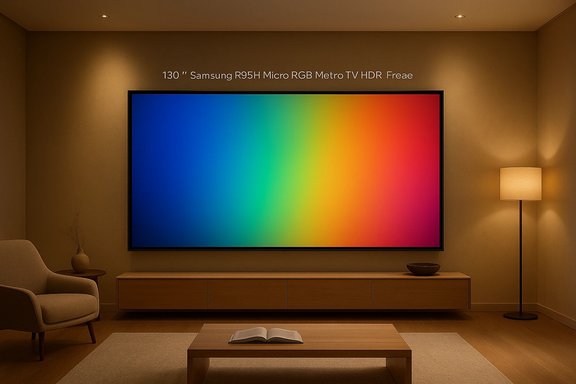
Minimalist living room with a giant rainbow-gradient TV framed above a low console.Background / Overview​

Samsung introduced the R95H at its CES 2026 showcase as the company’s largest Micro RGB panel to date and as a flagship for its 2026 television strategy. The product announcement bundles three clear narratives: hardware innovation (Micro RGB emitters and a certified wide‑gamut claim), industrial design (the Timeless Frame that integrates speakers into the bezel), and software/AI (the Vision AI Companion and HDR10+ ADVANCED support). The headline technical claims are straightforward: a 130‑inch diagonal Micro RGB panel (model R95H), a Micro RGB Precision Colour 100 platform that Samsung says delivers 100% coverage of the BT.2020 color gamut with VDE verification, a trio of AI image engines (Micro RGB AI Engine Pro, Micro RGB Colour Booster Pro, Micro RGB HDR Pro), and industry‑leading HDR and audio features such as HDR10+ ADVANCED and Eclipsa Audio. Samsung also emphasizes a low‑reflection “Glare Free” surface treatment to keep the vast screen usable in real home lighting conditions.

What Micro RGB actually is — a technical primer​

Micro RGB vs. Mini‑LED, microLED and OLED​

Micro RGB is a hybrid architectural approach: it places microscopic red, green and blue LED emitters in the backlight plane beneath an LCD modulation layer so the backlight itself contributes real RGB color rather than relying exclusively on a white LED plus filters or quantum dots. This differs from:
  • Mini‑LED (Neo QLED-style): many small white (or blue) LEDs used for zonal local dimming; color is shaped downstream by quantum dots and filters.
  • microLED (true self‑emissive microLED): per‑pixel RGB emitters, producing pixel‑level emission without an LCD layer — the theoretical ideal for contrast and black level, but very costly and complex to manufacture.
  • OLED / QD‑OLED: self‑emissive organic or quantum‑dot‑assisted emitters per pixel, delivering true pixel blacks and excellent off‑axis color, but with known tradeoffs like burn‑in and brightness limits.
Micro RGB attempts to bridge the gap: increase color volume and highlight brightness compared with standard Mini‑LED LCDs while retaining manufacturing advantages of LCD assembly techniques. The approach can yield purer primaries and more finely localized light control — if emitter density, optics and drive electronics are executed at scale.

The practical engineering tradeoffs​

Micro RGB’s promise is largely engineering dependent. The crucial parameters that determine real‑world performance are:
  • Emitter pitch and density (Samsung cites “sub‑100 µm” emitters in its technical brief, a metric tied to how locally the backlight can be controlled).
  • Optical stack design (how the light from RGB emitters is mixed, filtered and modulated by the LCD layer).
  • Drive electronics and firmware (mapping tiny emitter input to perceived color across brightness levels without artifacts).
  • Thermal and reliability engineering (tiny LEDs concentrated at high brightness create heat and reliability challenges on a 130‑inch canvas).
Samsung’s materials emphasize the potential for higher color volume and brighter specular highlights compared to traditional LCDs, but they also acknowledge that because the R95H retains an LCD modulation layer it will not be truly self‑emissive like microLED or OLED. Independent instrumented measurements will be decisive for determining how close Micro RGB comes to emissive technology in practice.

Colour claims: Micro RGB Precision Colour 100 and BT.2020​

Samsung markets the R95H under the banner Micro RGB Precision Colour 100, stating the panel achieves 100% coverage of the BT.2020 (Rec.2020) color container and that the implementation has been verified by VDE (Verband der Elektrotechnik). That claim is central to Samsung’s marketing: BT.2020 defines a very wide color container used for modern UHD workflows, and reaching it on a consumer display is a strong on‑paper milestone. Important technical context for readers:
  • Coverage of BT.2020 chromaticity endpoints is not the same as measured color volume across luminance; a display can map endpoints but still vary in how saturated colors are reproduced at different brightness levels.
  • Content availability: most consumer content today is mastered to DCI‑P3 or even Rec.709; full BT.2020 content is uncommon, so the practical benefit depends on future content pipelines and mastering workflows.
  • Independent verification: third‑party delta‑E, color‑volume graphs and measurement windows are the metrics that will determine real perceptual advantage. Samsung says VDE has verified the claim, but buyers should request the specific VDE report and measurement conditions.

Image processing and AI: Micro RGB AI Engine Pro​

What Samsung announced​

Samsung pairs the Micro RGB hardware with a stacked software approach:
  • Micro RGB AI Engine Pro — frame‑by‑frame AI processing to manage tone mapping and color fidelity.
  • Micro RGB Colour Booster Pro — targeted saturation and color enhancement in different image regions.
  • Micro RGB HDR Pro — HDR signal handling, presumably including per‑scene or per‑frame tone mapping.
The company says these engines work together to preserve detail in both bright and dark regions, enhance dull footage, and make the huge screen feel uniformly vivid from different viewing angles. Early demonstrations at CES emphasized vivid highlights and deep color, but reviewers on the show floor cautioned that AI pipelines can sometimes produce an “overprocessed” look if aggressiveness isn’t tunable.

Strengths and potential pitfalls​

  • Strength: AI-driven processing can extend the utility of wide‑gamut hardware, recovering perceived detail and matching scenes to the panel’s color volume.
  • Risk: Aggressive AI enhancement can alter creator intent, boosting saturation or contrast beyond what a director intended. Calibration controls and firmware updates will be important to let users choose fidelity vs. enhancement.
  • Verification: Quantify AI artifacting risks in motion via lab testing (temporal stability, haloing, edge artifacts) and ask for pre/post processing comparisons from Samsung.

HDR10+ ADVANCED, Eclipsa Audio and software features​

HDR10+ ADVANCED​

Samsung lists the R95H among its first TVs to support HDR10+ ADVANCED, a next‑generation HDR standard promoted by Samsung that promises extended dynamic metadata and finer local tone mapping. On paper, HDR10+ ADVANCED aims to allow more granular metadata for brighter, scene‑adaptive HDR presentation. Practical adoption will depend on studio and streaming platform support; Samsung’s support is a necessary first step but not by itself sufficient to create abundant native HDR10+ ADVANCED content.

Eclipsa Audio and frame‑integrated sound​

To align sound with such a large visual canvas, Samsung has integrated speakers into the R95H’s Timeless Frame and introduced Eclipsa Audio, a spatial audio processing suite tuned to the panel’s scale. The company’s goal is to reduce the perceptual disconnect between giant screens and off‑board speakers by making sound appear physically aligned with on‑screen action. Integrated audio is convenient, but serious home‑cinema buyers will still evaluate dynamic range, low‑frequency performance and multichannel compatibility before skipping an external sound system.

Vision AI Companion: LLMs, Copilot and generative wallpapers​

Samsung’s updated software stack centers on Vision AI Companion, which blends on‑device and cloud/LLM services to provide conversational search, Microsoft Copilot integration, and Perplexity access. Features highlighted include:
  • Conversational content search and discovery.
  • Live Translate for real‑time translation of foreign‑language content.
  • Generative Wallpaper — automatic wallpaper creation that matches home decor while the TV is in standby.
Samsung also notes multi‑agent integration and the ability to run generative features while respecting region‑specific availability and remote control hardware. These features further position the TV as an AI surface rather than a passive display. Buyers should investigate privacy policies, data flows for third‑party agents, and whether certain features require cloud processing or subscriptions.

Design: Timeless Frame and the “floating window” effect​

Samsung has resurrected a gallery‑style design principle it first proposed over a decade ago and rebranded it as the Timeless Frame for the R95H. The intent is to make a 130‑inch screen feel like a framed architectural window — a piece of furniture or art — rather than a dominating black slab. The company physically integrates audio into the frame, uses a low‑reflection Glare Free coating and offers mounting/stand options to help the giant screen sit within premium living spaces. Hun Lee, Samsung’s Executive Vice President for Visual Display, framed this as a revival of a long‑standing design philosophy. Design is a significant selling point for super‑large screens: at 130 inches diagonal the TV becomes a room’s focal object, and Samsung is clearly targeting buyers who want a living‑space statement piece that blends technology and interior design.

Practical realities: installation, price and availability​

A 130‑inch television is not a drop‑in replacement for a 65‑ or 75‑inch set. Practical considerations include:
  • Structural planning (wall reinforcement, ceiling and doorway transit).
  • Professional installation and calibration.
  • AV integration (rack space, heat dissipation, cabling).
  • Acoustic treatment if relying on integrated speakers alone.
Samsung presented the R95H as a CES showpiece and did not publish global retail pricing or a precise ship date at unveiling; that’s typical for halo products shown at trade shows. Interested buyers should expect premium pricing and regionally staged availability. Samsung’s press materials encourage demo visits at CES and follow‑up with local retailers for availability windows.

Independent verification: what to ask for and what to test​

For WindowsForum readers and AV integrators, rigorous verification is essential before accepting headline numbers. Key test items and documentation to request:
  • The exact VDE certification report that documents 100% BT.2020 coverage, including measurement conditions (window size, measurement instrument, and luminance level).
  • Delta‑E and color‑volume graphs across luminance levels to validate perceptual color fidelity—not just chromaticity endpoint coverage.
  • Measured black level and contrast performance vs. comparable OLED / microLED panels to understand low‑light behavior and haloing in small‑object HDR scenes.
  • Temporal stability and artifact testing for the AI pipelines (frame‑persistent artifacts, edge shimmer, oversaturation in motion).
  • Clearly documented installation and warranty terms for the panel and the integrated Micro RGB backlight, including serviceability/repair process for the backlight layer.
  • A privacy and data‑use disclosure for Vision AI Companion and third‑party agents like Microsoft Copilot and Perplexity — specifically which operations require cloud calls and what data is retained.

Strengths — why the R95H matters​

  • Scale and ambition: A 130‑inch consumer Micro RGB panel is a clear engineering and marketing statement that shifts the conversation around what’s possible for large‑format home displays.
  • Wide‑gamut hardware: If the VDE verification and independent color‑volume testing hold up, true BT.2020 coverage expands the palette available to creators and could future‑proof displays for richer HDR workflows.
  • Integrated design language: The Timeless Frame reframes how ultra‑large screens are presented in living spaces, and integrated audio aims to reduce installation friction for buyers.
  • AI and platform integration: Vision AI Companion, Copilot and Perplexity integrations make the TV a more interactive and generative surface — a trend that will matter as AI agents become more central to home computing.

Risks and caveats — what could go wrong​

  • Marketing numbers vs. measured performance: “100% BT.2020” is a headline metric; true perceptual advantage requires validated color volume and low delta‑E across luminance. Readers should treat the VDE claim as promising but ask for the full report.
  • Not self‑emissive: Because Micro RGB retains an LCD modulation layer, absolute blacks and pixel‑level emissive advantages remain with OLED and true microLED. Expect tradeoffs around haloing in certain HDR scenes.
  • AI overprocessing: Aggressive AI picture modes can create unnatural images; calibratable profiles and firmware updates are necessary to maintain fidelity.
  • Content ecosystem: Very little consumer content today fully exploits BT.2020; the full value of the wide gamut will grow only as studios and streaming services adopt new mastering targets.
  • Price and serviceability: Large, novel panels are expensive to buy, ship and service. Buyers should confirm warranties, on‑site support and long‑term firmware update commitments.

Practical buying checklist (for integrators and enthusiasts)​

  • Request the VDE certificate and accompanying measurement report for the R95H.
  • Book an in‑person demo and ask for calibrated test clips (SMPTE color bars, HDR test patterns, BT.2020‑mastered material).
  • Ask for delta‑E, color‑volume and luminance graphs across multiple APL (average picture level) windows.
  • Confirm installation requirements, professional mounting options, and shipping dimensions for your space.
  • Review Vision AI Companion’s privacy policy and data processing flows for third‑party agents.

The strategic significance for the TV market​

Samsung’s R95H is less about immediate mass adoption and more about signaling the company’s intent: advance wide‑gamut, AI‑driven picture technology at very large sizes while making design a core selling point for premium living spaces. The Micro RGB approach is a pragmatic path that aims to capture some of microLED’s color and brightness advantages without demanding tile‑based manufacturing. How successfully Samsung executes the hardware‑software pairing and how the market responds — both in terms of price tolerance and demand for BT.2020 content — will determine whether Micro RGB becomes a mainstream premium technology or remains a boutique halo.

Conclusion​

The Samsung R95H 130‑inch Micro RGB TV is an audacious engineering and design statement: a massive, gallery‑style display that pairs a bold claim of 100% BT.2020 coverage and advanced Micro RGB backlight engineering with AI image engines, HDR10+ ADVANCED support, frame‑integrated audio and a generative, agent‑driven smart layer. Early reports and Samsung’s own documentation confirm the model’s headline features, but the real test will be independent lab measurements and long‑term real‑world use to validate color volume, black‑level behavior, and the impact of AI processing on fidelity. For enthusiasts and integrators, the R95H is worth watching and demoing — and worth demanding detailed measurement reports and service terms before committing to what will almost certainly be a significant investment.
Source: Mashdigi Samsung unveils the world's first 130-inch Micro RGB TV! Paying homage to the classic "Timeless Frame" floating design, and further enhancing AI picture quality.
 

Samsung’s CES 2026 demonstration of a 130‑inch Micro RGB television — shown as the concept R95H — pushed a clear signal: giant, gallery‑style screens will remain a focal point of premium living‑room design, and Samsung is betting that moving true RGB emission into the backlight plane, plus heavy on‑device AI processing, can close much of the perceptual gap between high‑end LCDs and self‑emissive displays.

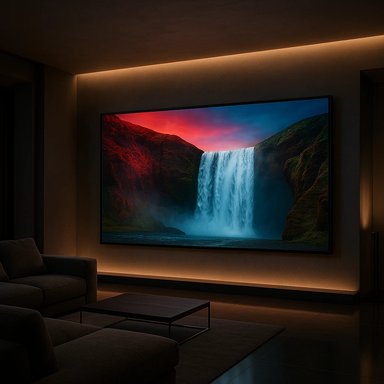
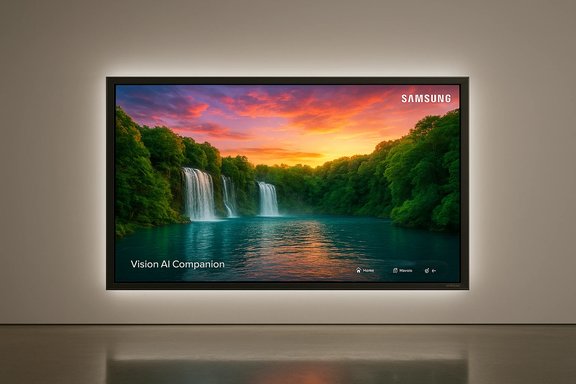
Cozy dark living room with a large wall-mounted screen displaying a waterfall and warm ambient backlighting.Background​

The R95H was unveiled during Samsung’s CES First Look/Exhibition Zone presentation as a showpiece rather than a retail announcement. The company displayed the 130‑inch Micro RGB screen in two configurations — freestanding on a large metal “Timeless Frame” stand that encircles the panel and as a wall‑mounted installation — and repeatedly described the unit as a concept to showcase technology direction rather than an imminent consumer SKU.
Micro RGB, in Samsung’s framing, replaces the traditional white or blue LED backlight and downstream color conversion stack with arrays of microscopic red, green and blue emitters in the backlight plane beneath an LCD modulation layer. Because the light source itself provides primary colors at very small scales, Samsung says Micro RGB can expand color volume and enable finer local luminance control than Mini‑LED/Neo QLED implementations while remaining more manufacturable than tiled self‑emissive microLED walls.

What Samsung Showed (Feature Snapshot)​

  • A 130‑inch Micro RGB panel marketed as the R95H, presented as the largest Micro RGB consumer display shown to date.
  • A gallery‑first industrial design — the Timeless Frame — that wraps the screen and integrates speakers (Eclipsa Audio) and structural mounting points.
  • A new image‑processing stack: Micro RGB AI Engine Pro, with subcomponents branded Micro RGB Colour Booster Pro and Micro RGB HDR Pro for real‑time frame‑by‑frame tuning.
  • Claims of Micro RGB Precision Colour 100 and VDE‑verified 100% coverage of the BT.2020 color container.
  • Support for HDR10+ ADVANCED, Glare‑Free anti‑reflection treatment, and a frame‑integrated audio system called Eclipsa Audio.
  • Expanded smart features under Vision AI Companion, including conversational search and integrations with Microsoft Copilot and Perplexity.
These points were repeated across Samsung’s materials and multiple press outlets on the CES show floor. The company positioned the R95H as a demonstration of where the technology and the platform can go, not as a product with announced pricing or a ship date.

Technical primer: What Micro RGB actually is​

How Micro RGB differs from Mini‑LED, OLED, and microLED​

  • Mini‑LED / Neo QLED: many small white (or blue) LEDs + quantum dot/color filter stack; local dimming through coarse zones; color produced downstream of the backlight.
  • OLED / QD‑OLED: self‑emissive per‑pixel light sources that deliver excellent blacks and pixel‑level control but historically trade off peak sustained brightness and face burn‑in concerns.
  • microLED (true microLED): per‑pixel RGB emitters with pixel‑level emissivity — the technical gold standard for brightness, color and black levels, but very expensive and complex at large single‑panel sizes.
  • Micro RGB: an intermediate, hybrid architecture — microscopic R/G/B emitters in the backlight plane that supply primary color emission beneath an LCD modulation layer, enabling far finer localized color control than white‑LED mini‑LED systems while avoiding the current manufacturing extremes of tiled microLED.

Why this matters on paper​

Because the backlight emits true primaries rather than filtered white light, Micro RGB can theoretically deliver:
  • Higher color purity and expanded color volume at high brightness — useful for HDR content.
  • Finer local luminance control that reduces haloing typical of zonal local dimming.
  • Retention of large‑panel manufacturing economics compared with self‑emissive microLED tiling.
But the approach is still fundamentally backlit: the LCD modulation layer remains above those emitters. That means absolute black levels and perfect pixel‑level emissivity remain the advantage of true self‑emissive panels unless Samsung’s optical stack and driving algorithms mitigate the familiar LCD tradeoffs.

Design and engineering notes​

The Timeless Frame stand and integrated audio​

Samsung reinterpreted its long‑running gallery aesthetic into a physical frame that both supports the massive 130‑inch display and houses the speaker array. The metal stand shown at CES encircles the screen and allows a small tilt for viewing adjustment; when wall‑mounted, Samsung indicated the entire frame/stand assembly must be affixed because it functions as a structural and acoustic module. This approach emphasizes the product’s role as an architectural object, not a simple wall slab.

Physical and installation implications​

  • A 130‑inch panel requires significant seat spacing, ceiling and wall clearances, and likely a professional installation with structural reinforcement. Samsung’s demos explicitly framed the R95H for large rooms and custom home‑theater installs rather than normal living rooms.
  • Because the frame contains speakers and acoustic components, installation is heavier and more integrated than typical modern TVs; the frame’s presence is part practical and part aesthetic.

The software and processing layer​

Samsung’s presentation centered the new hardware on an AI‑led image pipeline: Micro RGB AI Engine Pro with Color Booster and HDR Pro submodules. According to Samsung materials, this processing analyzes and optimizes image data in real time — improving color saturation, contrast, and local detail across both bright and dark scenes. The company also touted features such as Glare‑Free coatings and support for HDR10+ ADVANCED to manage extended dynamic metadata.
On the smart side, Vision AI Companion expands the TV’s role beyond entertainment: it provides conversational search, generative wallpapers, Live Translate, and third‑party agent integration with Microsoft Copilot and Perplexity. These additions underline Samsung’s positioning of the TV as a communal AI surface for the home.

Market positioning and pricing context​

Samsung clarified that the 130‑inch R95H was shown as a concept with no immediate plans to ship in the form presented at CES; that aligns with previous market moves where halo concept units appear at shows to demonstrate capability more than to denote immediate retail readiness.
For context on pricing tiers in Samsung’s large‑format strategy:
  • Samsung introduced a 115‑inch Micro RGB model last year and publicly associated a price in the ultra‑premium bracket (published examples put the 115‑inch near the $30,000 range). This gives a rough signal of the segment Samsung targets with Micro RGB.
  • Separate Micro‑LED televisions, which use different self‑emissive hardware, start much higher — commonly cited figures place entry points around the six‑figure mark, with $110,000 often referenced for larger microLED installations. These products serve a different value and performance segment, emphasizing pixel‑level emissivity that Micro RGB does not fully replicate.
Caveat: published prices for extremely large or bespoke televisions vary widely by configuration, region, and installation requirements. The 130‑inch R95H was explicitly shown as a demo concept, and Samsung did not announce retail pricing at CES. Consider any price comparisons illustrative rather than definitive.

Strengths: where Micro RGB could genuinely move the needle​

  • Color volume and sustained highlights: If Samsung’s Micro RGB hardware and the Micro RGB AI Engine Pro deliver as claimed, viewers could see richer, more saturated hues at high brightness levels — a persistent weak spot for OLEDs and a challenge for filter‑based LCDs.
  • Large‑format scalability: Micro RGB’s manufacturing flow aims to leverage LCD assembly scale while delivering color advantages closer to microLED, which could make very large single‑panel screens more attainable than current tiled microLED solutions.
  • Integrated design and audio: The Timeless Frame is a thoughtful response to the practical issue of making enormous screens feel like part of a room rather than a black monolith. The frame’s integrated Eclipsa Audio could improve out‑of‑the‑box spatial coherence for most buyers.
  • AI platform integration: Vision AI Companion with Copilot and Perplexity integrations brings productivity and search features to the TV surface, expanding use cases beyond passive viewing and reinforcing Samsung’s view of the TV as a communal AI display.

Risks and unresolved questions​

While the R95H is compelling on stage, several practical and technical risks remain:
  • Still an LCD stack: Because Micro RGB retains an LCD modulation layer, absolute black levels and pixel‑level emissivity are inherently limited compared to true self‑emissive microLED or OLED. The net picture advantage depends on emitter density, optical engineering and driver algorithms to mask or minimize those gaps.
  • Haloing and local contrast: Denser backlights reduce but don’t automatically eliminate haloing—how Samsung’s addressing and optical spread are engineered will determine whether haloing is perceptible on complex scenes. Independent lab tests will be decisive.
  • Manufacturer claims need independent verification: Samsung cited VDE verification of 100% BT.2020 coverage and described sub‑100‑micrometer emitter pitches; these are headline claims that require instrumented testing (color‑volume plots, emitter density maps, and dark‑scene behavior) before they can be treated as user‑facing guarantees.
  • Power consumption and heat: Large, high‑brightness RGB emitters across a 130‑inch canvas imply high power draw and thermal management needs; how Samsung addresses long‑term stability and heat‑related lifetime is not yet public. This is an important practical consideration for integrators.
  • Content ecosystem and BT.2020 usage: Most consumer content today is authored for narrower color containers (Rec.709 or DCI‑P3). Even with 100% BT.2020 hardware, practical benefit requires either remastered content or reliable color mapping that enhances rather than oversaturates source material.
  • Cost and installation complexity: If Samsung ever brings a 130‑inch Micro RGB display to market, it will be targeted at ultra‑premium buyers. The economics of purchase + reinforced installation + acoustic planning will keep it niche.

Verification checklist: what to demand from reviewers and labs​

Before treating stage claims as real‑world benefits, AV enthusiasts and integrators should insist on:
  • Measured color‑volume plots across luminance (CIE‑xy + color volume vs. nits).
  • Third‑party verification of emitter pitch / density and addressing architecture. Manufacturer pitch numbers (e.g., “sub‑100 μm”) are specific but need independent confirmation.
  • Black‑level and haloing quantification (zone edge artifacts, local contrast tests).
  • Long‑term stability and thermal profile under sustained HDR loads.
  • Evaluation of AI processing on native content (does AI preserve creative intent or produce over‑processed results?.
Until those items are publicly measured, treat the R95H as an important engineering milestone and design statement — not yet a quantified performance benchmark.

Practical guidance for homeowners and integrators​

  • Plan for professional site assessment: structural reinforcement, acoustic treatment, and cooling pathways must be part of the budget and design conversation for any >100‑inch display.
  • Seating distance and field of view: A 130‑inch diagonal will demand much greater viewing distances to avoid pixel‑perception artifacts and to match comfortable viewing angles for HDR content. Use standard seat‑to‑screen calculators during planning.
  • Audio strategy: While Eclipsa Audio promises integrated spatial sound, an external calibrated sound system will still be necessary for serious cinema fidelity; the frame‑integrated speakers primarily offer convenience and scaled coherence.
  • Content considerations: Expect the most noticeable gains on high‑quality HDR masters and dedicated home‑theater source material; mainstream broadcast or streaming SDR content will benefit less from a wide BT.2020 container unless remapped thoughtfully.

How this fits in the broader TV landscape​

Samsung’s R95H demonstration tightens the competitive frame for 2026: manufacturers are competing on how color is produced (micro‑scale RGB emission vs quantum‑dot conversion), how AI reshapes the viewing experience, and how displays integrate as interior design elements. LG and other vendors are also pursuing gallery and wallpaper form factors, wireless inputs and AI processing — but Samsung’s Micro RGB approach is notable for its explicit attempt to bring RGB emission into large single‑panel LCD manufacturing flows as a practical step toward microLED‑like color performance.
For consumers, the era ahead offers three clear premium trajectories:
  • OLED/QD‑OLED: best pixel‑level blacks and contrast for most home‑theater rooms with moderate peak brightness.
  • High‑density Mini‑LED/Neo QLED: very bright panels with zonal dimming tradeoffs and good HDR performance.
  • Micro RGB (this Samsung approach): a hybrid avenue that aims to boost color volume and highlight fidelity on massive panels while preserving much of LCD manufacturing scale.
True microLED remains the aspirational endpoint but will likely continue as a very high‑cost, limited‑scale option while hybrid approaches like Micro RGB occupy the high‑end consumer market in the medium term.

Conclusion​

Samsung’s 130‑inch Micro RGB R95H at CES 2026 was a deliberate, theatrical statement: an architectural screen, an assertion about the future of color generation, and a signal that AI and design will be as important as panel technology in defining premium televisions. The demo crystallizes several promising directions — higher color volume at sustained brightness, gallery‑grade industrial design, and AI‑first software experiences — but it also leaves essential verification tasks undone. VDE‑certified color coverage and sub‑100‑micrometer emitter pitches are headline‑worthy claims that require independent lab validation, and the enduring LCD limitations around absolute black and haloing must be quantified in real installations.
For display enthusiasts, integrators and affluent buyers, the right response is measured curiosity: admire the engineering boldness and plan installations carefully, but reserve technical and purchasing judgments until instrumented reviews and deployment case studies confirm that Micro RGB’s theoretical advantages translate into reproducible, long‑term benefits in the home.


Source: Dataconomy Samsung unveils massive 130-inch Micro RGB TV concept at CES 2026
 

Samsung’s headline-grabbing reveal at CES 2026 is a 130‑inch Micro RGB television — the R95H — a gallery‑scale statement that pairs a sub‑100 µm RGB backlight architecture, AI-driven image engines, and a refreshed “Timeless Frame” design aimed at redefining how premium TVs fit into the modern living room.

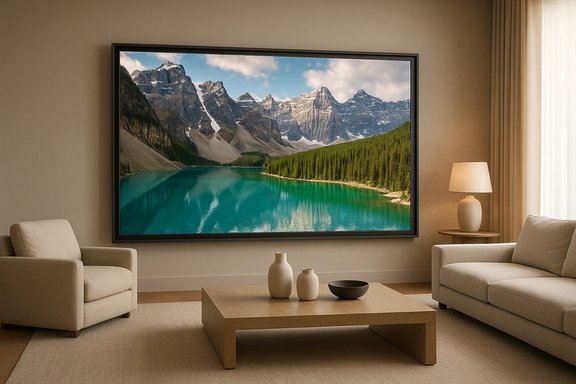
A modern living room with a large framed landscape of a turquoise lake and snow-capped mountains.Background​

Samsung introduced the R95H as the largest consumer Micro RGB panel the company has presented to date and positioned it as a halo product for its 2026 TV lineup. The company markets the set around three interconnected narratives: a new micro‑scale RGB backlight that contributes color at the source, a gallery‑style industrial design called the Timeless Frame, and an expanded software and AI stack under the Vision AI Companion umbrella.
Micro RGB represents an architectural hybrid: microscopic red, green and blue LEDs are placed in the backlight plane beneath an LCD modulation layer so the backlight itself contributes true primary color rather than relying solely on white LEDs plus filters or quantum dots. Samsung asserts the R95H uses sub‑100 micrometer RGB emitters and that the display achieves what it calls Micro RGB Precision Color 100 — a VDE‑verified claim of 100% coverage of the BT.2020 color gamut. These are headline technical claims that underpin Samsung’s marketing of the product.

What Samsung Announced: Key Features at a Glance​

  • Model: R95H, 130‑inch Micro RGB TV — marketed as the world’s first 130‑inch Micro RGB consumer set.
  • Micro RGB Backlight: Arrays of independently driven microscopic red/green/blue emitters (advertised as sub‑100 µm).
  • Color Certification: Marketing name Micro RGB Precision Color 100 with VDE verification cited for 100% BT.2020 coverage.
  • AI Image Pipeline: Micro RGB AI Engine Pro, Micro RGB Color Booster Pro, Micro RGB HDR Pro for frame‑by‑frame tone mapping and color refinement.
  • HDR & Audio: HDR10+ ADVANCED support; new spatial audio system Eclipsa Audio with speakers integrated into the Timeless Frame.
  • Design: Timeless Frame gallery aesthetic with a Glare Free anti‑reflection treatment intended to make the 130‑inch canvas read like architectural glazing.
  • Platform: Vision AI Companion with conversational search, Live Translate, generative wallpapers and integrations (Microsoft Copilot, Perplexity) to position the TV as a communal AI surface.
  • Availability & Price: Samsung showcased the R95H at CES; the company did not publish final retail pricing or broad ship dates at the time of the reveal.

Technical Primer: How Micro RGB Works (and Why It Matters)​

What Micro RGB changes about the backlight​

Traditional LED‑LCD displays illuminate a liquid‑crystal stack with white (or blue) LEDs, then convert that light to color via filters, quantum dots, or color wheels. Micro RGB moves the color generation itself down into the backlight: each microscopic emitter is red, green or blue, and can be driven independently to shape color and luminance at a much finer spatial scale. On paper, that yields:
  • Higher color purity because primaries are emitted directly.
  • Increased color volume — the ability to maintain saturated colors at higher luminance.
  • Finer local luminance control versus coarse zonal local dimming used in Mini‑LED sets.

How Micro RGB compares to other premium displays​

  • Mini‑LED / Neo QLED: Uses dense arrays of white or blue LEDs plus quantum dots and filters for color conversion. Improves peak brightness and zonal dimming but still relies on downstream color generation.
  • OLED / QD‑OLED: Self‑emissive pixels deliver perfect pixel‑level blacks and excellent contrast; color volume at high brightness is limited relative to bright LCD techniques.
  • microLED (monolithic emissive): True self‑emissive RGB microLED per pixel — the theoretical gold standard for brightness, color, and contrast but extremely difficult and costly to manufacture at single‑panel large sizes.
  • Micro RGB (Samsung’s approach): A hybrid retaining an LCD modulation layer but with the backlight itself emitting true RGB primaries at micro scale; intended to combine brightness and wide color volume with better manufacturability than monolithic microLED.

Practical tradeoffs​

Micro RGB can theoretically raise color volume and reduce haloing from large local dimming zones, but it retains limitations inherent to LCD stacks — most notably an absolute black floor that will not match true self‑emissive technologies, and the potential for haloing around very bright small highlights depending on emitter density and algorithms. Samsung’s sub‑100 µm emitter claim is central to minimizing those artifacts, but the real user experience depends on emitter pitch, driving architecture, and firmware. Those implementation details are not always fully disclosed at launch.

Design & Acoustics: The Timeless Frame and Eclipsa Audio​

Samsung is explicit about treating the R95H as an architectural object rather than an appliance. The Timeless Frame concept dresses the 130‑inch panel in a gallery‑style bezel designed to make the display read like a large window or framed artwork. The frame is also functional: speakers are integrated and tuned to the panel scale under the Eclipsa Audio label, aiming to reduce the perceptual disconnect between a massive image and an off‑board audio system. Samsung paired the frame with a Glare Free anti‑reflection coating to keep the surface usable in real home lighting conditions.
Practical implication: the R95H is presented as a turn‑key statement piece for large rooms, but buyers should plan for professional installation, wall reinforcement, and detailed acoustic planning. The frame‑integrated speakers may satisfy casual listening, but a dedicated AV system will still be necessary for theater‑grade experiences.

The Software Layer: Vision AI Companion and Ecosystem Moves​

Samsung is pushing the TV beyond picture performance into an AI platform. Vision AI Companion — described as a hybrid edge/cloud assistant — bundles conversational search, live translation, generative wallpapers, sports and audio modes, and integrations with third‑party agents such as Microsoft Copilot and Perplexity. Samsung also listed HDR10+ ADVANCED among the R95H’s capabilities, aligning its HDR roadmap with dynamic HDR metadata standards.
The headline takeaways here are twofold: first, Samsung wants to make the large TV an interactive communal AI surface; second, much of the value of these features depends on software maturity and privacy/data handling — questions Samsung did not fully resolve at the reveal. Buyers and integrators should request clarity on which Vision AI Companion features require cloud processing and how third‑party agents handle data.

Verification and What Remains Manufacturer‑Led​

Samsung’s announced claims are bold and specific: 130‑inch Micro RGB R95H, sub‑100 µm emitters, and VDE verification of 100% BT.2020. Multiple independent outlets repeated those claims after viewing Samsung’s CES demonstrations, and Samsung’s own materials cite the VDE evaluation. That creates a baseline of vendor‑led verification, but crucial measurement steps remain:
  • Independent lab measurements of color volume across luminance points (not just peak gamut numbers).
  • Instrumented testing of haloing and small‑specular highlight behavior to judge local contrast in practical content.
  • Long‑term stability and uniformity tests across the full 130‑inch panel, including manufacturing yield and potential repair pathways for the backlight unit.
Until third‑party labs publish detailed plots (color volume vs. luminance, ANSI contrast, absolute black measurements, and small bright object halo profiles), the R95H’s most important technical claims should be treated as manufacturer statements backed by a named test house, rather than settled performance facts.

Strengths: Where the R95H Could Deliver Real Gains​

  • Color volume potential: Direct RGB emission from the backlight has the theoretical advantage of preserving saturated color at high luminance, which would make HDR highlights look more natural and vivid on a 130‑inch canvas.
  • Large‑scale design integration: The Timeless Frame and integrated audio reduce the friction of placing a monstrous screen in a living space, catering to homeowners and integrators seeking showpiece displays.
  • AI and platform synergy: Vision AI Companion and third‑party agent integrations expand the TV’s role beyond passive consumption into productivity and interactive features, which could be compelling to households that want a multi‑use living‑room device.
  • Bridging microLED economics: If Samsung’s manufacturing yield and cost profile for Micro RGB are favorable, this hybrid approach could bring some of microLED’s color advantages to large, single‑panel consumer sizes at a lower price than monolithic microLED.

Risks, Unknowns and Practical Warnings​

  • Measurement gap: The VDE verification and sub‑100 µm claim are manufacturer‑friendly milestones, but independent lab data is required to understand how those specs translate across luminance, viewing distances, and various content types. Treat performance claims as provisional until verified.
  • Content and color pipelines: The BT.2020 container is very wide, but mainstream streaming and broadcast content is still largely authored in Rec.709 or DCI‑P3; there is limited native BT.2020 HDR material today. The R95H’s color advantage will be most visible with mastered HDR content and appropriate tone mapping.
  • Haloing and blacks: Because Micro RGB retains an LCD modulation layer, absolute black levels and haloing around small bright objects may still lag behind OLED and self‑emissive microLED unless emitter density and driving algorithms are exceptionally well implemented. The sub‑100 µm pitch claim mitigates that risk on paper but does not remove it.
  • Repairability and longevity: Large, dense micro‑emitter backlights raise questions about repair pathways. Buyers should request warranty clarity, BLU (backlight unit) repair or replacement terms, and service network readiness. Samsung’s materials did not provide exhaustive operational or warranty details at the reveal.
  • Price and market fit: A 130‑inch flagship will be expensive and best suited to affluent buyers, luxury integrators, and commercial installations. Expect professional installation, room planning, and potentially supplementary audio/acoustic expenditure. Samsung did not disclose pricing at CES.

Deployment Considerations for Prospective Buyers and Integrators​

  • Measure the room: A 130‑inch diagonal display requires careful sightline and seating‑distance planning. Ensure sightlines, mounting height, and viewing geometry work for your living space.
  • Structural readiness: Verify wall ratings, clearances, doorways, and ceiling heights before purchase; professional installers will likely be required.
  • AV system planning: Decide whether the R95H’s integrated Eclipsa Audio will suffice or if a dedicated surround or Atmos system is desired for cinema experiences. Factor in rack space and cable runs.
  • Calibration and lab testing: Plan for professional calibration to map HDR content, test dynamic metadata workflows (HDR10+ ADVANCED), and validate color performance in situ. Demand lab reports and instrumented measurements from retailers or reviewers before finalizing a purchase.
  • Warranty and service: Request full warranty wording and repair options for the BLU and display body, and confirm whether Samsung will offer on‑site service and spare parts for such a large, specialized panel.

Market Implications: What the R95H Means for the TV Industry​

Samsung’s R95H is a strategic move that signals the premium TV wars in 2026 will be fought on color science, AI integration, and design as much as on pixel counts or refresh rates. By pushing a hybrid Micro RGB approach to a 130‑inch consumer‑oriented product, Samsung attempts to:
  • Pressure competitors to prioritize color volume and AI features over raw brightness wars.
  • Create a new aspirational product category aimed at affluent homeowners and integrators who value theatrical scale and gallery aesthetics.
If Micro RGB can be manufactured at scale and delivered with dependable firmware and service infrastructure, it could broaden the available options for buyers who want large, color‑accurate canvases without the astronomical cost of tiled microLED installations. If those conditions are not met, the R95H may remain a compelling showpiece that is niche in practice.

Verification Checklist: What to Watch for in Hands‑On Reviews​

  • Measured color volume plots (saturation vs. luminance) across Rec.709, DCI‑P3 and BT.2020.
  • ANSI contrast, native black floor and small highlight halo measurements.
  • Uniformity and emitter density checks across the entire 130‑inch panel.
  • Long‑term burn‑in or retention behavior (where relevant) and customer‑facing warranty processes for BLU repair or replacement.
  • Real‑world HDR tone mapping behavior, including HDR10+ ADVANCED support and how streaming services’ masters are handled.

Conclusion​

Samsung’s R95H 130‑inch Micro RGB TV is an audacious technical and design statement: a hybrid backlight architecture that promises dramatic color volume and a gallery aesthetic that reframes what a living‑room screen can look like. The company’s specific claims — sub‑100 µm emitters and VDE‑verified 100% BT.2020 coverage — mark a clear attempt to move the display conversation toward how color is produced rather than solely how bright or how many pixels a screen contains.
Those claims are corroborated across multiple press briefings and Samsung materials, but they remain manufacturer‑led until independent, instrumented measurements and long‑term real‑world testing confirm that the theoretical advantages translate into tangible, repeatable benefits in homes and theaters. Prospective buyers should plan for professional installation, insist on lab‑grade verification of performance metrics, and request complete warranty and repair details for the BLU and panel.
For the market at large, the R95H tightens the premium competition around color fidelity and AI integration. Whether Micro RGB becomes an industry standard for large, high‑end televisions or remains a high‑cost showcase will depend on manufacturing scale, firmware quality, third‑party testing, and how quickly content ecosystems embrace wider color pipelines and dynamic HDR formats. In the near term, the R95H is both an impressive engineering milestone and a reminder that the final measure of display innovation is found in instrumented labs and living rooms — not only on stage.

Source: The Malaysian Reserve https://themalaysianreserve.com/202...ext-generation-color-and-bold-new-design/amp/
 

Samsung’s R95H — a 130‑inch Micro RGB television shown at CES 2026 — is less a conventional TV and more a manifesto about where large‑format displays, color science, and embedded AI might converge in premium homes and commercial spaces.

Cozy home theater with a 130-inch Samsung Micro RGB display and warm ambient lighting.Background / Overview​

Samsung unveiled the R95H as the crown jewel of its 2026 Micro RGB strategy, positioning the model as the largest Micro RGB consumer panel to date and a statement of engineering intent rather than an immediately mass‑market SKU. The set combines a gallery‑style chassis Samsung calls the Timeless Frame with a new Micro RGB backlight architecture and a heavy dose of on‑device AI processing branded as Micro RGB AI Engine Pro, Micro RGB Colour Booster Pro, and Micro RGB HDR Pro. Samsung is explicit about the R95H’s role: it is a halo product intended to show what the company believes is possible when you bring micro‑scale RGB emitters, third‑party color verification, and contemporary AI services together on an ultra‑large canvas. The company and several independent outlets report a headline claim that the panel covers 100% of the BT.2020 color gamut, with verification by Germany’s Verband der Elektrotechnik (VDE).

What is Micro RGB? A technical primer​

The architecture in plain language​

Micro RGB replaces the conventional white (or blue) LED backlight + color conversion approach used in LCD TVs with arrays of microscopic red, green, and blue LEDs in the backlight plane beneath an LCD modulation layer. Each tiny emitter can be driven independently, so the backlight itself contributes primary color and luminance at a much finer spatial scale than Mini‑LED zonal dimming can achieve. Samsung describes these emitters as sub‑100‑micrometer in size — a specification it highlights as central to the technology’s ability to deliver finer locality of light control.

Where Micro RGB sits in the ecosystem​

  • Traditional LED/LCD: uses white LEDs + color filters or quantum dots; color originates after the backlight.
  • Mini‑LED / Neo QLED: many smaller white LEDs improve zonal dimming but still depend on downstream color conversion.
  • OLED / QD‑OLED: self‑emissive pixels produce excellent blacks but can be limited in sustained peak brightness and have burn‑in considerations.
  • microLED (self‑emissive microLED panels): true per‑pixel RGB emission, excellent performance, but high manufacturing complexity and cost.
Micro RGB is a hybrid—it puts RGB emission at the backlight level while retaining the LCD modulation layer to control per‑pixel intensity. That makes it a pragmatic approach to increase color volume and brightness at very large sizes without the extreme cost or tiling complexity of monolithic microLED panels.

Key hardware and software claims (what Samsung says)​

Samsung’s public materials and CES showcase list a compact set of headline features for the R95H:
  • 130‑inch Micro RGB panel (model R95H), marketed as the world’s first Micro RGB TV at that size.
  • Micro RGB Precision Colour 100: claimed 100% BT.2020 coverage, with VDE certification cited as independent verification.
  • Sub‑100 µm independently driven RGB emitters in the backlight plane.
  • AI image pipeline: Micro RGB AI Engine Pro, Color Booster Pro, HDR Pro for frame‑by‑frame tone mapping and color refinement.
  • HDR10+ ADVANCED support (Samsung’s promoted next‑step dynamic HDR format).
  • New gallery‑style Timeless Frame design and a low‑reflection Glare Free surface treatment.
  • Integrated frame‑mounted audio (branded as Eclipsa Audio or similarly styled naming in Samsung materials) tuned specifically for a 130‑inch canvas.
  • Vision AI Companion: conversational on‑screen assistant, generative wallpaper, Live Translate, Microsoft Copilot and Perplexity integrations, and content‑specific modes such as AI Football Mode Pro.
These claims were repeated across Samsung’s newsroom and multiple press reports at CES; the company’s messaging framed the product as both a hardware milestone and a canvas for an AI‑forward TV platform.

Why the BT.2020 and VDE claims matter — and what they don’t guarantee​

The BT.2020 (Rec.2020) color container is an ambitious target: it defines a very wide gamut far beyond Rec.709 (HDTV) and wider than DCI‑P3 used in many HDR workflows. Saying a display “covers 100% of BT.2020” means the panel can physically produce the chromaticities defined in that container — on paper this signals extreme color capability.
Samsung’s public documentation and the CES Innovation Awards entry report VDE verification of the Micro RGB Precision Colour 100 claim, which is meaningful because it provides an independent measurement against a recognized standard. That said, three important caveats apply:
  • Coverage of the color container is not the same as accurate out‑of‑the‑box color reproduction — calibration, tone mapping, and signal chain all determine how faithfully real content is shown.
  • BT.2020 is wider than the majority of current consumer content pipelines. Very little mainstream streaming and broadcast content is authored natively for full BT.2020, and grading workflows often limit saturation and brightness to preserve intent on many displays. The practical benefit will depend heavily on source material and the TV’s tone‑mapping between color volume and brightness.
  • Verification typically requires careful specification of measurement conditions (illumination, peak luminance levels, measurement geometry). Buyers and reviewers should request the exact VDE report or test conditions before accepting marketing shorthand as a complete performance profile.
In short: the 100% BT.2020 + VDE headline is an impressive engineering badge, but real‑world gains hinge on calibration, content, and how Samsung maps modern HDR and SDR sources into that expanded gamut.

Image processing and HDR: Micro RGB AI Engine Pro and HDR10+ ADVANCED​

Samsung’s pitch for the R95H rests on pairing the Micro RGB hardware with aggressive on‑device AI. The company lists a trio of processing stacks — Micro RGB AI Engine Pro, Color Booster Pro, and HDR Pro — that are said to run frame‑by‑frame adjustments, optimize color saturation, and control local luminance to tame haloing and preserve detail. Press demos emphasize the system’s ability to sustain highlights and preserve saturated colors at high brightness. The set also supports HDR10+ ADVANCED, Samsung’s promoted extension of HDR10+ that aims to add more sophisticated dynamic metadata and scene‑level optimization. Adoption and content availability for HDR10+ ADVANCED remain open questions; industry adoption of new dynamic HDR formats tends to be gradual, and broad ecosystem support (streaming services, disc masters, and authoring tools) is required for the feature to be widely useful. Practical expectation: AI engines can visibly reduce artifacts and boost subjectively pleasing contrast, but they also change the signal the director intended. Enthusiasts and calibrators will want the option to disable aggressive processing and to access industry‑standard calibration pathways for objective measurements.

Design, acoustic strategy, and install considerations​

Samsung frames the R95H’s industrial design as a conscious attempt to make a gigantic display feel like architecture rather than a consumer appliance. The Timeless Frame wraps the panel in a gallery‑style border, while a low‑reflection Glare Free surface helps manage ambient light — both design moves that acknowledge the practical challenge of integrating a 130‑inch canvas into real living spaces. Audio is integrated into the frame, with Samsung branding the solution as Eclipsa Audio (naming varies slightly across early materials). The company says audio is specifically tuned for the panel’s scale to produce spatially coherent sound without mandatory external speakers. While convenient, integrated frame audio should be judged on its ability to deliver room‑filling, low‑distortion sound for cinema and music; many buyers will still prefer discrete sound systems for theater‑grade fidelity. Installation is nontrivial. A 130‑inch panel requires substantial wall real estate, likely structural reinforcement for wall mounting, and professional installation. Samsung showed the R95H on a metal stand that offers tilt and placement flexibility, but even free‑standing the unit needs space planning for viewing distance, seating geometry, and acoustic treatment.

Strengths — what the R95H gets right on paper and in demos​

  • Color ambition at scale: Pushing Micro RGB to 130 inches with VDE‑verified BT.2020 coverage signals a meaningful leap in achievable color volume for living‑room displays. This matters for projection‑style viewing and museum/installation use cases.
  • Hybrid engineering pragmatism: Micro RGB’s approach keeps the LCD modulation stack but moves color to the backlight. This can provide better color purity and sustained brightness than white‑LED backlights while avoiding the assembly and yield issues of full monolithic microLEDs.
  • Integrated, scale‑aware design: The Timeless Frame and frame‑tuned audio make the R95H a holistic object that’s easier to imagine as furniture or architecture rather than just a hulking TV. For high‑end residential and commercial installations, this matters.
  • AI feature set: Vision AI Companion and the expanded Tizen capabilities position Samsung’s TV more as a connected surface for productivity, translation, and generative content, not only passive consumption. For buyers who value a conversational TV and integrated services, the R95H packages a lot of functionality.

Risks, unknowns, and practical limitations​

  • Black level and haloing: Micro RGB still uses an LCD modulation layer, which means it cannot turn individual pixels completely off like OLED or self‑emissive microLED. The key engineering battleground will be how effectively Samsung’s optics and AI processing minimize haloing around bright objects on dark backgrounds. Independent lab tests will decide this.
  • Content availability: Very little mainstream content is mastered for full BT.2020. The practical advantage of an ultra‑wide gamut depends on content grading and how well the TV handles down‑ and up‑mapping from SDR, HDR, and color‑managed pipelines.
  • Price and service: Halo products at CES often arrive without pricing or broad availability. Expect a premium that reflects both the display’s size and the engineering complexity. Warranties, service logistics, and BLU (backlight unit) repairability will be critical for buyers of such a bespoke product.
  • Long‑term firmware and AI behavior: The AI features that make the R95H feel modern also create an ongoing dependency on firmware, cloud services, and privacy policy choices. Buyers should understand which Vision AI Companion features require cloud processing, what data leaves the home, and how updates are handled.
  • Measurement vs. marketing: Certification and marketing slogans are persuasive but not decisive. VDE verification is strong evidence of color capability, but reviewers will need to publish delta‑E, color‑volume curves, and black‑level charts measured across brightness levels to give a complete picture. Samsung’s own figures should be corroborated with independent instrumented tests.

What reviewers and professionals should measure first​

  • Independent color‑volume and gamut measurements across luminance levels (delta‑E and color volume graphs).
  • Full HDR pipeline handling: HDR10, HDR10+ ADVANCED behavior, Dolby Vision fallback (if any), and tone‑mapping at different peak luminance points.
  • Local contrast tests for haloing and blooming with high‑contrast patterns.
  • Off‑axis color and luminance uniformity on a 130‑inch canvas. Large panels can show significant geometric and optical variations across the surface.
  • Audio measurements for integrated frame speakers: frequency response, maximum SPL, and spatial imaging at typical listening distances.

Practical buying guidance (for integrators and affluent buyers)​

  • Book a live demo. Visual spectacle at CES can be persuasive; a measured demo in your intended room context is essential.
  • Request the VDE report and ask for measurement conditions (luminance points, colorimeter geometry). Independent integrators should compare Samsung’s figures to lab measurements.
  • Plan for professional installation. Wall reinforcement, safe handling, and cable management at this size are nontrivial expenses.
  • Clarify warranty and BLU repair policy. Micro RGB backlights are complex; determine what is covered and how replacements or field repairs are handled.
  • Assess whether integrated audio suffices for your use case. For cinematic fidelity, a dedicated sound system will usually still be preferable.

Broader market context and implications​

Samsung’s R95H arrives amid an industry shift toward denser RGB backlights and a renewed focus on color volume as a marketing and engineering axis. Other vendors are experimenting with similar approaches, and 2026 looks likely to be the year RGB backlights move from niche experiments into headline products. If Samsung can scale Micro RGB across multiple sizes with reasonable yields and consistent performance, the tech could become the dominant premium LCD‑derived path for buyers seeking brighter, more saturated large screens without microLED price tags. At the same time, the R95H exemplifies a contemporary shifting battleground: manufacturers no longer compete on pixel punchlines alone. They compete on color science, AI‑driven adaptation, design integration, and the degree to which displays become interactive household surfaces. The R95H bundles all of those ambitions into one very large, very expensive product that is as much a technology demonstrator as it is a potential retail model.

Final assessment: an ambitious milestone that needs independent verification​

The R95H is a clear technical and aesthetic statement: it pushes Micro RGB to a 130‑inch canvas, packages that canvas in a gallery‑style frame with integrated audio, and layers an ambitious set of AI services and processing engines on top. On paper and in press demos the product’s strengths are obvious — color volume, scale‑aware design, and feature breadth are all present. Samsung’s claims of VDE‑verified 100% BT.2020 coverage, sub‑100 µm emitters, and a robust AI picture pipeline are backed by company literature and consistent press reporting. However, several risk vectors remain: black‑level performance and haloing given the LCD modulation layer, the practical availability of BT.2020/native content, warranty and service logistics for such a large and complex BLU, and the long‑term behavior of AI features and cloud integrations. Until independent, instrumented reviews publish color‑volume graphs, delta‑E charts, and HDR tone‑mapping tests, the R95H should be read as a compelling engineering milestone and a strategic signal — not a mass‑market replacement for trusted OLED or pro projection systems.

Quick checklist for readers evaluating the R95H​

  • Verify the VDE certification paperwork and test conditions.
  • Insist on independent lab measurements (delta‑E, color volume, HDR tone‑mapping).
  • Budget for professional installation and acoustic treatment.
  • Confirm warranty specifics for the Micro RGB backlight and how service is delivered.
  • Test AI features for privacy, latency, and on‑device vs cloud processing requirements.

The R95H is an audacious step: it crystallizes the industry’s current interest in color volume, hybrid emission architectures, and AI as defining vectors for premium displays. If Samsung’s Micro RGB execution proves durable, reproducible, and serviceable at this scale — and if independent measurements match the company’s VDE‑backed claims — the R95H will be remembered as a pivotal early consumer expression of RGB micro‑emitter technology. Until then, it stands as a near‑term preview of a potential future where living‑room windows reproduce color and brightness at levels previously reserved for specialized cinema displays and gallery installations.
Source: absolutegeeks.com Inside Samsung’s largest and most ambitious Micro RGB display
 

Samsung 130-inch R95H Micro RGB HDR display showing an aurora-lit landscape.
Samsung’s 130‑inch R95H is a theatrical first impression: an ultra‑large Micro RGB television that promises unprecedented color fidelity by combining microscopic RGB emitters, AI‑driven image processing, and a gallery‑style Timeless Frame designed to make the display read like architectural glass rather than a slab of electronics. The set was unveiled as Samsung’s headline display ahead of CES 2026 and carries a string of bold technical claims — including VDE‑verified 100% coverage of the BT.2020 color gamut, sub‑100 micrometer RGB emitters, HDR10+ ADVANCED support, and an expanded Vision AI Companion platform — that aim to reposition high‑end TVs around color volume and intelligent features rather than just pixel counts and peak brightness.

Background​

Why Micro RGB matters now​

The consumer display market has seen three competing trajectories in recent years: continued refinement of OLED and QD‑OLED panels for deep blacks and cinematic contrast; Mini‑LED/Neo QLED approaches that push sustained brightness through dense white‑LED backlights and local dimming; and the long‑term promise of microLED — true self‑emissive red/green/blue emitters at pixel scale. Micro RGB sits between Mini‑LED and monolithic microLED. It places microscopic red, green and blue LEDs in the backlight plane beneath an LCD modulation layer, letting the backlight itself generate primary colors and fine local illumination while retaining an LCD stack that simplifies scaling to very large sizes. In theory, this hybrid approach can deliver wider color volume and cleaner saturated hues at high brightness without the extreme manufacturing cost of tiled microLED walls.

Where Samsung positions the R95H​

Samsung frames the R95H as the new flagship for its 2026 display strategy: a design and technology halo that showcases what Micro RGB can do at gallery scale. The company emphasizes three intertwined narratives: measurable picture advances (Micro RGB Precision Colour 100 and VDE validation), industrial design (the Timeless Frame and integrated frame‑tuned audio), and a richer AI/software layer (Micro RGB AI Engine Pro, Vision AI Companion, Microsoft Copilot and Perplexity integrations). The R95H was publicly displayed at Samsung’s CES exhibition and detailed in the company newsroom and press channels.

What Samsung is claiming — headline features​

  • A 130‑inch Micro RGB panel (model R95H), positioned as the world’s first 130‑inch Micro RGB consumer TV.
  • Micro RGB Precision Colour 100: a marketing name for the display’s claimed 100% coverage of the BT.2020 color gamut, with VDE verification cited by Samsung. This is a headline metric intended to signal very wide color capability on paper.
  • Sub‑100 micrometer RGB emitters in the backlight plane, enabling finer locality of light control and color mixing beneath the LCD layer.
  • An AI image pipeline — Micro RGB AI Engine Pro, Micro RGB Colour Booster Pro, and Micro RGB HDR Pro — for per‑frame tone mapping, color refinement, and contrast control.
  • Support for HDR10+ ADVANCED and next‑generation HDR handling on selected 2026 models.
  • A “Timeless Frame” gallery aesthetic with integrated Eclipsa Audio speakers and a low‑reflection Glare Free coating to reduce contrast loss in bright rooms.
  • Expanded smart features under Vision AI Companion, including live translation, AI‑generated wallpapers, AI Football Mode Pro, and integrations with Microsoft Copilot and the Perplexity assistant ecosystem.

Technical reality check: what "100% BT.2020" actually means​

BT.2020 (Rec.2020) is a very wide color container used as an aspirational target in UHD standards. When a display claims "100% BT.2020 coverage," it indicates that the panel’s primary chromaticities map to the extreme corners of the BT.2020 triangle on a chromaticity diagram — in short, it is capable of producing the saturated primaries specified by that standard.
However, color gamut coverage alone is not the full story for perceived color accuracy or realism. Two additional, crucial dimensions are:
  • Color volume — the ability to render saturated colors across different luminance levels. A display can hit the BT.2020 corner primaries at low or high luminance but still fail to sustain saturated hues at high brightness without clipping or distortion.
  • Color accuracy across luminance (and viewing conditions) — delta‑E measurements and VDP‑style color‑volume plots are needed to determine how faithfully a display reproduces reference content across dark and bright scenes.
Samsung’s VDE verification and claims address the first metric (gamut coverage) as measured; independent instrumented testing is needed to validate sustained color volume, fidelity across brightness ranges, and whether that 100% figure holds under real‑world content and calibration. Early coverage confirms Samsung’s VDE citation, but the essential color‑volume and delta‑E plots that matter to reviewers are still pending.

How Micro RGB differs from Mini‑LED, microLED, and OLED​

The hybrid architecture​

Micro RGB embeds microscopic red, green and blue emitters into the backlight plane beneath an LCD modulation layer. Unlike Mini‑LED/Neo QLED — which uses many white or blue LEDs plus quantum dots and downstream color filters — Micro RGB generates primary color at the backlight, improving color purity and enabling much finer local control of highlights and saturated hues.
True microLED is self‑emissive at pixel scale (no LCD layer), offering the best possible local control and black levels, but becomes expensive and complex to manufacture at very large monolithic sizes. Micro RGB attempts to capture much of microLED’s color advantages while keeping manufacturing flows closer to LCD production and scaling to titanic diagonals more affordably.

Practical tradeoffs​

Because Micro RGB remains an LCD‑modulated architecture, absolute pixel‑level blacks and per‑pixel emissivity will generally still lag behind true self‑emissive displays such as OLED or monolithic microLED until further optical and firmware engineering compresses the gap. That means the technology must address typical LCD artifacts — haloing, blooming around highlights, and black‑floor lift — through aggressive BLU control algorithms and optical design. Samsung’s message: combine dense emitter arrays with AI engines (Micro RGB HDR Pro / Scene Variable BLU Control) to minimize visible artifacts. Independent testing will determine how effectively it works.

Software and AI: more than just picture tuning​

Samsung pairs the R95H hardware with a beefed‑up software stack and assistant ecosystem. Key elements include:
  • Micro RGB AI Engine Pro / Colour Booster Pro / HDR Pro — these on‑device engines perform scene analysis, per‑frame tone mapping, and color balancing to take advantage of the finer BLU granularity. Samsung says the stack refines saturation without oversaturation and controls contrast in varied ambient lighting.
  • Vision AI Companion — a conversational and contextual layer built into the TV platform that offers intelligent search, live translation, AI‑generated wallpapers, and content recommendations. Samsung highlights integrations with Microsoft Copilot and Perplexity as assistant partners for web retrieval and productivity workflows. The newsroom notes voice recognition and content‑creation features but cautions that language and accent support, as well as AI‑generated content accuracy, vary by region and model.
  • AI Football Mode Pro & AI Sound Controller Pro — sports fans and audiophiles are promised content‑specific processing modes and audio calibration that adapt to room size and screen layout; Samsung’s frame‑integrated Eclipsa Audio is tuned for the 130‑inch scale.
These are meaningful software differentiators — but they also introduce variables: aggressive AI processing can introduce temporal artifacts (pumping, haloing, unnatural skin tones) if the algorithms misinterpret complex scenes. Firmware maturity and user‑adjustable processing sliders will be important to avoid "AI overprocessing" that some viewers find objectionable.

Design and installation — the Timeless Frame and Eclipsa Audio​

Samsung’s Timeless Frame wraps the 130‑inch panel in a thin gallery surround intended to make the display read as a framed window or artwork. The frame also houses speakers tuned to the panel scale; Samsung calls the system Eclipsa Audio and promises audio calibration that scales with screen size and room configuration so sound feels aligned with the image rather than seemingly "off screen." A Glare Free anti‑reflection coating is designed to combat contrast loss in sunlit rooms — a practical necessity on a 130‑inch canvas. Practical installation caveats are obvious: mounting or floor stand installation for a 130‑inch set will typically require professional integration, wall reinforcement, careful sightline planning and HVAC/lighting considerations to control reflections and acoustic response. Samsung is marketing the R95H to affluent buyers, integrators and dedicated media spaces where these constraints are manageable.

Independent corroboration and what’s still unverified​

Samsung’s newsroom and PR channels lay out the official specification and features; independent trade outlets (Gadgets360, Business Standard, CES Innovation Awards listing, Times of India and other coverage) repeat the core claims and provide early analysis. These secondary sources corroborate the 130‑inch model, Micro RGB branding, AI engines, Timeless Frame and VDE/gamut claims — establishing a consistent narrative across publisher and vendor materials. What remains to be instrumented by third‑party labs and reviewers:
  • Measured color volume plots across luminance levels (not just static gamut corners).
  • Full delta‑E performance across multiple calibration targets and viewing modes.
  • Effective mitigation of haloing and blooming in mixed scenes.
  • Long‑term firmware behavior and consistency across content types (film, HDR sports, games).
  • Real‑world behavior of AI processing pipelines (visible artifacts, latency, upscaling quality).
  • Pricing and availability by region; Samsung showed the R95H as a CES halo product and has not (as of the announcement) published final retail pricing or shipping dates.
Where claims are verifiable today, two independent sources already agree: Samsung’s own newsroom and the CES Innovation Awards listing explicitly describe the 100% BT.2020 claim and the Micro RGB architecture. Early press coverage from outlets like Business Standard and Gadgets360 copies the claims and adds context around glare reduction and integrated audio. Nonetheless, rigorous lab measurement will be the decisive proof for prospective buyers.

Strengths — what the R95H could deliver if Samsung’s engineering holds up​

  • Massive color gamut and potential for unmatched saturated hues — 100% BT.2020 on paper expands the theoretical palette available to HDR content, especially bright specular highlights and vibrant landscapes.
  • Large‑scale practicality — Micro RGB aims to bring superior color to projector‑like diagonals without the expense and complexity of tiled microLED systems, potentially making gallery‑scale displays more attainable for luxury home installations.
  • Integrated design and sound — the Timeless Frame and Eclipsa Audio help the TV sit as interior architecture, reducing the need for separate aesthetic shells and simplifying initial setups for buyers who don’t want large AV racks.
  • AI ecosystem synergy — Vision AI Companion, Copilot and Perplexity integrations could make the TV a more useful household surface for search, translation and assistant workflows, aligning with Samsung’s push toward "AI‑led living."
  • HDR format ambitions — HDR10+ ADVANCED support indicates Samsung’s continued investment in dynamic metadata HDR and per‑scene processing, which can yield better tone mapping when properly implemented.

Risks and unanswered questions​

  1. Technical limitations from the LCD layer
    • Micro RGB still uses an LCD modulation layer. That keeps manufacturing manageable for huge diagonals but preserves familiar LCD weaknesses: raised black floors, haloing around bright objects, and potential for visible blooming unless the BLU control is exceptionally precise. Firmware playbooks matter.
  2. The difference between gamut claims and perceptual gains
    • Hitting BT.2020 primaries is one thing; delivering usable color volume across brightness ranges is another. Content mastering rarely uses full BT.2020, and the ecosystem of content creation and delivery must catch up before average viewers can exploit the entire container. That makes the R95H most compelling to content creators, reference viewers, and early adopters who value technical fidelity.
  3. AI processing can be double‑edged
    • Per‑frame AI tone mapping and color boosting can improve perceived image quality but also risk introducing temporal inconsistencies, over‑processing or "waxing" skin tones. The quality of Samsung’s algorithms and the availability of conservative presets will be decisive.
  4. Price and installation friction
    • Large‑format, architectural installations are expensive and logistically complex. The R95H will likely carry a premium price and require professional installation, limiting its market to wealthy early adopters and integrators. Samsung has not published retail details at unveiling.
  5. Ecosystem and standards uncertainty
    • HDR10+ ADVANCED and other next‑gen HDR formats need broader content and device adoption to be truly meaningful. Competing vendors are pushing alternative technical routes (TCL’s X11L SQD Mini LED and LG’s new approaches), so the market will remain fragmented in 2026.
  6. Privacy and data handling with AI assistants
    • Integration with Microsoft Copilot and third‑party agents raises questions about voice data, cloud retrieval and on‑device processing. Samsung’s notes already flag variation in language support and AI content accuracy; consumers should read privacy and data use details when those features go live.

What to watch next (practical checklist)​

  1. Independent lab reviews reporting:
    • Color‑volume plots and delta‑E charts across luminance.
    • Measured black level, contrast ratio and halo metrics in mixed scenes.
    • Uniformity and viewing‑angle color stability.
  2. Firmware updates and processing modes:
    • How many user‑adjustable processing levels are available?
    • Is there a truly "reference" mode that disables aggressive AI processing for calibrated viewing?
  3. Pricing, shipping windows and professional install options:
    • Confirm MSRP, region availability and Samsung’s recommended integrators.
  4. Content availability:
    • Which streaming services and studios will master content to exploit the BT.2020 container and HDR10+ ADVANCED metadata?
  5. Real‑world demos:
    • Hands‑on demos at CES and subsequent trade events will show how Samsung tames large‑screen glare and acoustic behavior in typical living spaces.

Conclusion​

Samsung’s R95H 130‑inch Micro RGB TV is a confident, ambitious statement at CES 2026: a gallery‑scale display that packages micro‑scale RGB emitters, an aggressive AI image pipeline, a refined Timeless Frame aesthetic, and a platform‑level push into AI assistants and new HDR horizons. The engineering promise — particularly the 100% BT.2020 claim and sub‑100 µm emitter pitch — is compelling on paper and has been broadly repeated across Samsung’s newsroom, the CES Innovation Awards listing and independent press coverage. Yet the crucial proof will arrive in instrumented third‑party reviews that measure color volume, real‑world HDR performance and the visible impact of AI processing on diverse content. Until those measurements are widely available, treat the R95H as an exciting technological waypoint: a plausible route to richer, more architecturally friendly ultra‑large displays — but one that needs empirical validation before it can be declared the definitive successor to OLED or the ultimate home theater display.

Quick takeaway (for readers short on time)​

  • Samsung’s R95H is the company’s first 130‑inch Micro RGB TV, claiming 100% BT.2020 with VDE verification, sub‑100 µm micro‑emitters, advanced AI engines and a gallery‑style Timeless Frame with integrated Eclipsa Audio.
  • The technology promises wider color volume and brighter, purer highlights compared to conventional Mini‑LED designs, but independent lab data on color volume, delta‑E, black levels and haloing is still required.
  • Expect the R95H to be a premium, installation‑heavy product aimed at affluent buyers, integrators and early adopters; pricing and full retail availability were not announced at unveiling.
The R95H reads like Samsung’s answer to the question “how do we make the TV an architectural, color‑accurate centerpiece in the AI era?”; whether it becomes the pragmatic bridge between Mini‑LED and true self‑emissive microLED will be decided by measurements, firmware maturity and how rapidly content and AV ecosystems adopt the wider color and HDR tools it enables.

Source: sigortahaber.com Samsung Unveils 130-inch Micro RGB TV With Record-Breaking Color Precision Ahead of CES 2026
 

Samsung’s CES 2026 showcase opens with a bold claim: the R95H is the world’s first 130‑inch Micro RGB television, a purpose-built, gallery‑style giant that Samsung positions as its most advanced large‑format display yet and as a new milestone in color fidelity and AI‑enhanced picture processing.

Samsung wall-mounted TV shows a sunset over a lush waterfall and forest.Background​

Samsung’s Micro RGB story began as a step beyond mini‑LED backlights—an architecture that places individually controlled red, green and blue micro‑LED sources in an ultra‑fine array behind a conventional LCD panel. The company first commercialized Micro RGB at very large sizes in 2025 and has since expanded the family with new sizes and processing engines that lean heavily on AI for dynamic tone, contrast and color control. Samsung says the Micro RGB approach uses sub‑100µm RGB LEDs to enable more precise color mixing and zoned illumination than white‑LED mini‑LED systems. Micro RGB is an important marketing and engineering pivot: it attempts to capture the color and peak brightness advantages of emissive microLED concepts while remaining closer to LCD manufacturing economics. Independent coverage from several outlets has described Micro RGB as an LCD panel with a very fine RGB backlight rather than a self‑emissive microLED display—an important distinction for readers weighing image quality trade‑offs.

What Samsung announced at CES 2026​

The R95H at a glance​

  • A 130‑inch Micro RGB display, codenamed R95H, showcased at Samsung’s CES exhibition zone.
  • Core picture technology: Micro RGB AI Engine Pro, Micro RGB Color Booster Pro, and Micro RGB HDR Pro—AI‑driven subsystems Samsung says analyze and refine each frame to improve color fidelity, shadow detail and contrast.
  • Color claims: Micro RGB Precision Color 100, which Samsung states delivers 100% coverage of the BT.2020 color gamut and carries certification from Germany’s Verband der Elektrotechnik (VDE) for accurate reproduction.
  • HDR and audio: support for HDR10+ ADVANCED and Samsung’s spatial Eclipsa Audio system integrated into the frame.
  • Design: a new Timeless Frame gallery aesthetic intended to make the massive panel read like an architectural window; the frame houses speakers and audio electronics tuned to the display’s scale.
  • Smart features: updated Vision AI Companion with conversational search, content recommendations and tools such as AI Football Mode Pro, Live Translate, Generative Wallpaper, plus third‑party integration with Microsoft Copilot and Perplexity.
Samsung will physically demonstrate the R95H at CES 2026, but as of the announcement it has not published U.S. pricing or availability dates for the R95H.

Why Samsung emphasizes BT.2020 and VDE certification​

Samsung’s headline spec—100% BT.2020 coverage—is significant because BT.2020 (Rec. 2020) is the wide color gamut container used as the reference primaries for UHD content production workflows and HDR metadata. Full native coverage of BT.2020 is a rare and technically ambitious target for consumer displays because the standard’s primaries reach far beyond traditional consumer gamuts. VDE certification is an independent verification step that adds credibility to Samsung’s claims about color accuracy, and the company explicitly cites VDE in product materials as third‑party evidence that the panel reproduces its claimed color volume. Still, industry experts and reviewers will need hands‑on measurements and studio‑grade test patterns to confirm how the R95H maps content to its native primaries in real‑world viewing conditions. The certification is a positive sign, but it is not a substitute for independent lab reviews.

The Micro RGB technical reality (what it is and what it isn’t)​

How Micro RGB works​

Micro RGB is essentially a very dense, finely segmented RGB backlight behind a high‑performance LCD stack. Each tiny red, green or blue LED emitter is individually addressable at a micro scale (Samsung cites sub‑100µm emitter sizes), giving far greater zonal granularity and direct control of color mixing than typical white LED mini‑LED backlights. The result is higher color volume and greater peak brightness potential without the manufacturing complexity and price of true self‑emissive microLED panels.

Key advantages Samsung and observers highlight​

  • Higher peak brightness and color volume than OLED in many scenes, making HDR highlights more impactful in bright rooms.
  • No organic burn‑in risk, since the color sources are inorganic LEDs rather than organic emissive pixels.
  • Very high color gamut coverage—Samsung’s Micro RGB implementation targets full BT.2020 coverage, which could be meaningful for future content mastered with very wide primaries.

Limitations and realistic expectations​

  • Micro RGB is still an LCD with a backlight. That means it cannot turn individual pixels fully off the way true self‑emissive microLED or OLED displays can. Local dimming zones, however fine, still span many pixels and therefore cannot achieve per‑pixel contrast. Independent analysis has emphasized that Micro RGB’s zoning, while dramatic versus mini‑LED, still cannot match per‑pixel black levels of OLED or microLED.
  • Real‑world color appearance depends on tone mapping, color management and content mastering choices. Even with native BT.2020 coverage, most current streaming and broadcast content is still mastered to narrower gamuts (DCI‑P3 or even Rec.709), so the practical benefit will vary by source.
Because Micro RGB sits between mini‑LED and microLED in design philosophy, buyers should expect a blend of strengths and compromises: exceptional brightness and color volume in many scenes, but still a reliance on complex zoned dimming to approach deep blacks.

Design and audio: the Timeless Frame and Eclipsa Audio​

Samsung’s treatment of the R95H as an architectural object is notable. The Timeless Frame concept—an evolution of the company’s Gallery/‘Timeless Gallery’ aesthetic from earlier years—wraps the panel in a rigid framed mold intended to make the 130‑inch surface resemble a large window rather than a monolithic black rectangle. Samsung integrates speakers into that frame and says audio is tuned to match the visual scale, using the Eclipsa Audio architecture to spatialize sound and maintain cohesion between image and sound. This approach reduces the visual “appliance” presence of ultralarge displays and responds to the reality that a 130‑inch screen dominates a room. Integrated audio tuned for scale reduces dependence on separate AV racks or floorstanding speakers for acceptable everyday listening, although dedicated setups will still offer better dynamics and low‑frequency impact for serious home theaters.

Smart features, AI, and ecosystem integrations​

The R95H is as much a software product as it is a display. Samsung bundles an upgraded Vision AI Companion (VAC) that acts as a conversational assistant, content recommender and control hub for AI‑driven features: AI Football Mode Pro, AI Sound Controller Pro, Live Translate, Generative Wallpaper and more. The company also explicitly called out partnerships with Microsoft Copilot and Perplexity, signalling a strategy to open the TV’s assistant layer to outside LLM and search providers. AI-driven image processing can improve certain types of content—refining dull tones, improving shadow detail, and adjusting color mapping scene‑by‑scene—but it also raises two practical questions for enthusiasts:
  • How repeatable and predictable are those AI adjustments across different genres (sports, cinema, gaming)?
  • What are the latency and upscaling trade‑offs when AI processing is applied to fast motion or gaming content?
These are the areas where early hands‑on reviews will be critical: marketing materials promise neural processing gains, but real‑world performance depends on how Samsung balances fidelity, latency and the consumer’s ability to calibrate or disable aggressive processing.

HDR10+ ADVANCED and content ecosystem realities​

Samsung and HDR10+ Technologies announced HDR10+ ADVANCED earlier in the product cycle; Samsung says its 2026 TVs (including the R95H) implement that next‑generation HDR10+ variant. HDR10+ ADVANCED adds more granular dynamic metadata and other format improvements, but it is still emerging in streaming and disc ecosystems. Samsung’s inclusion of it is forward‑looking, yet the real value depends on content adoption from studios and streaming platforms. Similarly, the step to full BT.2020 native coverage is forward‑facing: most current mainstream streaming and broadcast content is not mastered to make use of the complete BT.2020 volume, and creative workflows currently center on DCI‑P3 or other practical masters. In short, the R95H is future‑proofed on paper, but today’s content library will only partially exploit that headroom.

Practical considerations for buyers and installers​

A 130‑inch television changes installation calculus. The R95H is a statement product but it brings logistics and ongoing costs:
  • Room size and seating: To get appropriate immersion without eye fatigue, plan for a deep seating distance. Using industry viewing‑angle guidance (THX and SMPTE), a 130‑inch diagonal requires substantial room depth: expect to position primary seats roughly 12–18 feet (3.7–5.5 meters) away for a cinematic 30–40° field of view. Many living rooms will be too shallow for this ideal positioning.
  • Wall structure and mounting: The weight and size of a 130‑inch panel and its rigid Timeless Frame will typically mandate reinforced wall mounting or professional installation, possibly including blocking and in‑wall AV routing. Allow for service access and cable management during planning.
  • Power and heat: Higher peak brightness and large backlight arrays draw significant power. Expect cooling design to be part of Samsung’s engineering, but buyers should consider the incremental electrical load and the potential need for dedicated circuits in dedicated media rooms.
  • Cost: Samsung has not disclosed price for the R95H at CES 2026. Previous Micro RGB entries and other very large premium displays have carried five‑figure price tags, and independent coverage suggests that Micro RGB systems remain a premium proposition relative to mainstream OLED and mini‑LED models. Buyers should prepare for a high cost of ownership.
  • Calibration and professional setup: To realize the potential of Micro RGB Precision Color 100 and VDE certification, professional calibration will be important—especially for AV enthusiasts who expect accurate color reproduction for movies or studio work.
Numbered quick‑check before purchase:
  • Measure room depth and confirm seating positions support 12–18 ft viewing distance for a balanced field of view.
  • Confirm wall strength and mounting plan with a qualified installer.
  • Check for power availability and consider a dedicated circuit if necessary.
  • Budget for calibration and a high‑quality AV front end or sound system if cinematic audio is a priority.
  • Ask Samsung or your dealer for detailed service‑and‑warranty terms on a 130‑inch product.

Competitive context and market risks​

Samsung’s R95H arrives into a competitive CES 2026 landscape where other vendors are also pushing wide‑gamut, very bright displays. For example, TCL’s X11L SQD Mini‑LED announces extremely high peak brightness targets (claims up to 10,000 nits for certain HDR highlights) and full BT.2020 coverage, positioning a rival technology path that emphasizes brute‑force brightness through backlight and quantum dot techniques. These parallel developments show the market is betting on superior HDR/brightness performance as a differentiator—yet they also complicate marketing claims about “the widest” or “world’s best” color coverage. Comparative testing will be required to determine not only color gamut but also color accuracy, tone mapping, and sustained HDR performance. Potential market risks and downsides:
  • Pricing and addressable market: Ultra‑large, ultra‑premium displays appeal to a very small segment of buyers. High unit costs limit mainstream uptake and slow economies of scale.
  • Name confusion and marketing framing: “Micro RGB” sounds similar to “microLED” and “MicroLED” has a different technical definition (self‑emissive). Consumer confusion may slow adoption or lead to mismatched expectations. Journalists and retailers will need to be precise explaining the difference.
  • Content mismatch: Until more content is mastered to use full BT.2020 headroom or HDR10+ ADVANCED is broadly available, the practical benefits will be incremental for most viewers.

What to watch for in hands‑on reviews​

The R95H’s promise is measurable and testable. Reviewers and technical reviewers should probe the following areas in early evaluations:
  • Color accuracy across luminance ranges: Does the display hit its claimable BT.2020 volume while preserving accurate hue and tone mapping for content mastered to DCI‑P3 or Rec.709? How much calibration is required?
  • Local dimming fidelity and black levels: Do the backlight zones produce convincing inky blacks in mixed scenes, or are there halo artifacts around bright highlights? This is where Micro RGB’s zoning limitations vs self‑emissive panels will be evident.
  • HDR peak brightness and sustained highlights: Peak nit numbers are useful, but sustained HDR performance and highlight roll‑off behavior tell the real story for HDR watching in bright rooms. How does the R95H compare to rival bright displays like TCL’s X11L in measured nits?
  • Gaming latency and features: Does the R95H support low‑latency game modes, high refresh rates or VRR without introducing visible processing artifacts when AI pipelines are engaged?
  • AI processing transparency: Can users tune or disable AI features for a purist mode, and how predictable are the enhancements across different content genres?

Final analysis — who the R95H is for​

The 130‑inch R95H is a halo product: it showcases Samsung’s latest Micro RGB engineering, promotes the company’s vision of AI‑enhanced living, and gives design‑oriented buyers a theatrical, window‑like centerpiece for very large spaces. For buyers who demand maximum brightness, dramatic color volume and a home cinema statement, the R95H will be compelling—assuming pricing and installation logistics align.
For cinephiles focused on pure black‑level fidelity and per‑pixel contrast, OLED and true microLED remain the technical leaders. For mainstream buyers, the cost and room requirements of a 130‑inch screen will make the R95H an impractical choice compared with high‑end 65–85‑inch OLED or mini‑LED sets.
Samsung’s announcement is an important step in display evolution: Micro RGB demonstrates that precise RGB backlighting can push color volume and HDR highlight performance into new territory while avoiding the manufacturing barriers of self‑emissive microLED. The technology is promising, but the “world’s first” headlines should be read alongside caveats—Micro RGB is not a per‑pixel emissive solution, and analysts and buyers should wait for independent lab measurements and side‑by‑side comparisons before drawing definitive conclusions about how it stacks up against rival ultra‑bright technologies.
Samsung’s R95H, with its Timeless Frame and Micro RGB arsenal, is a statement of intent: premium television remains a platform for bold engineering and theatrical design. The unit shown at CES 2026 reflects aspirations—both practical and aspirational—about the future of color, AI, and how display manufacturers will position hardware as part of a broader, AI‑driven ecosystem. The next phase of validation will be independent reviews, professional calibration testing and, ultimately, the arrival of content that can fully exploit the R95H’s claimed BT.2020 canvas and HDR10+ ADVANCED pipeline. Conclusion: Samsung’s 130‑inch Micro RGB R95H is a headline‑grabbing advance in large‑format TVs that combines ambitious color engineering, integrated audio and AI features with a gallery‑first design. It advances the conversation about where premium display technology goes next—but measured testing and practical considerations will determine whether it becomes a new benchmark or an impressive but niche showcase.
Source: ProPakistani Samsung Unveils World’s First 130-Inch Micro RGB TV at CES 2026
 

Samsung’s CES 2026 unveiling of a 130‑inch Micro RGB TV (model R95H) is a deliberate, theatrical push to reframe the television as both an ultra‑premium color instrument and an architectural object, combining Samsung’s new Micro RGB backlight architecture, an AI‑heavy image pipeline, and a gallery‑style “Timeless Frame” to present a 130‑inch panel that the company calls the world’s first of its size and class.

A large TV in a modern living room with warm backlighting shows a vivid canyon scene.Background / Overview​

Samsung introduced the R95H at CES 2026 as the largest Micro RGB consumer panel it has presented to date, positioning it as the halo product for the company’s 2026 display strategy. The R95H bundles several headline claims: a Micro RGB backlight composed of microscopic red, green and blue emitters, AI‑driven image engines (Micro RGB AI Engine Pro, Micro RGB Color Booster Pro and Micro RGB HDR Pro), a claimed 100% coverage of the BT.2020 color container (marketed as Micro RGB Precision Color 100) with VDE verification, and a refreshed industrial aesthetic called the Timeless Frame that integrates frame‑tuned audio (Eclipsa Audio). This announcement is consistent across Samsung’s own newsroom and multiple independent outlets that attended CES and reported from Samsung’s exhibition: the product is presented as a picture‑first, gallery‑styled statement rather than a mass‑market TV, and no retail price or concrete ship date was included at the reveal.

What “Micro RGB” actually is​

The technical concept in plain English​

Micro RGB is a hybrid display architecture that places microscopic red, green and blue LEDs in the backlight plane beneath an LCD modulation layer. Unlike conventional Mini‑LED (white or blue LEDs + quantum dots/filters) or true self‑emissive microLED (per‑pixel RGB emission without an LCD), Micro RGB moves color generation deeper into the light source so the backlight itself contributes saturated primaries and fine luminance control. On paper, that architecture expands color volume (saturated color at higher brightness) and enables tighter local control of highlights while retaining the more familiar LCD manufacturing flow.

How it differs from other premium display families​

  • Mini‑LED / Neo QLED: dense white/blue LED arrays + quantum dot/color filters, zonal local dimming.
  • OLED / QD‑OLED: self‑emissive pixels (excellent blacks, off‑axis color).
  • microLED: self‑emissive RGB pixels per pixel (ultimate performance, costly at large sizes).
  • Micro RGB (Samsung’s approach): RGB emitters in the backlight plane + LCD layer — a hybrid that aims to reap the color and highlight advantages of emissive tech while keeping scaling and cost advantages closer to LCD production.

The headline claims: color, HDR and certification​

Micro RGB Precision Color 100 and BT.2020​

Samsung markets the R95H under the umbrella Micro RGB Precision Color 100, stating the panel delivers 100% coverage of the BT.2020 color gamut and that this figure is verified by the Verband der Elektrotechnik (VDE). Achieving full BT.2020 coverage is a bold technical milestone on paper because BT.2020 is a significantly larger color container than DCI‑P3 or Rec.709; in practical terms, it indicates a very wide palette of reproducible hues at the panel level. Samsung’s press materials and multiple CES reports repeat the VDE verification claim. Caveat: VDE verification confirms aspects of color reproduction and primary coverage under specific test conditions, but it does not substitute for independent instrumented lab measurements across brightness, color volume (sustained saturation at high luminance), and viewing angle. Until third‑party reviewers publish measured colorimeters and spectroradiometer data for the R95H, the real‑world color volume and how that performance holds at different picture brightnesses remain manufacturer‑led claims. This is a crucial distinction for buyers and calibrators.

HDR10+ ADVANCED and HDR handling​

Samsung states that its 2026 TV lineup (including the R95H) is the first in the industry to implement HDR10+ ADVANCED, a next‑generation HDR format intended to carry richer dynamic metadata for more granular tone‑mapping. The R95H’s image stack—Micro RGB AI Engine Pro, Micro RGB Color Booster Pro and Micro RGB HDR Pro—is described as using frame‑by‑frame AI processing to refine contrast, lift shadow detail, and preserve color fidelity across bright and dark scenes. Several independent outlets that attended Samsung’s demos confirmed HDR10+ ADVANCED support as part of Samsung’s 2026 messaging. Caveat: HDR performance is measured by peak and sustained brightness, tone mapping quality, and local contrast. Micro RGB’s hardware could, in theory, deliver strong highlight retention and saturated hues, but how the AI engine maps HDR10+ ADVANCED metadata to the panel—especially in mixed scenes and long durations—must be validated with real measurements and extended viewing tests. Independent reviews will be the definitive check.

Image processing and AI features​

The on‑device stack​

Samsung’s marketing groups several compute elements under Micro RGB branding:
  • Micro RGB AI Engine Pro — core AI processing for per‑frame optimization.
  • Micro RGB Color Booster Pro — color saturation and fidelity tuning.
  • Micro RGB HDR Pro — dynamic tone mapping tied to HDR10+ ADVANCED.
Samsung says these engines use machine intelligence to refine dull tones, improve contrast, and preserve subtle detail in both highlights and shadows. Early hands‑on coverage reported a visibly impressive demo in a controlled environment, but stressed the need for instrumented and blind testing to separate optimization from oversaturation or processing artifacts.

Vision AI Companion and productivity integrations​

The R95H ships with Samsung’s expanded smart layer, Vision AI Companion, which is positioned as a conversational, multi‑agent assistant integrated with the TV experience. Samsung highlighted features such as:
  • Natural conversational search and proactive content recommendations.
  • AI Football Mode Pro and AI Sound Controller Pro for sports tuning.
  • Generative Wallpaper, Live Translate, Microsoft Copilot and Perplexity agents.
  • An extended software support promise (seven years of Tizen updates on flagship models).
These features are presented as part of Samsung’s effort to make the TV an “intelligent surface” that goes beyond passive content playback. Independent reporting noted the abundance of AI features but flagged regional availability differences and potential privacy/accuracy tradeoffs. Samsung itself cautions that features, languages and availability may vary by region and remote control model. Caveat: Features driven by large language models and cloud agents can create powerful new experiences, but they also introduce questions about latency, on‑device vs cloud processing, data handling and the real usefulness of conversational TV in day‑to‑day use. Samsung’s press materials explicitly warn that AI‑generated content should be confirmed for accuracy, and that voice recognition performance varies by language and accent.

Design and audio: Timeless Frame and Eclipsa Audio​

Timeless Frame: gallery‑grade industrial design​

Samsung reimagines the TV not as a black slab but as an architectural window. The Timeless Frame is a refined evolution of Samsung’s gallery heritage; it intentionally surrounds the panel with a frame that aims to make a 130‑inch screen read as mounted artwork or glazing rather than a hulking appliance. The design integrates stand and mounting options and pairs a low‑reflection Glare Free surface treatment to tame ambient reflections on the massive canvas. Multiple outlets described the R95H demo as visually striking in a showroom setting.

Eclipsa Audio and frame‑integrated sound​

Rather than expect buyers to pair an enormous display with a separate home theater system, Samsung integrates speakers into the Timeless Frame and brands the audio stack Eclipsa Audio, tuned specifically to the panel’s scale to create a sense that sound is physically anchored to the image. The company also cites Dolby Atmos compatibility. Independent coverage noted the convenience and novelty of frame‑integrated audio but emphasised that high‑end installations (dedicated AVR and loudspeakers) will still out‑perform integrated systems in most home theater setups.

Practical buyer considerations: installation, content, and cost​

A 130‑inch display is not a typical retail TV purchase; it demands careful planning.
  • Room planning: Allow for viewing distance, mounting clearances and sightlines. A 130‑inch diagonal will dominate most living rooms and may require structural reinforcement for wall mounting.
  • Calibration: Insist on calibrated demonstrations and instrumented measurements (gamut, color volume, HDR peak and sustained luminance, black level and blooming/haloing). Ask to see results measured with colorimeters and spectroradiometers.
  • Integration: Decide whether you’ll rely on the integrated Eclipsa Audio and Vision AI Companion or plan to pair the display with separate AV equipment and control systems. Professional installers can advise on cabling, ventilation and warranty constraints.
Pricing and availability: Samsung did not announce final retail pricing or specific ship dates at CES. Independent press coverage repeatedly notes that the R95H is a halo product showcased at CES and that pricing will appear closer to market introduction. Early speculation expects a premium, installation‑level price.

Risks, unknowns and technical caveats​

What’s verifiable now — and what isn’t​

  • Verifiable by announcement: Samsung’s claims and product name, the R95H model designation, gallery‑frame design and inclusion in Samsung’s 2026 lineup are confirmed by Samsung’s newsroom and multiple press outlets.
  • Manufacturer‑led claims that require independent validation: 100% BT.2020 coverage, the practical effectiveness of sub‑100 μm emitter pitch at scale, real‑world color volume across brightness, HDR sustained luminance, and how AI tone‑mapping behaves under long playback and diverse content. While Samsung cites VDE verification for color, third‑party lab measurements and in‑field reviews are essential to confirm these performance metrics under consumer conditions.

Technical tradeoffs to watch​

  • Because Micro RGB retains an LCD modulation layer, true pixel‑level emissivity (the theoretical advantage of self‑emissive microLED or OLED) remains different in nature. That means absolute blacks and the native emissivity advantages of self‑emissive technologies can still outpace Micro RGB in the deepest darks—unless optical and software mitigations narrow that gap. Independent measurements will reveal how well Samsung’s stack controls haloing and black floor.
  • Reliability and long‑term behavior: Any new LED emitter technology at micro scales raises questions about longevity, color stability and potential failure modes. Samsung’s engineering pedigree is strong, but long‑term reliability data for Micro RGB arrays in consumer scale panels is not yet available. Buyers should review warranty terms and service options.

Software and privacy considerations​

  • Vision AI Companion and cloud‑enabled agents introduce data flows that prospective buyers should evaluate. Samsung’s materials underscore region‑dependent availability and voice recognition caveats; the company also disclaims that AI outputs should be verified. These are practical reminders that an AI‑enabled TV involves both opportunity and operational risk.

How the R95H shifts the premium TV landscape​

Samsung’s 130‑inch Micro RGB R95H is a statement product with several market impacts:
  • It raises the technical bar for color volume and display scale in consumer living rooms, pushing competitors to respond with either improved color architectures or new design/value propositions.
  • It accelerates the industry conversation about whether backlight architecture (RGB micro‑emitters) or self‑emissive pixel tech will dominate the ultra‑large premium segment. Samsung’s Micro RGB is positioned as a pragmatic midpoint that could be more manufacturable than tiled microLED while delivering measurable color gains over white‑LED mini‑LED systems.
  • It reframes TVs as interior design elements with integrated audio and gallery aesthetics, a trend that premium buyers and integrators will need to accommodate with new installation and calibration services.

Quick technical checklist for reviewers and early buyers​

  • Request VDE test documentation and ask for the specific parameters tested (measurement conditions, colorimeter/spectroradiometer models, and test patterns).
  • Insist on independent lab measurements: BT.2020 coverage is only one metric—ask for color volume/XYZ plotting across brightness levels and measured HDR peak/sustained luminance.
  • Test for haloing and black floor in mixed scenes (bright objects on dark backgrounds) and measure ABL or sustained brightness handling.
  • Evaluate Vision AI Companion with representative workflows, noting the difference between local processing and cloud‑based agents (latency, privacy, and availability).
  • Confirm warranty, service options and long‑term support specific to Micro RGB modules and the 130‑inch form factor.

Conclusion​

Samsung’s R95H 130‑inch Micro RGB TV is a deliberate halo product: part technological manifesto, part interior design statement. The company has assembled a credible set of engineering claims—sub‑100 μm RGB emitters, an AI‑heavy image stack, VDE‑verified BT.2020 coverage and HDR10+ ADVANCED support—and wrapped them in a gallery aesthetic with frame‑integrated audio and a broad AI ecosystem. Early hands‑on reports and press demonstrations describe an impressive demonstration environment, and Samsung’s own documentation confirms the product’s headline features. That said, the leap from showroom demo to sustained, verifiable home performance depends on instrumented lab data, long‑term reliability evidence, and careful evaluation of how AI tone‑mapping and software features behave across real‑world content. Prospective buyers should pair excitement with due diligence: demand measured color and HDR tests, plan for professional installation, and review warranty and service policies before committing to what will likely be a significant premium investment. Until independent reviews publish hard numbers, the R95H is best read as Samsung’s bold vision of what ultra‑premium, AI‑native, gallery‑grade television might look—and sound—like in the next generation.
Source: PR Newswire UK Samsung Unveils World's First 130-Inch Micro RGB TV Featuring Next-Generation Color and Bold New Design
 

Samsung’s CES reveal of the R95H — a 130‑inch Micro RGB television — is a theatrical statement that pairs enormous physical scale with aggressive color claims, new AI features and a gallery‑style “Timeless Frame” design intended to reposition the ultra‑premium TV as both art object and household AI hub.

A modern living room with a 130-inch Micro RGB TV displaying a sunset over a tranquil lake.Background / Overview​

Samsung presented the 130‑inch R95H at its CES 2026 exhibit as the largest Micro RGB consumer display the company has shown to date. The company frames the set around three intertwined narratives: hardware innovation (an RGB micro‑LED backlight layer), industrial design (the Timeless Frame with integrated speakers), and software/AI (Vision AI Companion with third‑party agents such as Microsoft Copilot and Perplexity). These claims appear in Samsung’s official newsroom announcement and have been repeated across independent CES coverage. At a glance, Samsung’s headline specifications and positioning for the R95H are:
  • A 130‑inch Micro RGB panel (model R95H), marketed as the world’s first at this diagonal.
  • Branding around Micro RGB Precision Colour 100, a claim of 100% coverage of the BT.2020 color gamut, said to be verified by VDE (Verband der Elektrotechnik).
  • An AI image pipeline comprising Micro RGB AI Engine Pro, Micro RGB Colour Booster Pro, and Micro RGB HDR Pro for frame‑by‑frame tuning.
  • Support for HDR10+ Advanced, a new HDR ecosystem Samsung is championing for its 2026 flagships.
  • A gallery‑style Timeless Frame with Samsung’s Glare Free anti‑reflection surface and frame‑integrated Eclipsa Audio speakers.
  • An expanded smart layer, Vision AI Companion, delivering conversational search, Live Translate, generative wallpaper, AI Football Mode Pro, AI Sound Controller Pro, and integrations with Microsoft Copilot and Perplexity.
These claims form the basis of Samsung’s pitch: produce emissive‑like color volume and saturated highlights on a single, very large consumer panel while avoiding the extremely high manufacturing cost of full self‑emissive microLED walls. Early press reports praise the visual impact, but they uniformly note that independent instrumented measurements and retail demos remain necessary to validate manufacturer claims.

What “Micro RGB” actually means — technical primer​

How Micro RGB differs from other premium displays​

Micro RGB is a hybrid architecture: microscopic red, green and blue emitters are placed in the backlight plane beneath a liquid‑crystal modulation layer. This contrasts with:
  • Mini‑LED / Neo QLED: dense arrays of white (or blue) LEDs with quantum dots; color is still produced downstream via filters.
  • OLED / QD‑OLED: self‑emissive per‑pixel layers that deliver true pixel blacks without a backlight.
  • microLED (true microLED): per‑pixel RGB emitters without an LCD layer — the theoretical gold standard but extremely expensive to manufacture at single‑panel scale.
Micro RGB’s practical promise is that the backlight itself emits primaries, enabling purer primaries, greater color volume at high brightness and much finer local luminance control than conventional white‑LED backlights — all while retaining some manufacturing advantages of LCD lines. Samsung describes the R95H as using sub‑100 micrometer RGB emitters, a specification the company uses to explain fine locality of control.

Why emitter pitch and drive architecture matter​

Emitter pitch (the distance between adjacent emitters) and how those emitters are driven determine real‑world outcomes: local contrast, haloing around bright objects, and color consistency. A small physical emitter pitch enables tighter locality of control and reduces visible blooming, but it also requires highly capable drive electronics and optical management to prevent cross‑talk and maintain uniformity. Samsung’s promotional materials and CES briefings emphasize sub‑100 μm emitters but stop short of detailed lab data on emitter density per square inch, addressing granularity or pixel‑level modulation strategies. Independent measurements will be required to quantify those factors in practice.

Colour claims and HDR: what Samsung says and what that means​

Micro RGB Precision Colour 100 and BT.2020​

Samsung markets the R95H under the Micro RGB Precision Colour 100 umbrella, stating the panel delivers 100% coverage of the BT.2020 (Rec. 2020) color gamut, and cites verification by VDE. If fully realized, that is a meaningful technical milestone on paper because BT.2020 is a very wide color container with chromaticities well beyond DCI‑P3 and Rec.709, offering a larger palette of saturations and hues for HDR content. Samsung’s newsroom states this claim explicitly and references VDE verification. Independent press outlets that attended Samsung’s CES demonstrations also repeated the claim. Caveats:
  • BT.2020 coverage alone does not guarantee superior picture quality for everyday content. Most streaming and broadcast content today is authored to DCI‑P3 or narrower containers; BT.2020’s full potential is only realized with source material and mastering workflows that use it.
  • Color volume — how saturated colors hold at high luminance — is the more practical metric. Coverage of the BT.2020 triangle on a chromaticity chart is a static measure; how colors are reproduced across different brightness levels (color volume) depends on emitter efficiency, optical stack and processing algorithms.
  • While Samsung cites VDE verification, independent instrumented lab tests (contrast at different APLs, color volume at multiple luminance points, and metameric stability over time) will be necessary to validate performance claims across real‑world viewing conditions.

HDR10+ Advanced​

Samsung is positioning the 2026 flagships, including the R95H, as early adopters of HDR10+ Advanced, an evolution of its dynamic metadata HDR ecosystem. HDR10+ Advanced aims to deliver more granular metadata and improved tone mapping at the display level. The spec’s usefulness depends on how quickly studios, streaming services and game providers adopt the metadata workflows, and how well the TV’s Micro RGB HDR Pro engine maps complex metadata to its hybrid backlight architecture. Samsung’s official release lists HDR10+ Advanced among headline features.

AI, software and the Vision AI Companion​

What’s included​

Samsung has paired the R95H’s hardware with an ambitious software layer, Vision AI Companion, which the company markets as a conversational, proactive assistant for the living room. Highlighted features in Samsung’s materials and CES reporting include:
  • Conversational search and proactive recommendations.
  • Live Translate and Generative Wallpaper options.
  • Integrations with Microsoft Copilot and Perplexity for retrieval and assistant workflows.
  • Sport‑specific modes such as AI Football Mode Pro and audio features like AI Sound Controller Pro for dynamic audio balancing.

Practical implications and privacy risks​

The Vision AI Companion brings powerful convenience but also raises clear questions:
  • Which features run locally on the device vs. in the cloud? Cloud‑based processing can enable stronger models but creates privacy, latency and data‑retention concerns.
  • Third‑party agents (Microsoft Copilot, Perplexity) require data‑sharing agreements and clear user controls. Buyers should request detailed documentation on what data is sent off‑device, how long it is stored, and what opt‑out options exist.
  • AI picture and audio processing can improve perceived quality, but it can also alter creative intent. For critical viewing, Samsung will need to provide easy fidelity modes (e.g., Filmmaker Mode‑style presets) that bypass aggressive AI reprocessing.
Practical advice for early adopters: inspect privacy settings during setup, ask for explicit documentation about cloud processing, and request trial demos of local vs. cloud feature performance before purchase.

Design, acoustics and practical installation​

Timeless Frame and Glare Free​

Samsung’s Timeless Frame wraps the 130‑inch panel in a gallery‑style border designed to make the screen read like an architectural window or framed artwork rather than a hulking appliance. Given the size, Samsung also applies Glare Free anti‑reflection coating to reduce room reflections and preserve contrast. The design objective is clear: make 130 inches live comfortably in premium interiors. Samsung’s press materials and independent reports highlight these design choices as central to the product narrative.

Eclipsa Audio and frame‑integrated sound​

To improve coherence between image and sound at this scale, Samsung integrates speakers into the frame and brands the processing stack as Eclipsa Audio. This aims to reduce the perceptual disconnect between the image (which can be physically massive) and sound that traditionally comes from a small bezel or external bar. The practicality of frame‑integrated speakers depends on the quality and power of the drivers and whether buyers pair the display with a dedicated AV system for theater‑grade results.

Installation realities​

A 130‑inch television is materially different to buy and install:
  • Professional installation is essential: wall reinforcement, careful route planning for cables, and attention to HVAC/clearances.
  • Shipping, delivery and in‑home setup may carry premium costs; Samsung’s CES materials did not include final retail pricing or ship dates at the reveal.
  • Room design matters: viewing distance, seating geometry, and acoustic treatments become precious for leveraging the panel’s potential. Samsung positions the R95H for dedicated media rooms, luxury living rooms and premium integrators.

Independent verification: what to watch for in reviews and lab tests​

Samsung’s claims are specific but many critical performance dimensions require independent tests and real‑world demos. Look for these measurements from reputable testing labs and reviewers:
  • Measured coverage of BT.2020 and color volume across luminance points (not just a single point measurement).
  • Peak luminance and sustained luminance at realistic picture levels (average picture level, APL).
  • Black‑level measurements, local contrast and haloing around small bright objects (to assess Micro RGB’s local control).
  • Emitter uniformity, color shift off‑axis and angular color stability.
  • HDR10+ Advanced handling across multiple content sources and metadata conditions.
  • End‑to‑end latency and practical performance of Vision AI Companion features, including what is processed locally vs. in the cloud and how integrations with Copilot/Perplexity behave with region/language variants.
Until such tests appear, treat sub‑100 μm emitter and 100% BT.2020 as manufacturer claims supported by named verification, but pending independent confirmation across multiple measurement conditions.

How the R95H fits the competitive landscape​

Samsung’s Micro RGB strategy sits between two poles:
  • The bright, high‑APL advantage of Mini‑LED / Neo QLED LCDs.
  • The pixel‑level blacks and self‑emissive purity of OLED/QD‑OLED and true microLED.
Micro RGB attempts to combine the color and peak highlight advantages of emissive tech with the manufacturing scale of LCD. If Samsung achieves a genuine step‑change in color volume without severe haloing, Micro RGB could become the dominant approach for very large consumer panels. However, buyers should note:
  • OLED / QD‑OLED still lead in pixel‑level black and dark‑scene fidelity.
  • microLED (monolithic) remains the theoretical high end for brightness and color but is costly and not yet mainstream as single‑panel consumer products.
  • Content ecosystems need to catch up to fully use BT.2020 and HDR10+ Advanced metadata.

Benefits and potential buyer profiles​

  • Prospective buyers who benefit most:
  • Luxury homeowners, high‑end integrators and boutique commercial spaces where 130 inches makes sense aesthetically and spatially.
  • Early adopters wanting the latest color‑volume research and gallery‑style design.
  • Spaces where integrated audio and a single‑cabinet installation are desirable.
  • Key benefits Samsung advertises:
  • Extreme color container on paper (Micro RGB Precision Colour 100).
  • Gallery aesthetic and low‑reflection treatment for real rooms.
  • AI integration for search, translation and generative personalization.
  • Integrated spatial audio tuned to the large frame.

Risks, unknowns and cautionary points​

  • Independent lab validation pending. Samsung cites VDE verification for BT.2020, but instrumented tests across vendors and viewing conditions are still needed to confirm consistent performance. Treat the claims as promising but unproven in the field.
  • Content limitations. Most consumer content will not exploit full BT.2020 today; buyers must temper expectations about seeing dramatically different colors on ordinary streaming shows.
  • Haloing and black‑floor constraints. Micro RGB retains an LCD modulation layer, so absolute blacks and pixel‑level emissivity may still lag true emissive panels in very dark scenes; whether the R95H meaningfully narrows that gap remains to be measured.
  • Installation, cost and availability. No retail price or ship date was stated at the CES reveal; premium installation costs and integration complexity are a given for 130‑inch hardware.
  • Privacy and cloud dependency. Vision AI Companion features that use cloud agents (Copilot, Perplexity) require transparent privacy controls; buyers should request documentation before enabling cloud features.

Buying checklist for integrators and early adopters​

  • Request the VDE certification report and ask for measurement conditions used to declare 100% BT.2020.
  • Book an in‑person demo with calibrated test content (test patterns, reference HDR masters) and insist on instrumented measurements for brightness, color volume, and local contrast.
  • Clarify warranty and repair procedures for the Micro RGB backlight layer — micro‑emitters on a large panel present different failure modes than conventional LED arrays.
  • Confirm which Vision AI Companion features require cloud processing and obtain data‑use and retention policies for third‑party agents.
  • Budget for professional installation, acoustic planning, and potential external AV gear if theater‑grade sound is required.

Conclusion​

Samsung’s 130‑inch R95H is a showpiece: a bold engineering and design statement that pushes Micro RGB to an unprecedented consumer diagonal while wrapping the technology in gallery styling and a heavy software platform. The company’s claims — sub‑100 μm RGB emitters, Micro RGB Precision Colour 100 (VDE‑verified 100% BT.2020), HDR10+ Advanced support, and a host of Vision AI Companion features — are notable and well‑publicized in Samsung’s release and independent press coverage. Practical judgment requires independent measurement and retail demos. Key questions remain about measured color volume across luminance points, haloing in small‑object HDR scenes, sustained brightness at real‑world APLs and the privacy/operational footprint of the Vision AI Companion. Early adopters who prize color ambition and gallery aesthetics will find the R95H compelling on paper; integrators and buyers who need verified performance and predictable, long‑term ownership costs should wait for instrumented lab reviews and clearer pricing/availability.
Samsung’s R95H may well set a new reference for picture ambition in large‑format consumer displays — but the step from a convincing stage demo to a reliable, installable, measurable product is a critical one. Until independent labs and early retail experiences can reproduce Samsung’s headline claims, the R95H should be regarded as an exciting technological milestone with important unanswered questions that will determine whether Micro RGB becomes the new mainstream for ultra‑large displays.
Source: HiddenWires 'Peak of picture quality': Samsung unveils world's first 130-inch Micro RGB TV
 

Samsung’s CES 2026 reveal of the R95H — a 130‑inch Micro RGB television — marks an ambitious push into ultra‑large, AI‑driven displays and combines a gallery‑style design with a raft of next‑generation imaging and audio technologies.

A large flat-screen TV displays a sunlit courtyard with arched colonnades, in a modern beige living room.Background / Overview​

Samsung’s R95H is presented as the world’s first 130‑inch Micro RGB TV and sits at the top of the company’s 2026 premium lineup. The company frames the set not just as a technical showcase but as a design object: a framed “Timeless Frame” aesthetic intended to make the enormous screen read like an architectural window rather than a conventional television. Samsung’s official announcement emphasizes picture fidelity powered by a Micro RGB ecosystem — the Micro RGB AI Engine Pro, Micro RGB Color Booster Pro, Micro RGB HDR Pro — alongside features such as Micro RGB Precision Color 100 (claimed coverage of the BT.2020 gamut) and VDE certification for color reproduction. Multiple independent outlets covered the announcement at CES 2026 and corroborated Samsung’s headline claims about panel size, the gallery frame, new AI picture engines, VDE color certification, support for the newly introduced HDR10+ ADVANCED format, and the inclusion of Eclipsa Audio and the Vision AI Companion platform. Pricing and retail availability were not announced at the show.

What Samsung is promising: headline features​

  • Model and scale: R95H, 130‑inch Micro RGB display, the company’s largest Micro RGB panel to date.
  • Micro RGB imaging suite: Micro RGB AI Engine Pro, Micro RGB Color Booster Pro, Micro RGB HDR Pro, and Micro RGB Precision Color 100 (100% BT.2020 claim, VDE‑verified).
  • New HDR standard: HDR10+ ADVANCED support, presented as the next evolution in the HDR10+ family and positioned to compete with Dolby Vision 2. Early support from at least one major streamer was reported.
  • Audio: Integrated frame‑mounted speakers tuned to the 130‑inch scale and support for Eclipsa Audio, Samsung and Google’s open 3D audio format.
  • AI platform and productivity: Vision AI Companion — conversational search, proactive recommendations, and preloaded agents/apps including Microsoft Copilot and Perplexity, plus content‑specific modes like AI Football Mode Pro and AI Sound Controller Pro.
  • Anti‑glare and finish: Glare Free coating and a gallery framing concept called Timeless Frame that integrates audio into the bezel.
Each of these claims was repeated by third‑party press on the CES show floor; Samsung’s newsroom materials and product pages are the primary source for the technical names and certifications. Independent press reports provide corroboration and additional context about how Samsung positions Micro RGB relative to Mini‑LED and microLED alternatives.

Design and physical presence: “Timeless Frame” as architectural statement​

A gallery‑first approach​

Samsung explicitly designed the R95H to be read as an architectural element. The Timeless Frame borrows language from Samsung’s 2013 Timeless Gallery concept and wraps the 130‑inch panel in a consistent border that makes the display appear to float. The frame also functions as an acoustic enclosure: speakers and audio hardware are integrated into the bezel so that sound is perceived as coming from the screen itself instead of detached speakers. This approach signals a premium target audience: buyers who treat a TV as a curated centerpiece and who will weigh visual integration, mounting options, sightlines, and furniture placement in rooms with ceilings and walls that can accommodate a 130‑inch diagonal. Multiple outlets noted Samsung’s optional metal stand with tilt adjustments designed to help owners dial in viewing angle and sightline for such a large, luminous surface.

Build, installation and practical realities​

A 130‑inch panel changes the purchase calculus: shipping, in‑home handling, professional installation, and structural considerations (wall reinforcement, minimum viewing distances, and sightlines) are non‑trivial. Samsung’s CES materials do not include mass, shipping dimensions or a suggested retail price; independent press repeatedly warned readers that this remains a halo product with limited mainstream appeal until logistics and price are disclosed.

Display architecture: Micro RGB explained and scrutinized​

What Micro RGB claims to be​

Samsung describes Micro RGB as a sub‑100‑micrometre RGB LED backlight architecture in which tiny independent red, green and blue emitters drive color more precisely than white‑LED plus color‑filter approaches used in traditional Mini‑LED/LCD sets. The company pairs this hardware with a new AI pipeline — Micro RGB AI Engine Pro and related Pro subsystems — to optimize tone mapping, color volume and contrast on a frame‑by‑frame basis. Samsung frames Micro RGB as a pragmatic middle ground between conventional backlit LCDs and fully self‑emissive microLED.

The marketing shorthand: “Precision Color 100” and BT.2020​

Samsung’s headline number for the R95H is Micro RGB Precision Color 100, a marketing name for the claim that the set reaches 100% of the BT.2020 wide color gamut. That claim has been affirmed in Samsung’s press materials and is accompanied by VDE (Verband der Elektrotechnik) certification for Micro RGB color reproduction. VDE’s role, per Samsung’s statements, was to validate color‑reproduction performance against ITU BT.2020 test criteria. Caveat: achieving the BT.2020 envelope at specific chromaticity endpoints is a measurable engineering feat, but gamut coverage alone does not guarantee superior perceived color fidelity. Color volume (gamut at varying luminance levels), delta‑E accuracy across real content, tone mapping fidelity, and mastering metadata in stream and broadcast workflows determine how often consumers will see meaningful benefits. Instrumented lab measurements — color‑volume charts, delta‑E across luminance steps, and real‑world HDR mastering tests — are still required to validate perceived performance beyond the certification headline. Independent press underscored this and cautioned against equating a single certification metric with end‑user picture supremacy.

Micro RGB vs. RGB Mini‑LED vs. microLED​

  • Micro RGB (Samsung): sub‑100 μm RGB emitters beneath an LCD modulation layer; independent RGB control at tiny scale; paired with AI frame processing.
  • RGB Mini‑LED: typically larger RGB LED arrays with local dimming; substantial gains over white backlights but with potential blooming at zone edges.
  • microLED: true self‑emissive, per‑pixel RGB emitters without an LCD layer — the long‑term gold standard but still extremely costly and complex at large sizes.
Samsung positions Micro RGB as a cost‑practical path to high brightness, wide gamut and controlled blooming while using more mature manufacturing flows than full microLED. Independent reviewers emphasized that the real distinction will be visible in measurement labs and side‑by‑side demos, especially in scenes with mixed bright highlights and deep shadow detail.

HDR10+ ADVANCED: what it is and why it matters​

The new HDR battlefield​

HDR10+ ADVANCED is Samsung’s evolution of the HDR10+ ecosystem and is positioned as an industry response to Dolby Vision 2. The enhancements described in public reports include expanded brightness handling (targeting very high peak luminance), genre‑aware tone mapping, intelligent motion smoothing, additional local tone‑mapping granularity, cloud‑gaming optimizations, and more advanced color control. Samsung announced HDR10+ ADVANCED as part of its 2026 TV strategy and several outlets reported that at least one major streaming partner has committed early support.

Practical implications for buyers​

If HDR10+ ADVANCED lives up to its goals, it could improve the tone mapping and scene‑by‑scene rendering of HDR content on very bright TVs and on designs exploiting Micro RGB and similar high‑brightness panels. However, adoption by streaming services, studios and hardware partners matters far more than the specification itself. Early commitments from a major streamer were reported, which would help seed content, but broad interoperability and industry uptake will be the true determinant of value. Until retail units are measured and content is widely available, HDR10+ ADVANCED remains a promising standard with infancy risk.

Audio: Eclipsa Audio and integrated sound design​

Eclipsa Audio — developed jointly by Samsung and Google and grounded in the Alliance for Open Media’s IAMF specifications — is Samsung’s open, royalty‑free answer to immersive formats like Dolby Atmos. It focuses on 3D spatial rendering with channel scalability and a creator toolchain that can target many playback formats and devices. Samsung has already rolled Eclipsa into recent TV models and continues to develop certification and a broader ecosystem. The R95H integrates audio into the Timeless Frame and calls out support for Eclipsa Audio as a design pillar. Practical note: Eclipsa is newer than Atmos in market adoption, so content availability is currently narrower. However, its open nature and backing from Google and Samsung — plus initial inclusion on platforms such as YouTube — give it a path for faster content and device uptake if third‑party vendors embrace it. Independent coverage of Eclipsa’s upgrades and certification efforts underscores both the promise and the need for broader industry buy‑in.

Vision AI Companion: AI features, integrations and privacy questions​

Capabilities Samsung highlights​

The R95H arrives with an upgraded Vision AI Companion — a multi‑agent AI platform embedded in Tizen that promises conversational search, proactive recommendations and integrations with third‑party agents such as Microsoft Copilot and Perplexity. Samsung also lists content‑specific modes like AI Football Mode Pro and AI Sound Controller Pro, alongside Live Translate and Generative Wallpaper features that create or adapt on‑screen visuals using generative models. Samsung’s press material emphasizes hybrid on‑device/cloud processing for latency‑sensitive tasks.

Integration and practical caveats​

  • Feature availability is region‑ and model‑dependent; voice recognition and some agent integrations require specific remotes or Bluetooth accessories. Samsung’s documentation adds numerous regional caveats and notes that accuracy for AI‑generated content is not guaranteed.
  • Third‑party integrations (Microsoft Copilot, Perplexity) imply authentication and data sharing between Samsung, the third parties, and cloud providers. Consumers should confirm privacy settings, data handling policies, and opt‑out options before enabling features that rely on cloud LLMs. Independent previews and community forums raised these privacy and longevity questions emphatically.

Software updates and longevity​

Samsung publicly stated a substantial multi‑year update commitment for its 2026 TV lineup; several outlets reported a seven‑year Tizen OS upgrade promise for supported TVs. If honored, this is an industry‑leading software support window for televisions and would materially affect device longevity, security updates, and the continued operation of Vision AI Companion components. Buyers should verify the official warranty and software‑support terms for their region and model at retail.

Real‑world viewing: room, distance and content considerations​

A 130‑inch 4K panel changes recommended seating distances and viewing ergonomics. For comfortable 4K viewing, many AV guidelines suggest seating distances in the range of 1–1.5 times the screen height for immersive but comfortable acuity; for a 130‑inch diagonal, that equates to several meters of viewing distance and a room large enough to accommodate both the screen and the recommended sightlines. Samsung’s gallery approach aims at living rooms and dedicated media spaces with architecture to match, not small apartments. Independent press and forum commentary emphasized that owners should plan for professional measurement, wall reinforcement, and potentially custom HVAC and lighting adjustments to make the best use of the set.

Pricing, availability and market positioning​

Samsung did not publish pricing or a final ship date for the R95H at CES. Industry coverage positioned the R95H as a halo/statement product that will likely command a very high premium when it reaches retail, and whose initial buyers will mainly be high‑end home‑theater owners, commercial galleries, or affluent early adopters. Wider market impact will depend on pricing, distribution, and whether Samsung can scale Micro RGB manufacturing to lower price tiers.

Strengths: where Samsung appears to have an edge​

  • Scale and ambition: No competitor presented a 130‑inch Micro RGB offering at CES; the R95H is a statement product that consolidates Samsung’s Micro RGB roadmap and premium design language.
  • Integrated systems approach: Samsung pairs hardware (Micro RGB emitters, Glare Free, Eclipsa Audio) and software (AI Engine Pro, HDR10+ ADVANCED, Vision AI Companion) into a single curated platform aimed at premium experiences.
  • Color and certification claims: VDE certification and the BT.2020 headline are meaningful engineering milestones and show Samsung is pursuing measurable, verifiable performance targets.
  • Open audio strategy: Eclipsa Audio’s alignment with IAMF and Google partnership supports an open, royalty‑free path to immersive audio adoption.

Risks and unknowns: what buyers and integrators should watch​

  • Real‑world perceptual gains vs. marketing claims: Gamut coverage and certifications are valuable but insufficient to guarantee superior picture in everyday content. Color volume, tone mapping, and content mastering still determine visible improvements. Independent lab tests and side‑by‑side demos are essential.
  • Content and format adoption: HDR10+ ADVANCED and Eclipsa Audio will provide value only if studios, streamers and creators adopt them broadly. Early streamer commitments help, but ecosystem momentum matters.
  • AI feature privacy and durability: The Vision AI Companion’s third‑party integrations and cloud dependence raise privacy and continuity concerns. Services change, partnerships shift, and features may vary regionally or be retired over time. Confirm software‑support terms and data policies.
  • Price, logistics and installation: The sheer physical scale adds hidden costs: professional installation, potential wall reinforcement, shipping and returns complexity, and potential need for custom AV calibration services.
  • Measurement gap: Samsung’s press materials and demos are convincing at a high level, but independent lab data (delta‑E, color volume plots, local dimming measurements, HDR tone‑mapping comparisons) are required to validate the company’s most consequential claims. Any claim that lacks independent instrumented confirmation should be treated cautiously until third‑party reviews appear.

What to expect next and how to evaluate the R95H once it’s available​

  • Inspect independent lab reports measuring color accuracy (delta‑E), color volume, peak luminance, local dimming behavior, and HDR tone mapping on real content.
  • Evaluate HDR10+ ADVANCED content availability on major streaming services and confirm whether titles you care about are offered in the new format.
  • Test Eclipsa Audio content on the platform, including YouTube and any partner services, and compare subjective immersion vs. Atmos mixes.
  • Verify warranty and software‑support commitments for your country and understand which features require cloud services and how to opt out.
  • Factor in installation and living‑space requirements — professional mounting, room light control, and seating distance will impact perceived value.

Conclusion​

Samsung’s R95H 130‑inch Micro RGB TV is a bold technical and stylistic statement: a framed, gallery‑style, AI‑enhanced display that integrates a next‑generation backlight architecture, a new HDR standard, and a joint Google/Samsung 3D audio initiative. For buyers seeking an architectural centerpiece and the very latest picture and software features, the R95H offers an enticing vision of what modern premium TV could become. However, the R95H’s real‑world value depends on measurable performance across color volume and HDR tone mapping, the pace of content and platform adoption for HDR10+ ADVANCED and Eclipsa Audio, and SANITY‑CHECKS around installation costs and software privacy. Until independent lab measurements and retail availability materialize, the R95H remains an impressive engineering preview — one that could reshape the ultra‑premium TV category if Samsung’s claims hold up under scrutiny. Overall, the R95H shows Samsung doubling down on vertical integration: hardware, software, audio, and AI combined to sell an aspirational experience. The industry will be listening closely at CES 2026 and beyond to see whether the Micro RGB story translates into measurable, repeatable advantages for consumers and whether HDR10+ ADVANCED and Eclipsa Audio gather the broader ecosystem support required to matter.
Source: Technetbook Samsung Launches World's First 130-Inch Micro RGB TV R95H at CES 2026 with Advanced AI Features
 

New TVs are getting physically bigger by the year, but the more consequential arms race is happening behind the glass: processors, on‑device AI, new backlight architectures and software ecosystems that determine whether a giant panel behaves like a window to the world — or an expensive paperweight.

Cozy living room with a large wall-mounted TV showing football action and an OLED options panel.Background / Overview​

Manufacturers are racing on two fronts at once. One is obvious: larger diagonals and thinner frames. The other is less visible but more decisive: new panel chemistries and denser backlighting, and the emergence of on‑TV AI platforms that promise everything from studio‑grade upscaling to conversational assistants. Samsung, LG and Hisense (among others) used the last two CES cycles to convert those abstract promises into shipping product lines and showroom spectacles — from Samsung’s Neo QLED 8K and Micro RGB demonstrations to LG’s revived Wallpaper OLED and AI‑heavy webOS refreshes. This feature examines the technology and strategy behind today’s “bigger TVs,” validates vendor claims against manufacturer pages and independent reporting, and parses the practical tradeoffs buyers should weigh: picture tech, latency and HDMI readiness for gaming, software longevity, privacy, and the real cost of AI on the TV.

The hardware arms race: size, panels and what “bigger” buys you​

Bigger screens are mainstream — and getting cheaper per inch​

Where two years ago a 75‑inch set was aspirational, 85‑ and 98‑inch classes are now actively marketed to mainstream buyers and installers. Samsung’s recent Neo QLED 8K line ranges up to a 98‑inch model and the company showcased even more extreme sizes as halo items; pricing shows why these remain high‑end purchases (flagship 98‑inch Neo QLED listed in Samsung’s announcements at five‑figure MSRP territory). Large screens bring a straightforward user benefit: scale. A bigger image changes the viewing experience for sports, cinematic content and communal gaming. The technical caveat is that bigger doesn’t magically add native resolution — good processing and high‑quality upscaling are required, and that’s where the second arms race matters.

Panel technologies: OLED, QD‑OLED, Mini‑LED, Micro RGB / MicroLED​

The modern premium market now has several distinct display architectures, each with real strengths and tradeoffs:
  • OLED (WOLED / OLED evo): self‑emissive pixels give perfect blacks and near‑infinite contrast, excellent viewing angles, and ultra‑thin panels (the “Wallpaper” revival depends on this). OLED historically lagged in high sustained peak brightness, though manufacturers have pushed brightness higher with revised emitters and “Brightness Booster” tech. LG’s 2025/2026 marketing centers on brighter OLED evo panels with new α‑series processors to close the brightness gap.
  • QD‑OLED: merges quantum dots with OLED’s per‑pixel emission to boost color volume and peak brightness relative to classic WOLED. Sony and other vendors continue to refine QD‑OLED for high‑end color fidelity.
  • Mini‑LED / Neo QLED (quantum dot + dense LED backlight): an LCD layer modulated by thousands of small LEDs and aggressive local dimming. This format excels at peak brightness and resists burn‑in, making it strong for bright rooms, HDR highlights, and static art display modes. The tradeoff is potential haloing (bloom) around very small, bright highlights, although zone counts and algorithms have reduced this in modern designs.
  • Micro RGB / MicroLED hybrids: a recent and consequential development. Vendors are experimenting with sub‑100 µm red/green/blue emitters embedded in the backlight or as self‑emissive arrays. Samsung’s Micro RGB flagship demo (a 130‑inch R95H shown at CES) aimed to combine very wide color volume and high peak luminance with AI tone mapping on the display. Early coverage and vendor documentation position Micro RGB as a hybrid that narrows the gap between emissive microLED and Mini‑LED approaches — promising high color fidelity at extreme brightness if the engineering lives up to the claims. These remain halo products initially; pricing, installation complexity and independent lab validation will govern real adoption pace.

How to read vendor brightness and gamut claims​

Vendors measure peak brightness on small window sizes (e.g., a 3% or 10% APL window) and then extrapolate broader performance. That can make numbers look dramatic in marketing text. Independent lab reviews and instrumented tests (Delta‑E, measured nits at various APL windows, tone‑mapping fidelity) are necessary to confirm that a TV’s HDR highlights, color grading and low‑light shadow detail align with real‑world expectations. Treat single‑figure or vendor‑only metrics as conditional claims until validated.

The new battleground: on‑device AI and platform differentiation​

From “smart” to “intelligent” — what manufacturers are promising​

Modern premium sets are less about discrete hardware features and more about the integration between silicon, software and cloud services. Samsung’s Vision AI and LG’s webOS “AI” refreshes are built around the same idea: put large neural networks and multi‑engine inference on the TV to do things that used to require a phone or PC:
  • AI upscaling (turning HD / 4K sources into believable 4K/8K outputs)
  • Per‑frame HDR remastering and tone mapping
  • Contextual search, Live Translate subtitles and on‑screen info (Click to Search type features)
  • Generative wallpapers and personalized art modes
  • Voice ID and per‑user profiles tied to personalized recommendations.
Samsung’s 2025 Neo QLED 8K series uses an NQ8 AI Gen3 processor and 8K AI Upscaling to target low‑resolution sources, while LG’s α‑class processors (Gen8/Gen11 in recent models) push AI Picture and AI Sound features that reshape images and simulate surround sound via software. Both vendors now headline on‑device neural processing as a differentiator.

Why on‑device AI matters (and where it doesn’t)​

On‑device AI reduces latency and enables private inference for some tasks. For upscaling and per‑frame remastering, doing the work locally removes a dependency on streaming bandwidth or cloud servers. The result can be smoother motion handling and better perceptual detail restoration. However:
  • AI cannot conjure absent native detail; it infers likely details. Upscalers are increasingly convincing, but they remain best viewed as enhancers, not magic. Independent review comparisons are the definitive test.
  • Some AI features (conversational assistants, large‑model tasks) still rely on cloud services. The user experience depends on the blend of local and cloud processing and on how vendors expose privacy controls.

Microsoft Copilot and the LLM push into TV​

Two big platform trends accelerated in recent product cycles: the bundling of LLM‑powered assistants (e.g., Microsoft Copilot integrations) and partnerships that fold productivity‑grade AI into the living‑room. Samsung and LG announced Copilot and Multi‑AI integrations that enable conversational search, contextual questions about on‑screen content, and deeper cross‑device continuity with Windows ecosystems. These features can add real convenience — for example, instant actor bios, on‑screen fact‑checking, or multimodal search — but they also centralize data and create new dependency vectors for subscription services and ecosystem lock‑in.

Gaming and connectivity: HDMI 2.1, refresh rates and real‑world readiness​

HDMI 2.1 is now table stakes for enthusiasts​

High‑refresh, low‑latency gaming requires modern HDMI features: 4K@120Hz, VRR (Variable Refresh Rate), ALLM (Auto Low Latency Mode), eARC for high‑quality soundbars and consoles, and HDMI bandwidth management (QMS/QFT). LG’s OLED evo and higher tier mini‑LED/QLED sets advertise multiple HDMI 2.1 ports and refresh‑rate capabilities up to 144–165Hz in select models; Samsung’s Neo QLED also supports 4K gaming features and high motion rates. If gaming is a priority, check the number of true HDMI 2.1 ports (not vendor‑limited subsets) and whether ports support the full feature set across all inputs.

Realities for console and PC gamers​

  • Confirm the number of HDMI 2.1 ports supporting 4K120 and VRR — some sets limit high‑bandwidth features to a single port.
  • Look for low input lag and consistent VRR behavior at target resolutions; vendor numbers are useful but reviewer measurements matter.
  • For PC gamers, variable refresh beyond 120Hz (144–165Hz) is becoming available on flagship OLED and Mini‑LED models, but driver and GPU compatibility should be validated.

Software longevity, ecosystems and the economics of services​

OS and update promises​

Software is the new long‑term differentiator. Samsung has committed to longer OS support for certain models (seven years in recent announcements), and LG has public multi‑year commitments as well. Extended update windows matter when AI features and service integrations are the primary differentiators, since features often arrive or improve through firmware, not hardware swaps. Market share data shows a fragmented smart TV OS landscape: Samsung’s Tizen leads in device counts (per industry trackers), followed by other vendor OSes like VIDAA (Hisense), webOS (LG), Roku, Amazon Fire and Android/Google TV. This fragmentation shapes where apps and advertising dollars flow and determines how closely a TV will integrate with a user’s other devices.

Recurring revenue and lock‑in​

Manufacturers are packaging curated art subscriptions, advanced voice and search services, and cloud features that may be time‑limited or sold as add‑ons. That changes the total cost of ownership: a premium TV’s headline price is only part of the economic equation if key AI features require ongoing subscriptions. Vendor materials sometimes underplay this recurring cost. Evaluate what features require subscriptions and whether comparable functionality exists locally or from competing apps.

Privacy, security and the tradeoffs of “intelligent” TVs​

Data flows and on‑device vs cloud inference​

AI on TV sits at the intersection of convenience and surveillance risk. Helpful features (voice recognition, personalized recommendations, Live Translate) require access to audio, viewing habits and often cross‑device identifiers. Where inference occurs matters:
  • On‑device inference keeps raw sensor data local and is better for privacy, but large LLM tasks often still rely on cloud compute.
  • Cloud processing enables more powerful assistants but increases third‑party access to behavioral data and raises questions about retention, reuse and targeted advertising.

What buyers should demand​

  • Clear, accessible privacy controls that let users opt out of cloud features without crippling the TV.
  • Transparent retention and sharing policies for voice and usage logs.
  • Firmware update clarity and a documented update schedule (the seven‑year and five‑year promises are meaningful only if enforced and clearly scoped).

The buying checklist: what to prioritize in 2026​

If you’re shopping for a large set now, prioritize based on real needs, not marketing theater:
  • If you want perfect blacks and cinematic depth for a dim home theater: OLED (or QD‑OLED) remains the leading choice; verify measured HDR tone mapping and that the model has anti‑reflective coatings if installed in bright rooms.
  • If you want the brightest, most impactful highlights for a large, well‑lit space: Mini‑LED / Neo QLED can deliver spectacular HDR brightness and resistance to burn‑in. Check the number of dimming zones and independent lab reviews for halo artifacts.
  • If you want future bleeding‑edge color and scale and have a designer’s budget: watch Micro RGB / MicroLED demos closely. These can be transformative but remain niche premium buys until independent testing confirms the bold vendor claims and pricing becomes sustainable.
  • For gamers, verify HDMI 2.1 port counts, full VRR / 4K120 behavior across multiple inputs and low input lag measured by reviewers.
  • For privacy‑conscious buyers, demand on‑device toggle switches for AI features, and clarity on what is sent to the cloud and for how long. Ask sales staff whether Copilot/LLM queries can be processed locally and whether voice logs are retained server‑side.

Critical analysis: strengths, risks and who wins​

Notable strengths​

  • Real progress on image processing: Modern on‑device neural engines and new processors (Samsung NQ8, LG α Gen8/α11) materially improve perceived sharpness, motion handling and HDR mapping on many models — an immediate user‑visible gain.
  • Panel diversification: There’s now a credible choice set — OLED for blacks, Mini‑LED for bright rooms, and advancing micro‑LED approaches for unprecedented scale and color. This healthy competition accelerates meaningful improvements across price points.
  • Software and platform value: Longer update promises and integrated AI assistants create lasting device value if manufacturers honor update commitments.

Material risks and unresolved questions​

  • Vendor claims require independent validation: Many headline claims (100% BT.2020 coverage, micro‑emitter pitches, “visually lossless” wireless links, multi‑hundred‑Hz OLED behavior) are currently vendor‑driven and demo‑oriented. Independent lab numbers are essential before locking in a purchase based on marketing metrics. Treat vendor lumens and gamut numbers as provisional until verified.
  • Privacy and subscription creep: As TVs become services platforms, the economics will tilt toward subscription and data monetization. Consumers should assume some AI features will eventually be gated behind paid tiers unless manufacturers commit otherwise.
  • Installation and usability for extreme sizes: Super‑large displays (100–130‑inch range) bring structural, acoustic, and scaling problems. Upscaling cannot create native detail; installers must plan mounts, sightlines and integration carefully. The spectacle of size masks engineering and support complexity.
  • Fragmented ecosystems: OS market fragmentation means some apps and services may behave differently across regions and platforms; advertisers and app makers will optimize for dominant ecosystems, potentially disadvantaging smaller OS players.

Where this leads: short‑term and long‑term outlook​

Short term (12–24 months): expect iterative improvements across OLED and Mini‑LED lines, wider availability of high‑refresh gaming OLEDs, and the first commercial trickle of Micro RGB / microLED into niche, architectural products. AI features will improve through firmware, but many advanced LLM tasks will continue to require cloud offload. Medium to long term (3–5 years): if Micro RGB/microLED manufacturing scales, the industry could converge on emissive‑quality color and brightness without OLED’s burn‑in tradeoffs. Software ecosystems and service revenue will determine margins and update lifecycles; companies that commit to long update windows and privacy‑friendly on‑device AI will earn customer trust and reduce churn.

Conclusion​

The battle for TV dominance has shifted from “who can make the thinnest bezel” to “who controls the experience inside the box.” Size matters — a 98‑inch or 130‑inch screen is a showpiece — but the real competitive edge today comes from how effectively manufacturers combine panel engineering, neural‑scale processors, software ecosystems and sensible privacy choices. Samsung’s Vision AI and Micro RGB statements, LG’s α‑processor push and Wallpaper revival, and Hisense’s Mini‑LED/VIDAA pushes all point to an industry that’s converging on two truths: (1) AI and software will increasingly define value and (2) independent measurements and transparent update/privacy policies are the only reliable way to separate marketing from meaningful progress. Buyers should prioritize verified metrics, check update and subscription terms, and remember that the biggest screen in the room isn’t necessarily the best one — unless the technology behind it truly earns that space.
Source: The Weekly Times https://www.weeklytimesnow.com.au/a.../news-story/3a1c454615f03904d23866003d6e818d/
 

LG’s return to the “Wallpaper” TV is both a design manifesto and a technical gamble: the OLED evo W6 promises a near‑paper‑thin, wall‑hugging OLED panel — marketed as a 9 mm‑class display — that receives high‑bandwidth video and audio wirelessly from a separate Zero Connect Box, while bringing brighter sustained HDR, anti‑reflection engineering, and expanded AI features to the premium TV market.

A wall-mounted LG OLED evo TV displays a fiery canyon image above a long wooden console in a modern living room.Background​

LG pioneered the Wallpaper TV idea nearly a decade ago, and the W6 is the latest attempt to turn that art‑forward concept into a practical mainstream product. The original Wallpaper sets were visually revolutionary but functionally compromised by tethering cables and mandatory soundbars; the W6 rethinks the tradeoffs by relocating I/O and heavy electronics to an external hub and relying on a wireless A/V link to the panel. Early vendor materials and show coverage describe the W6 as targeted at buyers who value interior design as highly as picture performance. This revival is happening in the context of two broader industry trends: displays as permanent elements of interior design, and manufacturers aggressively pursuing higher sustained HDR luminance and reduced reflections for OLED panels. LG ties those trends together under the banners Hyper Radiant Color and Brightness Booster Ultra, promoted as ways to push OLED into brighter, more daylight‑friendly rooms without sacrificing deep blacks.

What LG announced — headline features​

LG’s public briefings and press materials emphasize a cluster of striking claims. These are the most load‑bearing specifications that will shape initial reactions and buying decisions:
  • 9 mm‑class panel that mounts nearly flush to the wall; available in large sizes (77‑inch and 83‑inch noted in LG materials).
  • Zero Connect Box: a compact external hub that holds HDMI/USB/Ethernet and transmits video, audio and control signals wirelessly to the panel up to about 10 meters (line‑of‑sight). The panel still requires a mains power connection.
  • Visually lossless wireless transmission of 4K video supporting up to 165 Hz refresh rates (LG’s demo claims include 4K at up to 165 Hz). Gaming‑oriented features include NVIDIA G‑SYNC Compatible, AMD FreeSync Premium, ALLM, and a vendor‑quoted 0.1 ms pixel response timing.
  • Hyper Radiant Color Technology + Brightness Booster Ultra: LG claims up to 3.9× peak luminance vs “conventional OLED” under specific test windows (LG’s internal measurement at a 3% window is the basis of the claim).
  • α11 AI Processor Gen3 with an NPU supporting a Dual AI Engine for parallel denoising and texture preservation, and new webOS features integrating Google Gemini and Microsoft Copilot under LG’s Multi‑AI approach.
  • Anti‑reflection and verification claims: Intertek “Reflection Free Premium” certification (applies to certain sizes) and UL verification statements about black‑level and color consistency under specified conditions.
Each of these headline items was presented at LG’s pre‑CES event and repeated by multiple trade outlets covering CES previews, but buyers should note that several of the most consequential numerical claims are manufacturer measurements and demo results that require independent lab validation.

Design and engineering: how you make a 9 mm TV practical​

The split architecture​

The W6’s defining mechanical decision is the split‑system architecture: a thin panel that houses the emissive layer, a minimalist on‑panel board and low‑profile speakers, and a separate Zero Connect Box that contains HDMI/USB ports, the main SoC, tuners and the wireless transmitter. This avoids the thick ribbon cable and permanent soundbar that dogged earlier Wallpaper designs, enabling the panel to sit flush against the wall with only a power cable remaining visible.
That split solves several historical problems — cooling headroom, I/O flexibility, and repairability — but it creates a new dependency: the Zero Connect Box becomes a single point of failure. If the box loses power or the wireless link becomes impaired, the panel has no direct I/O. LG’s marketing calls this “True Wireless,” but the term explicitly excludes mains power: the W6 still needs a dedicated power source behind the screen.

Thinness, mounts and practical installation​

Engineering a 9 mm‑class large‑format panel requires careful tradeoffs. The W6 gains structural reinforcement and thermal pathways not by making the panel thicker than wafer‑thin prototypes, but by miniaturizing electronics and offloading heat‑producing components to the Zero Connect Box. The revised mount is designed to make the TV sit shadow‑free and flush against drywall or a masonry surface, but professional installation is likely to be required for large sizes. Installers must plan for:
  • A secured mount anchored to studs or reinforced anchors.
  • In‑wall or concealed power routing for a near‑invisible look.
  • Consideration for ventilation and service access, since ultrathin panels complicate field repairs.

Picture technology: brightness, color, and reflection control​

LG positions the W6 as a significant OLED brightness evolution rather than a purely aesthetic product. The company groups its display advances under Hyper Radiant Color, combining panel engineering, optical coating and AI‑driven tone mapping to increase perceived brightness and reduce reflections. Brightness Booster Ultra is the marketing name for the pipeline LG says can deliver substantially higher peak luminance — the oft‑quoted figure is 3.9× peak brightness vs prior “conventional” OLED measured at a 3% window, per LG’s internal tests. Independent outlets covering LG’s CES briefings reported similar claims, and LG published notes explaining that brightness varies by model, screen size and measurement window — i.e., the 3.9× figure applies to narrow test conditions and specific panels. That means real‑world HDR nits (sustained vs peak, and over larger APL windows) may differ from marketing numbers. Prospective owners should expect improved HDR headroom compared with older WOLED panels, but exact nit values and HDR tone‑mapping behavior must be verified by independent lab testing when review units are available.

Anti‑reflection certifications​

LG highlights an Intertek “Reflection Free Premium” certification and UL verifications for black‑level and color consistency up to 500 lux under test conditions. Certifications like these are meaningful because reflections have long been OLED’s Achilles’ heel in bright rooms. However, certification methodologies and real‑world results are not identical: ambient lighting geometry, window glare, and room surfaces still play decisive roles in perceived reflectance. Intertek’s certification and LG’s UL verification help reduce uncertainty, but they do not make the panel immune to all real‑world reflection scenarios.

Performance and gaming: 4K at up to 165 Hz​

LG is explicitly pitching the W6 beyond living‑room TV use into high‑performance gaming territory. The company and multiple trade outlets cite 4K at up to 165 Hz, NVIDIA G‑SYNC compatibility, AMD FreeSync Premium, Auto Low Latency Mode (ALLM), and even a 0.1 ms pixel response claim. These specifications position the W6 to serve as a premium console/PC display as well as an immersive TV. A few technical clarifications matter for gamers and prosumers:
  • The advertised 0.1 ms figure is a pixel switching metric (how fast OLED subpixels change state) rather than system latency or end‑to‑end input lag. Input lag depends on processing pipelines, wireless transmission latency from the Zero Connect Box, and the path from the console/PC to the display. LG’s demo claims “visually lossless” wireless transmission with ISO/IEC testing references, but independent latency measurements are necessary to confirm suitability for competitive gaming.
  • Variable refresh and VRR support combined with high refresh‑rate capability make the W6 attractive to PC gamers who want a single multipurpose display. However, the wireless link introduces a variable not present in traditional wired HDMI connections: RF interference and multi‑path effects in typical home environments could affect both latency and sustained throughput. LG’s range guidance (≈10 meters line‑of‑sight) is useful, but practical placement and testing will be essential for serious gamers.

Software, AI and the living room experience​

The W6 ships with an upgraded webOS and an emphasis on Multi‑AI integrations. The α11 AI Processor Gen3 brings a more powerful NPU (LG claims a multi‑fold performance increase over prior generations) and a Dual AI Engine that runs denoising and texture preservation in parallel to avoid over‑smooth results. LG also promotes user‑facing features like Voice ID, an “In This Scene” capability for contextual content info, and a Gallery+ mode for ambient art and generative visuals. These are intended to make the W6 a lifestyle object as much as a display. Security and data governance are explicitly highlighted: LG describes an in‑house security layer called LG Shield, and the company emphasizes encryption and verifications in its consumer messaging. That said, integrating third‑party AI assistants (Google Gemini, Microsoft Copilot) raises questions about data flows and privacy that prospective buyers should scrutinize against final privacy policies and regional legal requirements.

Practical considerations and caveats​

Installation and serviceability​

The Wallpaper aesthetic is seductive, but executing it in an occupied home is nontrivial. The W6 still needs a mains power connection behind the panel, professional mounting to attach safely and level to drywall or masonry, and careful planning for Zero Connect Box placement to ensure a stable wireless link. Aesthetics come with installation cost and potential hidden expenses for in‑wall power, cable concealment and magnetic/flush‑style mounting hardware.
Ultra‑thin panels tend to be more difficult and expensive to service or repair. If a large portion of the TV’s electronics are integrated into a very thin chassis, panel‑level faults may require specialist parts or full module replacements rather than component swaps — another clear reason to factor in extended warranty and service plans for premium purchases.

The Zero Connect Box tradeoffs​

The Zero Connect Box simplifies cable clutter and enables the wallpaper look, but it centralizes risk: power loss, hardware fault, software updates or wireless pairing issues in the box can render the panel functionally inert until resolved. For integrators and AV pros, redundant routing (e.g., a backup streaming client or quick‑swap spare box) and careful placement outside of dense metal cabinetry are practical mitigation steps. LG advises avoiding placing the box in dense metal enclosures that could attenuate RF signals.

Wireless performance and real‑world variability​

LG’s claims of “visually lossless” wireless 4K transmission are compelling, but the term hinges on demo conditions and internal ISO/IEC tests. In real homes, RF interference, walls with metal studs, HVAC ducts, and crowded Wi‑Fi/tri‑band spectrum can reduce throughput or increase retransmissions. Installers should plan for line‑of‑sight placement within recommended range, and buyers should expect to test real‑world latency and throughput before relying on the W6 for competitive gaming or mission‑critical low‑latency tasks.

Pricing and availability​

At CES LG did not publish full retail pricing or global availability windows; the W6 is positioned as an ultra‑premium product and early indications from coverage point to a high price bracket. For most buyers, the combination of installation expenses and a likely premium MSRP suggests waiting for retailer pricing, review samples and installed demos before committing.

Risks and unknowns worth flagging​

  • Verification gap: Several of LG’s most eye‑catching numeric claims (3.9× brightness, “visually lossless” wireless, 0.1 ms pixel response) are vendor measurements or demo‑condition metrics. Independent lab tests will be necessary to verify sustained HDR headroom, real‑world reflectance, and system‑level latency.
  • Long‑term OLED durability: Increased peak brightness and higher sustained luminance can change thermal and electrochemical stress on OLED emitters. While modern OLED evo panels include lifetime optimization, buyers should be attentive to burn‑in guidance, warranty coverage, and how LG defines static image policies for long‑term display of UI elements or game HUDs. This is especially important for very large displays used as both TV and PC monitor.
  • Service and upgrade path: Ultra‑thin panels and bespoke mounts can be expensive to repair. The split architecture helps by isolating some electronics into the Zero Connect Box, but panel‑side faults remain potentially costly. Confirming the availability and pricing of replacement modules or authorized service centers is prudent before purchase.
  • Wireless environmental sensitivity: Home RF environments vary widely. The Zero Connect Box’s 10‑meter guidance is line‑of‑sight; real rooms with concrete, foil‑backed insulation, or metal fixtures can shrink that effective range or induce stutters. Integrators will need to test placements carefully.

Who should consider the W6 — and who should wait​

The W6 is most attractive to three buyer profiles:
  • Buyers who prioritize interior design and want a near‑invisible display that integrates seamlessly into a curated living space. The wallpaper look is unique and will be hard to replicate with conventional TVs.
  • Enthusiast gamers and PC users who want a large‑format, high‑refresh, G‑SYNC/FreeSync display and are prepared to validate latency in their environment. If the wireless link proves low‑latency in real setups, this could be a compelling all‑in‑one option.
  • Early adopters and integrators who value novelty and are comfortable with a higher‑risk, higher‑cost installation and potential servicing tradeoffs.
Those who should probably wait:
  • Buyers seeking the best verified HDR nit numbers and independent display lab validation — wait for professional reviews and measurement reports.
  • Budget‑conscious buyers or those unwilling to pay for professional installation and potential service premiums.
  • Users who need guaranteed low‑latency wired workflows for competitive gaming — wired HDMI remains the gold standard until wireless transmission is independently validated in diverse home conditions.

Practical checklist for prospective buyers and installers​

  • Confirm the exact model sizes, SKUs and local availability once LG publishes regional SKUs and launch dates.
  • Arrange an in‑home or showroom demo to evaluate reflection and brightness in representative lighting conditions. Don’t rely solely on showroom demos; bring game and content test files.
  • Budget for professional mounting, in‑wall power installation, and any concealment hardware to preserve the wallpaper aesthetic.
  • Test the Zero Connect Box placement and run latency/throughput checks in your intended home environment. If possible, test with your console/PC to confirm VRR behavior and input lag.
  • Review warranty terms thoroughly, and consider extended coverage that includes panel and labor for wall‑mounted installations.

Conclusion​

The LG OLED evo W6 is a bold, coherent restatement of the Wallpaper TV idea for a market that increasingly treats displays as furniture and focal points of interior design. Its combination of a 9 mm‑class near‑flush panel, a Zero Connect Box wireless architecture, brighter OLED claims via Hyper Radiant Color and Brightness Booster Ultra, and gaming‑grade refresh capabilities places the W6 at the intersection of style and high performance. Early reporting and LG’s own briefings paint a compelling picture, and multiple independent outlets echoed the same headline claims after LG’s CES preview. Yet the W6’s most consequential claims remain vendor‑measured or demo‑condition metrics. The critical next steps for the market are independent lab measurements, in‑home reviews that assess wireless reliability and latency, and long‑term usage data on brightness‑related durability. For design‑first buyers and integrators who value aesthetics over cost, the W6 may already look irresistible; for cautious buyers prioritizing verified HDR numbers, predictable latency and serviceability, waiting for full lab reviews and pricing is the prudent path. LG’s Wallpaper TV is back, and the W6 presents one of the clearest challenges we’ve seen to conventional TV expectations: it asks consumers to reframe a television not simply as an appliance but as an architectural element. Whether the W6’s technical promises — truly wireless 4K/165Hz, 3.9× brightness in select windows, and near‑reflection‑free surfaces — stand up to independent scrutiny will determine whether this is a fleeting design triumph or a lasting step forward in how TVs live with our interiors.
Source: Пепелац Ньюс https://pepelac.news/en/posts/id19417-lg-oled-evo-w6-thinnest-9-mm-fully-wireless-oled-tv/
 

Samsung’s new 130-inch Micro RGB TV arrives at CES 2026 as a statement piece — not just in size but in ambition: a gallery‑style, AI‑driven display that redefines how the company talks about color, sound and what a living‑room screen should feel like.

Cozy living room with a large TV displaying a vibrant sunset over a mountain lake.Background​

Samsung unveiled the R95H 130‑inch Micro RGB TV at Consumer Electronics Show (CES) 2026 in Las Vegas, positioning it as the company’s largest Micro RGB display to date and a flagship for a larger 2026 Micro RGB lineup. The announcement builds on Samsung’s Micro RGB efforts introduced over the last year and is framed as a design and engineering pivot: the company is marketing Micro RGB as a way to combine high color volume and sustained brightness at ultra‑large scale, while preserving the manufacturability advantages of LCD‑based production.
The public launch centers on three pillars: picture, design, and AI/experience. On picture, Samsung promotes a set of Micro RGB‑specific engines (Micro RGB AI Engine Pro, Micro RGB Color Booster Pro, Micro RGB HDR Pro) and a headline claim of Micro RGB Precision Color 100 — described as delivering 100% of the BT.2020 color gamut and certified by a recognized German testing body for color reproduction. On design, Samsung introduces the Timeless Frame, positioned as an evolution of the company’s 2013 gallery aesthetic, with audio integrated into the frame to match the visual scale. On experience, the set is wrapped in Samsung’s new Vision AI Companion ecosystem (conversational search, proactive recommendations, Microsoft Copilot and other AI apps), and it adds audio innovations under the “Eclipsa Audio” banner along with an anti‑reflective “Glare Free” surface.
This is a flagship announcement meant to show the limits of what Samsung can deliver in premium consumer displays. It is also typical CES messaging: big claims, selective detail, and a focus on differentiators that will need lab measurement and hands‑on reviews to confirm in real rooms.

What is Micro RGB? The technical context​

Micro RGB explained​

Micro RGB is an architectural approach that replaces or supplements a traditional white (or blue) LED backlight with microscopic red, green and blue emitters arranged densely in the backlight plane beneath an LCD modulation stack. In practical terms, the backlight itself becomes color‑capable rather than relying entirely on color filters or quantum dots on top of a white LED source.
This positions Micro RGB in a middle ground between:
  • Mini‑LED / Neo QLED: uses dense arrays of white or blue LEDs with quantum dot layers and zonal dimming for HDR performance.
  • microLED: true self‑emissive arrays where each pixel emits light independently (very expensive at large scale today).
  • OLED: self‑emissive, per‑pixel emissive blacks but constrained by sustained peak brightness and burn‑in concerns.
Micro RGB aims to deliver higher color volume and brighter highlights than traditional backlit LCDs, while keeping costs and manufacturing scale closer to LCD flows. Because the LCD modulation layer remains, absolute per‑pixel black is still bound by how well the stack and local dimming can control light; Micro RGB helps colour fidelity and highlight precision, but it does not turn the panel into a fully self‑emissive screen in the way microLED or OLED do.

Key engineering advantages and limits​

  • Advantages:
  • Improved color locality: RGB emitters allow the backlight to emit specific colors at fine granularity, improving saturated highlights and color fidelity.
  • Higher sustained brightness: Micro RGB can drive much higher sustained luminance in HDR windows than typical OLED without the same longevity concerns.
  • Large‑scale feasibility: Keeping the LCD stack allows Samsung to scale to very large diagonals (like 130 inches) more cost‑effectively than microLED tile assembly.
  • Limitations:
  • Black level and contrast: Because modulation still depends on a transmissive LCD layer, black levels and contrast can lag behind per‑pixel emissive technologies.
  • Complex driving algorithms: Performance depends heavily on AI tone‑mapping and the display’s processing pipeline; raw emitter density alone won’t guarantee superior perceived black or blooming.
  • Content mismatch: Most consumer content is not authored to exploit full BT.2020 color volume, so practical gains depend on upscaling, remapping and creative choices.

The R95H’s design and engineering highlights​

Timeless Frame: design as architecture​

Samsung describes the R95H’s physical approach as a “Timeless Frame,” a design language intended to make the display read like a gallery window rather than a device. The frame is a purposeful aesthetic choice: a structured border that makes the screen feel like a large art piece, with audio components integrated into that same frame to align sound source and picture scale.
Integrated audio is more than cosmetic. On a 130‑inch surface, speaker placement, directivity and room acoustics become as important as the panel itself; embedding tuned drivers into the frame attempts to provide a coherent audio‑visual anchor where sound appears to come from the image. Samsung further brands the audio system under Eclipsa Audio, which is intended to deliver spatialized 3D audio and better scene alignment.

Glare Free: dealing with reflections at scale​

Large glossy screens can be ruined by uncontrolled reflections. Samsung includes an anti‑reflective “Glare Free” surface treatment for the R95H to reduce specular reflections and preserve color and contrast in bright rooms. This is a crucial inclusion — for a 130‑inch display that will often be used in living and multifunctional spaces, practical anti‑reflection treatment is a must‑have.

Picture pipeline: AI, color and HDR​

Micro RGB Precision Color 100 and VDE certification​

Samsung markets the R95H with Micro RGB Precision Color 100, claiming 100% BT.2020 coverage. The company also states the panel received certification from an established German testing body for Micro RGB color reproduction — a noteworthy marketing milestone because BT.2020 is a very wide color container that historically has been beyond practical reach for most consumer panels.
Important context: this is a manufacturer claim supported by independent reporting in the trade press; the claim is measurable, but the practical meaning for everyday viewers depends on how content is authored and tone‑mapped. Most streaming and broadcast video today is produced for narrower gamuts (Rec.709, DCI‑P3). A display that can reproduce wider gamuts is future‑proofing, but the visible benefit varies with content.

Micro RGB AI Engine Pro, Color Booster Pro, HDR Pro​

Samsung’s processing suite for Micro RGB includes several AI‑enabled stages designed to manage the complex backlight and remapping tasks:
  • Micro RGB AI Engine Pro: an AI core that analyzes scenes and drives tone‑mapping and color decisions.
  • Micro RGB Color Booster Pro: targeted color saturation and volume adjustments to keep skin tones and natural hues accurate while boosting saturated highlights.
  • Micro RGB HDR Pro (and HDR10+ ADVANCED support): frame‑by‑frame and scene‑by‑scene HDR control, with Samsung positioning HDR10+ ADVANCED as the next‑gen HDR profile for more granular local tone mapping.
These features aim to convert the hardware’s potential into visible improvements. The catch: AI processing is only as good as the model, training data and firmware maturity. Early demonstrations can be impressive in a controlled environment, but independent testing will be required to quantify artifacting, tone‑mapping fidelity, and whether bright highlights preserve creative intent or push colorfulness at the cost of naturalism.

Software, AI features and the Vision AI Companion​

Samsung’s software positioning for the R95H is a major part of the product story. The set ships with the Vision AI Companion (VAC) — a multi‑agent platform that brings conversational search, proactive recommendations and integration with third‑party generative assistants.
Key items called out in the platform:
  • Conversational search and natural language queries.
  • Proactive recommendations, using on‑device analysis to suggest content and activities.
  • Built‑in access to tools and services such as AI Football Mode Pro, AI Sound Controller Pro, Live Translate, Generative Wallpaper, Microsoft Copilot, and Perplexity.
This is an example of the wider industry trend: TVs as home AI hubs. VAC aims to be a productivity and entertainment companion beyond passive viewing — suggesting recipes from cooking shows, translating speech, offering generative wallpapers, and tailoring sports audio and video modes.
Privacy and data governance are key concerns for this class of feature. Samsung indicates some features may be region‑ or model‑dependent and that voice models operate with defined language support. Buyers should seek clarity on:
  • Where voice and image data is processed (on‑device vs cloud).
  • Data retention policies and opt‑out controls.
  • How multi‑user profiles and personalization are handled.
Those are standard, solvable questions for manufacturers — but for devices designed to be conversationally interactive and to integrate third‑party LLM tools, clear privacy documentation and on‑device processing options matter.

Audio: Eclipsa Audio and frame‑tuned sound​

Eclipsa Audio appears to be Samsung’s latest take on spatial and immersive audio, optimized for very large display surfaces. The R95H’s integrated frame speakers are tuned to the panel’s scale so that sound feels aligned with the image — an important design choice for living‑room coherence.
Samsung also calls out AI Sound Controller Pro: automated mixing tools for live sports (separating commentary, crowd, and ambient noise) and content‑aware audio balancing. The company claims Dolby Atmos compatibility alongside its own spatial audio stack, indicating a focus on cinematic and sports performance.
As with all audio claims, real‑world listening tests and room acoustic measurements will be decisive. Large displays change the room’s acoustic interaction; driver quality, DSP, and user‑facing controls will determine whether the frame speakers can actually replace a discrete multi‑channel system for serious home‑theater use.

Practical considerations for buyers and integrators​

Resolution and content realities​

Notably, Samsung’s headline release for the 130‑inch model does not explicitly confirm the panel’s resolution in its initial announcement. Samsung’s Micro RGB family includes a 115‑inch variant that lists 4K (3,840 x 2,160) resolution, and current trends suggest very large consumer TVs often ship as 4K rather than 8K because of practical content availability and production economics. However, until Samsung publishes the full 130‑inch spec sheet, resolution for that model should be treated as unspecified.
What this means for buyers:
  • If the 130‑inch R95H is 4K, pixel density at 130 inches will be lower than smaller 4K sets — that’s normal for very large screens. Viewing distance and content type will determine perceived sharpness.
  • If Samsung elects to use 8K for the 130‑inch model, file sizes and upscaling behavior will be important; 8K content is still niche.

Room sizing and viewing distance​

A 130‑inch diagonal is enormous. Proper placement and room acoustics are critical:
  • Measure sightlines and wall space; a 130‑inch screen requires significant clearance and structural consideration for wall mounting.
  • Consider recommended viewing distance: for comfortable 4K perceived detail, viewers may need to sit relatively close despite the sheer size. For many living rooms, a 130‑inch screen will dominate the space.
  • Plan for ambient light and reflection control; even with Glare Free coatings, room lighting management matters in a screen this large.

Power, installation and service​

  • Power draw and thermal management are important in extremely large, bright displays; expect professional installation for best results.
  • Weight, mounting, and serviceability (ease of panel access, firmware update mechanisms) should be confirmed with installers and Samsung representatives.

Gaming, inputs and latency​

Samsung’s press materials emphasize AI‑driven picture and content features rather than explicit gaming numbers for the 130‑inch model. If gaming at high refresh rates is a priority, buyers should check for:
  • Native refresh rate support at target resolutions.
  • HDMI 2.1 / DSC handling, VRR stability, and input lag measurements.
  • Whether wireless streaming or external Zero‑Connect style boxes are used (some vendors move inputs to an external box for thin panels).

Competitive landscape at CES 2026​

CES 2026 showed a running theme: RGB‑capable backlights and micro‑scale emitter approaches are trending as alternative strategies to microLED and OLED, with multiple manufacturers showing RGB‑driven large‑panel solutions. Vendors emphasized different tradeoffs:
  • Some rivals are pushing RGB MiniLED or Micro RGB to achieve wide color volumes and high brightness while reducing costs relative to self‑emissive microLED.
  • Others are optimizing self‑emissive microLED for ultimate contrast at high price points.
  • AI integration and generative assistants are now table stakes: Microsoft, Google, and other AI partners are becoming default pieces of the TV experience.
Samsung’s R95H is a direct answer to the market push for larger, brighter, and smarter displays. Its success depends on how well Samsung’s Micro RGB execution compares to competitors’ approaches in real viewing tests.

Strengths — what Samsung did well​

  • Bold engineering and design statement: A 130‑inch Micro RGB TV is impressive in scale and ambition; the Timeless Frame makes the product an interior design object rather than merely a TV.
  • Color claims backed by third‑party testing: Samsung positions the product with measured color‑container claims (100% BT.2020) and cites independent certification for color reproduction, which is credible on paper.
  • AI and software integration: Vision AI Companion, Microsoft Copilot access and generative features show Samsung is serious about making the TV a central AI hub.
  • Integrated audio and anti‑reflection treatment: Addressing the audio and reflection problems that come with massive screens strengthens the product’s usability in real rooms.
  • Positioning for future content: Wide gamut, high brightness and AI remapping aim to future‑proof displays as content production evolves.

Risks and open questions​

  • Unspecified technical details: The announcement omits a clear resolution statement for the 130‑inch model. Buyers should insist on a full spec sheet before committing.
  • Reliance on AI processing: Many headline improvements depend on AI tone‑mapping and remapping. That adds sophisticated features but also increases the risk that early firmware may produce artifacts or inconsistent results.
  • Practical value of BT.2020 today: The perceptual benefit of 100% BT.2020 is conditional on content; the wider gamut is valuable for future content creation, but everyday streaming will often not saturate the capability.
  • Price and target market: Samsung positions the R95H in the ultra‑premium tier. Without a suggested retail price and concrete availability details, it’s hard to recommend for mainstream buyers. Installation and room prep costs will further increase the total ownership cost.
  • Real‑world black levels and blooming: Because Micro RGB retains an LCD modulation layer, true per‑pixel blacks remain a challenge. The real test will be in how well Samsung’s local control and AI reduce haloing and preserve dark‑scene fidelity.
  • Privacy and data governance: Vision AI Companion’s reliance on generative services and third‑party tools raises standard questions about where user data is processed and how long it’s retained. Clear, accessible privacy controls should be a buying prerequisite.

Buying checklist: what to request before you commit​

  • Confirm the 130‑inch model’s native resolution and any variable‑refresh modes.
  • Request objective measurements (independent lab or detailed Samsung datasheets) for peak brightness, black level, color gamut coverage and verified certification statements.
  • Ask about firmware update policy: how long Samsung will support the model with feature and security updates.
  • Verify HDR format support (HDR10+ ADVANCED, Dolby formats) and how the TV handles Dolby Vision (if supported at all).
  • Inspect audio measurements and whether the frame speakers can meaningfully substitute for a soundbar or AVR setup in your room.
  • Get a site visit quote for mounting, power, and cable routing; confirm Samsung or an authorized installer handles the installation.
  • Clarify privacy controls and how on‑device vs cloud processing is balanced for the Vision AI Companion features.

Final analysis — where this product fits​

The Samsung R95H 130‑inch Micro RGB TV is a bold, publicly demonstrable statement that combines scale, color ambition and a broad AI/UX ecosystem. For early adopters and ultra‑premium buyers who want the largest possible consumer screen and who value future‑oriented color capability, it will be an attractive option — once price and full technical specifications are confirmed.
However, buyers should treat headline claims as promising rather than definitive until independent lab measurements confirm how the Micro RGB approach performs on the parameters that matter most: black level, blooming control, HDR tone‑mapping fidelity, input lag and long‑term reliability. The product’s real value will depend on the maturity of Samsung’s processing pipeline and how well the company balances extraordinary brightness and color with natural, filmic presentation when it matters.
Samsung has set the conversation for large‑format premium TV in 2026. The R95H signals a clear direction: aggressive color capability, integrated AI experiences and design that tries to reframe the TV as a core piece of home architecture. For consumers and integrators, the coming weeks of hands‑on reviews and instrumented tests will determine whether this technical leap translates into practical, everyday excellence — or whether it remains an impressive but niche CES showpiece.

Source: مينا تك Samsung unveils 130-inch Micro RGB TV at Consumer Electronics Show 2026 | MENA TECH
 

LG’s CES 2026 OLED lineup shifts from a single headline to a more practical story: the company is taking its flagship 4‑layer Tandem WOLED technology out of the exclusive G‑series and into more mainstream models — but only selectively — while pairing brighter panels with a beefed‑up Alpha 11 AI Processor Gen3 and a smarter, multi‑assistant webOS 26.

Two wall-mounted TVs above a long wooden console in a modern living room.Background / Overview​

LG has been evolving its OLED stack for years, alternating between incremental panel tuning and occasional leaps — the Tandem approach (stacking sub‑pixel / emitter layers to increase light output without sacrificing OLED blacks) is one of those leaps. The 2026 refresh anchors that work in the G6 family and, crucially, in two large‑format C6H models, while the rest of the C6 line gets more modest updates. This split reflects a deliberate segmentation strategy: push high‑brightness OLED tech into flagship and large‑format models, keep mid‑range variants competitive on price by limiting the new panel to select SKUs. LG’s own CES messaging bundles the panel gains under the marketing umbrella Hyper Radiant Color Technology and pairs it with Brightness Booster Ultra, while the new Alpha 11 AI Processor Gen3 provides the processing headroom for smarter per‑frame decisions, generative features and gaming-focused latency reductions. The company also revived the Wallpaper concept (the W6) and introduced the Zero Connect Box to enable a near‑wireless gallery‑style installation. These are major positioning moves for LG: design + brightness + AI, delivered as a system.

What LG announced: the facts verified​

Tandem WOLED expansion — where it lands​

  • The G6 series is LG’s flagship 4K OLED for 2026 and receives the second‑generation 4‑layer Tandem WOLED across most sizes (48", 55", 65", 77", 83", 97" listed in LG materials), but specific anti‑reflection treatments and some tuning vary by size.
  • The C6 family is split this year into C6, CS6 and C6H variants. Only C6H 77‑inch and 83‑inch models get the upgraded 4‑layer Tandem panel; smaller C6/CS6 models keep the older panel technology. That makes Tandem effectively a premium option inside the C‑series rather than a across‑the‑board uplift.
These are vendor announcements; independent lab confirmation of absolute peak nits and sustained HDR performance is still pending. LG’s marketing figures cite internal test windows (e.g., 3% APL and other measurement conditions), which drive headline multipliers. Treat the figures as manufacturer‑measured until third‑party labs publish measured peak and sustained numbers.

Brightness and anti‑reflection claims​

  • LG positions the new Tandem + imaging pipeline as delivering substantially higher peak luminance — marketing materials claim up to 3.9× the brightness of “conventional OLED” in a 3% window for some 2026 models; elsewhere LG describes the G6 as offering roughly 20% more peak brightness than last year’s G5 in certain modes, and “nearly four times” the brightness of entry B‑series models in marketing comparisons. Those two ways of describing the advantage both appear in LG materials and in press coverage.
  • LG also applied a new anti‑reflective coating to select 55", 65", 77" and 83" G6 models, claiming roughly 50% reduction in glare compared with previous coatings — a practical advantage for bright rooms. The 48" G6 does not receive the same reflectance coating. These reductions are part of LG’s “Reflection Free Premium” messaging.
Independent outlets covering CES noted the same claims; they also emphasized that LG’s reflectance certificate (Intertek “Reflection Free Premium”) and brightness multipliers are manufacturer‑framed claims that require lab verification to convert into absolute nit figures across multiple APL windows.

Alpha 11 AI Processor Gen3 — the compute lift​

  • LG says the Alpha 11 Gen3 brings a substantial hardware uplift vs prior chips: roughly 50% faster CPU, 70% faster GPU and up to 5.6× faster NPU quoted in LG materials and corroborated by multiple press reports. LG uses that NPU headroom to implement a Dual AI Engine that can run denoising and texture preservation in parallel (Dual Super Upscaling in some SKUs).
  • Practical feature consequences include 4K 120Hz game streaming on GeForce Now (announced as debuting on 2026 LG OLEDs), Bluetooth ULL for controller latency reductions to as low as ~1 ms, and expanded PC gaming support up to 4K 165Hz on suitable paths. The G6 and Tandem C6H models are explicitly positioned to take full advantage of these features.
As with brightness, the compute performance claims originate with the vendor; press coverage repeats them but testers will need to measure real‑world inference throughput, system latency under complex pipelines, and the effect on end‑to‑end input lag in gaming scenarios.

webOS 26, AI assistants and Gallery+​

  • LG’s updated webOS 26 introduces deeper AI integration: Microsoft Copilot for voice queries and productivity‑style prompts and Google Gemini for generative creative tasks (images in Gallery+, on‑device prompts and assisted image creation). webOS 26 also includes new personalization features like Voice ID, an “In This Scene” contextual concierge and Gallery+ art curation. LG frames this as a “Multi‑AI” strategy where users can pick or switch assistants.
Vendor materials emphasize on‑device inference where possible for privacy/latency; they also note that some heavier generative tasks will fall back to cloud processing. Availability and specific features are expected to vary by region and by contractual arrangements between LG, Microsoft and Google.

Connectivity and standards — the limits​

  • LG’s 2026 OLEDs continue using HDMI 2.1 ports rather than adopting any new HDMI 2.2 flavor that was visible in other CES demos. That means the G6 and C6 lineups keep the current HDMI ecosystem (VRR, ALLM, eARC, 4K/120Hz) but do not include a new HDMI spec that some competitors were teasing. LG also appears to maintain current Dolby Vision (no immediate Dolby Vision 2 announcement) and has selective codec/format support choices.

Deep dive: what actually changes for buyers and gamers​

Picture quality: brightness vs OLED identity​

LG’s second‑gen Tandem WOLED is best understood as an attempt to narrow the gap between OLED’s perfect blacks and the higher peak brightness of high‑end LED or QD‑OLED rivals. If LG’s internal 3%‑window multipliers translate into real world peak nits and sustained HDR, the result will be a far more flexible OLED for bright rooms and HDR spectacle.
  • Strength: brighter spec sheets and a true anti‑reflective push make OLED usable in a wider set of living rooms without heavy compromises.
  • Caveat: marketing multipliers are measurement‑sensitive. A 3% window is good at generating headline numbers but tells you less about sustained scene brightness or average luminance during long HDR scenes. Independent labs must publish 1%, 3%, 10% and full‑screen APL results to compare apples to apples.

Gaming: latency, refresh and the wireless variable​

LG’s move to enable 4K 165Hz on some paths, GeForce Now 4K120 cloud gaming, and Bluetooth Ultra Low Latency for controllers is gamer‑forward. The Alpha 11 Gen3 compute uplift supports frame interpolation, motion handling and real‑time tone mapping benefits.
  • Strength: native on‑TV cloud gaming and 4K/120 cloud streams simplify setups for console and cloud gamers. The enhanced NPU can also mean cleaner upscaling of non‑4K content.
  • Risks and unknowns:
  • End‑to‑end input lag remains the key metric for competitive players — pixel response (0.1 ms quoted in vendor materials) is not the same as controller latency. Independent latency measurements are required.
  • For the W6 Wallpaper model, the Zero Connect Box introduces a wireless AV hop. LG claims “visually lossless” transmission and low latency, but wireless links add environmental variables: RF congestion, construction materials, and line‑of‑sight can affect performance during VRR and high‑frame‑rate gaming. Competitive gamers should wait for measured VRR stability and end‑to‑end lag figures with the Zero Connect link in the loop.

Availability and product fragmentation​

LG’s selective panel allocation — Tandem on G6 broadly but only on C6H 77" and 83" — introduces more SKU fragmentation than many buyers prefer. That fragmentation has three consequences:
  • Consumers must check the exact model suffix (G6 vs C6H vs C6 vs CS6) before assuming Tandem or anti‑reflection features are present.
  • Regional availability may vary: LG has not explicitly confirmed which markets will get C6H Tandem SKUs, so buyers should verify local model numbers when pre‑ordering.
  • Pricing and perceived value will hinge on these choices: a 77" C6H with Tandem could command a premium while similarly named C6 models might be mid‑range. Expect confusing retailer model grids at launch.

Strengths: what LG got right​

  • Addressing OLED’s two historic drawbacks: reflection in bright rooms and limited peak HDR output. The anti‑reflective coating plus Tandem stacking are direct engineering answers to consumer complaints about OLED usability in daylight.
  • Balanced system approach: panel changes + stronger on‑device AI + smarter software (webOS 26) mean picture gains are accompanied by actual processing capability to exploit them. This reduces the risk of a bright panel hampered by weak tone mapping or poor upscaling.
  • Design innovation with practicality: the W6 Wallpaper returns with a more pragmatic 9mm‑class thickness and a Zero Connect Box that removes visible cables while retaining features — a sensible compromise vs the fragility and compromises of earlier wafer‑thin attempts.
  • Gamer‑facing features that matter: GeForce Now 4K120 support, Bluetooth ULL controllers, and 4K/165Hz PC modes speak directly to a growing console/PC hybrid market.

Risks and weak points: what to watch for​

  • Vendor‑measured claims need labs: 3.9× brightness and “50% glare reduction” are compelling on paper, but both rely on vendor test conditions. Independent lab tests across multiple APL windows and reflectance measurement protocols are required to translate marketing numbers into real living‑room performance.
  • Wireless Zero Connect single point of failure: the W6’s beauty depends on a reliable wireless link. If the Zero Connect Box experiences interference or hardware faults, the entire display’s usability could be impacted. That architectural single‑point vulnerability should be considered in real‑world purchase decisions and installation plans.
  • Fragmented feature map: the C6 split (C6/C6H/CS6) increases the risk of consumer confusion at retail and of buyers unintentionally choosing a non‑Tandem SKU while thinking they’ve bought the “new C6.” Retailers and LG must clearly label model suffixes.
  • Missing new HDMI spec and other format updates: sticking with HDMI 2.1 while other vendors highlight new HDMI developments (and while the industry talks about next‑gen dynamic HDR formats) leaves some enthusiasts wanting more forward‑looking connectivity.
  • Service and repair considerations: ultra‑thin designs raise installation and service costs; buyers should factor potential premium for professional mounting or extended warranty, especially for W6 units that demand flush wall installs and in‑wall power planning.

Practical buying guidance (short checklist)​

  • Confirm the exact model code at retail — G6 = Tandem broadly; C6H 77"/83" = Tandem; C6, CS6 smaller sizes = older panel.
  • If you need bright‑room performance, insist on measured peak and sustained nits from reviews across 1%, 3%, 10% and full‑screen APL.
  • Gamers: request end‑to‑end input lag tests (not pixel response) and if considering W6, validate VRR and latency with the Zero Connect Box in your Wi‑Fi environment.
  • Plan for audio: the thin/Wallpaper aesthetic will push many buyers to buy an external sound system; check Dolby Atmos FlexConnect compatibility and whether your preferred speaker ecosystem is supported.
  • Factor in installation/service: flush mounts, in‑wall power, and warranty terms can materially affect total cost of ownership.

Where LG’s strategy fits the market​

LG’s 2026 slate is a strategic balancing act. The company is simultaneously:
  • Defending OLED’s design leadership with the W6 and G6 evolution (thinness, perfect blacks, gallery aesthetics), and
  • Pushing OLED into brighter‑room relevance through Tandem + anti‑reflection, while
  • Keeping mass‑market price points alive with segmented C‑series SKUs and introducing Micro RGB/mini‑LED families elsewhere in the portfolio to address truly large sizes and extremely high sustained brightness.
This multi‑axis approach hedges LG’s bets: premium buyers get the best OLED tech and design, enthusiasts get gaming features, and mainstream buyers still have affordable C‑series options. The net result is more consumer choice — and a more complicated purchase decision.

Final assessment: meaningful progress, but test the claims​

LG’s CES 2026 OLED messaging is credible and consistent across official materials and independent press coverage: Tandem OLED is expanding into G6 and selected C6H models, Alpha 11 Gen3 is a real compute uplift, and webOS 26 brings meaningful assistant integrations. These are system‑level upgrades that, when combined, could materially improve HDR spectacle, bright‑room usability and smart features for buyers prepared to pay for the top SKUs. That said, many of the most attention‑grabbing numbers (3.9× brightness, 5.6× NPU) are vendor‑measured and tied to specific test windows or feature modes. Independent lab verification and hands‑on latency/VRR testing will be essential before treating those claims as shopper guarantees. The C‑series fragmentation and the Zero Connect Box’s wireless dependency add further practical wrinkles to the buying decision.
For buyers seeking the best combination of OLED blacks, brighter HDR highlights and the latest smart/AI features: the G6 is LG’s clear bet and likely to be the safest route to get the full Tandem experience. For enthusiasts who want Tandem in a slightly lower price rung, watch for regional availability of the C6H 77" and 83" SKUs, verify local model codes and wait for independent lab reviews.

LG’s 2026 OLED story is not a single dramatic revolution so much as a pragmatic step: make OLED brighter, make it less reflective, give it smarter brains, and offer the options for buyers to choose how much of that innovation they want. The result should be better TVs for more rooms — but the industry’s most important verification will come from lab numbers, long‑term reliability reports, and real‑world wireless performance tests once review units ship to testers and customers.
Source: 91mobiles.com CES 2026: LG’s G6 and C6 OLED series TVs get Tandem OLED panels, but there’s a catch | 91mobiles.com
 

Back
Top