

Samsung opened enterprise generative AI tools to employees in June 2026 after earlier restrictions, and SK Hynix is now evaluating ChatGPT Enterprise and Microsoft Copilot as South Korea’s memory giants turn AI from a product-market boom into an internal operating system. The symbolism is hard to miss: the companies building the memory backbone of the AI economy are now trying to rewire their own workflows with the same class of tools. This is not merely another “ChatGPT comes to the office” story. It is a sign that the semiconductor industry’s AI cycle has moved from demand shock to management doctrine.
For the past three years, Samsung Electronics and SK Hynix have mostly appeared in the AI story as suppliers: DRAM, NAND, high-bandwidth memory, advanced packaging roadmaps, and the brutal capacity arithmetic behind GPU clusters. Investors treated them as the shovel makers in a gold rush that had become almost embarrassingly literal. If Nvidia, Microsoft, OpenAI, Google, Meta, and Amazon wanted more compute, the memory industry had leverage.
That framing is still true, but it is now incomplete. Samsung’s decision to let employees use enterprise versions of ChatGPT, Google Gemini, and Anthropic Claude, followed by SK Hynix’s evaluation of ChatGPT Enterprise and Microsoft Copilot, shows the next turn of the cycle. AI is not only a demand engine for chips; it is becoming a management layer inside the companies that make those chips.
That matters because semiconductor companies are unusually conservative users of outside software. They operate with dense intellectual property, classified customer relationships, export-control sensitivity, and manufacturing processes where leakage is not an abstract risk. The industry’s first instinct toward public AI tools was not enthusiasm but containment.
Samsung knows why. In 2023, the company became a cautionary tale after employees reportedly pasted sensitive code and meeting material into ChatGPT, prompting restrictions on external generative AI services. Whether every retelling of that episode has been precise or exaggerated, its effect was real: it gave every security team in every IP-heavy company a clean example of how not to deploy consumer AI.
The reversal in 2026 is therefore more meaningful than a routine procurement decision. Samsung is not simply saying that generative AI is useful. It is saying that the risk calculus has changed enough for enterprise controls, security training, access management, and vendor contracts to make external models usable at scale.
That is the practical lesson enterprise IT learned the hard way. Banning a tool that workers believe saves time does not eliminate use; it pushes use into personal accounts, browser workarounds, screenshots, private phones, and unsupervised data flows. A locked-down enterprise deployment may look riskier on paper because it is visible, but visibility is often the beginning of control.
Samsung’s approach appears designed around that logic. The company reportedly tested external generative AI tools with a large employee pilot before widening access, and access is tied to internal controls and security education. That is a more mature posture than the 2023 panic cycle, when the industry’s conversation was dominated by whether employees should be allowed near public chatbots at all.
The choice to support multiple models is also revealing. By opening ChatGPT, Gemini, and Claude rather than standardizing on a single assistant, Samsung is acknowledging what power users already know: no one model is best at every task. Some workers will prefer one model for summarization, another for code explanation, another for translation, and another for drafting or brainstorming.
That flexibility has a downside. Multi-model adoption complicates audit trails, policy management, procurement, identity integration, and user training. But for a conglomerate that spans consumer electronics, semiconductors, displays, appliances, software, marketing, manufacturing, and R&D, one-size-fits-all AI would probably be a fiction anyway.
CEO Kwak Noh-jung’s reported comments about reviewing ChatGPT and Microsoft 365 Copilot from the perspective of security and system architecture should not be read as corporate boilerplate. In a semiconductor company, “system architecture” is the story. The question is not whether employees can ask a chatbot to summarize a memo. It is where the model sits, what data it can see, what logs are retained, how identity is enforced, and how the company prevents sensitive material from being copied into prompts that should never leave the perimeter.
The company already operates internal AI services based on open-source models, according to the TradingKey report and other industry reporting. That is the natural first step for a chipmaker: build or host models where governance is easier, keep sensitive workloads close, and let employees experiment inside a controlled environment. The drawback is that internal models often lag the frontier models in reasoning quality, tool integration, multilingual fluency, and user experience.
That creates the pressure now facing SK Hynix. Employees see what modern commercial AI systems can do. Management sees competitors moving faster. Customers increasingly expect suppliers to operate with the same AI-assisted speed they demand from software firms. The question becomes less “Should we use external AI?” and more “Which tasks are safe enough to move first?”
A phased rollout beginning in non-core technical areas is the obvious answer. It lets the company measure productivity gains without immediately exposing the most sensitive manufacturing, design, and customer data. It also gives IT and security teams time to learn how employees actually use these systems, which is often different from how vendors imagine they will.
That gives Microsoft a different sales pitch from the model-first vendors. OpenAI can argue model quality, ecosystem momentum, and the familiarity of ChatGPT. Microsoft can argue that AI should inherit the enterprise’s existing permissions, compliance labels, retention policies, identity controls, and document boundaries. In highly regulated or IP-heavy environments, that pitch lands.
It does not mean Copilot is automatically safer in every deployment. Bad permissions in SharePoint become more dangerous when an AI assistant can discover and summarize everything a user is technically allowed to access. Legacy file sprawl, poorly classified documents, stale Teams channels, and overbroad group memberships can turn “AI readiness” into a mirror held up to years of governance debt.
But that is exactly why Copilot is likely to be in the conversation. It forces a company to confront the condition of its Microsoft tenant, which for many enterprises is the real nervous system of the office. If SK Hynix wants generative AI inside meetings, documents, email, spreadsheets, and internal collaboration, Microsoft has a route that does not require employees to constantly copy and paste corporate knowledge into a separate AI product.
The semiconductor industry is a good test of that promise. These companies are not casual office-suite users. They run complex engineering workflows, procurement chains, supplier negotiations, manufacturing reports, quality data, legal reviews, export compliance processes, and global HR systems. If Copilot can become useful there without creating an unacceptable data-risk profile, it strengthens Microsoft’s broader claim that AI will be embedded in work rather than bolted beside it.
Still, the positive reaction fits a larger investor story. The memory makers are not merely beneficiaries of AI infrastructure spending; they are increasingly being valued as central actors in the industrial reorganization around AI. Their stocks move on HBM supply, GPU demand, hyperscaler capex, pricing cycles, U.S.-China restrictions, export policy, and now, more subtly, on whether they can run themselves like AI-native companies.
That last part is easy to overstate, but it is not trivial. Semiconductor manufacturing is capital-intensive and unforgiving. Tiny improvements in engineering throughput, defect analysis, procurement forecasting, customer support, documentation, training, and internal knowledge retrieval can matter when scaled across tens of thousands of employees and billions of dollars in equipment.
Generative AI will not magically solve yield problems or invent process nodes on command. The more plausible value is mundane and therefore powerful: compressing the time it takes to find internal knowledge, draft reports, compare specifications, translate technical material, summarize meetings, generate first-pass code, and support decision-making across a sprawling organization.
Markets like stories with operating leverage. If AI tools can help the world’s largest chipmakers move faster while also selling into an AI hardware supercycle, the narrative compounds. That does not mean the narrative is guaranteed to survive contact with execution, but it explains why investors are watching internal AI adoption as more than a human-resources footnote.
Forecasts can be wrong, and semiconductor forecasts have a long history of looking most confident near the top of a cycle. But even allowing for uncertainty, the direction is unmistakable. AI infrastructure has turned memory from a cyclical component category into the constraint that shapes datacenter buildouts, accelerator packaging, system design, and cloud economics.
That is why Samsung and SK Hynix sit in such an unusual position. They are exposed to the old memory cycle, where oversupply can crush margins, but they are also exposed to the new AI cycle, where advanced memory becomes a strategic bottleneck. The companies are selling into a market where customers are less interested in generic capacity and more interested in the right memory, at the right power envelope, near the right compute engines, delivered at the right time.
Internal AI adoption should be understood against that pressure. A company trying to scale production, coordinate with hyperscalers, negotiate supply agreements, manage engineering complexity, and plan capital expenditure through a historically abnormal cycle needs better internal information flow. The same market boom that gives these firms pricing power also raises the cost of slow decisions.
That is where the enterprise AI story becomes more than office productivity theater. In a trillion-dollar-plus semiconductor market, the advantage may not come only from having better fabs. It may come from having better organizational memory — the ability to retrieve, reason over, and act on the knowledge already trapped inside engineering documents, emails, meeting notes, supplier files, and manufacturing reports.
A generic chatbot is not acceptable for high-value engineering work if it cannot provide contractual assurances, administrative controls, logging, data separation, identity integration, and policy enforcement. Even then, companies must decide which data classes are allowed, which employees get access, which workflows are excluded, and how violations are detected. The model’s benchmark score is only one variable in a much larger risk equation.
This is why enterprise versions of AI tools matter. They are not merely more expensive wrappers around consumer chatbots. They are the packaging that lets procurement, legal, security, compliance, and IT teams say yes without abdicating responsibility. That packaging will not eliminate risk, but it turns an ungoverned behavior into a managed system.
Samsung’s earlier ban and later reopening illustrate the rhythm many large companies will follow. First comes uncontrolled enthusiasm. Then comes a security incident or near miss. Then comes prohibition. Then comes the realization that prohibition cannot hold forever. Finally comes a governed rollout with training, access controls, approved tools, and narrowly defined acceptable use.
SK Hynix appears to be somewhere between the last two stages. Its leadership is not dismissing external AI; it is interrogating architecture. That is exactly what investors, customers, and employees should want to see. In this sector, speed without containment would be negligence.
That mundanity is not a weakness. Enterprise software succeeds when it disappears into routine work. The spreadsheet did not transform business because it looked futuristic; it transformed business because it made ordinary calculations, modeling, and reporting faster for millions of workers.
The same logic applies here. A semiconductor company is a dense knowledge machine. It produces documents, logs, specifications, presentations, emails, tickets, process notes, design reviews, and compliance records at industrial scale. If AI can make that knowledge searchable and usable without compromising secrets, the productivity gains may accumulate quietly.
The danger is that executives mistake surface-level usage for transformation. Counting prompts, licenses, or chatbot sessions is easy. Measuring whether AI reduces cycle time, improves decision quality, lowers rework, or accelerates onboarding is harder. The companies that benefit most will be the ones that connect AI deployment to specific workflows rather than treating it as a corporate fashion accessory.
There is also a labor-management dimension that should not be ignored. In South Korea’s semiconductor industry, the AI boom has already raised questions about compensation, bargaining power, and how profits are shared. If internal AI tools are presented only as efficiency machines, workers may hear a threat. If they are presented as capability tools that reduce drudgery and increase technical leverage, adoption will be easier.
For Microsoft-centric organizations, the Samsung and SK Hynix moves are a preview of the next budget cycle. Copilot will increasingly be evaluated not as a novelty but as part of the productivity stack. ChatGPT Enterprise will compete where model quality, custom GPT-style workflows, and broad user familiarity matter. Gemini and Claude will appear in departments where Google Workspace, coding workflows, writing preferences, or model-specific strengths justify them.
That means administrators should stop thinking of AI as a single purchase. It is becoming a portfolio decision. Identity, data-loss prevention, retention, sensitivity labels, endpoint controls, browser policy, API access, and audit logging will matter as much as the assistant interface.
The hard part is that AI readiness is mostly information-governance readiness. If a company has not cleaned up permissions, classified sensitive data, mapped repositories, or defined acceptable-use rules, an AI rollout can make old problems visible at frightening speed. The assistant does not create every exposure; it often reveals exposures that were already there.
That is the uncomfortable gift of enterprise AI. It forces organizations to confront whether their internal knowledge is organized enough to be useful and protected enough to be queried. The companies that answer yes will move faster. The companies that answer no will buy licenses and then wonder why deployment feels like a security incident waiting to happen.
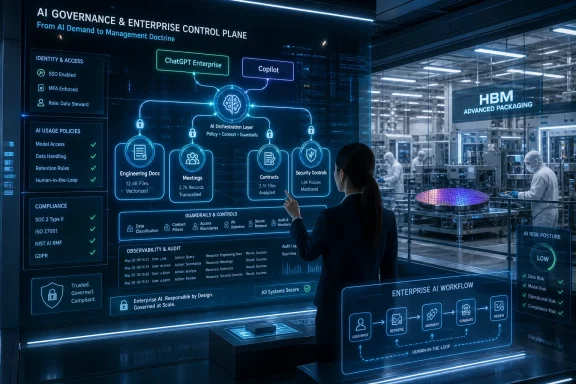 The Chipmakers Are No Longer Just Selling the AI Boom
For the past three years, Samsung Electronics and SK Hynix have mostly appeared in the AI story as suppliers: DRAM, NAND, high-bandwidth memory, advanced packaging roadmaps, and the brutal capacity arithmetic behind GPU clusters. Investors treated them as the shovel makers in a gold rush that had become almost embarrassingly literal. If Nvidia, Microsoft, OpenAI, Google, Meta, and Amazon wanted more compute, the memory industry had leverage.That framing is still true, but it is now incomplete. Samsung’s decision to let employees use enterprise versions of ChatGPT, Google Gemini, and Anthropic Claude, followed by SK Hynix’s evaluation of ChatGPT Enterprise and Microsoft Copilot, shows the next turn of the cycle. AI is not only a demand engine for chips; it is becoming a management layer inside the companies that make those chips.
That matters because semiconductor companies are unusually conservative users of outside software. They operate with dense intellectual property, classified customer relationships, export-control sensitivity, and manufacturing processes where leakage is not an abstract risk. The industry’s first instinct toward public AI tools was not enthusiasm but containment.
Samsung knows why. In 2023, the company became a cautionary tale after employees reportedly pasted sensitive code and meeting material into ChatGPT, prompting restrictions on external generative AI services. Whether every retelling of that episode has been precise or exaggerated, its effect was real: it gave every security team in every IP-heavy company a clean example of how not to deploy consumer AI.
The reversal in 2026 is therefore more meaningful than a routine procurement decision. Samsung is not simply saying that generative AI is useful. It is saying that the risk calculus has changed enough for enterprise controls, security training, access management, and vendor contracts to make external models usable at scale.
Samsung Turns a Ban Into a Governance Model
The striking part of Samsung’s move is not that employees will get access to AI tools. Many already had ways to use AI somewhere, somehow, with varying degrees of official permission. The real change is that Samsung is trying to make the sanctioned path easier than the shadow path.That is the practical lesson enterprise IT learned the hard way. Banning a tool that workers believe saves time does not eliminate use; it pushes use into personal accounts, browser workarounds, screenshots, private phones, and unsupervised data flows. A locked-down enterprise deployment may look riskier on paper because it is visible, but visibility is often the beginning of control.
Samsung’s approach appears designed around that logic. The company reportedly tested external generative AI tools with a large employee pilot before widening access, and access is tied to internal controls and security education. That is a more mature posture than the 2023 panic cycle, when the industry’s conversation was dominated by whether employees should be allowed near public chatbots at all.
The choice to support multiple models is also revealing. By opening ChatGPT, Gemini, and Claude rather than standardizing on a single assistant, Samsung is acknowledging what power users already know: no one model is best at every task. Some workers will prefer one model for summarization, another for code explanation, another for translation, and another for drafting or brainstorming.
That flexibility has a downside. Multi-model adoption complicates audit trails, policy management, procurement, identity integration, and user training. But for a conglomerate that spans consumer electronics, semiconductors, displays, appliances, software, marketing, manufacturing, and R&D, one-size-fits-all AI would probably be a fiction anyway.
SK Hynix Is Moving More Slowly Because Its Crown Jewels Are Hotter
SK Hynix’s response is more cautious, and that caution is rational. The company is not only riding the AI memory boom; it is one of the defining suppliers of high-bandwidth memory, the scarce and strategically important memory technology sitting beside modern AI accelerators. Its internal documents, yield data, customer roadmaps, and process knowledge are precisely the kind of information competitors would love to infer.CEO Kwak Noh-jung’s reported comments about reviewing ChatGPT and Microsoft 365 Copilot from the perspective of security and system architecture should not be read as corporate boilerplate. In a semiconductor company, “system architecture” is the story. The question is not whether employees can ask a chatbot to summarize a memo. It is where the model sits, what data it can see, what logs are retained, how identity is enforced, and how the company prevents sensitive material from being copied into prompts that should never leave the perimeter.
The company already operates internal AI services based on open-source models, according to the TradingKey report and other industry reporting. That is the natural first step for a chipmaker: build or host models where governance is easier, keep sensitive workloads close, and let employees experiment inside a controlled environment. The drawback is that internal models often lag the frontier models in reasoning quality, tool integration, multilingual fluency, and user experience.
That creates the pressure now facing SK Hynix. Employees see what modern commercial AI systems can do. Management sees competitors moving faster. Customers increasingly expect suppliers to operate with the same AI-assisted speed they demand from software firms. The question becomes less “Should we use external AI?” and more “Which tasks are safe enough to move first?”
A phased rollout beginning in non-core technical areas is the obvious answer. It lets the company measure productivity gains without immediately exposing the most sensitive manufacturing, design, and customer data. It also gives IT and security teams time to learn how employees actually use these systems, which is often different from how vendors imagine they will.
Microsoft Copilot Has a Natural Opening in the AI Factory
For WindowsForum readers, the Microsoft angle is not incidental. If SK Hynix is evaluating Microsoft Copilot alongside ChatGPT Enterprise, it is because Copilot enters the workplace through infrastructure that many enterprises already run: Microsoft 365, Entra ID, Purview, Teams, SharePoint, Outlook, Word, Excel, PowerPoint, and the administrative machinery around them.That gives Microsoft a different sales pitch from the model-first vendors. OpenAI can argue model quality, ecosystem momentum, and the familiarity of ChatGPT. Microsoft can argue that AI should inherit the enterprise’s existing permissions, compliance labels, retention policies, identity controls, and document boundaries. In highly regulated or IP-heavy environments, that pitch lands.
It does not mean Copilot is automatically safer in every deployment. Bad permissions in SharePoint become more dangerous when an AI assistant can discover and summarize everything a user is technically allowed to access. Legacy file sprawl, poorly classified documents, stale Teams channels, and overbroad group memberships can turn “AI readiness” into a mirror held up to years of governance debt.
But that is exactly why Copilot is likely to be in the conversation. It forces a company to confront the condition of its Microsoft tenant, which for many enterprises is the real nervous system of the office. If SK Hynix wants generative AI inside meetings, documents, email, spreadsheets, and internal collaboration, Microsoft has a route that does not require employees to constantly copy and paste corporate knowledge into a separate AI product.
The semiconductor industry is a good test of that promise. These companies are not casual office-suite users. They run complex engineering workflows, procurement chains, supplier negotiations, manufacturing reports, quality data, legal reviews, export compliance processes, and global HR systems. If Copilot can become useful there without creating an unacceptable data-risk profile, it strengthens Microsoft’s broader claim that AI will be embedded in work rather than bolted beside it.
The Market Is Pricing an Operating Shift, Not Just a Chatbot Rollout
The reported market reaction on June 12 should be handled carefully. Samsung and SK Hynix shares rose sharply during the Asian session, and the KOSPI gained support from the semiconductor heavyweights, but no serious market observer should attribute an index move of that scale to workplace chatbot access alone. The rally also followed a broader rebound in risk appetite and changing geopolitical signals.Still, the positive reaction fits a larger investor story. The memory makers are not merely beneficiaries of AI infrastructure spending; they are increasingly being valued as central actors in the industrial reorganization around AI. Their stocks move on HBM supply, GPU demand, hyperscaler capex, pricing cycles, U.S.-China restrictions, export policy, and now, more subtly, on whether they can run themselves like AI-native companies.
That last part is easy to overstate, but it is not trivial. Semiconductor manufacturing is capital-intensive and unforgiving. Tiny improvements in engineering throughput, defect analysis, procurement forecasting, customer support, documentation, training, and internal knowledge retrieval can matter when scaled across tens of thousands of employees and billions of dollars in equipment.
Generative AI will not magically solve yield problems or invent process nodes on command. The more plausible value is mundane and therefore powerful: compressing the time it takes to find internal knowledge, draft reports, compare specifications, translate technical material, summarize meetings, generate first-pass code, and support decision-making across a sprawling organization.
Markets like stories with operating leverage. If AI tools can help the world’s largest chipmakers move faster while also selling into an AI hardware supercycle, the narrative compounds. That does not mean the narrative is guaranteed to survive contact with execution, but it explains why investors are watching internal AI adoption as more than a human-resources footnote.
The WSTS Forecast Makes the Stakes Look Almost Unreal
The backdrop to all of this is a semiconductor market forecast that would have sounded absurd a few years ago. The latest WSTS spring forecast reportedly projects the global semiconductor market at roughly $1.51 trillion in 2026, with memory surpassing $800 billion after an extraordinary year-over-year surge. Gartner has also projected a dramatic 2026 expansion, with memory revenue expected to drive much of the acceleration.Forecasts can be wrong, and semiconductor forecasts have a long history of looking most confident near the top of a cycle. But even allowing for uncertainty, the direction is unmistakable. AI infrastructure has turned memory from a cyclical component category into the constraint that shapes datacenter buildouts, accelerator packaging, system design, and cloud economics.
That is why Samsung and SK Hynix sit in such an unusual position. They are exposed to the old memory cycle, where oversupply can crush margins, but they are also exposed to the new AI cycle, where advanced memory becomes a strategic bottleneck. The companies are selling into a market where customers are less interested in generic capacity and more interested in the right memory, at the right power envelope, near the right compute engines, delivered at the right time.
Internal AI adoption should be understood against that pressure. A company trying to scale production, coordinate with hyperscalers, negotiate supply agreements, manage engineering complexity, and plan capital expenditure through a historically abnormal cycle needs better internal information flow. The same market boom that gives these firms pricing power also raises the cost of slow decisions.
That is where the enterprise AI story becomes more than office productivity theater. In a trillion-dollar-plus semiconductor market, the advantage may not come only from having better fabs. It may come from having better organizational memory — the ability to retrieve, reason over, and act on the knowledge already trapped inside engineering documents, emails, meeting notes, supplier files, and manufacturing reports.
Security Is the Product Feature That Decides Everything
The corporate AI debate often gets framed as a contest between productivity and security. In semiconductor firms, that framing is too simplistic. Security is not the thing that slows deployment; security is the feature that makes deployment possible.A generic chatbot is not acceptable for high-value engineering work if it cannot provide contractual assurances, administrative controls, logging, data separation, identity integration, and policy enforcement. Even then, companies must decide which data classes are allowed, which employees get access, which workflows are excluded, and how violations are detected. The model’s benchmark score is only one variable in a much larger risk equation.
This is why enterprise versions of AI tools matter. They are not merely more expensive wrappers around consumer chatbots. They are the packaging that lets procurement, legal, security, compliance, and IT teams say yes without abdicating responsibility. That packaging will not eliminate risk, but it turns an ungoverned behavior into a managed system.
Samsung’s earlier ban and later reopening illustrate the rhythm many large companies will follow. First comes uncontrolled enthusiasm. Then comes a security incident or near miss. Then comes prohibition. Then comes the realization that prohibition cannot hold forever. Finally comes a governed rollout with training, access controls, approved tools, and narrowly defined acceptable use.
SK Hynix appears to be somewhere between the last two stages. Its leadership is not dismissing external AI; it is interrogating architecture. That is exactly what investors, customers, and employees should want to see. In this sector, speed without containment would be negligence.
The Real AI Use Cases Are Boring Until They Are Transformative
The most useful internal applications of generative AI at Samsung and SK Hynix are unlikely to look like science fiction. They will look like a process engineer asking for a summary of prior defect reports. They will look like a procurement manager comparing supplier language across contracts. They will look like a marketing team localizing a product launch. They will look like a manager asking Copilot to extract action items from meetings that should have been shorter.That mundanity is not a weakness. Enterprise software succeeds when it disappears into routine work. The spreadsheet did not transform business because it looked futuristic; it transformed business because it made ordinary calculations, modeling, and reporting faster for millions of workers.
The same logic applies here. A semiconductor company is a dense knowledge machine. It produces documents, logs, specifications, presentations, emails, tickets, process notes, design reviews, and compliance records at industrial scale. If AI can make that knowledge searchable and usable without compromising secrets, the productivity gains may accumulate quietly.
The danger is that executives mistake surface-level usage for transformation. Counting prompts, licenses, or chatbot sessions is easy. Measuring whether AI reduces cycle time, improves decision quality, lowers rework, or accelerates onboarding is harder. The companies that benefit most will be the ones that connect AI deployment to specific workflows rather than treating it as a corporate fashion accessory.
There is also a labor-management dimension that should not be ignored. In South Korea’s semiconductor industry, the AI boom has already raised questions about compensation, bargaining power, and how profits are shared. If internal AI tools are presented only as efficiency machines, workers may hear a threat. If they are presented as capability tools that reduce drudgery and increase technical leverage, adoption will be easier.
Windows Shops Should Read This as a Preview
The semiconductor industry’s AI adoption has lessons beyond Korea and beyond chip manufacturing. Most enterprise Windows environments are less secretive than a memory fab, but they face the same basic problem: employees want powerful AI tools, vendors are racing to embed them, and IT departments must turn a chaotic behavior into a governed platform.For Microsoft-centric organizations, the Samsung and SK Hynix moves are a preview of the next budget cycle. Copilot will increasingly be evaluated not as a novelty but as part of the productivity stack. ChatGPT Enterprise will compete where model quality, custom GPT-style workflows, and broad user familiarity matter. Gemini and Claude will appear in departments where Google Workspace, coding workflows, writing preferences, or model-specific strengths justify them.
That means administrators should stop thinking of AI as a single purchase. It is becoming a portfolio decision. Identity, data-loss prevention, retention, sensitivity labels, endpoint controls, browser policy, API access, and audit logging will matter as much as the assistant interface.
The hard part is that AI readiness is mostly information-governance readiness. If a company has not cleaned up permissions, classified sensitive data, mapped repositories, or defined acceptable-use rules, an AI rollout can make old problems visible at frightening speed. The assistant does not create every exposure; it often reveals exposures that were already there.
That is the uncomfortable gift of enterprise AI. It forces organizations to confront whether their internal knowledge is organized enough to be useful and protected enough to be queried. The companies that answer yes will move faster. The companies that answer no will buy licenses and then wonder why deployment feels like a security incident waiting to happen.
The AI Boom Has Entered the Back Office of the Companies That Power It
The concrete lesson from Samsung and SK Hynix is not that every company should immediately turn on every AI assistant. It is that the enterprise phase of generative AI has arrived in the most IP-sensitive corners of the technology supply chain, and it is arriving through governance rather than rebellion.- Samsung’s reopening of external AI tools marks a shift from blanket restriction toward controlled enterprise access.
- SK Hynix’s evaluation of ChatGPT Enterprise and Microsoft Copilot shows that even the most strategically exposed chipmakers are preparing for broader AI-assisted workflows.
- The commercial opportunity for Microsoft is especially strong where Copilot can inherit existing identity, compliance, and Microsoft 365 data controls.
- The productivity upside will come less from spectacular demonstrations than from routine improvements in documentation, search, translation, reporting, coding, and meeting follow-up.
- The main constraint is not employee interest but whether companies can classify data, enforce permissions, log usage, and prevent sensitive leakage.
- The semiconductor market’s AI-driven expansion raises the value of faster internal decision-making at precisely the moment these companies are under maximum operational pressure.
References
- Primary source: TradingKey
Published: 2026-06-12T04:50:09.641368
Following Samsung, SK Hynix Evaluates Introducing ChatGPT as Semiconductor Industry Accelerates AI Embrace
TradingKey - Following Samsung Electronics’ June 11 announcement to grant all employees access to external generative AI services, SK Hynix has confirmed it is assessing the feasibility of introducing ChatGPT Enterprise and Microsoft Copilot. The semiconductor industry is transitioning from the...www.tradingkey.com - Related coverage: techtimes.com
Samsung Embraces ChatGPT, Gemini, Claude Groupwide Three Years After Banning Public AI Tools
Samsung said on June 9 that it will roll out external generative AI tools — Google’s Gemini, OpenAI’s ChatGPT, and Anthropic’s Claude — across all of its affiliates this month, the first time thewww.techtimes.com - Related coverage: gartner.com
Gartner Forecasts Worldwide Semiconductor Revenue to Exceed $1.3 Trillion in 2026
Global semiconductor revenue is projected to exceed $1.3 trillion in 2026, exhibiting the highest growth in the last two decades, according to Gartner, Inc., a business and technology insights company.www.gartner.com - Related coverage: en.sedaily.com
Samsung Electronics Opens External Generative AI to Workforce After 2,500-Employee Pilot - Seoul Economic Daily
Samsung Electronics will fully open external generative AI tools including ChatGPT, Gemini, and Claude on its work network for DX Division employees from June, after a two-month pilot involving 2,500 employees.en.sedaily.com
- Related coverage: xatakamovil.com
El siguiente paso de la IA en Samsung no está en la pantalla de los Galaxy, sino en lo que pasa dentro de sus oficinas
Hay empresas que aprenden las lecciones de sus errores y las convierten en política interna. En 2023, Samsung se vio en una situación incómoda: varios...www.xatakamovil.com - Related coverage: tomshardware.com
Semiconductor industry on track to hit $1 trillion in sales in 2026, SIA predicts — bumper forecast follows $791.7 billion haul for 2025 | Tom's Hardware
Driven by AI and elevated prices, of course.www.tomshardware.com
- Related coverage: sammyguru.com
Samsung Brings ChatGPT, Gemini, Claude to DX Operations - SammyGuru
Samsung allows DX Division employees to use ChatGPT, Gemini, and Claude as part of its AI Transformation strategy.sammyguru.com - Related coverage: windowscentral.com
Microsoft secures more AI memory as demand explodes | Windows Central
Microsoft's platforms may avoid DRAM supply issues, if this report is to be believed.www.windowscentral.com - Related coverage: winbuzzer.com
Microsoft Courts SK Hynix as its Maia 200 AI Chip Raises Memory Stakes
Microsoft has courted SK Hynix as Maia 200's 216GB HBM3e design raises memory-supply stakes for AI inference, but no new summit or chip deal is public. winbuzzer.com
- Related coverage: moneycontrol.com
Samsung, SK Hynix roar back as AI chip trade finds its feet after Kospi crash
Samsung Electronics and SK Hynix led a sharp Kospi rebound after an AI-led selloff, as investors returned to South Korea’s memory chip stocks despite heightened volatility.www.moneycontrol.com - Related coverage: financecharts.com
Samsung Electronics (SSNLF) PE Ratio - Current & Historical Data (Jun 2026)
Get the pe ratio charts for Samsung Electronics (SSNLF). We're 100% free for everything. Get 20 years of historical pe ratio charts for SSNLF stock and other companies.www.financecharts.com - Related coverage: economictimes.indiatimes.com
Kospi ends 8% lower as chip rout deepens; Samsung, SK Hynix crash up to 10% - The Economic Times
South Korea's KOSPI index experienced a significant selloff, plunging 8.23% as investors cashed in on the AI rally, revealing the market's heavy reliance on semiconductor stocks. This sharp reversal, exacerbated by geopolitical tensions, saw major chipmakers like Samsung and SK Hynix tumble...economictimes.indiatimes.com
- Related coverage: m.economictimes.com
Kospi surges 5% after 15% rout in 3 sessions. What’s fuelling 2026’s top market? - The Economic Times
South Korean technology stocks rebounded sharply on Tuesday as investors returned to AI-linked shares after a steep three-day selloff that had pushed the KOSPI down more than 15%. Semiconductor stocks led the recovery, with SK Hynix jumping 8%, Samsung Electronics rising 4%.m.economictimes.com
- Related coverage: straitstimes.com
Samsung hits US$1 trillion market value on AI chip boom | The Straits Times
Discover how Samsung Electronics reached a US$1 trillion market valuation driven by the booming demand for AI chips and a surge in its stock performance. Read more at straitstimes.com.www.straitstimes.com
