

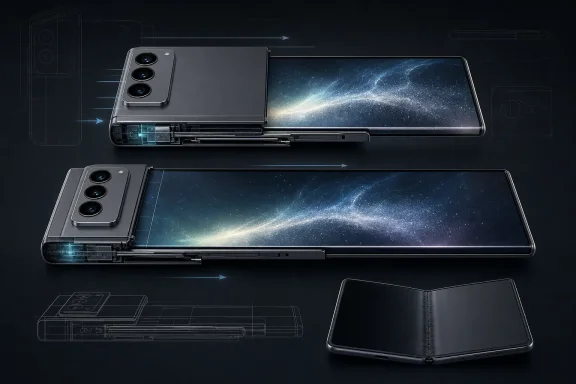
Samsung’s latest rollable-phone clue is a May 2026 patent, surfaced by WearView and xLeaks7, describing a Galaxy-style handset whose display slides sideways while the rear camera module moves with the expanding chassis rather than staying fixed in place. The filing does not put a Galaxy Z Rollable on store shelves, and it does not overturn Samsung’s nearer-term roadmap of foldables, TriFold hardware, and Galaxy S26 phones. But it shows Samsung engineers attacking the one problem foldables have never fully escaped: the fold itself. Just as Apple is reportedly preparing its first folding iPhone, Samsung is sketching a post-foldable phone that tries to make the crease look like yesterday’s compromise.
The clever part of Samsung’s patent is not simply that the screen expands. Rollable and slidable displays have been doing that in trade-show glass boxes for years. The interesting move is that Samsung appears to be treating the camera island as a piece of active mechanical architecture rather than a decorative bump glued to the back of a phone.
That matters because rollables have a brutal packaging problem. A conventional phone is a stack: screen, battery, circuit boards, cameras, frame, glass. A foldable is two stacks joined by a hinge. A rollable wants to be one stack that secretly contains another screen state, which means the body must store display material, rails, motors or springs, and reinforcement without turning into a brick.
Put the camera module on the fixed half of the device and the design gets thick fast. Put it on the moving section and the phone can expand while the camera travels with the portion of the chassis that needs the room. Samsung’s patent describes that second approach: the rear cameras ride outward as the screen grows and return into a cutout when the handset contracts.
It is an elegant answer because it turns a liability into choreography. The very thing that makes modern phones awkward — the camera bump — becomes part of the mechanism that allows the phone to change shape. In a market where most premium slabs now look like variations of the same glass rectangle, that is the rare hardware idea that can be understood from across a room.
Still, dismissing this patent as “just a patent” misses the pattern. Samsung Display has spent years publicly showing rollable, slidable, and stretchable panels, while Samsung’s mobile division has spent the same period selling the foldable phones that actually survive carrier stores, warranty desks, and YouTube torture tests. The gap between those two Samsungs has been the story.
The display arm has the theater. It can take a booth at CES or MWC and show a panel unfurling like science fiction, then pack it away before anyone has to ask about dust ingress, battery swelling, or replacement cost. Samsung MX, the phone division, has to ship objects that millions of people put in pockets, drop on tile, finance through carriers, and expect to last three or four years.
This patent is notable because it sounds less like a concept-board flourish and more like a systems-level attempt to reconcile those worlds. The moving camera is not there because it looks cool, though it certainly would. It is there because a real rollable phone needs a place for optics, structure, and motion to coexist without making the device too thick to justify itself.
That is dangerous for Samsung. The Galaxy Fold line normalized large folding phones, but it never fully turned them into the default premium phone. Foldables remain expensive, mechanically complex, and visibly different in a way that can be either futuristic or fussy depending on the buyer. The crease has improved, the hinge has slimmed, and the software has matured, but the central compromise remains easy to see.
If Apple enters with a polished foldable iPhone, Samsung faces a familiar problem. It may have created the category only to watch Apple reframe it for the mainstream. That happened, in different ways, with tablets, watches, and wireless earbuds: rivals explored first, Apple arrived later, and the market conversation bent around Cupertino’s version.
Samsung’s rollable work reads like a hedge against that moment. If Apple is about to bless the folding phone, Samsung needs somewhere to go next. A phone that expands without a hinge gives Samsung a plausible answer: yes, Apple has finally reached the fold, but Samsung is already sketching the device after the fold.
Manufacturers have worked hard to minimize it. New hinge geometries reduce stress. Ultra-thin glass layers have improved. Panel makers have learned how to hide the valley better than the first Galaxy Fold ever could. But a folding display still has a fold line because the device’s central idea demands one.
Rollables promise a different compromise. The display bends around a curve inside the chassis rather than folding sharply down the middle of the usable canvas. In the open state, the user gets a broad screen without a central valley. In the closed state, the device can theoretically look and feel closer to a normal slab than a folded tablet.
That promise is powerful because it attacks the two things ordinary buyers notice first about foldables: the crease and the thickness. Reviewers can talk about multitasking, app continuity, and hinge tolerances, but a store customer picks up a foldable and immediately sees a line in the screen and a thick object in the hand. A successful rollable would make both complaints less obvious.
That is a harsher engineering problem than it looks. A foldable opens along a defined axis. A rollable changes its dimensions continuously across a range of positions. The software must know the screen state, the frame must stay rigid, the display must remain flat, and the moving parts must survive dust, pocket lint, thermal expansion, drops, and the subtle abuse of daily life.
This is why the moving camera module matters. It hints that Samsung understands the rollable problem as a whole-device architecture challenge, not merely a display challenge. A panel that extends is impressive. A phone whose cameras, sensors, chassis, and software all remain aligned while the body changes shape is a much bigger ask.
The patent’s sensor language also points to augmented reality and spatial awareness use cases. If a camera module shifts with the chassis, the phone needs to understand not only that it has expanded, but how that movement changes the geometry of the imaging system. That is the difference between a party trick and a device that can still shoot, scan, track, and stabilize accurately in multiple physical states.
The viral fascination around LG’s abandoned hardware has only grown because it feels like a glimpse of a path the industry did not take. The device was real enough to make foldables look less inevitable, yet fragile enough as a business proposition that it never reached customers. That combination has made rollables a recurring ghost in smartphone design.
Oppo, Motorola, TCL, Tecno, and others have all played with related ideas. Some concepts expand vertically, turning a compact phone into a taller phone. Others expand sideways, chasing a tablet-like canvas. TCL’s Fold ’n Roll was especially interesting because it mashed together two flexible-screen ambitions: fold first, then roll further.
None of these devices has broken through as a mainstream commercial product. That is the warning label attached to Samsung’s patent. The industry has not lacked imagination; it has lacked a version of the rollable phone that can be manufactured at scale, priced within shouting distance of sanity, and trusted to survive real users.
At CES 2025, Samsung Display showed the Slidable Flex Duet, a panel that expanded from a smaller tablet-like size into a much larger canvas. At MWC 2026, it showed mobile slidable concepts that made the same pitch in phone-sized terms. The message has been consistent: the display side of Samsung believes the rectangle is no longer fixed.
That matters for WindowsForum readers because display roadmaps often leak into PC roadmaps before phone roadmaps. Lenovo’s ThinkBook Plus with a rollable display has already shown that the mechanism can leave the demo booth when the device class, pricing, and use case line up. A laptop has more room for rails, power, structure, and warranty tolerance than a phone. It is a gentler proving ground.
Phones are less forgiving. They are dropped more, pocketed more, exposed to more dust and moisture, and judged more brutally on thickness and battery life. But if rollable screens can survive in shipping PCs, the question shifts from “is this physically possible?” to “can Samsung make it phone-sized, carrier-ready, and profitable?”
That has been one of the Fold line’s enduring problems. Samsung has made its book-style foldables thinner and better, but they still ask users to accept a device that is not quite a normal phone when closed and not quite a normal tablet when open. Enthusiasts understand the trade. Mainstream buyers often see the price first and the compromises second.
A rollable that begins as a credible Galaxy S-class slab would change that pitch. The buyer would not be choosing between a normal flagship and a foldable; they would be choosing a normal flagship that can become something larger. That psychological shift is enormous.
The camera system reinforces the point. Samsung’s premium phones are already identified by their rear camera layouts, and the patent leans into that visual language. The concept does not imagine a weird prototype slab with awkward laboratory styling. It imagines a recognizable Galaxy that happens to pull itself wider.
Moving mechanisms create support questions. How does a case work? How does a screen protector work? What happens when grit gets into the rail? Can the device be enrolled, wiped, repaired, and redeployed with predictable cost? Does the expanded state change how apps render in managed environments? How does it behave under mobile device management policies that assume fixed display dimensions?
Foldables already forced some of those conversations. Android’s large-screen work, app continuity, multi-window behavior, and posture awareness have all improved because foldables made phones less predictable. Rollables would push that further because the screen is not merely open or closed. It may exist across intermediate widths, and software has to decide whether those states matter.
That has implications for Windows users, too. Microsoft’s Android apps, remote desktop clients, cloud PC experiences, and enterprise collaboration tools all benefit from more screen space. But they also depend on predictable layouts, input behavior, and security controls. A rollable Galaxy that works beautifully with DeX or Windows 365 could be compelling; one that leaves apps confused between phone and tablet modes would feel like a demo that escaped too early.
Samsung has spent years improving foldable durability claims, water resistance, hinge design, and service procedures. Even so, foldable repairs can still be painful. Screen assemblies are expensive, tolerances are tight, and damage that would be cosmetic on a slab phone can become catastrophic on a flexible device.
A rollable phone adds more failure modes. The display can fail, the mechanism can fail, the alignment sensors can fail, the camera carriage can fail, and the frame can fail to seat cleanly in either state. Even if each component is reliable, the combined system must remain reliable after years of movement.
This is where the patent-to-product gap becomes clearest. A patent can describe the geometry. A commercial phone must survive being dropped while half-open, shoved into a dusty pocket, charged under a pillow, used in rain, mounted in a car, and handed to a toddler. The engineering problem is not making the screen move once. It is making the screen move correctly for the thousandth time.
That does not mean Samsung wins automatically. Component revenue is not the same as platform power. Apple’s strength lies in integration, software consistency, retail messaging, and the ability to turn a hardware category into an ecosystem feature. If the iPhone Fold becomes the foldable people actually buy in volume, Samsung’s early lead in foldables will look less secure even if Samsung Display sits inside the device.
That is why Samsung needs a next act. The company cannot simply say it had foldables first. The smartphone market rarely rewards historical credit. It rewards the device in front of the buyer this year.
A rollable Galaxy would give Samsung a way to reclaim the design narrative. It would say that foldables were not the destination; they were the bridge. Whether that argument works depends on execution, but as positioning, it is exactly the kind of move Samsung likes: visually dramatic, technically difficult, and pointed directly at Apple’s late arrival.
A rollable phone would need that maturity from day one. The expanded screen cannot merely make everything wider. It has to invite useful state changes: split apps, better video timelines, richer photo editing, more comfortable browser layouts, and desktop-style tools where appropriate. If the expansion only makes social feeds wider, the mechanism will feel wasted.
Samsung’s ecosystem gives it some tools. DeX remains one of the more interesting underused ideas in mobile computing. Galaxy AI features could be adapted to larger canvases. Microsoft integration through Office, OneDrive, Phone Link, Teams, and Windows 365 could make a rollable Galaxy more than a media device.
But the phone must avoid becoming a puzzle. Users should not have to think about which apps support which width, or whether expanding the display will break a session. The best version of this device would make expansion feel as ordinary as rotating a phone — a physical change that software simply understands.
That makes business sense. Foldables are no longer pure experiments. They are premium products with known buyers and improving margins. Samsung can iterate annually, shave millimeters, brighten displays, improve cameras, and claim durability gains. It can sell a story that consumers already understand.
Rollables are riskier because they reset the trust clock. Even if Samsung has the panel, the mechanical architecture, and the software, it would need to persuade buyers that a new kind of moving phone will not age badly. The company would also need to explain why this is better than a Fold, not merely different.
That is why the first rollable Galaxy, if it ever ships, may not be a mass-market flagship. It could arrive as an Ultra-priced limited device, a concept phone with a warranty, or a regional launch aimed at proving demand. Samsung has used that strategy before: make the future expensive, let enthusiasts subsidize the learning curve, then normalize the design over several generations.
Modern flagships are camera systems, thermal systems, radio systems, battery systems, and software platforms squeezed into thin bodies. A new display form factor cannot ignore those constraints. It has to reorganize the whole device around them.
Samsung’s patent does that in a small but meaningful way. By relocating the camera with the moving chassis, it suggests that the expandable portion is not just a hidden screen tray. It is part of the phone’s functional body. That makes the idea more complicated, but also more plausible.
There is also a branding dimension. A camera island that visibly travels as the screen expands would be instantly recognizable in ads, launch videos, and store demos. Samsung has struggled at times to make foldable improvements visible to casual buyers because hinge refinements and crease reductions are subtle. A moving camera is not subtle.
The practical stakes are easy to miss beneath the gadget spectacle. A successful rollable could change how mobile operating systems think about screen size. It could give remote work and cloud PC tools a better pocket device. It could make premium Android phones feel visually adventurous again at a moment when slab phones have become iterative to the point of parody.
It could also fail for familiar reasons. Too expensive, too fragile, too thick, too hard to repair, too dependent on apps that never quite adapt. Every futuristic phone has to pass through the same mundane gates: battery life, durability, price, supply, software, and service.
That is why Samsung’s next move matters more than the patent itself. If Samsung Display keeps showing panels while Samsung MX keeps shipping only foldables, this remains an intriguing sketch. If the phone division begins teasing durability targets, developer tools, accessory plans, or production timelines, the story changes.
But the strategic lesson is sharper. Apple’s expected foldable iPhone threatens to make the foldable category feel newly mainstream just as Samsung is looking for a way to define the sequel. Samsung does not need a rollable phone tomorrow. It needs a credible answer to the day Apple makes folding feel normal.
The patent supplies the outline of that answer. It points to a phone that preserves the familiar slab shape, expands into a larger canvas, and uses a moving camera module to avoid the thickness penalty that could otherwise doom the design. It is not proof of readiness, but it is proof of intent.
 Samsung’s Next Phone War Is Being Fought in the Space Behind the Camera
The clever part of Samsung’s patent is not simply that the screen expands. Rollable and slidable displays have been doing that in trade-show glass boxes for years. The interesting move is that Samsung appears to be treating the camera island as a piece of active mechanical architecture rather than a decorative bump glued to the back of a phone.That matters because rollables have a brutal packaging problem. A conventional phone is a stack: screen, battery, circuit boards, cameras, frame, glass. A foldable is two stacks joined by a hinge. A rollable wants to be one stack that secretly contains another screen state, which means the body must store display material, rails, motors or springs, and reinforcement without turning into a brick.
Put the camera module on the fixed half of the device and the design gets thick fast. Put it on the moving section and the phone can expand while the camera travels with the portion of the chassis that needs the room. Samsung’s patent describes that second approach: the rear cameras ride outward as the screen grows and return into a cutout when the handset contracts.
It is an elegant answer because it turns a liability into choreography. The very thing that makes modern phones awkward — the camera bump — becomes part of the mechanism that allows the phone to change shape. In a market where most premium slabs now look like variations of the same glass rectangle, that is the rare hardware idea that can be understood from across a room.
The Patent Is Not a Product, but It Is Not Nothing
Patents are where speculative phone dreams go to multiply. Every major device maker files ideas that never become products, and Samsung is particularly good at leaving futuristic hardware in the liminal zone between engineering demo and commercial launch. The graveyard is crowded with transparent phones, wraparound screens, dual-hinge oddities, and modular dreams that made more sense in diagrams than in repair shops.Still, dismissing this patent as “just a patent” misses the pattern. Samsung Display has spent years publicly showing rollable, slidable, and stretchable panels, while Samsung’s mobile division has spent the same period selling the foldable phones that actually survive carrier stores, warranty desks, and YouTube torture tests. The gap between those two Samsungs has been the story.
The display arm has the theater. It can take a booth at CES or MWC and show a panel unfurling like science fiction, then pack it away before anyone has to ask about dust ingress, battery swelling, or replacement cost. Samsung MX, the phone division, has to ship objects that millions of people put in pockets, drop on tile, finance through carriers, and expect to last three or four years.
This patent is notable because it sounds less like a concept-board flourish and more like a systems-level attempt to reconcile those worlds. The moving camera is not there because it looks cool, though it certainly would. It is there because a real rollable phone needs a place for optics, structure, and motion to coexist without making the device too thick to justify itself.
Apple Arrives at the Fold Just as Samsung Looks Past It
The timing is what gives this patent its edge. Apple is widely expected, according to supply-chain reporting and analyst notes, to enter the foldable market with a book-style iPhone around the iPhone 18 cycle. The company is late by Samsung’s standards, but Apple is rarely judged by how early it joins a category. It is judged by whether it makes the category feel finished.That is dangerous for Samsung. The Galaxy Fold line normalized large folding phones, but it never fully turned them into the default premium phone. Foldables remain expensive, mechanically complex, and visibly different in a way that can be either futuristic or fussy depending on the buyer. The crease has improved, the hinge has slimmed, and the software has matured, but the central compromise remains easy to see.
If Apple enters with a polished foldable iPhone, Samsung faces a familiar problem. It may have created the category only to watch Apple reframe it for the mainstream. That happened, in different ways, with tablets, watches, and wireless earbuds: rivals explored first, Apple arrived later, and the market conversation bent around Cupertino’s version.
Samsung’s rollable work reads like a hedge against that moment. If Apple is about to bless the folding phone, Samsung needs somewhere to go next. A phone that expands without a hinge gives Samsung a plausible answer: yes, Apple has finally reached the fold, but Samsung is already sketching the device after the fold.
The Crease Was Always More Than Cosmetic
The crease gets discussed as an aesthetic flaw, but it is really a symbol of the whole foldable bargain. It reminds users that the display bends in the same place thousands of times. It catches light at odd angles. It changes how the surface feels under a finger or stylus. It tells the buyer, every day, that this expensive thing is doing something mechanically unnatural.Manufacturers have worked hard to minimize it. New hinge geometries reduce stress. Ultra-thin glass layers have improved. Panel makers have learned how to hide the valley better than the first Galaxy Fold ever could. But a folding display still has a fold line because the device’s central idea demands one.
Rollables promise a different compromise. The display bends around a curve inside the chassis rather than folding sharply down the middle of the usable canvas. In the open state, the user gets a broad screen without a central valley. In the closed state, the device can theoretically look and feel closer to a normal slab than a folded tablet.
That promise is powerful because it attacks the two things ordinary buyers notice first about foldables: the crease and the thickness. Reviewers can talk about multitasking, app continuity, and hinge tolerances, but a store customer picks up a foldable and immediately sees a line in the screen and a thick object in the hand. A successful rollable would make both complaints less obvious.
The Cost of Erasing the Fold Is More Machinery
The catch is that rollables do not eliminate complexity. They move it. Foldables ask users to trust a hinge and a flexible panel. Rollables ask users to trust a sliding frame, stored display material, tensioning systems, internal trays, rails, gears, motors, springs, and sensors that must agree about where the phone is at any given moment.That is a harsher engineering problem than it looks. A foldable opens along a defined axis. A rollable changes its dimensions continuously across a range of positions. The software must know the screen state, the frame must stay rigid, the display must remain flat, and the moving parts must survive dust, pocket lint, thermal expansion, drops, and the subtle abuse of daily life.
This is why the moving camera module matters. It hints that Samsung understands the rollable problem as a whole-device architecture challenge, not merely a display challenge. A panel that extends is impressive. A phone whose cameras, sensors, chassis, and software all remain aligned while the body changes shape is a much bigger ask.
The patent’s sensor language also points to augmented reality and spatial awareness use cases. If a camera module shifts with the chassis, the phone needs to understand not only that it has expanded, but how that movement changes the geometry of the imaging system. That is the difference between a party trick and a device that can still shoot, scan, track, and stabilize accurately in multiple physical states.
LG Already Showed the Future, Then Walked Away From It
Samsung is not the first company to reach for this idea. LG famously showed a rollable phone concept before exiting the smartphone business, leaving behind one of the great “what if” devices of the modern mobile era. The LG Rollable proved that the form factor could be made tangible, but it also proved that timing, cost, and corporate patience matter as much as engineering.The viral fascination around LG’s abandoned hardware has only grown because it feels like a glimpse of a path the industry did not take. The device was real enough to make foldables look less inevitable, yet fragile enough as a business proposition that it never reached customers. That combination has made rollables a recurring ghost in smartphone design.
Oppo, Motorola, TCL, Tecno, and others have all played with related ideas. Some concepts expand vertically, turning a compact phone into a taller phone. Others expand sideways, chasing a tablet-like canvas. TCL’s Fold ’n Roll was especially interesting because it mashed together two flexible-screen ambitions: fold first, then roll further.
None of these devices has broken through as a mainstream commercial product. That is the warning label attached to Samsung’s patent. The industry has not lacked imagination; it has lacked a version of the rollable phone that can be manufactured at scale, priced within shouting distance of sanity, and trusted to survive real users.
Samsung Display Has Been Rehearsing in Public
Samsung’s advantage is that it owns so much of the enabling technology. Samsung Display is not merely a supplier hanging around the edge of this story. It is the company that has been showing the panels, courting device makers, and refining the flexible OLED stack that both Samsung and its rivals depend on.At CES 2025, Samsung Display showed the Slidable Flex Duet, a panel that expanded from a smaller tablet-like size into a much larger canvas. At MWC 2026, it showed mobile slidable concepts that made the same pitch in phone-sized terms. The message has been consistent: the display side of Samsung believes the rectangle is no longer fixed.
That matters for WindowsForum readers because display roadmaps often leak into PC roadmaps before phone roadmaps. Lenovo’s ThinkBook Plus with a rollable display has already shown that the mechanism can leave the demo booth when the device class, pricing, and use case line up. A laptop has more room for rails, power, structure, and warranty tolerance than a phone. It is a gentler proving ground.
Phones are less forgiving. They are dropped more, pocketed more, exposed to more dust and moisture, and judged more brutally on thickness and battery life. But if rollable screens can survive in shipping PCs, the question shifts from “is this physically possible?” to “can Samsung make it phone-sized, carrier-ready, and profitable?”
The Galaxy S26 Shadow Makes the Concept Easier to Understand
The Yanko Design piece frames the compact state as roughly Galaxy S26-like, and that comparison is useful even if the exact dimensions remain speculative. A rollable phone only makes sense if its closed state feels like a normal flagship. If it feels like a compromised foldable even when closed, the argument collapses.That has been one of the Fold line’s enduring problems. Samsung has made its book-style foldables thinner and better, but they still ask users to accept a device that is not quite a normal phone when closed and not quite a normal tablet when open. Enthusiasts understand the trade. Mainstream buyers often see the price first and the compromises second.
A rollable that begins as a credible Galaxy S-class slab would change that pitch. The buyer would not be choosing between a normal flagship and a foldable; they would be choosing a normal flagship that can become something larger. That psychological shift is enormous.
The camera system reinforces the point. Samsung’s premium phones are already identified by their rear camera layouts, and the patent leans into that visual language. The concept does not imagine a weird prototype slab with awkward laboratory styling. It imagines a recognizable Galaxy that happens to pull itself wider.
Enterprise IT Will See the Moving Parts Before the Magic
For enthusiasts, the appeal is obvious. A pocketable Windows remote desktop canvas, a better Teams screen, a more usable browser, a larger map, a portable admin dashboard — the use cases write themselves. For IT departments, the first reaction will be less romantic.Moving mechanisms create support questions. How does a case work? How does a screen protector work? What happens when grit gets into the rail? Can the device be enrolled, wiped, repaired, and redeployed with predictable cost? Does the expanded state change how apps render in managed environments? How does it behave under mobile device management policies that assume fixed display dimensions?
Foldables already forced some of those conversations. Android’s large-screen work, app continuity, multi-window behavior, and posture awareness have all improved because foldables made phones less predictable. Rollables would push that further because the screen is not merely open or closed. It may exist across intermediate widths, and software has to decide whether those states matter.
That has implications for Windows users, too. Microsoft’s Android apps, remote desktop clients, cloud PC experiences, and enterprise collaboration tools all benefit from more screen space. But they also depend on predictable layouts, input behavior, and security controls. A rollable Galaxy that works beautifully with DeX or Windows 365 could be compelling; one that leaves apps confused between phone and tablet modes would feel like a demo that escaped too early.
The Repair Story Could Decide the Product Before the Market Does
The least glamorous question may be the most important: who fixes this thing? A foldable hinge is complex, but it is now a known part of the repair ecosystem. A rollable mechanism with moving cameras, tracked chassis positions, and a flexible display stored inside the body could be more delicate and more expensive.Samsung has spent years improving foldable durability claims, water resistance, hinge design, and service procedures. Even so, foldable repairs can still be painful. Screen assemblies are expensive, tolerances are tight, and damage that would be cosmetic on a slab phone can become catastrophic on a flexible device.
A rollable phone adds more failure modes. The display can fail, the mechanism can fail, the alignment sensors can fail, the camera carriage can fail, and the frame can fail to seat cleanly in either state. Even if each component is reliable, the combined system must remain reliable after years of movement.
This is where the patent-to-product gap becomes clearest. A patent can describe the geometry. A commercial phone must survive being dropped while half-open, shoved into a dusty pocket, charged under a pillow, used in rain, mounted in a car, and handed to a toddler. The engineering problem is not making the screen move once. It is making the screen move correctly for the thousandth time.
Apple’s Dependence on Samsung Display Is the Industry’s Strangest Twist
If Apple’s foldable iPhone arrives with a Samsung-made inner display, the competitive story becomes wonderfully awkward. Samsung Electronics and Apple will be rivals at retail, but Samsung Display may profit from Apple’s entry into the category. Apple could validate foldables for mainstream buyers using one of Samsung’s most important component technologies.That does not mean Samsung wins automatically. Component revenue is not the same as platform power. Apple’s strength lies in integration, software consistency, retail messaging, and the ability to turn a hardware category into an ecosystem feature. If the iPhone Fold becomes the foldable people actually buy in volume, Samsung’s early lead in foldables will look less secure even if Samsung Display sits inside the device.
That is why Samsung needs a next act. The company cannot simply say it had foldables first. The smartphone market rarely rewards historical credit. It rewards the device in front of the buyer this year.
A rollable Galaxy would give Samsung a way to reclaim the design narrative. It would say that foldables were not the destination; they were the bridge. Whether that argument works depends on execution, but as positioning, it is exactly the kind of move Samsung likes: visually dramatic, technically difficult, and pointed directly at Apple’s late arrival.
The Software Has to Make the Hardware Feel Inevitable
Hardware spectacle gets attention, but software decides whether new form factors become habits. Samsung learned this with the early Galaxy Fold. The first versions were astonishing to unfold, but the app experience often felt like a stretched phone rather than a coherent small tablet. Years of Android improvements, Samsung multitasking features, and developer adaptation made the category more credible.A rollable phone would need that maturity from day one. The expanded screen cannot merely make everything wider. It has to invite useful state changes: split apps, better video timelines, richer photo editing, more comfortable browser layouts, and desktop-style tools where appropriate. If the expansion only makes social feeds wider, the mechanism will feel wasted.
Samsung’s ecosystem gives it some tools. DeX remains one of the more interesting underused ideas in mobile computing. Galaxy AI features could be adapted to larger canvases. Microsoft integration through Office, OneDrive, Phone Link, Teams, and Windows 365 could make a rollable Galaxy more than a media device.
But the phone must avoid becoming a puzzle. Users should not have to think about which apps support which width, or whether expanding the display will break a session. The best version of this device would make expansion feel as ordinary as rotating a phone — a physical change that software simply understands.
The Real Roadmap Still Belongs to Hinges
For now, Samsung’s shipping roadmap is still built around foldables, not rollables. The Galaxy Z Fold and Z Flip lines have brand recognition, supply chains, repair procedures, accessories, and software support. The rumored or expected TriFold direction extends that logic rather than replacing it. It asks Samsung to add more folds, not remove the fold entirely.That makes business sense. Foldables are no longer pure experiments. They are premium products with known buyers and improving margins. Samsung can iterate annually, shave millimeters, brighten displays, improve cameras, and claim durability gains. It can sell a story that consumers already understand.
Rollables are riskier because they reset the trust clock. Even if Samsung has the panel, the mechanical architecture, and the software, it would need to persuade buyers that a new kind of moving phone will not age badly. The company would also need to explain why this is better than a Fold, not merely different.
That is why the first rollable Galaxy, if it ever ships, may not be a mass-market flagship. It could arrive as an Ultra-priced limited device, a concept phone with a warranty, or a regional launch aimed at proving demand. Samsung has used that strategy before: make the future expensive, let enthusiasts subsidize the learning curve, then normalize the design over several generations.
The Camera That Moves May Be the Detail That Makes the Whole Thing Believable
The moving camera module is the most convincing part of the patent because it acknowledges that future phones are not just screens. Early flexible-display hype often treated the panel as the whole product. Bend the screen, win the future. Reality has been harsher.Modern flagships are camera systems, thermal systems, radio systems, battery systems, and software platforms squeezed into thin bodies. A new display form factor cannot ignore those constraints. It has to reorganize the whole device around them.
Samsung’s patent does that in a small but meaningful way. By relocating the camera with the moving chassis, it suggests that the expandable portion is not just a hidden screen tray. It is part of the phone’s functional body. That makes the idea more complicated, but also more plausible.
There is also a branding dimension. A camera island that visibly travels as the screen expands would be instantly recognizable in ads, launch videos, and store demos. Samsung has struggled at times to make foldable improvements visible to casual buyers because hinge refinements and crease reductions are subtle. A moving camera is not subtle.
The Shape After the Fold Is Coming Into Focus
The Samsung patent does not prove that a Galaxy rollable is imminent. It does prove that the industry’s next argument is already forming. Foldables asked whether buyers would accept a phone that becomes a tablet by opening like a book. Rollables ask whether buyers would prefer a phone that becomes larger without revealing a hinge at all.The practical stakes are easy to miss beneath the gadget spectacle. A successful rollable could change how mobile operating systems think about screen size. It could give remote work and cloud PC tools a better pocket device. It could make premium Android phones feel visually adventurous again at a moment when slab phones have become iterative to the point of parody.
It could also fail for familiar reasons. Too expensive, too fragile, too thick, too hard to repair, too dependent on apps that never quite adapt. Every futuristic phone has to pass through the same mundane gates: battery life, durability, price, supply, software, and service.
That is why Samsung’s next move matters more than the patent itself. If Samsung Display keeps showing panels while Samsung MX keeps shipping only foldables, this remains an intriguing sketch. If the phone division begins teasing durability targets, developer tools, accessory plans, or production timelines, the story changes.
The Samsung Rollable Story Is Really About What Comes After Apple Validates the Fold
The near-term lesson is not that buyers should wait for a Galaxy Z Rollable. They should not. The sensible assumption is that Samsung’s next commercial push remains foldable and possibly tri-fold, while rollables stay on the research and concept track.But the strategic lesson is sharper. Apple’s expected foldable iPhone threatens to make the foldable category feel newly mainstream just as Samsung is looking for a way to define the sequel. Samsung does not need a rollable phone tomorrow. It needs a credible answer to the day Apple makes folding feel normal.
The patent supplies the outline of that answer. It points to a phone that preserves the familiar slab shape, expands into a larger canvas, and uses a moving camera module to avoid the thickness penalty that could otherwise doom the design. It is not proof of readiness, but it is proof of intent.
The Moving-Camera Patent Leaves Samsung With a Clearer Burden of Proof
Samsung’s rollable idea is compelling because it is specific, not because it is guaranteed. The patent gives enthusiasts enough detail to imagine the product and engineers enough detail to see the traps.- Samsung’s May 2026 patent describes a sideways-expanding phone with a rear camera module that moves with the sliding portion of the chassis.
- The design tries to solve a real rollable-phone packaging problem by preventing the camera system from forcing unnecessary thickness into the stationary body.
- The filing arrives as Apple is reportedly preparing its first foldable iPhone, likely with Samsung Display technology inside.
- Samsung Display has shown multiple slidable and rollable panel concepts, but Samsung’s phone division has not yet put a rollable Galaxy on its public product roadmap.
- Rollables could reduce the visible crease and folded thickness complaints that still shadow foldables, but they introduce new risks around motors, rails, durability, repair, and software adaptation.
- The clearest sign of a real product would be Samsung MX talking about durability, app behavior, serviceability, and launch timing rather than Samsung Display demonstrating another panel under trade-show lights.
References
- Primary source: Yanko Design
Published: Tue, 30 Jun 2026 00:30:00 GMT
Samsung’s Rolling Display Phone begins taking shape just as Apple preps the iPhone Fold - Yanko Design
Render based on schematic Samsung's product roadmap for this year lists the TriFold and the Galaxy S26, with no rollable phone anywhere on it. A patent the company filed in May (uncovered by WearView) tells a different story about where its engineers are looking. The filing describes a...www.yankodesign.com
- Related coverage: lowyat.net
- Related coverage: macrumors.com
Apple's Foldable iPhone Will Have a Samsung-Made OLED Display
Apple has agreed to source foldable OLED panels exclusively from Samsung for the next three years, reports The Elec. Apple will not use foldable panels from other display suppliers as part of the agreement, according to the Korea-based outlet. The company is said to have accepted the terms given...www.macrumors.com - Related coverage: wearview.co
Samsung Galaxy Z Rollable Movable Camera
Samsung's Galaxy Z Rollable patent shows a rollable phone whose rear camera module slides out as the screen expands sideways. Here's what the leak reveals.www.wearview.co - Related coverage: intomobile.com
Samsung’s Galaxy Z Rollable patent shows moving camera that slides with expandable screen
New patent reveals rollable phone design where rear camera module moves outward as display expands sidewayswww.intomobile.com - Related coverage: gagadget.com
Samsung's rollable phone patent shows a camera that moves with the screen
Samsung has filed a patent for a rollable smartphone with a rear camera that physically moves as the screen expands — a design that could one day offer foldablegagadget.com
- Related coverage: notebookcheck.net
Samsung’s sliding/rollable phone could have a unique camera design for slimmer profile - Notebookcheck News
Samsung has registered multiple patents for rollable or sliding phones and one of them has a unique implementation for the cameras. The designs show the phone in its standard and extended shapes. www.notebookcheck.net
- Related coverage: phonearena.com
Apple said to be locked into Samsung for foldable iPhone screens, but surprisingly starting small - PhoneArena
Three years, one supplier, and the early numbers are telling.www.phonearena.com - Related coverage: sammobile.com
Samsung Display bags a 3-year exclusive OLED deal for Apple's foldable iPhones - SamMobile
Samsung Display has reportedly signed a three-year exclusive deal with Apple to supply OLED panels for foldable iPhones. - SamMobilewww.sammobile.com - Related coverage: techadvisor.com
Samsung Galaxy Rollable & Slidable Phone Patents Spotted - Tech Advisor
The next big Samsung foldable innovations could come in the form of two wildly futuristic designswww.techadvisor.com - Related coverage: androidcentral.com
Leaked 'Galaxy Z Rollable' patent certainly is different, but not unheard of for Samsung | Android Central
Practicality could be in question.www.androidcentral.com - Related coverage: t3.com
Samsung still testing expanding, rollable phones rather than foldables – patent shows peculiar design | T3
Samsung's latest filing could crack the flexible phone codewww.t3.com - Related coverage: techlusive.in
- Related coverage: tomsguide.com
iPhone Fold tipped for September 2026 release by JPMorgan — with a $2,000 price tag | Tom's Guide
A JPMorgan analyst has spoken about the expected launch timing and pricing for the iPhone Fold, backing up what previous leakers have said.www.tomsguide.com - Related coverage: techradar.com
- Related coverage: whathifi.com
iPhone Fold: design rumours, price leaks and everything we know so far | What Hi-Fi?
Looks likely to launch in Septemberwww.whathifi.com - Related coverage: ashgabattimes.com
