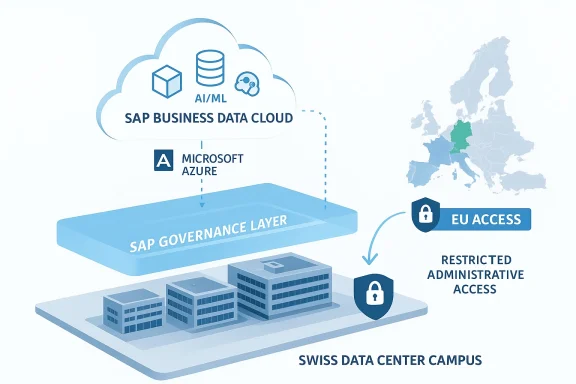
SAP and Microsoft’s joint rollout of SAP Business Data Cloud on Microsoft Azure in Switzerland marks a practical next step in delivering EU Access options and data-sovereign cloud choices to enterprise customers, giving Swiss organizations the ability to combine SAP-governed business data with Azure analytics and AI while formally addressing regional compliance and sovereignty expectations.
SAP Business Data Cloud (BDC) is SAP’s cloud offering designed to bring business-context semantics, governance, and trusted metadata to enterprise data across SAP and non‑SAP sources. Deployed as part of SAP’s broader Business Technology Platform ecosystem, BDC aims to act as a semantic, governed layer that powers analytics, master data, and AI use cases without forcing wholesale migration of every dataset into a single system.
Microsoft’s announcement that BDC will be available on Microsoft Azure in Switzerland — with EU Access availability — is a continuation of a multi-year partnership between the two vendors. The move follows earlier launches and sovereignty-focused efforts in Germany and other regions, and it aligns with broader market trends: hyperscalers and enterprise SaaS vendors are delivering localized cloud options, EU‑bound processing controls, and contractual/technical measures intended to reassure regulated customers in finance, public sector, healthcare, and other sensitive industries.
In plain terms, Swiss customers can now provision SAP Business Data Cloud functionality in Azure regions that meet specific access and residency requirements, while consuming Azure-native analytics and AI services. That combination is meant to deliver three outcomes: customer choice over platform and tooling, maintained business semantics and trust in SAP-managed data, and the ability to build cross‑enterprise data and AI architectures tailored to workload needs.
If you are a Swiss CIO, head of data, or architect evaluating this path, treat the availability as an invitation to design a governed hybrid architecture — but insist on concrete contractual guarantees, third‑party validation, and a realistic budget for the integration and governance work that follows.
Adoption will succeed where governance is treated as a cross‑cutting engineering discipline, not an add‑on; where identity and lineage are federated end‑to‑end; and where legal counsel and cloud architects collaborate from the earliest design decisions. Only then will organizations convert the promise of choice and trusted data into safer, faster, and more valuable AI‑driven outcomes.
In short: the launch is a strategic win for customers who need both trust and innovation, but it is not a turnkey shortcut around the hard work of governance, compliance, and integrated operations that true multi‑cloud data architectures require.
Source: Microsoft Source SAP Business Data Cloud available on Microsoft Azure Data Centre in Switzerland - Source EMEA
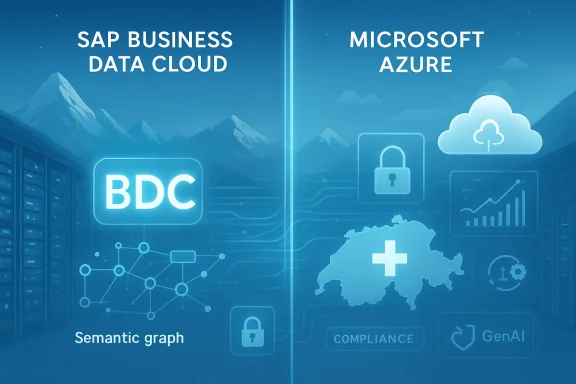 Background / Overview
SAP Business Data Cloud (BDC) is SAP’s cloud offering designed to bring business-context semantics, governance, and trusted metadata to enterprise data across SAP and non‑SAP sources. Deployed as part of SAP’s broader Business Technology Platform ecosystem, BDC aims to act as a semantic, governed layer that powers analytics, master data, and AI use cases without forcing wholesale migration of every dataset into a single system.Microsoft’s announcement that BDC will be available on Microsoft Azure in Switzerland — with EU Access availability — is a continuation of a multi-year partnership between the two vendors. The move follows earlier launches and sovereignty-focused efforts in Germany and other regions, and it aligns with broader market trends: hyperscalers and enterprise SaaS vendors are delivering localized cloud options, EU‑bound processing controls, and contractual/technical measures intended to reassure regulated customers in finance, public sector, healthcare, and other sensitive industries.
In plain terms, Swiss customers can now provision SAP Business Data Cloud functionality in Azure regions that meet specific access and residency requirements, while consuming Azure-native analytics and AI services. That combination is meant to deliver three outcomes: customer choice over platform and tooling, maintained business semantics and trust in SAP-managed data, and the ability to build cross‑enterprise data and AI architectures tailored to workload needs.
What this availability actually delivers
EU Access availability explained (practical implications)
- EU Access availability in this context refers to an operational configuration and contractual model that limits administrative and operational access to data and platform management to personnel and processes that fall within the EU/Swiss jurisdictional boundary or under SAP/Microsoft controlled processes that honor EU/Swiss data‑access commitments.
- For organizations with strict sovereignty or compliance obligations, the key practical promises are: data residency (data at rest stored in the specified region), restricted administrative access and controls, and procedural commitments around how cross-border requests are handled.
- It’s important to note that these models are not a single silver bullet: they typically combine technical boundaries (region-level deployments, specialized personnel access controls), contractual commitments (terms specifying where data is stored and who can access it), and operational arrangements (local engineers or local operator models, or special “EU‑only” access procedures).
Technical capabilities enabled by the on‑Azure deployment
- Customers can run SAP Business Data Cloud components on Azure infrastructure in Swiss Azure regions, while integrating with Azure analytics and GenAI tooling for consumption and advanced analytics.
- The offering supports scenarios where SAP-governed datasets retain business semantics and governance within BDC, while enterprise-level analytics and machine learning models can be built using Azure services — creating a hybrid model that avoids forcing a single technology stack for every use case.
- Integrations commonly referenced with BDC include SAP Datasphere, SAP Analytics Cloud, and partner technologies such as Databricks. For Azure customers, that means easier alignment with Azure Synapse Analytics, Microsoft Fabric, Azure Databricks, and Azure AI services when appropriate.
Where Switzerland fits in the regional rollout
- Switzerland becomes the second European market explicitly called out for EU Access availability for SAP BDC on Azure, following earlier deployments and specialized sovereignty efforts in Germany.
- This is consistent with both SAP and Microsoft expanding their localized cloud and sovereign-capability footprint to accommodate strict regulatory and public-sector requirements across Europe.
Why Swiss customers should care — benefits and business value
1. Choice without losing trust
Organizations can choose the platform that best suits a workload:- Keep SAP-centric workloads and governance close to SAP-controlled BDC for semantically accurate, governed datasets.
- Use Azure services for broad enterprise analytics, AI model training, or interactive BI that benefits from Azure’s developer ecosystem.
2. Data sovereignty and compliance
Local deployment options and EU/Swiss‑focused access commitments help address regulatory concerns head‑on:- Public-sector bodies, regulated financial institutions, and health providers often require both residency and demonstrable controls over who can access data.
- A Swiss Azure deployment with EU Access availability provides a more defensible posture for those customers than using only global, non-localized instances.
3. Faster AI and analytics adoption
By enabling access to Azure analytics and AI stacks while preserving SAP semantics, teams can:- Prototype and iterate with Azure-native ML/AI frameworks.
- Use governed, business-contextualized datasets from BDC for safer model training (reducing the risk of model drift and misinterpretation).
- Accelerate time-to-insight by using the best tool for each job.
4. Operational continuity and enterprise-grade SLAs
Large vendors typically pair these rollouts with clear SLAs, support pathways, and migration programs — all of which matter for mission-critical SAP landscapes.Critical analysis: strengths, caveats, and practical risks
Strengths worth noting
- Real-world customer flexibility. The approach recognizes that enterprises rarely want to replatform everything at once. The hybrid model embraces heterogeneity and practical migration patterns.
- Improved sovereign posture. Localized deployments and EU Access constructs reduce friction for customers with strict data residency and governance mandates.
- Ecosystem leverage. Combining SAP’s semantic layer with Azure’s AI and analytics can reduce time-to-value for data projects while preserving enterprise control.
- Strategic vendor alignment. A deeper SAP–Microsoft partnership signals long-term joint engineering, which benefits customers through integrated tooling and clearer support pathways.
Risks, limitations, and what to watch for
- Sovereignty semantics vs. legal reality. Technical controls and contractual promises reduce exposure but do not negate national or extraterritorial legal orders (e.g., law enforcement or intelligence agency requests). Customers must evaluate legal risk for their jurisdiction and sector in addition to the technical claims vendors make.
- Operational complexity. Running governed SAP data in BDC while consuming it in Azure introduces architecture and operational complexity: cross‑system metadata management, identity federation, lineage and audit continuity, and latency considerations.
- Hidden costs. Data egress, inter-region replication, multi-vendor integration, and specialized managed services can increase total cost of ownership. Proof-of-concept budgets often underestimate governance and integration effort.
- Vendor control and lock‑in nuance. The phrase “customer choice” is meaningful but nuanced. While you can choose where to consume data, switching major platform components later still requires data migration, re-certification of models, and re-establishing governance flows.
- Governance gaps at edges. If all governance and semantics live in BDC but downstream Azure processes lack adequate enforcement, model drift, data leakage, and compliance gaps are still possible. Governance must be enforced across the entire data lifecycle.
- Supply chain and geopolitical risks. Dependence on any hyperscaler still exposes customers to global supply chain and geopolitical dynamics (regional outages, sanctions, legal regimes). Contingency planning is essential.
Implementation guidance for IT and architecture teams
If your organization is evaluating or planning to adopt SAP Business Data Cloud on Azure in Switzerland, consider these practical steps.Technical design checklist
- Map data residency and processing constraints. Classify datasets by regulatory sensitivity, residency constraints, and permissible processing locations.
- Define where semantics live. Choose which datasets remain governed in BDC and which will be exported or replicated to Azure for analytical workloads.
- Design identity and access controls. Federate identity across SAP and Azure with strict role definitions and administrative separation where required.
- Plan data movement and minimal copies. Favor virtualization or low‑latency access patterns where possible to reduce duplication and governance surface area.
- Standardize lineage and audit. Ensure every data access and transformation is traceable across BDC and Azure components for compliance and model explainability.
- Account for network and performance. Benchmark expected latency and throughput for analytics workloads that span BDC and Azure compute.
- Validate backup and DR strategies. Confirm that SLAs and disaster recovery plans meet your regulatory and business continuity needs across providers.
Security, compliance, and legal due diligence
- Request explicit contractual terms on access, cross‑border data requests, and the provider’s obligation to notify and contest non‑compliant requests where allowed.
- Conduct a legal counsel review of CLOUD Act and other extraterritorial access implications relative to your industry and data types.
- Perform third‑party audits and penetration tests on any integrated solution to validate controls and boundaries.
- Use encryption by default, including encryption in transit and at rest, and consider customer-managed keys with localized key stores where legally advantageous.
Governance and operational readiness
- Create a cross-functional governance body that includes IT, security, legal, data science, and line-of-business stakeholders.
- Operationalize policies for data retention, access approvals, and model lifecycle management.
- Invest in staff skilling and runbooks to manage a hybrid, multi-cloud environment — operational gaps are often people and process problems, not just technology.
Commercial and cost considerations
- Cost transparency is critical. Get pricing for region-specific provisioning, managed services, data egress, and any specialized sovereignty features. Model different scenarios (development, testing, production).
- Negotiate support and escalation paths. For sovereign deployments, ensure there are well-defined local escalation channels and SLAs for incident response.
- Evaluate third-party partners. Systems integrators with proven SAP + Azure experience can accelerate adoption and reduce risk; verify their Swiss-specific experience for compliance-oriented deployments.
How this fits into larger enterprise data and AI strategies
A pragmatic path for enterprise modernization
The hybrid approach — governed semantics in SAP BDC + Azure analytics/AI for consumption — supports a pragmatic modernization road map:- Stage 1: Governed ingestion and normalization in BDC; minimal replication to Azure for analytics.
- Stage 2: Expand Azure-based models and analytics while preserving BDC as the semantic source of truth.
- Stage 3: Mature a governed model lifecycle with continuous monitoring, retraining, and explainability integrated across platforms.
Not an either/or decision
The offering acknowledges a reality many enterprises face: some workloads are best kept close to the ERP/transactional layer, while others benefit from the agility and broad ecosystem of a hyperscaler’s analytics and AI services. This model acknowledges the need for heterogeneous tooling — and seeks to make that heterogeneity manageable.Questions CIOs and data leaders should ask vendors and partners
- Precisely what does EU Access availability mean in contractual and operational terms for my data and accounts?
- Who will have administrative access to my data and metadata — and under what conditions?
- Where will encryption keys reside and who controls key revocation?
- What are the mechanics and costs for data egress, replication, and cross-region failover?
- How will you ensure consistent lineage, semantic integrity, and auditability across BDC and Azure?
- Can you provide customer references for Swiss deployments in my industry?
- What are the escalation procedures and local support options for regulated incidents?
- How do you handle law‑enforcement or government access requests that cross jurisdictions?
The bigger picture: market impact and vendor dynamics
This Swiss availability reflects broader market dynamics:- Hyperscalers and enterprise software vendors are increasingly offering localized, sovereignty‑aware variants of their cloud services to win regulated workloads.
- Partnerships (SAP + Microsoft, and in some cases with third parties) are now engineered to reduce friction for enterprises that must balance governance and innovation.
- The real competitive battleground is no longer only features or performance; it’s the vendor’s ability to demonstrate trustworthy governance, resilient operations, and legally defensible access models.
Final assessment and practical verdict
SAP Business Data Cloud on Azure in Switzerland is a meaningful, pragmatic offering for enterprises that want to:- Preserve SAP‑level semantics, governance, and trust for critical datasets;
- Leverage Azure’s analytics and AI capabilities where they make sense; and
- Demonstrate a stronger sovereign posture through regionally constrained access commitments.
If you are a Swiss CIO, head of data, or architect evaluating this path, treat the availability as an invitation to design a governed hybrid architecture — but insist on concrete contractual guarantees, third‑party validation, and a realistic budget for the integration and governance work that follows.
Adoption will succeed where governance is treated as a cross‑cutting engineering discipline, not an add‑on; where identity and lineage are federated end‑to‑end; and where legal counsel and cloud architects collaborate from the earliest design decisions. Only then will organizations convert the promise of choice and trusted data into safer, faster, and more valuable AI‑driven outcomes.
In short: the launch is a strategic win for customers who need both trust and innovation, but it is not a turnkey shortcut around the hard work of governance, compliance, and integrated operations that true multi‑cloud data architectures require.
Source: Microsoft Source SAP Business Data Cloud available on Microsoft Azure Data Centre in Switzerland - Source EMEA