

Schneider Electric’s latest collaboration with Microsoft is more than another industrial AI announcement. It is a concrete demonstration that open, software-defined automation is moving from theory to field-tested reality, and that the shift matters most in places where downtime is costly and process conditions are unforgiving. In green hydrogen, where margins are thin and operating discipline is everything, the companies say they have shown how AI can help cut cost, improve stability, and reduce the drag of proprietary control systems. The deeper message is broader: industrial modernization may finally be following the same playbook that transformed enterprise IT.
For years, industrial automation has been trapped between two worlds. On one side sits the reliability-first culture of factories, refineries, utilities, and process plants, where controllers are expected to run for decades with minimal interruption. On the other side is the pace of digital innovation, where software, cloud services, and AI models evolve every few months and users expect continuous improvement. That mismatch has left many industrial operators with systems that are stable but rigid, secure but hard to extend, and dependable but expensive to modernize.
Schneider Electric has been building its answer to that problem for several years through EcoStruxure Automation Expert, its open automation platform designed to decouple software from hardware. The company has repeatedly framed that approach as a way to break proprietary lock-in, improve portability, and allow automation applications to move more easily across equipment generations and vendor ecosystems. At ACHEMA 2024, Schneider Electric described the platform as the world’s first open, software-defined automation control platform and emphasized support for larger plant architectures, stronger protocol interoperability, and integrated AI capabilities. (se.com)
Microsoft, meanwhile, has been making a parallel push to bring generative AI and cloud services into industrial environments. The company has positioned Azure, Azure AI Foundry, edge computing, and partner ecosystems as the connective tissue for “industrial copilots” and other AI-assisted workflows. Schneider Electric’s 2025 Automate showcase made that relationship explicit, with the company saying its industrial copilot integrates Microsoft Azure AI Foundry with Schneider Electric’s industrial automation stack to boost productivity and simplify application development. (se.com)
The result is not just a partnership around software tools. It is a shared bet that industrial transformation will increasingly depend on a migration path rather than a rip-and-replace upgrade cycle. That distinction matters because industrial customers are rarely free to stop production, discard installed assets, or retrain entire engineering teams overnight. A viable modernization strategy has to respect legacy investments while still opening the door to faster engineering, portable logic, better diagnostics, and scalable AI.
Schneider Electric and Microsoft have also spent years signaling this direction publicly. Microsoft has highlighted Schneider Electric among its industrial co-innovation partners, and recent Microsoft material in 2026 says the companies continue to advance intelligent automation and IoT with Azure OpenAI and Azure AI Foundry across EcoStruxure. (news.microsoft.com) That continuity is important: this is not a sudden experiment, but the latest stage of a long industrial software alignment.
Because the cost base is so electricity-heavy, a reported up to 10% improvement in electricity consumption is not a marginal tuning exercise. It can materially change levelized hydrogen cost, especially when applied across a larger installation over long operating periods. Schneider Electric says that the improvement in the h2e POWER deployment could translate to roughly €500,000 per year for a typical 10 MW plant.
This is where AI-powered automation becomes strategically important. Instead of treating the electrolyzer as a fixed machine with static logic, the control system can learn operational patterns, predict maintenance needs, and adapt behavior in response to changing conditions. That is the real promise here: not merely remote monitoring, but a smarter operating model that understands the process as a living system rather than a frozen workflow.
The deployment also matters geographically. India is trying to build industrial capacity, clean energy infrastructure, and advanced manufacturing capability at the same time. A successful autonomous green hydrogen reference site in Pune has implications far beyond one project, because it demonstrates that open automation is not just a Western retrofit story. It can be adapted to emerging markets where energy economics and industrial scaling pressures are especially intense.
That hardware/software separation is not just a technical convenience. It changes the economics of modernization. Instead of throwing away functioning infrastructure, operators can preserve assets where it makes sense and upgrade the intelligence layer incrementally. In practical terms, that makes migration easier to justify financially and less disruptive operationally.
Schneider Electric’s Automate 2025 material said its copilot integrates with Microsoft Azure AI Foundry and is available inside the new EcoStruxure Automation Expert Platform. That detail matters because it suggests Microsoft is not simply supplying generic cloud capacity. It is helping underpin a specific industrial workflow model in which engineers, operators, and AI systems collaborate across environments. (se.com)
That concern is not academic. Industrial users have lived through generations of proprietary systems, and many have seen expensive platforms become hard to maintain, hard to extend, or hard to integrate with new analytics tools. An open software-defined model can reduce those pain points, but only if the ecosystem around it is genuinely interoperable and not merely branded as open.
The deeper implication is that software-defined automation could shift engineering talent away from repetitive configuration work and toward higher-value design, optimization, and resilience planning. That does not eliminate the need for experienced controls engineers. It makes their time more leverageable, especially in environments where knowledge is scarce and turnover is high.
This is particularly important in complex industries where a small misunderstanding can cause large consequences. If the system can surface relevant documentation, suggest control logic, and help validate configuration choices, it can shorten the gap between problem detection and corrective action. That is not glamorous work, but it is exactly where industrial efficiency is often won or lost.
There is also a safety dimension. In a process plant, a copilot that surfaces a questionable configuration or flags anomalous behavior is only useful if the human operator can trust the recommendation chain. That means explainability, strong validation, and disciplined governance remain critical even when the tooling becomes more intelligent.
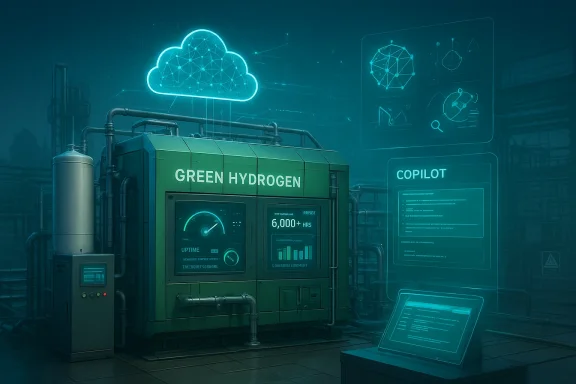
The important part is that the system has been running for more than 6,000 hours while handling part-load and full-load conditions. That suggests the automation is not merely reacting to predefined scenarios. It is helping the process adapt over time in conditions that can be difficult to stabilize.
If the system can reduce stack wear while preserving output quality, it does more than save maintenance expense. It helps extend asset life and protect the economics of the electrolyzer itself. That is especially valuable in green hydrogen, where capex is already high and investors need confidence that equipment can deliver durable performance.
If the same software logic can be reused across multiple locations and plant sizes, the economics of deployment improve dramatically. The first site becomes a learning asset, not a one-off project. Over time, that could create a flywheel where each plant improves the next one through shared models, shared diagnostics, and shared operational intelligence.
That competition is not only about features. It is about who gets to define the next layer of value in industrial operations. If software, not fixed hardware, becomes the center of gravity, then vendors will compete more on ecosystem breadth, model quality, interoperability, and update velocity.
Recent Microsoft coverage around industrial AI has emphasized partner-driven copilots and manufacturing data solutions, while Schneider Electric itself has continued to showcase AI integration across its portfolio. The result is a converging market where cloud vendors, automation vendors, and industrial software companies increasingly meet in the middle.
There is also a subtle ecosystem effect. Once a few high-profile reference sites establish confidence in open, AI-assisted automation, procurement teams will start asking for comparable roadmaps from every supplier. That could accelerate consolidation around platforms that are both open and enterprise-grade.
There is also a workforce angle. Industrial copilots can reduce the burden on operators and engineers by handling repetitive work and surfacing the right information at the right time. In an environment with labor shortages and aging industrial workforces, that can be a decisive advantage. It is not a replacement for expertise; it is an amplifier of scarce expertise.
This is why industrial AI matters outside the factory gate. The same logic that helps a hydrogen plant optimize thermal balance may eventually help water systems, grid assets, and other critical infrastructure operate more intelligently. Schneider Electric has been steadily making that broader case across utilities, grids, and resilient infrastructure.
That coherence is important because industrial buyers dislike fragmented roadmaps. They want to know whether a platform can support current operations, future upgrades, and different industrial verticals without losing continuity. Schneider Electric is trying to answer yes across all three dimensions.
This is also why the partnership matters for complex industries. Process plants and hydrogen systems are not just collections of devices. They are systems of systems, with thermal, electrical, mechanical, and digital dependencies. The more context AI can absorb, the more useful it becomes.
Still, maturity does not mean inevitability. Adoption will depend on trust, integration quality, cybersecurity, and measurable ROI. But the architecture is getting closer to what industrial buyers have wanted for a long time: flexibility without fragility.
The other thing to watch is whether the industrial copilot evolves from a productivity aid into a more deeply embedded operational layer. That would mean better integration with lifecycle engineering, fleet analytics, maintenance orchestration, and compliance workflows. If that happens, the line between software development, operations, and control engineering will blur further.
The key milestones to watch are straightforward:
That is a subtle but profound shift. When hardware no longer dictates the whole lifecycle of automation, innovation can move faster, maintenance can become smarter, and industrial decarbonization can become more achievable. In that sense, the real story is not the copilot itself, but the operating model it represents: open, reusable, AI-enabled, and built to scale.
Source: IT Voice Media Pvt. Ltd. https://www.itvoice.in/schneider-el...drogen-and-complex-industries-with-microsoft/
 Background
For years, industrial automation has been trapped between two worlds. On one side sits the reliability-first culture of factories, refineries, utilities, and process plants, where controllers are expected to run for decades with minimal interruption. On the other side is the pace of digital innovation, where software, cloud services, and AI models evolve every few months and users expect continuous improvement. That mismatch has left many industrial operators with systems that are stable but rigid, secure but hard to extend, and dependable but expensive to modernize.Schneider Electric has been building its answer to that problem for several years through EcoStruxure Automation Expert, its open automation platform designed to decouple software from hardware. The company has repeatedly framed that approach as a way to break proprietary lock-in, improve portability, and allow automation applications to move more easily across equipment generations and vendor ecosystems. At ACHEMA 2024, Schneider Electric described the platform as the world’s first open, software-defined automation control platform and emphasized support for larger plant architectures, stronger protocol interoperability, and integrated AI capabilities. (se.com)
Microsoft, meanwhile, has been making a parallel push to bring generative AI and cloud services into industrial environments. The company has positioned Azure, Azure AI Foundry, edge computing, and partner ecosystems as the connective tissue for “industrial copilots” and other AI-assisted workflows. Schneider Electric’s 2025 Automate showcase made that relationship explicit, with the company saying its industrial copilot integrates Microsoft Azure AI Foundry with Schneider Electric’s industrial automation stack to boost productivity and simplify application development. (se.com)
The result is not just a partnership around software tools. It is a shared bet that industrial transformation will increasingly depend on a migration path rather than a rip-and-replace upgrade cycle. That distinction matters because industrial customers are rarely free to stop production, discard installed assets, or retrain entire engineering teams overnight. A viable modernization strategy has to respect legacy investments while still opening the door to faster engineering, portable logic, better diagnostics, and scalable AI.
Schneider Electric and Microsoft have also spent years signaling this direction publicly. Microsoft has highlighted Schneider Electric among its industrial co-innovation partners, and recent Microsoft material in 2026 says the companies continue to advance intelligent automation and IoT with Azure OpenAI and Azure AI Foundry across EcoStruxure. (news.microsoft.com) That continuity is important: this is not a sudden experiment, but the latest stage of a long industrial software alignment.
Why Green Hydrogen Is the Right Test Case
Green hydrogen is one of the most demanding proving grounds imaginable for industrial AI. The sector is under intense pressure to scale quickly while also driving costs down enough to compete with fossil-based alternatives. That challenge is particularly acute for solid oxide electrolyzer cells, or SOECs, which promise very high efficiency but operate under extreme thermal and control requirements. In other words, this is the sort of environment where a control error is not a nuisance; it can affect economics, uptime, and equipment life.A Cost Structure That Punishes Inefficiency
The economics of hydrogen production make even modest efficiency gains meaningful. Electricity is widely understood to be the dominant operating cost in electrolysis-based production, and Schneider Electric’s own framing says it accounts for more than 70% of total hydrogen production cost in the scenario discussed by the companies. That makes load management, thermal balance, maintenance timing, and control precision central to the plant’s financial performance.Because the cost base is so electricity-heavy, a reported up to 10% improvement in electricity consumption is not a marginal tuning exercise. It can materially change levelized hydrogen cost, especially when applied across a larger installation over long operating periods. Schneider Electric says that the improvement in the h2e POWER deployment could translate to roughly €500,000 per year for a typical 10 MW plant.
Why SOECs Are Hard to Automate
SOECs run hotter and more sensitively than many other electrolyzer types. That makes them efficient, but also demanding in terms of startup behavior, thermal transitions, load following, and component stress. A traditional automation setup can do the job, but it often requires specialized oversight and manual intervention that limits scalability.This is where AI-powered automation becomes strategically important. Instead of treating the electrolyzer as a fixed machine with static logic, the control system can learn operational patterns, predict maintenance needs, and adapt behavior in response to changing conditions. That is the real promise here: not merely remote monitoring, but a smarter operating model that understands the process as a living system rather than a frozen workflow.
What Makes This Deployment Notable
The companies say the h2e POWER system has already exceeded 6,000 hours of stable operation in part-load and full-load conditions. That kind of sustained run time matters because industrial AI is often impressive in demos but weaker in endurance. In this case, the message is that autonomy is not being shown only in a lab; it is being exercised over a meaningful operational horizon.The deployment also matters geographically. India is trying to build industrial capacity, clean energy infrastructure, and advanced manufacturing capability at the same time. A successful autonomous green hydrogen reference site in Pune has implications far beyond one project, because it demonstrates that open automation is not just a Western retrofit story. It can be adapted to emerging markets where energy economics and industrial scaling pressures are especially intense.
- High-efficiency hydrogen production needs better control, not just better hardware.
- SOECs are efficient but operationally unforgiving.
- Energy savings compound quickly in electricity-heavy processes.
- Long-duration autonomous operation is more convincing than short demo success.
- India is a strategically important proving ground for scalable clean-tech automation.
The Architecture: Open Automation Meets Cloud and Edge AI
The most important technical idea in this collaboration is architectural. Schneider Electric and Microsoft are not just embedding a chatbot into factory software. They are trying to separate automation intelligence from rigid hardware dependencies and distribute that intelligence across cloud and edge layers in a more portable way. That approach is designed to reduce vendor lock-in and make industrial software behave more like modern enterprise software—modular, updateable, and easier to reuse.EcoStruxure Automation Expert as the Control Foundation
Schneider Electric has been clear that EcoStruxure Automation Expert is the backbone of this vision. The platform is intended to let customers deploy automation applications independently of specific hardware generations, which is a major shift for process and discrete industries that historically tied software to proprietary control stacks. Schneider Electric’s ACHEMA 2024 material described the platform as breaking the proprietary constraints of traditional systems while adding interoperability and larger I/O capacity. (se.com)That hardware/software separation is not just a technical convenience. It changes the economics of modernization. Instead of throwing away functioning infrastructure, operators can preserve assets where it makes sense and upgrade the intelligence layer incrementally. In practical terms, that makes migration easier to justify financially and less disruptive operationally.
Microsoft Azure as the Orchestration Layer
Microsoft’s role is to provide the cloud and edge infrastructure that allows data to move from sensors to dashboards to model inference and back again. The logic here is straightforward: if the plant’s intelligence lives only at the control layer, it remains narrow and isolated. If it can also interact with cloud-native analytics, AI services, and remote monitoring, it becomes part of a broader digital ecosystem.Schneider Electric’s Automate 2025 material said its copilot integrates with Microsoft Azure AI Foundry and is available inside the new EcoStruxure Automation Expert Platform. That detail matters because it suggests Microsoft is not simply supplying generic cloud capacity. It is helping underpin a specific industrial workflow model in which engineers, operators, and AI systems collaborate across environments. (se.com)
Why Open Standards Matter
The open-architecture pitch is perhaps the most strategically important part of the story. Industrial customers are often wary of solutions that work well only inside one vendor’s stack. By emphasizing portability, interoperability, and reuse across vendors and generations of infrastructure, Schneider Electric is trying to answer a long-standing objection to “digital transformation” in industrial settings: what happens when the next upgrade arrives, or the vendor strategy changes?That concern is not academic. Industrial users have lived through generations of proprietary systems, and many have seen expensive platforms become hard to maintain, hard to extend, or hard to integrate with new analytics tools. An open software-defined model can reduce those pain points, but only if the ecosystem around it is genuinely interoperable and not merely branded as open.
- Portability lowers the cost of future upgrades.
- Interoperability reduces engineering friction.
- Edge inference supports low-latency decisions.
- Cloud services make fleet-wide learning possible.
- Open standards limit long-term lock-in risk.
What the Industrial Copilot Actually Changes
The headline feature in the Schneider Electric and Microsoft collaboration is the Industrial Copilot, but its real value is not that it chats. Its value is that it compresses and assists some of the most time-consuming, error-prone parts of industrial engineering. Those include writing logic, searching documentation, configuring systems, and troubleshooting operational issues under pressure.Engineering Time Becomes a Strategic Variable
Schneider Electric says engineering teams using the copilot report up to 50% time savings, with production line changes that once took weeks now completed in hours. That is an ambitious claim, and as with all vendor-reported performance figures, it should be treated carefully. Still, even a smaller real-world gain would be significant because engineering labor is often the bottleneck in industrial modernization. (se.com)The deeper implication is that software-defined automation could shift engineering talent away from repetitive configuration work and toward higher-value design, optimization, and resilience planning. That does not eliminate the need for experienced controls engineers. It makes their time more leverageable, especially in environments where knowledge is scarce and turnover is high.
Copilot as a Knowledge Multiplier
Industrial plants accumulate enormous amounts of tribal knowledge. Much of it lives in manuals, hard-to-query documentation, vendor notes, and the memory of a few key specialists. A copilot can become a bridge between that fragmented knowledge base and the people trying to operate the plant day to day.This is particularly important in complex industries where a small misunderstanding can cause large consequences. If the system can surface relevant documentation, suggest control logic, and help validate configuration choices, it can shorten the gap between problem detection and corrective action. That is not glamorous work, but it is exactly where industrial efficiency is often won or lost.
Human Operators Still Matter
The best reading of this announcement is not that AI replaces plant staff. Rather, it changes the task mix. Schneider Electric’s messaging emphasizes that copilots help workers focus on complex activities while reducing repetitive burdens and supporting predictive maintenance. That framing reflects the current reality of industrial AI: the immediate objective is augmentation, not full autonomy.There is also a safety dimension. In a process plant, a copilot that surfaces a questionable configuration or flags anomalous behavior is only useful if the human operator can trust the recommendation chain. That means explainability, strong validation, and disciplined governance remain critical even when the tooling becomes more intelligent.
Key Practical Effects
- Faster documentation lookup and code generation.
- Less time spent on repetitive configuration tasks.
- Better troubleshooting support during incidents.
- Improved knowledge retention across teams.
- More consistent application development across sites.
The h2e POWER Case Study and What It Proves
The h2e POWER deployment is the part of the story that gives the partnership real industrial credibility. Green hydrogen is not a toy workload, and SOEC control is not a place where companies can hide behind marketing language for long. The field results matter because they show the architecture working in a complex, high-stakes energy process.A Real Plant, Not a Slide Deck
Schneider Electric and h2e POWER say they deployed an AI-powered control solution on a 20 kW SOEC system. The system continuously monitors thermal balance, hydrogen flow, energy inputs, safety, and equipment health, remotely. That kind of monitoring sounds obvious in consumer software terms, but in industrial settings it usually requires deep integration, precise control models, and a strong reliability posture.The important part is that the system has been running for more than 6,000 hours while handling part-load and full-load conditions. That suggests the automation is not merely reacting to predefined scenarios. It is helping the process adapt over time in conditions that can be difficult to stabilize.
Predictive Maintenance as Economic Defense
One of the most interesting claims is that the solution demonstrated just-in-time predictive maintenance. In process industries, maintenance is often either too early, which wastes useful asset life, or too late, which causes downtime and damage. Predictive intelligence tries to hit the middle ground, but it only works when the data pipeline, control logic, and operational context are aligned.If the system can reduce stack wear while preserving output quality, it does more than save maintenance expense. It helps extend asset life and protect the economics of the electrolyzer itself. That is especially valuable in green hydrogen, where capex is already high and investors need confidence that equipment can deliver durable performance.
Scaling from a Pilot to a Platform
The most compelling part of the h2e POWER story may be its portability. Siddharth Mayur of h2e POWER said the open architecture means intelligence can be redeployed across the company’s installed base without the lock-in that has constrained industrial innovation for decades. That is exactly the kind of statement that turns a single deployment into a platform narrative.If the same software logic can be reused across multiple locations and plant sizes, the economics of deployment improve dramatically. The first site becomes a learning asset, not a one-off project. Over time, that could create a flywheel where each plant improves the next one through shared models, shared diagnostics, and shared operational intelligence.
Why This Matters for India and Beyond
India has a strong strategic interest in reducing industrial energy waste, expanding clean hydrogen capacity, and building a globally competitive manufacturing base. A successful autonomous SOEC deployment fits neatly into all three goals. It shows that advanced automation can support both sustainability and industrial productivity rather than forcing companies to choose between them.- Demonstrates autonomous control in a demanding clean-energy process.
- Validates long-duration stability under variable load conditions.
- Suggests predictive maintenance can improve asset durability.
- Points to reusable intelligence across a fleet of sites.
- Strengthens the case for software-defined hydrogen plants.
Competitive Implications for Industrial Automation
This collaboration is also a competitive statement. Schneider Electric is signaling that it does not want industrial automation to be defined solely by hardware incumbency or by closed control environments. Microsoft, for its part, is reinforcing its position as a cloud-and-AI platform partner for industrial transformation rather than a generic software vendor.Pressure on Traditional Automation Models
Many industrial vendors still depend on tightly coupled proprietary ecosystems. Those systems have strengths, especially in reliability and process control continuity, but they can be slow to adapt when customers want AI, fleet analytics, or more flexible engineering workflows. Schneider Electric’s open software-defined strategy directly challenges that model by arguing that modern industrial automation should be more portable and easier to extend.That competition is not only about features. It is about who gets to define the next layer of value in industrial operations. If software, not fixed hardware, becomes the center of gravity, then vendors will compete more on ecosystem breadth, model quality, interoperability, and update velocity.
Microsoft’s Industrial Footprint Keeps Expanding
Microsoft has spent the last several years expanding its industrial AI narrative through partnerships with Siemens, Schneider Electric, and others. The company’s value proposition is increasingly about bringing Azure, AI models, data fabric, and edge services into operational environments. That makes Microsoft less of a bystander and more of an orchestration layer for industrial intelligence.Recent Microsoft coverage around industrial AI has emphasized partner-driven copilots and manufacturing data solutions, while Schneider Electric itself has continued to showcase AI integration across its portfolio. The result is a converging market where cloud vendors, automation vendors, and industrial software companies increasingly meet in the middle.
Rivals Will Need More Than Messaging
For competitors, the response cannot be limited to saying they support AI too. The bar is moving toward demonstrable outcomes: reduced downtime, faster engineering, improved energy efficiency, and easier reuse of applications across sites. Vendors that cannot prove those benefits in real industrial conditions will struggle to keep pace.There is also a subtle ecosystem effect. Once a few high-profile reference sites establish confidence in open, AI-assisted automation, procurement teams will start asking for comparable roadmaps from every supplier. That could accelerate consolidation around platforms that are both open and enterprise-grade.
What This Means for Buyers
Industrial buyers should read this as a shift in evaluation criteria. The question is no longer simply which controller is most reliable. It is also which platform can support portable logic, fleet-wide intelligence, and AI-assisted engineering without trapping customers in a rigid upgrade cycle. That is a much harder competitive race for legacy-centric vendors to win.- Platform openness is becoming a procurement criterion.
- AI features now need to show operational ROI.
- Long-term lock-in is increasingly a liability.
- Ecosystem partnerships matter as much as product specs.
- Reference deployments will shape buying decisions.
Enterprise vs. Consumer Impact: Different Stakes, Same Shift
Industrial automation stories sometimes look remote to consumer readers, but the implications are broader than they first appear. Enterprise users see the immediate productivity and resilience gains, while consumers eventually feel the effects through lower costs, faster deployment of clean energy, and more reliable infrastructure. The difference is in timing and visibility, not in relevance.Enterprise: Productivity, Resilience, and Skills
For enterprise users, the benefits are direct and measurable. Faster engineering cycles mean shorter commissioning windows and fewer delays in plant modifications. AI-assisted diagnostics can reduce unplanned downtime and help preserve knowledge in organizations where experienced controls engineers are scarce.There is also a workforce angle. Industrial copilots can reduce the burden on operators and engineers by handling repetitive work and surfacing the right information at the right time. In an environment with labor shortages and aging industrial workforces, that can be a decisive advantage. It is not a replacement for expertise; it is an amplifier of scarce expertise.
Consumer: Energy Transition and Infrastructure Quality
Consumers are less likely to notice the software architecture, but they will notice the downstream outcomes if the model scales. Lower-cost green hydrogen supports decarbonization in hard-to-abate sectors. More efficient industrial plants can reduce the energy intensity of goods. More resilient utilities and cleaner energy infrastructure can improve reliability over time.This is why industrial AI matters outside the factory gate. The same logic that helps a hydrogen plant optimize thermal balance may eventually help water systems, grid assets, and other critical infrastructure operate more intelligently. Schneider Electric has been steadily making that broader case across utilities, grids, and resilient infrastructure.
The Crossover Effect
The crossover between enterprise and consumer value is getting stronger because energy, manufacturing, and digital systems are more interconnected than ever. When industrial companies save time and energy, those efficiencies can propagate into supply chains, price structures, and availability. That means industrial software decisions are no longer background IT choices; they are part of the broader economic infrastructure.In Short
- Enterprises gain speed, visibility, and resilience.
- Consumers benefit indirectly through better infrastructure.
- Clean energy projects become more bankable.
- Industrial knowledge becomes easier to scale.
- Operational efficiency can ripple across supply chains.
The Open, Software-Defined Playbook Is Maturing
Schneider Electric’s messaging has remained remarkably consistent, but the substance behind it is growing more concrete. Open automation is no longer just a philosophy or a whitepaper theme. It is turning into a product strategy, a field deployment model, and an AI operating layer that can be demonstrated in real plants.From Vision to Commercial Architecture
The company’s recent announcements show a clear through line: open automation at ACHEMA, industrial copilots at Automate, distributed control innovations with Intel and Red Hat, and now AI-driven green hydrogen use cases with Microsoft. Taken together, these form a coherent modernization story rather than disconnected product launches. (se.com)That coherence is important because industrial buyers dislike fragmented roadmaps. They want to know whether a platform can support current operations, future upgrades, and different industrial verticals without losing continuity. Schneider Electric is trying to answer yes across all three dimensions.
The Role of Data Context
A major benefit of the software-defined approach is that it allows data to be contextualized across the plant lifecycle. Raw sensor data is useful, but operational intelligence comes from connecting that data to equipment states, engineering context, and business outcomes. Microsoft’s cloud and AI stack can help provide that connective layer, especially when edge inference is paired with cloud-scale analysis.This is also why the partnership matters for complex industries. Process plants and hydrogen systems are not just collections of devices. They are systems of systems, with thermal, electrical, mechanical, and digital dependencies. The more context AI can absorb, the more useful it becomes.
Why Timing Matters Now
The timing is favorable because industrial companies are facing multiple pressures at once: labor shortages, energy costs, decarbonization mandates, and the need to unlock more value from existing assets. At the same time, AI capabilities have become good enough to assist with engineering workflows, documentation, and prediction in ways that were not practical a few years ago. That convergence is what makes the current wave more credible than earlier digital transformation hype.Still, maturity does not mean inevitability. Adoption will depend on trust, integration quality, cybersecurity, and measurable ROI. But the architecture is getting closer to what industrial buyers have wanted for a long time: flexibility without fragility.
- Open automation is moving from concept to execution.
- AI is becoming a core engineering aid.
- Context-rich data is more valuable than raw telemetry.
- Cross-vendor portability can reduce modernization friction.
- The current technology window is unusually favorable.
Strengths and Opportunities
The strongest aspect of this collaboration is that it links a clear industrial pain point to a practical architectural response. It does not ask customers to abandon legacy investments, and it does not rely on vague promises about transformation. Instead, it offers a path toward measurable gains in engineering speed, operational visibility, and process efficiency.- Lower modernization friction for plants that cannot afford a rip-and-replace strategy.
- Better engineering productivity through AI-assisted configuration and logic generation.
- Improved energy efficiency in electricity-heavy processes like hydrogen production.
- Stronger predictive maintenance that can protect expensive assets.
- Portable automation logic that can be reused across sites and vendors.
- Greater resilience through cloud-edge coordination and richer context.
- A compelling reference use case in green hydrogen, where the business case is easy to understand.
Risks and Concerns
The risks are just as important as the promise. Industrial AI can fail in ways that consumer software rarely does, and the consequences of poor integration can be expensive, unsafe, or operationally disruptive. Vendor claims should also be treated with healthy skepticism until they are independently validated across more deployments.- Performance claims may not generalize beyond a specific pilot site or workload.
- Cybersecurity exposure can increase when cloud, edge, and plant systems are more tightly connected.
- Integration complexity may still be high for brownfield industrial environments.
- AI recommendation quality can vary when the underlying data is incomplete or noisy.
- Operator trust issues may slow adoption if recommendations are not explainable.
- Vendor ecosystem dependence could reappear in new form if “open” platforms become de facto controlled stacks.
- Safety-critical concerns remain paramount in process industries where automation mistakes can cascade.
Looking Ahead
The next phase of this story will be less about announcements and more about replication. The central question is whether Schneider Electric and Microsoft can turn h2e POWER into a repeatable template for other hydrogen projects and, beyond that, for other complex industrial processes. If they can, the collaboration will look less like a partnership and more like a blueprint for industrial modernization.The other thing to watch is whether the industrial copilot evolves from a productivity aid into a more deeply embedded operational layer. That would mean better integration with lifecycle engineering, fleet analytics, maintenance orchestration, and compliance workflows. If that happens, the line between software development, operations, and control engineering will blur further.
The key milestones to watch are straightforward:
- Additional autonomous hydrogen deployments at larger scale.
- Independent validation of efficiency and maintenance gains.
- Broader availability of the industrial copilot across sectors.
- More evidence of portable logic across mixed vendor environments.
- Security and governance features designed for regulated industrial settings.
That is a subtle but profound shift. When hardware no longer dictates the whole lifecycle of automation, innovation can move faster, maintenance can become smarter, and industrial decarbonization can become more achievable. In that sense, the real story is not the copilot itself, but the operating model it represents: open, reusable, AI-enabled, and built to scale.
Source: IT Voice Media Pvt. Ltd. https://www.itvoice.in/schneider-el...drogen-and-complex-industries-with-microsoft/
