
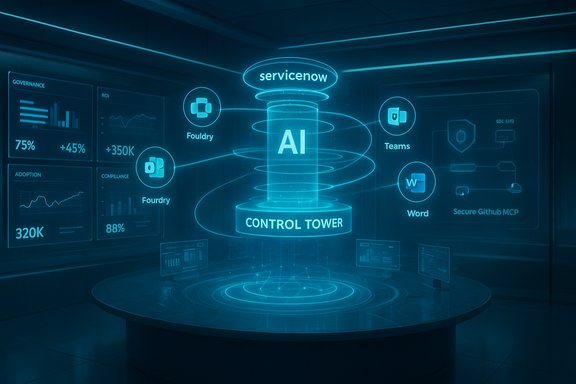
ServiceNow’s latest announcement tightens the bond between workflow automation and AI copilots by delivering a suite of integrations with Microsoft designed to turn conversational insights into governed, auditable work — not just helpful suggestions. Announced during Microsoft Ignite in mid-November 2025, the enhancements center on agent orchestration and governance: ServiceNow’s AI Control Tower will surface and manage agents running on Microsoft platforms (including Microsoft Foundry and Copilot Studio), ServiceNow Build Agent will interoperate with GitHub through the Model Context Protocol (MCP) to bring developer context into automated workflows, and a forthcoming Now Assist ↔ Agent 365 link promises to let employees trigger enterprise workflows directly from Microsoft 365 apps like Teams, Outlook, and Word. The vendor message is simple: don’t treat generative AI as a sidebar — fold it into deterministic workflows with enterprise-grade controls, visibility, and measurable ROI.
ServiceNow and Microsoft have steadily expanded a strategic alliance over the past several years, layering productivity integrations on top of ServiceNow’s core workflow platform and Microsoft’s cloud and productivity stack. Earlier integrations connected Now Assist with Microsoft 365 Copilot to allow users to launch ServiceNow workflows from within Office apps; the new wave of integrations takes that concept further by addressing the next frontier of AI deployment: agentic systems — collections of autonomous or semi-autonomous AI agents that act on behalf of people or processes.
At Microsoft Ignite 2025, Microsoft described a broader platform strategy for agents — branded as Agent 365 — and a richer Copilot ecosystem that includes Copilot Studio and Microsoft Foundry. Agent 365 is positioned as a control plane that inventories, governs, and secures agents in an organization, while Copilot Studio and Foundry are the toolchains for authoring and deploying agent behaviors. ServiceNow’s update plugs its governance and orchestration primitives into that control plane: the ServiceNow AI Control Tower will discover, profile, and apply policy to Microsoft-hosted agents, and ServiceNow’s Configuration Management Database (CMDB) is the anchor for cross-platform context and policy enforcement.
These announcements were presented as generally available (or becoming GA) by the end of the year, and — as with most vendor roadmaps announced at conferences — availability timing should be treated as targeted until customers see formal GA dates and documentation.
For the broader ecosystem, the partnerships and use of open protocols (like MCP) are notable. They make it easier for third-party models and vendors (Anthropic, OpenAI alternatives, etc. to plug into enterprise workflows, reducing single-vendor dependence. That said, customers will still wrestle with choices about where models run (Azure, AWS-hosted endpoints, or vendor clouds) and how that affects compliance and latency.
However, the benefits are contingent on disciplined governance and careful rollout. Agents widen the attack surface and raise operational risks if permissions, data scopes, and validation steps are not rigorously enforced. For CIOs and enterprise architects, the immediate task is not simply to enable agent features, but to design and operationalize the governance, testing, and monitoring frameworks that ensure agent-driven automation delivers consistent business value without introducing unacceptable risk.
Enterprises that approach this methodically — prioritizing concrete use cases, enforcing least-privilege, and instrumenting for visibility and rollback — will likely capture substantial productivity gains. Those that treat agentic AI as an extension of ungoverned chat tools may discover the costs outweigh the early conveniences. The new ServiceNow–Microsoft integrations make the controlled, auditable path feasible; the work now shifts to disciplined delivery.
Source: ERP Today ServiceNow Advances Enterprise AI Through Integrations with Microsoft
 Background
ServiceNow and Microsoft have steadily expanded a strategic alliance over the past several years, layering productivity integrations on top of ServiceNow’s core workflow platform and Microsoft’s cloud and productivity stack. Earlier integrations connected Now Assist with Microsoft 365 Copilot to allow users to launch ServiceNow workflows from within Office apps; the new wave of integrations takes that concept further by addressing the next frontier of AI deployment: agentic systems — collections of autonomous or semi-autonomous AI agents that act on behalf of people or processes.At Microsoft Ignite 2025, Microsoft described a broader platform strategy for agents — branded as Agent 365 — and a richer Copilot ecosystem that includes Copilot Studio and Microsoft Foundry. Agent 365 is positioned as a control plane that inventories, governs, and secures agents in an organization, while Copilot Studio and Foundry are the toolchains for authoring and deploying agent behaviors. ServiceNow’s update plugs its governance and orchestration primitives into that control plane: the ServiceNow AI Control Tower will discover, profile, and apply policy to Microsoft-hosted agents, and ServiceNow’s Configuration Management Database (CMDB) is the anchor for cross-platform context and policy enforcement.
These announcements were presented as generally available (or becoming GA) by the end of the year, and — as with most vendor roadmaps announced at conferences — availability timing should be treated as targeted until customers see formal GA dates and documentation.
What ServiceNow announced and why it matters
The three pillars: Collaboration, Orchestration, Governance
ServiceNow framed the news around three interlocking capabilities:- Collaboration — connecting AI copilots and agents where employees already work (Microsoft Teams, Outlook, Word), enabling AI teammates to take contextual, identity-aware actions.
- Orchestration — linking agent actions to deterministic ServiceNow workflows so that agent outputs result in repeatable, auditable business outcomes.
- Governance — delivering centralized visibility, policy management, and risk controls across agents running in Microsoft environments.
Key technical touchpoints
- AI Control Tower ↔ Microsoft Foundry & Copilot Studio: The Control Tower will be able to discover agents authored or deployed on Microsoft platforms, ingest metadata, and map agents into ServiceNow’s governance model. ServiceNow’s CMDB provides the contextual fabric to attach agents to services, data stores, and business processes.
- Agent discovery and policy enforcement: Organizations can inventory agents, apply access controls, restrict data scopes, and monitor runtime behavior — all from a unified UI that surfaces adoption, performance metrics, and ROI.
- Build Agent ↔ GitHub MCP server: Integrating ServiceNow Build Agent with GitHub through the Model Context Protocol means agents can securely consume developer artifacts — issues, PRs, discussions — and act upon them while maintaining developer oversight.
- Now Assist ↔ Agent 365 integration for Microsoft 365: This will allow users to invoke enterprise workflows directly from Office apps. Agents will act with enterprise identity, respecting permission boundaries and audit trails.
How this fits into Microsoft’s agent strategy
Microsoft’s recent push around Copilot, Copilot Studio, Foundry, and Agent 365 maps well onto ServiceNow’s goals. Microsoft positions Agent 365 as the organizational control plane that provides:- a registry for agents,
- access control and least-privilege for agent actions,
- visualization and analytics to monitor agent behavior,
- interoperability bridges to third-party services and data, and
- security tooling to detect and remediate threats targeting agents.
Strengths and practical benefits
ServiceNow’s approach addresses several hard enterprise needs around AI adoption. The most notable strengths include:- Enterprise-grade governance: ServiceNow surfaces agent inventories and applies consistent policies across platforms. Tying agent metadata to the CMDB helps enterprises understand the impact domain of each agent — which services, data sources, and teams it touches.
- Context-rich automation: By feeding Microsoft-hosted agents with ServiceNow context (and vice versa), organizations can reduce error-prone manual handoffs. Agents become aware of assets, incidents, and process state before taking action.
- Developer productivity gains: The MCP-enabled GitHub integration reduces context switches for developers: agents can read issue status and PR discussions and then file automated tickets, triage, or trigger CI/CD flows while keeping humans in the loop.
- Visibility and measurable value: Dashboards that track adoption, performance, and ROI create a business language for AI investments. This helps security, compliance, and finance stakeholders make informed tradeoffs.
- Better compliance posture for regulated industries: Audit trails and access controls are essential for financial, healthcare, and public sector organizations where autonomous AI actions must be recorded and explained.
- User-level productivity gains: Embedding Now Assist and AI teammates into Microsoft 365 apps brings powerful workflow triggers directly into the user’s flow of work — summarizing an email and filing a ticket without leaving Outlook is a concrete time-saver.
Risks, limitations, and open questions
The promise is compelling, but the complexity and risk surface expand when agents are given the ability to act across systems. Key concerns include:- Surface area for data leakage: Agents that can access emails, documents, and tickets increase the chances of inadvertent data exposure. Ensuring agents only operate with least-privilege and strict data scoping is critical.
- Agent autonomy vs. determinism: Mixing generative AI agents with deterministic workflows is powerful, but the boundary between suggestion and action must be tightly controlled. When should an agent act autonomously and when should it require human approval? This decision matrix must be clear and enforceable.
- Model behavior and hallucinations: Agents built on large language models can hallucinate or produce plausible but incorrect outputs. Workflows that accept agent outputs as fact without validation risk operational errors.
- Complex policy integration: Organizations with multiple compliance regimes (GDPR, HIPAA, sector-specific rules) may find policy translation and enforcement across the Microsoft-ServiceNow stack tricky. Policy rules must be expressed in machine-actionable ways and tested.
- Identity and access complexity: Agents acting with “enterprise identity” need well-modeled permissions. Misconfiguration could allow an agent excessive reach across systems.
- Operational overhead and alert noise: Centralized visibility helps, but without good baselines and thresholds, monitoring can generate noise, increasing alert fatigue for SecOps and SRE teams.
- Vendor interoperability and lock-in: While integrations improve value for joint customers, they may encourage deeper entrenchment in a Microsoft-ServiceNow stack, complicating future migrations or multi-cloud strategies.
- Availability and maturity caveats: Conference-era announcements frequently target previews and pilot programs. Organizations should treat “end of year” or similar availability targets as provisional and validate GA features and SLAs before large-scale adoption.
Recommended adoption approach: a practical checklist
Organizations should treat agentic AI adoption as a program, not a single project. The following sequence balances speed and safety:- Inventory and prioritize use cases
- Start with clear, high-value tasks where agents can reduce manual steps (ticket triage, meeting notes → action items, code triage).
- Run a controlled pilot
- Use a limited group with clear success metrics (time saved, reduction in manual steps, accuracy).
- Define governance policies up front
- Specify data scopes, approval thresholds, retention policies, and incident response playbooks.
- Apply least-privilege access
- Configure agent permissions conservatively and escalate only as needed.
- Integrate logging and monitoring
- Ensure all agent actions produce immutable logs that feed SIEM and audit systems.
- Validate outputs
- Implement verification steps for agent outputs, especially for decisions causing state changes (creating tickets, changing configurations).
- Train users and operators
- Offer training on expectations, limitations, and escalation paths when agents behave unexpectedly.
- Measure business outcomes
- Use dashboards to quantify ROI and operational impact; iterate based on data.
- Scale gradually
- Expand agent scopes and user populations only after maturity gates are satisfied.
- Continually reassess
- Revisit policy, model choice, and tooling as agents evolve and the threat landscape shifts.
Technical and procurement considerations
When evaluating ServiceNow + Microsoft agent architectures, IT leaders should consider:- Data residency and sovereignty: Confirm where agent models run and where data passes. Enterprises with stringent residency requirements must validate that integrations respect those constraints.
- Model governance and supplier diversity: Understand which base models power agents (OpenAI, Anthropic, in-house, etc., how model updates are managed, and whether the platform allows model choice or lock-in.
- SLAs and support: Ask for explicit SLAs on agent availability, latency, and incident response — especially for agents performing critical business functions.
- Identity federation and auditability: Ensure agent identities are represented in audit logs with traceability to actions and decision rationale.
- Cost modeling: Agent workloads can consume significant compute and token costs (for LLM-backed agents). Budget for both platform licensing and variable usage costs; model expected spend for high-volume scenarios.
- Integration testing and tamper resistance: Verify that agents cannot be tricked into performing unauthorized actions via prompt injection or malicious artifacts.
- Change management and governance tooling: Check whether the integrated stack supports versioning of agent behaviors, rollbacks, and staged rollouts.
Governance patterns that work
The industry is converging on a few practical governance patterns that ServiceNow’s integrations make feasible:- Agent registry + approval workflow: All agents must be registered and undergo a simple approval process before being authorized to act in production domains.
- Policy-as-code: Policies that describe allowed data scopes and actions are stored in version-controlled repositories and enforced by control planes.
- Audit-first design: Every agent action is accompanied by a human-readable “why” log and a machine-readable justification. This supports audit and forensic analysis.
- Human-in-the-loop thresholds: Define specific thresholds where agents must require human confirmation (e.g., financial transactions over X amount, changes to production configs).
- Fail-safe and rollback mechanisms: Workflows triggered by agents include automatic rollback or remediation steps in case of unexpected outcomes.
Competitive and ecosystem implications
ServiceNow’s play is strategically clever: rather than building a full-scale agent creation platform to compete with Microsoft’s Copilot Studio, ServiceNow positions itself as the enterprise “control plane” for agent operations. This leverages ServiceNow’s strength in process, governance, and CMDB while tapping into Microsoft’s scale in productivity and model tooling.For the broader ecosystem, the partnerships and use of open protocols (like MCP) are notable. They make it easier for third-party models and vendors (Anthropic, OpenAI alternatives, etc. to plug into enterprise workflows, reducing single-vendor dependence. That said, customers will still wrestle with choices about where models run (Azure, AWS-hosted endpoints, or vendor clouds) and how that affects compliance and latency.
What to watch next
- GA timelines and documentation: Monitor formal GA announcements and technical documentation to confirm which features are production-ready and under what licensing terms.
- Security advisories and case studies: Look for early customer case studies and any security reports that highlight integration pitfalls or best practices.
- Model provenance controls: Watch whether platforms provide stronger controls for model provenance and explainability — crucial for regulated industries.
- Interoperability standards adoption: Keep an eye on whether MCP and similar protocols become default standards for enterprise agent context sharing.
- Cost and consumption models: As agent adoption grows, expect vendors to introduce usage-based pricing. Early cost modeling will be essential.
Bottom line
ServiceNow’s integrations with Microsoft represent a pragmatic next step in enterprise AI adoption: unite the scale and convenience of Microsoft’s Copilot and agent tooling with ServiceNow’s governance and workflow determinism. The combination addresses a key enterprise need — turning AI suggestions into reliable, auditable business outcomes — while preserving security and control.However, the benefits are contingent on disciplined governance and careful rollout. Agents widen the attack surface and raise operational risks if permissions, data scopes, and validation steps are not rigorously enforced. For CIOs and enterprise architects, the immediate task is not simply to enable agent features, but to design and operationalize the governance, testing, and monitoring frameworks that ensure agent-driven automation delivers consistent business value without introducing unacceptable risk.
Enterprises that approach this methodically — prioritizing concrete use cases, enforcing least-privilege, and instrumenting for visibility and rollback — will likely capture substantial productivity gains. Those that treat agentic AI as an extension of ungoverned chat tools may discover the costs outweigh the early conveniences. The new ServiceNow–Microsoft integrations make the controlled, auditable path feasible; the work now shifts to disciplined delivery.
Source: ERP Today ServiceNow Advances Enterprise AI Through Integrations with Microsoft
