

Shopify’s 2026 enterprise playbook arrives with a simple, urgent thesis: the competitive value of custom e‑commerce stacks has largely migrated from "differentiator" to "maintenance tax," and moving to a platform-built commerce model can free engineering capacity, lower TCO, and accelerate new revenue streams. The claim is bold and quantifiable: Shopify’s enterprise materials and commissioned EY research assert migrations are materially faster and cheaper, while platform primitives like Shop Pay, Agentic Storefronts, and Sidekick let teams focus on customer-facing innovation instead of infrastructure upkeep. This feature examines those claims, verifies the core facts where possible, assesses trade‑offs for enterprise IT teams, and lays out a pragmatic path for organizations considering the leap off a custom stack. The starting point is Shopify’s enterprise write-up—you'll find the same arguments echoed across case studies, partner guides, and migration analyses in the public materials. maintenance tax and why it matters
Custom platforms were born out of necessity: brands needed control, unique experiences, and integrations that off‑the‑shelf systems didn’t offer. Over time, however, many teams find that the cost of ownership compounds:
The cost manifests in three interdependent ways:
The empirical claims—migration speed, lower cost, Shop Pay network effects, and platform TCO advantages—have credible traces in public filings, analyst coverage, and industry reportage, but buyers should treat vendor‑commissioned numbers as starting points for scoped validation. Use the migration pilot approach to test the thesis against your catalog, integration complexity, and compliance needs. If you can demonstrate the same reallocation of developer cycles documented in case studies, the result is transformative: more experimentation, faster customer‑facing features, and a better chance to shape market differentiation rather than maintaining plumbing.
If your backlog includes checkout optimizations, loyalty or subscription features, or integrations to new discovery surfaces that have been waiting for months, start by quantifying the value of shipping those items. The right pilot will show whether migrating your infrastructure buys you the runway to build them—and whether the vendor‑commissioned efficiencies translate into the real business outcomes your CFO and CTO need to see.
Source: Shopify Beyond Custom: When Innovation No Longer Competes with Maintenance (2026) - Shopify Indonesia
Custom platforms were born out of necessity: brands needed control, unique experiences, and integrations that off‑the‑shelf systems didn’t offer. Over time, however, many teams find that the cost of ownership compounds:
- Security patches, third‑party integration churn, and bespoke connectors require senior engineering time every month.
- Cloud and infrastructure bills scale unpredictably as traffic and integration complexity grow.
- Feature roadmaps slow as capacity shifts from product experiments to bug triage and regression testing.
 Why this is an ess problem, not just a cost problem
The cost manifests in three interdependent ways:- Direct operating expense: salaries, contractors, and cloud cost required to keep a bespoke stack running.
- Opportunity cost: delayed checkout improvements, loyalty programs, and new channel experiments that would have improved revenue or reduced CAC.
- Strategic risk: inability to reach buyers on emerging discovery surfaces (mobile wallets, marketplaces, agentic AI assistants) because every new channel is a months‑long engineering project.
What Shopify claims you get by migrating
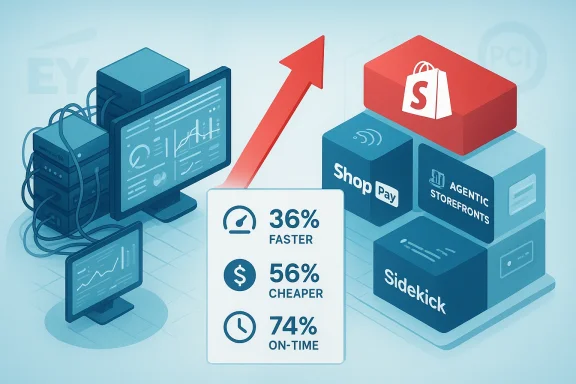
Shopify’s enterprise narrative ties platform capabilities to concrete operational outcomes. The key claims (summarized from Shopify’s enterprise materials and the migration study they commissioned) are:- Migrations to Shopify are faster, cheaper, and more predictable: Shopify cites figures showing migrations are 36% faster, 56% less expensive, and 74% more likely to finish on time based on research it commissioned. These figures appear repeatedly across Shopify’s enterprise pages. ;
- Lower ongoing TCO: Shopify states its total cost of ownership is materially lower than competitors on platform and operating costs (Shopify cites an average 33% lower TCO and lower operating and platform costs).
- Platform‑level capabilities shift maintenance out of the merchant’s backlog: PCI, SOC attestations, vulnerability management, DDoS protection, and platform security are hacing merchant audit and patch cycles.
- Built‑in conversion primitives: Shop Pay and Shopify Checkout are presented as high‑impact capabilities that materially lift conversion—Shop Pay is reported as having hundreds of millions of users and is said to deliver as much as a 50% lift vs. guest checkout in Shopify’s cited analyses.
- Rapid channel enablement and AI readiness: Shopify promotes Agentic Storefronts and catalog primitives that let merchants nal AI surfaces without writing bespoke agents or checkout flows.
Verifying the claims: what’s fact, what’s vendor‑commissioned, and what needs context
As a journalist and IT practitioner you want evidence, not rhetoric. Below I verify the most load‑bearing claims using public filings, analyst coverage, and independent reporting.- Migration metrics (36% faster, 56% less expensive, 74% more likely to finish on time): These figures are documented in Shopify’s enterprise pages and attributed to a research engagement published by EY in October 2025. Shopify reproduces the EY‑commissioned conclusions and methodology notes (sample size, GMV bands, and timeframe), which makes the claim traceable to a reputable auditor/consultant engagement—but the underlying EY report is not broadly republished in full, so the percentages should be treated as vendor‑commissioned and directionally useful rather than universal guarantees. Use the EY finding as evidence of likely advantages in many typical enterprise migrations, but perform your own scope‑specific estimation.
- R&D scale ($1.4 billion): Shopify itself reports an investment figure in that ballpark for recent years; the company’s investor materials and regulatory filings confirm elevated R&D spend consistent with this claim. Shopify’s investor and product pages state the $1.4B figure, and the company’s SEC filing (Form 10‑K) documents the underlying operating expense lines that make up R&D. The point here is verifiable: Shopify invests heavily in product R&D, which supports the argument that platform-level features will continue rolling out.
- Market reach and Shop Pay scale: Multiple independent industry publications and payment/commerce outlets report Shop Pay’s network effect—Shop Pay reached well over 150 million users in recent years and captured a growing share of GMV. PYMNTS, industry blogs, and Shopify’s own product pages cite hundreds of millions of accounts and a large share of platform volume coming through Shop Pay. This confirms the network effect Shopify describes (buyers arriving with stored payment info). That network effect materially reduces friction for returning buyers and is a defensible advantage for merchants enabling Shop Pay.
- Market position (US e‑commerce share): Several reputable outlets and market analysts put Shopify’s share of U.S. e‑commerce in the low‑teens by GMV; the Financial Times and other press placements have reported Shopify powering approximately 12% of U.S. e‑commerce sales in recent public estimates. Different methodologies (site count, GMV, storefront usage) produce different percentages, so treat the "12%" headline as the GMV‑oriented industry estimate rather than an absolute across every metric.
- Analyst recognitions (Forrester, IDC): Shopify highlights top placements in analyst assessments. IDC public pages reproduce Shopify’s Leader ranking in IDC MarketScape for certain 2024 evaluations, which Shopify links to. Forrester’s public summary for the Forrester Wave: Commerce Solutions has more nuance—their public summary suggests there were no outright leaders in that specific B2C Wave, and that buyers should use the Wave as a diagnostic; Shopify’s materials, by contrast, claim top scores in Forrester's evaluation. Because Forrester reports are paywalled and nuanced, I flag this as an area where vendor language and analyst summaries diverge: verify the specific Forrester evaluation, cut, and report before using "Forrester ranked Shopify at the top" as a decisive procurement argument.
Case evidencually reported after migrating
Vendor case studies are not randomized trials, but they provide practical examples of outcomes in real implementations. Shopifals and partner communications include multiple merchant stories with measurable results:- Lull: a decade of custom infrastructure rebuilt on Shopify in ~frastructure cost reductions and faster product launches.
- Dollar Shave Club: reduced tech maintenance FTE allocation (reported ~40% reduction in maintenance resources) and reallocated teams to strategic roadmaps.
- MakerFlo: loyalty programs and features that previously took 5–10 months reportedly redeployed in days or hours post‑migration, freeing ~$120k annually.
Strengths: where platform migration tends to win
- Predictability and velocity: prebuilt connectors, an app ecosystem, and platform updates reduce unknowns and speed delivery cycles.
- Security and compliance: centralized PCI and SOC artifacts remove repetitive audit and patch cycles from each merchant’s backlog, lowering specialist staffing needs.
- Built‑in conversion primitives: accelerated checkout and Shop Pay’s stored payment network materially reduce checkout friction for returning buyers.
- Channel readiness: platform primitives for marketplaces, mobile wallets, and conversational AI shorten per‑channel engineering time from months to days.
- Economies of scale in R&D: a concentrated, well‑funded R&D engine invests in capabilities (AI assistants, testing infrastructure, checkout optimization) that individual merchants would pay tens of millions to replicate.
Risks and trade‑offs: what a migration does not solve automatically
Platform migration is not a cure‑all. The trade‑offs you must weigh include:- Loss of absolute control: highly bespoke checkout or product workflows that are truly unique to your business might require custom apps or compromises.
- App/extension governance: a large ecosystem reduces build time but requires governance to avoid vendor lock‑in at the app layer and to maintain data and privacy controls.
- Migration complexity for legacy integrations: ERPs, tax engines, or custom fulfillment architectures still require planning and testing; prebuilt adapters help but rarely eliminate bespoke mapping and reconciliation tasks.
- Vendor concentration risk: consolidating critical commerce primitives onto a single vendor raises questions about vendor SLAs, roadmaps, and cost trajectory over multi‑year horizons.
- Vendor‑commissioned studies require vendor‑aligned cohorts: the EY/Shopify study is informative, but your migration economics will depend on catalog size, internationalization needs, and the count of bespoke legacy integrations.
Practical migration playbook: how to test the hypothesis in ninety days
If your organization is debating "stay or migrate," follow a compact, evidence-driven approach to reduce risk and validate outcomes quickly.- Define the hypothesis in business terms.
- Example: "Migrating to Shopify will free 40% of our SRE/devops cycles within 12 months and increase checkout conversion by 10% in the first 6 months."
- Audit the build vs. buy ledger.
- Inventory every bespoke feature and label it: revenue‑differentiating, operational, or commoditized.
- RP, OMS, PIM, tax, payments) and rank them by complexity and risk.
- Run a 90‑day technical feasibility sprint.
- Engage a systems integrator with enterprise Shopify experience for a focused discovery and pilot plan. Shopify’s partner network includes both global SIs and specialized commerce agencies; these partners typically run enterprise pilots that validate integration cadence and uplift assumptions.
- Build a migration TCO and runway model.
- Include transition costs, projected infrastructure savings, projected conversion lift, and reallocated engineering capacity.
- Validate vendor‑commissioned metrics (EY study figures) against your pilot data.
- Start phased migration: checkout and payment rails first.
- Migrating checkout and payments early delivers measurable revenue impacts (Shop Pay and Checkout optimizations) and begins to de‑risk core transactional flows.
- Reallocate and measure.
- As maintenance tasks drop, measure reallocation of staff to backlog items that increase revenue; track throughput and conversion to validate the ROI case.
Conclusion: an evidence‑driven route out of the maintenance trap
Platform migration is a strategic choice, not a reflex. Shopify’s 2026 enterprise message crystt many IT and commerce leaders know intimately: maintenance consumes scarce engineering capacity and delays the features that matter. The combination of platform R&D scale, a deep app ecosystem, and expedited channel primitives creates real operational leverage for many merchants—especially those whose differentiation is product, brand, or go‑to‑market rather than bespoke checkout logic.The empirical claims—migration speed, lower cost, Shop Pay network effects, and platform TCO advantages—have credible traces in public filings, analyst coverage, and industry reportage, but buyers should treat vendor‑commissioned numbers as starting points for scoped validation. Use the migration pilot approach to test the thesis against your catalog, integration complexity, and compliance needs. If you can demonstrate the same reallocation of developer cycles documented in case studies, the result is transformative: more experimentation, faster customer‑facing features, and a better chance to shape market differentiation rather than maintaining plumbing.
If your backlog includes checkout optimizations, loyalty or subscription features, or integrations to new discovery surfaces that have been waiting for months, start by quantifying the value of shipping those items. The right pilot will show whether migrating your infrastructure buys you the runway to build them—and whether the vendor‑commissioned efficiencies translate into the real business outcomes your CFO and CTO need to see.
Source: Shopify Beyond Custom: When Innovation No Longer Competes with Maintenance (2026) - Shopify Indonesia
