

Verdict: do not buy a new Xbox console at full price in June 2026 unless you need one immediately; keep Game Pass only if you actively use it, wait through Microsoft’s post-June 30 reset for hardware clarity, and treat PC/cloud/PlayStation as safer fallback paths. Xbox has not announced a normal next-console cycle so much as admitted that the old one is economically breaking. The practical move is to separate your games library from your hardware loyalty before Microsoft does it for you.
The clearest signal in Xbox’s June reset memo is not the corporate language about revival, alignment, or the “next 100 days.” It is the admission that the current Xbox model is not producing enough margin, not growing enough revenue outside Activision Blizzard King, and not absorbing hardware costs well enough to continue as-is.
That changes the consumer question. This is no longer simply “Should I buy a Series X or wait for the next Xbox?” It is “Should I buy a subsidized console from a business that is openly saying the subsidy model is under pressure?”
For most readers, the answer is wait. If you already own an Xbox Series X or Series S, keep it, maintain your library, and resist paying full price for a replacement unless yours fails. If you do not own one, buy only if you find a meaningful discount, you want current Xbox exclusives and back catalog access now, and you accept that the next Xbox hardware proposition may look less like a traditional console generation.
The same logic applies to Game Pass. Keep it if you are actively playing enough games each month to justify the fee. Cancel or rotate it if it has become a default subscription that mostly gives you permission to browse. Xbox’s reset is a useful reminder that subscriptions are not sentimental objects; they are monthly financial instruments.
That is the sentence that should stop anyone from treating the next Xbox as a routine appliance purchase. Microsoft is not merely saying that consoles are expensive to build. It is saying the combination of hardware subsidy, content investment, platform infrastructure, and strategic sprawl has failed to deliver the financial profile leadership now wants.
For years, Xbox’s pitch was that Microsoft could afford to be patient. The company had cloud infrastructure, Windows, Azure, Game Pass, first-party studios, and the balance sheet to play a longer game than Sony or Nintendo. The June memo reframes that patience as something closer to accumulated technical and financial debt.
This matters because hardware decisions are downstream of business models. If a console is sold at little margin or with a subsidy, the platform holder must recover value elsewhere: software royalties, subscriptions, accessories, storefront cuts, advertising, cloud tie-ins, or some combination of all of them. When leadership says that cannot continue, the buyer should assume the next hardware offer will change the recovery mechanism.
That does not mean Xbox hardware is dead. It means the next Xbox may be priced, bundled, financed, partnered, or positioned differently from the Series X and Series S generation. For a buyer, that is a flashing yellow light.
Sharma and Booty said console storage component costs were already more than twice as high as the previous fall when Sharma joined in February 2026, then doubled again, with costs potentially rising to more than five times two-years-prior pricing by the 2027 holiday season. Memory costs, according to the memo, have followed a broadly similar trajectory.
That is not a normal “parts are expensive this quarter” complaint. Storage and memory are core console ingredients. If those inputs keep rising, the company has fewer clean options: raise prices, cut storage, change the hardware architecture, rely more heavily on partners, bundle financing and subscriptions, or push players toward cloud and PC endpoints where Microsoft does not carry the same box-by-box economics.
This is why waiting for a cheaper Xbox is not the same as waiting for a cheaper television. The old expectation that consoles become cheaper to manufacture as the generation matures depends on favorable component curves and high-volume manufacturing. Xbox is saying the curve is moving the wrong way for key components.
That creates an awkward buyer paradox. If you can find a current Xbox at a genuine discount, it may be a better hardware value than whatever follows. But because the business model is under review, buying at full price today still carries strategic risk. The right answer is not “never buy.” It is “never buy casually.”
Layoffs do not automatically mean product cancellation, and budget cuts do not automatically mean weaker games. But in a division that is already saying it is overextended, under-margin, constrained by hardware costs, and looking for a new business model, post-fiscal-year restructuring can reveal which parts of the Xbox strategy are protected and which were rhetorical cover.
The important distinction is between layoffs as an accounting event and layoffs as a strategy event. Accounting layoffs reduce headcount to hit targets. Strategy layoffs tell you which bets are being abandoned, merged, slowed, or starved.
For WindowsForum readers, that means waiting is not passive. Watch what happens after June 30: which studios are affected, whether hardware teams remain central, whether Game Pass messaging changes, whether PC becomes more prominent, and whether Microsoft starts talking more openly about partners. The shape of the cuts may tell us more about the next Xbox than any teaser video.
WindowsForum users have already been circling this question in discussions about layoffs, exclusives, Microsoft’s AI spending, and whether Xbox is being sunsetted as a traditional console brand. That anxiety is not just console-war noise. It is a rational response to a platform holder telling its own employees that the old plan is not sustainable.
A radically different console business model could mean several things without requiring Xbox to abandon hardware. It could mean OEM-style partnerships where Microsoft defines the platform and partners build devices. It could mean subscription-financed hardware. It could mean a broader family of Windows-adjacent gaming devices. It could mean a console whose value proposition is less “best box under the TV” and more “managed endpoint for the Xbox ecosystem.”
The memo’s reference to hardware partnerships and commitment to Helix points in that direction, though Microsoft has not provided enough public detail to treat Helix as a consumer-ready roadmap. The safe interpretation is that Xbox is trying to preserve a console center of gravity while reducing the risk of building and subsidizing every box itself.
That is potentially smart for Microsoft and confusing for buyers. A partner-heavy Xbox hardware world could create more choice, but also more fragmentation. Enthusiasts may get more form factors; ordinary buyers may face harder questions about performance targets, storage tiers, compatibility, pricing, warranty support, and whether a device is truly “Xbox” or merely Xbox-capable.
This is where PC users should pay attention. If Xbox hardware becomes more Windows-like, the boundary between console and PC may blur in Microsoft’s favor. But blurred boundaries rarely make launch-window buying easier.
But Game Pass is not a substitute for hardware clarity. A subscription can make a console feel cheaper, but it does not remove the risk that the console model around it is changing. In fact, the reset memo makes clear that subscription, streaming, devices, and content strategies have all pulled on Xbox’s studio system.
The correct Game Pass decision is therefore mechanical, not tribal. Look at what you played in the last two billing cycles. If you completed games, sampled titles you would otherwise have bought, or use cloud and PC access regularly, keep it. If you mostly renewed out of habit, cancel and resubscribe when there is a specific title or family need.
For IT-minded households, this is the same logic used for SaaS audits. Unused recurring spend is not loyalty. It is leakage. Xbox’s reset is a good moment to audit your entertainment stack with the same ruthlessness you would apply to dormant cloud seats.
A PC can access Microsoft’s gaming ecosystem, third-party stores, mods, peripherals, productivity tools, streaming services, and non-Xbox libraries. It is less elegant than a console and often more expensive upfront, but it is not dependent on one platform holder maintaining one hardware-subsidy model.
The tradeoff is complexity. PC gaming still asks users to manage drivers, storefronts, launchers, shader compilation, settings, Windows updates, and hardware variance. For WindowsForum readers, that complexity may be tolerable or even part of the hobby. For families that want a quiet box under the TV, it is a real cost.
Still, the strategic value is obvious. If Xbox continues moving toward PC, cloud, and partner devices, a Windows gaming machine becomes the place where Microsoft’s optionality lands first. If Xbox reverses course and doubles down on exclusive console hardware, a PC still remains the broadest gaming platform available to most Windows users.
Sony’s model is easier for consumers to understand. You buy the box, buy games, subscribe if you want the service layer, and expect the platform holder to protect the console as the center of its strategy. That clarity has value when the competing platform is warning about new models, hardware partnerships, and a reset.
The case for pivoting to PlayStation is strongest if you want a living-room console first and a Microsoft ecosystem second. It is weaker if your library, friends list, controller preference, accessibility setup, or family subscriptions are already deeply tied to Xbox. Switching platforms is never free; the hidden cost is the stuff you have already bought, learned, and configured.
Cloud gaming sits somewhere else entirely. It is a useful supplement, a travel option, a way to sample games, and potentially a long-term endpoint for some users. But it is not yet the universal replacement for local hardware, especially for latency-sensitive players, data-conscious households, or anyone who wants predictable ownership of the experience.
If your current Xbox works, do nothing. That is not glamorous advice, but it is the financially rational response to a platform reset. Keep your saves, controllers, and library intact while Microsoft tells the market what “radically different” means in practice.
If you are shopping for a child, shared household, or casual living-room setup, the current Xbox can still make sense at a discount. The Series S-style value proposition has always been about convenience, not future-proofing. Just do not confuse a cheap entry point with a long-term platform guarantee.
If you are a power user deciding between a premium console and a PC upgrade, lean PC unless you specifically need the console experience. The PC path gives you the most strategic flexibility if Xbox’s future becomes a hybrid of Windows, partner devices, Game Pass, and cloud.
If you are primarily a single-player console buyer with no Xbox library baggage, PlayStation is the less ambiguous console bet. That is not an indictment of Xbox games. It is a recognition that buying into hardware during a business-model reset is different from buying into hardware during a confident generational ramp.
The Xbox memo even uses language that would not sound out of place in an internal cloud-platform review: overly complex systems, hundreds of dependencies, vendor reliance, slower shipping velocity, and a need to rebuild the stack. Strip away the controllers and mascots, and the diagnosis is a platform engineering problem.
That matters because Microsoft increasingly thinks across endpoints, identity, subscriptions, cloud delivery, and partner ecosystems. Xbox is not separate from that worldview. If the console becomes more like a managed gaming endpoint, Windows and cloud architecture become more central to the experience, not less.
Sysadmins should also notice the cultural shift. The same company that sells stability to enterprise customers is telling gaming customers that the platform needs a reset. That does not make Xbox unsafe, but it does make the next year a period for observation rather than blind procurement, especially in schools, labs, lounges, esports rooms, and shared-device environments.
For any organization buying gaming hardware, the recommendation is straightforward: avoid speculative bulk purchases until Microsoft clarifies the hardware roadmap. Buy replacement units only when needed, standardize accessories where possible, and keep software entitlements tied to accounts rather than assumptions about future boxes.
That uncertainty is not automatically fatal. Microsoft still owns major franchises, Windows remains central to PC gaming, and Game Pass still has real utility when used deliberately. The problem is that Xbox’s strongest consumer pitch has always been simplicity, and the reset temporarily makes everything more conditional.
The next few months should be read as signal-gathering time. If layoffs after June 30 spare core hardware, platform, and first-party execution capacity, the reset may become a disciplined reboot. If the cuts scatter across studios and infrastructure while leadership keeps talking about transformation, confidence should fall.
Watch for whether “radically different” becomes a concrete offer later in 2026. A named partner device, a clear pricing model, a transparent compatibility promise, or a coherent Helix explanation would help. Vague ecosystem language would not.
Most of all, watch whether Xbox can explain who the next console is for. A premium player wants performance. A family wants value. A PC user wants flexibility. A cloud user wants access. A platform that tries to serve all of them without prioritizing any of them risks repeating the overextension its own memo now admits.
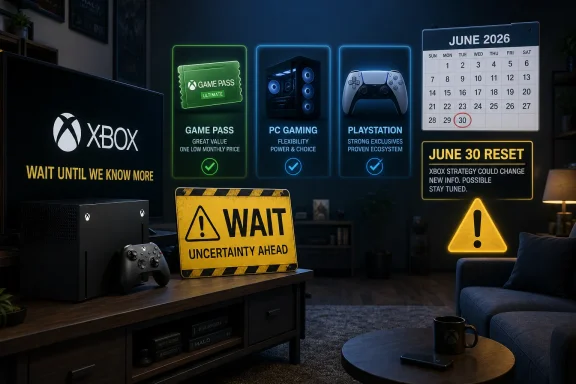 Xbox Has Made the Buying Decision Easier by Making the Business Case Harder
The clearest signal in Xbox’s June reset memo is not the corporate language about revival, alignment, or the “next 100 days.” It is the admission that the current Xbox model is not producing enough margin, not growing enough revenue outside Activision Blizzard King, and not absorbing hardware costs well enough to continue as-is.That changes the consumer question. This is no longer simply “Should I buy a Series X or wait for the next Xbox?” It is “Should I buy a subsidized console from a business that is openly saying the subsidy model is under pressure?”
For most readers, the answer is wait. If you already own an Xbox Series X or Series S, keep it, maintain your library, and resist paying full price for a replacement unless yours fails. If you do not own one, buy only if you find a meaningful discount, you want current Xbox exclusives and back catalog access now, and you accept that the next Xbox hardware proposition may look less like a traditional console generation.
The same logic applies to Game Pass. Keep it if you are actively playing enough games each month to justify the fee. Cancel or rotate it if it has become a default subscription that mostly gives you permission to browse. Xbox’s reset is a useful reminder that subscriptions are not sentimental objects; they are monthly financial instruments.
The Memo Says the Quiet Part Loudly: Xbox’s Console Subsidy Is Under Stress
In the June 10 memo from Asha Sharma and Matt Booty, Xbox said it expects to end the fiscal year at about a 3% accountability margin. Excluding Activision Blizzard King, the memo said Xbox has spent more than $20 billion over five years on content, platform, and hardware subsidy while annual revenue declined by nearly half a billion.That is the sentence that should stop anyone from treating the next Xbox as a routine appliance purchase. Microsoft is not merely saying that consoles are expensive to build. It is saying the combination of hardware subsidy, content investment, platform infrastructure, and strategic sprawl has failed to deliver the financial profile leadership now wants.
For years, Xbox’s pitch was that Microsoft could afford to be patient. The company had cloud infrastructure, Windows, Azure, Game Pass, first-party studios, and the balance sheet to play a longer game than Sony or Nintendo. The June memo reframes that patience as something closer to accumulated technical and financial debt.
This matters because hardware decisions are downstream of business models. If a console is sold at little margin or with a subsidy, the platform holder must recover value elsewhere: software royalties, subscriptions, accessories, storefront cuts, advertising, cloud tie-ins, or some combination of all of them. When leadership says that cannot continue, the buyer should assume the next hardware offer will change the recovery mechanism.
That does not mean Xbox hardware is dead. It means the next Xbox may be priced, bundled, financed, partnered, or positioned differently from the Series X and Series S generation. For a buyer, that is a flashing yellow light.
The Storage Cost Shock Turns “Wait for a Slim Model” Into a Bad Assumption
The usual console-cycle advice is comforting: wait for the revision, wait for the cheaper bundle, wait for the smaller box, wait for the holiday deal. Xbox’s memo attacks that logic directly.Sharma and Booty said console storage component costs were already more than twice as high as the previous fall when Sharma joined in February 2026, then doubled again, with costs potentially rising to more than five times two-years-prior pricing by the 2027 holiday season. Memory costs, according to the memo, have followed a broadly similar trajectory.
That is not a normal “parts are expensive this quarter” complaint. Storage and memory are core console ingredients. If those inputs keep rising, the company has fewer clean options: raise prices, cut storage, change the hardware architecture, rely more heavily on partners, bundle financing and subscriptions, or push players toward cloud and PC endpoints where Microsoft does not carry the same box-by-box economics.
This is why waiting for a cheaper Xbox is not the same as waiting for a cheaper television. The old expectation that consoles become cheaper to manufacture as the generation matures depends on favorable component curves and high-volume manufacturing. Xbox is saying the curve is moving the wrong way for key components.
That creates an awkward buyer paradox. If you can find a current Xbox at a genuine discount, it may be a better hardware value than whatever follows. But because the business model is under review, buying at full price today still carries strategic risk. The right answer is not “never buy.” It is “never buy casually.”
The Layoff Window Makes June 30 the First Date to Watch
Bloomberg reported that layoffs are expected shortly after Microsoft’s fiscal year ends on June 30, 2026, with significant budget cuts also under discussion. That date matters because it gives buyers and Xbox watchers a near-term checkpoint.Layoffs do not automatically mean product cancellation, and budget cuts do not automatically mean weaker games. But in a division that is already saying it is overextended, under-margin, constrained by hardware costs, and looking for a new business model, post-fiscal-year restructuring can reveal which parts of the Xbox strategy are protected and which were rhetorical cover.
The important distinction is between layoffs as an accounting event and layoffs as a strategy event. Accounting layoffs reduce headcount to hit targets. Strategy layoffs tell you which bets are being abandoned, merged, slowed, or starved.
For WindowsForum readers, that means waiting is not passive. Watch what happens after June 30: which studios are affected, whether hardware teams remain central, whether Game Pass messaging changes, whether PC becomes more prominent, and whether Microsoft starts talking more openly about partners. The shape of the cuts may tell us more about the next Xbox than any teaser video.
WindowsForum users have already been circling this question in discussions about layoffs, exclusives, Microsoft’s AI spending, and whether Xbox is being sunsetted as a traditional console brand. That anxiety is not just console-war noise. It is a rational response to a platform holder telling its own employees that the old plan is not sustainable.
“Radically Different” Is Not Marketing Fluff This Time
In a June 9 Fortune interview, Sharma said Xbox should expect “radically different business models” for consoles to emerge later in 2026 rather than simply chasing the “most premium, high-performance console.” That line deserves more attention than the usual next-gen speculation.A radically different console business model could mean several things without requiring Xbox to abandon hardware. It could mean OEM-style partnerships where Microsoft defines the platform and partners build devices. It could mean subscription-financed hardware. It could mean a broader family of Windows-adjacent gaming devices. It could mean a console whose value proposition is less “best box under the TV” and more “managed endpoint for the Xbox ecosystem.”
The memo’s reference to hardware partnerships and commitment to Helix points in that direction, though Microsoft has not provided enough public detail to treat Helix as a consumer-ready roadmap. The safe interpretation is that Xbox is trying to preserve a console center of gravity while reducing the risk of building and subsidizing every box itself.
That is potentially smart for Microsoft and confusing for buyers. A partner-heavy Xbox hardware world could create more choice, but also more fragmentation. Enthusiasts may get more form factors; ordinary buyers may face harder questions about performance targets, storage tiers, compatibility, pricing, warranty support, and whether a device is truly “Xbox” or merely Xbox-capable.
This is where PC users should pay attention. If Xbox hardware becomes more Windows-like, the boundary between console and PC may blur in Microsoft’s favor. But blurred boundaries rarely make launch-window buying easier.
Game Pass Is Still Useful, but It Is No Longer a Hardware Answer
Game Pass used to simplify the Xbox recommendation. Buy the box, subscribe, and you get a large rotating library plus first-party value. That pitch remains attractive for heavy users, families, and anyone who treats games like a buffet rather than a shelf of permanent purchases.But Game Pass is not a substitute for hardware clarity. A subscription can make a console feel cheaper, but it does not remove the risk that the console model around it is changing. In fact, the reset memo makes clear that subscription, streaming, devices, and content strategies have all pulled on Xbox’s studio system.
The correct Game Pass decision is therefore mechanical, not tribal. Look at what you played in the last two billing cycles. If you completed games, sampled titles you would otherwise have bought, or use cloud and PC access regularly, keep it. If you mostly renewed out of habit, cancel and resubscribe when there is a specific title or family need.
For IT-minded households, this is the same logic used for SaaS audits. Unused recurring spend is not loyalty. It is leakage. Xbox’s reset is a good moment to audit your entertainment stack with the same ruthlessness you would apply to dormant cloud seats.
The PC Path Is the Least Risky Microsoft-Aligned Option
For Windows enthusiasts, the least risky way to stay close to Xbox may increasingly be the PC. That does not mean every Xbox owner should run out and build a gaming rig. It does mean that a Windows gaming setup gives you more escape routes if Microsoft’s console strategy mutates.A PC can access Microsoft’s gaming ecosystem, third-party stores, mods, peripherals, productivity tools, streaming services, and non-Xbox libraries. It is less elegant than a console and often more expensive upfront, but it is not dependent on one platform holder maintaining one hardware-subsidy model.
The tradeoff is complexity. PC gaming still asks users to manage drivers, storefronts, launchers, shader compilation, settings, Windows updates, and hardware variance. For WindowsForum readers, that complexity may be tolerable or even part of the hobby. For families that want a quiet box under the TV, it is a real cost.
Still, the strategic value is obvious. If Xbox continues moving toward PC, cloud, and partner devices, a Windows gaming machine becomes the place where Microsoft’s optionality lands first. If Xbox reverses course and doubles down on exclusive console hardware, a PC still remains the broadest gaming platform available to most Windows users.
PlayStation Becomes the Conservative Console Choice by Default
A strange thing happens when Xbox openly questions its hardware economics: PlayStation becomes the conservative option, even for people who prefer Microsoft’s services. Not necessarily the better value, not necessarily the better ecosystem, but the more conventional console bet.Sony’s model is easier for consumers to understand. You buy the box, buy games, subscribe if you want the service layer, and expect the platform holder to protect the console as the center of its strategy. That clarity has value when the competing platform is warning about new models, hardware partnerships, and a reset.
The case for pivoting to PlayStation is strongest if you want a living-room console first and a Microsoft ecosystem second. It is weaker if your library, friends list, controller preference, accessibility setup, or family subscriptions are already deeply tied to Xbox. Switching platforms is never free; the hidden cost is the stuff you have already bought, learned, and configured.
Cloud gaming sits somewhere else entirely. It is a useful supplement, a travel option, a way to sample games, and potentially a long-term endpoint for some users. But it is not yet the universal replacement for local hardware, especially for latency-sensitive players, data-conscious households, or anyone who wants predictable ownership of the experience.
The Sensible 2026 Buying Matrix Is Brutally Simple
The decision tree is now clearer than the branding. Buy an Xbox only when the use case is immediate and the price is right. Wait if you are buying out of curiosity, upgrade itch, or fear of missing the next generation. Pivot if you want stability more than ecosystem continuity.If your current Xbox works, do nothing. That is not glamorous advice, but it is the financially rational response to a platform reset. Keep your saves, controllers, and library intact while Microsoft tells the market what “radically different” means in practice.
If you are shopping for a child, shared household, or casual living-room setup, the current Xbox can still make sense at a discount. The Series S-style value proposition has always been about convenience, not future-proofing. Just do not confuse a cheap entry point with a long-term platform guarantee.
If you are a power user deciding between a premium console and a PC upgrade, lean PC unless you specifically need the console experience. The PC path gives you the most strategic flexibility if Xbox’s future becomes a hybrid of Windows, partner devices, Game Pass, and cloud.
If you are primarily a single-player console buyer with no Xbox library baggage, PlayStation is the less ambiguous console bet. That is not an indictment of Xbox games. It is a recognition that buying into hardware during a business-model reset is different from buying into hardware during a confident generational ramp.
Where Enterprise IT Should Read Between the Lines
This may look like a consumer gaming story, but the Microsoft pattern will feel familiar to IT pros. A platform with too many strategies, too many dependencies, vendor reliance, margin pressure, and unclear ownership eventually has to rationalize.The Xbox memo even uses language that would not sound out of place in an internal cloud-platform review: overly complex systems, hundreds of dependencies, vendor reliance, slower shipping velocity, and a need to rebuild the stack. Strip away the controllers and mascots, and the diagnosis is a platform engineering problem.
That matters because Microsoft increasingly thinks across endpoints, identity, subscriptions, cloud delivery, and partner ecosystems. Xbox is not separate from that worldview. If the console becomes more like a managed gaming endpoint, Windows and cloud architecture become more central to the experience, not less.
Sysadmins should also notice the cultural shift. The same company that sells stability to enterprise customers is telling gaming customers that the platform needs a reset. That does not make Xbox unsafe, but it does make the next year a period for observation rather than blind procurement, especially in schools, labs, lounges, esports rooms, and shared-device environments.
For any organization buying gaming hardware, the recommendation is straightforward: avoid speculative bulk purchases until Microsoft clarifies the hardware roadmap. Buy replacement units only when needed, standardize accessories where possible, and keep software entitlements tied to accounts rather than assumptions about future boxes.
The Real Xbox Reset Is a Test of Buyer Patience
Here is the concrete reading of the situation: Xbox is not asking players to believe in a new console yet. It is asking employees, partners, and customers to tolerate uncertainty while leadership rebuilds the economics underneath the brand.That uncertainty is not automatically fatal. Microsoft still owns major franchises, Windows remains central to PC gaming, and Game Pass still has real utility when used deliberately. The problem is that Xbox’s strongest consumer pitch has always been simplicity, and the reset temporarily makes everything more conditional.
The next few months should be read as signal-gathering time. If layoffs after June 30 spare core hardware, platform, and first-party execution capacity, the reset may become a disciplined reboot. If the cuts scatter across studios and infrastructure while leadership keeps talking about transformation, confidence should fall.
Watch for whether “radically different” becomes a concrete offer later in 2026. A named partner device, a clear pricing model, a transparent compatibility promise, or a coherent Helix explanation would help. Vague ecosystem language would not.
Most of all, watch whether Xbox can explain who the next console is for. A premium player wants performance. A family wants value. A PC user wants flexibility. A cloud user wants access. A platform that tries to serve all of them without prioritizing any of them risks repeating the overextension its own memo now admits.
The Buyer’s Short List Before Microsoft Shows Its Hand
The useful response is not panic. It is disciplined delay. Xbox has given customers enough information to avoid a bad impulse purchase, but not enough to justify a confident next-generation bet.- If you already own a working Xbox Series X or Series S, keep it and wait for Microsoft’s post-June 30 restructuring and later-2026 hardware-model details before upgrading.
- If you want an Xbox today, buy only at a discount and only because you plan to use it immediately, not because you expect a traditional console cycle to unfold.
- If you subscribe to Game Pass, keep it only when your recent play history proves that it is replacing purchases or delivering regular value.
- If you are a Windows enthusiast or power user, treat PC gaming as the most flexible Microsoft-aligned path through the reset.
- If you want the simplest conventional console bet with the least Microsoft-specific uncertainty, consider PlayStation instead of waiting for Xbox to define its next model.
- If you manage shared or institutional gaming hardware, postpone nonessential Xbox fleet purchases until Microsoft clarifies hardware partnerships, pricing, and support expectations.
References
- Primary source: windowscentral.com
Xbox admits it’s “over‑extended” as leadership signals a major rethink of its studio strategy | Windows Central
Xbox leadership admits the company became overextended and says major changes are needed to strengthen its biggest franchises.www.windowscentral.com - Independent coverage: gamesradar.com
Major Xbox layoffs reportedly on the way as CEO Asha Sharma admits Microsoft's gaming division is "over extended" | GamesRadar+
Going forward, this cannot continuewww.gamesradar.com - Independent coverage: pcgamer.com
Xbox lost 'millions' of Game Pass subscribers after last year's massive price hike | PC Gamer
This would explain why Asha Sharma moved so quickly to lower them.www.pcgamer.com - Independent coverage: techspot.com
Xbox is planning major layoffs and hinting at "radically different" console business model | TechSpot
Although Xbox chief Asha Sharma didn't say "layoffs" in her recent memo to staff, the message's tone certainly gives off the feeling that they're coming. Sources recently...www.techspot.com - Independent coverage: gamespot.com
Xbox CEO Believes Consoles Are Too Expensive And "Radically Different" Plans Are Needed
Asha Sharma hints that big changes may be coming to Xbox later this year as she acknowledges the difficult moment for the industry.www.gamespot.com - Independent coverage: purexbox.com
- Independent coverage: gematsu.com
Xbox CEO Asha Sharma and executive vice president Matt Booty publish staff memo ‘Next 100 Days: Xbox Reset’ - Gematsu
Xbox CEO Asha Sharma and Xbox executive vice president and chief content officer Matt Booty have published a memo sent to Xbox staff today…www.gematsu.com - Independent coverage: techtimes.com
Xbox July Layoffs Confirmed as CEO Sharma Eyes Affordable Console Tier
Xbox layoffs 2026 are confirmed for July as CEO Asha Sharma’s Reset memo discloses a $500 million revenue decline over five years, a 3% profit margin, and hints at a more affordable Xbox consolewww.techtimes.com - Independent coverage: tweaktown.com
'Radically different' business models coming to Xbox, CEO Asha Sharma says
Xbox CEO Asha Sharma says that new business models will 'start to come into orbit' in 2026, hinting at possible innovations like ad-supported game streams. www.tweaktown.com
