

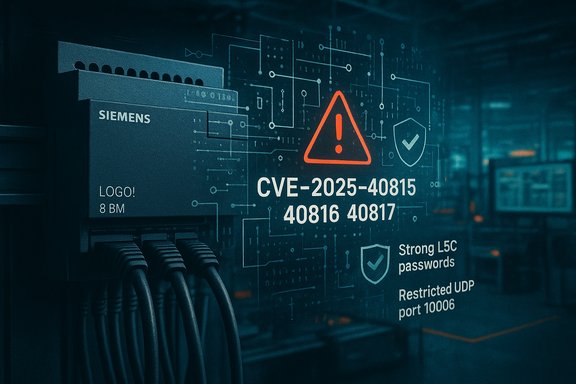
Siemens has published a ProductCERT advisory confirming multiple high‑severity vulnerabilities in the LOGO! 8 BM family (including SIPLUS variants) that can be exploited remotely to cause buffer overflows, denial‑of‑service, and unauthorized changes to device configuration such as IP address and system time — the advisory maps these issues to CVE‑2025‑40815, CVE‑2025‑40816 and CVE‑2025‑40817 and assigns high CVSS v3.1 and v4.0 ratings; Siemens says fixes are being prepared and provides immediate mitigations for operators to apply now.
Background / Overview
Siemens LOGO! base modules (LOGO! 8 BM and SIPLUS variants) are compact logic modules used widely for small automation tasks in commercial and transportation systems worldwide. The new ProductCERT advisory (SSA‑267056) published 11 November 2025 describes three distinct vulnerabilities that together present both direct device‑level risk and operational risk for environments where these devices are network reachable. The most serious — tracked as CVE‑2025‑40815 — is a classic buffer‑overflow triggered by malformed TCP packets that, per Siemens’ analysis, can give an attacker control of the instruction counter and the potential to run arbitrary code. This notice follows an established pattern: LOGO! devices have been the subject of multiple advisories over recent years covering issues such as hard‑coded keys and unprotected project data, so operators should treat this as part of a continuing risk profile for these devices rather than an isolated incident. Public vulnerability databases and national vulnerability records have been updated to include the new CVE records and scoring.What Siemens says: the canonical technical details
Affected products (Siemens mapping)
Siemens lists a broad set of SKUs and SIPLUS variants as affected — covering many LOGO! 12/24RCE, 230RCE, 24CE, and 24RCE models and their SIPLUS counterparts; in the advisory Siemens marks all versions of the listed SKUs as affected until patched. The advisory is SKU‑specific and operators must check exact model numbers and firmware versions against Siemens’ ProductCERT tables.Vulnerability summary
- CVE‑2025‑40815 — Classic buffer overflow (CWE‑120): improper validation of TCP packet structure in multiple methods; can cause buffer overflow and potentially allow arbitrary code execution. Siemens assigns a CVSS v3.1 vector indicating network attack vector and high impact; a CVSS v4.0 base score of 8.6 is recorded.
- CVE‑2025‑40816 — Missing validation / missing authentication for key function (CWE‑306): improper validations during interaction that may allow an unauthenticated remote actor to manipulate the device’s IP address, making it unreachable. Siemens and NVD list a high CVSS v3.1 score and a CVSS v4.0 score in the high range.
- CVE‑2025‑40817 — Missing validation allowing time manipulation (CWE‑306): an unauthenticated remote actor could change the device’s time, causing operational deviations. CVSS scoring places this as high/important but comparatively lower than the buffer‑overflow CVE.
Reporter and coordination
Siemens ProductCERT credits the Security Research Team at Thales Cybersecurity Services Australia for reporting these issues, and Siemens says it is preparing fixed versions while providing interim mitigations.Risk evaluation — what these vulnerabilities mean in practice
Siemens’ advisory and independent registries converge on the same core risk model: these faults are network‑accessible and, in realistic deployments where LOGO! devices are reachable from maintenance or corporate networks (or via remote maintenance tunnels), they create an attractive attack path.- Execution of arbitrary code: A successful exploit of CVE‑2025‑40815 can permit code execution on an embedded logic module. On devices with direct actuator or I/O control this could be used to change control logic, corrupt telemetry, or create persistent footholds.
- Denial‑of‑service and operational disruption: Manipulating IP address or system time (CVE‑2025‑40816/40817) can render devices unreachable or cause scheduling and coordination errors — outcomes that in OT contexts often require physical visits or power cycles to remediate.
- Low bar for reachability in many networks: Many LOGO! devices are deployed on networks where segmentation is weak or remote access is provisioned for vendor maintenance. Attackers who can reach the device’s management ports can attempt exploitation without local access, increasing likelihood. Historical advisories on LOGO! devices (hard‑coded keys, unencrypted project data) show the product family has had repeated information‑disclosure and authentication shortcomings that reduce the cost for adversaries to map and target devices.
- Exploitability vs. prerequisites: Siemens’ CVSS vectors indicate some privileges or preconditions (PR:H for the most severe CVE under certain scoring schemas), which may mean that some exploit paths require local or higher‑privileged access depending on deployment; however CVSS v4 attack vector and impact numbers still report high network risk. Treat this as practically exploitable where network reachability exists.
Cross‑checking claims and independent validation
Two independent, authoritative sources corroborate Siemens’ core technical claims and scoring:- The Siemens ProductCERT advisory SSA‑267056 lists the CVE IDs, affected SKUs, CWE classifications and recommended mitigations.
- The U.S. National Vulnerability Database (NVD) has an entry for CVE‑2025‑40815 that records vendor CNA scoring and enumerates the affected SKUs, confirming the advisory’s scope and the CVSS v4 value assigned by the vendor.
Mitigations Siemens recommends (and what works now)
Siemens states that fixes are being prepared, and provides specific interim mitigations:- For CVE‑2025‑40815 (buffer overflow): protect the LSC access to the device with a strong password. Siemens notes no fixed firmware was available at advisory publication for some SKUs, so password protection on the LSC (local service/console) is the primary operational control until patches arrive.
- For CVE‑2025‑40816 and CVE‑2025‑40817 (IP and time manipulation): restrict network access to UDP port 10006 to trusted IP addresses only. Siemens indicates no fix is planned immediately for these behaviors, so network filtering is the recommended compensating control.
- General Siemens guidance: configure devices in protected IT/OT environments following Siemens’ operational guidelines for industrial security, follow product manuals, and limit network exposure of management interfaces.
Immediate, practical checklist for LOGO! operators (ordered steps)
- Inventory: Identify every LOGO! device (by SKU and firmware) on the network and classify whether it is reachable from corporate networks, VPNs, or the internet. Keep an authoritative asset inventory before performing changes.
- Isolate & restrict: Block access from untrusted networks to LOGO! devices. If you cannot patch immediately, apply firewall rules to restrict access to trusted management hosts only. In particular, restrict UDP 10006 to trusted IPs as Siemens recommends.
- Secure LSC: Immediately apply strong, unique passwords to all LSC/localconsole access on LOGO! devices and remove any default or blank credentials. Siemens recommends this as a mitigation for CVE‑2025‑40815.
- Update plan: Register with Siemens ProductCERT and monitor SSA‑267056 for fixed firmware releases. When Siemens publishes patches, plan staged updates (test → pilot → production) with rollback plans for OT safety.
- Monitoring & detection: Add IDS/IPS rules to detect anomalous TCP/UDP traffic patterns to LOGO! management ports; look for unexpected changes to device IP or system time. Centralize logs from engineering workstations and OT gateways for faster triage.
- Secure remote access: Replace direct port forwarding with a hardened jump host, VPN with MFA, or out‑of‑band remote access solutions. Limit vendor maintenance tunnels to authorized and monitored sessions.
- Change management & backups: Maintain safe configuration backups and verify integrity; ensure any reconfiguration or firmware application follows formal change control to avoid accidental downtime.
- Threat‑hunting: If suspicious activity is observed — unexpected device resets, time changes, abnormal traffic to port 10006 — follow incident response playbooks and engage vendor support. CISA and Siemens both recommend reporting suspected exploitation.
Detection strategies and indicators of compromise
Given the nature of these vulnerabilities, detection should focus on both network behavior and device state changes:- Network indicators:
- Unexpected TCP traffic patterns to management interfaces; crafted or malformed TCP streams that precede a crash or unusual device behavior.
- UDP traffic to port 10006 from untrusted hosts or mass scans to that port.
- Sudden connections to ports used by engineering or maintenance services from unknown external IPs.
- Device indicators:
- Unexplained changes to IP configuration or system time on Device Management pages or in syslogs.
- Repeated process crashes or device reboots coincident with anomalous packets.
- New user accounts or modified LSC settings (if accessible).
- Host/engineering workstation indicators:
- Unexpected software that communicates with LOGO! devices or new remote sessions initiating configuration tasks.
- Logs showing failed or successful LSC logins outside of known maintenance windows.
Operational and sectoral impact — why this matters beyond a single device
LOGO! devices are simple by design but ubiquitous in building automation, HVAC, conveyor control, and transport systems. Compromise of a LOGO! device rarely causes catastrophic national‑scale outages on its own, but the practical risks are significant:- Cumulative impact: Many small devices, if exploited en masse, can disrupt building operations, transportation scheduling, or telemetry that feeds higher‑level supervisory systems.
- Safety & continuity: Time and IP manipulation and arbitrary code execution can alter scheduled actions or sensor reporting, potentially causing safety interlocks or incorrect actuation.
- Entry points for lateral movement: Once an attacker can execute code on an OT device, pivot opportunities to engineering workstations and supervisory systems increase where segmentation is weak.
- Remediation cost: Reaching, patching, and validating thousands of widely distributed LOGO! devices can require on‑site intervention and planned downtime for many operators.
What remains uncertain — flagged claims and cautions
- Public exploitation status: As of publication of the Siemens ProductCERT advisory (11 November 2025) and related republishing activity, public reports of active exploitation specifically targeting these CVEs were not prominent in major national advisories; however absence of public reports does not mean the vulnerabilities are not being probed or exploited in targeted intrusions. Operators should assume active interest and act accordingly. This advisory environment is dynamic; verify current exploitation reports before assuming a low risk posture.
- Exact exploit prerequisites: Siemens’ CVSS vectors show some privileges may be required in attack scenarios; real‑world exploitability depends on firmware, runtime protections, and network topology. Treat vendor scoring as authoritative for guidance, but validate exploitability in your environment with caution and in controlled test labs.
- Timeline for patches: Siemens says fixes are being prepared, but product‑by‑product timelines often vary. If your device model is scheduled for a later update, compensate with network controls and operational mitigations. Track Siemens ProductCERT for the definitive patch timeline.
Long‑term recommendations and resilience practices
- Formalize OT asset management: Keep SKU‑level inventories, firmware baselines, and vendor advisories linked to change windows. Rapidly identify which devices map to Siemens’ advisory tables.
- Enforce segmentation and least privilege: Ensure LOGO! devices are on strictly limited OT VLANs with tightly controlled access via jump hosts or hardened management servers. Apply firewall ACLs and micro‑segmentation for critical subnets.
- Harden remote maintenance: Use MFA, time‑limited VPN sessions, and session logging for vendor maintenance access. Disable or remove unnecessary remote tunnels.
- Patch testing pipelines for OT: Adopt staged update practices that respect safety validation and rollback planning so vendor patches can be applied promptly without undue operational risk.
- Regular security exercises and hunting: Run tabletop exercises that include OT device compromise scenarios and integrate OT telemetry into enterprise SOC workflows for faster detection and response.
Conclusion
The LOGO! 8 BM advisory is a reminder that even compact, “low‑profile” automation devices can host high‑impact vulnerabilities — including remote exploitable buffer overflows — that merit immediate operational attention. Siemens’ ProductCERT entry (SSA‑267056) and NVD entries provide the authoritative technical mapping and scoring; Siemens’ interim mitigations (strong LSC passwords and port 10006 UDP restrictions) are practical stopgaps but not substitutes for vendor patches. Operators must treat this as a high‑priority OT risk: identify affected assets, restrict network exposure, harden local access, monitor for anomalous activity, and apply Siemens’ firmware updates as soon as they are validated and available. For teams running mixed IT/OT environments, this advisory is a clear call to action: bridge asset inventories, enforce segmentation, and ensure change windows and test plans are ready so vendor fixes can be implemented safely and quickly when released. The combination of confirmed CVE assignments, vendor acknowledgement, and high CVSS v4 scoring makes this an immediate operational priority for owners of LOGO! devices.Source: CISA Siemens LOGO! 8 BM Devices | CISA
