

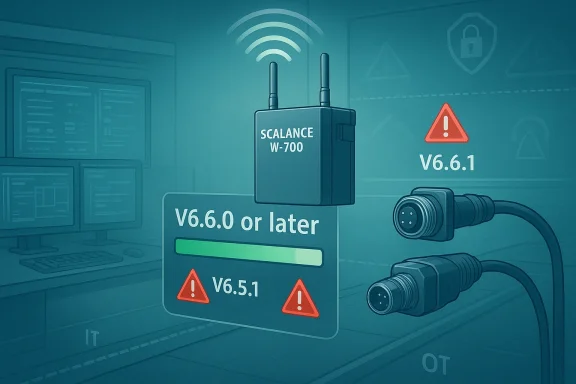
Siemens’ SCALANCE W-700 IEEE 802.11n family is back in the security spotlight, and this time the fix story is materially different from Siemens’ earlier position. The latest advisory update says the affected W-700 802.11n devices are impacted by multiple vulnerabilities, but that V6.6.0 or later resolves the issue set for the listed models, replacing the earlier “no fix planned” posture that Siemens had documented in the advisory history.
For operators, that is the headline: this is no longer a case of “mitigate and wait.” It is a concrete firmware-upgrade problem with a defined target version, and the affected device list is broad enough that many industrial wireless deployments will need a careful inventory check before they can claim closure. The advisory also shows why SCALANCE has remained a recurring focus for industrial security teams: these are not generic Wi-Fi products, but wireless devices used to connect PLCs, HMIs, and other industrial components, which means the security impact is never confined to the radio interface alone.
Siemens’ SCALANCE family sits in a particularly sensitive part of the industrial networking stack. These devices bridge industrial components over wireless links, which makes them operationally valuable and security-sensitive at the same time. The W-700 series in particular is part of Siemens’ long-running IEEE 802.11n portfolio, and the version history shows a mature product line with multiple release branches stretching across the 5.x and 6.x firmware era.
That historical context matters because industrial gear often stays in service for years, sometimes far longer than mainstream IT hardware. Firmware that was acceptable at the time of deployment can become the weakest trust boundary in an otherwise carefully segmented plant network. When Siemens updates the security posture of a family like this, it is not just shipping code; it is reshaping the risk profile of wireless connectivity inside factories, utilities, and other critical environments.
The advisory now ties the W-700 802.11n family to multiple CVEs, including legacy issues and more recent disclosure IDs, which suggests that the affected firmware carried forward a set of weaknesses that only became fully addressed in the 6.6.0 line. That kind of accumulation is typical in industrial embedded products, where compatibility, long support windows, and hardware constraints can delay remediation. The result is a patch story that is simple on paper but complicated in practice.
It is also important that Siemens’ own advisory history shows a change in posture over time. In 2022, the company explicitly clarified that no fix was planned for the SCALANCE W-700 IEEE 802.11n family; by the April 2026 revision, the same advisory records that a fix for the 802.11n family was added. That reversal is unusual enough to be noteworthy, and it suggests either a later engineering breakthrough or a reassessment of support feasibility for the product line.
For defenders, the practical lesson is straightforward: even when a vendor appears to have closed the door on a legacy line, that position can change. Industrial asset owners need to keep checking advisories, because “no fix planned” is not always the final word. In this case, the final word appears to be a specific firmware target: V6.6.0 or later.
That shift matters for procurement, lifecycle management, and asset retirement planning. If an industrial wireless platform can receive a late-cycle security update after being written off, operators need to revisit assumptions about long-term support. Conversely, if a device has already been migrated or replaced, the new firmware path may still matter for spare inventory, remote sites, or vendor-managed fleets.
The other key change is that the vulnerability set is presented as a multiple-CVE package rather than a single isolated flaw. That usually signals a broader hardening effort rather than a one-off patch. In practical terms, Siemens appears to have addressed a group of issues across the product line rather than one narrow exploit path.
The version history PDF also shows the long continuity of SCALANCE W releases, with multiple branches like V5.2.x, V6.1.x, V6.3.x, V6.4.x, and V6.5.x documented before the V6.6.0 fix line appears in the advisory update. That pattern suggests the family has been maintained across multiple generations, which is good news for customers but also a sign that firmware drift may be common across mixed estates.
For a security team, the danger is not just one vulnerable device. It is a campus or plant where different procurement years, hardware variants, and regional ordering numbers coexist. Once that happens, the patch plan is no longer one binary decision. It becomes a branch-by-branch verification exercise.
That is where many remediation programs stumble. A site may know it has “SCALANCE W wireless gear,” but not which exact model and release branch is installed on each unit. If the affected fleet includes both RJ45 and M12 versions, plus U.S. and non-U.S. order codes, the verification burden rises quickly.
The good news is that Siemens has provided a version threshold rather than a vague “update when possible” instruction. That makes fleet correlation much easier. The bad news is that mixed hardware generations can still derail rollout timing, especially where validation windows are narrow and maintenance access is limited.
Because they bridge critical devices over wireless links, the device’s own attack surface becomes a gateway to upstream industrial systems. If an adversary can interfere with the wireless infrastructure, the downstream effects can include process interruption, unauthorized communications, or degraded trust in the plant’s connectivity model. That is why a firmware bulletin for an access device can matter as much as a vulnerability in a PLC.
This is also why industrial defenders should treat “wireless infrastructure” as an OT component with the same seriousness they give to firewalls, remote access gateways, and engineering workstations. A weak radio bridge can turn into a weak perimeter.
That also means the patch is more likely to affect several code paths, which can make testing more important. Industrial teams should not assume that a single vulnerability type maps cleanly to a single operational symptom. A cluster of flaws can affect authentication, memory handling, input validation, or browser-facing components simultaneously.
The advisory snapshot in the CISA republication does not provide the same per-CVE breakdown for this W-700 802.11n family that Siemens’ broader ProductCERT entries sometimes do, so the safest interpretation is to treat the set as a general hardening release tied to the entire affected branch. That is an inference, but it is a reasonable one given the way the fix is packaged.
If the vulnerable SCALANCE unit is used to carry traffic between controls and operator interfaces, a compromise can affect both availability and trust. Even when no one is actively exploiting a flaw, the fact that the device is vulnerable changes the security assumptions around maintenance windows, remote support, and network segmentation.
This is why industrial advisories often trigger two different conversations: one about patching, and one about architecture. The patch closes the known hole, but the architecture determines how damaging that hole was in the first place.
CISA also repeats defensive guidance that has become standard in ICS advisories: minimize network exposure, isolate control networks behind firewalls, use secure remote access, and keep VPNs updated if they are part of the access path. Those recommendations sound familiar because they are still necessary. Industrial wireless gear is exactly the kind of asset that benefits from layered segmentation and constrained reachability.
The republication disclaimer is also worth noting. CISA states that the advisory is a direct conversion from Siemens CSAF and that CISA is not responsible for editorial or technical accuracy of the republished text. That is a reminder to treat Siemens as the authoritative source for product-specific remediation, with CISA serving as a broad distribution channel.
The timing also interacts with lifecycle management. Some plants may have already treated W-700 802.11n devices as end-of-support-like assets because Siemens had once indicated no fix was planned. The new advisory changes that calculus and may justify bringing these devices back into active patch cycles. That is a strong argument for continuous advisory monitoring, not one-time bulletin review.
Enterprises should also expect version drift. A facility may have some units already at or near V6.6.0, while others remain on older branch releases. That kind of fragmentation is common in industrial wireless deployments because replacements are often done piecemeal, not fleet-wide.
If the devices are tied to production networks, the business case for patching becomes stronger, but the change-management burden also grows. Enterprise teams need to validate that the update does not disrupt wireless coverage, roaming behavior, or industrial application timing. The right answer is usually disciplined maintenance, not emergency improvisation.
The same principle applies to remote access. If vendor support paths, engineering laptops, or wireless management channels can reach the devices, organizations should ensure those paths are tightly controlled and monitored. Wireless infrastructure is often the first place where a trust-boundary mistake becomes visible.
The wiring and physical layout also matter. M12 and ruggedized variants often appear in harsher environments where access is inconvenient and downtime is expensive. That can slow patching even when the security case is obvious. The result is that the most robust-looking hardware can sometimes be the hardest to remediate quickly.
Industrial defenders should also remember that wireless equipment can be part of a broader fallback path. If wired access is unavailable or expensive to extend, the wireless layer often becomes a critical operational dependency. That means patching a SCALANCE device is not just a security task; it is a business continuity task.
That sequence may sound basic, but industrial security is often about executing basic steps consistently. The challenge is less about novelty than discipline. The more varied the deployment, the more disciplined the upgrade process must be.
A second thing to watch is whether this advisory changes how operators think about legacy support. The fact that Siemens added a fix after previously indicating none was planned may encourage some customers to hold onto older industrial wireless hardware longer than they otherwise would. That could be sensible, but only if patch monitoring remains active and inventories stay accurate.
Finally, security teams should watch for opportunities to use this event as a broader audit trigger. Wireless infrastructure, remote-access paths, and OT segmentation are often reviewed separately, but they are tightly linked in practice. A clean firmware upgrade is useful; a cleaner trust model is better.
Source: CISA Siemens SCALANCE | CISA
For operators, that is the headline: this is no longer a case of “mitigate and wait.” It is a concrete firmware-upgrade problem with a defined target version, and the affected device list is broad enough that many industrial wireless deployments will need a careful inventory check before they can claim closure. The advisory also shows why SCALANCE has remained a recurring focus for industrial security teams: these are not generic Wi-Fi products, but wireless devices used to connect PLCs, HMIs, and other industrial components, which means the security impact is never confined to the radio interface alone.
 Background
Siemens’ SCALANCE family sits in a particularly sensitive part of the industrial networking stack. These devices bridge industrial components over wireless links, which makes them operationally valuable and security-sensitive at the same time. The W-700 series in particular is part of Siemens’ long-running IEEE 802.11n portfolio, and the version history shows a mature product line with multiple release branches stretching across the 5.x and 6.x firmware era.That historical context matters because industrial gear often stays in service for years, sometimes far longer than mainstream IT hardware. Firmware that was acceptable at the time of deployment can become the weakest trust boundary in an otherwise carefully segmented plant network. When Siemens updates the security posture of a family like this, it is not just shipping code; it is reshaping the risk profile of wireless connectivity inside factories, utilities, and other critical environments.
The advisory now ties the W-700 802.11n family to multiple CVEs, including legacy issues and more recent disclosure IDs, which suggests that the affected firmware carried forward a set of weaknesses that only became fully addressed in the 6.6.0 line. That kind of accumulation is typical in industrial embedded products, where compatibility, long support windows, and hardware constraints can delay remediation. The result is a patch story that is simple on paper but complicated in practice.
It is also important that Siemens’ own advisory history shows a change in posture over time. In 2022, the company explicitly clarified that no fix was planned for the SCALANCE W-700 IEEE 802.11n family; by the April 2026 revision, the same advisory records that a fix for the 802.11n family was added. That reversal is unusual enough to be noteworthy, and it suggests either a later engineering breakthrough or a reassessment of support feasibility for the product line.
For defenders, the practical lesson is straightforward: even when a vendor appears to have closed the door on a legacy line, that position can change. Industrial asset owners need to keep checking advisories, because “no fix planned” is not always the final word. In this case, the final word appears to be a specific firmware target: V6.6.0 or later.
What Siemens Has Changed
The central change in this advisory is the fix state. The W-700 802.11n family is now marked as affected below V6.6.0, with Siemens directing customers to update to V6.6.0 or later. That is a clean remediation boundary, and it is the kind of answer plant teams like to see because it lets them translate a vulnerability bulletin into a version-control task.From “no fix planned” to a fixed branch
The advisory’s revision history is especially important here. In 2022, Siemens documented that no fix was planned for the W-700 IEEE 802.11n family. The 2026 revision then adds a fix for that family, which means anyone who stopped tracking the issue when it looked unsupported now has a different operational reality to manage.That shift matters for procurement, lifecycle management, and asset retirement planning. If an industrial wireless platform can receive a late-cycle security update after being written off, operators need to revisit assumptions about long-term support. Conversely, if a device has already been migrated or replaced, the new firmware path may still matter for spare inventory, remote sites, or vendor-managed fleets.
The other key change is that the vulnerability set is presented as a multiple-CVE package rather than a single isolated flaw. That usually signals a broader hardening effort rather than a one-off patch. In practical terms, Siemens appears to have addressed a group of issues across the product line rather than one narrow exploit path.
- Fixed version: V6.6.0 or later
- Affected scope: all versions below V6.6.0
- Product family: SCALANCE W-700 IEEE 802.11n
- Advisory posture change: from no fix planned to fixed support
Why the firmware boundary matters
Version boundaries are the currency of industrial security. A patch note that names a product but not a threshold is hard to operationalize; a note that says “below V6.6.0” is actionable. That distinction is not academic. It determines whether an organization can automate inventory checks, flag noncompliant nodes, and schedule upgrades across a fleet of access points or wireless clients.The version history PDF also shows the long continuity of SCALANCE W releases, with multiple branches like V5.2.x, V6.1.x, V6.3.x, V6.4.x, and V6.5.x documented before the V6.6.0 fix line appears in the advisory update. That pattern suggests the family has been maintained across multiple generations, which is good news for customers but also a sign that firmware drift may be common across mixed estates.
For a security team, the danger is not just one vulnerable device. It is a campus or plant where different procurement years, hardware variants, and regional ordering numbers coexist. Once that happens, the patch plan is no longer one binary decision. It becomes a branch-by-branch verification exercise.
Affected Products and Scope
The affected product list is long, but it is also precise. Siemens names many SCALANCE W-700 models, including W721-1 RJ45, W722-1 RJ45, W734-1 RJ45, W738-1 M12, W748-1 RJ45 and M12, W761-1 RJ45, W774-1 RJ45 and M12 variants, W778-1 M12 variants, and the W786-1, W786-2, W786-2IA, W788-1, and W788-2 families. Several regional ordering numbers are explicitly included, including U.S. variants, which means this is not a localized support note. It is a global industrial advisory.Hardware variety increases operational risk
The number of ordering numbers is not just a catalog detail. It is an indicator that the same firmware issue may sit on different physical packages, connector styles, and market-specific SKUs. In industrial environments, that creates the classic inventory challenge: the same logical product can appear under several procurement and maintenance labels.That is where many remediation programs stumble. A site may know it has “SCALANCE W wireless gear,” but not which exact model and release branch is installed on each unit. If the affected fleet includes both RJ45 and M12 versions, plus U.S. and non-U.S. order codes, the verification burden rises quickly.
The good news is that Siemens has provided a version threshold rather than a vague “update when possible” instruction. That makes fleet correlation much easier. The bad news is that mixed hardware generations can still derail rollout timing, especially where validation windows are narrow and maintenance access is limited.
- W721-1 RJ45
- W722-1 RJ45
- W734-1 RJ45
- W738-1 M12
- W748-1 RJ45 and M12
- W761-1 RJ45
- W774-1 RJ45 and M12 EEC
- W778-1 M12 and M12 EEC
- W786-1, W786-2, W786-2IA
- W788-1 and W788-2, including M12 and EEC variants
Why these devices are sensitive
SCALANCE W devices are not ordinary office Wi-Fi products. Siemens describes them as wireless communication devices used to connect industrial components such as PLCs and HMIs according to IEEE 802.11 standards. That makes them part of the control network fabric, not just a convenience layer for mobility.Because they bridge critical devices over wireless links, the device’s own attack surface becomes a gateway to upstream industrial systems. If an adversary can interfere with the wireless infrastructure, the downstream effects can include process interruption, unauthorized communications, or degraded trust in the plant’s connectivity model. That is why a firmware bulletin for an access device can matter as much as a vulnerability in a PLC.
This is also why industrial defenders should treat “wireless infrastructure” as an OT component with the same seriousness they give to firewalls, remote access gateways, and engineering workstations. A weak radio bridge can turn into a weak perimeter.
The Vulnerability Picture
Siemens and CISA describe the issue as multiple vulnerabilities affecting the W-700 802.11n family before V6.6.0. The republished advisory lists a cluster of CVEs: CVE-2020-24588, CVE-2020-26139, CVE-2020-26140, CVE-2020-26141, CVE-2020-26143, CVE-2020-26144, CVE-2020-26146, CVE-2020-26147, CVE-2021-3712, CVE-2022-0778, CVE-2022-31765, CVE-2022-36323, CVE-2022-36324, CVE-2022-36325, and CVE-2023-44373. That breadth strongly suggests a bundled remediation effort rather than one isolated defect.Why “multiple vulnerabilities” matters
A long CVE list changes how defenders should think about the fix. Instead of asking whether one bug can be blocked by a firewall rule or whether one service can be disabled, operators should assume that the product’s overall security posture needed broader correction. In other words, this is not a single-wound repair; it is a structural patch.That also means the patch is more likely to affect several code paths, which can make testing more important. Industrial teams should not assume that a single vulnerability type maps cleanly to a single operational symptom. A cluster of flaws can affect authentication, memory handling, input validation, or browser-facing components simultaneously.
The advisory snapshot in the CISA republication does not provide the same per-CVE breakdown for this W-700 802.11n family that Siemens’ broader ProductCERT entries sometimes do, so the safest interpretation is to treat the set as a general hardening release tied to the entire affected branch. That is an inference, but it is a reasonable one given the way the fix is packaged.
- Multiple CVEs, one firmware target
- Broad remediation scope rather than a narrow bug fix
- Higher need for post-upgrade validation
- Greater likelihood of shared root causes across components
Security significance in industrial wireless
Industrial wireless devices can be deceptively ordinary from a user perspective. They look like access points, bridge radios, or client modules, but their role in a plant is usually much more privileged than a consumer Wi-Fi router. That means exploitability is only part of the story; operational placement matters just as much.If the vulnerable SCALANCE unit is used to carry traffic between controls and operator interfaces, a compromise can affect both availability and trust. Even when no one is actively exploiting a flaw, the fact that the device is vulnerable changes the security assumptions around maintenance windows, remote support, and network segmentation.
This is why industrial advisories often trigger two different conversations: one about patching, and one about architecture. The patch closes the known hole, but the architecture determines how damaging that hole was in the first place.
CISA’s Role and Why the Republication Matters
CISA’s republication of the Siemens advisory is useful because it turns a vendor bulletin into a more visible operational signal for critical infrastructure defenders. The agency’s ICS page identifies the sector impact as Communications, Information Technology, and Critical Manufacturing, and it notes that the advisory is a verbatim republication of Siemens ProductCERT material. That makes the content a visibility amplifier, not a reinterpretation.What the republication tells us
When CISA republishes an industrial advisory, it is often because the issue has enough sector relevance that the broader OT audience should see it quickly. Here, the timing is especially notable: Siemens’ advisory was revised on April 14, 2026, and CISA’s republication landed on April 21, 2026. That short lag is consistent with the agency’s role as a disseminator of vendor risk notices.CISA also repeats defensive guidance that has become standard in ICS advisories: minimize network exposure, isolate control networks behind firewalls, use secure remote access, and keep VPNs updated if they are part of the access path. Those recommendations sound familiar because they are still necessary. Industrial wireless gear is exactly the kind of asset that benefits from layered segmentation and constrained reachability.
The republication disclaimer is also worth noting. CISA states that the advisory is a direct conversion from Siemens CSAF and that CISA is not responsible for editorial or technical accuracy of the republished text. That is a reminder to treat Siemens as the authoritative source for product-specific remediation, with CISA serving as a broad distribution channel.
Why operators should care about timing
Industrial environments are notorious for delayed remediation. In that context, every extra week between disclosure and patching is a week in which operational assumptions remain stale. A published fix with a clear version boundary is the best-case outcome, but only if teams move from notice to action promptly.The timing also interacts with lifecycle management. Some plants may have already treated W-700 802.11n devices as end-of-support-like assets because Siemens had once indicated no fix was planned. The new advisory changes that calculus and may justify bringing these devices back into active patch cycles. That is a strong argument for continuous advisory monitoring, not one-time bulletin review.
- CISA republished the Siemens advisory for wider visibility
- The agency reinforces segmentation and remote-access controls
- Siemens remains the source of truth for the fix version
- Timing matters because OT patch cycles are slow by design
Operational Impact for Enterprises
For enterprises with mixed IT/OT environments, the biggest issue is usually inventory discipline. SCALANCE wireless units may not be tracked with the same rigor as endpoints or servers, especially if they were installed by integrators or managed under a separate maintenance contract. That creates an opening for vulnerable devices to stay online long after a remediation bulletin is published.Hidden devices, hidden risk
The SCALANCE naming convention is useful to humans but not always to asset databases. A site may know it has a “wireless bridge” or “industrial AP,” while the exact model and firmware branch live in a separate spreadsheet, maintenance ticket, or vendor portal. In practice, that means remediation starts with discovery, not with downloading firmware.Enterprises should also expect version drift. A facility may have some units already at or near V6.6.0, while others remain on older branch releases. That kind of fragmentation is common in industrial wireless deployments because replacements are often done piecemeal, not fleet-wide.
If the devices are tied to production networks, the business case for patching becomes stronger, but the change-management burden also grows. Enterprise teams need to validate that the update does not disrupt wireless coverage, roaming behavior, or industrial application timing. The right answer is usually disciplined maintenance, not emergency improvisation.
Practical enterprise priorities
A sensible enterprise response is to group devices by exact model, firmware branch, and business criticality. Once that is done, the remediation sequence becomes far more manageable. The goal is to avoid treating “SCALANCE” as a single monolithic class when the actual deployment is fragmented across many product variants.The same principle applies to remote access. If vendor support paths, engineering laptops, or wireless management channels can reach the devices, organizations should ensure those paths are tightly controlled and monitored. Wireless infrastructure is often the first place where a trust-boundary mistake becomes visible.
- Discover exact model and ordering number
- Verify installed firmware against V6.6.0
- Check where devices sit in network topology
- Validate roaming and industrial traffic after upgrade
- Review remote-support access paths and vendor exceptions
Operational Impact for Industrial Sites
In smaller industrial sites, the risk is often not lack of concern but lack of bandwidth. Teams may have only a few people covering operations, maintenance, and security, and the wireless infrastructure may be treated as “good enough” until a bulletin like this forces a closer look. That makes the advisory a useful reminder that connectivity gear deserves the same lifecycle attention as controllers and HMIs.Why small sites can be especially exposed
Smaller sites often rely more heavily on defaults, templates, and vendor recommendations. If a device was deployed years ago, it may still be running the firmware that shipped with the original installation. In such environments, a fixed version like V6.6.0 is helpful only if somebody knows the device exists, knows where it is, and can schedule the upgrade.The wiring and physical layout also matter. M12 and ruggedized variants often appear in harsher environments where access is inconvenient and downtime is expensive. That can slow patching even when the security case is obvious. The result is that the most robust-looking hardware can sometimes be the hardest to remediate quickly.
Industrial defenders should also remember that wireless equipment can be part of a broader fallback path. If wired access is unavailable or expensive to extend, the wireless layer often becomes a critical operational dependency. That means patching a SCALANCE device is not just a security task; it is a business continuity task.
How to prioritize remediation
The right order of operations is fairly simple. First, identify all SCALANCE W-700 802.11n devices. Second, determine which units are below V6.6.0. Third, prioritize the ones that sit on sensitive production paths or remote-access corridors. Fourth, validate the upgrade in a maintenance window that reflects the site’s actual wireless dependency, not just a generic IT schedule.That sequence may sound basic, but industrial security is often about executing basic steps consistently. The challenge is less about novelty than discipline. The more varied the deployment, the more disciplined the upgrade process must be.
- Identify every wireless node in use
- Confirm exact firmware version
- Rank by process criticality
- Validate maintenance windows carefully
- Re-test production connectivity after deployment
Strengths and Opportunities
The strongest thing about this advisory is its clarity. Siemens now gives operators a precise remediation threshold, a broad model list, and a straightforward path to closure, which is exactly what industrial defenders need when dealing with long-lived wireless infrastructure. The late addition of a fix for a family once described as unsupported is also a useful reminder that lifecycle assumptions can change.- Clear fix target: V6.6.0 or later
- Broad product mapping makes exposure checks practical
- Advisory history reveals a meaningful support update
- Helps organizations revisit legacy wireless lifecycle assumptions
- Encourages better asset inventory discipline
- Supports stronger segmentation and access control review
- Creates an opportunity to validate remote-access paths and vendor exceptions
Risks and Concerns
The obvious risk is exposure time. Industrial sites rarely patch wireless infrastructure as quickly as IT fleets, and that delay can leave old firmware in place long after the fix is available. A second concern is misidentification: if teams do not track exact SCALANCE variants and version branches, they may believe they are compliant when they are not.- Patch lag can outlast disclosure by weeks or months
- Mixed fleets make version tracking difficult
- Legacy procurement records can hide old firmware
- Wireless devices may be overlooked in OT inventories
- Maintenance windows can delay upgrades
- Remote support paths may widen the practical attack surface
- A vulnerable radio bridge can affect downstream industrial trust
Looking Ahead
The next thing to watch is adoption. Siemens has given customers a clear target, but the real question is how quickly organizations with SCALANCE W-700 deployments can move to V6.6.0 or later across all affected variants. In industrial security, published fixes are only half the story; validation, scheduling, and maintenance access determine whether exposure actually shrinks.A second thing to watch is whether this advisory changes how operators think about legacy support. The fact that Siemens added a fix after previously indicating none was planned may encourage some customers to hold onto older industrial wireless hardware longer than they otherwise would. That could be sensible, but only if patch monitoring remains active and inventories stay accurate.
Finally, security teams should watch for opportunities to use this event as a broader audit trigger. Wireless infrastructure, remote-access paths, and OT segmentation are often reviewed separately, but they are tightly linked in practice. A clean firmware upgrade is useful; a cleaner trust model is better.
- Confirm every SCALANCE W-700 802.11n unit below V6.6.0
- Validate firmware rollout across all regional SKUs
- Recheck segmentation around industrial wireless segments
- Review remote support and maintenance access
- Document post-upgrade functional tests and rollback plans
Source: CISA Siemens SCALANCE | CISA
