

Silverfort is integrating its identity-security controls with Google Cloud’s Agent Gateway and Microsoft Copilot Studio in 2026 to enforce real-time access decisions for enterprise AI agents as they call APIs, retrieve data, and trigger workflows. The move is less about another AI-security badge on a partner page than about a more uncomfortable admission: agents are becoming actors inside corporate networks. If an AI agent can touch the same systems as an employee, a service account, or a privileged automation script, it needs to be governed at the moment it acts. The old model of “authenticate once, trust until revoked” is starting to look dangerously quaint.
Enterprise AI started, at least in its most marketable form, as a productivity interface. A chatbot answered questions, summarized documents, drafted emails, or searched a knowledge base. That model was security-sensitive, but it was still relatively contained: the user asked, the model responded, and the blast radius usually depended on what data the model could see.
Agents change the equation because they do not merely answer. They plan, call tools, pass context to other systems, invoke APIs, and sometimes keep working after the initial human prompt has disappeared into a queue of delegated tasks. That is the difference between a calculator and an intern with access to Salesforce, SharePoint, GitHub, ServiceNow, and a few internal APIs nobody has audited since 2019.
This is why Google Cloud’s Gemini Enterprise Agent Platform and Microsoft Copilot Studio matter beyond the AI hype cycle. Both platforms are designed to make agent creation easier and more scalable, lowering the barrier between an idea and an agent that can act across enterprise systems. That convenience is precisely the point — and precisely the risk.
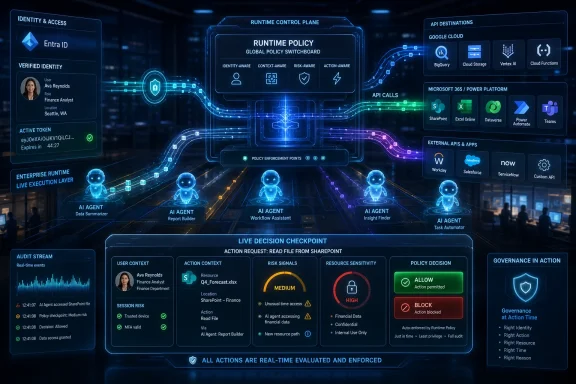
Silverfort’s integrations land in that gap. The company is positioning identity security not as a perimeter around AI, but as a runtime control plane inside the flow of agent activity. In plainer language: when an agent tries to do something meaningful, the system should ask whether that action is allowed right now, under the current identity context, with the current risk signals.
That assumption frays when the actor is an AI agent. A human user may be unpredictable, but humans at least have a relatively stable organizational role, a known device, an employment status, and a pattern of interaction that security teams have spent decades modeling. A service account is also risky, but its purpose is typically narrow: backup this database, synchronize that directory, rotate those logs.
An AI agent sits awkwardly between those categories. It may act on behalf of a human, under its own machine identity, through a delegated token, or via a chain of tools that touches multiple services before the original request is complete. The permissions may look valid at the start, while the actual work evolves into something broader, stranger, or more sensitive than the person who approved the agent expected.
That is the practical case for runtime identity security. It is not enough to ask whether the agent was created by the right team or whether it authenticated successfully. The harder question is whether this particular agent, tied to this user or owner, should be allowed to take this particular action against this particular resource at this particular moment.
Microsoft Copilot Studio presents a different but related challenge. Its low-code and no-code approach is deliberately designed for broad adoption, allowing business users and developers to create agents that interact with Microsoft 365, Power Platform, cloud services, and business applications. That democratization is commercially powerful, but it also means the security model cannot assume that every agent builder understands identity chains, delegated permissions, token scope, or the difference between a connector that reads data and one that can modify it.
Silverfort’s pitch is that these worlds need a centralized identity-security layer that spans human users, service accounts, third-party agents, and enterprise-built AI systems. In the Google integration, the emphasis is visibility and enforcement around agent communication with APIs and external tools. In Copilot Studio, the focus is evaluating access requests as an agent begins to act, blocking unauthorized or risky behavior before execution rather than merely logging it afterward.
That distinction matters. A log entry is useful for forensics, compliance, and incident response, but it is a weak consolation prize if an agent has already moved sensitive records, changed configuration, or triggered a workflow that should never have fired. Runtime enforcement shifts the security conversation from “what happened?” to “should this be allowed to happen at all?”
But the service account analogy breaks down quickly. A service account is usually deterministic: it runs a defined workload, follows a predictable path, and fails in relatively familiar ways. It may be overprivileged, neglected, or abused by attackers, but its legitimate behavior is generally narrow enough to baseline.
An agent’s legitimate behavior can be broader by design. It may choose between tools, retrieve context, generate intermediate steps, ask another agent for help, or decide that completing a user’s goal requires accessing a system that was not obvious at the beginning. The more useful the agent, the more it resembles a dynamic decision-maker rather than a static automation script.
That flexibility is what enterprises are buying. It is also what makes static permissions so dangerous. If an agent has blanket access “just in case,” the organization has recreated the worst pattern of legacy service accounts, only with a reasoning engine attached.
Real enterprises are messier. Permissions accrete. Business units build shadow workflows. SaaS connectors multiply. Data labels are inconsistent. A proof-of-concept agent becomes a production dependency because it solved someone’s problem faster than the ticket queue could. The gap between intended behavior and actual behavior is where identity attacks live.
Runtime enforcement is an acknowledgment that design-time controls are necessary but insufficient. Preconfigured permissions still matter; least privilege still matters; secure development practices still matter. But AI agents introduce enough variability that security decisions must follow the agent into execution.
That does not mean every action should trigger a bureaucratic approval flow. The point is not to turn agents into unusable compliance machines. The point is to make policy evaluation continuous, contextual, and fast enough to match the speed of automated work.
Enterprises already struggle with orphaned service accounts and stale application registrations. AI agents could make that problem worse by multiplying rapidly across business units, especially when low-code tools make creation easy. Without ownership metadata and lifecycle governance, an organization may not know who approved an agent, what it was built to do, why it has access to a system, or whether anyone still depends on it.
Tying agents back to humans also helps distinguish legitimate delegation from suspicious behavior. An agent acting for a finance manager at quarter close may reasonably request access to certain reporting systems. The same agent invoking an HR data export through an unusual connector at 2 a.m. deserves more scrutiny.
This is where identity security becomes more than authentication. The goal is to preserve a chain of accountability from human intent to machine execution. Without that chain, “the AI did it” becomes the enterprise version of “the intern deleted production.”
That makes governance harder. Agent-to-agent communication creates chains of authority that can blur the original source of permission. If Agent A is allowed to ask Agent B for a report, and Agent B has access to a sensitive database, did Agent A effectively gain database access? If an external third-party agent contributes to a workflow, whose policy governs the handoff?
These are not abstract philosophy problems. They are practical access-control problems dressed in AI vocabulary. Every chain of delegation introduces the possibility of privilege amplification, context leakage, or policy bypass.
A centralized control plane is attractive because fragmented platform-specific policies will not scale cleanly across these chains. If one agent lives in Copilot Studio, another in Google’s ecosystem, a third in a SaaS application, and a fourth behind an internal API gateway, security teams need more than a spreadsheet of connector permissions. They need a way to reason about the interaction as an identity event.
An agent can produce a harmless-looking response while performing a dangerous operation behind the scenes. Conversely, a prompt may look benign while causing the agent to call a privileged tool in a way the user did not anticipate. The security boundary cannot live only in the language layer.
Identity-aware runtime enforcement addresses a different plane of risk. It asks what the agent is doing with enterprise authority. That includes API calls, workflow triggers, data retrieval, privilege use, and interactions with other identities.
The distinction will matter for WindowsForum readers who live in Microsoft-heavy environments. A Copilot Studio agent that respects Microsoft 365 permissions when reading documents is one thing. An agent that can invoke Power Automate flows, call business APIs, or operate through connectors that touch production systems is another. The former is an information-access question; the latter is an operational-control question.
The lesson from previous low-code waves is clear. When creation becomes easy, governance has to become automatic. Manual review does not scale when every department can build workflows that connect to sensitive systems.
AI agents amplify that lesson because their behavior can be less transparent than a conventional workflow. A Power Automate flow may be complicated, but its steps are usually explicit. An agent may decide which tool to call based on context, retrieved content, or the evolving interpretation of a user’s request. That flexibility complicates review and makes runtime monitoring more valuable.
For admins, the practical challenge will be inventory first. You cannot secure agents you cannot see. The next challenge is policy mapping: which agents exist, who owns them, what identities they use, what connectors they can call, what data they can touch, and what actions should require stronger controls.
A static least-privilege model tries to define the smallest fixed set of permissions an identity needs. For agents, the better model may be conditional privilege: allow narrow actions when context supports them, block or challenge actions when risk increases, and revoke capabilities when the agent drifts outside its expected operating lane.
That requires policy engines to understand more than the identity label. They need signals about the user behind the task, the requested resource, the sensitivity of the data, the method of access, the environment, the agent’s normal behavior, and the current threat context. This is why Silverfort and other identity-security vendors are crowding around the runtime layer. The value is not simply knowing that an agent exists; it is deciding whether a specific action is acceptable before it executes.
There is a risk, of course, that runtime enforcement becomes another vendor checkbox. Enterprises have seen this movie with zero trust, XDR, SASE, and every other security category that started as an architecture and became a procurement label. The useful test is concrete: can the control stop an agent from doing something it should not do, without breaking the workflow it was built to perform?
Traditional logs often answer only fragments of that story. One system records an API call. Another records a token exchange. A third logs a workflow execution. A fourth records the user’s original request. In a multi-agent environment, those fragments may be scattered across vendors and clouds.
A runtime identity layer can help if it correlates those events into a coherent narrative. That is valuable for incident response, but also for governance. Security teams need to identify risky agents before they become breach paths, and compliance teams need evidence that automated decisions were subject to policy.
The bar should be higher than “we have logs.” Enterprises should demand logs that explain identity chains and authorization decisions. Otherwise, the audit trail becomes another haystack built for a future investigator who will arrive too late.
Microsoft has already been moving toward dedicated identity constructs for agents, while Google is building agent governance into its enterprise AI platform. Security vendors are responding by trying to sit across these ecosystems before each platform hardens into a silo. That competitive dynamic is good for visibility, but it also means customers should expect churn.
The danger is that organizations will buy tools faster than they update their operating model. Agent security is not solved by inserting a vendor between an agent and an API. It also requires naming conventions, ownership rules, environment boundaries, approval workflows, incident playbooks, and decisions about when agents are allowed to act without human confirmation.
The technology is necessary. The governance muscle is not optional.
That proximity is exactly why identity controls matter. A poorly governed agent does not need exotic malware techniques to cause trouble. It may only need a connector with too much access, a delegated token used in the wrong context, or a workflow that writes to a system the user did not realize was in scope.
Administrators should assume that AI-agent governance will become part of the same daily discipline as conditional access, privileged identity management, app consent review, and service-principal hygiene. The vocabulary may change, but the operational burden will feel familiar: inventory, scope, monitor, review, revoke.
The difference is tempo. Agents can act faster than humans and can chain actions across systems without waiting for the kind of visual cues that might alert a user. That makes preventive controls more important than post-event review.
For decades, enterprises have layered more intelligence onto login time: MFA, device compliance, risk scoring, impossible-travel detection, session controls. Those checks remain useful, but they are not sufficient for autonomous agents because the risk may emerge after authentication. The agent’s first step may be harmless; the fifth step may be sensitive; the tenth may be a policy violation.
Runtime enforcement moves the control point closer to the consequential action. That does not eliminate the need for strong authentication. It acknowledges that authentication is the beginning of trust evaluation, not the end.
This is the same philosophical move that drove zero trust, but agents make it less optional. When software can decide, delegate, and execute at scale, trust has to be continuously earned at the level of behavior.
 The Agent Is No Longer Just a Chat Window
Enterprise AI started, at least in its most marketable form, as a productivity interface. A chatbot answered questions, summarized documents, drafted emails, or searched a knowledge base. That model was security-sensitive, but it was still relatively contained: the user asked, the model responded, and the blast radius usually depended on what data the model could see.Agents change the equation because they do not merely answer. They plan, call tools, pass context to other systems, invoke APIs, and sometimes keep working after the initial human prompt has disappeared into a queue of delegated tasks. That is the difference between a calculator and an intern with access to Salesforce, SharePoint, GitHub, ServiceNow, and a few internal APIs nobody has audited since 2019.
This is why Google Cloud’s Gemini Enterprise Agent Platform and Microsoft Copilot Studio matter beyond the AI hype cycle. Both platforms are designed to make agent creation easier and more scalable, lowering the barrier between an idea and an agent that can act across enterprise systems. That convenience is precisely the point — and precisely the risk.
Silverfort’s integrations land in that gap. The company is positioning identity security not as a perimeter around AI, but as a runtime control plane inside the flow of agent activity. In plainer language: when an agent tries to do something meaningful, the system should ask whether that action is allowed right now, under the current identity context, with the current risk signals.
Identity Becomes the New Runtime Boundary
Traditional identity and access management was built around discrete events. A user logs in. A service account presents a token. An API key is accepted or denied. Conditional access may check device posture, location, or multifactor authentication, but much of the enterprise security model still assumes that a valid identity plus a valid permission equals a valid action.That assumption frays when the actor is an AI agent. A human user may be unpredictable, but humans at least have a relatively stable organizational role, a known device, an employment status, and a pattern of interaction that security teams have spent decades modeling. A service account is also risky, but its purpose is typically narrow: backup this database, synchronize that directory, rotate those logs.
An AI agent sits awkwardly between those categories. It may act on behalf of a human, under its own machine identity, through a delegated token, or via a chain of tools that touches multiple services before the original request is complete. The permissions may look valid at the start, while the actual work evolves into something broader, stranger, or more sensitive than the person who approved the agent expected.
That is the practical case for runtime identity security. It is not enough to ask whether the agent was created by the right team or whether it authenticated successfully. The harder question is whether this particular agent, tied to this user or owner, should be allowed to take this particular action against this particular resource at this particular moment.
Google and Microsoft Are Building the Rails; Security Vendors Want the Switches
Google Cloud’s Agent Gateway is part of the infrastructure layer for governing how agents communicate with tools, APIs, and other enterprise resources inside the Gemini Enterprise Agent Platform. It is a natural place to insert policy because it sits close to the traffic that matters. If agents are going to move through an enterprise like software-defined coworkers, the gateway becomes one of the few places where their actions can be observed and controlled before they land.Microsoft Copilot Studio presents a different but related challenge. Its low-code and no-code approach is deliberately designed for broad adoption, allowing business users and developers to create agents that interact with Microsoft 365, Power Platform, cloud services, and business applications. That democratization is commercially powerful, but it also means the security model cannot assume that every agent builder understands identity chains, delegated permissions, token scope, or the difference between a connector that reads data and one that can modify it.
Silverfort’s pitch is that these worlds need a centralized identity-security layer that spans human users, service accounts, third-party agents, and enterprise-built AI systems. In the Google integration, the emphasis is visibility and enforcement around agent communication with APIs and external tools. In Copilot Studio, the focus is evaluating access requests as an agent begins to act, blocking unauthorized or risky behavior before execution rather than merely logging it afterward.
That distinction matters. A log entry is useful for forensics, compliance, and incident response, but it is a weak consolation prize if an agent has already moved sensitive records, changed configuration, or triggered a workflow that should never have fired. Runtime enforcement shifts the security conversation from “what happened?” to “should this be allowed to happen at all?”
The Service Account Analogy Is Useful, Then Misleading
Security teams are tempted to classify AI agents as another form of non-human identity. That is partly right. Agents need identities, owners, permissions, lifecycle management, monitoring, and audit trails. They should not float through the enterprise as anonymous prompt-shaped exceptions to policy.But the service account analogy breaks down quickly. A service account is usually deterministic: it runs a defined workload, follows a predictable path, and fails in relatively familiar ways. It may be overprivileged, neglected, or abused by attackers, but its legitimate behavior is generally narrow enough to baseline.
An agent’s legitimate behavior can be broader by design. It may choose between tools, retrieve context, generate intermediate steps, ask another agent for help, or decide that completing a user’s goal requires accessing a system that was not obvious at the beginning. The more useful the agent, the more it resembles a dynamic decision-maker rather than a static automation script.
That flexibility is what enterprises are buying. It is also what makes static permissions so dangerous. If an agent has blanket access “just in case,” the organization has recreated the worst pattern of legacy service accounts, only with a reasoning engine attached.
Runtime Controls Are a Bet Against Perfect Design-Time Security
There is a comforting fantasy in enterprise architecture that every risk can be designed away before production. In that world, agents would be built with perfectly scoped permissions, tested against every edge case, reviewed by security, and deployed into environments where connectors, APIs, and data classifications all behave as expected. It is a lovely diagram.Real enterprises are messier. Permissions accrete. Business units build shadow workflows. SaaS connectors multiply. Data labels are inconsistent. A proof-of-concept agent becomes a production dependency because it solved someone’s problem faster than the ticket queue could. The gap between intended behavior and actual behavior is where identity attacks live.
Runtime enforcement is an acknowledgment that design-time controls are necessary but insufficient. Preconfigured permissions still matter; least privilege still matters; secure development practices still matter. But AI agents introduce enough variability that security decisions must follow the agent into execution.
That does not mean every action should trigger a bureaucratic approval flow. The point is not to turn agents into unusable compliance machines. The point is to make policy evaluation continuous, contextual, and fast enough to match the speed of automated work.
The Human Owner Still Matters
One of the most important details in Silverfort’s framing is the effort to connect agent activity back to human owners. That may sound administratively obvious, but it is foundational. If an agent can act without a responsible person, team, or business process behind it, accountability dissolves.Enterprises already struggle with orphaned service accounts and stale application registrations. AI agents could make that problem worse by multiplying rapidly across business units, especially when low-code tools make creation easy. Without ownership metadata and lifecycle governance, an organization may not know who approved an agent, what it was built to do, why it has access to a system, or whether anyone still depends on it.
Tying agents back to humans also helps distinguish legitimate delegation from suspicious behavior. An agent acting for a finance manager at quarter close may reasonably request access to certain reporting systems. The same agent invoking an HR data export through an unusual connector at 2 a.m. deserves more scrutiny.
This is where identity security becomes more than authentication. The goal is to preserve a chain of accountability from human intent to machine execution. Without that chain, “the AI did it” becomes the enterprise version of “the intern deleted production.”
Agent-to-Agent Communication Expands the Blast Radius
The next stage of enterprise AI will not be a single agent performing a single task. It will be agent ecosystems: one agent receives a request, another retrieves data, a third writes code, a fourth opens a ticket, and a fifth checks compliance policy. Google, Microsoft, and other platform vendors are already building toward interoperability because no single model or toolchain will own the entire enterprise workflow.That makes governance harder. Agent-to-agent communication creates chains of authority that can blur the original source of permission. If Agent A is allowed to ask Agent B for a report, and Agent B has access to a sensitive database, did Agent A effectively gain database access? If an external third-party agent contributes to a workflow, whose policy governs the handoff?
These are not abstract philosophy problems. They are practical access-control problems dressed in AI vocabulary. Every chain of delegation introduces the possibility of privilege amplification, context leakage, or policy bypass.
A centralized control plane is attractive because fragmented platform-specific policies will not scale cleanly across these chains. If one agent lives in Copilot Studio, another in Google’s ecosystem, a third in a SaaS application, and a fourth behind an internal API gateway, security teams need more than a spreadsheet of connector permissions. They need a way to reason about the interaction as an identity event.
Prompt Guardrails Are Not Identity Guardrails
Much of the early AI-security conversation focused on prompts and responses. That made sense. Prompt injection, jailbreaks, sensitive-data leakage, and unsafe outputs are real risks, and model-level safeguards remain important. But protecting the conversation is not the same as protecting the action.An agent can produce a harmless-looking response while performing a dangerous operation behind the scenes. Conversely, a prompt may look benign while causing the agent to call a privileged tool in a way the user did not anticipate. The security boundary cannot live only in the language layer.
Identity-aware runtime enforcement addresses a different plane of risk. It asks what the agent is doing with enterprise authority. That includes API calls, workflow triggers, data retrieval, privilege use, and interactions with other identities.
The distinction will matter for WindowsForum readers who live in Microsoft-heavy environments. A Copilot Studio agent that respects Microsoft 365 permissions when reading documents is one thing. An agent that can invoke Power Automate flows, call business APIs, or operate through connectors that touch production systems is another. The former is an information-access question; the latter is an operational-control question.
Low-Code AI Makes Governance a Mainstream Admin Problem
Copilot Studio and similar platforms are not aimed only at AI researchers or software engineers. They are aimed at departments that want to automate work without waiting for traditional development cycles. That is a feature, not a bug, but it shifts security pressure onto administrators who may already be managing Teams sprawl, SharePoint permissions, Power Platform environments, Entra ID roles, endpoint compliance, and a backlog of conditional-access exceptions.The lesson from previous low-code waves is clear. When creation becomes easy, governance has to become automatic. Manual review does not scale when every department can build workflows that connect to sensitive systems.
AI agents amplify that lesson because their behavior can be less transparent than a conventional workflow. A Power Automate flow may be complicated, but its steps are usually explicit. An agent may decide which tool to call based on context, retrieved content, or the evolving interpretation of a user’s request. That flexibility complicates review and makes runtime monitoring more valuable.
For admins, the practical challenge will be inventory first. You cannot secure agents you cannot see. The next challenge is policy mapping: which agents exist, who owns them, what identities they use, what connectors they can call, what data they can touch, and what actions should require stronger controls.
Least Privilege Has to Become Less Static
Least privilege is one of those security principles that everyone endorses and few organizations implement cleanly. It is hard enough for humans. It is harder for service accounts. It may be hardest for AI agents because the entire value proposition is adaptability.A static least-privilege model tries to define the smallest fixed set of permissions an identity needs. For agents, the better model may be conditional privilege: allow narrow actions when context supports them, block or challenge actions when risk increases, and revoke capabilities when the agent drifts outside its expected operating lane.
That requires policy engines to understand more than the identity label. They need signals about the user behind the task, the requested resource, the sensitivity of the data, the method of access, the environment, the agent’s normal behavior, and the current threat context. This is why Silverfort and other identity-security vendors are crowding around the runtime layer. The value is not simply knowing that an agent exists; it is deciding whether a specific action is acceptable before it executes.
There is a risk, of course, that runtime enforcement becomes another vendor checkbox. Enterprises have seen this movie with zero trust, XDR, SASE, and every other security category that started as an architecture and became a procurement label. The useful test is concrete: can the control stop an agent from doing something it should not do, without breaking the workflow it was built to perform?
Audit Trails Must Explain the Decision, Not Just the Event
Regulated industries will care about AI-agent auditability almost as much as prevention. If an agent approves a refund, modifies a customer record, deploys a configuration change, or retrieves sensitive files, the organization needs to reconstruct the chain. Who initiated the task? Which agent acted? Which identity was used? Which policy allowed it? Which data was accessed? Which tool calls were made?Traditional logs often answer only fragments of that story. One system records an API call. Another records a token exchange. A third logs a workflow execution. A fourth records the user’s original request. In a multi-agent environment, those fragments may be scattered across vendors and clouds.
A runtime identity layer can help if it correlates those events into a coherent narrative. That is valuable for incident response, but also for governance. Security teams need to identify risky agents before they become breach paths, and compliance teams need evidence that automated decisions were subject to policy.
The bar should be higher than “we have logs.” Enterprises should demand logs that explain identity chains and authorization decisions. Otherwise, the audit trail becomes another haystack built for a future investigator who will arrive too late.
The Agent Identity Market Is Still Being Invented
It is tempting to treat Silverfort’s Google and Microsoft integrations as the arrival of a mature category. It is more accurate to call it an early land grab in a market that is still defining its primitives. What is an AI-agent identity? How should it differ from a service principal, workload identity, or application registration? How should ownership transfer work? What happens when an agent is forked, upgraded, or composed into another agent?Microsoft has already been moving toward dedicated identity constructs for agents, while Google is building agent governance into its enterprise AI platform. Security vendors are responding by trying to sit across these ecosystems before each platform hardens into a silo. That competitive dynamic is good for visibility, but it also means customers should expect churn.
The danger is that organizations will buy tools faster than they update their operating model. Agent security is not solved by inserting a vendor between an agent and an API. It also requires naming conventions, ownership rules, environment boundaries, approval workflows, incident playbooks, and decisions about when agents are allowed to act without human confirmation.
The technology is necessary. The governance muscle is not optional.
Windows Shops Will Feel This Through Entra, Power Platform, and Connectors
For Windows-centric enterprises, the most immediate relevance is not theoretical agent ecosystems; it is the Microsoft estate they already run. Copilot Studio, Microsoft 365, Entra ID, Power Platform, SharePoint, Teams, Dynamics, and Azure services create a dense fabric of permissions and connectors. Agents built in that environment can become productive quickly because so much enterprise data is already nearby.That proximity is exactly why identity controls matter. A poorly governed agent does not need exotic malware techniques to cause trouble. It may only need a connector with too much access, a delegated token used in the wrong context, or a workflow that writes to a system the user did not realize was in scope.
Administrators should assume that AI-agent governance will become part of the same daily discipline as conditional access, privileged identity management, app consent review, and service-principal hygiene. The vocabulary may change, but the operational burden will feel familiar: inventory, scope, monitor, review, revoke.
The difference is tempo. Agents can act faster than humans and can chain actions across systems without waiting for the kind of visual cues that might alert a user. That makes preventive controls more important than post-event review.
The Security Model Is Moving From Login Time to Action Time
The cleanest way to understand this shift is to compare two moments. Login-time security asks whether an identity should be allowed into a system. Action-time security asks whether the next thing that identity is about to do should be allowed.For decades, enterprises have layered more intelligence onto login time: MFA, device compliance, risk scoring, impossible-travel detection, session controls. Those checks remain useful, but they are not sufficient for autonomous agents because the risk may emerge after authentication. The agent’s first step may be harmless; the fifth step may be sensitive; the tenth may be a policy violation.
Runtime enforcement moves the control point closer to the consequential action. That does not eliminate the need for strong authentication. It acknowledges that authentication is the beginning of trust evaluation, not the end.
This is the same philosophical move that drove zero trust, but agents make it less optional. When software can decide, delegate, and execute at scale, trust has to be continuously earned at the level of behavior.
The Agent Era Will Reward the Teams That Inventory Before They Automate
The concrete lesson from the Silverfort integrations is not that every enterprise should rush to one vendor. It is that agentic AI forces identity teams, platform owners, and security operations to converge earlier than they may prefer. Before agents become invisible infrastructure, organizations should decide how they will name them, own them, restrict them, and stop them.- Organizations should treat AI agents as enterprise identities with owners, permissions, lifecycle rules, and audit obligations.
- Runtime enforcement is becoming necessary because agent behavior can evolve after authentication and during task execution.
- Copilot Studio and Google’s Agent Gateway show that agent governance is moving into mainstream enterprise platforms, not remaining a specialist AI concern.
- Static permissions are especially risky for agents because useful agents often choose tools and actions dynamically.
- Security teams should prioritize agent inventory, connector review, delegated-token controls, and policy correlation across human and machine identities.
- Audit trails should capture not only what an agent did, but why the action was allowed or blocked under enterprise policy.
References
- Primary source: SC Media
Published: 2026-06-08T14:15:08.782646
Guardrails for agents: How to secure AI at runtime | resource | SC Media
Here's how identity security is becoming the enforcement layer for agentic AI.www.scworld.com - Related coverage: silverfort.com
Silverfort Secures AI Agents on Google Cloud in Runtime with Agent Gateway Integration - Silverfort
Organizations are adopting AI agents faster than most identity and security teams can inventory, govern, or monitor them. These agents authenticatewww.silverfort.com - Official source: cloud.google.com
AI Agents for Gemini Enterprise app | Google Cloud
Create, deploy, and govern your AI agents on one secure platform. Use Google-made, custom-built, and third-party agents with Gemini Enterprise app.cloud.google.com
