

South Africa’s State Information Technology Agency has advertised a five-year transversal networking contract on National Treasury’s eTenders Portal, seeking suppliers for LAN, wireless, WAN, SD-WAN, backhaul, structured cabling, network management and related services, with briefing on July 9 and bids due July 27, 2026. The size of the shopping list is the headline, but the real story is more strategic: government networking is being treated less like commodity plumbing and more like a managed, software-defined operating layer. For Windows administrators and infrastructure teams, the week’s tender crop also reads like a map of where public-sector IT pain has moved — licensing, backups, data protection, risk software, cloud replication, and legacy Windows-dependent industrial protocols. The procurement notice is local to South Africa, but the pattern is familiar everywhere: the network is becoming the control plane for government digital services, and the bill is coming due.
SITA’s transversal networking bid is not merely a request for switches and routers. It folds ethernet switches, wireless LAN, WAN routing, SD-WAN, backhaul, copper and fibre cabling, peripherals, network management, and a long menu of services into a single accreditation-style contract. That matters because transversal contracts are designed to be reused across government, turning one procurement process into a purchasing vehicle for multiple organs of state.
The tender language is broad enough to cover the physical layer, the logical layer, and the operational layer. It asks not only for supply and delivery but for needs analysis, consultation, design, specification, programming, integration, commissioning, training, support, operations, maintenance, optimisation, automation, and end-of-life services. In plain English, SITA is not buying a box; it is buying a lifecycle.
That lifecycle framing is the most important signal in the advert. Government networks are no longer static estates where hardware is installed, labelled, and left to age until the next capital refresh. They are platforms that must carry cloud workloads, identity traffic, endpoint management, collaboration, video, digital health systems, records platforms, and citizen-facing applications.
The tender’s reference to intelligent OSS/BSS applications and FCAPS makes the intent even clearer. FCAPS — fault, configuration, accounting, performance, and security management — is old telecom vocabulary, but it fits the moment. Public-sector networks increasingly need telecom-grade visibility, not just an SNMP dashboard and a spreadsheet of uplinks.
That is good news for mature integrators and less comfortable for resellers whose value proposition stops at procurement. A government-wide network contract demands logistics, spares, field engineers, escalation paths, security alignment, and documentation discipline. It also demands the ability to coexist with what is already installed, because public-sector networks rarely enjoy clean-sheet replacement.
The scale implied by SITA’s wording also raises a governance issue. The more a transversal contract standardises purchasing, the more it can shape architecture across departments that have different local requirements. Standardisation can reduce duplication and support costs, but it can also harden one generation of design decisions into five years of default choices.
That is where the requirement for optimisation and automation becomes significant. If SITA and its suppliers treat automation as an afterthought, the contract risks becoming a large hardware catalogue with better paperwork. If they treat it as a core operating model, the contract could help departments move away from brittle, manually configured networks that struggle to support modern service delivery.
SD-WAN does not magically solve bandwidth, uptime, or security problems. It can, however, give administrators more policy control over how traffic moves across multiple links and destinations. For departments using Microsoft 365, cloud-hosted applications, VPNs, and remote management tooling, routing everything through legacy chokepoints can become both expensive and fragile.
The practical question is whether the contract will encourage architectural modernisation or merely rename existing WAN refreshes. A modern SD-WAN deployment needs application-aware routing, telemetry, security integration, and operational maturity. Without those, it becomes another managed router service with a shinier console.
For Windows shops, the shift is especially relevant because endpoint identity, update management, Defender telemetry, Intune policies, Entra ID sign-ins, remote desktop services, file access, and collaboration traffic all depend on network assumptions. When the network is unreliable or opaque, Windows administration becomes guesswork. When the network is observable and policy-driven, the operating system estate becomes easier to secure and support.
These are not glamour projects. They are the mechanics of institutional IT: virtualisation, privacy, risk dashboards, server support, disaster recovery, backup, monitoring, medical records rollout, and industrial protocol remediation. That is precisely why they matter.
The Department of Trade, Industry and Competition’s requirement for HPE server infrastructure support is another reminder that on-premises infrastructure remains firmly embedded in public-sector operations. Cloud strategy may dominate conference stages, but government services still run on physical servers, SANs, hypervisors, backup appliances, and old integrations whose failure would be immediately visible to citizens and staff.
The Eastern Cape Department of Public Works and Infrastructure’s disaster recovery and managed backup tender makes the same point from a resilience angle. The stated goals — uninterrupted disaster recovery capability, compliance with recovery time and recovery point objectives, ICT continuity, and secure off-site cloud replication within South Africa — are the language of organisations that know downtime is not theoretical. Backup is no longer a back-office insurance policy; it is one of the central security controls of the ransomware era.
POPIA compliance gives the requirement a statutory edge, but the operational logic goes beyond South African law. Public agencies hold citizen identifiers, company records, contact details, case histories, financial information, and records that can be damaging if leaked or misused. Masking protects against both external compromise and ordinary internal overexposure.
The tender’s scope across external-facing digital platforms, internal operational systems, and legacy environments is important. Privacy failures often occur not in the shiny new portal but in the forgotten database copy, the test environment, the reporting extract, or the legacy system that everyone is afraid to touch. A credible masking solution has to handle that mess.
For Windows-heavy estates, this can become a database, identity, and access-control challenge. SQL Server environments, file shares, application servers, Active Directory groups, privileged access workflows, and audit logs all become part of the privacy boundary. Masking works best when it is not bolted on at the end but built into the way teams move data through development and operations.
GRC platforms can be useful, but they can also become expensive filing cabinets. Their value depends on whether they connect to real operational evidence or merely collect manually updated status reports. In organisations where risk registers are detached from patch levels, backup tests, identity reviews, incident response exercises, procurement exceptions, and audit findings, a GRC system can create the appearance of control without the substance.
The tender’s inclusion of analytics, reports, dashboards, and user training suggests an attempt to move risk management into daily decision-making. That is the right ambition. The danger is that dashboard culture can reward what is easy to count rather than what is most important.
For IT pros, the question is whether such a platform will ingest meaningful data from service management, security tools, vulnerability scanners, backup platforms, endpoint management systems, and change controls. If it does, it can help align technology risk with business accountability. If it does not, administrators will simply inherit another reporting burden.
That changes how municipal infrastructure should be viewed. A city fibre network is not only a connectivity tool for government buildings and services. If managed carefully, it can become a wholesale platform that supports local broadband competition and generates value from sunk infrastructure.
The risk is that wholesaling network capacity requires carrier-grade operational discipline. Service providers and commercial premises expect availability, provisioning processes, fault response, capacity planning, and predictable terms. A municipal network built primarily for internal service delivery may need a different operating model when third parties depend on it.
The companion tender for corporate network management monitoring maintenance reinforces that point. eThekwini says its core MPLS network has grown substantially alongside its fibre footprint and that demand now requires an upgrade to a new network platform. The existing Cisco ASR and Nexus 7k references place this squarely in the world of serious carrier and data-centre networking, not municipal Wi-Fi tinkering.
That is an enormous implementation challenge. EMR projects do not fail only because software is inadequate. They fail because clinics lack stable connectivity, devices are insufficient, staff are undertrained, workflows are poorly understood, identity and access controls are weak, support is slow, and data quality collapses under operational pressure.
The tender’s emphasis on training, capacity building, change management, and monitoring usage is therefore encouraging. Digitising a clinical encounter is not the same as installing an application. It changes how nurses, clerks, clinicians, administrators, and managers work under pressure.
This is also where the SITA networking contract and the health tender intersect. An EMR system depends on networks, endpoint reliability, identity services, backup, monitoring, and support. If the infrastructure layer is weak, the application layer will be blamed for failures it did not cause.
VMware procurement also sits in a more complicated market than it did a few years ago. Customers worldwide have been reassessing virtualisation licensing, support models, and long-term platform choices amid vendor changes and price sensitivity. A government department seeking a 36-month agreement is not just buying continuity; it is buying time.
That time can be used well or wasted. Used well, it allows an organisation to rationalise workloads, improve backup and recovery, modernise monitoring, document dependencies, and decide which systems should stay on-premises, move to cloud, or be rebuilt. Wasted, it simply extends the current architecture until the next procurement cycle arrives with the same unresolved questions.
For Windows Server administrators, VMware remains part of the daily fabric. Domain controllers, application servers, SQL Server workloads, file services, management servers, and legacy applications often live there. Any licensing or support disruption quickly becomes an operating-system problem, even when the root cause sits in procurement.
That sentence contains years of accumulated technical debt. OPC DA is part of the older OPC Classic family, widely used in industrial automation and SCADA environments. It relies on Microsoft COM and DCOM for communication, which made sense in a Windows-centric industrial world but became increasingly awkward as security expectations changed.
Microsoft’s DCOM hardening programme, tied to a Windows security feature bypass vulnerability, forced organisations to confront old assumptions about remote activation and authentication. Many ordinary enterprise applications adjusted quietly, but industrial environments are different. They often include long-lived systems, vendor appliances, unsupported software, fragile integrations, and operational constraints that make patching and reconfiguration risky.
Eskom’s RFI is therefore not just a search for a protocol bridge. It is a public example of what happens when Windows security improvements collide with control systems designed for longevity over agility. The utility’s mention of absent OEM support makes the issue sharper: when the original vendor is gone, the customer inherits the architecture.
Security hardening changes are not arbitrary. DCOM’s historical flexibility created risk, especially where unauthenticated or weakly authenticated remote activation could be abused. Microsoft’s move to strengthen authentication was the kind of platform change security teams want and legacy operators fear.
The conflict is not between security and reliability in some abstract sense. It is between two forms of risk that land on different schedules. A security vulnerability is a live exposure that attackers may exploit; a broken control-system integration is an operational failure that may interrupt essential services immediately.
This is why Eskom’s RFI deserves attention beyond South Africa. Utilities, manufacturers, mines, transport operators, and public infrastructure providers around the world face similar decisions. They can harden DCOM configurations, deploy gateways, migrate to OPC UA, encapsulate legacy systems, segment networks more aggressively, or re-engineer applications — but none of those paths is free.
This has obvious benefits. Remote briefings widen access, reduce costs, and create a cleaner administrative trail when questions and answers are consolidated. They also favour bidders with mature digital workflows and reliable connectivity.
But Teams briefings also illustrate a subtle dependency. Public procurement now assumes that suppliers can operate inside Microsoft’s collaboration ecosystem, manage calendar invites, links, identity prompts, audio, chat, document downloads, and meeting etiquette. For smaller suppliers, especially those with constrained connectivity or less polished back-office systems, that assumption can still create friction.
It is a small example of a larger shift. Microsoft 365, Teams, Windows endpoints, identity systems, and cloud storage are not just productivity tools anymore. They increasingly mediate how governments buy, govern, communicate, and deliver services.
That schedule matters because complex bids require more than pricing. Vendors need to assess technical scope, partner requirements, legal terms, staffing commitments, compliance obligations, and delivery risk. When public-sector buyers ask for sophisticated managed services on short timelines, they may unintentionally favour incumbents and larger firms with prebuilt bid machinery.
This is not necessarily evidence of poor procurement. Government buying cycles are shaped by budget windows, administrative deadlines, and policy requirements. But it does raise a practical concern: the more complex the requirement, the more time the market needs to respond well.
For buyers, rushed complexity can translate into thin responses, risk-loaded pricing, or bids that look compliant on paper but lack delivery depth. For suppliers, it can encourage templated promises rather than careful solution design. In infrastructure, those shortcuts tend to surface later as change requests, support gaps, and implementation delays.
This is the post-pandemic, post-ransomware, hybrid-government procurement landscape. Public-sector IT leaders have learned that digital services are not merely websites and applications. They are chains of dependency that run through power, fibre, identity, endpoints, hypervisors, databases, backup vaults, monitoring systems, administrators, and service providers.
The SITA networking tender sits at the centre of that chain because almost everything else depends on connectivity. Data masking tools need access to systems and databases. GRC tools need integrations and evidence feeds. EMR rollouts need clinics online. Backup replication needs reliable links. VMware support needs management access. OPC remediation may need segmented architectures and secure bridges.
This is why the phrase related services does so much work in the SITA advert. In mature infrastructure, the service wrap is not peripheral. It is the difference between a network that exists and a network that can be trusted.
The Eskom item shows the danger of assuming old Windows integration patterns can continue indefinitely. The VMware tender shows that Windows Server workloads still rely heavily on hypervisor licensing and support stability. The EMR rollout shows how endpoint configuration, identity, printing, local networks, and user training can make or break national digital projects.
The data masking tender points to another Windows-adjacent reality: administrators are custodians of sensitive data even when they do not own the business process. File servers, SQL instances, application service accounts, remote access tools, and backup copies all become privacy risk surfaces. Security is no longer just patching and antivirus; it is knowing where the data goes.
The networking contract ties these pieces together. If SITA’s transversal vehicle improves standardisation, monitoring, automation, and support quality, many downstream projects become easier. If it becomes another slow procurement wrapper around fragmented implementation, departments will continue solving infrastructure problems one tender at a time.
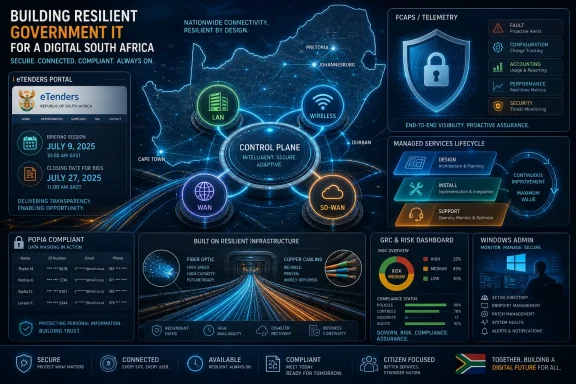 SITA’s Networking Tender Turns Cabling Into Policy
SITA’s transversal networking bid is not merely a request for switches and routers. It folds ethernet switches, wireless LAN, WAN routing, SD-WAN, backhaul, copper and fibre cabling, peripherals, network management, and a long menu of services into a single accreditation-style contract. That matters because transversal contracts are designed to be reused across government, turning one procurement process into a purchasing vehicle for multiple organs of state.The tender language is broad enough to cover the physical layer, the logical layer, and the operational layer. It asks not only for supply and delivery but for needs analysis, consultation, design, specification, programming, integration, commissioning, training, support, operations, maintenance, optimisation, automation, and end-of-life services. In plain English, SITA is not buying a box; it is buying a lifecycle.
That lifecycle framing is the most important signal in the advert. Government networks are no longer static estates where hardware is installed, labelled, and left to age until the next capital refresh. They are platforms that must carry cloud workloads, identity traffic, endpoint management, collaboration, video, digital health systems, records platforms, and citizen-facing applications.
The tender’s reference to intelligent OSS/BSS applications and FCAPS makes the intent even clearer. FCAPS — fault, configuration, accounting, performance, and security management — is old telecom vocabulary, but it fits the moment. Public-sector networks increasingly need telecom-grade visibility, not just an SNMP dashboard and a spreadsheet of uplinks.
The Five-Year Frame Rewards Operators, Not Box Shifters
A five-year networking contract changes the vendor calculus. A bidder can no longer win convincingly by leading with discounts on hardware alone. The contract requires warranties, on-site support, maintenance plans, and optional support extensions, which pushes the competition toward suppliers that can staff, monitor, automate, and troubleshoot across a messy multi-site estate.That is good news for mature integrators and less comfortable for resellers whose value proposition stops at procurement. A government-wide network contract demands logistics, spares, field engineers, escalation paths, security alignment, and documentation discipline. It also demands the ability to coexist with what is already installed, because public-sector networks rarely enjoy clean-sheet replacement.
The scale implied by SITA’s wording also raises a governance issue. The more a transversal contract standardises purchasing, the more it can shape architecture across departments that have different local requirements. Standardisation can reduce duplication and support costs, but it can also harden one generation of design decisions into five years of default choices.
That is where the requirement for optimisation and automation becomes significant. If SITA and its suppliers treat automation as an afterthought, the contract risks becoming a large hardware catalogue with better paperwork. If they treat it as a core operating model, the contract could help departments move away from brittle, manually configured networks that struggle to support modern service delivery.
SD-WAN Is the Quiet Admission That the Perimeter Has Moved
The inclusion of SD-WAN is not surprising, but it is revealing. South African government departments, like their counterparts elsewhere, now operate across central offices, provincial offices, remote sites, hosted services, cloud platforms, and hybrid application estates. Traditional WAN architecture was built for a world where branch traffic came back to a central data centre; that world has been fading for years.SD-WAN does not magically solve bandwidth, uptime, or security problems. It can, however, give administrators more policy control over how traffic moves across multiple links and destinations. For departments using Microsoft 365, cloud-hosted applications, VPNs, and remote management tooling, routing everything through legacy chokepoints can become both expensive and fragile.
The practical question is whether the contract will encourage architectural modernisation or merely rename existing WAN refreshes. A modern SD-WAN deployment needs application-aware routing, telemetry, security integration, and operational maturity. Without those, it becomes another managed router service with a shinier console.
For Windows shops, the shift is especially relevant because endpoint identity, update management, Defender telemetry, Intune policies, Entra ID sign-ins, remote desktop services, file access, and collaboration traffic all depend on network assumptions. When the network is unreliable or opaque, Windows administration becomes guesswork. When the network is observable and policy-driven, the operating system estate becomes easier to secure and support.
The Tender List Shows a State Rebuilding Its Operational Core
The SITA networking bid takes the top spot, but the rest of the tender slate is just as instructive. SITA is also seeking VMware enterprise licence products, upgrades, installation, configuration, maintenance, and support for the Department of Water and Sanitation. The Companies and Intellectual Property Commission wants a data masking solution to support POPIA compliance. The Presidency wants governance, risk, and compliance software for five years.These are not glamour projects. They are the mechanics of institutional IT: virtualisation, privacy, risk dashboards, server support, disaster recovery, backup, monitoring, medical records rollout, and industrial protocol remediation. That is precisely why they matter.
The Department of Trade, Industry and Competition’s requirement for HPE server infrastructure support is another reminder that on-premises infrastructure remains firmly embedded in public-sector operations. Cloud strategy may dominate conference stages, but government services still run on physical servers, SANs, hypervisors, backup appliances, and old integrations whose failure would be immediately visible to citizens and staff.
The Eastern Cape Department of Public Works and Infrastructure’s disaster recovery and managed backup tender makes the same point from a resilience angle. The stated goals — uninterrupted disaster recovery capability, compliance with recovery time and recovery point objectives, ICT continuity, and secure off-site cloud replication within South Africa — are the language of organisations that know downtime is not theoretical. Backup is no longer a back-office insurance policy; it is one of the central security controls of the ransomware era.
POPIA Turns Data Masking From Nice-to-Have Into Survival Gear
The CIPC’s data masking tender deserves more attention than it will probably get. Data masking is rarely politically visible, but it is one of the technologies that separates serious privacy programmes from compliance theatre. If developers, testers, analysts, support teams, and vendors can access production-like data without exposing real personal information, the organisation reduces risk without freezing delivery.POPIA compliance gives the requirement a statutory edge, but the operational logic goes beyond South African law. Public agencies hold citizen identifiers, company records, contact details, case histories, financial information, and records that can be damaging if leaked or misused. Masking protects against both external compromise and ordinary internal overexposure.
The tender’s scope across external-facing digital platforms, internal operational systems, and legacy environments is important. Privacy failures often occur not in the shiny new portal but in the forgotten database copy, the test environment, the reporting extract, or the legacy system that everyone is afraid to touch. A credible masking solution has to handle that mess.
For Windows-heavy estates, this can become a database, identity, and access-control challenge. SQL Server environments, file shares, application servers, Active Directory groups, privileged access workflows, and audit logs all become part of the privacy boundary. Masking works best when it is not bolted on at the end but built into the way teams move data through development and operations.
The Presidency’s GRC Purchase Reflects a Dashboard-Hungry Government
The Presidency’s request for governance, risk, and compliance system software is a different kind of infrastructure project. It is not about packets, storage, or CPU cycles. It is about the management layer that sits above them, where executives want risk exposures identified, measured, mitigated, monitored, analysed, and turned into dashboards.GRC platforms can be useful, but they can also become expensive filing cabinets. Their value depends on whether they connect to real operational evidence or merely collect manually updated status reports. In organisations where risk registers are detached from patch levels, backup tests, identity reviews, incident response exercises, procurement exceptions, and audit findings, a GRC system can create the appearance of control without the substance.
The tender’s inclusion of analytics, reports, dashboards, and user training suggests an attempt to move risk management into daily decision-making. That is the right ambition. The danger is that dashboard culture can reward what is easy to count rather than what is most important.
For IT pros, the question is whether such a platform will ingest meaningful data from service management, security tools, vulnerability scanners, backup platforms, endpoint management systems, and change controls. If it does, it can help align technology risk with business accountability. If it does not, administrators will simply inherit another reporting burden.
eThekwini’s Fibre Estate Becomes a Commercial Asset
eThekwini Metropolitan Municipality’s tender for wholesaling excess network capacity is one of the more commercially interesting items in the list. The municipality says its fibre-optic network stretches from Craigieburn in the south to Tongaat in the north and Cato Ridge in the west, with approximately 2,800km of installed fibre. It already wholesales excess capacity to licensed service providers, which then sell to customers.That changes how municipal infrastructure should be viewed. A city fibre network is not only a connectivity tool for government buildings and services. If managed carefully, it can become a wholesale platform that supports local broadband competition and generates value from sunk infrastructure.
The risk is that wholesaling network capacity requires carrier-grade operational discipline. Service providers and commercial premises expect availability, provisioning processes, fault response, capacity planning, and predictable terms. A municipal network built primarily for internal service delivery may need a different operating model when third parties depend on it.
The companion tender for corporate network management monitoring maintenance reinforces that point. eThekwini says its core MPLS network has grown substantially alongside its fibre footprint and that demand now requires an upgrade to a new network platform. The existing Cisco ASR and Nexus 7k references place this squarely in the world of serious carrier and data-centre networking, not municipal Wi-Fi tinkering.
Health’s EMR Rollout Is Where Infrastructure Meets the Citizen
The national Department of Health’s electronic medical record rollout is the tender most likely to affect ordinary people directly. The department wants service providers to support the rollout of its bespoke EMR digital solution across all fixed primary healthcare facilities in eight provinces over 18 months. The work includes project management, risk and issue handling, hardware installation, software setup, testing, go-live processes, user training, change management, and usage monitoring.That is an enormous implementation challenge. EMR projects do not fail only because software is inadequate. They fail because clinics lack stable connectivity, devices are insufficient, staff are undertrained, workflows are poorly understood, identity and access controls are weak, support is slow, and data quality collapses under operational pressure.
The tender’s emphasis on training, capacity building, change management, and monitoring usage is therefore encouraging. Digitising a clinical encounter is not the same as installing an application. It changes how nurses, clerks, clinicians, administrators, and managers work under pressure.
This is also where the SITA networking contract and the health tender intersect. An EMR system depends on networks, endpoint reliability, identity services, backup, monitoring, and support. If the infrastructure layer is weak, the application layer will be blamed for failures it did not cause.
VMware Licensing Shows the Hybrid Estate Is Still Alive
The Department of Water and Sanitation’s VMware enterprise licence procurement is a reminder that virtualised server infrastructure remains a backbone technology. Despite years of cloud migration talk, many public-sector workloads still run in VMware environments because they are stable, familiar, and integrated into existing operational processes. Licensing, upgrades, configuration, support, and maintenance are not optional extras; they are the cost of keeping that estate governable.VMware procurement also sits in a more complicated market than it did a few years ago. Customers worldwide have been reassessing virtualisation licensing, support models, and long-term platform choices amid vendor changes and price sensitivity. A government department seeking a 36-month agreement is not just buying continuity; it is buying time.
That time can be used well or wasted. Used well, it allows an organisation to rationalise workloads, improve backup and recovery, modernise monitoring, document dependencies, and decide which systems should stay on-premises, move to cloud, or be rebuilt. Wasted, it simply extends the current architecture until the next procurement cycle arrives with the same unresolved questions.
For Windows Server administrators, VMware remains part of the daily fabric. Domain controllers, application servers, SQL Server workloads, file services, management servers, and legacy applications often live there. Any licensing or support disruption quickly becomes an operating-system problem, even when the root cause sits in procurement.
Eskom’s OPC Problem Is a Windows Security Story in Industrial Clothing
Eskom’s request for information may be the most WindowsForum-relevant item in the entire set. The utility is looking for commercially available or proven technology to re-engineer OPC Data Access communication for control systems affected by Microsoft security changes on Windows systems using OPC Classic architecture over DCOM. It notes that OEM support is no longer available because the relevant vendors have exited the business.That sentence contains years of accumulated technical debt. OPC DA is part of the older OPC Classic family, widely used in industrial automation and SCADA environments. It relies on Microsoft COM and DCOM for communication, which made sense in a Windows-centric industrial world but became increasingly awkward as security expectations changed.
Microsoft’s DCOM hardening programme, tied to a Windows security feature bypass vulnerability, forced organisations to confront old assumptions about remote activation and authentication. Many ordinary enterprise applications adjusted quietly, but industrial environments are different. They often include long-lived systems, vendor appliances, unsupported software, fragile integrations, and operational constraints that make patching and reconfiguration risky.
Eskom’s RFI is therefore not just a search for a protocol bridge. It is a public example of what happens when Windows security improvements collide with control systems designed for longevity over agility. The utility’s mention of absent OEM support makes the issue sharper: when the original vendor is gone, the customer inherits the architecture.
DCOM Hardening Exposed the Cost of Assuming Windows Would Stay Still
For decades, industrial and enterprise software treated Windows as both a platform and a compatibility contract. If an application worked on a particular version, organisations often expected to preserve it through careful patching, network isolation, and institutional memory. That bargain has become harder to maintain.Security hardening changes are not arbitrary. DCOM’s historical flexibility created risk, especially where unauthenticated or weakly authenticated remote activation could be abused. Microsoft’s move to strengthen authentication was the kind of platform change security teams want and legacy operators fear.
The conflict is not between security and reliability in some abstract sense. It is between two forms of risk that land on different schedules. A security vulnerability is a live exposure that attackers may exploit; a broken control-system integration is an operational failure that may interrupt essential services immediately.
This is why Eskom’s RFI deserves attention beyond South Africa. Utilities, manufacturers, mines, transport operators, and public infrastructure providers around the world face similar decisions. They can harden DCOM configurations, deploy gateways, migrate to OPC UA, encapsulate legacy systems, segment networks more aggressively, or re-engineer applications — but none of those paths is free.
The Microsoft Teams Briefing Is Now the Procurement Default
Several tenders in the list use Microsoft Teams for compulsory or non-compulsory briefings. That detail seems mundane, but it reflects how collaboration platforms have become part of procurement infrastructure. Tender clarification sessions, once tied to physical venues and travel logistics, now run through the same enterprise communication stack used for daily meetings.This has obvious benefits. Remote briefings widen access, reduce costs, and create a cleaner administrative trail when questions and answers are consolidated. They also favour bidders with mature digital workflows and reliable connectivity.
But Teams briefings also illustrate a subtle dependency. Public procurement now assumes that suppliers can operate inside Microsoft’s collaboration ecosystem, manage calendar invites, links, identity prompts, audio, chat, document downloads, and meeting etiquette. For smaller suppliers, especially those with constrained connectivity or less polished back-office systems, that assumption can still create friction.
It is a small example of a larger shift. Microsoft 365, Teams, Windows endpoints, identity systems, and cloud storage are not just productivity tools anymore. They increasingly mediate how governments buy, govern, communicate, and deliver services.
The Tender Calendar Compresses Ambition Into July
The closing dates are tight. CIPC’s data masking bid closes on July 6. The Department of Trade, Industry and Competition’s HPE support tender closes on July 10. The Department of Health’s EMR rollout closes on July 13. Eskom’s RFI closes on July 14. The Presidency’s GRC tender closes on July 20. Several major infrastructure and networking bids close on July 23, July 24, and July 27.That schedule matters because complex bids require more than pricing. Vendors need to assess technical scope, partner requirements, legal terms, staffing commitments, compliance obligations, and delivery risk. When public-sector buyers ask for sophisticated managed services on short timelines, they may unintentionally favour incumbents and larger firms with prebuilt bid machinery.
This is not necessarily evidence of poor procurement. Government buying cycles are shaped by budget windows, administrative deadlines, and policy requirements. But it does raise a practical concern: the more complex the requirement, the more time the market needs to respond well.
For buyers, rushed complexity can translate into thin responses, risk-loaded pricing, or bids that look compliant on paper but lack delivery depth. For suppliers, it can encourage templated promises rather than careful solution design. In infrastructure, those shortcuts tend to surface later as change requests, support gaps, and implementation delays.
Government IT Is Buying Resilience Because It Has Learned Fragility
The common thread running through the tender list is resilience. Networking resilience. Backup resilience. Virtualisation support resilience. Privacy resilience. Risk visibility. Medical-record rollout capacity. Industrial protocol continuity. Even the wholesaling of municipal fibre capacity depends on operational resilience if third-party providers are to trust the platform.This is the post-pandemic, post-ransomware, hybrid-government procurement landscape. Public-sector IT leaders have learned that digital services are not merely websites and applications. They are chains of dependency that run through power, fibre, identity, endpoints, hypervisors, databases, backup vaults, monitoring systems, administrators, and service providers.
The SITA networking tender sits at the centre of that chain because almost everything else depends on connectivity. Data masking tools need access to systems and databases. GRC tools need integrations and evidence feeds. EMR rollouts need clinics online. Backup replication needs reliable links. VMware support needs management access. OPC remediation may need segmented architectures and secure bridges.
This is why the phrase related services does so much work in the SITA advert. In mature infrastructure, the service wrap is not peripheral. It is the difference between a network that exists and a network that can be trusted.
Windows Admins Should Read This as a Dependency Map
For WindowsForum readers, the South African tender list is not just a procurement digest from another market. It is a dependency map for modern Windows estates. The operating system is embedded in virtualisation clusters, industrial control systems, endpoint fleets, collaboration workflows, risk platforms, databases, and health applications.The Eskom item shows the danger of assuming old Windows integration patterns can continue indefinitely. The VMware tender shows that Windows Server workloads still rely heavily on hypervisor licensing and support stability. The EMR rollout shows how endpoint configuration, identity, printing, local networks, and user training can make or break national digital projects.
The data masking tender points to another Windows-adjacent reality: administrators are custodians of sensitive data even when they do not own the business process. File servers, SQL instances, application service accounts, remote access tools, and backup copies all become privacy risk surfaces. Security is no longer just patching and antivirus; it is knowing where the data goes.
The networking contract ties these pieces together. If SITA’s transversal vehicle improves standardisation, monitoring, automation, and support quality, many downstream projects become easier. If it becomes another slow procurement wrapper around fragmented implementation, departments will continue solving infrastructure problems one tender at a time.
The July Bids Reveal the Real Modernisation Agenda
The most concrete lesson from this tender slate is that public-sector modernisation is not one big transformation programme. It is a stack of unglamorous procurements that decide whether transformation can survive contact with reality. The July deadlines should be read less as isolated opportunities and more as an infrastructure agenda taking shape through purchasing.- SITA’s five-year transversal networking contract could influence government LAN, WAN, SD-WAN, wireless, cabling, management, and support standards well beyond a single department.
- The strongest bidders will need operational depth, not just hardware pricing, because the contract bundles design, installation, support, optimisation, automation, and lifecycle services.
- Eskom’s OPC DA request shows how Windows security hardening can force industrial operators to re-engineer legacy DCOM-dependent systems when vendor support has disappeared.
- The Department of Health’s EMR rollout will depend as much on connectivity, devices, training, and change management as on the clinical software itself.
- CIPC’s data masking bid reflects a broader move from privacy policy to technical enforcement across production, internal, external, and legacy environments.
- eThekwini’s fibre tenders show that municipal networks can become wholesale infrastructure assets, but only if managed with carrier-grade discipline.
References
- Primary source: ITWeb
Published: 2026-06-29T11:42:09.706061
Top ICT tenders: Transversal networking contract up for grabs | ITWeb
The hardware and services contract will run for a period of five years, says the State IT Agency. www.itweb.co.za
