

Qualcomm announced Snapdragon C on May 28, 2026, as a new entry-level Arm processor family for Windows 11 PCs, with Acer, HP, and Lenovo preparing systems that target roughly $300-and-up price points. The pitch is simple: bring the battery-life and quiet-design story of Windows on Arm down from premium Copilot+ PCs into the market where Chromebooks and Apple’s $599 MacBook Neo now set the expectations. The harder question is whether Windows can survive that descent without repeating the netbook era’s oldest mistake: making “cheap” feel like a warning label. Snapdragon C is less a chip announcement than a referendum on whether Microsoft’s PC ecosystem can finally make low-cost Windows feel modern.
For most of the Windows-on-Arm revival, Qualcomm’s public case has been aspirational. Snapdragon X Elite and its successors were positioned against MacBook Airs, premium ultrabooks, and business-class machines where buyers could be persuaded to care about silent operation, standby time, and local AI performance. Snapdragon C turns that argument upside down. It is not asking whether Arm can beat Intel at the top; it is asking whether Arm can rescue the bottom of the Windows laptop shelf.
That matters because the low end of the PC market has always been where Windows’ strengths and weaknesses are most exposed. Windows has the application catalog, the peripheral compatibility, the enterprise familiarity, and the accumulated muscle memory of decades. It also has the background services, update complexity, driver baggage, and OEM cost-cutting habits that can make a $299 laptop feel like a punishment.
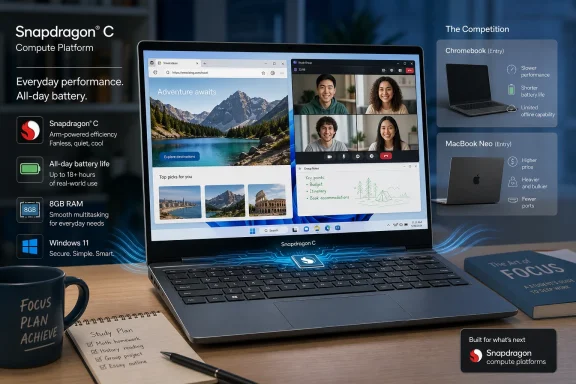
Qualcomm is presenting Snapdragon C as a way to change that equation. The company is talking about all-day battery life, cool and quiet designs, responsive everyday performance, and “AI capabilities,” but it is notably not pretending this is a flagship platform in disguise. The new family is aimed at light productivity, media consumption, student use, family computing, and small-business front-of-house tasks. That is the polite way of saying email, browser tabs, Office, video calls, streaming, school portals, and the occasional printer driver nightmare.
The obvious competitive targets are Chromebooks and Apple’s new MacBook Neo. But the more uncomfortable target is the existing low-cost Windows laptop, the machine that ships with just enough storage to update itself once, just enough RAM to make Edge feel apologetic, and just enough battery life to disappoint a student by lunch. Snapdragon C is an attempt to make that category less embarrassing.
That is why Snapdragon C’s $300-ish positioning is both exciting and dangerous. A chip can help with idle power, thermals, connected standby, and battery life. It cannot magically make a bad panel readable, a cramped chassis sturdy, or 4GB of RAM acceptable in a modern Windows machine. If OEMs treat Snapdragon C as permission to build the cheapest possible Windows laptop, the platform will inherit every complaint people already have about budget PCs.
There is at least one encouraging sign: Thurrott reports that Snapdragon C-based PCs will start with 8GB of RAM. That should be the floor, not a feature. In 2026, an 8GB Windows laptop is still not luxurious, but it is at least plausible for the audience Qualcomm is naming: students, families, and customer-facing small businesses. A 4GB Windows 11 machine belongs in a museum exhibit about avoidable suffering.
The real contest, then, is not whether Qualcomm can technically produce a low-power SoC. It almost certainly can. The contest is whether Acer, HP, Lenovo, Microsoft, and Qualcomm can hold the line on minimum viable quality at a price point where every dollar has a lobbyist.
That creates a problem for Windows vendors. A $299 Windows laptop does not have to match a $599 MacBook spec-for-spec, but it does have to justify itself as more than half as good for half the money. If the MacBook Neo becomes the mental benchmark for parents, students, and casual users, then the old Windows defense — “it was cheap” — becomes less persuasive.
Qualcomm’s answer is volume and variety. A Snapdragon C laptop can be smaller, larger, cheaper, convertible, education-focused, business-focused, ruggedized, or simply boring in the way procurement departments appreciate. Apple will sell the MacBook Neo as a singular object. Windows OEMs will sell a category.
That is both the PC ecosystem’s superpower and its curse. Choice lets Windows meet markets Apple ignores. Choice also creates aisle confusion, where two machines with similar names and prices can differ wildly in RAM, storage, display quality, Wi-Fi, keyboard, and support lifespan. Snapdragon C gives OEMs a new ingredient. It does not guarantee they will cook the same meal.
That absence is not automatically damning. Entry-level silicon is often announced first as a platform story and specified later as devices get closer to launch. But it does mean the announcement should be read as a market-positioning move, not a performance claim. The words “responsive performance” do a lot of work in low-end PC marketing, and historically they have meant everything from “pleasant enough” to “please close three tabs.”
The Copilot+ PC angle is equally revealing. Snapdragon C is not being positioned as inherently Copilot+ capable. That likely means some combination of NPU performance, memory configuration, or product segmentation keeps it outside Microsoft’s premium AI PC badge. In practical terms, that may not matter much to the students and families Qualcomm is courting. Most buyers in this bracket are not comparison-shopping NPUs.
But for Microsoft, it matters symbolically. The company has spent two years trying to make Copilot+ PCs feel like the future of Windows. Snapdragon C suggests that the future will be tiered: premium Arm PCs with the full AI badge, and cheaper Arm PCs that get the battery-life story without the same local-AI branding. That may be sensible. It also risks turning “AI PC” into another label customers learn to ignore.
For many ordinary users, the browser is the platform. Microsoft 365, Google Workspace, Teams, Zoom, Slack, YouTube, Netflix, school management systems, and banking sites define the daily workload. Native Arm support for mainstream apps has improved significantly since the awkward first wave of Windows-on-Arm devices, and emulation is no longer the existential liability it once was. The cheaper the machine, the more likely the buyer’s workload is to fit the platform’s strengths.
That does not erase compatibility concerns. Windows’ advantage is that users assume it will run the thing — the old utility, the obscure VPN client, the test-proctoring software, the label printer package, the classroom app that has not been updated since 2018. Arm breaks that assumption often enough that it becomes a support issue, especially in education and small business where there may be no IT department to translate processor architecture into buying advice.
Qualcomm and Microsoft therefore need to make Snapdragon C machines boring in the best sense. Users should not have to know they bought an Arm PC because something failed unexpectedly. If the platform is noticed mainly because the fan is absent and the battery meter moves slowly, it wins. If it is noticed because a required app behaves strangely, it loses.
This is where Chromebooks remain dangerous. ChromeOS is not beloved because it is more powerful than Windows. It is beloved in schools and homes because it is comparatively hard to ruin, easy to manage, and legible to non-enthusiasts. Windows has deeper capability, but capability is not the same as confidence. At $300, confidence matters.
Microsoft also has to decide how aggressively it wants to use these machines as on-ramps into its services. The temptation will be obvious: Microsoft 365, Copilot, OneDrive storage, Xbox Cloud Gaming, Edge, and the Microsoft Store all become more valuable as cheap Windows hardware proliferates. But the more Windows feels like a funnel, the more users compare it unfavorably with the simplicity of alternatives.
The best version of Snapdragon C Windows is not a miniature premium PC. It is a disciplined basic PC. That requires restraint from Microsoft and OEMs alike, and restraint has rarely been the PC industry’s most profitable instinct.
The OEM incentives are complicated. A $299 starting price is useful for headlines and retail filters. The better products may sit at $399 or $499, where there is enough budget for a decent display, more storage, and a chassis that does not creak under normal typing. That middle range is where Snapdragon C could be most interesting: not as the cheapest Windows PC, but as the first cheap Windows PC that does not feel like a compromise stack.
Education will be a particularly important test. Schools buy for price, manageability, durability, battery life, and replacement cycles. They also care about keyboards that survive children, hinges that survive backpacks, and support images that do not create seasonal misery for administrators. A Snapdragon C education laptop with strong battery life and quiet thermals could be appealing, but only if Windows management and app compatibility do not make ChromeOS look easy by comparison.
Small businesses are another plausible audience. A front-desk machine, point-of-service companion, field intake laptop, or shared family-business PC does not need workstation horsepower. It needs reliability, battery endurance, video calls, browser performance, and peripheral support. That last item is where Windows should shine — and where Arm compatibility must be invisible.
For enthusiasts, the distinction is understandable. Not every NPU is equal. Not every device has enough memory. Not every Windows feature should be promised on every machine. For retail shoppers, however, the distinction may be muddy. A box that says Snapdragon, AI, and Windows 11 but not Copilot+ may invite exactly the kind of confusion Microsoft has spent years trying to reduce.
This is not just a marketing issue. It affects support expectations. If a buyer sees AI-branded Windows features in commercials but buys a cheaper Snapdragon C laptop that lacks some of them, the failure will be attributed to Windows, not to NPU TOPS or memory thresholds. The PC industry has a long history of inventing badges that make sense internally and dissolve under fluorescent retail lighting.
The solution is not to pretend Snapdragon C is more than it is. The solution is to sell it honestly. Battery life, silence, instant-on behavior, and a sane baseline configuration are more valuable to this audience than a half-explained promise of local AI. If Qualcomm and Microsoft can resist the urge to AI-wash a budget laptop, they may find the simpler story is stronger.
Intel and AMD still dominate the Windows PC ecosystem, and x86 remains the safest compatibility choice. But the low end is exactly where their traditional strengths can become less visible. If the user lives in the browser and Office, the difference between x86 and Arm matters less than whether the laptop wakes instantly and lasts through the day. Performance per watt becomes more emotionally meaningful than peak benchmark performance.
That does not mean Snapdragon C will automatically win. Intel and AMD have efficient low-end parts, mature driver ecosystems, and broad OEM relationships. They also benefit from buyer inertia and IT familiarity. But Qualcomm is attacking a weakness the x86 ecosystem has tolerated for too long: cheap Windows laptops that feel cheap in motion, not just on paper.
Competition here is healthy. If Snapdragon C forces x86 budget PCs to improve battery life, thermals, and baseline configurations, users win even if they never buy a Qualcomm-powered laptop. The point is not that Arm must conquer the low end. The point is that the low end has needed pressure for years.
The more important issue is consistency. A laptop that lasts twelve hours in a browser test but stumbles during video calls, school portals, or background updates will not feel trustworthy. A machine that sleeps efficiently but drains unpredictably in a backpack will resurrect old Windows standby complaints. A budget PC has less margin for disappointment because its buyer may not have the money or patience to replace it quickly.
Thermals are part of the same story. Fanless or quiet designs are attractive only if performance remains stable under normal workloads. Nobody buying a Snapdragon C laptop should expect workstation behavior, but they should expect the machine not to bog down during a Teams call with a few browser tabs open. That is the practical bar.
Reviewers will need to test these machines like real cheap laptops, not like failed premium laptops. The right questions are not whether Snapdragon C can compile a giant codebase or crush a gaming benchmark. The right questions are whether it can survive a school day, a family evening, a week of updates, and a messy pile of mainstream apps without making the owner regret saving money.
Snapdragon C is not a netbook platform, but it enters a market shaped by the same temptation. The temptation is to chase the lowest headline price, move units through back-to-school promotions, and let the user experience be someone else’s problem. That approach can succeed quarterly and fail strategically.
The better lesson from netbooks is that cheap hardware still needs dignity. A budget laptop can have limits without feeling cynical. It can be modest without being miserable. It can say no to gaming, heavy creative workloads, and advanced AI features while still saying yes to a good keyboard, competent display, fast wake, reliable Wi-Fi, and enough RAM.
If Snapdragon C helps the PC industry relearn that lesson, it will matter more than its benchmark scores. If it becomes another excuse to flood retail shelves with compromised Windows machines, it will be remembered as a missed opportunity wrapped in an efficient SoC.
The most concrete things to watch are not the slogans. They are the configurations, the screens, the memory floor, the storage choices, the update behavior, and the first wave of reviews from people using these machines as actual low-cost PCs. The platform will succeed or fail in those details.
 Qualcomm Moves the Arm Argument Downmarket
For most of the Windows-on-Arm revival, Qualcomm’s public case has been aspirational. Snapdragon X Elite and its successors were positioned against MacBook Airs, premium ultrabooks, and business-class machines where buyers could be persuaded to care about silent operation, standby time, and local AI performance. Snapdragon C turns that argument upside down. It is not asking whether Arm can beat Intel at the top; it is asking whether Arm can rescue the bottom of the Windows laptop shelf.That matters because the low end of the PC market has always been where Windows’ strengths and weaknesses are most exposed. Windows has the application catalog, the peripheral compatibility, the enterprise familiarity, and the accumulated muscle memory of decades. It also has the background services, update complexity, driver baggage, and OEM cost-cutting habits that can make a $299 laptop feel like a punishment.
Qualcomm is presenting Snapdragon C as a way to change that equation. The company is talking about all-day battery life, cool and quiet designs, responsive everyday performance, and “AI capabilities,” but it is notably not pretending this is a flagship platform in disguise. The new family is aimed at light productivity, media consumption, student use, family computing, and small-business front-of-house tasks. That is the polite way of saying email, browser tabs, Office, video calls, streaming, school portals, and the occasional printer driver nightmare.
The obvious competitive targets are Chromebooks and Apple’s new MacBook Neo. But the more uncomfortable target is the existing low-cost Windows laptop, the machine that ships with just enough storage to update itself once, just enough RAM to make Edge feel apologetic, and just enough battery life to disappoint a student by lunch. Snapdragon C is an attempt to make that category less embarrassing.
The $300 Windows PC Has Always Been a Trap
Windows OEMs know how to hit a price point. The problem is that they often hit it by removing everything users notice after the receipt is printed. Displays get dimmer, storage gets slower, keyboards get mushier, trackpads get weird, webcams get grainy, and batteries get smaller. The CPU, meanwhile, gets blamed for a whole system engineered around compromise.That is why Snapdragon C’s $300-ish positioning is both exciting and dangerous. A chip can help with idle power, thermals, connected standby, and battery life. It cannot magically make a bad panel readable, a cramped chassis sturdy, or 4GB of RAM acceptable in a modern Windows machine. If OEMs treat Snapdragon C as permission to build the cheapest possible Windows laptop, the platform will inherit every complaint people already have about budget PCs.
There is at least one encouraging sign: Thurrott reports that Snapdragon C-based PCs will start with 8GB of RAM. That should be the floor, not a feature. In 2026, an 8GB Windows laptop is still not luxurious, but it is at least plausible for the audience Qualcomm is naming: students, families, and customer-facing small businesses. A 4GB Windows 11 machine belongs in a museum exhibit about avoidable suffering.
The real contest, then, is not whether Qualcomm can technically produce a low-power SoC. It almost certainly can. The contest is whether Acer, HP, Lenovo, Microsoft, and Qualcomm can hold the line on minimum viable quality at a price point where every dollar has a lobbyist.
Apple’s MacBook Neo Changed the Comparison Before Qualcomm Arrived
Apple’s $599 MacBook Neo is important not because it is cheap in absolute terms, but because it resets what “entry level” is supposed to feel like. Apple did not enter the Chromebook-adjacent market by selling a visibly distressed Mac. It entered with a colorful, low-cost machine that still carries the Mac brand’s core promise: coherent hardware, long battery life, predictable performance, and fewer configuration traps.That creates a problem for Windows vendors. A $299 Windows laptop does not have to match a $599 MacBook spec-for-spec, but it does have to justify itself as more than half as good for half the money. If the MacBook Neo becomes the mental benchmark for parents, students, and casual users, then the old Windows defense — “it was cheap” — becomes less persuasive.
Qualcomm’s answer is volume and variety. A Snapdragon C laptop can be smaller, larger, cheaper, convertible, education-focused, business-focused, ruggedized, or simply boring in the way procurement departments appreciate. Apple will sell the MacBook Neo as a singular object. Windows OEMs will sell a category.
That is both the PC ecosystem’s superpower and its curse. Choice lets Windows meet markets Apple ignores. Choice also creates aisle confusion, where two machines with similar names and prices can differ wildly in RAM, storage, display quality, Wi-Fi, keyboard, and support lifespan. Snapdragon C gives OEMs a new ingredient. It does not guarantee they will cook the same meal.
The Missing Specs Are the Story
Qualcomm has not yet provided the kind of technical disclosure that would let buyers, reviewers, or IT departments make a grounded judgment. Windows Central reports that Snapdragon C does not use Qualcomm’s Oryon cores, the custom CPU architecture that underpins the company’s higher-end PC push. The company has also not detailed the NPU, CPU configuration, GPU, process node, memory support, or performance targets in the way enthusiasts would expect.That absence is not automatically damning. Entry-level silicon is often announced first as a platform story and specified later as devices get closer to launch. But it does mean the announcement should be read as a market-positioning move, not a performance claim. The words “responsive performance” do a lot of work in low-end PC marketing, and historically they have meant everything from “pleasant enough” to “please close three tabs.”
The Copilot+ PC angle is equally revealing. Snapdragon C is not being positioned as inherently Copilot+ capable. That likely means some combination of NPU performance, memory configuration, or product segmentation keeps it outside Microsoft’s premium AI PC badge. In practical terms, that may not matter much to the students and families Qualcomm is courting. Most buyers in this bracket are not comparison-shopping NPUs.
But for Microsoft, it matters symbolically. The company has spent two years trying to make Copilot+ PCs feel like the future of Windows. Snapdragon C suggests that the future will be tiered: premium Arm PCs with the full AI badge, and cheaper Arm PCs that get the battery-life story without the same local-AI branding. That may be sensible. It also risks turning “AI PC” into another label customers learn to ignore.
Windows on Arm Finally Gets the Use Case It Should Have Had First
There is an irony here: low-cost, long-battery, low-heat laptops are arguably the most natural use case for Windows on Arm. The earliest Windows-on-Arm PCs tried to sell always-connected mobility before the software ecosystem was ready. The premium Snapdragon X generation tried to prove that Arm could be fast enough for serious PC buyers. Snapdragon C lands in the middle of those lessons. It does not need to beat a workstation. It needs to make a cheap laptop feel less cheap.For many ordinary users, the browser is the platform. Microsoft 365, Google Workspace, Teams, Zoom, Slack, YouTube, Netflix, school management systems, and banking sites define the daily workload. Native Arm support for mainstream apps has improved significantly since the awkward first wave of Windows-on-Arm devices, and emulation is no longer the existential liability it once was. The cheaper the machine, the more likely the buyer’s workload is to fit the platform’s strengths.
That does not erase compatibility concerns. Windows’ advantage is that users assume it will run the thing — the old utility, the obscure VPN client, the test-proctoring software, the label printer package, the classroom app that has not been updated since 2018. Arm breaks that assumption often enough that it becomes a support issue, especially in education and small business where there may be no IT department to translate processor architecture into buying advice.
Qualcomm and Microsoft therefore need to make Snapdragon C machines boring in the best sense. Users should not have to know they bought an Arm PC because something failed unexpectedly. If the platform is noticed mainly because the fan is absent and the battery meter moves slowly, it wins. If it is noticed because a required app behaves strangely, it loses.
Microsoft Needs More Than a Silicon Partner
Snapdragon C puts pressure on Microsoft because this is not merely Qualcomm’s fight. Windows 11 has to scale down gracefully, and that has not always been its defining talent. A low-cost Arm laptop that boots quickly, sleeps reliably, updates cleanly, and avoids nagging users into subscription fatigue would be a compelling device. A low-cost Arm laptop that spends its first hour pulling updates, surfacing ads, and explaining OneDrive backups to a confused parent would be business as usual.This is where Chromebooks remain dangerous. ChromeOS is not beloved because it is more powerful than Windows. It is beloved in schools and homes because it is comparatively hard to ruin, easy to manage, and legible to non-enthusiasts. Windows has deeper capability, but capability is not the same as confidence. At $300, confidence matters.
Microsoft also has to decide how aggressively it wants to use these machines as on-ramps into its services. The temptation will be obvious: Microsoft 365, Copilot, OneDrive storage, Xbox Cloud Gaming, Edge, and the Microsoft Store all become more valuable as cheap Windows hardware proliferates. But the more Windows feels like a funnel, the more users compare it unfavorably with the simplicity of alternatives.
The best version of Snapdragon C Windows is not a miniature premium PC. It is a disciplined basic PC. That requires restraint from Microsoft and OEMs alike, and restraint has rarely been the PC industry’s most profitable instinct.
Acer, HP, and Lenovo Will Decide Whether the Platform Has Dignity
Qualcomm can announce the chip, but Acer, HP, and Lenovo will define the reputation. Their first Snapdragon C designs will set the visual and experiential baseline. If the machines arrive as flimsy gray slabs with poor screens and bargain-bin storage, Snapdragon C will be remembered as another low-end part. If they arrive as quiet, attractive, competent laptops with sensible configurations, the market may notice.The OEM incentives are complicated. A $299 starting price is useful for headlines and retail filters. The better products may sit at $399 or $499, where there is enough budget for a decent display, more storage, and a chassis that does not creak under normal typing. That middle range is where Snapdragon C could be most interesting: not as the cheapest Windows PC, but as the first cheap Windows PC that does not feel like a compromise stack.
Education will be a particularly important test. Schools buy for price, manageability, durability, battery life, and replacement cycles. They also care about keyboards that survive children, hinges that survive backpacks, and support images that do not create seasonal misery for administrators. A Snapdragon C education laptop with strong battery life and quiet thermals could be appealing, but only if Windows management and app compatibility do not make ChromeOS look easy by comparison.
Small businesses are another plausible audience. A front-desk machine, point-of-service companion, field intake laptop, or shared family-business PC does not need workstation horsepower. It needs reliability, battery endurance, video calls, browser performance, and peripheral support. That last item is where Windows should shine — and where Arm compatibility must be invisible.
The Copilot+ Divide Could Become a Branding Mess
Microsoft’s Copilot+ PC program was supposed to simplify the AI PC story: machines with sufficiently capable NPUs would enable a new class of local AI features. In practice, the value proposition has been uneven, with hardware arriving faster than must-have software. Snapdragon C complicates that message further by bringing “AI capabilities” to lower-cost devices without necessarily qualifying for the Copilot+ badge.For enthusiasts, the distinction is understandable. Not every NPU is equal. Not every device has enough memory. Not every Windows feature should be promised on every machine. For retail shoppers, however, the distinction may be muddy. A box that says Snapdragon, AI, and Windows 11 but not Copilot+ may invite exactly the kind of confusion Microsoft has spent years trying to reduce.
This is not just a marketing issue. It affects support expectations. If a buyer sees AI-branded Windows features in commercials but buys a cheaper Snapdragon C laptop that lacks some of them, the failure will be attributed to Windows, not to NPU TOPS or memory thresholds. The PC industry has a long history of inventing badges that make sense internally and dissolve under fluorescent retail lighting.
The solution is not to pretend Snapdragon C is more than it is. The solution is to sell it honestly. Battery life, silence, instant-on behavior, and a sane baseline configuration are more valuable to this audience than a half-explained promise of local AI. If Qualcomm and Microsoft can resist the urge to AI-wash a budget laptop, they may find the simpler story is stronger.
Intel and AMD Should Not Dismiss the Low End
It would be easy to frame Snapdragon C as a niche response to Apple and Chromebooks. That would be a mistake. The low end of the PC market is where platform habits are formed. A student who gets a good cheap Windows-on-Arm laptop in 2026 may become an adult who does not reflexively equate Windows laptops with hot fans and bad battery life. A family that replaces a Chromebook with a quiet Windows machine may rediscover the value of a fuller desktop OS.Intel and AMD still dominate the Windows PC ecosystem, and x86 remains the safest compatibility choice. But the low end is exactly where their traditional strengths can become less visible. If the user lives in the browser and Office, the difference between x86 and Arm matters less than whether the laptop wakes instantly and lasts through the day. Performance per watt becomes more emotionally meaningful than peak benchmark performance.
That does not mean Snapdragon C will automatically win. Intel and AMD have efficient low-end parts, mature driver ecosystems, and broad OEM relationships. They also benefit from buyer inertia and IT familiarity. But Qualcomm is attacking a weakness the x86 ecosystem has tolerated for too long: cheap Windows laptops that feel cheap in motion, not just on paper.
Competition here is healthy. If Snapdragon C forces x86 budget PCs to improve battery life, thermals, and baseline configurations, users win even if they never buy a Qualcomm-powered laptop. The point is not that Arm must conquer the low end. The point is that the low end has needed pressure for years.
The Battery-Life Promise Is Necessary but Not Sufficient
“All-day battery life” is one of the most abused phrases in laptop marketing. It can mean a controlled video playback test, a productivity benchmark with the display dimmed, or an optimistic interpretation of a battery curve no real user will reproduce. Qualcomm’s architecture gives it a credible foundation for long endurance, but credibility is not the same as proof.The more important issue is consistency. A laptop that lasts twelve hours in a browser test but stumbles during video calls, school portals, or background updates will not feel trustworthy. A machine that sleeps efficiently but drains unpredictably in a backpack will resurrect old Windows standby complaints. A budget PC has less margin for disappointment because its buyer may not have the money or patience to replace it quickly.
Thermals are part of the same story. Fanless or quiet designs are attractive only if performance remains stable under normal workloads. Nobody buying a Snapdragon C laptop should expect workstation behavior, but they should expect the machine not to bog down during a Teams call with a few browser tabs open. That is the practical bar.
Reviewers will need to test these machines like real cheap laptops, not like failed premium laptops. The right questions are not whether Snapdragon C can compile a giant codebase or crush a gaming benchmark. The right questions are whether it can survive a school day, a family evening, a week of updates, and a messy pile of mainstream apps without making the owner regret saving money.
The Old Netbook Lesson Still Haunts Windows
The PC industry has been here before. Netbooks were cheap, portable, and briefly irresistible. They also trained a generation of buyers to associate low-cost Windows with cramped screens, weak CPUs, bad keyboards, and a general sense that the future had arrived underpowered. Tablets and Chromebooks exploited that disappointment.Snapdragon C is not a netbook platform, but it enters a market shaped by the same temptation. The temptation is to chase the lowest headline price, move units through back-to-school promotions, and let the user experience be someone else’s problem. That approach can succeed quarterly and fail strategically.
The better lesson from netbooks is that cheap hardware still needs dignity. A budget laptop can have limits without feeling cynical. It can be modest without being miserable. It can say no to gaming, heavy creative workloads, and advanced AI features while still saying yes to a good keyboard, competent display, fast wake, reliable Wi-Fi, and enough RAM.
If Snapdragon C helps the PC industry relearn that lesson, it will matter more than its benchmark scores. If it becomes another excuse to flood retail shelves with compromised Windows machines, it will be remembered as a missed opportunity wrapped in an efficient SoC.
The First Snapdragon C Laptops Will Tell Us Whether Windows Has Learned the Price of Cheap
Qualcomm’s announcement leaves enough unknowns that nobody should crown Snapdragon C yet. The architecture details are thin, the performance claims are broad, and the product quality will depend heavily on OEM execution. Still, the outline is significant because it aims Windows on Arm at a market where its benefits could be immediately understandable.The most concrete things to watch are not the slogans. They are the configurations, the screens, the memory floor, the storage choices, the update behavior, and the first wave of reviews from people using these machines as actual low-cost PCs. The platform will succeed or fail in those details.
- Snapdragon C is Qualcomm’s attempt to move Windows on Arm from premium laptops into the budget market where Chromebooks and the MacBook Neo now define expectations.
- The reported 8GB RAM starting point is encouraging, but OEMs still need to avoid weak displays, slow storage, and fragile chassis designs.
- The lack of full technical detail means buyers should wait for device-specific reviews rather than treating the announcement as a performance guarantee.
- Snapdragon C does not appear to be positioned as a default Copilot+ PC platform, which may keep the AI story secondary to battery life and quiet operation.
- Acer, HP, and Lenovo will determine whether the first systems feel like modern low-cost PCs or merely cheaper Windows machines.
- The biggest opportunity is not raw speed, but making a $300-to-$500 Windows laptop feel reliable, quiet, and pleasant enough for everyday work.
References
- Primary source: Windows Central
Published: Thu, 28 May 2026 13:00:00 GMT
Qualcomm Snapdragon C is official, and it's taking aim at MacBook Neo and Chromebooks: New low-end ARM chip brings all day battery life to $300 Windows 11 devices | Windows Central
Qualcomm has unveiled its new entry-level ARM-based SoC for Windows 11 devices that will begin shipping later this year on devices that cost as low as $300.www.windowscentral.com - Independent coverage: thurrott.com
Published: Thu, 28 May 2026 13:01:24 GMT
Qualcomm Announces Snapdragon C, Partners With PC Makers to Take On the MacBook Neo - Thurrott.com
Well, that was quick: Qualcomm is expanding its Snapdragon chips for PCs with a new low-cost entry for PCs that cost $300 and up.www.thurrott.com - Related coverage: macrumors.com
Apple Announces $599 'MacBook Neo' With A18 Pro Chip
Apple today announced the "MacBook Neo," an all-new kind of low-cost Mac featuring the A18 Pro chip for $599. The MacBook Neo is the first Mac to be powered by an iPhone chip; the A18 Pro debuted in 2024's iPhone 16 Pro models. Apple says it is up to 50% faster for everyday tasks...www.macrumors.com - Related coverage: tomshardware.com
Apple announces $599 MacBook Neo running A18 Pro chip — budget laptop features 16-hour battery and comes in fun colors | Tom's Hardware
Apple debuts a new entry-level MacBook at just the right timewww.tomshardware.com - Related coverage: techspot.com
Apple unveils $599 MacBook Neo powered by A18 Pro iPhone chip | TechSpot
Following months of speculation and leaks, the Cupertino giant has officially introduced the MacBook Neo. Representing perhaps the most ambitious display of synergy within Apple's hardware stack...www.techspot.com - Related coverage: techcrunch.com
Meet the MacBook Neo, Apple's colorful answer to the Chromebook, starting at $599 | TechCrunch
Apple is offering the MacBook Neo at a more affordable price point by using an A18 Pro chip, which is used in the iPhone 16 Pro.techcrunch.com
- Related coverage: macworld.com
MacBook Neo guide: Price, availability, specs and MacBook Air comparison | Macworld
Apple's MacBook Neo is proving very popular, so much so stocks are low. Here's the price, specs, battery life and how it compares with MacBook Air.www.macworld.com - Related coverage: 9to5mac.com
MacBook Neo is now official: A18 Pro chip, $599, four colors, more
Apple’s new MacBook Neo is now official. After already announcing six new products this week, Apple just unveiled the all-new...9to5mac.com - Related coverage: notebookcheck.net
MacBook Neo: Apple launches new compact MacBook starting at $599 - Notebookcheck News
Apple has released a new compact MacBook, almost eight years after discontinuing the 12-inch MacBook. Larger and heavier than its spiritual predecessor, the MacBook Neo makes various compromises to hit a $599 starting price. www.notebookcheck.net
- Related coverage: arstechnica.com
The $599 MacBook Neo is Apple's long-awaited colorful, lower-cost MacBook - Ars Technica
Cute, colorful laptop takes the place of the old $599 M1 MacBook Air.arstechnica.com - Related coverage: qualcomm.com
- Related coverage: tomsguide.com
Qualcomm at CES 2026: What to expect from Snapdragon X2 series chips | Tom's Guide
Qualcomm's Snapdragon X2 CPUs are set to push Windows on Arm chips in laptops even further at CES 2026. Here's what to expect.www.tomsguide.com - Related coverage: s204.q4cdn.com
Qualcomm Announces New Flagship Snapdragon 855 Mobile Platform - A New Decade of 5G, AI, and XR
PDF documents204.q4cdn.com
