

SoftServe’s announcement this week that it has launched a dedicated Microsoft Partner Business Unit (BU) signals a deliberate, platform-first bet on Microsoft’s cloud, data and agentic AI roadmap—and it packages SoftServe’s existing IP (notably the SoftServe Adaptive Modernization Platform, SAMP), Fabric-focused data services, and cross-vendor simulation work into a single, Microsoft-aligned delivery vehicle.
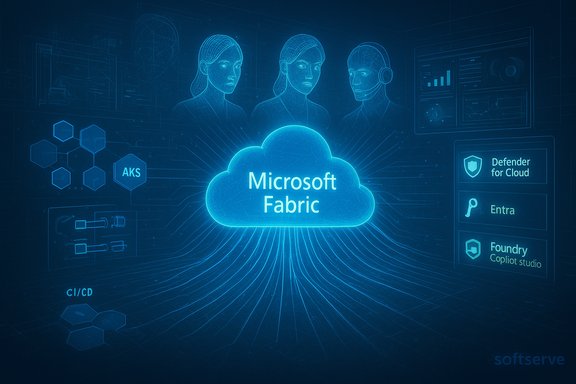
SoftServe framed the new Microsoft BU as the next stage in a multi-decade relationship with Microsoft, consolidating expertise across three core pillars: Data & AI, App Innovation & Modernization, and Infrastructure & Security. The public announcement presents the BU as a way to accelerate enterprise adoption of Microsoft Fabric, Copilot Studio and Azure AI Foundry, and to scale modernization projects via SAMP on Azure Kubernetes Service (AKS). The BU is explicitly positioned to take advantage of Microsoft’s current go‑to‑market focus—unified data platforms, governed model hosting, and agent-based automation—offering packaged plays for data modernization, RAG (retrieval‑augmented generation) pipelines, and “agentic” copilots. SoftServe’s marketing materials and press distribution emphasize speed-to-value claims (for example, “three tailored AI agents in 30 days” via an Agentic Catalyst) and measurable operational wins in customer case work.
Two public artifacts present different performance numbers:
SoftServe’s new Microsoft Business Unit is a timely and strategically coherent response to the enterprise demand for integrated, governed data-and-agent platforms—but the transition from press release to production-grade outcomes will be judged on the transparency and audibility of the engineering evidence behind the headline metrics.
Source: HPCwire SoftServe Launches Dedicated Microsoft Business Unit to Advance Data, AI, and App Modernization - BigDATAwire
 Background / Overview
SoftServe framed the new Microsoft BU as the next stage in a multi-decade relationship with Microsoft, consolidating expertise across three core pillars: Data & AI, App Innovation & Modernization, and Infrastructure & Security. The public announcement presents the BU as a way to accelerate enterprise adoption of Microsoft Fabric, Copilot Studio and Azure AI Foundry, and to scale modernization projects via SAMP on Azure Kubernetes Service (AKS). The BU is explicitly positioned to take advantage of Microsoft’s current go‑to‑market focus—unified data platforms, governed model hosting, and agent-based automation—offering packaged plays for data modernization, RAG (retrieval‑augmented generation) pipelines, and “agentic” copilots. SoftServe’s marketing materials and press distribution emphasize speed-to-value claims (for example, “three tailored AI agents in 30 days” via an Agentic Catalyst) and measurable operational wins in customer case work. What SoftServe is Offering: Pillars and Productized IP
Data & AI: Microsoft Fabric and Foundry integration
SoftServe markets itself as a Microsoft Fabric Featured Partner, promising to use Fabric and Microsoft Foundry to unify data (OneLake) and produce governed data fabrics that feed analytics and model grounding. The positioning is consistent across the company press release and partner pages, where SoftServe details specializations in analytics and Foundry tooling. This makes Fabric the central spine for RAG pipelines and data‑grounded copilots in SoftServe’s BU playbook. What this means in practice:- Fabric / OneLake as a single data plane to reduce duplication and provide lineage for LLM grounding.
- Use of Microsoft Foundry and Azure OpenAI control planes for model selection, routing, and governance.
- Packaged Fabric adoption and analytics accelerators to shorten the data-to-AI timeline.
App Innovation & Modernization: SAMP on AKS
SoftServe positions SAMP (SoftServe Adaptive Modernization Platform) running on AKS as a platform engineering accelerator for migrations and modernization. The company claims SAMP standardizes IaC, CI/CD, governance and cost controls, enabling teams to deploy and update applications far faster—promotional copy cites update cadences “up to 20x faster.” SoftServe’s product pages illustrate cross‑cloud modernization scenarios and landing zone automation using SAMP. Key features:- AKS-based platform landing zones and reusable Helm/CI templates.
- Infra-as-Code and policy guardrails for compliance at scale.
- Prescriptive pipelines to integrate Copilot Studio and Azure AI Foundry into application stacks.
Infrastructure & Security: Cloud security specializations and ecosystem partners
The BU emphasizes Cloud Security specializations and integrates Microsoft security primitives (Defender for Cloud, Microsoft Sentinel, Entra) as a managed baseline for clients. SoftServe also lists ecosystem partnerships (NVIDIA, Databricks, Ansys) to support GPU-accelerated and simulation-heavy workloads. The company’s recent industry recognition—NVIDIA’s 2025 Americas NPN Service Delivery Partner of the Year—is a public indicator of traction in accelerated-compute projects. Security posture: SoftServe’s messaging points to a governance-first blueprint, but independent assurance—SOC2/ISO certifications, penetration-test reports and delivery-team attestations—remains the critical proof point enterprises should require. SoftServe’s market positioning is credible; the security baseline should be contractually enforced.Case Study Spotlight: Krones and the Digital Twin Claims
SoftServe highlights a multivendor engagement with Krones (bottling machinery) as a flagship example: complex CFD simulations, digital twins, and operational dashboards that inform production and maintenance decisions.Two public artifacts present different performance numbers:
- SoftServe’s Krones case study documents a reduction in CFD cycle time from 3–4 hours to about 30 minutes, achieved through an integrated stack (Ansys Fluent, NVIDIA acceleration, Azure/AKS orchestration, CADFEM support). This is a detailed vendor case on SoftServe’s website.
- Multiple press distributions that re-run SoftServe’s announcement (press wires and third‑party outlets) contain a more aggressive claim: simulation time reduced “from up to four hours down to five minutes.” This faster figure appears across distributed press copies but is not reflected in the detailed SoftServe case study’s technical notes.
- CFD and digital‑twin runtimes are highly sensitive to mesh resolution, solver approximation, GPU SKU, node counts, fidelity trade-offs and caching strategies. A drop from hours to 30 minutes is impressive; a drop to five minutes would represent an additional order‑of‑magnitude gain that typically requires heavy approximation, near real‑time model reductions, or specialized hardware/software stacks.
- The stronger, auditable artifact is the detailed case study that explains the stack; where press copies summarize results and amplify figures, procurement teams should insist on the runbook that produced the measurement.
Independent Signals and Corroboration
To assess credibility, the announcement was cross‑checked against multiple independent artifacts:- SoftServe’s corporate press release and partner web pages that lay out the BU and its capabilities.
- The Krones case study hosted on SoftServe’s resources hub detailing stack and outcomes (30-minute simulation claim).
- Microsoft’s Fabric partner materials and partner directory, which confirm the existence of a Fabric Featured Partner program and highlight the partner model in general—SoftServe’s claim of being a Fabric Featured Partner is published on its own partner pages, but authoritative confirmation should come from a Partner Center snapshot.
- External recognition such as NVIDIA’s partner award, which corroborates SoftServe’s capability in accelerated compute.
Critical Analysis: Strengths, Practical Value, and Risks
Strengths — What’s convincing
- Platform alignment: SoftServe’s BU maps directly to Microsoft’s strategic pillars: Fabric for data, Foundry/Copilot Studio for model governance and agent orchestration, and AKS for containerized, GPU-backed inference. That coherence simplifies vendor conversations and enables project scoping along a single platform curve.
- Productized delivery IP: SAMP on AKS and packaged “Agentic Catalyst” offers are design patterns that reduce engineering variability and can significantly shorten time-to-proof. SAMP’s use in cross-cloud modernization scenarios is documented in SoftServe materials.
- Ecosystem depth for compute-heavy workloads: Awards and partnerships with NVIDIA and Ansys suggest real experience with GPU‑accelerated simulations and domain tools—important for customers in manufacturing and engineering.
Risks and open questions
- Marketing vs. engineering detail: Headline claims—“three agents in 30 days,” “rollouts 20x faster,” or “simulations reduced to five minutes”—require an engineering runbook. Without documented test conditions, node counts, fidelity trade-offs and acceptance criteria, such metrics are marketing benchmarks, not procurement guarantees. Flagging and verifying these claims is essential.
- Governance and agentic AI hazards: Agentic agents that act (not just advise) multiply attack surface and governance complexity. Enterprises must insist on identity controls, audit trails, least‑privilege provisioning (Entra), and model‑governance processes—preferably contractualized. SoftServe emphasizes governance in its messaging, but governance is an operational discipline that must be operationalized, audited and insured.
- Partner Center verification: Microsoft Partner Center is the authoritative ledger for partner specializations. Public marketing pages are useful, but buyers must request partner center snapshots and partner IDs before awarding contracts that rely on specific advanced competencies (Fabric, Foundry, Kubernetes, Cloud Security).
- Vendor concentration and cloud portability: The BU’s strength is Microsoft alignment, but customers with multicloud strategies or strict portability requirements should confirm architecture choices in SAMP and ask for documented exit plans and replatforming playbooks. SoftServe’s SAMP claims cross-cloud capability, but implementation detail matters.
How Enterprise Buyers Should Evaluate SoftServe’s Microsoft BU
Below is a practical, procurement-ready checklist to convert marketing promises into auditable deliverables:- Obtain Partner Center evidence: request a Partner Center snapshot showing Fabric Featured Partner recognition, specializations (Analytics on Foundry, Kubernetes on Azure, Cloud Security), timestamps, and Partner ID. This is the canonical proof of status.
- Ask for two refereed customer references with measurable KPIs: modernization cadence (pre/post), simulation runtimes with test conditions, downtime improvements with supporting logs. Contactable, named references are non‑negotiable.
- Run a scoped PoC with contractual acceptance criteria: define data sets, model fidelity, mesh resolution (for simulation), compute SKUs, and target SLA thresholds. Time‑box the PoC (4–8 weeks) and require a runbook.
- Demand governance artifacts: agent provisioning runbooks, Entra identity flows, telemetry retention policies, Purview/response playbooks and SOC2/ISO attestation for the delivery team. Red‑team results for any agentic automation accessing sensitive data are strongly advised.
- Verify SAMP deliverables: review the SAMP architecture, the AKS landing zone templates, IaC artifacts (ARM/Bicep or Terraform), and evidence of CI/CD cadence improvements documented across at least two client engagements.
- Confirm computed economics: ask for a modeled Azure consumption plan that shows projected inferencing cost, storage cost for Fabric/OneLake, and a cost governance plan (MACC/MACC or similar) to mitigate runaway spend.
The Strategic Implications for Microsoft and the Partner Ecosystem
SoftServe’s move to create a dedicated Microsoft BU is emblematic of a broader partner dynamic: hyperscalers’ platform roadmaps (Fabric, Foundry, Copilot Studio, AKS) favor partners that can offer vertically integrated, auditable playbooks that reduce pilot‑to‑production friction. For Microsoft, partners that industrialize these playbooks help accelerate consumption of Azure services, co‑sell motions, and transactable marketplace offers. For the partner ecosystem, the battleground is time‑to‑value, governable productionization, and demonstrable customer outcomes. Partners that can show:- reproducible PoCs that meet contractual acceptance criteria,
- audited governance processes for agentic AI,
- and credible cross‑vendor simulation and GPU orchestration,
Final Assessment and Bottom Line
SoftServe’s Microsoft Business Unit is a logical, market‑timely consolidation of platform-aligned capabilities that matter to enterprise IT: data unification (Fabric), agentic copilots and model governance (Foundry/Copilot Studio), and application modernization (SAMP on AKS). Public materials and partner recognitions (including the NVIDIA award and a published Krones case study) provide credible evidence that SoftServe has both the technical IP and cross‑vendor relationships to pursue these use cases. However, several commercially relevant claims in the launch messaging—particularly aggressive runtime and acceleration numbers—require engineering evidence before they can be relied upon in procurement. Enterprises should treat the BU as a promising, Microsoft‑centric integrator and demand the artifacts that turn marketing statements into enforceable outcomes: Partner Center snapshots, runbooks for performance claims, audited security and governance artifacts, and measurable PoC results.Practical Next Steps for IT Leaders
- Require a Partner Center snapshot as part of the RFP.
- Insist on an initial time‑boxed PoC with explicit acceptance criteria and documented test environments (compute SKUs, mesh size for simulation, data sample sizes).
- Negotiate governance and security SLAs that include agent approval flows, identity lifecycle events, and telemetry retention commitments.
- Validate economic models for Azure consumption and ask for transactable marketplace or MACC alignment where available.
SoftServe’s new Microsoft Business Unit is a timely and strategically coherent response to the enterprise demand for integrated, governed data-and-agent platforms—but the transition from press release to production-grade outcomes will be judged on the transparency and audibility of the engineering evidence behind the headline metrics.
Source: HPCwire SoftServe Launches Dedicated Microsoft Business Unit to Advance Data, AI, and App Modernization - BigDATAwire
