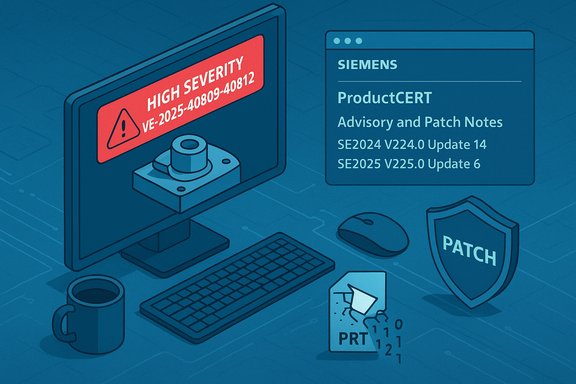
Siemens Solid Edge users and industrial CAD operators must treat a cluster of high‑severity parsing flaws as a live operational risk: multiple vulnerabilities (CVE‑2025‑40809 through CVE‑2025‑40812) in Solid Edge’s PRT file handling can crash the application or allow arbitrary code execution unless affected installations are updated or untrusted files blocked.
Siemens ProductCERT and the U.S. Cybersecurity and Infrastructure Security Agency (CISA) republished an advisory describing a set of memory‑corruption bugs in Siemens Solid Edge that are triggered when the application parses specially crafted PRT files. The issues include out‑of‑bounds write and out‑of‑bounds read conditions leading to potential denial‑of‑service or remote code execution in the context of the Solid Edge process. Siemens has assigned CVE identifiers CVE‑2025‑40809, CVE‑2025‑40810, CVE‑2025‑40811, and CVE‑2025‑40812 for the four distinct flaws.
The vendor‑supplied severity metrics place these vulnerabilities solidly in the high range: CVSS v3.1 base scores of 7.8 and CVSS v4 base scores of 7.3 were published for each CVE, reflecting high impact on confidentiality, integrity, and availability when successfully exploited. The advisory emphasizes that these bugs are not remotely exploitable across the internet by default; they require the victim to open a malicious PRT file in an affected Solid Edge instance.
Given the prevalence of CAD file exchange in manufacturing supply chains, the most effective organizational defense is a combination of immediate behavioral changes (don’t open untrusted PRT files), technical controls (sandboxing, file scanning), and timely patch management validated against Siemens ProductCERT advisories. Operators should also assume that public disclosure increases the likelihood of targeted exploitation attempts and therefore act with urgency even when public exploitation has not yet been observed.
Conclusion
The intersection of complex binary file formats and globally distributed engineering workflows creates a sustained risk for operational technology and intellectual property. The Solid Edge advisory reinforces two immutable operational requirements: maintain an accurate inventory and update posture for critical engineering software, and enforce strict, auditable controls for inbound design content. Implement the vendor updates, harden file handling, and treat every externally sourced PRT as potentially hostile until proven otherwise.
Source: CISA Siemens Solid Edge | CISA
 Background / Overview
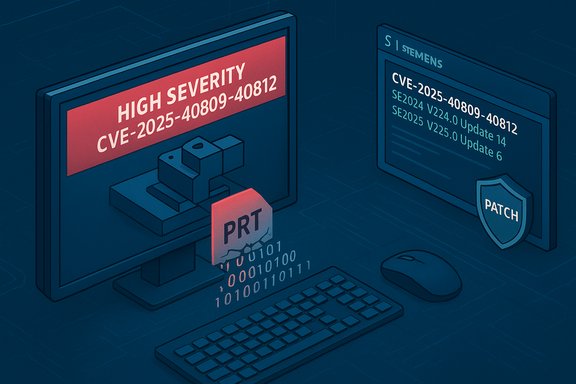
Siemens ProductCERT and the U.S. Cybersecurity and Infrastructure Security Agency (CISA) republished an advisory describing a set of memory‑corruption bugs in Siemens Solid Edge that are triggered when the application parses specially crafted PRT files. The issues include out‑of‑bounds write and out‑of‑bounds read conditions leading to potential denial‑of‑service or remote code execution in the context of the Solid Edge process. Siemens has assigned CVE identifiers CVE‑2025‑40809, CVE‑2025‑40810, CVE‑2025‑40811, and CVE‑2025‑40812 for the four distinct flaws.The vendor‑supplied severity metrics place these vulnerabilities solidly in the high range: CVSS v3.1 base scores of 7.8 and CVSS v4 base scores of 7.3 were published for each CVE, reflecting high impact on confidentiality, integrity, and availability when successfully exploited. The advisory emphasizes that these bugs are not remotely exploitable across the internet by default; they require the victim to open a malicious PRT file in an affected Solid Edge instance.
Affected products and patch status
Product and version matrix
- Siemens Solid Edge SE2024: all versions older than V224.0 Update 14 are affected.
- Siemens Solid Edge SE2025: all versions older than V225.0 Update 6 are affected.
What “not remotely exploitable” means in practice
The advisory describes these as file‑parsing vulnerabilities: an attacker must supply a specially crafted PRT file and have a user or automated process open that file in Solid Edge. While this rules out raw, unauthenticated remote exploitation via the internet in most default deployments, it does not eliminate serious operational attack paths:- Email or file‑share vectors: malicious PRT files sent as attachments or stored on shared drives can reach designers and engineers.
- Supply‑chain and third‑party library transfers: imported CAD assets from partners, contractors, or customers are routine in engineering workflows.
- Local network access: adversaries with footholds on enterprise or OT workstations could deliver and trigger a malicious file.
Technical details (what the bugs do)
Out‑of‑bounds read and write during PRT parsing
The affected Solid Edge components mishandle bounds checking while deserializing elements of PRT files. Two different classes of memory errors were reported:- Out‑of‑bounds write — can corrupt adjacent memory structures, leading to process instability, denial‑of‑service, or the possibility to hijack control flow and execute attacker code under the Solid Edge process privileges (CVE‑2025‑40809 and CVE‑2025‑40810).
- Out‑of‑bounds read — can disclose memory contents or cause crashes that may be chainable into more powerful attacks (CVE‑2025‑40811 and CVE‑2025‑40812).
Attack complexity and prerequisites
The published CVSS vectors reflect an attack vector of local/adjacent network or file opening (AV:L in CVSS v3.1) with low attack complexity in several classifications, because the exploit relies on a single malformed file rather than multi‑stage exploitation. The attacker does not need privileges beyond what the user running Solid Edge has, and exploitation typically requires user interaction (opening the file). The v4 vectors translate this to a similarly serious posture with user interaction required.Risk evaluation — who should worry most
High‑value targets
- Engineering and CAD workstations used in critical manufacturing, aerospace, automotive, and industrial design. Compromise of these endpoints can disclose IP or provide stepping stones into corporate or operational networks. These sectors are specifically called out in advisory context.
- File servers and shared project repositories that host PRT assets. If a malicious PRT is placed on a shared drive, it can reach multiple designers or build systems.
- Third‑party exchange workflows (vendors, contractors, customers) where PRT files are routinely exchanged without rigorous content inspection.
Practical impact scenarios
- Crash and denial of service: Opening a crafted PRT causes Solid Edge to crash, halting design work and potentially corrupting session data. Repeated crashes can create operational disruption in time‑sensitive projects.
- Arbitrary code execution: A successful exploit could run code with the privileges of the Solid Edge user, enabling data exfiltration, lateral movement, or deployment of persistent backdoors on engineering hosts.
- Supply‑chain compromise: Suppliers or external partners whose files are trusted and routinely opened by engineering teams can become inadvertent vectors for attackers targeting a manufacturer or OEM.
Likelihood and exploitation status
The advisory notes no known public exploitation specifically targeting these vulnerabilities at the time of publication, but it also emphasizes the exposure risk of the attack vector (malicious files). Operators must assume a realistic threat model: attackers frequently weaponize parsing bugs once publicized, and the design community’s heavy reliance on inbound file exchange increases exposure window risk.Vendor and agency guidance (official mitigations)
Siemens and CISA provide layered guidance:- Immediate workaround: Do not open untrusted PRT files in affected Solid Edge installations. This is the single most effective short‑term step.
- Patch: Update Solid Edge SE2024 to V224.0 Update 14 or later and SE2025 to V225.0 Update 6 or later. Confirm the applied build against Siemens ProductCERT advisory entries before marking systems remediated.
- Network hardening: Minimize network exposure of engineering endpoints and servers, isolate design networks from broader corporate and internet‑facing systems, and place control systems and high‑value endpoints behind firewalls.
- Secure remote access: When remote access is required, use secure, updated VPNs, bastion hosts, or zero‑trust access gateways. Recognize that VPNs themselves must be kept patched and monitored.
Practical response playbook for IT and OT teams
1. Triage and inventory (Immediate — within hours)
- Identify all hosts running Solid Edge (SE2024 and SE2025 families).
- Record exact product build numbers and update status.
- Locate shared drives, archives, and mailboxes that accept or store PRT files from third parties.
2. Containment (Hours to days)
- Block or quarantine inbound PRT files from untrusted sources at email gateways and file servers.
- Apply file‑type filtering and automatic sandboxing to inspect PRT files before exposing them to end users.
- Enforce a policy that engineering files from external partners are opened only on jump hosts or isolated VMs.
3. Patch and validate (Days to weeks)
- Apply Siemens’ published updates to affected Solid Edge instances: V224.0 Update 14 for SE2024 and V225.0 Update 6 for SE2025, or later. Confirm vendor build numbers after patching.
- Test updates in a staging environment before enterprise‑wide rollouts to detect interoperability issues.
4. Long‑term hardening (Weeks to months)
- Implement workstation segmentation and least‑privilege policies for CAD users; consider running Solid Edge under restricted accounts or sandboxed containers where feasible.
- Harden file exchange processes with automated scanning, content disarm and reconstruction (CDR), or vendor prove‑back processes.
- Train engineering and procurement teams on the risks of opening unvetted CAD files and institute verification steps for external assets.
5. Detection and monitoring
- Monitor for unusual Solid Edge process crashes, repeated file‑open failures, or suspicious child processes spawned by CAD applications.
- Collect and analyze endpoint telemetry (EDR) on design machines and keep forensic logs for any suspected exploitation.
- Implement file integrity monitoring and alerting for changes on network shares where CAD assets are stored.
Detection signatures and forensic indicators
Because these are memory‑corruption bugs, detection focuses on operational and behavioral indicators rather than single static signatures:- Repeated Solid Edge crashes tied to PRT file openings or specific user accounts.
- Unexplained process restarts or anomalous module loads in the Solid Edge process.
- New or unusual outbound connections initiated from CAD workstations following a file open.
- Presence of previously unseen DLLs, scripts, or scheduled tasks on engineering machines.
Supply‑chain and collaboration implications
Solid Edge is embedded in multi‑party engineering workflows; the advisory highlights a common industrial reality:- CAD ecosystems rely on file exchange with suppliers, subcontractors, and customers. A single malicious or compromised file can traverse many organizations.
- Vendor and partner security practices vary; organizations should require secure file delivery practices, signed archives, or checksums for exchanged files.
- For high‑risk projects (defense, aerospace, critical infrastructure), restrict inbound CAD files to sanitized ingestion systems and perform content validation prior to opening on production workstations.
Why attackers target CAD file formats
CAD file parsers routinely handle complex binary formats, nested objects, and embedded metadata — a large attack surface. Attackers target these formats because:- CAD files are trusted and often opened without the same scrutiny as email attachments.
- Successful exploitation yields intellectual property and design blueprints, which are valuable for espionage and sabotage.
- In industrial environments, CAD compromise can serve as a pivot into engineering control systems and product lifecycles.
Strengths and limitations of the published advisories
Strengths
- The advisory provides specific CVE identifiers and CVSS scores, allowing operators to prioritize risk.
- Siemens has released fixed builds and concrete update guidance for affected Solid Edge releases.
- CISA reiterates operational controls and the importance of isolating critical systems, reinforcing layered defense strategies.
Limitations and risks
- CISA’s policy since January 10, 2023, means its advisories for Siemens products are initial only and operators must follow Siemens ProductCERT for ongoing updates; this procedural change increases the reliance on vendor communications. Operators should treat ProductCERT as the authoritative source for remediation status.
- The “not remotely exploitable” label may lull organizations into complacency; real‑world attack chains commonly include social engineering and file exchange vectors that produce the necessary file‑open action.
- Some environments will find it operationally difficult to immediately patch CAD workstations due to testing requirements, third‑party add‑ins, or certification constraints; this extends exposure windows and makes robust containment essential.
Recommended checklist (at a glance)
- Immediately: Block untrusted PRT files and alert engineering teams.
- Within 24–72 hours: Inventory Solid Edge hosts and confirm versions.
- Within 7 days: Apply Siemens’ security updates where compatible; otherwise isolate or sandbox those hosts.
- Ongoing: Harden file exchange, implement file scanning/CDR, and monitor engineering endpoints for anomalous behavior.
Final assessment and operational outlook
The Solid Edge CVE‑2025‑40809–40812 cluster represents a classic but serious problem class for industrial design environments: memory‑safety bugs in file parsers that are exploitable by crafted files. Siemens has provided fixes for supported releases, and CISA has reinforced the practical mitigations of isolating critical systems and minimizing exposure. Organizations that rely on Solid Edge should treat this advisory as urgent: patch quickly where possible, and where patching is delayed implement rigorous containment, scanning, and least‑privilege practices to minimize exposure.Given the prevalence of CAD file exchange in manufacturing supply chains, the most effective organizational defense is a combination of immediate behavioral changes (don’t open untrusted PRT files), technical controls (sandboxing, file scanning), and timely patch management validated against Siemens ProductCERT advisories. Operators should also assume that public disclosure increases the likelihood of targeted exploitation attempts and therefore act with urgency even when public exploitation has not yet been observed.
Conclusion
The intersection of complex binary file formats and globally distributed engineering workflows creates a sustained risk for operational technology and intellectual property. The Solid Edge advisory reinforces two immutable operational requirements: maintain an accurate inventory and update posture for critical engineering software, and enforce strict, auditable controls for inbound design content. Implement the vendor updates, harden file handling, and treat every externally sourced PRT as potentially hostile until proven otherwise.
Source: CISA Siemens Solid Edge | CISA