

SonarSource this week announced a set of SonarQube plugins and integrations that bring its code-quality and security checks into Claude Code, GitHub Copilot, OpenAI Codex CLI, Cursor, GitHub agent workflows, and, soon, Google’s Antigravity CLI. The pitch is simple: if AI coding agents are going to write more of the codebase, verification has to move into the place where the code is being generated. That is less a product launch than a concession to the new software supply chain. The bottleneck is no longer whether a machine can produce code; it is whether an organization can still know what that code is.
The most interesting part of SonarSource’s announcement is not that SonarQube now reaches another IDE or terminal. Static analysis vendors have been chasing developers into their editors for years, because nobody wants to learn about a trivial bug after it has already become a pull request argument. The novelty here is the target: not the developer alone, but the agentic workflow that increasingly sits between the developer and the code.
That shift matters. Claude Code in the terminal, Copilot in VS Code, Codex CLI in a shell, Cursor as an AI-native editor, and GitHub-hosted coding agents do not behave like one consistent development environment. They are a loose federation of assistants, each with its own context, defaults, incentives, and failure modes. Developers may experience them as a productivity layer, but platform teams see something more awkward: many code-generation paths feeding the same repository.
Sonar’s argument is that quality gates cannot remain a downstream ritual if upstream code production has fragmented. A CI pipeline can still reject a pull request, but the agent that wrote the bad code has already moved on. The human is left holding the remediation bill, and the promised productivity gain starts to look like deferred maintenance with better autocomplete.
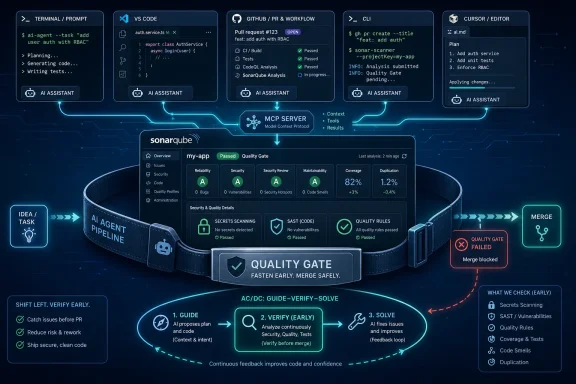
That is why the company is framing the launch around an “Agent Centric Development Cycle,” or AC/DC, rather than just another plugin bundle. The branding is cute, but the underlying idea is serious. Sonar wants to guide agents before they write, verify their output as they work, and push fixes back into the same loop before flawed code hardens into a review, a merge, or an incident.
AI coding breaks the emotional bargain behind that model. When a human developer writes code for several hours, a failed check is a correction to work they still understand. When an agent generates a patch in seconds, a failed check can feel like an archaeological exercise. The person reviewing the failure may not have authored the code in any meaningful sense, yet still has to debug it, explain it, and own it.
The result is what Sonar calls verification debt. The phrase is useful because it captures the asymmetry of AI-assisted development: generation gets cheaper faster than review does. If organizations add more coding agents without adding a consistent way to validate their output, they are not eliminating work. They are moving it into review queues, incident response, security triage, and future refactoring.
This is where Sonar’s announcement lands with unusual timing. The 2026 Sonar State of Code Developer Survey, according to Sonar’s own published summary, found that AI accounts for 42 percent of committed code today and is expected by developers to reach 65 percent by 2027. The same survey found a trust gap: almost all developers surveyed did not fully trust AI-generated code, while fewer than half said they always verify it before committing.
Even if one treats vendor surveys with the usual caution, the direction of travel is obvious. AI-generated code is no longer a novelty sprinkled into side projects. It is becoming normal production material. Once that happens, verification stops being an optional hygiene practice and becomes part of the organization’s operational risk model.
One developer may prompt Claude Code from a terminal with broad repository access. Another may use Copilot inside Visual Studio Code. A third may use Cursor for a feature branch and then hand the result to GitHub’s agentic workflow for follow-up tasks. Each tool can be useful, and each can improve quickly, but none of them automatically guarantees that the organization’s rules are being applied consistently.
That is a governance problem disguised as a developer-experience problem. Security teams generally do not want to tell developers which editor to love. Platform teams do not want to maintain brittle one-off integrations for every fashionable coding agent. Engineering leaders do not want to discover that “AI adoption” has quietly created several parallel software factories with different standards.
SonarQube’s value proposition here is not that it magically makes generated code safe. It is that one verification layer can follow the work across multiple generation surfaces. The same quality profiles, security rules, duplication checks, complexity thresholds, and quality gates can be applied whether the code started in a terminal prompt or an AI-powered IDE.
That sounds mundane, but mundane is what enterprise software governance often needs. The safest AI coding story is not the flashiest demo. It is the one where generated code is boringly subjected to the same standards as everything else.
The more security-sensitive feature is secrets scanning before data enters the model context. Sonar says every file Claude reads and every prompt the developer enters can be scanned for more than 450 secret patterns. That is a direct response to one of the least glamorous but most immediate risks of AI tooling: accidentally feeding credentials, tokens, or sensitive configuration into a model context window.
This is not a theoretical concern. Developers routinely paste stack traces, environment snippets, configuration files, and half-redacted logs into AI tools because the tool is sitting right there and appears helpful. If the assistant is operating in a local project, it may also read files the developer did not consciously inspect. The risk is not just bad generated code; it is the quiet expansion of what counts as “shared” with an AI system.
By putting hooks in front of that flow, Sonar is effectively trying to make the context boundary enforceable. That is important because modern coding agents are only as useful as the context they can consume. The more powerful the agent, the greater the temptation to hand it the whole project. Secrets scanning becomes the tollbooth on the road to broader context.
But GitHub’s agentic workflow changes the social mechanics. When an agent can be mentioned in an issue or pull request, assigned work, authenticate, run verification, and report back inside the same collaboration surface, code review starts to look less like a handoff and more like an orchestration layer. The repo becomes not just a destination for code, but a control plane for machine labor.
That is a profound change for WindowsForum’s core audience of administrators and IT pros, even if they are not writing application code every day. The same organizational pattern is familiar from infrastructure automation: once automation can take assignments, operate with credentials, and make changes, the question becomes who audits the automation and where the audit happens. Coding agents are joining that world.
Sonar’s GitHub Agent App reportedly uses OIDC authentication and runs verification against a quality gate before surfacing findings in the GitHub workflow. The key detail is not the acronym; it is the placement. Findings appear where the agent and human collaborators are already coordinating. That reduces the gap between detection and remediation, which is where many security and quality processes lose force.
If CI is a courthouse, the GitHub agent workflow is closer to a workshop. Sonar wants verification inside the workshop, before bad code has to be formally prosecuted.
Sonar’s Codex integration lets prompts invoke SonarQube analysis so code-quality concerns can shape AI-assisted work from the start. The Cursor integration connects the IDE’s agent to SonarQube Server and SonarQube Cloud, checking generated code against the team’s standards as it is written. Support for Antigravity CLI is described as coming soon, extending the pattern to yet another agent surface.
This is where the announcement becomes a bet on market structure. Sonar is not pretending there will be one winning AI coding interface. It is assuming the opposite: that the developer toolchain will remain plural, shifting, and partially chaotic. In that world, verification vendors win by becoming the common substrate beneath the churn.
The risk, of course, is that plugin coverage becomes its own treadmill. Today’s hot agent may be tomorrow’s abandoned experiment. Enterprises will not thank a vendor for creating another integration matrix that has to be nursed through version changes, authentication quirks, and policy mismatches. Sonar’s answer is to build around shared components such as the MCP Server, CLI, and Agent Engine rather than treating each tool as a bespoke island.
That architecture is sensible. Whether it is sufficient will depend on how stable the agent ecosystem becomes, and how much of the AI coding market standardizes around common protocols. MCP has momentum, but momentum is not the same thing as permanence.
That is both the opportunity and the hazard. A coding assistant with tool access can be far more useful than one limited to suggestions. It can query project status, inspect issues, check coverage, look up dependency risks, or ask for quality-gate results. But every additional tool also expands the assistant’s effective reach.
Sonar’s MCP Server is positioned as the bridge between agents and SonarQube analysis. Through it, agents can retrieve issues, check quality gates, inspect security hotspots, measure coverage, find duplications, analyze snippets, and check dependencies for vulnerabilities. Sonar says this works with SonarQube Cloud through a native endpoint and with SonarQube Server through a self-hosted Docker deployment.
For administrators, the deployment distinction matters. Cloud convenience may fit smaller teams or SaaS-first organizations, while self-hosted MCP infrastructure will appeal to shops with stricter data-boundary, compliance, or network-control requirements. The more the assistant becomes part of the toolchain, the more deployment details stop being implementation trivia and become governance choices.
The industry has learned this lesson before. CI runners, package registries, artifact repositories, and secrets managers all began as productivity infrastructure and became security infrastructure. MCP servers are likely to follow the same path.
The Guide phase is about context and constraints. In theory, SonarQube can feed standards, architecture rules, and coding guidelines into the agent before generation. That matters because many AI coding failures are not syntax errors; they are mismatches with local conventions, security expectations, dependency policies, and architectural intent.
The Verify phase is about analysis in the agent’s inner loop. Sonar’s claim is that its engine can provide CI-level precision quickly enough to be useful while the agent is still working. The promise is not merely faster linting. It is feedback that arrives early enough for the agent to incorporate it, rather than late enough to annoy the human.
The Solve phase is the implied payoff. If an agent can see the issue, understand the relevant rule, and patch the code while still holding the task context, remediation becomes cheaper. That does not eliminate the need for human review. It changes what human review should focus on: architecture, intent, maintainability, and business logic rather than easily detectable mistakes.
The catch is that verification is only as good as the rules, context, and organizational willingness behind it. A bad quality profile automated across five agents is still a bad quality profile. AC/DC makes sense only if teams treat their standards as living engineering assets, not a compliance checkbox.
Traditional secret scanning usually watches repositories, commits, or CI events. That is still necessary, but AI assistants introduce another leakage path: a secret can be exposed to the assistant before it is ever committed. If a model context becomes the first place a credential is mishandled, repository scanning is too late.
This is why scanning prompts and files before they enter an LLM context window is an important line in the announcement. It acknowledges that AI coding workflows are not just software-development workflows; they are data-handling workflows. The assistant’s context window becomes a temporary workspace, and that workspace needs guardrails.
Windows administrators should recognize the pattern from endpoint management. Once sensitive work moves onto an endpoint, policy has to follow the user rather than wait for the data center. AI coding agents are the developer equivalent: local, interactive, and close to sensitive material. Waiting for a central system to catch everything after the fact is an increasingly weak bet.
The same principle applies to dependency and vulnerability checks. If an assistant proposes adding a library, changing an authentication flow, or generating serialization code, the risk is introduced at generation time. The earlier the toolchain can push back, the more likely the correction becomes part of the original work rather than a later security ticket.
CI is good at enforcing consistency. It is less good at preserving developer flow. When a pipeline fails ten minutes after a generated patch, the developer has to reload context, interpret the finding, and decide whether to repair manually or ask the agent to try again. That delay is small in clock time but large in cognitive cost.
Inner-loop verification reduces that cost by pushing routine feedback into the moment of creation. It does not have to catch everything to be useful. If it catches the obvious security smell, the duplicated block, the broken quality rule, or the accidental secret before a pull request exists, it has already improved the economics of review.
There is also a cultural effect. Developers are more likely to accept tools that help them finish work than tools that appear only to reject it. An agent that can see SonarQube findings and fix them while drafting code turns quality enforcement into part of the creative process. A pipeline failure turns it into a stop sign.
The best systems will use both. Inner-loop verification will shape the code as it is written; CI will confirm that the final artifact meets shared standards. That layered model is familiar to security professionals, who have long argued that no single control should carry the whole burden.
The Windows ecosystem has also become deeply GitHub-shaped. Microsoft’s ownership of GitHub, Copilot’s integration into developer environments, and the popularity of VS Code mean that AI coding workflows often land naturally in places Windows teams already use. Sonar’s Copilot and GitHub integrations therefore matter beyond the Silicon Valley startup crowd.
For sysadmins, the most immediate implication may be policy. If developers are allowed to use multiple AI coding tools, organizations need to decide what “allowed” means. Does the tool have access to private repositories? Can it read environment files? Are prompts logged? Are secrets blocked before context ingestion? Are generated changes tagged, reviewed, or scanned differently?
For platform engineering teams, the announcement reinforces the need for a standard verification service that is independent of any single assistant. Without that, every new AI tool becomes a negotiation: new access model, new scanning story, new exceptions, new documentation, new failure modes. That is not sustainable at enterprise scale.
The larger lesson is that AI coding adoption is becoming an infrastructure decision. Treating it as a collection of personal productivity choices is how organizations end up with invisible policy drift.
The reason is review economics. If generated code requires disproportionate verification effort, the productivity gain is partly illusory. A developer may spend less time typing but more time validating, rewriting, debugging, or explaining. A team may produce more pull requests but overload reviewers. An organization may deploy faster but experience more incidents.
This is the uncomfortable subtext of Sonar’s survey claim that developers using SonarQube are less likely to report outages due to AI-generated code. Vendor-sponsored metrics should not be swallowed whole, but the conceptual point is plausible: teams with stronger verification practices should fare better when code volume rises. The faster the input stream, the more valuable the filter.
The challenge is that verification tools must avoid becoming noise machines. Developers already live with too many warnings, many of them irrelevant, duplicated, or misprioritized. If AI agents are asked to remediate low-value findings endlessly, organizations may simply automate toil. Worse, agents may produce superficial fixes that satisfy a rule while worsening readability or design.
Sonar’s advantage is that it already has mature static-analysis and quality-gate concepts. Its risk is that agentic workflows demand a higher signal-to-noise ratio than traditional dashboards. A human can ignore a noisy report. An agent may obediently churn on it, burning tokens and time while creating code churn.
These questions are not glamorous, but they determine whether the system actually protects anything. A secrets-scanning hook that developers can bypass casually is a suggestion, not a control. An MCP server with overbroad access can become a new attack surface. A quality gate that teams routinely waive under deadline pressure becomes theater.
There is also a data-flow question. Organizations need to understand what code and metadata move between the IDE, terminal, MCP server, SonarQube Cloud or Server, GitHub, and the AI provider. In heavily regulated industries, the ability to self-host parts of the workflow may be decisive. In smaller teams, cloud integration may be acceptable, but it still deserves conscious review.
The deeper point is that “trusted verification” is not created by installing a plugin. It is created by aligning tooling, policy, developer experience, and auditability. Sonar can provide the mechanism, but customers still have to make governance decisions that match their risk tolerance.
That may be the central tension of the AI coding era. Developers want tools that feel frictionless. Security teams want controls that are enforceable. The winners will be systems that make the safe path the convenient path.
That means organizations may eventually need to treat agents as supply-chain participants. Which agents contributed to a change? Which tools did they call? Which policy checks did they pass? Were secrets blocked? Did the agent remediate a security finding, and was that remediation reviewed? These questions sound futuristic only until the first incident investigation requires answers.
Sonar’s integrations do not solve provenance by themselves, but they point toward a more instrumented development loop. If verification runs inside the agent workflow and reports into GitHub or the IDE, teams get more chances to capture intent, findings, and remediation steps. That record may become valuable not just for quality, but for accountability.
The flip side is complexity. Every added integration creates another place where credentials, permissions, logs, and network paths must be managed. The agentic toolchain could easily become as tangled as the CI/CD systems it is supposed to accelerate. That is why standardization around components such as MCP matters, and why enterprises will scrutinize deployment models carefully.
The best outcome would be a world where agents are powerful but constrained, productive but observable, and flexible without becoming ungoverned. Sonar is positioning itself as one of the companies that can make that outcome plausible.
If the Claude Code plugin blocks a real secret before it leaves the machine, developers will understand its value instantly. If Copilot can fix a SonarQube issue without derailing the flow, reviewers may quietly bless it. If Cursor users see useful project-specific feedback while generating code, the integration becomes a productivity feature rather than a compliance burden.
But if setup is brittle, findings are noisy, authentication fails mysteriously, or agents loop on cosmetic issues, developers will route around the tool. That is especially true in the AI coding world, where alternatives are only a terminal command or extension install away. The same fragmentation Sonar is trying to tame also gives frustrated developers escape hatches.
This is why Sonar’s emphasis on a single configuration and one quality bar is important. Platform teams need a way to make the approved path easy. If every tool requires separate setup and tuning, standards will drift. If the verification layer follows the developer across tools with minimal ceremony, policy has a fighting chance.
The launch is therefore not just about coverage. It is about habit formation. Sonar needs developers to see verification as part of asking the agent to work, not as a separate bureaucratic step after the fun part is over.
The more durable response is to make verification portable, early, and enforceable enough to matter. That means bringing security and quality signals into terminals, IDEs, GitHub workflows, and agent prompts. It also means accepting that AI coding governance is now part of platform engineering, not a side quest for individual developers.
The concrete implications are straightforward:
 Sonar Is Selling a Seatbelt for the Agentic Coding Era
The most interesting part of SonarSource’s announcement is not that SonarQube now reaches another IDE or terminal. Static analysis vendors have been chasing developers into their editors for years, because nobody wants to learn about a trivial bug after it has already become a pull request argument. The novelty here is the target: not the developer alone, but the agentic workflow that increasingly sits between the developer and the code.That shift matters. Claude Code in the terminal, Copilot in VS Code, Codex CLI in a shell, Cursor as an AI-native editor, and GitHub-hosted coding agents do not behave like one consistent development environment. They are a loose federation of assistants, each with its own context, defaults, incentives, and failure modes. Developers may experience them as a productivity layer, but platform teams see something more awkward: many code-generation paths feeding the same repository.
Sonar’s argument is that quality gates cannot remain a downstream ritual if upstream code production has fragmented. A CI pipeline can still reject a pull request, but the agent that wrote the bad code has already moved on. The human is left holding the remediation bill, and the promised productivity gain starts to look like deferred maintenance with better autocomplete.
That is why the company is framing the launch around an “Agent Centric Development Cycle,” or AC/DC, rather than just another plugin bundle. The branding is cute, but the underlying idea is serious. Sonar wants to guide agents before they write, verify their output as they work, and push fixes back into the same loop before flawed code hardens into a review, a merge, or an incident.
The Old Quality Gate Arrives Too Late for Machine-Speed Code
For two decades, the mainstream DevOps compromise has been to let developers move fast locally and rely on shared systems to impose discipline later. Linters, tests, SAST, dependency checks, secret scanning, and policy enforcement all found homes in CI/CD because CI/CD was the common choke point. It was imperfect, but it was legible.AI coding breaks the emotional bargain behind that model. When a human developer writes code for several hours, a failed check is a correction to work they still understand. When an agent generates a patch in seconds, a failed check can feel like an archaeological exercise. The person reviewing the failure may not have authored the code in any meaningful sense, yet still has to debug it, explain it, and own it.
The result is what Sonar calls verification debt. The phrase is useful because it captures the asymmetry of AI-assisted development: generation gets cheaper faster than review does. If organizations add more coding agents without adding a consistent way to validate their output, they are not eliminating work. They are moving it into review queues, incident response, security triage, and future refactoring.
This is where Sonar’s announcement lands with unusual timing. The 2026 Sonar State of Code Developer Survey, according to Sonar’s own published summary, found that AI accounts for 42 percent of committed code today and is expected by developers to reach 65 percent by 2027. The same survey found a trust gap: almost all developers surveyed did not fully trust AI-generated code, while fewer than half said they always verify it before committing.
Even if one treats vendor surveys with the usual caution, the direction of travel is obvious. AI-generated code is no longer a novelty sprinkled into side projects. It is becoming normal production material. Once that happens, verification stops being an optional hygiene practice and becomes part of the organization’s operational risk model.
Fragmentation Is the Real Enemy, Not Any One Coding Assistant
It is tempting to reduce the AI coding debate to a contest between tools: Copilot versus Cursor, Claude Code versus Codex, local agents versus cloud agents. That misses the point. The enterprise problem is not that one assistant is uniquely dangerous; it is that every assistant can become a separate policy island.One developer may prompt Claude Code from a terminal with broad repository access. Another may use Copilot inside Visual Studio Code. A third may use Cursor for a feature branch and then hand the result to GitHub’s agentic workflow for follow-up tasks. Each tool can be useful, and each can improve quickly, but none of them automatically guarantees that the organization’s rules are being applied consistently.
That is a governance problem disguised as a developer-experience problem. Security teams generally do not want to tell developers which editor to love. Platform teams do not want to maintain brittle one-off integrations for every fashionable coding agent. Engineering leaders do not want to discover that “AI adoption” has quietly created several parallel software factories with different standards.
SonarQube’s value proposition here is not that it magically makes generated code safe. It is that one verification layer can follow the work across multiple generation surfaces. The same quality profiles, security rules, duplication checks, complexity thresholds, and quality gates can be applied whether the code started in a terminal prompt or an AI-powered IDE.
That sounds mundane, but mundane is what enterprise software governance often needs. The safest AI coding story is not the flashiest demo. It is the one where generated code is boringly subjected to the same standards as everything else.
Claude Code Gets the Full Inner-Loop Treatment
The Claude Code integration appears to be the most complete expression of Sonar’s strategy. Sonar says the plugin packages skills, agents, hooks, and the SonarQube MCP Server so Claude can access SonarQube analysis from the terminal. That means the agent can interact with findings about code smells, duplication, complexity, SAST issues, and other project-level signals without forcing the developer to leave the workflow.The more security-sensitive feature is secrets scanning before data enters the model context. Sonar says every file Claude reads and every prompt the developer enters can be scanned for more than 450 secret patterns. That is a direct response to one of the least glamorous but most immediate risks of AI tooling: accidentally feeding credentials, tokens, or sensitive configuration into a model context window.
This is not a theoretical concern. Developers routinely paste stack traces, environment snippets, configuration files, and half-redacted logs into AI tools because the tool is sitting right there and appears helpful. If the assistant is operating in a local project, it may also read files the developer did not consciously inspect. The risk is not just bad generated code; it is the quiet expansion of what counts as “shared” with an AI system.
By putting hooks in front of that flow, Sonar is effectively trying to make the context boundary enforceable. That is important because modern coding agents are only as useful as the context they can consume. The more powerful the agent, the greater the temptation to hand it the whole project. Secrets scanning becomes the tollbooth on the road to broader context.
Copilot and GitHub Show Why Verification Has to Live Where Work Is Assigned
The GitHub Copilot and GitHub Agent App pieces of the announcement are equally revealing. Copilot is already deeply embedded in the daily routine of many developers, especially in Microsoft-oriented shops. A SonarQube-aware Copilot experience that can list issues, suggest fixes, and write tests based on analysis is a natural extension of the “shift left” mantra.But GitHub’s agentic workflow changes the social mechanics. When an agent can be mentioned in an issue or pull request, assigned work, authenticate, run verification, and report back inside the same collaboration surface, code review starts to look less like a handoff and more like an orchestration layer. The repo becomes not just a destination for code, but a control plane for machine labor.
That is a profound change for WindowsForum’s core audience of administrators and IT pros, even if they are not writing application code every day. The same organizational pattern is familiar from infrastructure automation: once automation can take assignments, operate with credentials, and make changes, the question becomes who audits the automation and where the audit happens. Coding agents are joining that world.
Sonar’s GitHub Agent App reportedly uses OIDC authentication and runs verification against a quality gate before surfacing findings in the GitHub workflow. The key detail is not the acronym; it is the placement. Findings appear where the agent and human collaborators are already coordinating. That reduces the gap between detection and remediation, which is where many security and quality processes lose force.
If CI is a courthouse, the GitHub agent workflow is closer to a workshop. Sonar wants verification inside the workshop, before bad code has to be formally prosecuted.
Codex, Cursor, and the Coming CLI Sprawl
OpenAI’s Codex CLI and Cursor represent another side of the same trend: developers are no longer waiting for AI features to arrive in a single blessed IDE. They are assembling workflows from terminals, editors, chat interfaces, model-specific tools, and repository automation. The resulting environment is powerful, personal, and messy.Sonar’s Codex integration lets prompts invoke SonarQube analysis so code-quality concerns can shape AI-assisted work from the start. The Cursor integration connects the IDE’s agent to SonarQube Server and SonarQube Cloud, checking generated code against the team’s standards as it is written. Support for Antigravity CLI is described as coming soon, extending the pattern to yet another agent surface.
This is where the announcement becomes a bet on market structure. Sonar is not pretending there will be one winning AI coding interface. It is assuming the opposite: that the developer toolchain will remain plural, shifting, and partially chaotic. In that world, verification vendors win by becoming the common substrate beneath the churn.
The risk, of course, is that plugin coverage becomes its own treadmill. Today’s hot agent may be tomorrow’s abandoned experiment. Enterprises will not thank a vendor for creating another integration matrix that has to be nursed through version changes, authentication quirks, and policy mismatches. Sonar’s answer is to build around shared components such as the MCP Server, CLI, and Agent Engine rather than treating each tool as a bespoke island.
That architecture is sensible. Whether it is sufficient will depend on how stable the agent ecosystem becomes, and how much of the AI coding market standardizes around common protocols. MCP has momentum, but momentum is not the same thing as permanence.
MCP Turns the Assistant Into a Participant in the Toolchain
The Model Context Protocol, better known as MCP, is central to this launch because it gives AI assistants a structured way to talk to external tools. In plain English, MCP is one of the mechanisms that lets an assistant stop being a text box and start behaving like a participant in the development environment. It can inspect, retrieve, analyze, and act through exposed capabilities.That is both the opportunity and the hazard. A coding assistant with tool access can be far more useful than one limited to suggestions. It can query project status, inspect issues, check coverage, look up dependency risks, or ask for quality-gate results. But every additional tool also expands the assistant’s effective reach.
Sonar’s MCP Server is positioned as the bridge between agents and SonarQube analysis. Through it, agents can retrieve issues, check quality gates, inspect security hotspots, measure coverage, find duplications, analyze snippets, and check dependencies for vulnerabilities. Sonar says this works with SonarQube Cloud through a native endpoint and with SonarQube Server through a self-hosted Docker deployment.
For administrators, the deployment distinction matters. Cloud convenience may fit smaller teams or SaaS-first organizations, while self-hosted MCP infrastructure will appeal to shops with stricter data-boundary, compliance, or network-control requirements. The more the assistant becomes part of the toolchain, the more deployment details stop being implementation trivia and become governance choices.
The industry has learned this lesson before. CI runners, package registries, artifact repositories, and secrets managers all began as productivity infrastructure and became security infrastructure. MCP servers are likely to follow the same path.
Sonar’s AC/DC Framing Is Marketing, but the Workflow Problem Is Real
“Agent Centric Development Cycle” is the sort of phrase that invites eye-rolling, especially with the AC/DC acronym doing obvious work. Yet the workflow it describes is not imaginary. AI coding requires a loop in which agents are guided by standards, checked against project reality, and asked to remediate before their output becomes someone else’s problem.The Guide phase is about context and constraints. In theory, SonarQube can feed standards, architecture rules, and coding guidelines into the agent before generation. That matters because many AI coding failures are not syntax errors; they are mismatches with local conventions, security expectations, dependency policies, and architectural intent.
The Verify phase is about analysis in the agent’s inner loop. Sonar’s claim is that its engine can provide CI-level precision quickly enough to be useful while the agent is still working. The promise is not merely faster linting. It is feedback that arrives early enough for the agent to incorporate it, rather than late enough to annoy the human.
The Solve phase is the implied payoff. If an agent can see the issue, understand the relevant rule, and patch the code while still holding the task context, remediation becomes cheaper. That does not eliminate the need for human review. It changes what human review should focus on: architecture, intent, maintainability, and business logic rather than easily detectable mistakes.
The catch is that verification is only as good as the rules, context, and organizational willingness behind it. A bad quality profile automated across five agents is still a bad quality profile. AC/DC makes sense only if teams treat their standards as living engineering assets, not a compliance checkbox.
The Security Story Starts Before the Code Exists
Much of the AI coding debate centers on the code produced by models, but Sonar’s secrets-scanning emphasis points to a broader security concern: the inputs. An agent cannot generate useful project-aware code without reading code, prompts, configuration, and sometimes operational clues. That creates a new pre-code security surface.Traditional secret scanning usually watches repositories, commits, or CI events. That is still necessary, but AI assistants introduce another leakage path: a secret can be exposed to the assistant before it is ever committed. If a model context becomes the first place a credential is mishandled, repository scanning is too late.
This is why scanning prompts and files before they enter an LLM context window is an important line in the announcement. It acknowledges that AI coding workflows are not just software-development workflows; they are data-handling workflows. The assistant’s context window becomes a temporary workspace, and that workspace needs guardrails.
Windows administrators should recognize the pattern from endpoint management. Once sensitive work moves onto an endpoint, policy has to follow the user rather than wait for the data center. AI coding agents are the developer equivalent: local, interactive, and close to sensitive material. Waiting for a central system to catch everything after the fact is an increasingly weak bet.
The same principle applies to dependency and vulnerability checks. If an assistant proposes adding a library, changing an authentication flow, or generating serialization code, the risk is introduced at generation time. The earlier the toolchain can push back, the more likely the correction becomes part of the original work rather than a later security ticket.
CI Is Still Necessary, but It Is No Longer Sufficient
None of this means CI/CD quality gates are obsolete. They remain the authoritative shared checkpoint before code merges or deploys. In regulated environments, they may also be the audit record that matters. The mistake would be treating inner-loop verification as a replacement rather than a pressure relief valve.CI is good at enforcing consistency. It is less good at preserving developer flow. When a pipeline fails ten minutes after a generated patch, the developer has to reload context, interpret the finding, and decide whether to repair manually or ask the agent to try again. That delay is small in clock time but large in cognitive cost.
Inner-loop verification reduces that cost by pushing routine feedback into the moment of creation. It does not have to catch everything to be useful. If it catches the obvious security smell, the duplicated block, the broken quality rule, or the accidental secret before a pull request exists, it has already improved the economics of review.
There is also a cultural effect. Developers are more likely to accept tools that help them finish work than tools that appear only to reject it. An agent that can see SonarQube findings and fix them while drafting code turns quality enforcement into part of the creative process. A pipeline failure turns it into a stop sign.
The best systems will use both. Inner-loop verification will shape the code as it is written; CI will confirm that the final artifact meets shared standards. That layered model is familiar to security professionals, who have long argued that no single control should carry the whole burden.
Windows Shops Should Read This as a Platform Engineering Story
At first glance, SonarQube plugins for Claude Code and Cursor may look like developer-tool news, not Windows news. That is too narrow. Windows-centric organizations are already absorbing AI into Visual Studio Code, GitHub, Azure DevOps-adjacent workflows, PowerShell scripting, internal line-of-business development, and automation glue. The same verification problem applies whether the output is a C# service, a TypeScript frontend, an infrastructure script, or a deployment helper.The Windows ecosystem has also become deeply GitHub-shaped. Microsoft’s ownership of GitHub, Copilot’s integration into developer environments, and the popularity of VS Code mean that AI coding workflows often land naturally in places Windows teams already use. Sonar’s Copilot and GitHub integrations therefore matter beyond the Silicon Valley startup crowd.
For sysadmins, the most immediate implication may be policy. If developers are allowed to use multiple AI coding tools, organizations need to decide what “allowed” means. Does the tool have access to private repositories? Can it read environment files? Are prompts logged? Are secrets blocked before context ingestion? Are generated changes tagged, reviewed, or scanned differently?
For platform engineering teams, the announcement reinforces the need for a standard verification service that is independent of any single assistant. Without that, every new AI tool becomes a negotiation: new access model, new scanning story, new exceptions, new documentation, new failure modes. That is not sustainable at enterprise scale.
The larger lesson is that AI coding adoption is becoming an infrastructure decision. Treating it as a collection of personal productivity choices is how organizations end up with invisible policy drift.
The Productivity Promise Now Depends on Review Economics
The AI coding market has spent the last few years selling speed. Generate the boilerplate faster. Draft the test faster. Convert the API faster. Explain the stack trace faster. All of that can be true, and still not translate into faster, safer software delivery.The reason is review economics. If generated code requires disproportionate verification effort, the productivity gain is partly illusory. A developer may spend less time typing but more time validating, rewriting, debugging, or explaining. A team may produce more pull requests but overload reviewers. An organization may deploy faster but experience more incidents.
This is the uncomfortable subtext of Sonar’s survey claim that developers using SonarQube are less likely to report outages due to AI-generated code. Vendor-sponsored metrics should not be swallowed whole, but the conceptual point is plausible: teams with stronger verification practices should fare better when code volume rises. The faster the input stream, the more valuable the filter.
The challenge is that verification tools must avoid becoming noise machines. Developers already live with too many warnings, many of them irrelevant, duplicated, or misprioritized. If AI agents are asked to remediate low-value findings endlessly, organizations may simply automate toil. Worse, agents may produce superficial fixes that satisfy a rule while worsening readability or design.
Sonar’s advantage is that it already has mature static-analysis and quality-gate concepts. Its risk is that agentic workflows demand a higher signal-to-noise ratio than traditional dashboards. A human can ignore a noisy report. An agent may obediently churn on it, burning tokens and time while creating code churn.
Trusting Generated Code Requires Trusting the Verification Layer
A consistent verification layer sounds reassuring, but it raises its own trust questions. Who configures the rules? Who approves exceptions? How are false positives handled? Which repositories are covered? What happens when the agent cannot authenticate to the analysis service? Does the workflow fail closed, fail open, or silently degrade?These questions are not glamorous, but they determine whether the system actually protects anything. A secrets-scanning hook that developers can bypass casually is a suggestion, not a control. An MCP server with overbroad access can become a new attack surface. A quality gate that teams routinely waive under deadline pressure becomes theater.
There is also a data-flow question. Organizations need to understand what code and metadata move between the IDE, terminal, MCP server, SonarQube Cloud or Server, GitHub, and the AI provider. In heavily regulated industries, the ability to self-host parts of the workflow may be decisive. In smaller teams, cloud integration may be acceptable, but it still deserves conscious review.
The deeper point is that “trusted verification” is not created by installing a plugin. It is created by aligning tooling, policy, developer experience, and auditability. Sonar can provide the mechanism, but customers still have to make governance decisions that match their risk tolerance.
That may be the central tension of the AI coding era. Developers want tools that feel frictionless. Security teams want controls that are enforceable. The winners will be systems that make the safe path the convenient path.
The Agent Is Now Part of the Supply Chain
Software supply-chain security used to focus on dependencies, build systems, registries, signing, provenance, and deployment paths. AI coding agents complicate that map because they influence source before the traditional supply chain begins. They are not dependencies in the usual sense, but they can shape the code as powerfully as a library or framework.That means organizations may eventually need to treat agents as supply-chain participants. Which agents contributed to a change? Which tools did they call? Which policy checks did they pass? Were secrets blocked? Did the agent remediate a security finding, and was that remediation reviewed? These questions sound futuristic only until the first incident investigation requires answers.
Sonar’s integrations do not solve provenance by themselves, but they point toward a more instrumented development loop. If verification runs inside the agent workflow and reports into GitHub or the IDE, teams get more chances to capture intent, findings, and remediation steps. That record may become valuable not just for quality, but for accountability.
The flip side is complexity. Every added integration creates another place where credentials, permissions, logs, and network paths must be managed. The agentic toolchain could easily become as tangled as the CI/CD systems it is supposed to accelerate. That is why standardization around components such as MCP matters, and why enterprises will scrutinize deployment models carefully.
The best outcome would be a world where agents are powerful but constrained, productive but observable, and flexible without becoming ungoverned. Sonar is positioning itself as one of the companies that can make that outcome plausible.
The Real Test Will Be Whether Developers Leave It Turned On
Developer tools succeed when they become part of muscle memory. Security tools fail when they are perceived as something to disable before real work begins. Sonar’s plugins will therefore be judged less by launch-day feature lists than by daily friction.If the Claude Code plugin blocks a real secret before it leaves the machine, developers will understand its value instantly. If Copilot can fix a SonarQube issue without derailing the flow, reviewers may quietly bless it. If Cursor users see useful project-specific feedback while generating code, the integration becomes a productivity feature rather than a compliance burden.
But if setup is brittle, findings are noisy, authentication fails mysteriously, or agents loop on cosmetic issues, developers will route around the tool. That is especially true in the AI coding world, where alternatives are only a terminal command or extension install away. The same fragmentation Sonar is trying to tame also gives frustrated developers escape hatches.
This is why Sonar’s emphasis on a single configuration and one quality bar is important. Platform teams need a way to make the approved path easy. If every tool requires separate setup and tuning, standards will drift. If the verification layer follows the developer across tools with minimal ceremony, policy has a fighting chance.
The launch is therefore not just about coverage. It is about habit formation. Sonar needs developers to see verification as part of asking the agent to work, not as a separate bureaucratic step after the fun part is over.
The New Rule Is Faster Code, Earlier Skepticism
SonarSource’s announcement is best read as a practical response to a market that has already moved. AI coding agents are here, developers are using several of them, and organizations cannot wish the resulting fragmentation away. The sensible response is not to ban every tool that generates code, nor to trust every generated patch because it compiles.The more durable response is to make verification portable, early, and enforceable enough to matter. That means bringing security and quality signals into terminals, IDEs, GitHub workflows, and agent prompts. It also means accepting that AI coding governance is now part of platform engineering, not a side quest for individual developers.
The concrete implications are straightforward:
- SonarQube is moving from a downstream analysis tool toward an inner-loop verification layer for AI coding agents.
- The launch covers Claude Code, GitHub Copilot, GitHub agent workflows, OpenAI Codex CLI, and Cursor, with Antigravity CLI support described as coming soon.
- Secrets scanning before prompts and files enter an LLM context window is one of the most important security controls in the announcement.
- MCP matters because it gives agents a structured way to retrieve SonarQube findings, quality-gate status, coverage, duplication, dependency, and security information.
- CI/CD checks remain necessary, but they are too late to carry the whole burden when agents generate code at machine speed.
- Enterprises should treat AI coding tools as part of the software supply chain and standardize verification across them before tool sprawl becomes policy drift.
References
- Primary source: Security Boulevard
Published: Wed, 01 Jul 2026 22:48:32 GMT
SonarQube plugins bring trusted verification to Claude Code, Copilot, Codex, Cursor, and beyond - Security Boulevard
Eliminate verification debt with plugins & how to secure AI coding agents across Claude, Copilot, and Cursor using SonarQube. Reduce code outages by up to 44%.securityboulevard.com - Related coverage: techradar.com
‘Speed without control is a liability, not an advantage': GitLab study reveals AI code generation is outpacing controls | TechRadar
GitLab study finds governance isn’t keeping pace with AIwww.techradar.com - Related coverage: sonarsource.com
State of Code Developer Survey report: The current reality of AI coding | Sonar
Sonar analyzes over 750 billion lines of code every day. This gives us a unique, high-level view of the state of code quality and security across the globe.www.sonarsource.com - Related coverage: claudepluginhub.com
sonarqube - Claude Code Plugin | ClaudePluginHub
Enforce SonarQube code quality and security within the agent coding loop, allowing you to analyze files, fix issues, check test coverage, detect…www.claudepluginhub.com - Official source: docs.github.com
Scanning for secrets with the GitHub MCP server - GitHub Docs
Detect exposed secrets in real time from your AI coding agent, before they ever reach your repository. docs.github.com
- Official source: code.claude.com
Connect Claude Code to tools via MCP - Claude Code Docs
Learn how to connect Claude Code to your tools with the Model Context Protocol.code.claude.com
- Related coverage: itpro.com
So much for ‘trust but verify’: Nearly half of software developers don’t check AI-generated code – and 38% say it's because it takes longer than reviewing code produced by colleagues | IT Pro
A majority of developers are using AI to create code, but even though most don't trust the output, they're failing to take steps to verify it.www.itpro.com - Related coverage: newrelic.com
