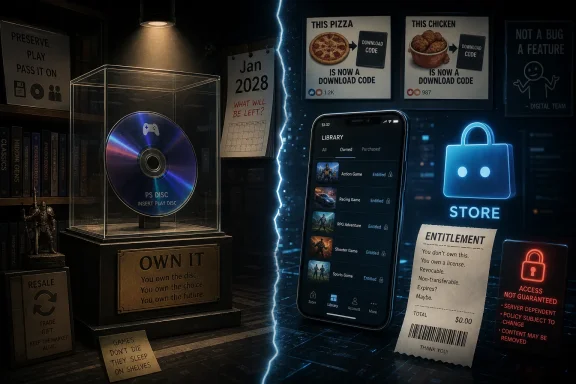
Sony’s July 1 announcement says new PlayStation games will stop shipping on physical discs in January 2028, moving future releases to digital delivery through PlayStation Store and retailer-sold digital formats. The decision is not just a format change; it is a forced renegotiation of what PlayStation ownership means. For Microsoft, it creates an opening at the exact moment Xbox hardware looks least settled. For Windows 11, it creates a rare chance to sell itself not as a desktop operating system with games attached, but as the escape hatch for console players who feel the walls closing in.
Sony’s case is simple enough on paper: most players already buy digitally, and manufacturing discs for a shrinking share of the market costs money. The company is following the same gravitational pull that transformed music, movies, software, and PC gaming years ago. If PlayStation’s business is increasingly subscriptions, storefronts, account libraries, and downloadable content, then the plastic disc is an expensive symbol of an older era.
But symbols matter, especially in console gaming. A disc is not just a storage medium; it is a used-game market, a lending system, a collector’s object, a gift, a fallback when a storefront breaks, and a psychological claim that the thing you bought exists outside a company account page. Sony can truthfully say digital is where the market has gone while still underestimating how many customers saw physical games as the last visible line between buying and merely accessing.
That is why the backlash has been so sharp. Players who have accepted day-one patches, mandatory installs, online accounts, cloud saves, and digital deluxe editions are still reacting as if Sony crossed a line. The line was never purely technical. It was emotional, cultural, and economic.
The uncomfortable part for Sony is that its own history makes the decision feel like a reversal rather than an inevitability. PlayStation built part of the PS4 generation’s identity around being the console that did not make game ownership weird. Now, thirteen years after the Xbox One launch fiasco gave Sony one of the easiest marketing wins in gaming history, PlayStation is the brand telling players that the next era comes without discs.
That moment mattered because it framed Sony as the defender of the obvious. You bought a game, you owned the copy, you could share it, sell it, lend it, put it on a shelf, or dig it out years later. Microsoft’s original Xbox One strategy was not only unpopular because it was restrictive; it was unpopular because it made consumers aware of the hidden power platform holders wanted over retail games.
Sony benefited from that resentment. The PS4 did not merely beat Xbox One on price, hardware, or messaging. It won trust by letting Microsoft look like the company trying to drag console players into an account-bound future before they were ready.
The irony is that the industry did get dragged there anyway. The difference is that it happened slowly, with sales, convenience, subscriptions, and storage installs doing what corporate policy could not do overnight. Digital libraries became normal. Physical copies became less complete. Multiplayer games became services. Even single-player games often needed patches large enough to make the disc feel like a license token with box art.
Sony’s 2028 deadline simply removes the ambiguity. The company is no longer letting the market erode physical ownership in the background. It is setting an end date.
That is the part players are reacting to. Many of them already own hundreds of digital games. They are not rejecting downloads in principle. They are rejecting a future in which there is no alternative when the download becomes the only version that matters.
The preservation argument is easy to caricature because most people are not archivists. But game preservation is not just about museums or historians. It is about whether software survives corporate neglect, expired licenses, delisted music, dead authentication systems, and storefront closures. Players have already watched digital shops age badly, and every shutdown makes the promise of permanent account libraries feel more conditional.
Physical media has its own myths. A disc is not magic. Some modern discs are incomplete without patches, and many online games cannot be meaningfully preserved by a retail copy alone. But physical media still distributes power. It gives retailers a role, gives collectors a market, gives families a way to share, and gives consumers a fallback that is not entirely mediated by one company’s servers.
Sony’s announcement threatens that balance. The move may make sense in a spreadsheet, but the spreadsheet does not have to explain to a thirty-year PlayStation customer why a shelf full of games suddenly feels like the end of a lineage.
That change says a lot about the state of gaming. PC used to be the complicated alternative: more powerful, more flexible, more expensive, and more annoying. It required drivers, launchers, settings menus, graphics presets, storefront choices, controller configuration, and a tolerance for troubleshooting that console players did not always want.
But the value proposition has shifted. If PlayStation no longer offers physical ownership as a meaningful distinction, then the console’s simplicity has to stand on its own. Once players are being asked to accept account-bound digital libraries anyway, PC starts looking less alien. It has Steam, GOG, Epic, Xbox, Battle.net, modding, ultrawide support, cheaper online play, more input options, and fewer generational walls.
That does not mean PC is a clean victory for ownership. Steam is still a digital platform. Most PC games are still licenses. DRM still exists. Launchers still break. But the PC’s advantage is pluralism. No single hardware maker controls the entire lifecycle of the machine, the storefront, the accessories, the upgrade path, and the backward compatibility story.
For a PlayStation loyalist who feels trapped by Sony’s decision, that pluralism may matter more than the disc itself. The appeal is not that PC perfectly preserves the old console retail model. The appeal is that PC does not require trusting one console vendor to define the future of every purchase.
The trouble is that Xbox has spent years blurring the meaning of being an Xbox customer. Xbox is a console, a Windows app, a cloud service, a subscription, a publisher, and a brand that now appears on competing devices. That strategy has advantages, but it also makes it hard for Microsoft to present Xbox hardware as the stable physical-media refuge PlayStation fans may imagine.
The direction of travel is obvious across the industry. Microsoft already sells a disc-less Series S, has pushed Game Pass as the center of its gaming identity, and has increasingly treated hardware as one endpoint among many. Reports about next-generation Xbox planning have repeatedly suggested more PC-like hardware, deeper Windows integration, and uncertainty around the future role of a disc drive. Even if Microsoft keeps some form of physical compatibility, it is hard to believe the company sees discs as the strategic center of the next Xbox.
That is the paradox. Sony’s move may push some players toward Xbox, but Xbox itself is not a return to 2013. It is another route into a digital ecosystem, just one with a different storefront, a different subscription pitch, and a more complicated relationship with Windows.
Microsoft’s strongest play may therefore not be “come to Xbox instead.” It may be “come to the Microsoft gaming ecosystem wherever you want to play.” That is less emotionally satisfying for disc loyalists, but it is much closer to how Microsoft actually behaves.
That is the reputation Microsoft has been trying to change. The new console-style Xbox experience for Windows 11 is not a small cosmetic tweak; it is an admission that the normal desktop is a bad living-room interface. A controller-first full-screen shell says the quiet part out loud: if Microsoft wants console players on PC, it has to make Windows feel less like Windows.
This matters because PlayStation defectors are not all planning to build tower PCs. Many are looking at handhelds, compact living-room machines, mini PCs, and devices that behave like consoles while retaining PC flexibility. In that world, the Windows desktop is not a feature. It is friction.
A full-screen Xbox interface gives Microsoft a way to hide the rough edges. It can surface libraries, Game Pass, cloud gaming, the store, and recently played titles without asking a new PC player to navigate taskbars, pop-ups, update prompts, and tiny desktop controls from a couch. It does not solve every Windows gaming problem, but it solves the first impression problem.
That first impression is critical. A console player angry at Sony is not automatically ready to become a PC hobbyist. Microsoft has to catch that player before the first driver issue, launcher conflict, or sleep-state bug turns curiosity into regret.
That distinction matters most on handhelds. Windows gaming handhelds have improved quickly, but they still fight the operating system more than they should. Battery life, standby reliability, shader compilation, controller navigation, and inconsistent launcher behavior remain obvious weaknesses next to purpose-built console software or SteamOS-style environments.
Microsoft knows this. The company’s recent gaming work on Windows has focused not just on interface changes but also on performance, background resource use, and making the OS less intrusive when a device is being used primarily for games. The promise is appealing: a PC that can behave like a console when you want it to, then become a full Windows machine when you need it to.
But promise is not product. If Windows 11 courts PlayStation refugees, it inherits console expectations. Those users will not grade on the PC curve. They will expect suspend and resume to work, controllers to behave consistently, games to launch without ceremony, and the operating system to stay out of the way.
The irony is sharp. Sony’s digital decision may push players toward Windows, but Windows will only keep them if it becomes less visibly Windows at the moments that matter.
That compromise pleases almost nobody. Retailers keep a product category, but lose the used-game loop that made physical games valuable. Collectors get a box, but not the object that gave the box meaning. Gift buyers get something wrap-ready, but still hand over a redemption code tied to an account. Preservationists get less than they had before.
The code-in-a-box model is not new, and on PC it has been common for years. But consoles trained customers differently. Console retail shelves taught players that a game was a thing. Even after installs became mandatory, the disc maintained the ceremony of ownership.
Once the disc disappears, the retail box starts to look like theater. It is there to reassure customers who still like buying something tangible, while quietly removing the parts of tangibility that mattered most. That may be good transition management, but it is poor emotional design.
The industry often assumes consumers are irrationally attached to plastic. That misses the point. Consumers are attached to rights, habits, resale value, giftability, and independence. Plastic was merely the container.
Sony’s decision tells that audience it is no longer central to the PlayStation future. Some will adapt. Some will keep collecting older releases. Some will move to Nintendo for as long as Nintendo keeps physical media relevant. Others will look to boutique publishers and limited-run companies while they still can.
But a portion will leave the console ecosystem altogether. For them, PC’s lack of traditional physical media is not a dealbreaker because PC offers other forms of control. DRM-free storefronts exist. Mods extend game life. Files can be backed up. Old games can often be coaxed into running through community fixes long after official support ends.
That is not the same as owning a disc. It may be better in some ways and worse in others. But it gives technically inclined players a sense of agency that a locked console storefront cannot match.
Sony’s mistake may be assuming physical buyers are simply late adopters of digital. Many are not. They are customers who understand the digital future perfectly well and dislike the power arrangement it creates.
Sony’s disc decision reinforces that shift. Once every new PlayStation game is digital, a PlayStation library becomes more visibly dependent on Sony’s store, Sony’s network, Sony’s compatibility policies, and Sony’s account rules. The console becomes the access device, not the owner’s archive.
Microsoft has been preparing for this world more openly. Game Pass, cloud gaming, Play Anywhere, PC integration, and cross-device saves all point toward an ecosystem where the box under the TV is optional. That makes Xbox less pure as a console competitor but potentially more durable as a digital library strategy.
Valve may be the more important comparison. Steam has trained PC players to accept digital libraries by pairing them with aggressive sales, broad compatibility, community features, user reviews, mod distribution, and a long record of keeping old purchases accessible. Steam is not ownership in the physical sense, but it has built trust by making the digital bargain feel reliable.
That is the bar Sony now has to clear. If PlayStation wants to remove discs, it has to make the digital library feel safer, more portable, more durable, and more consumer-friendly. Otherwise, players will compare Sony not to the declining physical market, but to the best digital ecosystems available elsewhere.
For console platforms, preservation is especially fragile because hardware, firmware, storefronts, and accounts are tightly coupled. A PC game can sometimes survive through community patches, emulation, wrappers, and unofficial fixes. A console game locked behind a closed ecosystem depends much more heavily on the platform holder’s decisions.
Sony can argue that existing discs and planned pre-2028 discs are unaffected, and that is important. The company is not confiscating shelves. But the future pipeline matters. New games define what a platform becomes, and after January 2028, the physical PlayStation lineage effectively stops for new releases.
That changes the cultural record. Future collectors may be able to preserve boxes, codes, screenshots, and account histories, but not retail discs for new PlayStation titles. For a medium still struggling to preserve its own past, that is not a small shift.
The broader industry should pay attention because this is how formats end: not with one dramatic shutdown, but with a platform holder declaring that the next generation of releases no longer needs the old medium. Once a company as large as Sony moves, publishers, retailers, and competitors recalibrate around that reality.
Microsoft’s contradictions are obvious. It wants Windows to be the best place to game, but Windows remains cluttered with features gamers did not ask for. It wants Xbox to be everywhere, but that makes Xbox hardware feel less essential. It wants Game Pass to be irresistible, but subscription economics have raised questions across the industry about sustainability, discoverability, and long-term value for developers.
Still, Microsoft has one advantage Sony does not: it can meet angry PlayStation users with flexibility rather than a single replacement box. A player can buy a handheld, a desktop, a laptop, a mini PC, or an Xbox. They can use Steam, Game Pass, Epic, GOG, or a publisher launcher. They can connect a DualSense controller if they want. They can mod games, stream games, emulate older titles where legally appropriate, or build a machine around the performance target they care about.
That flexibility is messy, but it is also the point. Sony’s decision makes PlayStation feel more controlled. Windows can counter by feeling less controlled, even if the reality is complicated.
For Microsoft, the challenge is to turn that philosophical advantage into a practical one. A console-like Windows mode, better handheld behavior, fewer intrusive prompts, and smoother game performance are not side quests. They are the product.
Their destinations will differ. The price-sensitive used-game buyer may not find PC attractive if hardware costs remain high. The collector may drift toward older platforms or limited physical releases. The performance enthusiast may already have been halfway to PC. The casual player may complain loudly and then keep buying PlayStation games digitally because friends, trophies, and existing libraries are powerful anchors.
Sony knows this. The company is likely betting that outrage will not translate into mass abandonment. That may be a good bet. Console ecosystems are sticky, and most players do not rebuild their gaming lives over one policy change that takes effect in 2028.
But not every strategic mistake shows up as an immediate exodus. Sometimes the damage is slower. A player who would have bought PS6 at launch may wait. A parent who would have bought a PlayStation for physical gifts may consider a PC handheld. A collector who bought every first-party special edition may stop. A lapsed Xbox or PC user may decide the next generation is the right time to switch.
Sony does not need to lose everyone for this to matter. It only needs to weaken the emotional default that made PlayStation feel like the safe choice.
Sony has time to soften the landing. It could clarify how retailers will sell digital formats, improve refund policies, strengthen account protections, expand offline access guarantees, and make long-term library preservation part of the pitch. If it removes physical media without improving consumer rights, it will look like a one-way transfer of power.
Microsoft has time to make Windows gaming feel credible to console players. That means the Xbox-style full-screen experience cannot remain a novelty for enthusiasts toggling hidden features. It has to become reliable, visible, and boring in the best sense. The user should turn on a device with a controller and start playing.
Valve and the SteamOS ecosystem also have time to benefit. If Windows handhelds stumble, SteamOS-style devices will look increasingly attractive to players who want PC libraries without desktop baggage. Sony’s decision does not guarantee Microsoft wins; it guarantees players will compare alternatives more seriously.
Retailers and physical-media companies face the hardest transition. They can sell codes, merchandise, collector’s boxes, and accessories, but the economic engine of physical games weakens once discs disappear from new PlayStation releases. The used-game shelf, already diminished, becomes more historical than current.
Kojima’s sharper warning was aimed at streaming and cloud-based access. His point is that downloaded games at least leave data on a player’s own hardware, while cloud gaming turns access into something controlled entirely by remote servers, subscriptions, licensing, and availability decisions. If distribution stops, users may no longer be able to play the games or watch the films they care about.
The practical impact for Windows and Xbox users is that the preservation debate is expanding beyond discs versus downloads. Kojima’s comments reinforce why PC storefront choice, local installs, backups, and DRM-free options matter to players looking for more control. They also complicate Microsoft’s own pitch: Game Pass and cloud gaming are convenient, but they do not answer the ownership concerns now driving some PlayStation backlash.
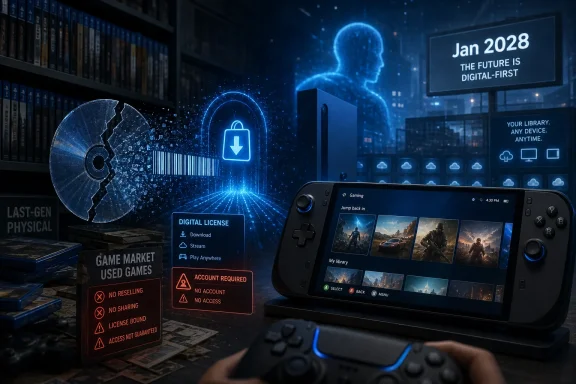 Sony Turns a Consumer Trend Into a Loyalty Test
Sony’s case is simple enough on paper: most players already buy digitally, and manufacturing discs for a shrinking share of the market costs money. The company is following the same gravitational pull that transformed music, movies, software, and PC gaming years ago. If PlayStation’s business is increasingly subscriptions, storefronts, account libraries, and downloadable content, then the plastic disc is an expensive symbol of an older era.But symbols matter, especially in console gaming. A disc is not just a storage medium; it is a used-game market, a lending system, a collector’s object, a gift, a fallback when a storefront breaks, and a psychological claim that the thing you bought exists outside a company account page. Sony can truthfully say digital is where the market has gone while still underestimating how many customers saw physical games as the last visible line between buying and merely accessing.
That is why the backlash has been so sharp. Players who have accepted day-one patches, mandatory installs, online accounts, cloud saves, and digital deluxe editions are still reacting as if Sony crossed a line. The line was never purely technical. It was emotional, cultural, and economic.
The uncomfortable part for Sony is that its own history makes the decision feel like a reversal rather than an inevitability. PlayStation built part of the PS4 generation’s identity around being the console that did not make game ownership weird. Now, thirteen years after the Xbox One launch fiasco gave Sony one of the easiest marketing wins in gaming history, PlayStation is the brand telling players that the next era comes without discs.
The Ghost of 2013 Is Still Sitting in the Drive Bay
The reason this story has traveled so quickly is that gamers have long memories when a company’s old marketing can be used as a weapon. Sony’s famous PS4-era jab at Microsoft, the one that reduced game sharing to handing someone a disc, has become less like a joke and more like evidence. It captured a moment when PlayStation sounded uncomplicated and Xbox sounded like a licensing seminar.That moment mattered because it framed Sony as the defender of the obvious. You bought a game, you owned the copy, you could share it, sell it, lend it, put it on a shelf, or dig it out years later. Microsoft’s original Xbox One strategy was not only unpopular because it was restrictive; it was unpopular because it made consumers aware of the hidden power platform holders wanted over retail games.
Sony benefited from that resentment. The PS4 did not merely beat Xbox One on price, hardware, or messaging. It won trust by letting Microsoft look like the company trying to drag console players into an account-bound future before they were ready.
The irony is that the industry did get dragged there anyway. The difference is that it happened slowly, with sales, convenience, subscriptions, and storage installs doing what corporate policy could not do overnight. Digital libraries became normal. Physical copies became less complete. Multiplayer games became services. Even single-player games often needed patches large enough to make the disc feel like a license token with box art.
Sony’s 2028 deadline simply removes the ambiguity. The company is no longer letting the market erode physical ownership in the background. It is setting an end date.
PlayStation’s Problem Is Not Digital Games, It Is Digital Dependence
The modern console business wants customers inside a closed loop. That loop includes the store, the subscription tier, the refund policy, the wallet balance, the cloud save, the account ban system, and the platform holder’s definition of availability. Digital distribution is convenient, but it also centralizes control.That is the part players are reacting to. Many of them already own hundreds of digital games. They are not rejecting downloads in principle. They are rejecting a future in which there is no alternative when the download becomes the only version that matters.
The preservation argument is easy to caricature because most people are not archivists. But game preservation is not just about museums or historians. It is about whether software survives corporate neglect, expired licenses, delisted music, dead authentication systems, and storefront closures. Players have already watched digital shops age badly, and every shutdown makes the promise of permanent account libraries feel more conditional.
Physical media has its own myths. A disc is not magic. Some modern discs are incomplete without patches, and many online games cannot be meaningfully preserved by a retail copy alone. But physical media still distributes power. It gives retailers a role, gives collectors a market, gives families a way to share, and gives consumers a fallback that is not entirely mediated by one company’s servers.
Sony’s announcement threatens that balance. The move may make sense in a spreadsheet, but the spreadsheet does not have to explain to a thirty-year PlayStation customer why a shelf full of games suddenly feels like the end of a lineage.
The PC Suddenly Looks Less Like a Hobby and More Like an Exit
The most interesting part of the backlash is not that some PlayStation fans are angry. It is where they say they are going. A decade ago, the obvious destination would have been Xbox. Today, a striking number of players are looking at PC first.That change says a lot about the state of gaming. PC used to be the complicated alternative: more powerful, more flexible, more expensive, and more annoying. It required drivers, launchers, settings menus, graphics presets, storefront choices, controller configuration, and a tolerance for troubleshooting that console players did not always want.
But the value proposition has shifted. If PlayStation no longer offers physical ownership as a meaningful distinction, then the console’s simplicity has to stand on its own. Once players are being asked to accept account-bound digital libraries anyway, PC starts looking less alien. It has Steam, GOG, Epic, Xbox, Battle.net, modding, ultrawide support, cheaper online play, more input options, and fewer generational walls.
That does not mean PC is a clean victory for ownership. Steam is still a digital platform. Most PC games are still licenses. DRM still exists. Launchers still break. But the PC’s advantage is pluralism. No single hardware maker controls the entire lifecycle of the machine, the storefront, the accessories, the upgrade path, and the backward compatibility story.
For a PlayStation loyalist who feels trapped by Sony’s decision, that pluralism may matter more than the disc itself. The appeal is not that PC perfectly preserves the old console retail model. The appeal is that PC does not require trusting one console vendor to define the future of every purchase.
Xbox Is the Tempting Refuge With the Same Storm Clouds
Microsoft should be enjoying this moment more than it probably can. Sony has handed Xbox a ready-made attack line: PlayStation walked away from discs. In a healthier Xbox hardware cycle, that would be a clean opportunity to court collectors, used-game buyers, and players who still want a console under the television.The trouble is that Xbox has spent years blurring the meaning of being an Xbox customer. Xbox is a console, a Windows app, a cloud service, a subscription, a publisher, and a brand that now appears on competing devices. That strategy has advantages, but it also makes it hard for Microsoft to present Xbox hardware as the stable physical-media refuge PlayStation fans may imagine.
The direction of travel is obvious across the industry. Microsoft already sells a disc-less Series S, has pushed Game Pass as the center of its gaming identity, and has increasingly treated hardware as one endpoint among many. Reports about next-generation Xbox planning have repeatedly suggested more PC-like hardware, deeper Windows integration, and uncertainty around the future role of a disc drive. Even if Microsoft keeps some form of physical compatibility, it is hard to believe the company sees discs as the strategic center of the next Xbox.
That is the paradox. Sony’s move may push some players toward Xbox, but Xbox itself is not a return to 2013. It is another route into a digital ecosystem, just one with a different storefront, a different subscription pitch, and a more complicated relationship with Windows.
Microsoft’s strongest play may therefore not be “come to Xbox instead.” It may be “come to the Microsoft gaming ecosystem wherever you want to play.” That is less emotionally satisfying for disc loyalists, but it is much closer to how Microsoft actually behaves.
Windows 11 Gets the Opening Xbox Hardware Could Not Create Alone
For years, Microsoft’s gaming strategy has had a strange imbalance. Windows is the largest gaming platform Microsoft owns, but Xbox is the gaming brand people recognize. PC players may spend thousands on hardware, but Windows itself often feels like the tax they pay to get to Steam.That is the reputation Microsoft has been trying to change. The new console-style Xbox experience for Windows 11 is not a small cosmetic tweak; it is an admission that the normal desktop is a bad living-room interface. A controller-first full-screen shell says the quiet part out loud: if Microsoft wants console players on PC, it has to make Windows feel less like Windows.
This matters because PlayStation defectors are not all planning to build tower PCs. Many are looking at handhelds, compact living-room machines, mini PCs, and devices that behave like consoles while retaining PC flexibility. In that world, the Windows desktop is not a feature. It is friction.
A full-screen Xbox interface gives Microsoft a way to hide the rough edges. It can surface libraries, Game Pass, cloud gaming, the store, and recently played titles without asking a new PC player to navigate taskbars, pop-ups, update prompts, and tiny desktop controls from a couch. It does not solve every Windows gaming problem, but it solves the first impression problem.
That first impression is critical. A console player angry at Sony is not automatically ready to become a PC hobbyist. Microsoft has to catch that player before the first driver issue, launcher conflict, or sleep-state bug turns curiosity into regret.
Hiding Windows Is Not the Same as Fixing Windows
The danger for Microsoft is mistaking a better shell for a better platform. Windows 11 can be made to look console-like, but underneath it remains a general-purpose operating system with decades of assumptions that were never built around instant-on gaming. The desktop can be hidden; the scheduler, update model, driver stack, power behavior, and background services cannot be wished away.That distinction matters most on handhelds. Windows gaming handhelds have improved quickly, but they still fight the operating system more than they should. Battery life, standby reliability, shader compilation, controller navigation, and inconsistent launcher behavior remain obvious weaknesses next to purpose-built console software or SteamOS-style environments.
Microsoft knows this. The company’s recent gaming work on Windows has focused not just on interface changes but also on performance, background resource use, and making the OS less intrusive when a device is being used primarily for games. The promise is appealing: a PC that can behave like a console when you want it to, then become a full Windows machine when you need it to.
But promise is not product. If Windows 11 courts PlayStation refugees, it inherits console expectations. Those users will not grade on the PC curve. They will expect suspend and resume to work, controllers to behave consistently, games to launch without ceremony, and the operating system to stay out of the way.
The irony is sharp. Sony’s digital decision may push players toward Windows, but Windows will only keep them if it becomes less visibly Windows at the moments that matter.
Retail Boxes Without Discs Are a Strange Half-Step
Sony’s plan to keep selling games through retailers in digital formats is revealing. It suggests the company does not want to abandon retail relationships entirely, but also no longer wants retail to handle actual game media. The box may survive, but as packaging for a code.That compromise pleases almost nobody. Retailers keep a product category, but lose the used-game loop that made physical games valuable. Collectors get a box, but not the object that gave the box meaning. Gift buyers get something wrap-ready, but still hand over a redemption code tied to an account. Preservationists get less than they had before.
The code-in-a-box model is not new, and on PC it has been common for years. But consoles trained customers differently. Console retail shelves taught players that a game was a thing. Even after installs became mandatory, the disc maintained the ceremony of ownership.
Once the disc disappears, the retail box starts to look like theater. It is there to reassure customers who still like buying something tangible, while quietly removing the parts of tangibility that mattered most. That may be good transition management, but it is poor emotional design.
The industry often assumes consumers are irrationally attached to plastic. That misses the point. Consumers are attached to rights, habits, resale value, giftability, and independence. Plastic was merely the container.
Collectors Are Warning About a Market Sony Does Not Measure Well
Physical collectors are easy to dismiss because they are not the majority. But they are disproportionately loud, loyal, and culturally important. They buy deluxe editions, share shelf photos, keep franchises visible between releases, and act as a living archive for older platforms.Sony’s decision tells that audience it is no longer central to the PlayStation future. Some will adapt. Some will keep collecting older releases. Some will move to Nintendo for as long as Nintendo keeps physical media relevant. Others will look to boutique publishers and limited-run companies while they still can.
But a portion will leave the console ecosystem altogether. For them, PC’s lack of traditional physical media is not a dealbreaker because PC offers other forms of control. DRM-free storefronts exist. Mods extend game life. Files can be backed up. Old games can often be coaxed into running through community fixes long after official support ends.
That is not the same as owning a disc. It may be better in some ways and worse in others. But it gives technically inclined players a sense of agency that a locked console storefront cannot match.
Sony’s mistake may be assuming physical buyers are simply late adopters of digital. Many are not. They are customers who understand the digital future perfectly well and dislike the power arrangement it creates.
The Console War Gives Way to the Library War
The old PlayStation-versus-Xbox framing is increasingly inadequate. The real fight is over libraries, subscriptions, identities, and where players believe their purchases will have the longest life. Hardware still matters, but the platform is now the account.Sony’s disc decision reinforces that shift. Once every new PlayStation game is digital, a PlayStation library becomes more visibly dependent on Sony’s store, Sony’s network, Sony’s compatibility policies, and Sony’s account rules. The console becomes the access device, not the owner’s archive.
Microsoft has been preparing for this world more openly. Game Pass, cloud gaming, Play Anywhere, PC integration, and cross-device saves all point toward an ecosystem where the box under the TV is optional. That makes Xbox less pure as a console competitor but potentially more durable as a digital library strategy.
Valve may be the more important comparison. Steam has trained PC players to accept digital libraries by pairing them with aggressive sales, broad compatibility, community features, user reviews, mod distribution, and a long record of keeping old purchases accessible. Steam is not ownership in the physical sense, but it has built trust by making the digital bargain feel reliable.
That is the bar Sony now has to clear. If PlayStation wants to remove discs, it has to make the digital library feel safer, more portable, more durable, and more consumer-friendly. Otherwise, players will compare Sony not to the declining physical market, but to the best digital ecosystems available elsewhere.
Preservation Becomes a Consumer Issue, Not a Museum Issue
The preservation debate has matured because players have lived through enough closures to understand the stakes. Digital storefronts are not eternal. Licensing deals expire. Online services shut down. Patches vanish. Even when games remain downloadable, the surrounding ecosystem can decay.For console platforms, preservation is especially fragile because hardware, firmware, storefronts, and accounts are tightly coupled. A PC game can sometimes survive through community patches, emulation, wrappers, and unofficial fixes. A console game locked behind a closed ecosystem depends much more heavily on the platform holder’s decisions.
Sony can argue that existing discs and planned pre-2028 discs are unaffected, and that is important. The company is not confiscating shelves. But the future pipeline matters. New games define what a platform becomes, and after January 2028, the physical PlayStation lineage effectively stops for new releases.
That changes the cultural record. Future collectors may be able to preserve boxes, codes, screenshots, and account histories, but not retail discs for new PlayStation titles. For a medium still struggling to preserve its own past, that is not a small shift.
The broader industry should pay attention because this is how formats end: not with one dramatic shutdown, but with a platform holder declaring that the next generation of releases no longer needs the old medium. Once a company as large as Sony moves, publishers, retailers, and competitors recalibrate around that reality.
Microsoft’s Gift Comes Wrapped in Its Own Contradictions
If there is a winner in Sony’s announcement, it is not automatically Xbox. It is the idea of the Windows gaming PC as the least-bad answer to platform dependence. That is a subtler win, and one Microsoft can still squander.Microsoft’s contradictions are obvious. It wants Windows to be the best place to game, but Windows remains cluttered with features gamers did not ask for. It wants Xbox to be everywhere, but that makes Xbox hardware feel less essential. It wants Game Pass to be irresistible, but subscription economics have raised questions across the industry about sustainability, discoverability, and long-term value for developers.
Still, Microsoft has one advantage Sony does not: it can meet angry PlayStation users with flexibility rather than a single replacement box. A player can buy a handheld, a desktop, a laptop, a mini PC, or an Xbox. They can use Steam, Game Pass, Epic, GOG, or a publisher launcher. They can connect a DualSense controller if they want. They can mod games, stream games, emulate older titles where legally appropriate, or build a machine around the performance target they care about.
That flexibility is messy, but it is also the point. Sony’s decision makes PlayStation feel more controlled. Windows can counter by feeling less controlled, even if the reality is complicated.
For Microsoft, the challenge is to turn that philosophical advantage into a practical one. A console-like Windows mode, better handheld behavior, fewer intrusive prompts, and smoother game performance are not side quests. They are the product.
The Players Sony Angered Are Not All the Same
It would be a mistake to treat the backlash as one unified revolt. Some players are angry because they resell games. Some are angry because they collect. Some are worried about preservation. Some dislike account dependence. Some simply enjoy the ritual of buying discs. Some are using the announcement as a chance to vent years of frustration with pricing, subscriptions, remasters, and platform exclusives.Their destinations will differ. The price-sensitive used-game buyer may not find PC attractive if hardware costs remain high. The collector may drift toward older platforms or limited physical releases. The performance enthusiast may already have been halfway to PC. The casual player may complain loudly and then keep buying PlayStation games digitally because friends, trophies, and existing libraries are powerful anchors.
Sony knows this. The company is likely betting that outrage will not translate into mass abandonment. That may be a good bet. Console ecosystems are sticky, and most players do not rebuild their gaming lives over one policy change that takes effect in 2028.
But not every strategic mistake shows up as an immediate exodus. Sometimes the damage is slower. A player who would have bought PS6 at launch may wait. A parent who would have bought a PlayStation for physical gifts may consider a PC handheld. A collector who bought every first-party special edition may stop. A lapsed Xbox or PC user may decide the next generation is the right time to switch.
Sony does not need to lose everyone for this to matter. It only needs to weaken the emotional default that made PlayStation feel like the safe choice.
The 2028 Deadline Gives Everyone Time to Choose Sides
The most concrete thing about Sony’s announcement is the date. January 2028 is close enough to shape buying decisions but far enough away for platform holders, retailers, and players to adjust. That makes the next eighteen months unusually important.Sony has time to soften the landing. It could clarify how retailers will sell digital formats, improve refund policies, strengthen account protections, expand offline access guarantees, and make long-term library preservation part of the pitch. If it removes physical media without improving consumer rights, it will look like a one-way transfer of power.
Microsoft has time to make Windows gaming feel credible to console players. That means the Xbox-style full-screen experience cannot remain a novelty for enthusiasts toggling hidden features. It has to become reliable, visible, and boring in the best sense. The user should turn on a device with a controller and start playing.
Valve and the SteamOS ecosystem also have time to benefit. If Windows handhelds stumble, SteamOS-style devices will look increasingly attractive to players who want PC libraries without desktop baggage. Sony’s decision does not guarantee Microsoft wins; it guarantees players will compare alternatives more seriously.
Retailers and physical-media companies face the hardest transition. They can sell codes, merchandise, collector’s boxes, and accessories, but the economic engine of physical games weakens once discs disappear from new PlayStation releases. The used-game shelf, already diminished, becomes more historical than current.
The PlayStation Shelf Stops Being the Center of the Room
The practical lessons are less dramatic than the backlash, but they are more durable. Sony’s announcement is not the death of gaming, nor is it proof that every angry fan will build a Windows 11 PC. It is a marker that the console business has moved from selling objects to managing access, and players are finally saying out loud that the trade has costs.- Sony’s January 2028 cutoff applies to new PlayStation games, while existing and already planned disc releases remain outside the immediate change.
- Retail versions of future PlayStation games may continue to exist, but their value changes if the box contains a digital entitlement instead of a disc.
- Xbox may gain attention from angry PlayStation users, but Microsoft’s own strategy also points toward a more digital, account-centered future.
- Windows 11 has a real opening if its Xbox-style full-screen experience can make PC gaming feel natural from a couch or handheld.
- PC is not a perfect substitute for physical ownership, but its open hardware and multiple storefronts give players more ways to reduce dependence on one platform holder.
- The next phase of the backlash will be measured less by social-media anger than by PS6-era buying decisions, handheld adoption, and where younger players build their libraries.
Update: Hideo Kojima warns cloud gaming is the bigger ownership threat (July 5, 2026)
Wccftech reports that Hideo Kojima has now weighed in on Sony’s planned end of new PlayStation disc production in January 2028, calling the loss of physical media “really sad” while arguing that discs disappearing is only the first stage of a broader shift away from consumer control.Kojima’s sharper warning was aimed at streaming and cloud-based access. His point is that downloaded games at least leave data on a player’s own hardware, while cloud gaming turns access into something controlled entirely by remote servers, subscriptions, licensing, and availability decisions. If distribution stops, users may no longer be able to play the games or watch the films they care about.
The practical impact for Windows and Xbox users is that the preservation debate is expanding beyond discs versus downloads. Kojima’s comments reinforce why PC storefront choice, local installs, backups, and DRM-free options matter to players looking for more control. They also complicate Microsoft’s own pitch: Game Pass and cloud gaming are convenient, but they do not answer the ownership concerns now driving some PlayStation backlash.
References
- Primary source: Windows Latest
Published: Thu, 02 Jul 2026 21:05:08 GMT
PlayStation fans brutally reject Sony's disc decision, eye Windows 11 PCs over Xbox
Sony confirmed physical PlayStation discs end in January 2028, and angry fans are threatening to abandon consoles for Windows 11 PCs instead. www.windowslatest.com
- Related coverage: tomshardware.com
Sony officially kills the PlayStation disc, ending physical game production in 2028 — shutting down the PlayStation Store on the PlayStation 3 and PS Vita systems | Tom's Hardware
This announcement essentially sounds the death knell for physical media in cutting-edge gaming.www.tomshardware.com - Related coverage: gamesradar.com
PlayStation is ending physical disc production for new games in 2028 as Sony says "general preference for digital media significantly outpaces physical discs" | GamesRadar+
"This is a natural direction" for the companywww.gamesradar.com - Related coverage: tomsguide.com
PlayStation is officially killing physical discs — here's when they disappear and what that means for you | Tom's Guide
Sony is officially ending physical disc versions of brand-new games starting in January 2028. Here's why the company has decided to make this decision.www.tomsguide.com - Related coverage: windowscentral.com
Windows 11 just changed the name of Xbox mode (kind of) | Windows Central
Windows 11’s latest Insider build quietly swaps “Xbox mode” for “XBOX mode,” reflecting Microsoft’s broader push to unify the brand.www.windowscentral.com - Related coverage: gematsu.com
Sony Interactive Entertainment to end physical game disc production in January 2028 - Gematsu
Sony Interactive Entertainment will end physical game disc production for all new games releasing on PlayStation consoles starting January 2028…www.gematsu.com
- Related coverage: dotesports.com
PlayStation physical discs ending for new games in January 2028
Sony will stop producing physical discs for new PlayStation games from January 2028, with future releases sold digitally through PlayStation Store and retailers.dotesports.com - Related coverage: games.gg
PlayStation Goes Digital-Only: What It Means for PS5 and PS6 | GAMES.GG
Sony is ending physical disc production for new PlayStation games. Here's what the shift to digital-only means for PS5 owners and the future of PS6.games.gg - Related coverage: forbes.com
Playstation Discs Will Be Scrapped Starting In 2028
The company said this change would not impact games that were already released.www.forbes.com - Related coverage: thenextweb.com
Sony will stop making physical PlayStation game discs in January 2028
Sony announced it will end physical disc production for new PlayStation games starting January 2028, as digital downloads now account for 85 percent of sales.thenextweb.com - Related coverage: gigazine.net
Playstationがコンソール向け新作ゲームのディスク生産を2028年1月で終了すると発表、2028年1月以降はダウンロード版のみに - GIGAZINE
2026年7月1日、Playstation公式ブログであるPlayStation.Blogで、Playstationコンソール向け新作ゲームのディスク生産が2028年1月で終了することが発表されました。gigazine.net - Related coverage: allthings.how
Xbox FSE (Full Screen Experience) on Windows 11: Setup, controls, and performance
Learn how the Xbox full screen experience works on handhelds and PCs, how to turn it on, and what to expect day to day.allthings.how - Related coverage: engadget.com
Sony Will Stop Making Disc-Based PlayStation Games Starting 2028
RIP to physical PlayStation discs.www.engadget.com - Related coverage: hardwarezone.com.sg
PlayStation ends physical disc production | HardwareZone Singapore
Sony will stop producing physical discs for new PlayStation games from January 2028, signalling a major shift to digital distribution. www.hardwarezone.com.sg
- Related coverage: elpais.com
Adiós a los discos de la PlayStation: Sony dejará de publicar ese formato de videojuegos | Tecnología | EL PAÍS
La compañía anuncia que a partir de enero 2028 todos los títulos nuevos serán solo en formato digitalelpais.com
Last edited: