

Sony Interactive Entertainment president and CEO Hideaki Nishino said in a recent investor Q&A that Sony cannot realistically absorb every rise in PlayStation component costs, after PS5 price increases outside Japan and fresh U.S. data showing PlayStation’s weakest May hardware unit sales since 2000. The remark is more than a defense of one price hike. It is Sony telling the market that the old console bargain — subsidized hardware now, platform profits later — no longer governs PlayStation strategy. For players, developers, and rivals, that changes the emotional contract around console generations.
For decades, the games business trained customers to think of a console as a subsidized doorway. The machine under the television was the expensive thing manufacturers were willing to discount because the real money arrived later, through licensing fees, first-party games, accessories, subscriptions, and network services. That bargain was never as simple as folklore made it sound, but it shaped expectations: console prices usually fell over time, and late-generation buyers were supposed to get the best deal.
Nishino’s answer cuts against that memory. He described PlayStation hardware as the base for an ecosystem, but also said Sony does not intend to sell hardware at significant losses. The company’s message is blunt: the box is still strategic, but it is no longer sacred enough to protect consumers from the bill of materials.
That matters because the PS5 is not a launch product anymore. It arrived in November 2020, fought through pandemic-era supply constraints, and is now deep into the mature phase of its life cycle. Historically, that is when console makers talk about broadening the market, trimming costs, and using cheaper hardware to bring in families, younger players, and late adopters. Instead, Sony is talking about memory prices, manufacturing costs, and value communication.
The phrase “value we provide in relation to pricing” sounds like corporate gauze, but the underlying argument is clear. Sony believes PlayStation can command a higher hardware price because the ecosystem around the console is valuable enough to hold demand. The risk is equally clear: if customers decide the ecosystem is not worth the premium, the console business begins to look less like a mass-market platform and more like a high-end consumer electronics category.
Nishino said sales are proceeding as planned and that Sony does not believe price hikes have caused a decline in demand. That may be true inside Sony’s internal forecast. A company can plan for lower unit volume at higher margin, especially when it has an installed base large enough to monetize through software and services. But “as planned” is not the same thing as “healthy” from the perspective of market expansion.
This is the uncomfortable middle of the PS5 generation. The console is popular enough to remain central to the industry, but expensive enough that its late-cycle appeal is no longer automatic. A buyer looking at a console shelf in 2026 is not comparing the PS5 to its 2020 launch promise; they are comparing it to a used console, a gaming PC, a Steam Deck-style handheld, a Switch 2, cloud gaming, mobile games, and the reality that many of their friends are still playing cross-generation titles.
The traditional late-cycle console discount was not just a consumer perk. It was a platform growth mechanism. Lower prices widened the funnel, which helped software sales, multiplayer communities, and developer confidence. If prices rise instead of fall, the funnel narrows at exactly the point when a platform should be squeezing the last major wave of adoption out of its installed generation.
That is why Nishino’s comment should not be dismissed as a greedy company discovering price increases. The console business is built on long planning cycles, aggressive cost targets, and a delicate balance between performance and affordability. If the cost curve stops moving in the expected direction, the whole model becomes harder to maintain.
But Sony’s problem is not merely that parts cost more. It is that the company has spent years teaching investors that PlayStation is a platform with durable margins, recurring revenue, and ecosystem leverage. Once a division is judged less like a toy business and more like a digital services business, the tolerance for hardware losses shrinks. The console becomes infrastructure, but infrastructure still has to justify itself on the income statement.
That shift is subtle but profound. The PS5 does not merely play games; it supports PlayStation Plus, the PlayStation Store, accessories, remote play devices, digital purchases, and a customer relationship Sony wants to stretch across screens. Yet the more Sony emphasizes that ecosystem, the more it invites customers to ask why the entry ticket keeps getting more expensive.
That ecosystem logic makes sense. Console makers are trying to escape the hard edges of the seven-year cycle. If players can buy a console, subscribe to services, use companion hardware, play some titles on PC, and stay inside a branded account system, the platform becomes less dependent on one hardware launch every generation.
But Portal also illustrates the limit of that strategy. It is an accessory to the PS5 experience, not a replacement for the PS5. It works best for people already bought into the ecosystem, with the network setup, game library, and household use case to justify it. That makes it additive for loyalists, but not necessarily persuasive for price-sensitive newcomers.
Sony’s challenge is that ecosystem products can deepen engagement without solving affordability. A family balking at a higher console price is not likely to be reassured by the existence of a remote player. An enthusiast may appreciate the broader PlayStation hardware family, but the marginal buyer wants to know why the console costs more now than they expected it to cost years after launch.
The ecosystem argument also puts more pressure on software. If Sony is asking customers to understand the “value” behind higher pricing, the first answer cannot be a spreadsheet. It has to be games, services, backward compatibility, account continuity, performance, and social gravity. The platform must feel alive enough that the price is annoying rather than disqualifying.
This is why the old “wait for the next generation” reflex feels weaker than usual. A PS6 that delivers a major technical leap may cost more than players expect. A PS6 that aims to stay affordable may need to compromise on specifications, timing, or ambition. A delayed PS6 might preserve the PS5 base longer, but it would also extend a generation already defined by cross-gen releases and arguments about whether the current hardware has been fully used.
The industry has been here before in pieces, but not quite in this combination. The PlayStation 3 launched too expensive and had to fight its way back. The PS4 benefited from clean messaging, developer-friendly architecture, and a more digestible price. The PS5 launched into extraordinary demand but abnormal supply constraints. The PS6 may launch into something stranger: a market where consoles are still culturally powerful but no longer obviously cheap compared with other ways to play.
Sony knows this. That is why the company’s language is careful. It is not promising a cheap future, and it is not openly declaring a premium-only strategy. It is preserving optionality, which is what executives do when the cost model is uncertain and the consumer reaction is hard to predict.
Microsoft has spent years de-emphasizing console exclusivity in favor of Game Pass, PC, cloud, and a broader Xbox ecosystem. Sony has moved more cautiously, but it too is releasing more games on PC and talking about ways to expand beyond the console. Both companies appear to understand that the dedicated living-room console is no longer the only growth engine.
What differs is the degree of dependence. Sony still needs PlayStation hardware to anchor its platform economics and brand prestige. Microsoft can tolerate a more ambiguous hardware role because Xbox is increasingly tied to services, Windows PCs, and publishing scale. Nintendo, meanwhile, plays a different game by selling distinctive hardware wrapped around first-party software that rarely has direct substitutes.
That leaves Sony in a difficult but not disastrous position. It has the best conventional console business, but the conventional console business is becoming harder. The company can raise prices and protect margins, or chase units and risk profitability. Nishino’s answer suggests Sony would rather defend the economics of the platform than preserve every inherited assumption about console affordability.
If fewer late adopters enter the ecosystem, publishers may lean harder on cross-platform releases, PC ports, and service models that monetize existing players more aggressively. That does not mean PlayStation stops being essential. It means the economics of exclusivity and platform-first development become more complicated.
Sony’s own first-party strategy reflects this tension. The company still depends on prestige single-player franchises to define PlayStation, but it has also pursued live-service games as a way to create recurring engagement. Nishino’s comments about revitalizing the market through first- and third-party content fit that strategy. A higher-priced console needs games that keep justifying the platform after the hardware sale.
The danger is that live-service ambitions can look like an answer to an investor problem rather than a player problem. If Sony’s hardware becomes more expensive and its software strategy tilts too visibly toward recurring monetization, the audience may see less value, not more. The company has to prove that the ecosystem is richer because of these bets, not merely more extractive.
The result is a more confusing buying decision. The PS5 library is stronger than it was at launch, but the hardware value proposition is murkier. The console is older, the successor is somewhere on the horizon, and the price may not feel like a late-generation bargain. Even loyal PlayStation customers can feel the mismatch between lifecycle expectations and current pricing.
There is also a trust issue. Console makers sell not just hardware but timing confidence. Buyers want to believe they are entering a stable platform at a fair point in its life. If prices rise late in the cycle, some customers will wonder whether the next generation will punish early adopters, late adopters, or both.
Sony’s answer is to emphasize value. That can work, but only if the value is visible. Better first-party release cadence, stronger subscription offerings, seamless backward compatibility, repairability, storage flexibility, and clear communication around the next-generation transition all matter more when the hardware price rises.
The PC used to be the expensive, flexible alternative to the fixed-price console. That distinction is blurrier now. A console can still offer simplicity and optimized performance, but a higher console price makes a Windows gaming PC or handheld more plausible for some buyers, especially if they already need a general-purpose machine. Meanwhile, Sony’s expanding PC catalog gives players more ways to remain adjacent to PlayStation without buying every PlayStation device.
This does not mean the PC automatically wins. Windows gaming still has driver issues, storefront fragmentation, shader compilation annoyances, anti-cheat headaches, and a much wider range of hardware outcomes. Consoles remain attractive precisely because they collapse complexity into a single target. But when the price gap narrows, complexity becomes a trade-off rather than an automatic disqualifier.
Sony knows PC is both a release valve and a threat. PC ports extend software revenue and brand reach, but they also teach some customers that patience can replace platform loyalty. If PlayStation hardware is no longer clearly cheaper over time, Sony must make the console experience feel uniquely convenient, not merely temporarily exclusive.
Sony can probably defend higher PlayStation hardware prices for a while, especially if first-party games, third-party support, and ecosystem devices keep the brand central to the living room. The harder question is whether it can launch the next generation without making customers feel as if the console has become just another premium gadget chasing margin in a market already full of expensive screens. If the PS6 era is going to work, Sony will need more than a defensible bill of materials; it will need to rebuild the feeling that buying into PlayStation early, late, or anywhere in between is still a deal worth making.
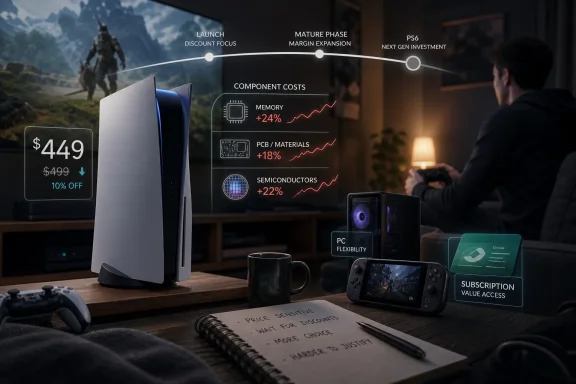 Sony Stops Pretending the Console Is a Loss Leader
For decades, the games business trained customers to think of a console as a subsidized doorway. The machine under the television was the expensive thing manufacturers were willing to discount because the real money arrived later, through licensing fees, first-party games, accessories, subscriptions, and network services. That bargain was never as simple as folklore made it sound, but it shaped expectations: console prices usually fell over time, and late-generation buyers were supposed to get the best deal.Nishino’s answer cuts against that memory. He described PlayStation hardware as the base for an ecosystem, but also said Sony does not intend to sell hardware at significant losses. The company’s message is blunt: the box is still strategic, but it is no longer sacred enough to protect consumers from the bill of materials.
That matters because the PS5 is not a launch product anymore. It arrived in November 2020, fought through pandemic-era supply constraints, and is now deep into the mature phase of its life cycle. Historically, that is when console makers talk about broadening the market, trimming costs, and using cheaper hardware to bring in families, younger players, and late adopters. Instead, Sony is talking about memory prices, manufacturing costs, and value communication.
The phrase “value we provide in relation to pricing” sounds like corporate gauze, but the underlying argument is clear. Sony believes PlayStation can command a higher hardware price because the ecosystem around the console is valuable enough to hold demand. The risk is equally clear: if customers decide the ecosystem is not worth the premium, the console business begins to look less like a mass-market platform and more like a high-end consumer electronics category.
The PS5 Price Curve Has Bent the Wrong Way
The awkwardness for Sony is that this is not happening in a vacuum. Recent U.S. market reporting from Circana, relayed by multiple outlets, says PlayStation hardware unit sales in May 2026 fell to their lowest May total since May 2000. Xbox reportedly had its worst May ever. The industry can debate causation, but the timing is brutal: higher average selling prices, softer hardware demand, and a consumer base already stretched by inflation and subscription fatigue.Nishino said sales are proceeding as planned and that Sony does not believe price hikes have caused a decline in demand. That may be true inside Sony’s internal forecast. A company can plan for lower unit volume at higher margin, especially when it has an installed base large enough to monetize through software and services. But “as planned” is not the same thing as “healthy” from the perspective of market expansion.
This is the uncomfortable middle of the PS5 generation. The console is popular enough to remain central to the industry, but expensive enough that its late-cycle appeal is no longer automatic. A buyer looking at a console shelf in 2026 is not comparing the PS5 to its 2020 launch promise; they are comparing it to a used console, a gaming PC, a Steam Deck-style handheld, a Switch 2, cloud gaming, mobile games, and the reality that many of their friends are still playing cross-generation titles.
The traditional late-cycle console discount was not just a consumer perk. It was a platform growth mechanism. Lower prices widened the funnel, which helped software sales, multiplayer communities, and developer confidence. If prices rise instead of fall, the funnel narrows at exactly the point when a platform should be squeezing the last major wave of adoption out of its installed generation.
Component Costs Have Become a Strategy Problem
Sony’s defense rests on a real issue: components are more expensive, and memory in particular has become a pressure point across the hardware industry. AI infrastructure demand, constrained supply, and competition for high-performance memory have changed the economics of devices that once benefited from predictable cost reductions. Consoles depend on custom designs, but they do not exist outside the semiconductor market.That is why Nishino’s comment should not be dismissed as a greedy company discovering price increases. The console business is built on long planning cycles, aggressive cost targets, and a delicate balance between performance and affordability. If the cost curve stops moving in the expected direction, the whole model becomes harder to maintain.
But Sony’s problem is not merely that parts cost more. It is that the company has spent years teaching investors that PlayStation is a platform with durable margins, recurring revenue, and ecosystem leverage. Once a division is judged less like a toy business and more like a digital services business, the tolerance for hardware losses shrinks. The console becomes infrastructure, but infrastructure still has to justify itself on the income statement.
That shift is subtle but profound. The PS5 does not merely play games; it supports PlayStation Plus, the PlayStation Store, accessories, remote play devices, digital purchases, and a customer relationship Sony wants to stretch across screens. Yet the more Sony emphasizes that ecosystem, the more it invites customers to ask why the entry ticket keeps getting more expensive.
PlayStation Portal Shows the Ecosystem Pitch — and Its Limits
Nishino’s mention of the PlayStation Portal is not incidental. Sony wants PlayStation to be more than a living-room appliance. Portal, remote play, PC releases, mobile experiments, and live-service ambitions all point toward a PlayStation identity that travels beyond the single console box.That ecosystem logic makes sense. Console makers are trying to escape the hard edges of the seven-year cycle. If players can buy a console, subscribe to services, use companion hardware, play some titles on PC, and stay inside a branded account system, the platform becomes less dependent on one hardware launch every generation.
But Portal also illustrates the limit of that strategy. It is an accessory to the PS5 experience, not a replacement for the PS5. It works best for people already bought into the ecosystem, with the network setup, game library, and household use case to justify it. That makes it additive for loyalists, but not necessarily persuasive for price-sensitive newcomers.
Sony’s challenge is that ecosystem products can deepen engagement without solving affordability. A family balking at a higher console price is not likely to be reassured by the existence of a remote player. An enthusiast may appreciate the broader PlayStation hardware family, but the marginal buyer wants to know why the console costs more now than they expected it to cost years after launch.
The ecosystem argument also puts more pressure on software. If Sony is asking customers to understand the “value” behind higher pricing, the first answer cannot be a spreadsheet. It has to be games, services, backward compatibility, account continuity, performance, and social gravity. The platform must feel alive enough that the price is annoying rather than disqualifying.
The PS6 Is Already Being Priced in Public
Nishino was asked about the next generation because the PS5 price debate is really a PS6 debate in disguise. If Sony will not absorb component increases now, why would anyone assume it will absorb them later? The next console will almost certainly face the same forces: expensive memory, advanced silicon, inflation-sensitive consumers, and an investor base that has grown accustomed to PlayStation profitability.This is why the old “wait for the next generation” reflex feels weaker than usual. A PS6 that delivers a major technical leap may cost more than players expect. A PS6 that aims to stay affordable may need to compromise on specifications, timing, or ambition. A delayed PS6 might preserve the PS5 base longer, but it would also extend a generation already defined by cross-gen releases and arguments about whether the current hardware has been fully used.
The industry has been here before in pieces, but not quite in this combination. The PlayStation 3 launched too expensive and had to fight its way back. The PS4 benefited from clean messaging, developer-friendly architecture, and a more digestible price. The PS5 launched into extraordinary demand but abnormal supply constraints. The PS6 may launch into something stranger: a market where consoles are still culturally powerful but no longer obviously cheap compared with other ways to play.
Sony knows this. That is why the company’s language is careful. It is not promising a cheap future, and it is not openly declaring a premium-only strategy. It is preserving optionality, which is what executives do when the cost model is uncertain and the consumer reaction is hard to predict.
The Console War Is Becoming a Margin War
The irony is that Sony is still in a stronger hardware position than Microsoft in the traditional console race. PlayStation has the larger console footprint, stronger global brand momentum, and a clearer identity as a dedicated game platform. Yet the market data showing weakness for both PlayStation and Xbox suggests the real enemy is not simply the rival box. It is the price ceiling of the category itself.Microsoft has spent years de-emphasizing console exclusivity in favor of Game Pass, PC, cloud, and a broader Xbox ecosystem. Sony has moved more cautiously, but it too is releasing more games on PC and talking about ways to expand beyond the console. Both companies appear to understand that the dedicated living-room console is no longer the only growth engine.
What differs is the degree of dependence. Sony still needs PlayStation hardware to anchor its platform economics and brand prestige. Microsoft can tolerate a more ambiguous hardware role because Xbox is increasingly tied to services, Windows PCs, and publishing scale. Nintendo, meanwhile, plays a different game by selling distinctive hardware wrapped around first-party software that rarely has direct substitutes.
That leaves Sony in a difficult but not disastrous position. It has the best conventional console business, but the conventional console business is becoming harder. The company can raise prices and protect margins, or chase units and risk profitability. Nishino’s answer suggests Sony would rather defend the economics of the platform than preserve every inherited assumption about console affordability.
Developers Should Read the Signal, Not Just the Price Tag
For developers, the immediate question is not whether PS5 sales had a bad month. It is whether higher hardware prices slow the expansion of the active audience. A console’s installed base is only useful if people are buying games, subscribing to services, and staying engaged. Late-cycle hardware buyers have historically been important because they arrive into a rich library and can generate long-tail software revenue.If fewer late adopters enter the ecosystem, publishers may lean harder on cross-platform releases, PC ports, and service models that monetize existing players more aggressively. That does not mean PlayStation stops being essential. It means the economics of exclusivity and platform-first development become more complicated.
Sony’s own first-party strategy reflects this tension. The company still depends on prestige single-player franchises to define PlayStation, but it has also pursued live-service games as a way to create recurring engagement. Nishino’s comments about revitalizing the market through first- and third-party content fit that strategy. A higher-priced console needs games that keep justifying the platform after the hardware sale.
The danger is that live-service ambitions can look like an answer to an investor problem rather than a player problem. If Sony’s hardware becomes more expensive and its software strategy tilts too visibly toward recurring monetization, the audience may see less value, not more. The company has to prove that the ecosystem is richer because of these bets, not merely more extractive.
Players Are Being Asked to Finance the End of Cheap Hardware
For consumers, the practical consequence is simple: waiting may no longer guarantee a cheaper console. That is a major psychological break. A player who skipped the launch window because of shortages, bundles, or early-generation software gaps could reasonably expect better prices later. In 2026, that assumption looks fragile.The result is a more confusing buying decision. The PS5 library is stronger than it was at launch, but the hardware value proposition is murkier. The console is older, the successor is somewhere on the horizon, and the price may not feel like a late-generation bargain. Even loyal PlayStation customers can feel the mismatch between lifecycle expectations and current pricing.
There is also a trust issue. Console makers sell not just hardware but timing confidence. Buyers want to believe they are entering a stable platform at a fair point in its life. If prices rise late in the cycle, some customers will wonder whether the next generation will punish early adopters, late adopters, or both.
Sony’s answer is to emphasize value. That can work, but only if the value is visible. Better first-party release cadence, stronger subscription offerings, seamless backward compatibility, repairability, storage flexibility, and clear communication around the next-generation transition all matter more when the hardware price rises.
The Windows and PC Angle Is No Longer Peripheral
For WindowsForum readers, the PlayStation pricing debate is not just console gossip. It is part of the same component-cost and platform-strategy story reshaping PCs. Memory pricing, GPU availability, AI-driven datacenter demand, handheld gaming PCs, and cross-platform releases are all colliding in the same consumer budget.The PC used to be the expensive, flexible alternative to the fixed-price console. That distinction is blurrier now. A console can still offer simplicity and optimized performance, but a higher console price makes a Windows gaming PC or handheld more plausible for some buyers, especially if they already need a general-purpose machine. Meanwhile, Sony’s expanding PC catalog gives players more ways to remain adjacent to PlayStation without buying every PlayStation device.
This does not mean the PC automatically wins. Windows gaming still has driver issues, storefront fragmentation, shader compilation annoyances, anti-cheat headaches, and a much wider range of hardware outcomes. Consoles remain attractive precisely because they collapse complexity into a single target. But when the price gap narrows, complexity becomes a trade-off rather than an automatic disqualifier.
Sony knows PC is both a release valve and a threat. PC ports extend software revenue and brand reach, but they also teach some customers that patience can replace platform loyalty. If PlayStation hardware is no longer clearly cheaper over time, Sony must make the console experience feel uniquely convenient, not merely temporarily exclusive.
The Numbers Sony Cannot Smooth Over
The most important details in this story are not complicated, and that is why they are hard for Sony to message away. The company can argue that demand remains within plan, but the public signals point to a console market under real pressure.- Sony’s PlayStation chief says the company cannot realistically absorb all component cost increases.
- Sony says it does not intend to sell PlayStation hardware at significant losses.
- PS5 price increases have already reached markets outside Japan.
- U.S. PlayStation hardware unit sales reportedly hit their lowest May level since May 2000.
- The next PlayStation generation is now being framed by cost discipline before Sony has even announced the machine.
- Higher console prices make PC, handheld, used hardware, and subscription-driven alternatives more credible substitutes for some buyers.
Sony can probably defend higher PlayStation hardware prices for a while, especially if first-party games, third-party support, and ecosystem devices keep the brand central to the living room. The harder question is whether it can launch the next generation without making customers feel as if the console has become just another premium gadget chasing margin in a market already full of expensive screens. If the PS6 era is going to work, Sony will need more than a defensible bill of materials; it will need to rebuild the feeling that buying into PlayStation early, late, or anywhere in between is still a deal worth making.
References
- Primary source: GamingBolt
Published: 2026-06-29T19:10:14.183876
PlayStation President Says Sony Can’t “Absorb All Component Cost Increases”
Hideaki Nishino also spoke about how PlayStation hardware serves the base around which the company can build an ecosystem.gamingbolt.com - Related coverage: techspot.com
PlayStation sales just had its worst May in 25 years, and Xbox's was the worst ever | TechSpot
Market research firm Circana's Mat Piscatella reports that May 2026 saw the lowest number of PlayStation consoles sold in the United States during any May since 2000,...www.techspot.com - Related coverage: insider-gaming.com
PlayStation Hardware Crashes to Lowest May Numbers in 25 Years - Insider Gaming
PlayStation has experienced the worst May numbers for hardware sales in the past 25 years. Here are more details.insider-gaming.com - Related coverage: tweaktown.com
PlayStation and Xbox record their worst May in decades after recent price increases
Recent price hikes crush console hardware sales, as new sales data shows PlayStation posted its worst May since 2000 and Xbox its worst May ever. www.tweaktown.com
- Related coverage: gamedev.net
PlayStation hardware sales fall to their lowest May total since … | GameDev.net
PS5 unit sales in the US fell 58% year over year in May, hitting their weakest May since 2000, while Xbox also logged its lowest May ever. The surprise is that… gamedev.net
- Related coverage: gamesradar.com
Another PS5 price hike isn't the "plan," says Sony CEO, but I'm not getting my hopes up | GamesRadar+
I don't think many people plan a price hike directly after a price hikewww.gamesradar.com
- Related coverage: techradar.com
- Related coverage: phys.org
- Related coverage: sony.com
- Related coverage: ashgabattimes.com
