

South Korea’s ICT exports reached a record $47.79 billion in May 2026, rising 128.9 percent from a year earlier, as semiconductor exports surged to $37.16 billion and AI-server demand pulled memory, SSDs, displays, and related components higher. The number is not just another macroeconomic trophy for Seoul. It is a price signal from the hardware layer beneath every cloud service, Windows workstation refresh, Copilot rollout, and AI server buildout now competing for memory supply. The AI boom has moved from keynote slides into customs data, and the result is a global technology stack increasingly priced by scarcity.
For years, “AI demand” was an abstraction that vendors used to explain capex plans, GPU roadmaps, and cloud-region expansions. South Korea’s May ICT export data makes it look less like a forecast and more like a shipping manifest. When a single month’s ICT exports can more than double year over year, and when semiconductors alone account for nearly four-fifths of the total, the market is no longer merely anticipating AI infrastructure; it is paying for it.
The striking part is not that chips are doing well. South Korea has long been one of the world’s key semiconductor exporters, with Samsung Electronics and SK hynix sitting near the center of the memory economy. The striking part is the scale and concentration of the jump: semiconductors up 169.2 percent, computers and peripherals up 259.6 percent, and SSD demand strong enough to help that category set records for a fourth consecutive month.
That mix tells a cleaner story than the usual “tech exports rebound” headline. This is not a broad consumer-electronics recovery led by households buying more phones and laptops. It is an infrastructure cycle, driven by AI servers that need high-bandwidth memory, DRAM, NAND, and storage at enormous scale.
For WindowsForum readers, that matters because Windows is not insulated from the cloud hardware cycle. Microsoft’s AI services, Azure capacity, Windows Copilot features, developer tooling, endpoint management, and enterprise workloads all sit somewhere on top of the same global supply chain. If memory and storage are being repriced at the export dock, the effects eventually show up in server invoices, cloud margins, device configurations, and refresh planning.
Memory used to be the part of the PC and server market that many buyers noticed only when it was cheap enough to overprovision. In downturns, DRAM and NAND suppliers cut capacity, prices collapsed, and buyers enjoyed bargain upgrades. In upturns, prices rose, but the cycle often felt familiar enough for IT departments to wait it out.
AI has made that old rhythm less comfortable. Training clusters and inference servers are not just CPU boxes with a few accelerators attached. They are memory-hungry systems whose usefulness depends on feeding accelerators quickly, keeping models resident, and moving data without bottlenecks. High-bandwidth memory gets the spotlight, but the broader pull on DRAM and NAND is what turns an AI buildout into a sector-wide pricing event.
That is why the SSD export surge matters. The report points to semiconductor-based storage devices for AI servers as a driver of computers and peripherals exports. This is an awkward classification with a straightforward meaning: storage is being dragged into the same AI infrastructure race as GPUs and memory.
Enterprise IT has seen this movie in smaller form. A new workload class arrives, vendors promise productivity gains, capacity planning gets optimistic, and suddenly the supposedly boring parts of the stack become scarce. What is different this time is that the workload class is being subsidized by nearly every hyperscaler, software platform, and national industrial strategy at once.
That gives the May export number a relevance beyond Korea’s own economy. It is an indicator of how aggressively the world is building the substrate for AI services. If semiconductors and SSDs are leaving Korean factories at record values, then cloud providers, OEMs, and server builders are either expanding capacity or paying more to secure the capacity they already planned.
For Windows users, the connection may seem indirect. A consumer buying a laptop in Ohio or a sysadmin budgeting for new servers in Manchester does not negotiate with Korean chip exporters. But supply-chain pressure is rarely polite enough to stay where it begins. It filters into bill-of-materials costs, OEM configuration choices, cloud-service pricing discipline, and the subtle shrinking of what vendors can include at a given price point.
The Windows PC market is especially exposed to this kind of pressure because it is being asked to do two things at once. Microsoft and its partners want to sell a new generation of AI PCs with neural processing units and more generous baseline memory. At the same time, data-center operators are competing for memory and storage to run the server-side AI systems that make those PCs feel useful.
That creates a quiet tension. The client side of the Windows ecosystem needs better local hardware to justify AI branding, while the cloud side needs staggering amounts of server hardware to deliver AI features at scale. South Korea’s export data suggests the cloud side is currently winning the bidding war.
In a normal refresh market, OEMs could use falling component costs to sweeten configurations. More RAM becomes standard. SSD capacities increase. Midrange laptops get specs that looked premium two years earlier. That is how many Windows fleets have historically improved without IT departments feeling every component-price move directly.
A memory-led export boom threatens that pattern. If DRAM and SSD pricing stay elevated, OEMs face unpleasant choices: raise prices, protect margins by holding configurations steady, or reserve better specs for higher-end models. None of those outcomes helps organizations trying to replace aging Windows 10 fleets while also preparing for heavier local AI workloads.
This is not a prediction that every laptop will suddenly become unaffordable. Component pricing moves through contracts, inventories, and product tiers unevenly. Large OEMs have buffers, and consumer demand still matters. But the days when IT buyers could assume that 16GB would quickly become the effortless mainstream baseline may be less certain if server-side AI demand keeps absorbing memory supply.
The practical effect is likely to be most visible in the middle of the market. Premium systems will get the RAM and SSD capacity needed to wear the AI PC badge confidently. Budget systems will remain budget systems. The squeeze comes for business-class machines, where procurement teams expect durability, manageability, security features, and enough memory headroom to survive a four- or five-year lifecycle.
Organizations now face a split architecture. Some AI workloads belong in the cloud because they need massive shared infrastructure and managed model services. Others belong closer to the data because of latency, privacy, compliance, cost control, or simple operational preference. That means more businesses are looking again at local servers, GPU workstations, edge appliances, and storage-heavy systems.
South Korea’s export data reflects that same split from the supply side. The boom is not only in semiconductors as an abstract category; it is also in SSDs for AI servers and components feeding specific manufacturing and assembly hubs. Vietnam-oriented communication equipment parts and Mexico-oriented electrical equipment point to a distributed production chain that ultimately serves global device and infrastructure demand.
Windows Server administrators and virtualization teams should read this as a warning against lazy capacity assumptions. If AI pilots become production workloads, they will not only require GPUs or NPUs. They will require memory, storage, networking, power, cooling, and management tooling. The expensive component is rarely the only constrained component.
This is where the export boom becomes operational. A sysadmin does not need to forecast Korean trade balances to know that a storage upgrade quoted in June may look different in September. In an AI-driven cycle, deferring infrastructure decisions can save money if the hype fades, but it can also expose buyers to tighter supply and higher prices if demand keeps accelerating.
Those details are important because they keep the story from becoming too one-dimensional. South Korea’s ICT sector is not simply a memory-chip vending machine. It remains deeply connected to the premium smartphone, display, and component ecosystems that shape consumer electronics worldwide.
But the hierarchy is clear. Displays rose 2.8 percent, mobile phones 15.9 percent, and communication equipment 3.7 percent. Those are respectable gains, yet they are not the reason ICT exports hit an all-time high. The record belongs to semiconductors and AI-adjacent infrastructure.
That distinction matters because consumer electronics demand and AI infrastructure demand behave differently. Phone cycles are seasonal and brand-driven. Display demand is tied to model launches and replacement cycles. AI infrastructure demand is tied to capital expenditure by hyperscalers, enterprise adoption curves, model economics, and the competitive fear that being late to capacity means being late to the market.
When all of those forces point in the same direction, the supply chain does not just grow; it tightens. The consumer device market may get pulled behind the infrastructure market, especially where both require advanced memory, storage, and packaging capacity. That is the uncomfortable lesson in the May numbers.
Memory has always been cyclical. Suppliers add capacity, buyers over-order, inventories swing, and prices eventually correct. The AI boom may stretch the cycle, and high-bandwidth memory may alter the economics for leading suppliers, but it does not repeal the basic danger of building too much around a single demand narrative.
The current narrative is especially powerful because it links industrial policy, corporate competition, and software strategy. Governments want domestic AI capacity. Cloud providers want to avoid being capacity-constrained. Software companies want AI features everywhere. Enterprises want productivity gains without admitting that many deployments are still experiments.
That combination can produce real demand and speculative overbuild at the same time. The hard part is knowing which is which while orders are still flowing. Customs data tells us what shipped and what it was worth; it does not tell us whether every downstream buyer will earn an adequate return on the infrastructure now being assembled.
For WindowsForum’s audience, the risk is not academic. Enterprises that overbuild AI capacity may later cut back on software spending, defer endpoint upgrades, or consolidate cloud commitments. Vendors that overestimate AI PC demand may leave buyers with confusing product tiers and short-lived branding. A hot component market can turn into a hangover if the workload adoption curve fails to match the hardware buildout.
The company can optimize models, design better infrastructure, negotiate large supply contracts, and diversify accelerator sources. But it cannot software-engineer its way out of every memory and storage constraint. If the global AI supply chain is repricing DRAM, NAND, and advanced memory, then even the largest platform companies must absorb, pass on, or work around those costs.
This matters for the economics of Copilot-style services. Generative AI features are not like adding a new menu item to Word or a new toggle in Windows Settings. They impose inference costs, storage requirements, security-review burdens, and support complexity. If the hardware underneath those services becomes more expensive, vendors have to decide how much AI they can bundle and how much they must meter.
That tension is already visible across the software industry. AI features are marketed as inevitable, but the pricing is often segmented, capped, or attached to premium subscriptions. The more expensive the infrastructure, the less likely vendors are to give away unlimited usage as a default part of existing licenses.
For administrators, that means AI adoption should be treated less like a feature update and more like a resource contract. The question is not simply whether a tool works. It is how usage is measured, where data is processed, what happens when quotas arrive, and whether the promised productivity gain survives the cost model.
That does not mean every SSD shipment is a national-security event. It does mean the supply chain beneath Windows laptops, Azure regions, and enterprise servers is increasingly shaped by policy as well as price. Export controls, subsidies, tariffs, energy constraints, and regional manufacturing strategies all matter more than they did when the industry’s main concern was simply building cheaper devices at scale.
The geographic details in the May report hint at this complexity. Exports to China including Hong Kong reportedly more than doubled, while shipments to Vietnam rose sharply. Communication equipment parts bound for Vietnam and electrical equipment headed for Mexico reflect a production map that has been reorganized by both efficiency and politics.
For IT buyers, geopolitics appears as delay, price variation, vendor substitution, and support complexity. A procurement team may not care where a component was made until a policy change, port disruption, or export restriction affects availability. Then the abstract supply chain becomes a ticket backlog.
This is why the old advice to standardize hardware needs a 2026 update. Standardization still matters, but resilience now matters alongside it. A fleet strategy that depends on one model, one supplier, one region, or one narrow configuration can become brittle when component markets move quickly.
This is where South Korea’s export boom loops back into the client market. If AI server demand keeps memory and NAND prices elevated, PC vendors may be tempted to sell “AI-ready” systems with just enough hardware to satisfy launch requirements. That would repeat a familiar Windows ecosystem mistake: meeting the letter of the spec while leaving users with a machine that feels constrained two years later.
Windows 11 already made baseline hardware a front-page issue for many users. The next phase will be less about TPMs and supported CPUs and more about whether local AI features, browser workloads, collaboration apps, endpoint security agents, and developer tools can coexist comfortably. On modern Windows systems, 8GB is increasingly a compromise, not a foundation.
The industry’s marketing language will try to smooth this over. Expect clean badges, neat product families, and confident claims about hybrid AI. But IT departments should look past the sticker and ask the old questions with renewed force: how much memory is soldered, how much is upgradeable, how much SSD capacity is realistic after encryption and management tools, and whether the device can survive its intended lifecycle.
The irony is that AI PCs may become most useful when buyers refuse to buy the cheapest AI PCs. Local AI needs local resources. If those resources are expensive because the server market is consuming them, then a credible AI PC refresh may cost more than the industry’s promotional decks imply.
A measured response is better than a dramatic one. Organizations do not need to buy every server now or overpay for every laptop configuration. They do need to align procurement with realistic workload plans, support windows, and the likelihood that AI features will increase local and cloud resource consumption over the next several years.
That means finance, IT, security, and application owners should have a more honest conversation than “when do we turn on Copilot?” They should ask what data will be processed, where inference will happen, what hardware is required, what usage costs look like, and which endpoints are too weak to carry the next software cycle gracefully.
The companies that handle this well will treat hardware as part of AI governance. The companies that handle it poorly will discover that AI strategy written only in software terms tends to become a procurement surprise later.
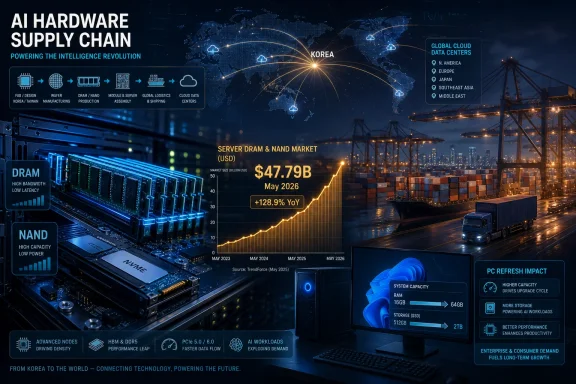 The AI Boom Has Finally Reached the Export Ledger
For years, “AI demand” was an abstraction that vendors used to explain capex plans, GPU roadmaps, and cloud-region expansions. South Korea’s May ICT export data makes it look less like a forecast and more like a shipping manifest. When a single month’s ICT exports can more than double year over year, and when semiconductors alone account for nearly four-fifths of the total, the market is no longer merely anticipating AI infrastructure; it is paying for it.The striking part is not that chips are doing well. South Korea has long been one of the world’s key semiconductor exporters, with Samsung Electronics and SK hynix sitting near the center of the memory economy. The striking part is the scale and concentration of the jump: semiconductors up 169.2 percent, computers and peripherals up 259.6 percent, and SSD demand strong enough to help that category set records for a fourth consecutive month.
That mix tells a cleaner story than the usual “tech exports rebound” headline. This is not a broad consumer-electronics recovery led by households buying more phones and laptops. It is an infrastructure cycle, driven by AI servers that need high-bandwidth memory, DRAM, NAND, and storage at enormous scale.
For WindowsForum readers, that matters because Windows is not insulated from the cloud hardware cycle. Microsoft’s AI services, Azure capacity, Windows Copilot features, developer tooling, endpoint management, and enterprise workloads all sit somewhere on top of the same global supply chain. If memory and storage are being repriced at the export dock, the effects eventually show up in server invoices, cloud margins, device configurations, and refresh planning.
Memory Is No Longer the Quiet Commodity Under the Motherboard
The most revealing detail in the May data is the reported move in DRAM pricing. The 8Gb DRAM price rose from about $13 in February to $20 in May, with the year-over-year comparison showing an extraordinary increase. That is the kind of price action that turns memory from a background component into a boardroom variable.Memory used to be the part of the PC and server market that many buyers noticed only when it was cheap enough to overprovision. In downturns, DRAM and NAND suppliers cut capacity, prices collapsed, and buyers enjoyed bargain upgrades. In upturns, prices rose, but the cycle often felt familiar enough for IT departments to wait it out.
AI has made that old rhythm less comfortable. Training clusters and inference servers are not just CPU boxes with a few accelerators attached. They are memory-hungry systems whose usefulness depends on feeding accelerators quickly, keeping models resident, and moving data without bottlenecks. High-bandwidth memory gets the spotlight, but the broader pull on DRAM and NAND is what turns an AI buildout into a sector-wide pricing event.
That is why the SSD export surge matters. The report points to semiconductor-based storage devices for AI servers as a driver of computers and peripherals exports. This is an awkward classification with a straightforward meaning: storage is being dragged into the same AI infrastructure race as GPUs and memory.
Enterprise IT has seen this movie in smaller form. A new workload class arrives, vendors promise productivity gains, capacity planning gets optimistic, and suddenly the supposedly boring parts of the stack become scarce. What is different this time is that the workload class is being subsidized by nearly every hyperscaler, software platform, and national industrial strategy at once.
South Korea Is Selling the Picks and Shovels of the Copilot Era
Microsoft’s AI ambitions are usually discussed through the lens of software: Copilot in Windows, Copilot for Microsoft 365, Azure OpenAI Service, GitHub Copilot, and the gradual embedding of generative AI into management and security tools. But every one of those services depends on a hardware economy in which South Korea is unusually important. The country may not own the full AI stack, but it supplies much of the memory and storage that make the stack usable.That gives the May export number a relevance beyond Korea’s own economy. It is an indicator of how aggressively the world is building the substrate for AI services. If semiconductors and SSDs are leaving Korean factories at record values, then cloud providers, OEMs, and server builders are either expanding capacity or paying more to secure the capacity they already planned.
For Windows users, the connection may seem indirect. A consumer buying a laptop in Ohio or a sysadmin budgeting for new servers in Manchester does not negotiate with Korean chip exporters. But supply-chain pressure is rarely polite enough to stay where it begins. It filters into bill-of-materials costs, OEM configuration choices, cloud-service pricing discipline, and the subtle shrinking of what vendors can include at a given price point.
The Windows PC market is especially exposed to this kind of pressure because it is being asked to do two things at once. Microsoft and its partners want to sell a new generation of AI PCs with neural processing units and more generous baseline memory. At the same time, data-center operators are competing for memory and storage to run the server-side AI systems that make those PCs feel useful.
That creates a quiet tension. The client side of the Windows ecosystem needs better local hardware to justify AI branding, while the cloud side needs staggering amounts of server hardware to deliver AI features at scale. South Korea’s export data suggests the cloud side is currently winning the bidding war.
The PC Refresh Cycle Meets a More Expensive Supply Chain
The timing is awkward for Windows shops. The Windows 10 end-of-support deadline in October 2025 has already pushed many organizations into a delayed but unavoidable hardware conversation. Windows 11’s requirements forced older machines out of the eligible pool, and the AI PC marketing cycle has encouraged buyers to think beyond a like-for-like replacement.In a normal refresh market, OEMs could use falling component costs to sweeten configurations. More RAM becomes standard. SSD capacities increase. Midrange laptops get specs that looked premium two years earlier. That is how many Windows fleets have historically improved without IT departments feeling every component-price move directly.
A memory-led export boom threatens that pattern. If DRAM and SSD pricing stay elevated, OEMs face unpleasant choices: raise prices, protect margins by holding configurations steady, or reserve better specs for higher-end models. None of those outcomes helps organizations trying to replace aging Windows 10 fleets while also preparing for heavier local AI workloads.
This is not a prediction that every laptop will suddenly become unaffordable. Component pricing moves through contracts, inventories, and product tiers unevenly. Large OEMs have buffers, and consumer demand still matters. But the days when IT buyers could assume that 16GB would quickly become the effortless mainstream baseline may be less certain if server-side AI demand keeps absorbing memory supply.
The practical effect is likely to be most visible in the middle of the market. Premium systems will get the RAM and SSD capacity needed to wear the AI PC badge confidently. Budget systems will remain budget systems. The squeeze comes for business-class machines, where procurement teams expect durability, manageability, security features, and enough memory headroom to survive a four- or five-year lifecycle.
The Server Room Is Back in the Story
For much of the cloud era, local infrastructure was treated as yesterday’s problem. The fashionable answer to capacity constraints was to move more workloads to the cloud and let hyperscalers worry about the hardware. AI has complicated that story.Organizations now face a split architecture. Some AI workloads belong in the cloud because they need massive shared infrastructure and managed model services. Others belong closer to the data because of latency, privacy, compliance, cost control, or simple operational preference. That means more businesses are looking again at local servers, GPU workstations, edge appliances, and storage-heavy systems.
South Korea’s export data reflects that same split from the supply side. The boom is not only in semiconductors as an abstract category; it is also in SSDs for AI servers and components feeding specific manufacturing and assembly hubs. Vietnam-oriented communication equipment parts and Mexico-oriented electrical equipment point to a distributed production chain that ultimately serves global device and infrastructure demand.
Windows Server administrators and virtualization teams should read this as a warning against lazy capacity assumptions. If AI pilots become production workloads, they will not only require GPUs or NPUs. They will require memory, storage, networking, power, cooling, and management tooling. The expensive component is rarely the only constrained component.
This is where the export boom becomes operational. A sysadmin does not need to forecast Korean trade balances to know that a storage upgrade quoted in June may look different in September. In an AI-driven cycle, deferring infrastructure decisions can save money if the hype fades, but it can also expose buyers to tighter supply and higher prices if demand keeps accelerating.
Displays and Phones Are Along for the Ride, Not Driving the Train
The May data also showed gains in displays, mobile phones, and communication equipment. OLED demand tied to new mobile phones helped displays rebound, while higher average selling prices for premium phones supported handset exports. Camera modules benefited from demand for higher-value parts.Those details are important because they keep the story from becoming too one-dimensional. South Korea’s ICT sector is not simply a memory-chip vending machine. It remains deeply connected to the premium smartphone, display, and component ecosystems that shape consumer electronics worldwide.
But the hierarchy is clear. Displays rose 2.8 percent, mobile phones 15.9 percent, and communication equipment 3.7 percent. Those are respectable gains, yet they are not the reason ICT exports hit an all-time high. The record belongs to semiconductors and AI-adjacent infrastructure.
That distinction matters because consumer electronics demand and AI infrastructure demand behave differently. Phone cycles are seasonal and brand-driven. Display demand is tied to model launches and replacement cycles. AI infrastructure demand is tied to capital expenditure by hyperscalers, enterprise adoption curves, model economics, and the competitive fear that being late to capacity means being late to the market.
When all of those forces point in the same direction, the supply chain does not just grow; it tightens. The consumer device market may get pulled behind the infrastructure market, especially where both require advanced memory, storage, and packaging capacity. That is the uncomfortable lesson in the May numbers.
The Export Record Is Also a Concentration Risk
A record month makes for good headlines, but it also exposes a vulnerability. South Korea’s ICT export boom is heavily dependent on semiconductors, and within semiconductors, the current excitement is heavily dependent on AI-related demand and memory pricing. That is lucrative when the cycle is rising, but it creates a familiar concentration risk.Memory has always been cyclical. Suppliers add capacity, buyers over-order, inventories swing, and prices eventually correct. The AI boom may stretch the cycle, and high-bandwidth memory may alter the economics for leading suppliers, but it does not repeal the basic danger of building too much around a single demand narrative.
The current narrative is especially powerful because it links industrial policy, corporate competition, and software strategy. Governments want domestic AI capacity. Cloud providers want to avoid being capacity-constrained. Software companies want AI features everywhere. Enterprises want productivity gains without admitting that many deployments are still experiments.
That combination can produce real demand and speculative overbuild at the same time. The hard part is knowing which is which while orders are still flowing. Customs data tells us what shipped and what it was worth; it does not tell us whether every downstream buyer will earn an adequate return on the infrastructure now being assembled.
For WindowsForum’s audience, the risk is not academic. Enterprises that overbuild AI capacity may later cut back on software spending, defer endpoint upgrades, or consolidate cloud commitments. Vendors that overestimate AI PC demand may leave buyers with confusing product tiers and short-lived branding. A hot component market can turn into a hangover if the workload adoption curve fails to match the hardware buildout.
Microsoft’s AI Strategy Depends on Someone Else’s Scarcity
Microsoft sits in an enviable but exposed position. Its AI strategy spans cloud, productivity software, operating systems, developer platforms, and security. That breadth gives it many ways to monetize AI, but it also gives it many ways to be affected by hardware scarcity.The company can optimize models, design better infrastructure, negotiate large supply contracts, and diversify accelerator sources. But it cannot software-engineer its way out of every memory and storage constraint. If the global AI supply chain is repricing DRAM, NAND, and advanced memory, then even the largest platform companies must absorb, pass on, or work around those costs.
This matters for the economics of Copilot-style services. Generative AI features are not like adding a new menu item to Word or a new toggle in Windows Settings. They impose inference costs, storage requirements, security-review burdens, and support complexity. If the hardware underneath those services becomes more expensive, vendors have to decide how much AI they can bundle and how much they must meter.
That tension is already visible across the software industry. AI features are marketed as inevitable, but the pricing is often segmented, capped, or attached to premium subscriptions. The more expensive the infrastructure, the less likely vendors are to give away unlimited usage as a default part of existing licenses.
For administrators, that means AI adoption should be treated less like a feature update and more like a resource contract. The question is not simply whether a tool works. It is how usage is measured, where data is processed, what happens when quotas arrive, and whether the promised productivity gain survives the cost model.
The Hardware Stack Is Becoming Geopolitical Again
South Korea’s record ICT exports also land in a world that has stopped pretending semiconductors are ordinary goods. Chips are now strategic assets. Memory supply, advanced packaging, foundry capacity, and server assembly all sit inside a geopolitical contest over AI capability.That does not mean every SSD shipment is a national-security event. It does mean the supply chain beneath Windows laptops, Azure regions, and enterprise servers is increasingly shaped by policy as well as price. Export controls, subsidies, tariffs, energy constraints, and regional manufacturing strategies all matter more than they did when the industry’s main concern was simply building cheaper devices at scale.
The geographic details in the May report hint at this complexity. Exports to China including Hong Kong reportedly more than doubled, while shipments to Vietnam rose sharply. Communication equipment parts bound for Vietnam and electrical equipment headed for Mexico reflect a production map that has been reorganized by both efficiency and politics.
For IT buyers, geopolitics appears as delay, price variation, vendor substitution, and support complexity. A procurement team may not care where a component was made until a policy change, port disruption, or export restriction affects availability. Then the abstract supply chain becomes a ticket backlog.
This is why the old advice to standardize hardware needs a 2026 update. Standardization still matters, but resilience now matters alongside it. A fleet strategy that depends on one model, one supplier, one region, or one narrow configuration can become brittle when component markets move quickly.
AI PCs Will Be Judged by Memory, Not Stickers
The AI PC has been marketed around NPUs, TOPS ratings, and local inference. Those metrics are not meaningless, but they risk distracting buyers from a more mundane truth: the useful lifespan of an AI-capable Windows PC will depend heavily on memory and storage headroom. A machine that technically qualifies for an AI feature set may still age poorly if it ships with cramped RAM or a small SSD.This is where South Korea’s export boom loops back into the client market. If AI server demand keeps memory and NAND prices elevated, PC vendors may be tempted to sell “AI-ready” systems with just enough hardware to satisfy launch requirements. That would repeat a familiar Windows ecosystem mistake: meeting the letter of the spec while leaving users with a machine that feels constrained two years later.
Windows 11 already made baseline hardware a front-page issue for many users. The next phase will be less about TPMs and supported CPUs and more about whether local AI features, browser workloads, collaboration apps, endpoint security agents, and developer tools can coexist comfortably. On modern Windows systems, 8GB is increasingly a compromise, not a foundation.
The industry’s marketing language will try to smooth this over. Expect clean badges, neat product families, and confident claims about hybrid AI. But IT departments should look past the sticker and ask the old questions with renewed force: how much memory is soldered, how much is upgradeable, how much SSD capacity is realistic after encryption and management tools, and whether the device can survive its intended lifecycle.
The irony is that AI PCs may become most useful when buyers refuse to buy the cheapest AI PCs. Local AI needs local resources. If those resources are expensive because the server market is consuming them, then a credible AI PC refresh may cost more than the industry’s promotional decks imply.
The Numbers Seoul Published Are a Warning Label for Procurement
The most concrete lesson from May’s ICT export record is that infrastructure demand has escaped the realm of speculative forecasting. Buyers should not panic, but they should stop assuming that memory and storage will be passive line items in the AI era. South Korea’s export data is a warning label printed in dollars.A measured response is better than a dramatic one. Organizations do not need to buy every server now or overpay for every laptop configuration. They do need to align procurement with realistic workload plans, support windows, and the likelihood that AI features will increase local and cloud resource consumption over the next several years.
That means finance, IT, security, and application owners should have a more honest conversation than “when do we turn on Copilot?” They should ask what data will be processed, where inference will happen, what hardware is required, what usage costs look like, and which endpoints are too weak to carry the next software cycle gracefully.
The companies that handle this well will treat hardware as part of AI governance. The companies that handle it poorly will discover that AI strategy written only in software terms tends to become a procurement surprise later.
The Signal Hidden in a $47.79 Billion Month
South Korea’s May export record does not settle the AI debate, but it does sharpen the practical stakes. The boom is real enough to move national trade data, concentrated enough to create risk, and close enough to the Windows ecosystem to matter for everyday technology decisions.- South Korea’s May ICT exports reached an all-time monthly high because AI infrastructure demand is now translating into large-scale semiconductor and SSD shipments.
- Semiconductor exports dominated the record, which makes the boom powerful but also exposes the sector to memory-cycle volatility.
- Rising DRAM and storage prices could complicate Windows PC refresh plans, especially for organizations trying to buy long-lived business systems.
- AI server demand is likely to influence cloud economics, enterprise infrastructure budgets, and the way vendors package Copilot-style services.
- IT buyers should treat AI adoption as a hardware and capacity-planning issue, not merely as a software licensing decision.
- The safest procurement strategy is to buy for realistic lifecycle headroom rather than chase the thinnest possible definition of “AI-ready.”
References
- Primary source: 매일경제
Published: 2026-06-14T05:40:09.650600
Exports of the Information and Communication Industry (ICT) hit an all-time high last month on the b.. - MK
Exports of the Information and Communication Industry (ICT) hit an all-time high last month on the back of soaring semiconductor prices.According to the Ministry of Trade, Industry and Energy on the 1..www.mk.co.kr - Related coverage: urdupoint.com
Koreas ICT Exports Reach US$47.79 Billion In May - UrduPoint
The Republic of Koreas exports of information and communication technology (ICT) products posted the highest monthly figure on record in May, driven by demand for semiconductors and other products related to the artificial intelligence (AI) ecosystem, data showed Sunday.Outbound ICT shipments...www.urdupoint.com
- Related coverage: newkerala.com
S. Korea ICT Exports Hit Record $47.79B in May on AI Boom
South Korea's ICT exports surged 128.9% to a record $47.79 billion in May, driven by AI demand for semiconductors and SSDs. Trade surplus hit $32.09 billion.www.newkerala.com - Related coverage: chosun.com
South Korea's ICT Exports Surge to $43.51B on AI, Semiconductors
South Koreas ICT Exports Surge to $43.51B on AI, Semiconductors AI, semiconductor boom fuels 112% surge, ICT accounts for half of industrial shipmentswww.chosun.com - Related coverage: tradingeconomics.com

South Korea Exports Reach Fresh Record High
South Korea’s exports jumped 53.2% yoy to a record high of USD 87.75 billion in May 2026, surpassing forecasts of 48.4%, accelerating from a 48% rise in April. Exports exceeded USD 80 billion for the 3rd straight month, mainly driven by a surge in semiconductor shipments. Shipments rose for a...
tradingeconomics.com
