

South Korea’s AI Safety Institute signed a memorandum of understanding with OpenAI on June 17, 2026, making South Korea the fourth country after the United States, the United Kingdom, and Japan to form a formal AI security cooperation arrangement with the ChatGPT maker. The deal is not a product launch, and that is precisely why it matters. It is another sign that frontier AI governance is moving from speeches and summits into the quieter machinery of evaluations, benchmarks, red-team exercises, and national standards. For Windows users, developers, and enterprise administrators, the story is less about OpenAI gaining another diplomatic photo opportunity than about governments trying to decide who gets to inspect the systems that will increasingly sit inside operating systems, productivity suites, cloud consoles, and security tooling.
The agreement pairs OpenAI with South Korea’s AI Safety Institute, known as AISI, under the country’s Ministry of Science and ICT. According to reporting on the memorandum, the two sides plan to exchange technical expertise and work on a global framework for evaluating AI security, with particular attention to Korean-language behavior and South Korea’s social context.
That local emphasis is not a footnote. AI systems that appear well-behaved in English can fail differently in Korean, Japanese, Arabic, Hindi, or any other language with distinct social norms, legal categories, idioms, and political sensitivities. Safety testing that treats English as the default and everything else as a localization layer is not really global testing; it is export control dressed as measurement.
South Korea’s move therefore has a dual character. It is joining a club of countries that want access to frontier AI evaluation work, but it is also arguing that the club’s tests cannot remain culturally and linguistically narrow. In a country with world-class chipmakers, gaming companies, device manufacturers, telecom operators, and cloud ambitions, AI safety is not an abstract ethics exercise. It is industrial policy with a security vocabulary.
The phrase “AI security standards” can sound bloodless, but the work behind it is intensely practical. Evaluators need to know whether a model can help write malware, evade detection, manipulate users, leak sensitive data, automate fraud, or behave unpredictably when connected to tools. They also need to know whether those risks change when the model is prompted in Korean, asked about Korean institutions, or embedded in services used by Korean citizens.
That matters because frontier AI companies have a trust problem that cannot be solved by publishing model cards and blog posts. The most capable systems are expensive to train, hard to reproduce, and often evaluated behind closed doors. Governments do not want to learn about dangerous capabilities from a public launch, a viral jailbreak, or a postmortem after a model has already been wired into corporate workflows.
The emerging compromise is voluntary pre-release or near-release evaluation by trusted public bodies. It is imperfect, and it can become performative if the government side lacks technical depth or legal leverage. But it is still a meaningful shift from the early generative AI boom, when the market’s default setting was to ship first and explain later.
OpenAI also has its own reasons to prefer this model. Bilateral agreements let the company cultivate regulators, shape the language of evaluation, and demonstrate seriousness without immediately submitting to a single binding global regime. In other words, cooperation is both governance and strategy. It gives governments a window into frontier systems while giving OpenAI a voice in defining what counts as responsible deployment.
That tension should not be treated as scandalous. It is how standards often form in technology: vendors, governments, researchers, and customers circle the same problem until their incentives partially align. The risk is not that OpenAI is in the room. The risk is that the room becomes too small.
South Korea’s agreement with OpenAI appears to sit closest to the security and evaluation track. The reporting emphasizes AI risk verification, safety protocols, and an assessment system suited to Korean language and society. That points to a practical evaluation agenda rather than a broad philosophical charter.
For enterprise IT, that narrower framing may actually be useful. Administrators do not need another white paper declaring that AI should be ethical. They need to know whether an AI assistant in a help desk tool can be tricked into revealing credentials, whether a code-generation model will produce insecure defaults, and whether a multilingual support bot can be manipulated into violating company policy.
The Windows ecosystem is already moving in this direction. Copilots, local AI models, cloud-connected agents, endpoint protection tools, and productivity assistants are converging into a new software layer that sits between the user and the system. The old model of security assumed that applications did what developers coded them to do. The AI model assumes that applications interpret, infer, generate, and act.
That shift makes evaluation harder. A traditional software bug can often be reproduced with a defined input and patched with a defined fix. A model failure may depend on prompt phrasing, conversation history, language, tool permissions, retrieved documents, policy layers, and stochastic output. Security testing has to become more like adversarial fieldwork than checklist compliance.
A model may understand Korean grammar but misunderstand Korean hierarchy. It may translate a harmful request into something that bypasses a safety classifier trained mostly on English data. It may mishandle honorifics, regional references, defamation risk, political content, medical terminology, or financial scams that have local patterns. It may also perform worse on Korean-language cybersecurity prompts simply because the training and evaluation data are thinner.
This is where national AI safety institutes can add value that a vendor cannot easily claim for itself. A Korean public institute can convene linguists, security researchers, civil society experts, prosecutors, educators, and industry specialists who understand local harm patterns. OpenAI can bring model access and engineering expertise. Neither side can fully do the other’s job.
The same logic applies beyond Korea. If AI safety evaluation becomes a handful of English-language tests administered by a few Western institutions, it will fail both politically and technically. Politically, countries will resist standards that look like imported compliance. Technically, the tests will miss failure modes that arise only when models are used by real communities in real languages.
For WindowsForum readers, this matters because Microsoft’s ecosystem is global by default. A Windows deployment in Seoul, São Paulo, Warsaw, or Dubai may use the same cloud control plane, the same identity architecture, and the same AI assistant branding. But the users, regulations, threat actors, and social engineering patterns differ. A global AI feature that is tested locally in only one or two contexts is not globally safe.
South Korea understands this. Its government has been trying to position the country not only as an AI adopter but as a rule-shaper. The OpenAI memorandum follows broader South Korean activity around AI governance, standards cooperation, and institutional capacity. Seoul does not want to be downstream from Washington, London, Brussels, Tokyo, or Beijing when the rules for frontier AI are written.
That ambition is rational. South Korea has strategic exposure on nearly every AI axis. It is a semiconductor powerhouse, a consumer electronics exporter, a cybersecurity target, a major gaming and entertainment producer, and a U.S. treaty ally living next to one of the world’s most active cyber and military adversaries. Its AI risk model cannot be copied wholesale from a larger country with different assumptions.
Standards also shape markets. Once governments converge on evaluation requirements, those requirements become procurement filters. Cloud vendors, endpoint security companies, SaaS providers, and AI startups will have to demonstrate that their systems meet recognized testing regimes. The organizations that help design those regimes gain influence over what “safe enough” means.
This is why OpenAI’s expanding network deserves scrutiny. If a private company helps build the tests by which its own systems are judged, conflict-of-interest alarms should ring. But excluding frontier labs entirely would make the tests less informed. The real question is whether these partnerships produce independent, reproducible, and transparent evaluation capacity — or simply normalize a vendor-approved version of oversight.
A voluntary MOU can accelerate technical exchange. It can get government researchers access to model behavior, evaluation methods, and threat intelligence they would otherwise struggle to obtain. It can also establish habits of cooperation before a crisis forces governments and companies into reactive regulation.
But voluntary arrangements are fragile. They depend on personalities, political priorities, company strategy, and the willingness of both sides to keep sharing information when the findings are inconvenient. If an evaluation reveals that a flagship model has dangerous cyber capability, weak safeguards in Korean, or a tendency to mishandle sensitive local content, what happens next? Is deployment delayed? Is the public told? Are customers notified? Or does the result disappear into a confidential mitigation process?
Those are not cynical questions. They are the governance questions that determine whether AI safety institutes become meaningful watchdogs or well-funded advisory panels. The public does not need every red-team transcript, and some security findings should remain restricted. But a system that produces no public accountability will eventually be treated as reputational laundering.
The challenge for South Korea is to use OpenAI’s cooperation without becoming dependent on it. AISI needs access to frontier systems, but it also needs independent methods, domestic datasets, local research capacity, and the ability to compare vendors. OpenAI should be one input into Korea’s AI safety strategy, not the architecture.
The impact will arrive more slowly and more deeply. Procurement teams will begin asking whether AI-enabled tools have passed recognized evaluations. Security teams will ask whether vendors can document model behavior under adversarial prompting. Legal teams will ask whether AI features used in regulated workflows have been assessed for local language and jurisdictional risk.
This is already visible in how enterprises think about generative AI. The early question was whether employees should be allowed to use ChatGPT at all. The next question was whether company data could safely flow into AI systems. The emerging question is whether AI agents should be allowed to take actions across email, files, tickets, code repositories, identity systems, and cloud infrastructure.
That last question is the one that will define the next decade of enterprise risk. A chatbot that gives a bad answer is a support problem. An agent that misconfigures a firewall, approves a fraudulent invoice, summarizes privileged documents for the wrong user, or writes insecure code into production is an operational problem. Standards for evaluating that class of behavior are not optional decoration; they are the scaffolding for adoption.
Windows environments are especially exposed because they remain the connective tissue of enterprise computing. Identity, endpoint management, office documents, browser sessions, remote access, and security telemetry all converge there. As AI becomes a control surface for those systems, evaluation frameworks will matter as much to administrators as compatibility matrices and compliance certifications do today.
If national AI safety institutes develop trusted evaluation methods with OpenAI, those methods will influence how customers evaluate Copilot-like products across Microsoft 365, Azure, GitHub, Windows, and security offerings. Even where Microsoft uses its own orchestration, policy, and infrastructure layers, the frontier model provider remains part of the trust chain.
This creates an awkward but necessary question for customers. When a vendor says an AI feature is safe, which layer has been tested? The base model? The system prompt? The retrieval pipeline? The connector permissions? The admin controls? The logging and audit trail? The user interface that encourages people to accept generated output?
A model can pass a safety evaluation in isolation and still create risk when embedded inside a powerful enterprise workflow. Conversely, a risky base capability can be constrained by strong product design, permissions, monitoring, and human approval. Standards that focus only on the model will miss the system. Standards that focus only on product policy will miss the model.
South Korea’s emphasis on assessment systems could help if it pushes evaluation toward real deployment contexts. The most useful AI safety tests will not ask only whether a model can produce a dangerous answer in a lab. They will ask whether a deployed agent can be induced to misuse the tools it has been given, especially in the language and institutional setting where real users operate.
The speed is striking because governments usually move slowly on technical standards. But frontier AI compressed the timeline. Systems became publicly available before legislators, auditors, courts, and standards bodies had a shared vocabulary for what they were regulating. Safety institutes are an attempt to build that vocabulary under pressure.
That pressure produces institutional messiness. Names change from safety to security. Missions shift with elections. Agencies compete for jurisdiction. Vendors announce partnerships that may sound more definitive than they are. The public hears “AI safety” and may reasonably wonder whether that means preventing sci-fi catastrophe, stopping phishing emails, reducing bias, or keeping children away from harmful content.
The answer is: all of the above, sometimes, depending on who is speaking. That ambiguity is a problem. If AI safety is everything, it risks becoming nothing. A useful evaluation framework has to say what class of harm it is measuring, what evidence it requires, and what consequence follows from failure.
South Korea’s agreement with OpenAI will be worth watching precisely because it sits at this boundary. If it produces concrete Korean-language benchmarks, shared red-team methods, and public lessons for high-risk deployment, it will add substance. If it produces only diplomatic language about cooperation, it will be another tile in the mosaic of AI governance theater.
That concern maps directly onto enterprise security. AI assistants are becoming agents, and agents are software entities with goals, permissions, memory, and tool access. Once an AI system can read documents, call APIs, execute code, modify tickets, send messages, or make recommendations that humans routinely accept, it becomes part of the attack surface.
Traditional security training tells users not to click suspicious links. AI-era security will also have to tell systems not to obey malicious instructions hidden inside documents, emails, webpages, calendar invites, pull requests, and support tickets. Prompt injection is not just a parlor trick; it is a new version of untrusted input crossing a trust boundary.
Administrators should therefore expect AI evaluation language to show up in vendor questionnaires and internal risk reviews. Does the product isolate instructions from data? Does it respect least privilege? Can admins disable tool use? Are model interactions logged? Can sensitive outputs be audited? Does the system behave consistently across languages?
These questions are not answered by a glossy statement that a model was developed responsibly. They require technical documentation, test results, and operational controls. National AI safety institutes may eventually help standardize those demands, but enterprises should not wait for the standards to mature before asking them.
Japan moved early with its own AI Safety Institute and has played a prominent role in international AI governance discussions. South Korea is now deepening its role through AISI and partnerships like the OpenAI memorandum. Singapore has been active in AI testing and governance frameworks. China, of course, has its own regulatory and industrial path, shaped by state control, platform governance, and strategic competition.
This Asian dimension matters because AI deployment patterns differ across societies. Mobile-first services, super-app ecosystems, gaming cultures, education pressures, workplace hierarchies, and state security concerns all influence how AI systems are used and abused. A model that is safe enough in one institutional context may be dangerously under-tested in another.
South Korea’s role is especially interesting because it sits between several worlds. It is a U.S.-aligned democracy with deep exposure to American cloud and software ecosystems. It is also an Asian technology powerhouse with domestic champions and regional security concerns. Its standards work could therefore bridge Western frontier model governance and Asian deployment realities.
That bridge will be valuable only if Seoul resists becoming a passive recipient of vendor frameworks. The strongest version of this agreement is not “OpenAI teaches Korea how to test AI.” It is “Korea helps define tests OpenAI could not design alone.”
This is what happens when a private AI lab becomes a geopolitical actor. OpenAI is not a state, but its systems may affect education, defense, software development, media, public administration, cybersecurity, and labor markets. Governments therefore treat access to its leadership and technology as a policy matter, not just a business development opportunity.
That status brings benefits and burdens. OpenAI gets influence, market access, and the credibility that comes from working with public institutions. It also inherits expectations that ordinary software vendors often avoid. When your models are discussed in the same breath as national standards and security protocols, “we are just a platform” stops being a convincing answer.
South Korea’s memorandum is another sign that frontier AI firms are entering the infrastructure category. Infrastructure companies do not merely sell tools; they become part of national resilience planning. That is why inspection, standards, and accountability now follow them across borders.
The most meaningful output would be evidence of repeatable testing. That could include Korean-language safety benchmarks, red-team protocols for cyber and fraud misuse, shared taxonomies of high-risk behavior, and guidance for evaluating AI systems embedded in real products. Less useful would be a broad declaration that both sides support safe and trustworthy AI, which everyone already says.
The agreement should also be judged by whether it strengthens South Korea’s independent capacity. If AISI emerges with better tools, better datasets, and better authority to evaluate multiple vendors, the partnership will have served a public purpose. If it primarily gives OpenAI another line in its global trust résumé, the public benefit will be thinner.
There is nothing wrong with starting through cooperation. Governments need access, and companies need technically competent counterparts. But the end state cannot be a world in which every national evaluator relies on private labs to define the exam.
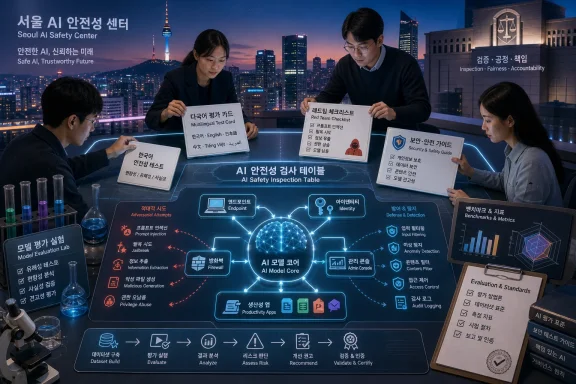 Seoul Wants a Seat at the Inspection Table, Not Just a Better Chatbot
The agreement pairs OpenAI with South Korea’s AI Safety Institute, known as AISI, under the country’s Ministry of Science and ICT. According to reporting on the memorandum, the two sides plan to exchange technical expertise and work on a global framework for evaluating AI security, with particular attention to Korean-language behavior and South Korea’s social context.That local emphasis is not a footnote. AI systems that appear well-behaved in English can fail differently in Korean, Japanese, Arabic, Hindi, or any other language with distinct social norms, legal categories, idioms, and political sensitivities. Safety testing that treats English as the default and everything else as a localization layer is not really global testing; it is export control dressed as measurement.
South Korea’s move therefore has a dual character. It is joining a club of countries that want access to frontier AI evaluation work, but it is also arguing that the club’s tests cannot remain culturally and linguistically narrow. In a country with world-class chipmakers, gaming companies, device manufacturers, telecom operators, and cloud ambitions, AI safety is not an abstract ethics exercise. It is industrial policy with a security vocabulary.
The phrase “AI security standards” can sound bloodless, but the work behind it is intensely practical. Evaluators need to know whether a model can help write malware, evade detection, manipulate users, leak sensitive data, automate fraud, or behave unpredictably when connected to tools. They also need to know whether those risks change when the model is prompted in Korean, asked about Korean institutions, or embedded in services used by Korean citizens.
OpenAI Is Building a Safety Network Before Regulators Build One for It
OpenAI has already entered similar arrangements with organizations in the United States, the United Kingdom, and Japan. The South Korean agreement extends that pattern into one of Asia’s most technologically sophisticated economies and strengthens OpenAI’s pitch that it is willing to work with national evaluators rather than merely lobby against regulation from the outside.That matters because frontier AI companies have a trust problem that cannot be solved by publishing model cards and blog posts. The most capable systems are expensive to train, hard to reproduce, and often evaluated behind closed doors. Governments do not want to learn about dangerous capabilities from a public launch, a viral jailbreak, or a postmortem after a model has already been wired into corporate workflows.
The emerging compromise is voluntary pre-release or near-release evaluation by trusted public bodies. It is imperfect, and it can become performative if the government side lacks technical depth or legal leverage. But it is still a meaningful shift from the early generative AI boom, when the market’s default setting was to ship first and explain later.
OpenAI also has its own reasons to prefer this model. Bilateral agreements let the company cultivate regulators, shape the language of evaluation, and demonstrate seriousness without immediately submitting to a single binding global regime. In other words, cooperation is both governance and strategy. It gives governments a window into frontier systems while giving OpenAI a voice in defining what counts as responsible deployment.
That tension should not be treated as scandalous. It is how standards often form in technology: vendors, governments, researchers, and customers circle the same problem until their incentives partially align. The risk is not that OpenAI is in the room. The risk is that the room becomes too small.
The Real Test Is Whether “Safety” Means Security, Rights, or Market Access
The word safety has become a container for several different debates that do not always belong together. One camp worries about frontier models assisting cyberattacks, biological misuse, autonomous weapons, or large-scale deception. Another worries about bias, discrimination, labor displacement, privacy, and consumer manipulation. A third cares mostly about whether AI systems can be certified, procured, insured, and sold across borders.South Korea’s agreement with OpenAI appears to sit closest to the security and evaluation track. The reporting emphasizes AI risk verification, safety protocols, and an assessment system suited to Korean language and society. That points to a practical evaluation agenda rather than a broad philosophical charter.
For enterprise IT, that narrower framing may actually be useful. Administrators do not need another white paper declaring that AI should be ethical. They need to know whether an AI assistant in a help desk tool can be tricked into revealing credentials, whether a code-generation model will produce insecure defaults, and whether a multilingual support bot can be manipulated into violating company policy.
The Windows ecosystem is already moving in this direction. Copilots, local AI models, cloud-connected agents, endpoint protection tools, and productivity assistants are converging into a new software layer that sits between the user and the system. The old model of security assumed that applications did what developers coded them to do. The AI model assumes that applications interpret, infer, generate, and act.
That shift makes evaluation harder. A traditional software bug can often be reproduced with a defined input and patched with a defined fix. A model failure may depend on prompt phrasing, conversation history, language, tool permissions, retrieved documents, policy layers, and stochastic output. Security testing has to become more like adversarial fieldwork than checklist compliance.
Korean-Language Evaluation Is Not a Localization Chore
The most interesting line in the South Korean arrangement is the plan to tailor assessment to the Korean language and social context. That should not be read as diplomatic padding. It is a recognition that model behavior is mediated by culture, law, and language in ways that benchmark designers have often underweighted.A model may understand Korean grammar but misunderstand Korean hierarchy. It may translate a harmful request into something that bypasses a safety classifier trained mostly on English data. It may mishandle honorifics, regional references, defamation risk, political content, medical terminology, or financial scams that have local patterns. It may also perform worse on Korean-language cybersecurity prompts simply because the training and evaluation data are thinner.
This is where national AI safety institutes can add value that a vendor cannot easily claim for itself. A Korean public institute can convene linguists, security researchers, civil society experts, prosecutors, educators, and industry specialists who understand local harm patterns. OpenAI can bring model access and engineering expertise. Neither side can fully do the other’s job.
The same logic applies beyond Korea. If AI safety evaluation becomes a handful of English-language tests administered by a few Western institutions, it will fail both politically and technically. Politically, countries will resist standards that look like imported compliance. Technically, the tests will miss failure modes that arise only when models are used by real communities in real languages.
For WindowsForum readers, this matters because Microsoft’s ecosystem is global by default. A Windows deployment in Seoul, São Paulo, Warsaw, or Dubai may use the same cloud control plane, the same identity architecture, and the same AI assistant branding. But the users, regulations, threat actors, and social engineering patterns differ. A global AI feature that is tested locally in only one or two contexts is not globally safe.
Standards Are Becoming the New AI Battleground
The AI race is usually described as a contest over chips, models, talent, and cloud capacity. That is true, but incomplete. The next phase will also be a contest over standards: who defines risky capability, who certifies mitigation, who gets early access to models, and whose evaluation results are trusted by procurement officers and regulators.South Korea understands this. Its government has been trying to position the country not only as an AI adopter but as a rule-shaper. The OpenAI memorandum follows broader South Korean activity around AI governance, standards cooperation, and institutional capacity. Seoul does not want to be downstream from Washington, London, Brussels, Tokyo, or Beijing when the rules for frontier AI are written.
That ambition is rational. South Korea has strategic exposure on nearly every AI axis. It is a semiconductor powerhouse, a consumer electronics exporter, a cybersecurity target, a major gaming and entertainment producer, and a U.S. treaty ally living next to one of the world’s most active cyber and military adversaries. Its AI risk model cannot be copied wholesale from a larger country with different assumptions.
Standards also shape markets. Once governments converge on evaluation requirements, those requirements become procurement filters. Cloud vendors, endpoint security companies, SaaS providers, and AI startups will have to demonstrate that their systems meet recognized testing regimes. The organizations that help design those regimes gain influence over what “safe enough” means.
This is why OpenAI’s expanding network deserves scrutiny. If a private company helps build the tests by which its own systems are judged, conflict-of-interest alarms should ring. But excluding frontier labs entirely would make the tests less informed. The real question is whether these partnerships produce independent, reproducible, and transparent evaluation capacity — or simply normalize a vendor-approved version of oversight.
Voluntary Cooperation Is Useful Until It Becomes a Substitute for Law
Memoranda of understanding are not laws. They create channels, not obligations of the kind that auditors, courts, or regulators can enforce. That does not make them worthless, but it should discipline our expectations.A voluntary MOU can accelerate technical exchange. It can get government researchers access to model behavior, evaluation methods, and threat intelligence they would otherwise struggle to obtain. It can also establish habits of cooperation before a crisis forces governments and companies into reactive regulation.
But voluntary arrangements are fragile. They depend on personalities, political priorities, company strategy, and the willingness of both sides to keep sharing information when the findings are inconvenient. If an evaluation reveals that a flagship model has dangerous cyber capability, weak safeguards in Korean, or a tendency to mishandle sensitive local content, what happens next? Is deployment delayed? Is the public told? Are customers notified? Or does the result disappear into a confidential mitigation process?
Those are not cynical questions. They are the governance questions that determine whether AI safety institutes become meaningful watchdogs or well-funded advisory panels. The public does not need every red-team transcript, and some security findings should remain restricted. But a system that produces no public accountability will eventually be treated as reputational laundering.
The challenge for South Korea is to use OpenAI’s cooperation without becoming dependent on it. AISI needs access to frontier systems, but it also needs independent methods, domestic datasets, local research capacity, and the ability to compare vendors. OpenAI should be one input into Korea’s AI safety strategy, not the architecture.
The Enterprise Impact Will Arrive Through Procurement, Not Press Releases
Most Windows administrators will not feel the effect of this agreement tomorrow. No Patch Tuesday setting will change because South Korea signed an MOU with OpenAI. No Group Policy toggle will suddenly appear labeled “Comply with Korean AI Safety Institute Evaluation Framework.”The impact will arrive more slowly and more deeply. Procurement teams will begin asking whether AI-enabled tools have passed recognized evaluations. Security teams will ask whether vendors can document model behavior under adversarial prompting. Legal teams will ask whether AI features used in regulated workflows have been assessed for local language and jurisdictional risk.
This is already visible in how enterprises think about generative AI. The early question was whether employees should be allowed to use ChatGPT at all. The next question was whether company data could safely flow into AI systems. The emerging question is whether AI agents should be allowed to take actions across email, files, tickets, code repositories, identity systems, and cloud infrastructure.
That last question is the one that will define the next decade of enterprise risk. A chatbot that gives a bad answer is a support problem. An agent that misconfigures a firewall, approves a fraudulent invoice, summarizes privileged documents for the wrong user, or writes insecure code into production is an operational problem. Standards for evaluating that class of behavior are not optional decoration; they are the scaffolding for adoption.
Windows environments are especially exposed because they remain the connective tissue of enterprise computing. Identity, endpoint management, office documents, browser sessions, remote access, and security telemetry all converge there. As AI becomes a control surface for those systems, evaluation frameworks will matter as much to administrators as compatibility matrices and compliance certifications do today.
Microsoft Is the Unspoken Shadow Over Every OpenAI Safety Deal
Any OpenAI governance story inevitably casts a Microsoft-shaped shadow. Microsoft is OpenAI’s most important commercial partner, and AI features built on OpenAI technology have been woven into Microsoft’s cloud, developer, and productivity strategies. That does not mean every OpenAI safety agreement is secretly a Microsoft story, but WindowsForum readers should recognize the ecosystem implications.If national AI safety institutes develop trusted evaluation methods with OpenAI, those methods will influence how customers evaluate Copilot-like products across Microsoft 365, Azure, GitHub, Windows, and security offerings. Even where Microsoft uses its own orchestration, policy, and infrastructure layers, the frontier model provider remains part of the trust chain.
This creates an awkward but necessary question for customers. When a vendor says an AI feature is safe, which layer has been tested? The base model? The system prompt? The retrieval pipeline? The connector permissions? The admin controls? The logging and audit trail? The user interface that encourages people to accept generated output?
A model can pass a safety evaluation in isolation and still create risk when embedded inside a powerful enterprise workflow. Conversely, a risky base capability can be constrained by strong product design, permissions, monitoring, and human approval. Standards that focus only on the model will miss the system. Standards that focus only on product policy will miss the model.
South Korea’s emphasis on assessment systems could help if it pushes evaluation toward real deployment contexts. The most useful AI safety tests will not ask only whether a model can produce a dangerous answer in a lab. They will ask whether a deployed agent can be induced to misuse the tools it has been given, especially in the language and institutional setting where real users operate.
The International Network Is Growing Faster Than the Public Vocabulary
AI safety institutes have multiplied quickly since governments began treating frontier AI as a strategic technology rather than a normal software category. The United States, United Kingdom, Japan, South Korea, Singapore, Canada, Australia, European institutions, and others have all moved to develop or coordinate AI evaluation capacity in some form.The speed is striking because governments usually move slowly on technical standards. But frontier AI compressed the timeline. Systems became publicly available before legislators, auditors, courts, and standards bodies had a shared vocabulary for what they were regulating. Safety institutes are an attempt to build that vocabulary under pressure.
That pressure produces institutional messiness. Names change from safety to security. Missions shift with elections. Agencies compete for jurisdiction. Vendors announce partnerships that may sound more definitive than they are. The public hears “AI safety” and may reasonably wonder whether that means preventing sci-fi catastrophe, stopping phishing emails, reducing bias, or keeping children away from harmful content.
The answer is: all of the above, sometimes, depending on who is speaking. That ambiguity is a problem. If AI safety is everything, it risks becoming nothing. A useful evaluation framework has to say what class of harm it is measuring, what evidence it requires, and what consequence follows from failure.
South Korea’s agreement with OpenAI will be worth watching precisely because it sits at this boundary. If it produces concrete Korean-language benchmarks, shared red-team methods, and public lessons for high-risk deployment, it will add substance. If it produces only diplomatic language about cooperation, it will be another tile in the mosaic of AI governance theater.
Security Teams Should Read This as a Warning About Agents
The most immediate practical lesson from the South Korean deal is not that OpenAI is safer today than it was last week. It is that governments are increasingly worried about capability evaluation — the measurement of what advanced AI systems can actually do when pushed, connected, or misused.That concern maps directly onto enterprise security. AI assistants are becoming agents, and agents are software entities with goals, permissions, memory, and tool access. Once an AI system can read documents, call APIs, execute code, modify tickets, send messages, or make recommendations that humans routinely accept, it becomes part of the attack surface.
Traditional security training tells users not to click suspicious links. AI-era security will also have to tell systems not to obey malicious instructions hidden inside documents, emails, webpages, calendar invites, pull requests, and support tickets. Prompt injection is not just a parlor trick; it is a new version of untrusted input crossing a trust boundary.
Administrators should therefore expect AI evaluation language to show up in vendor questionnaires and internal risk reviews. Does the product isolate instructions from data? Does it respect least privilege? Can admins disable tool use? Are model interactions logged? Can sensitive outputs be audited? Does the system behave consistently across languages?
These questions are not answered by a glossy statement that a model was developed responsibly. They require technical documentation, test results, and operational controls. National AI safety institutes may eventually help standardize those demands, but enterprises should not wait for the standards to mature before asking them.
The Politics of AI Safety Now Runs Through Asia
For several years, the most visible AI governance debate was transatlantic: U.S. innovation culture versus European regulation, with the United Kingdom trying to position itself as a convening power after Brexit. That frame is now too narrow. Asia is not merely an AI market; it is a standards arena.Japan moved early with its own AI Safety Institute and has played a prominent role in international AI governance discussions. South Korea is now deepening its role through AISI and partnerships like the OpenAI memorandum. Singapore has been active in AI testing and governance frameworks. China, of course, has its own regulatory and industrial path, shaped by state control, platform governance, and strategic competition.
This Asian dimension matters because AI deployment patterns differ across societies. Mobile-first services, super-app ecosystems, gaming cultures, education pressures, workplace hierarchies, and state security concerns all influence how AI systems are used and abused. A model that is safe enough in one institutional context may be dangerously under-tested in another.
South Korea’s role is especially interesting because it sits between several worlds. It is a U.S.-aligned democracy with deep exposure to American cloud and software ecosystems. It is also an Asian technology powerhouse with domestic champions and regional security concerns. Its standards work could therefore bridge Western frontier model governance and Asian deployment realities.
That bridge will be valuable only if Seoul resists becoming a passive recipient of vendor frameworks. The strongest version of this agreement is not “OpenAI teaches Korea how to test AI.” It is “Korea helps define tests OpenAI could not design alone.”
The Altman Trip Delay Is a Sideshow, but It Hints at the Stakes
Qazinform’s report notes that OpenAI CEO Sam Altman had earlier delayed a trip to South Korea. That detail is easy to overread, and there is no need to turn scheduling into strategy without evidence. Still, the mention reflects a broader reality: OpenAI’s relationships with governments have become important enough that executive travel, ministerial meetings, and memoranda now attract diplomatic attention.This is what happens when a private AI lab becomes a geopolitical actor. OpenAI is not a state, but its systems may affect education, defense, software development, media, public administration, cybersecurity, and labor markets. Governments therefore treat access to its leadership and technology as a policy matter, not just a business development opportunity.
That status brings benefits and burdens. OpenAI gets influence, market access, and the credibility that comes from working with public institutions. It also inherits expectations that ordinary software vendors often avoid. When your models are discussed in the same breath as national standards and security protocols, “we are just a platform” stops being a convincing answer.
South Korea’s memorandum is another sign that frontier AI firms are entering the infrastructure category. Infrastructure companies do not merely sell tools; they become part of national resilience planning. That is why inspection, standards, and accountability now follow them across borders.
The Deal’s Meaning Is Concrete Even If the Details Are Not
The memorandum still leaves many important questions unanswered. We do not yet know the exact evaluation methods, the timeline for working-level meetings, the degree of model access AISI will receive, or how much of the resulting framework will become public. Those omissions are normal at the MOU stage, but they are also where the real story will eventually live.The most meaningful output would be evidence of repeatable testing. That could include Korean-language safety benchmarks, red-team protocols for cyber and fraud misuse, shared taxonomies of high-risk behavior, and guidance for evaluating AI systems embedded in real products. Less useful would be a broad declaration that both sides support safe and trustworthy AI, which everyone already says.
The agreement should also be judged by whether it strengthens South Korea’s independent capacity. If AISI emerges with better tools, better datasets, and better authority to evaluate multiple vendors, the partnership will have served a public purpose. If it primarily gives OpenAI another line in its global trust résumé, the public benefit will be thinner.
There is nothing wrong with starting through cooperation. Governments need access, and companies need technically competent counterparts. But the end state cannot be a world in which every national evaluator relies on private labs to define the exam.
Seoul’s OpenAI Deal Gives IT Leaders a Preview of the Next Compliance Layer
The practical readout for WindowsForum’s audience is that AI safety is moving toward the same institutional pattern as cybersecurity: voluntary frameworks first, procurement pressure next, and eventually more formal compliance regimes. The South Korean MOU is one piece of that transition, not the whole puzzle.- South Korea has become the fourth country reported to have a formal AI safety or security cooperation arrangement with OpenAI, following the United States, the United Kingdom, and Japan.
- The agreement’s most important technical promise is the development of evaluation methods that account for Korean language and social context, not merely generic English-language safety tests.
- OpenAI benefits by expanding a global network of government-facing safety relationships, but those relationships will be credible only if public institutes retain independent evaluation capacity.
- Enterprise IT teams should expect AI safety assessments to become part of procurement, vendor risk management, and security reviews for AI-enabled software.
- The most consequential risks will appear when AI models become agents with access to files, identity systems, code, tickets, email, and administrative tools.
- For Windows and Microsoft ecosystem customers, the relevant question will be whether safety claims apply to the deployed product as a whole, not just the underlying model.
References
- Primary source: Qazinform
Published: 2026-06-17T14:50:13.683002
Fourth nation partners with OpenAI to shape AI security standards
South Korea has become the fourth nation to establish a formal security partnership in artificial intelligence (AI) with OpenAI, the developer of ChatGPT, Yonhap reports.qazinform.com - Related coverage: mlex.com
South Korea's AI Safety Institute, OpenAI sign MOU on AI safety in high-risk sectors | MLex | Specialist news and analysis on legal risk and regulation
MLex Summary: South Korea’s AI Safety Institute has signed a memorandum of understanding with OpenAI to strengthen cooperation on AI safety assessments in high-risk sectors. The Ministry of Science and ICT said Tuesday that under the MOU, the two organizations will share knowledge and best...www.mlex.com - Related coverage: koreajoongangdaily.joins.com
OpenAI to expand Daybreak cybersecurity initiative to Korea
OpenAI is expanding its Daybreak cybersecurity initiative to Korea's public and private sectors, a move that stands in contrast to Anthropic's stringent standards for access to its Glasswing program to foreign countries.koreajoongangdaily.joins.com - Related coverage: en.sedaily.com
Korea Expands AI Security Talks to OpenAI After Anthropic Amid 'Mythos Shock' Concerns - Seoul Economic Daily
South Korea's Ministry of Science and ICT held an AI security workshop with OpenAI on the 18th, expanding cybersecurity cooperation with global AI firms following talks with Anthropic.en.sedaily.com
- Official source: cdn.openai.com
- Related coverage: techcrunch.com
OpenAI pledges to give U.S. AI Safety Institute early access to its next model | TechCrunch
OpenAI CEO Sam Altman said that OpenAI is working on an agreement with the U.S. AI Safety Institute to give early access to its next flagship model for evaluations.techcrunch.com
- Related coverage: techrepublic.com
OpenAI and Anthropic Sign Deals With U.S. AI Safety Institute
OpenAI and Anthropic have signed an agreement with the U.S.government, offering their frontier AI models for testing and safety research.www.techrepublic.com
- Related coverage: ansi.org
Supporting AI Safety, U.S. AI Safety Institute Signs Agreements with Anthropic and OpenAI to Enable Collaborative Research
The U.S. Artificial Intelligence (AI) Safety Institute at the Department of Commerce’s National Institute of Standards and Technology (NIST) recently announced that it has signed agreements with Anthropic and OpenAI to advance safe and trustworthy AI, establishing a framework for the U.S. AI... www.ansi.org
- Related coverage: gov.uk
OpenAI and Microsoft join UK’s international coalition to safeguard AI development - GOV.UK
OpenAI and Microsoft pledge funding to AI Security Institute’s Alignment Project: an international effort on AI systems that are safe, secure and under control.www.gov.uk
- Related coverage: computerworld.com
OpenAI, Anthropic agree to get their models tested for safety before making them public – Computerworld
The agreements signed with the US AI Safety Institute also include the entities engaging in collaborative research on evaluating capabilities and safety risks, and methods to mitigating those risks. www.computerworld.com
- Official source: openai.com
Working with US CAISI and UK AISI to build more secure AI systems | OpenAI
OpenAI shares progress on the partnership with the US CAISI and UK AISI to strengthen AI safety and security.openai.com - Related coverage: sdxcentral.com
U.S. AI Safety Institute Signs Agreements Regarding AI Safety Research, Testing and Evaluation With Anthropic and OpenAI - SDxCentral
U.S. AI Safety Institute Signs Agreements Regarding AI Safety Research, Testing and Evaluation With Anthropic and OpenAIwww.sdxcentral.com - Related coverage: axios.com
Pentagon approves OpenAI safety red lines after dumping Anthropic
The Pentagon has complained Anthropic's red lines on military use were "woke."www.axios.com
- Related coverage: fedscoop.com
OpenAI, Anthropic enter AI agreements with US AI Safety Institute | FedScoop
The AI Safety Institute will have access to new models before and following their releases under the new testing and evaluation pacts. fedscoop.com
