

The Southaven Chamber of Commerce said it will host a six-day fundraising cruise from June 12 to June 17, 2027, aboard Carnival Dream, sailing round trip from New Orleans to Cozumel and Progreso, Mexico. The announcement is simple on its face: cabins start at $850 per person, deposits are due by June 30, 2026, and proceeds support the Chamber Foundation. But the more interesting story is what the chamber is really selling. This is not just a trip; it is a year-ahead bet that community fundraising works best when it looks less like an obligation and more like a shared experience.
Local chambers have always lived in the space between commerce and community. They host breakfasts, ribbon cuttings, luncheons, workshops, mixers, and award nights because business relationships rarely form through press releases alone. The Southaven Chamber’s 2027 cruise extends that logic offshore.
By tying a Carnival Dream itinerary to the Chamber Foundation, the chamber is converting leisure travel into a funding mechanism for scholarships, mentorship programs, and small-business grants. That is a different emotional pitch from a gala table or a raffle ticket. It asks residents and business owners to treat their vacation budget as a community investment.
The timing matters. A June 2027 cruise announced in May 2026 gives would-be travelers more than a year to plan, budget, coordinate family schedules, and decide whether the trip fits. It also gives the chamber a long runway to market the event through its existing network rather than relying on a short burst of ticket sales.
There is a practical cleverness in that. Cruises are built around group sales, early deposits, and fixed itineraries. Chambers are built around networks, referrals, and recurring local engagement. Put the two together, and the fundraiser becomes less of a one-night event and more of a rolling campaign.
A chamber can talk about a cruise for months, but cruise inventory is not abstract. Cabins, categories, rates, and group blocks all depend on people committing early enough for organizers to know what kind of event they are building. The deposit deadline gives the chamber a way to separate casual interest from actual participation.
The $850 starting price also frames the audience. This is not positioned as an ultra-luxury donor retreat, but it is not a trivial purchase either, especially for families. That price point makes the fundraising proposition more delicate: the chamber needs participants to feel they are getting both a vacation and a cause worth supporting.
That dual promise is where local organizations often succeed or stumble. If the trip is marketed only as a vacation, the foundation becomes a tagline. If it is marketed only as a fundraiser, the vacation starts to feel like a surcharge. The chamber’s task over the next year will be keeping both halves visible.
The listed itinerary is also straightforward: depart New Orleans on Saturday, spend a day at sea, visit Cozumel on Monday, visit Progreso on Tuesday, spend another day at sea, and return to New Orleans on Thursday. That rhythm is precisely what makes cruises attractive to group organizers. There is enough structure to keep everyone moving together, but enough free time for families, friends, and business contacts to make the trip their own.
Cozumel is one of the most familiar ports in the Western Caribbean cruise market, with an established excursion economy and a broad appeal to first-time and repeat cruisers. Progreso, on the Yucatán coast, adds a second Mexico stop with a different feel and access to regional cultural excursions. For a chamber group, that combination matters because the trip has to appeal to members, nonmembers, families, and friends.
The itinerary is not exotic, and that is probably the point. A fundraiser like this does not need to be adventurous in the travel-industry sense. It needs to be legible, affordable enough for a broad audience, and easy to explain in a single chamber email.
A scholarship program tells a community that business leadership has a stake in the next generation. Mentorship programs tell young professionals and emerging entrepreneurs that relationships still matter. Small-business grants say, more concretely, that the chamber is not only convening business owners but trying to move resources toward them.
The cruise gives those programs a more visible fundraising vehicle. Many foundations struggle with the same problem: their work is important but not always easy to dramatize. A scholarship awarded months later can feel distant from the check written today. A cruise, by contrast, creates a shared narrative before the money is even spent.
That can be powerful, but it also raises the standard for transparency. Participants will reasonably want to know how their booking supports the foundation, whether through a commission, group rebate, donation structure, or another fundraising arrangement. The announcement says every booking will support the foundation; the next step is making that support easy to understand.
Most chamber programming is naturally member-centered. Even when events are public, the social center of gravity often belongs to business owners, managers, vendors, civic officials, and nonprofit leaders. A cruise changes the composition. Spouses, children, friends, retirees, and residents with no chamber affiliation can become part of the chamber’s orbit.
That broader invitation may be useful for recruitment. Someone who would never attend a breakfast networking event might still join a group cruise with neighbors or coworkers. Once there, they encounter the chamber not as a dues organization but as a convener of local relationships.
This is where the fundraiser becomes a soft-power exercise. The chamber is not only raising money; it is creating a setting in which its brand can become more personal. In a local economy, that kind of familiarity can matter as much as a brochure.
Community fundraising works when donors can see the connection between the event and the outcome. A dinner auction does this through speeches, honorees, and program videos. A golf tournament does it through signage, sponsors, and beneficiary stories. A cruise has to work harder because the experience itself can overshadow the cause.
The chamber can address that by making the foundation visible throughout the campaign rather than waiting until departure. Profiles of scholarship recipients, explanations of mentorship outcomes, and examples of past small-business support would give the trip a civic spine. Without that, the announcement risks being read as a vacation offer with a charitable footnote.
The optics also depend on who participates. If the cruise draws a broad mix of residents and small-business owners, it will feel like a community trip. If it reads as a closed social event for insiders, critics may ask why a foundation fundraiser needed a ship. The chamber’s explicit invitation to nonmembers is a smart hedge against that perception.
That shift is not cynical. It reflects a real change in how people evaluate community participation. A donor may still care about scholarships or small-business grants, but the event has to justify a night out, a weekend, or in this case, part of a vacation budget. The cause gets attention when the format earns it.
For chambers, experiential fundraising also reinforces their central function: convening. The value of a chamber is not merely that it can send announcements. It is that it can place people in rooms, on patios, at luncheons, in workshops, and now potentially aboard a cruise ship where relationships form outside the ordinary workday script.
That does not mean every fundraiser should become a getaway. It means organizations are learning that attention is a scarce resource. If they want sustained engagement, they have to build events that people remember.
The Gulf Coast cruise market has long benefited from that regional accessibility. For communities in Mississippi, Tennessee, Arkansas, and Louisiana, New Orleans functions as a cruise gateway that can be reached by car. That keeps the trip in the realm of a group outing rather than a full-scale international travel project.
The chamber’s itinerary also avoids the complexity of multiple flights, passport logistics for air travel, or scattered hotel arrangements across a distant city. Participants still need to pay attention to cruise documentation requirements and travel rules, but the overall planning burden is lower than many comparable fundraisers.
That accessibility strengthens the chamber’s pitch. The trip can be sold as a major experience without becoming logistically intimidating. For a fundraiser dependent on broad participation, that is a crucial distinction.
A cruise environment changes the tempo of networking. Conversations happen over meals, excursions, deck chairs, and chance encounters rather than timed mixers. That can deepen relationships, but it can also blur boundaries between business and leisure.
The chamber will need to set expectations carefully. Some participants may want networking opportunities; others may want a family vacation that happens to support a foundation. The best version of this event will not force every traveler into a programming schedule. It will create optional moments for connection while preserving the vacation people paid for.
That balance is easier said than done. Too little structure, and the chamber loses the community-building advantage. Too much structure, and the cruise starts to feel like a conference at sea. The strongest chamber events usually understand the room; in this case, the room just happens to float.
In a city like Southaven, where commerce is shaped by regional traffic, logistics, retail, services, and proximity to Memphis, small businesses occupy a complicated place. They benefit from growth but also compete in a market where scale, rent, labor, and marketing costs can be unforgiving. A small grant will not transform that landscape, but it can help a business buy equipment, improve visibility, launch a project, or bridge a gap.
That is why the foundation’s grant work deserves to be more than a line in the announcement. If the chamber can show concrete examples of what grant dollars have done or could do, the cruise becomes more persuasive. Donors and travelers respond to specificity.
The same is true for scholarships and mentorships. A cruise cabin is a personal purchase; the foundation needs to make the public benefit feel equally tangible. The clearer the outcomes, the stronger the case.
Local organizations often rely on familiarity to carry that trust. A chamber announcement, especially one circulating through social media or local news, may be enough for many residents. Still, travel purchases are not the same as luncheon registrations. They involve larger sums, longer timelines, and more variables.
The chamber would be well served by keeping details centralized and consistent. Cabin categories, payment schedules, refund rules, travel documentation guidance, and contact information should be easy to find. In group travel, confusion is the enemy of momentum.
There is also a cybersecurity-adjacent lesson here, even for a non-tech story. Shortened booking links are convenient, but any campaign asking people to pay money through a link should make verification easy. A chamber website page, office contact, or named travel coordinator can help prevent uncertainty and reduce the risk of lookalike scams.
The strongest approach would be to treat the cruise as a yearlong foundation campaign with the trip as the capstone. That could include updates on scholarship cycles, mentorship milestones, grant recipients, and business-development stories. Each update would remind potential travelers that the cruise is not merely a product but a funding channel.
The chamber’s recent programming suggests it already understands recurring engagement. Workshops, social events, business gatherings, and sponsored networking sessions all serve different slices of the local business community. The cruise can sit within that ecosystem rather than apart from it.
The challenge is not getting people to notice the announcement once. It is sustaining interest through deposit deadlines, payment milestones, cabin availability updates, and the long gap before departure. Fundraising campaigns succeed when they turn a date on the calendar into a story people can follow.
A cruise stretches that geography. For six days, the community becomes portable. The Southaven business network is no longer defined by a meeting room, a chamber office, or a restaurant patio; it is defined by the people who chose to go.
That portability may be especially appealing in a region where civic identity overlaps with family life, church networks, schools, youth programs, and small businesses. A chamber cruise can become a hybrid of vacation, reunion, networking event, and fundraiser. That hybridity is exactly what makes it promising and tricky.
If the trip succeeds, it may encourage more local organizations to think beyond conventional fundraising venues. If it struggles, the lesson may be that community goodwill does not automatically translate into travel commitments. Either way, the chamber is testing the elasticity of its network.
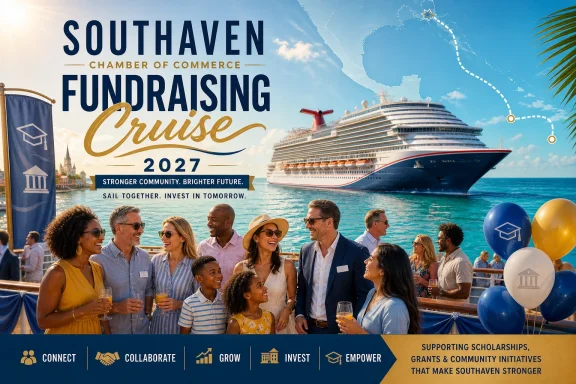 Southaven Turns a Vacation Into a Civic Instrument
Local chambers have always lived in the space between commerce and community. They host breakfasts, ribbon cuttings, luncheons, workshops, mixers, and award nights because business relationships rarely form through press releases alone. The Southaven Chamber’s 2027 cruise extends that logic offshore.By tying a Carnival Dream itinerary to the Chamber Foundation, the chamber is converting leisure travel into a funding mechanism for scholarships, mentorship programs, and small-business grants. That is a different emotional pitch from a gala table or a raffle ticket. It asks residents and business owners to treat their vacation budget as a community investment.
The timing matters. A June 2027 cruise announced in May 2026 gives would-be travelers more than a year to plan, budget, coordinate family schedules, and decide whether the trip fits. It also gives the chamber a long runway to market the event through its existing network rather than relying on a short burst of ticket sales.
There is a practical cleverness in that. Cruises are built around group sales, early deposits, and fixed itineraries. Chambers are built around networks, referrals, and recurring local engagement. Put the two together, and the fundraiser becomes less of a one-night event and more of a rolling campaign.
The Deposit Deadline Is the Real Starting Gun
The headline date is June 12, 2027, but the operational date is June 30, 2026. That is when the $150 deposit is due, according to the chamber’s announcement. For a fundraiser, that early commitment is not a footnote; it is the mechanism that turns curiosity into a countable audience.A chamber can talk about a cruise for months, but cruise inventory is not abstract. Cabins, categories, rates, and group blocks all depend on people committing early enough for organizers to know what kind of event they are building. The deposit deadline gives the chamber a way to separate casual interest from actual participation.
The $850 starting price also frames the audience. This is not positioned as an ultra-luxury donor retreat, but it is not a trivial purchase either, especially for families. That price point makes the fundraising proposition more delicate: the chamber needs participants to feel they are getting both a vacation and a cause worth supporting.
That dual promise is where local organizations often succeed or stumble. If the trip is marketed only as a vacation, the foundation becomes a tagline. If it is marketed only as a fundraiser, the vacation starts to feel like a surcharge. The chamber’s task over the next year will be keeping both halves visible.
Carnival Dream Gives the Plan a Familiar Shape
The choice of Carnival Dream is not incidental. Carnival’s Gulf Coast cruises are familiar territory for Mid-South travelers, and New Orleans is a manageable departure point from North Mississippi. For Southaven-area residents, that lowers the psychological barrier compared with a fundraiser requiring flights, complicated transfers, or unfamiliar ports.The listed itinerary is also straightforward: depart New Orleans on Saturday, spend a day at sea, visit Cozumel on Monday, visit Progreso on Tuesday, spend another day at sea, and return to New Orleans on Thursday. That rhythm is precisely what makes cruises attractive to group organizers. There is enough structure to keep everyone moving together, but enough free time for families, friends, and business contacts to make the trip their own.
Cozumel is one of the most familiar ports in the Western Caribbean cruise market, with an established excursion economy and a broad appeal to first-time and repeat cruisers. Progreso, on the Yucatán coast, adds a second Mexico stop with a different feel and access to regional cultural excursions. For a chamber group, that combination matters because the trip has to appeal to members, nonmembers, families, and friends.
The itinerary is not exotic, and that is probably the point. A fundraiser like this does not need to be adventurous in the travel-industry sense. It needs to be legible, affordable enough for a broad audience, and easy to explain in a single chamber email.
The Chamber Foundation Gets a More Public Stage
The Chamber Foundation is the beneficiary, and the chamber says the funds support scholarships, mentorship programs, and small-business grants. Those are the kinds of programs that sit neatly inside a chamber’s civic identity. They connect workforce development, education, entrepreneurship, and local economic mobility.A scholarship program tells a community that business leadership has a stake in the next generation. Mentorship programs tell young professionals and emerging entrepreneurs that relationships still matter. Small-business grants say, more concretely, that the chamber is not only convening business owners but trying to move resources toward them.
The cruise gives those programs a more visible fundraising vehicle. Many foundations struggle with the same problem: their work is important but not always easy to dramatize. A scholarship awarded months later can feel distant from the check written today. A cruise, by contrast, creates a shared narrative before the money is even spent.
That can be powerful, but it also raises the standard for transparency. Participants will reasonably want to know how their booking supports the foundation, whether through a commission, group rebate, donation structure, or another fundraising arrangement. The announcement says every booking will support the foundation; the next step is making that support easy to understand.
A Chamber Event Built for Members and Nonmembers Alike
One notable detail in the announcement is that the cruise is open to members, nonmembers, families, and friends. That is more than a hospitality gesture. It expands the chamber’s audience beyond the usual business-card circuit.Most chamber programming is naturally member-centered. Even when events are public, the social center of gravity often belongs to business owners, managers, vendors, civic officials, and nonprofit leaders. A cruise changes the composition. Spouses, children, friends, retirees, and residents with no chamber affiliation can become part of the chamber’s orbit.
That broader invitation may be useful for recruitment. Someone who would never attend a breakfast networking event might still join a group cruise with neighbors or coworkers. Once there, they encounter the chamber not as a dues organization but as a convener of local relationships.
This is where the fundraiser becomes a soft-power exercise. The chamber is not only raising money; it is creating a setting in which its brand can become more personal. In a local economy, that kind of familiarity can matter as much as a brochure.
The Risk Is Not the Ship, but the Optics
There is an obvious tension in any fundraising cruise. A vacation at sea can look celebratory, even indulgent, while the stated beneficiaries are scholarships, mentorships, and grants. That does not make the idea improper, but it does make messaging important.Community fundraising works when donors can see the connection between the event and the outcome. A dinner auction does this through speeches, honorees, and program videos. A golf tournament does it through signage, sponsors, and beneficiary stories. A cruise has to work harder because the experience itself can overshadow the cause.
The chamber can address that by making the foundation visible throughout the campaign rather than waiting until departure. Profiles of scholarship recipients, explanations of mentorship outcomes, and examples of past small-business support would give the trip a civic spine. Without that, the announcement risks being read as a vacation offer with a charitable footnote.
The optics also depend on who participates. If the cruise draws a broad mix of residents and small-business owners, it will feel like a community trip. If it reads as a closed social event for insiders, critics may ask why a foundation fundraiser needed a ship. The chamber’s explicit invitation to nonmembers is a smart hedge against that perception.
Fundraising Is Moving Toward Experiences Because Attention Is Scarce
The Southaven cruise fits a larger pattern in local civic life. Traditional fundraisers compete with crowded calendars, donor fatigue, and a public that is increasingly selective about where it spends both money and time. Organizations are responding by turning fundraisers into experiences people might have chosen anyway.That shift is not cynical. It reflects a real change in how people evaluate community participation. A donor may still care about scholarships or small-business grants, but the event has to justify a night out, a weekend, or in this case, part of a vacation budget. The cause gets attention when the format earns it.
For chambers, experiential fundraising also reinforces their central function: convening. The value of a chamber is not merely that it can send announcements. It is that it can place people in rooms, on patios, at luncheons, in workshops, and now potentially aboard a cruise ship where relationships form outside the ordinary workday script.
That does not mean every fundraiser should become a getaway. It means organizations are learning that attention is a scarce resource. If they want sustained engagement, they have to build events that people remember.
The New Orleans Departure Makes the Trip Regional, Not Remote
For Southaven, New Orleans is a practical embarkation point. The drive is long enough to feel like travel but familiar enough to avoid the friction of air travel. That matters for families watching costs and for older travelers who may prefer a simpler departure plan.The Gulf Coast cruise market has long benefited from that regional accessibility. For communities in Mississippi, Tennessee, Arkansas, and Louisiana, New Orleans functions as a cruise gateway that can be reached by car. That keeps the trip in the realm of a group outing rather than a full-scale international travel project.
The chamber’s itinerary also avoids the complexity of multiple flights, passport logistics for air travel, or scattered hotel arrangements across a distant city. Participants still need to pay attention to cruise documentation requirements and travel rules, but the overall planning burden is lower than many comparable fundraisers.
That accessibility strengthens the chamber’s pitch. The trip can be sold as a major experience without becoming logistically intimidating. For a fundraiser dependent on broad participation, that is a crucial distinction.
The Business Case Is Relationship-Building in Disguise
The cruise is framed as a fundraiser, but it is also a networking event stretched across six days. That may sound awkward until you remember how much local business is built on familiarity. People hire, refer, recommend, sponsor, and collaborate with people they know.A cruise environment changes the tempo of networking. Conversations happen over meals, excursions, deck chairs, and chance encounters rather than timed mixers. That can deepen relationships, but it can also blur boundaries between business and leisure.
The chamber will need to set expectations carefully. Some participants may want networking opportunities; others may want a family vacation that happens to support a foundation. The best version of this event will not force every traveler into a programming schedule. It will create optional moments for connection while preserving the vacation people paid for.
That balance is easier said than done. Too little structure, and the chamber loses the community-building advantage. Too much structure, and the cruise starts to feel like a conference at sea. The strongest chamber events usually understand the room; in this case, the room just happens to float.
Small-Business Grants Give the Cruise Local Economic Relevance
Among the foundation’s stated funding targets, small-business grants may be the most directly tied to the chamber’s institutional purpose. Scholarships and mentorships are long-term investments in people. Grants can put dollars into the hands of local operators facing immediate needs.In a city like Southaven, where commerce is shaped by regional traffic, logistics, retail, services, and proximity to Memphis, small businesses occupy a complicated place. They benefit from growth but also compete in a market where scale, rent, labor, and marketing costs can be unforgiving. A small grant will not transform that landscape, but it can help a business buy equipment, improve visibility, launch a project, or bridge a gap.
That is why the foundation’s grant work deserves to be more than a line in the announcement. If the chamber can show concrete examples of what grant dollars have done or could do, the cruise becomes more persuasive. Donors and travelers respond to specificity.
The same is true for scholarships and mentorships. A cruise cabin is a personal purchase; the foundation needs to make the public benefit feel equally tangible. The clearer the outcomes, the stronger the case.
The Booking Link Is Convenient, but Trust Still Matters
The chamber directed interested travelers to book through its provided link. That is standard for group travel campaigns, but it also places trust at the center of the transaction. People need to know they are booking through the right channel, under the right terms, and with a clear understanding of deposits, rates, deadlines, and cancellation policies.Local organizations often rely on familiarity to carry that trust. A chamber announcement, especially one circulating through social media or local news, may be enough for many residents. Still, travel purchases are not the same as luncheon registrations. They involve larger sums, longer timelines, and more variables.
The chamber would be well served by keeping details centralized and consistent. Cabin categories, payment schedules, refund rules, travel documentation guidance, and contact information should be easy to find. In group travel, confusion is the enemy of momentum.
There is also a cybersecurity-adjacent lesson here, even for a non-tech story. Shortened booking links are convenient, but any campaign asking people to pay money through a link should make verification easy. A chamber website page, office contact, or named travel coordinator can help prevent uncertainty and reduce the risk of lookalike scams.
The Calendar Gives the Chamber a Year to Prove the Cause
A long lead time can either build momentum or dilute urgency. The Southaven Chamber has more than a year before the ship sails, which means it has time to tell a better story than a single announcement can carry. It also means the campaign will need periodic renewal.The strongest approach would be to treat the cruise as a yearlong foundation campaign with the trip as the capstone. That could include updates on scholarship cycles, mentorship milestones, grant recipients, and business-development stories. Each update would remind potential travelers that the cruise is not merely a product but a funding channel.
The chamber’s recent programming suggests it already understands recurring engagement. Workshops, social events, business gatherings, and sponsored networking sessions all serve different slices of the local business community. The cruise can sit within that ecosystem rather than apart from it.
The challenge is not getting people to notice the announcement once. It is sustaining interest through deposit deadlines, payment milestones, cabin availability updates, and the long gap before departure. Fundraising campaigns succeed when they turn a date on the calendar into a story people can follow.
The Chamber Is Testing How Far Community Loyalty Travels
The most interesting test is whether local loyalty can travel 500 miles to a port and then across the Gulf. Chambers usually operate within geographic boundaries. Their members join because they want visibility, advocacy, relationships, and influence in a local market.A cruise stretches that geography. For six days, the community becomes portable. The Southaven business network is no longer defined by a meeting room, a chamber office, or a restaurant patio; it is defined by the people who chose to go.
That portability may be especially appealing in a region where civic identity overlaps with family life, church networks, schools, youth programs, and small businesses. A chamber cruise can become a hybrid of vacation, reunion, networking event, and fundraiser. That hybridity is exactly what makes it promising and tricky.
If the trip succeeds, it may encourage more local organizations to think beyond conventional fundraising venues. If it struggles, the lesson may be that community goodwill does not automatically translate into travel commitments. Either way, the chamber is testing the elasticity of its network.
The Mexico Cruise Succeeds Only If the Foundation Remains the Main Character
The concrete facts are easy to remember, but the strategic implications are what will determine whether the fundraiser works.- The Southaven Chamber plans a June 12-17, 2027, Carnival Dream cruise from New Orleans to Cozumel and Progreso.
- Rooms are advertised as starting at $850 per person, with a $150 deposit due by June 30, 2026.
- The chamber says every booking will support the Chamber Foundation’s scholarships, mentorship programs, and small-business grants.
- The trip is open beyond chamber membership, including nonmembers, families, and friends.
- The campaign’s success will depend on clear booking terms, visible foundation outcomes, and sustained communication over the next year.
- The cruise gives the chamber a chance to turn fundraising into relationship-building, but only if the charitable purpose stays visible.
References
- Primary source: DeSoto County News
Published: 2026-05-27T16:13:08.166342
Southaven Chamber Plans June 2027 Fundraising Cruise to Mexico | DeSoto County News
The Southaven Chamber announced a six-day cruise aboard the Carnival Dream from New Orleans to Cozumel and Progreso June 12-17, 2027, saying bookings start at $850 per person and benefit the Chamber Foundation.desotocountynews.com - Related coverage: cayole.com
Carnival Dream - June 12, 2027 ( 5 Nights ) - Great Cruise Deals
Offers cheap cruise deals for Carnival Dream sailing on June 12, 2027 for 5 nights. View available categories, historical prices and future price predictions. Book your cruise online.www.cayole.com
- Related coverage: travelagewest.com
5 Night Caribbean Cruise on the Carnival Dream Cruise Schedule | TravelAge West
5 Night Caribbean Cruise on the Carnival Cruise Line Carnival Dream Schedule, Itinerary, and Prices. Plan your 5 Night Caribbean Cruise Carnival Cruise Line cruise with our cruise schedules, prices, and sail dates. Find sailing destinations for Carnival Dream.www.travelagewest.com
- Related coverage: southaven.org
