

SpaceX went public on June 12, 2026, under the ticker SPCX after pricing the largest initial public offering in market history, but its first message to public shareholders was that dividends are not part of the plan. That is not a footnote; it is the entire bargain. Investors are being offered exposure to rockets, Starlink, spectrum, AI infrastructure, and Elon Musk’s empire-building appetite, but not a claim on near-term cash payouts. For income investors, the most hyped listing in years is less a missed opportunity than a reminder that not every public company is built to serve every public shareholder.
The public-market pitch around SpaceX is easy to understand because it compresses several investor fantasies into one ticker. It is a launch company with government contracts, a satellite broadband operator with global ambitions, a spectrum story, a data-center spender, and now a public Musk vehicle with the gravitational pull that comes with that name.
But the same breadth that makes SpaceX exciting also makes it inhospitable to dividend investors. The company is not presenting itself as a mature cash-return machine. It is presenting itself as a capital allocator in markets where scale is expensive, mistakes are expensive, and waiting is expensive.
That distinction matters because a dividend is not merely a reward. It is a signal that management believes the business can fund its operations, invest for growth, and still return cash without weakening the company’s strategic position. SpaceX’s own posture says the opposite: the foreseeable future belongs to reinvestment.
In ordinary IPO analysis, “no dividend” barely registers. Young tech companies often say the same thing, and investors shrug. SpaceX is different because it is not a narrow software startup burning cash to acquire users; it is a sprawling industrial-and-network infrastructure company whose ambitions require steel, silicon, launch cadence, orbital capacity, ground terminals, spectrum rights, and data-center build-outs.
For SpaceX, the phrasing is not defensive legal housekeeping. It is a compact with the market: buy the stock if you believe retained capital can compound into something larger than today’s valuation implies. Do not buy it expecting quarterly checks to smooth the ride.
That is where income investors are effectively excluded. Retirees, dividend-growth funds, yield-focused institutions, and conservative allocators can admire the business and still find the security unsuitable. A company can be strategically important, technologically formidable, and financially fascinating while being a poor fit for portfolios built around cash distributions.
The neglect is not accidental. It is designed into the company’s priorities. SpaceX is asking public investors to finance acceleration, not harvest.
That is the seductive version of the story. The harder version is that Starlink’s success increases the number of things SpaceX can spend money on. More subscribers justify more satellites, more satellites require replenishment and launch capacity, and direct-to-device ambitions turn the business from broadband provider into telecom infrastructure contender.
The result is a paradox familiar to growth investors but frustrating to income investors. The better the opportunity looks, the more management can justify keeping the cash. A mature satellite broadband operator might return capital; a company trying to dominate global connectivity from orbit is more likely to reinvest aggressively.
This is why profitability in one segment does not automatically translate into dividends at the parent company. A conglomerate with one cash-generating arm and two capital-hungry arms can use the strong unit as internal funding. Starlink may be the engine, but SpaceX has many vehicles attached to it.
That makes SpaceX different from the cleanest software growth stories. A software company can sometimes scale revenue faster than costs once the product and distribution engine are built. SpaceX can gain efficiencies, reuse rockets, and drive down launch costs, but it still operates in a domain where physics sends invoices.
The company’s space segment may be strategically indispensable even when it is not the largest contributor to revenue. It supports Starlink deployment, government missions, brand power, and the company’s broader moat. But indispensable does not mean dividend-friendly.
For income investors, capital intensity is not merely an accounting category. It is a claim on cash before shareholders ever see it. Every rocket program, every facility expansion, every satellite refresh cycle, and every speculative frontier project competes with the dividend line that SpaceX has already told investors not to expect.
If SpaceX’s AI unit is competing in the same arms race as the largest cloud and model companies, then it cannot behave like a slow-and-steady dividend payer. It needs chips, power, facilities, networking, engineering talent, and time. The market may reward that ambition, but the spending profile is hostile to income discipline.
This is where investors should separate excitement from suitability. A company can be exposed to the most fashionable technology theme of the decade and still be a bad instrument for anyone seeking predictable portfolio income. In fact, the fashion can make the income case worse because management has more reason to chase scale.
AI also complicates the valuation question. Investors are not simply valuing a launch company or a broadband network. They are valuing a Musk-led conglomerate with expensive claims on multiple frontiers. That may support a premium for believers, but it raises the hurdle for anyone asking when free cash will become distributable cash.
That is not inherently bad. The public market exists partly to fund large ambitions. Railroads, telecom networks, semiconductor fabs, automakers, and energy systems have all leaned on public capital at different points because private balance sheets were not enough.
But income investors should resist the emotional framing of an IPO as proof that a company is ready to share cash. SpaceX did not list because it had run out of things to build. It listed while its build-out was still part of the investment thesis.
That matters for expectations. The shareholder base SpaceX wants is one that tolerates volatility, believes in long-duration reinvestment, and accepts that management will prioritize strategic optionality over near-term yield. The shareholder base it does not naturally serve is one that measures management discipline by cash returned each quarter.
But Apple’s path was unusual in ways that do not map neatly onto SpaceX. Apple eventually became a consumer electronics and services colossus with staggering operating leverage, immense free cash flow, and a product ecosystem that could support buybacks and dividends while still funding research and development. Its capex needs were meaningful, but they did not resemble building a vertically integrated space, satellite, telecom, and AI infrastructure empire.
SpaceX may one day become mature enough to return capital. The point is not that dividends are impossible forever. The point is that the company’s current structure gives investors little reason to expect that day soon, and perhaps less reason to believe dividends will ever become central to the story.
Dividend investors do not need to be hostile to growth. Many of the best dividend companies were once aggressive reinvestors. But buying a no-dividend stock because another company eventually paid one is not income investing; it is growth speculation with a dividend fantasy attached.
For income investors, however, the same concentration of vision can be a liability. Dividend policy is partly about governance culture. Companies that develop a habit of returning cash usually do so because boards, management teams, and shareholder bases treat capital returns as a discipline rather than an afterthought.
Musk-led companies are not generally associated with conservative capital-return orthodoxy. They are associated with expansion, moonshots, operational intensity, and strategic pivots that can leave traditional valuation frameworks gasping for oxygen. That can create enormous upside, but it is not the temperament of a utility-style dividend payer.
The question is not whether Musk can build valuable businesses. The question is whether the company’s controlling culture is likely to prioritize the needs of investors who want dependable cash distributions. Right now, the answer is plainly no.
Those questions are healthy even when the answer is “not yet.” They force investors to distinguish between business quality and stock suitability. SpaceX may be one of the most important companies of the next decade and still be a mismatch for anyone who needs income now.
That mismatch should not be treated as a moral failing on either side. SpaceX is not obligated to become a Dividend King to justify its existence. Income investors are not obligated to buy a historic IPO simply because it dominates financial media for a week.
The danger comes when investors confuse access with alignment. Public trading gives everyone the ability to buy, but it does not mean the company is built for every portfolio. SpaceX has opened the door to public shareholders while making clear which shareholders it is optimized for.
For growth investors, that may be acceptable if SpaceX keeps expanding its addressable markets. For income investors, it is an especially difficult setup because there is no yield to compensate for waiting. The return depends almost entirely on price appreciation, which means the stock must keep persuading future buyers that the next phase of growth is still underpriced.
That dynamic can work spectacularly, as many technology investors know. It can also punish late entrants when enthusiasm outruns execution. Without dividends, shareholders cannot rely on cash distributions to offset valuation compression.
This is why “great company” and “good income investment” remain separate categories. SpaceX can be both operationally extraordinary and financially unsuitable for yield portfolios. The distinction is not pedantic; it is the difference between buying a business narrative and buying a cash-flow instrument.
SpaceX is operating in that same infrastructure tradition, only with harsher physics and more theatrical branding. It is building networks above the planet and compute capacity on it. Those are not light commitments.
The comparison matters because IT buyers and sysadmins understand that infrastructure is never finished. Networks need upgrades, hardware ages, software stacks evolve, security requirements tighten, and capacity planning is a permanent job. SpaceX’s public shareholders are buying into a company whose core businesses will likely remain in a constant state of expansion and refresh.
That is exciting for investors who want exposure to platform creation. It is less exciting for investors who want the platform to settle down and mail them checks. Infrastructure can become cash-generative, but only after the build-out reaches a phase where maintenance and incremental expansion no longer consume the story.
Conglomerates can create value by sharing capabilities across divisions. SpaceX can launch its own satellites, use Starlink cash to fund broader ambitions, and leverage engineering culture across hardware, software, and infrastructure. That integration is part of the bull case.
Conglomerates can also obscure capital allocation. Profitable units can subsidize speculative units. Segment results can look promising while consolidated cash flow remains under pressure. Investors may find themselves cheering one business while quietly funding another.
Income investors usually prefer clarity because dividends depend on reliable surplus cash. SpaceX offers ambition before clarity. That may be exactly why growth investors are interested, but it is also why the dividend crowd is right to stand back.
That makes them boring by design. Boredom is part of the product. Their shareholders are not paying for maximum optionality; they are paying for resilience, predictability, and a management culture that treats the dividend as a promise.
SpaceX is offering almost the inverse. It is a company where optionality is the product. Its appeal lies in the possibility that several hard, expensive bets will reinforce each other and create a platform unlike anything else in the public market.
Neither model invalidates the other. But pretending they serve the same investor is how people end up disappointed. SpaceX is not neglecting income investors because management forgot them; it is neglecting them because serving them would conflict with the company’s chosen mission.
At today’s stage, the answer is obvious. SpaceX has too many plausible uses for capital to justify distributing it merely to satisfy investors who bought the wrong kind of stock. A dividend would be a strange signal from a company still trying to define multiple markets.
That does not mean management gets a blank check. Public shareholders should demand evidence that reinvested capital earns attractive returns. They should scrutinize segment losses, debt, dilution, governance, and whether the company’s sprawling ambitions create value or simply consume the cash produced by Starlink.
But those are growth-investor questions, not income-investor comforts. The right debate is whether SpaceX can compound retained earnings effectively. The wrong debate is whether the company should pretend to be a dividend stock.
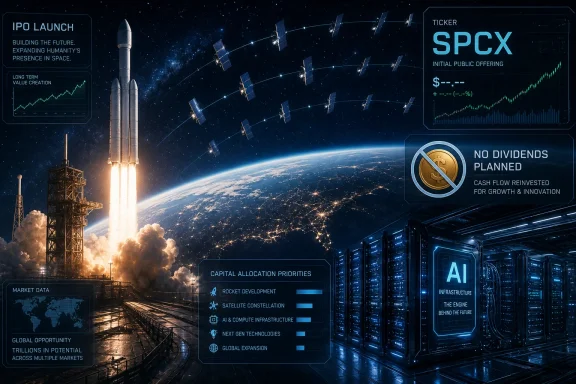 SpaceX Sells the Future, Not the Coupon
The public-market pitch around SpaceX is easy to understand because it compresses several investor fantasies into one ticker. It is a launch company with government contracts, a satellite broadband operator with global ambitions, a spectrum story, a data-center spender, and now a public Musk vehicle with the gravitational pull that comes with that name.But the same breadth that makes SpaceX exciting also makes it inhospitable to dividend investors. The company is not presenting itself as a mature cash-return machine. It is presenting itself as a capital allocator in markets where scale is expensive, mistakes are expensive, and waiting is expensive.
That distinction matters because a dividend is not merely a reward. It is a signal that management believes the business can fund its operations, invest for growth, and still return cash without weakening the company’s strategic position. SpaceX’s own posture says the opposite: the foreseeable future belongs to reinvestment.
In ordinary IPO analysis, “no dividend” barely registers. Young tech companies often say the same thing, and investors shrug. SpaceX is different because it is not a narrow software startup burning cash to acquire users; it is a sprawling industrial-and-network infrastructure company whose ambitions require steel, silicon, launch cadence, orbital capacity, ground terminals, spectrum rights, and data-center build-outs.
The Dividend Clause Says the Quiet Part Out Loud
The company’s dividend policy is blunt in the way IPO filings usually are. SpaceX does not expect to declare or pay cash dividends in the foreseeable future, and it intends to retain future earnings, if any, to finance growth. That language is boilerplate, but boilerplate can still be revealing when it aligns perfectly with the business model.For SpaceX, the phrasing is not defensive legal housekeeping. It is a compact with the market: buy the stock if you believe retained capital can compound into something larger than today’s valuation implies. Do not buy it expecting quarterly checks to smooth the ride.
That is where income investors are effectively excluded. Retirees, dividend-growth funds, yield-focused institutions, and conservative allocators can admire the business and still find the security unsuitable. A company can be strategically important, technologically formidable, and financially fascinating while being a poor fit for portfolios built around cash distributions.
The neglect is not accidental. It is designed into the company’s priorities. SpaceX is asking public investors to finance acceleration, not harvest.
Starlink Gives SpaceX a Cash Engine, but Not a Dividend Culture
The strongest argument against dismissing SpaceX as an income dead zone is Starlink. The connectivity business has become the company’s most mature commercial engine, and its economics are much easier for public investors to grasp than lunar ambitions or Mars rhetoric. A global broadband network with recurring revenue looks, at first glance, like the kind of asset that could eventually throw off distributable cash.That is the seductive version of the story. The harder version is that Starlink’s success increases the number of things SpaceX can spend money on. More subscribers justify more satellites, more satellites require replenishment and launch capacity, and direct-to-device ambitions turn the business from broadband provider into telecom infrastructure contender.
The result is a paradox familiar to growth investors but frustrating to income investors. The better the opportunity looks, the more management can justify keeping the cash. A mature satellite broadband operator might return capital; a company trying to dominate global connectivity from orbit is more likely to reinvest aggressively.
This is why profitability in one segment does not automatically translate into dividends at the parent company. A conglomerate with one cash-generating arm and two capital-hungry arms can use the strong unit as internal funding. Starlink may be the engine, but SpaceX has many vehicles attached to it.
Rockets Are Not a Software Margin Story
Public markets love to describe every ambitious company as a technology company because the label implies scalability and margin expansion. SpaceX is a technology company in the literal sense, but its costs do not disappear into code. Launch systems, spacecraft, engines, factories, test facilities, ground infrastructure, and failure recovery are all physical realities.That makes SpaceX different from the cleanest software growth stories. A software company can sometimes scale revenue faster than costs once the product and distribution engine are built. SpaceX can gain efficiencies, reuse rockets, and drive down launch costs, but it still operates in a domain where physics sends invoices.
The company’s space segment may be strategically indispensable even when it is not the largest contributor to revenue. It supports Starlink deployment, government missions, brand power, and the company’s broader moat. But indispensable does not mean dividend-friendly.
For income investors, capital intensity is not merely an accounting category. It is a claim on cash before shareholders ever see it. Every rocket program, every facility expansion, every satellite refresh cycle, and every speculative frontier project competes with the dividend line that SpaceX has already told investors not to expect.
AI Turns the Cash Question From Hard to Brutal
The AI side of the business makes the dividend debate even less plausible. Data centers are among the defining capital projects of this market cycle, and companies chasing frontier AI capacity are spending as if infrastructure itself is the competitive moat. That turns cash into ammunition.If SpaceX’s AI unit is competing in the same arms race as the largest cloud and model companies, then it cannot behave like a slow-and-steady dividend payer. It needs chips, power, facilities, networking, engineering talent, and time. The market may reward that ambition, but the spending profile is hostile to income discipline.
This is where investors should separate excitement from suitability. A company can be exposed to the most fashionable technology theme of the decade and still be a bad instrument for anyone seeking predictable portfolio income. In fact, the fashion can make the income case worse because management has more reason to chase scale.
AI also complicates the valuation question. Investors are not simply valuing a launch company or a broadband network. They are valuing a Musk-led conglomerate with expensive claims on multiple frontiers. That may support a premium for believers, but it raises the hurdle for anyone asking when free cash will become distributable cash.
The IPO Was a Capital Raise, Not a Graduation Ceremony
There is a popular misconception that going public means a company has crossed from adolescence into adulthood. In reality, an IPO can be a funding event, a liquidity event, a branding event, or a governance event. For SpaceX, the scale of the offering reinforces that the company came to market with enormous capital needs still ahead of it.That is not inherently bad. The public market exists partly to fund large ambitions. Railroads, telecom networks, semiconductor fabs, automakers, and energy systems have all leaned on public capital at different points because private balance sheets were not enough.
But income investors should resist the emotional framing of an IPO as proof that a company is ready to share cash. SpaceX did not list because it had run out of things to build. It listed while its build-out was still part of the investment thesis.
That matters for expectations. The shareholder base SpaceX wants is one that tolerates volatility, believes in long-duration reinvestment, and accepts that management will prioritize strategic optionality over near-term yield. The shareholder base it does not naturally serve is one that measures management discipline by cash returned each quarter.
Apple Is the Wrong Comfort Blanket
The standard counterargument is Apple. Apple went years without paying a dividend, then restored one once the iPhone era created enough cash flow to fund both growth and shareholder returns. It is a tempting analogy because it lets investors imagine SpaceX as a future dividend giant rather than a permanent reinvestment machine.But Apple’s path was unusual in ways that do not map neatly onto SpaceX. Apple eventually became a consumer electronics and services colossus with staggering operating leverage, immense free cash flow, and a product ecosystem that could support buybacks and dividends while still funding research and development. Its capex needs were meaningful, but they did not resemble building a vertically integrated space, satellite, telecom, and AI infrastructure empire.
SpaceX may one day become mature enough to return capital. The point is not that dividends are impossible forever. The point is that the company’s current structure gives investors little reason to expect that day soon, and perhaps less reason to believe dividends will ever become central to the story.
Dividend investors do not need to be hostile to growth. Many of the best dividend companies were once aggressive reinvestors. But buying a no-dividend stock because another company eventually paid one is not income investing; it is growth speculation with a dividend fantasy attached.
Musk’s Control Premium Cuts Both Ways
Elon Musk is central to the SpaceX premium. The market is not merely buying assets; it is buying a record of improbable execution, a willingness to take technical risks, and a public persona that can attract capital and attention at extraordinary scale. That premium is real, even for investors who dislike the circus around it.For income investors, however, the same concentration of vision can be a liability. Dividend policy is partly about governance culture. Companies that develop a habit of returning cash usually do so because boards, management teams, and shareholder bases treat capital returns as a discipline rather than an afterthought.
Musk-led companies are not generally associated with conservative capital-return orthodoxy. They are associated with expansion, moonshots, operational intensity, and strategic pivots that can leave traditional valuation frameworks gasping for oxygen. That can create enormous upside, but it is not the temperament of a utility-style dividend payer.
The question is not whether Musk can build valuable businesses. The question is whether the company’s controlling culture is likely to prioritize the needs of investors who want dependable cash distributions. Right now, the answer is plainly no.
The Neglected Investor Is Not Always the Wrong Investor
It is easy to mock income investors as unadventurous, especially during a market frenzy around a glamorous IPO. But yield-focused investors serve a real function in the market. They ask whether a company’s profits are durable, whether capital allocation is disciplined, and whether shareholders will ever receive cash rather than only stories.Those questions are healthy even when the answer is “not yet.” They force investors to distinguish between business quality and stock suitability. SpaceX may be one of the most important companies of the next decade and still be a mismatch for anyone who needs income now.
That mismatch should not be treated as a moral failing on either side. SpaceX is not obligated to become a Dividend King to justify its existence. Income investors are not obligated to buy a historic IPO simply because it dominates financial media for a week.
The danger comes when investors confuse access with alignment. Public trading gives everyone the ability to buy, but it does not mean the company is built for every portfolio. SpaceX has opened the door to public shareholders while making clear which shareholders it is optimized for.
Valuation Makes the No-Dividend Problem Sharper
A no-dividend policy is normal for a high-growth company. A no-dividend policy attached to one of the largest valuations ever placed on a newly public company is a different proposition. The higher the starting price, the more future success has already been pulled into the present.For growth investors, that may be acceptable if SpaceX keeps expanding its addressable markets. For income investors, it is an especially difficult setup because there is no yield to compensate for waiting. The return depends almost entirely on price appreciation, which means the stock must keep persuading future buyers that the next phase of growth is still underpriced.
That dynamic can work spectacularly, as many technology investors know. It can also punish late entrants when enthusiasm outruns execution. Without dividends, shareholders cannot rely on cash distributions to offset valuation compression.
This is why “great company” and “good income investment” remain separate categories. SpaceX can be both operationally extraordinary and financially unsuitable for yield portfolios. The distinction is not pedantic; it is the difference between buying a business narrative and buying a cash-flow instrument.
WindowsForum Readers Should Recognize the Infrastructure Pattern
For Windows enthusiasts and IT pros, the SpaceX story has a familiar infrastructure rhythm. The companies that reshape platforms often spend heavily before the payoff is visible. Microsoft’s cloud era, the hyperscaler data-center build-out, fiber networks, semiconductor capacity, and even enterprise software ecosystems all required years of reinvestment before the market could judge the durability of returns.SpaceX is operating in that same infrastructure tradition, only with harsher physics and more theatrical branding. It is building networks above the planet and compute capacity on it. Those are not light commitments.
The comparison matters because IT buyers and sysadmins understand that infrastructure is never finished. Networks need upgrades, hardware ages, software stacks evolve, security requirements tighten, and capacity planning is a permanent job. SpaceX’s public shareholders are buying into a company whose core businesses will likely remain in a constant state of expansion and refresh.
That is exciting for investors who want exposure to platform creation. It is less exciting for investors who want the platform to settle down and mail them checks. Infrastructure can become cash-generative, but only after the build-out reaches a phase where maintenance and incremental expansion no longer consume the story.
The Public Market Now Has to Price a Conglomerate It Barely Knows
Another reason income investors should be cautious is that SpaceX is not a clean, single-line business. Investors can understand its segments individually, but valuing the combination is harder. Space launch, satellite communications, direct-to-device connectivity, AI infrastructure, social platform exposure, and long-range Mars ambitions do not belong in one easy spreadsheet tab.Conglomerates can create value by sharing capabilities across divisions. SpaceX can launch its own satellites, use Starlink cash to fund broader ambitions, and leverage engineering culture across hardware, software, and infrastructure. That integration is part of the bull case.
Conglomerates can also obscure capital allocation. Profitable units can subsidize speculative units. Segment results can look promising while consolidated cash flow remains under pressure. Investors may find themselves cheering one business while quietly funding another.
Income investors usually prefer clarity because dividends depend on reliable surplus cash. SpaceX offers ambition before clarity. That may be exactly why growth investors are interested, but it is also why the dividend crowd is right to stand back.
The Dividend Kings Look Boring Because They Are Doing a Different Job
The comparison to long-running dividend growers is useful because it reveals the category error. Dividend Kings and similar income stocks are not trying to colonize Mars, blanket the planet with satellite coverage, or compete in frontier AI. They are trying to generate enough dependable cash to raise payouts year after year.That makes them boring by design. Boredom is part of the product. Their shareholders are not paying for maximum optionality; they are paying for resilience, predictability, and a management culture that treats the dividend as a promise.
SpaceX is offering almost the inverse. It is a company where optionality is the product. Its appeal lies in the possibility that several hard, expensive bets will reinforce each other and create a platform unlike anything else in the public market.
Neither model invalidates the other. But pretending they serve the same investor is how people end up disappointed. SpaceX is not neglecting income investors because management forgot them; it is neglecting them because serving them would conflict with the company’s chosen mission.
The Cash Will Have Better Things to Do
The most concrete way to think about SpaceX’s dividend problem is to imagine the internal capital meeting. If the company generates an extra dollar, where does that dollar go? To shareholders, or to launch capacity, satellite production, spectrum integration, AI compute, ground infrastructure, regulatory expansion, and whatever new strategic priority emerges next?At today’s stage, the answer is obvious. SpaceX has too many plausible uses for capital to justify distributing it merely to satisfy investors who bought the wrong kind of stock. A dividend would be a strange signal from a company still trying to define multiple markets.
That does not mean management gets a blank check. Public shareholders should demand evidence that reinvested capital earns attractive returns. They should scrutinize segment losses, debt, dilution, governance, and whether the company’s sprawling ambitions create value or simply consume the cash produced by Starlink.
But those are growth-investor questions, not income-investor comforts. The right debate is whether SpaceX can compound retained earnings effectively. The wrong debate is whether the company should pretend to be a dividend stock.
The One Investor SpaceX Is Leaving on the Launchpad
SpaceX’s IPO has given ordinary investors something they rarely had before: direct public-market exposure to one of the most consequential private companies of the modern era. That access is meaningful, but access does not erase trade-offs. The neglected investor is the one who wants income, predictability, and a near-term claim on cash rather than a long-duration wager on reinvestment.- SpaceX’s public listing gives investors exposure to launch, satellite connectivity, spectrum, and AI infrastructure, but not to a foreseeable cash dividend.
- The company’s own dividend language indicates that future earnings, if any, are expected to be retained for growth rather than distributed to shareholders.
- Starlink may provide the strongest cash engine inside SpaceX, but its growth opportunities also create strong reasons to keep reinvesting.
- The capital intensity of rockets, satellites, data centers, and network infrastructure makes SpaceX a poor match for portfolios built around dependable yield.
- Investors who buy SPCX should understand that they are underwriting expansion and execution risk, not purchasing a conventional income vehicle.
References
- Primary source: aol.com
Published: 2026-06-21T06:50:13.401772
Here's 1 Type of Investor Who's Being Utterly Neglected by SpaceX - AOL
The company isn't going to offer the one thing a great many market players crave.www.aol.com - Related coverage: moneyweek.com
SpaceX IPO blasts off: shares gain 20% on first day | MoneyWeek
SpaceX set the record for the largest IPO in history on Friday, ending its first day on the public markets with a $2 trillion market cap.moneyweek.com - Related coverage: ir.spacex.com
SpaceX - Space Exploration Technologies Corp. Announces Pricing of Initial Public Offering
STARBASE, Texas, June 11, 2026 – Space Exploration Technologies Corp.(“SpaceX”) today confirmedthe pricing of its initial public offering of 555,555,555shares of its Class A common stock, at a public offering price of $135.00per share. The shares are expected to begin trading on the Nasdaq...ir.spacex.com
- Related coverage: techcrunch.com
SpaceX officially prices shares at $135 in the largest IPO ever | TechCrunch
Wits its official share pricing announcement, SpaceX's IPO has begun.techcrunch.com - Related coverage: fool.com
Forget the SpaceX IPO: 3 AI Space Stocks to Buy and Hold Instead | The Motley Fool
While SpaceX is getting most of the attention, other AI space stocks could have more long-term growth potential.www.fool.com - Related coverage: spcx.capital
SpaceX IPO (SPCX): The $75B Listing, Valuation & How to Buy | SPCX.capital
The SpaceX IPO is complete: SPCX priced at $135, listed on the Nasdaq June 12, 2026 and opened at $150. Valuation, share structure, lock-ups, and how to buy. With sources.spcx.capital
- Related coverage: euronews.com
SpaceX makes its Nasdaq debut after the largest public offering in history | Euronews
Elon Musk's SpaceX began trading on the Nasdaq this Friday under the ticker SPCX, following a record $75bn (€65bn) capital raise that valued the AI and space firm at about $1.78 trillion (€1.54trn).www.euronews.com - Related coverage: globenewswire.com
Defiance ETFs to Launch SPCU, The 2X SpaceX ETF, as the
Defiance ETFs to Launch SPCU, The 2X SpaceX ETF, as the SpaceX (SPCX) IPO Nears...www.globenewswire.com - Related coverage: finder.com
How to Buy SpaceX Stock (SPCX)
We explain how to buy SPCX stock, compare the best stock trading platforms and use a detailed analysis to learn about (SPCX).www.finder.com
- Related coverage: content.spacex.com
- Related coverage: coindesk.com
SpaceX opens at $162 in blockbuster Nasdaq debut
Shares were initially priced at $135 a share during the Thursday IPO.www.coindesk.com - Related coverage: axios.com
SpaceX raises $75 billion in its IPO
It's the largest U.S. IPO ever, and makes SpaceX one of the world's most valuable companies.www.axios.com
- Related coverage: kiplinger.com
Should You Buy SPCX Stock? | Kiplinger
The massive SpaceX IPO has come and gone, with SPCX stock now trading on the Nasdaq.www.kiplinger.com - Related coverage: space.com
SpaceX goes public with a mind-bogglingly historic IPO. The space industry may never be the same. | Space
SpaceX went public with the largest IPO in history, making Elon Musk the world's first trillionaire.www.space.com - Related coverage: tradeglobaltr.com
