

Valve’s long-running Steam Deck wishlist finally shipped a small but consequential battery- and OLED-friendly feature this month, while Microsoft quietly flipped a major switch in datacenter silicon with the announcement of the Azure Cobalt 200 — a 132-core Arm-based SoC aimed squarely at cloud-native and AI workloads.
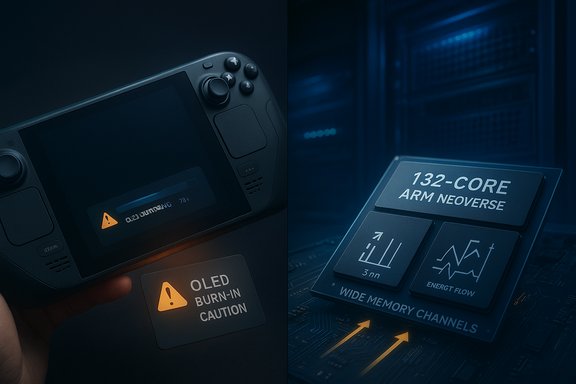
The two stories intersect at an industry-wide theme: purpose-built power efficiency. Valve’s Steam Deck update introduces a display-off low‑power download mode that lets the handheld finish downloads with the screen off and then sleep, addressing battery life, heat, and OLED wear concerns for long installs. This quality‑of‑life change is rolling out through Steam’s Beta and Preview channels now and will reach Stable channels in due course. Microsoft’s Cobalt 200 is a different scale of the same idea — workload‑aware energy proportionality. The Cobalt 200 SoC uses Arm Neoverse Compute Subsystem V3 building blocks and packs 132 active cores, chipletized as 66+66, with large per‑core L2 caches and a substantial L3 system cache. It’s built on TSMC’s 3 nm node and includes per‑core DVFS (dynamic voltage and frequency scaling) to let Azure modulate power at core granularity for mixed cloud workloads. Microsoft says first production servers are already live in Azure datacenters, with broader availability in 2026.
Microsoft’s Cobalt 200 is a much larger bet: a custom Arm SoC that formalizes the hyperscaler strategy to wring efficiency from silicon, packaging, and software co‑design. The design choices — chipletization, per‑core DVFS, large caches, and 3 nm manufacturing — are defensible and aligned with where cloud workloads are headed. The critical question now is verification: whether Cobalt 200’s theoretical efficiency and throughput translate into consistent, measurable gains across diverse, production workloads at scale. Both stories, in their respective domains, underscore a single lesson: efficient design delivered at the right layer — firmware for handhelds, silicon for datacenters — can produce immediate, tangible benefits for users and operators alike.
Source: TechPowerUp Steam Deck Display-Off Downloads Arrive in Mainline Update With Other Fixes | TechPowerUp}
Source: TechPowerUp Microsoft Rolls Out Cobalt 200 CPU with 132 Arm Cores | TechPowerUp}
 Background
The two stories intersect at an industry-wide theme: purpose-built power efficiency. Valve’s Steam Deck update introduces a display-off low‑power download mode that lets the handheld finish downloads with the screen off and then sleep, addressing battery life, heat, and OLED wear concerns for long installs. This quality‑of‑life change is rolling out through Steam’s Beta and Preview channels now and will reach Stable channels in due course. Microsoft’s Cobalt 200 is a different scale of the same idea — workload‑aware energy proportionality. The Cobalt 200 SoC uses Arm Neoverse Compute Subsystem V3 building blocks and packs 132 active cores, chipletized as 66+66, with large per‑core L2 caches and a substantial L3 system cache. It’s built on TSMC’s 3 nm node and includes per‑core DVFS (dynamic voltage and frequency scaling) to let Azure modulate power at core granularity for mixed cloud workloads. Microsoft says first production servers are already live in Azure datacenters, with broader availability in 2026. Steam Deck: What changed and why it matters
The feature in brief
Valve added a “Display‑Off Downloads” option that allows the Steam Deck to continue completing active downloads in a low‑power state while the screen is turned off, then enter sleep when downloads finish. The mode is enabled by default while the Deck is connected to power, and it can be manually enabled when on battery through Settings > Power. If the battery falls below 20%, the device will enter full sleep to prevent deep discharge during unattended downloads. The feature is currently in Beta and Preview channels.Why users asked for it
For handheld owners the pain points were simple and concrete: long downloads or large game installs required leaving the screen on, which burned battery, generated heat, and — in the case of OLED models — contributed to panel wear when left lit for hours. The new mode addresses all three issues simultaneously by keeping network and storage stacks active while suspending the display and most higher‑power subsystems. The result is quieter, cooler installs and less battery drain during unattended downloads.How it works in practice
- Initiating a download and pressing the power button brings up a dialog asking whether to continue downloading with the display off; if the user agrees, the device switches to a low‑power download mode and the display turns off.
- When idle during a download, the Deck may automatically enter the display‑off download state after a configured timeout.
- Users can wake the Deck to check progress; a simplified progress screen appears and offers a choice to fully wake or allow the download to continue.
- Safety interlocks pause downloads and force full sleep if battery percentage drops below the configured threshold (20% by default) to avoid data corruption or battery stress.
Strengths and practical impact
- Battery savings and heat reduction: Turning off the display and lowering power to nonessential subsystems is the lowest‑risk way to reduce energy draw and thermal output during long transfers.
- Preserves OLED lifetime: For Steam Deck OLED owners, reduced screen‑on time translates to less risk of burn‑in or accelerated aging.
- User control and safety: The dialog and battery threshold give users control while protecting the device from accidental deep discharge.
- Low friction: The interface is simple and mirrors user expectations from smartphones and laptops that perform background network tasks with screens off.
Risks and limitations
- Carrier and network expectations: On mobile data or constrained networks, users might not intend background downloads to persist if they assume the device slept; Valve mitigates this by defaulting the feature to enabled only when plugged in.
- Bag‑safety concerns: In the past Valve was cautious about allowing screen‑off activity because a device that appears asleep but is active could build heat in a bag. The new design appears to include limits and automatic sleep triggers, but users should still be deliberate when initiating screen‑off downloads while enclosed.
- Beta rollout: As with any OS change, regressions are possible. Users on the Beta/Preview channels will be first to encounter edge cases; Stable channel users should wait for the broader roll‑out if they need rock‑solid reliability.
Microsoft Cobalt 200: a closer look
Architecture highlights
Microsoft describes Cobalt 200 as a chipletized SoC featuring two 66‑core chiplets for a total of 132 Arm Neoverse‑V3 cores, each with roughly 3 MB of private L2 cache and a shared 192 MB L3 system cache. The memory subsystem is wide (reported as a 12‑channel DDR5 interface across the package), and per‑core DVFS lets Azure scale individual cores depending on workload intensity and latency requirements. Microsoft positions Cobalt 200 as a cloud‑native CPU optimized for throughput, efficiency, and integration with Azure’s networking and storage offloads.Verified claims and cross‑checks
- Microsoft’s Azure Infrastructure Blog post is the primary announcement and includes the 132‑core claim, the Neoverse CSS V3 base, and the 3 nm process note.
- Independent reporting and analysis (Phoronix and other outlets) confirm the headline specs and note Microsoft’s stated target of up to 50% performance improvement over the prior Cobalt 100 generation, though those gains are qualified as Microsoft estimates awaiting independent benchmarking.
What Microsoft is optimizing for
Microsoft’s public framing focuses on cloud‑native workloads and energy efficiency. The Cobalt line is intended to offer:- Workload consolidation: High core counts and wide memory bandwidth to pack more threads and containers per server footprint.
- Energy proportionality: Per‑core DVFS and advanced process geometry to reduce energy per operation across diverse workloads.
- Tighter stack integration: Offloads and co‑design with Azure’s networking, storage, and security systems to improve end‑to‑end throughput and management.
Strengths and potential advantages
- Finer‑grained power control: Per‑core DVFS is a meaningful differentiator for variable cloud workloads; it can reduce power for idle threads while preserving responsiveness for latency‑sensitive tasks.
- Chiplet approach: Using multiple chiplets on a single package improves yields and lets Microsoft scale core counts without incurring the same manufacturing risk as monolithic dies.
- Ecosystem alignment: Building on Arm Neoverse CSS V3 gives Microsoft access to a tested ecosystem and a clear upgrade path tied to Arm’s roadmap.
- Sustainability argument: By focusing on efficiency gains and energy per operation, Cobalt 200 supports cloud operators’ goals to reduce overall datacenter energy consumption per unit of work.
Risks, unknowns, and verification needs
- Benchmarks vs. real workloads: Microsoft’s up to 50% improvement claim is an engineering target; independent third‑party benchmarks across representative cloud stacks will be necessary to validate those numbers. Early in‑house tests can be optimized to favorable cases.
- Software and ecosystem maturity: Arm‑based server ecosystems have matured rapidly, but certain legacy enterprise stacks still expect x86 semantics or rely on microarchitecture-specific optimizations. Porting and optimization efforts at the OS and hypervisor layer remain nontrivial for some customers.
- Availability and instance types: Microsoft says some production servers are already live internally, but public availability of Cobalt‑based Azure instances is slated for 2026. Customers deciding between immediate GPU/CPU options and waiting for Cobalt‑backed instances will need concrete pricing and instance sizing information.
Comparing the two launches: scale, intent, and engineering tradeoffs
Valve’s update and Microsoft’s Cobalt 200 could not be further apart in scale, but both reflect the same engineering axis: do more work while using less visible power.- Valve’s change targets the device‑level UX: lower heat, better battery life, and hardware longevity for handhelds. It’s a small, pragmatic software addition with immediate user impact.
- Microsoft’s announcement is a platform move: custom silicon designed to reshape how cloud compute is provisioned and priced. This is strategic, capital‑intensive, and relies on a broad supply chain, OS support, and customer adoption.
Practical guidance for users and administrators
Steam Deck owners
- If you participate in Beta/Preview channels and often download large games or updates, enable Display‑Off Downloads to save battery and reduce heat when charging overnight.
- If you’re on battery and care about conserving data or preserving battery cycles, leave the feature disabled or limit its use — it’s enabled on battery only if you explicitly toggle it.
- Avoid leaving the device inside confined, warm environments (e.g., a soft bag) while running downloads to mitigate any residual heat‑build accumulation risk. Valve’s safeguards reduce this risk but do not eliminate it entirely.
Cloud architects and procurement teams
- Track Cobalt 200 instance availability and pricing. Early internal deployments indicate Microsoft is confident in the design, but commercial procurement decisions should be based on independent benchmarking for your workload classes.
- For highly parallel, containerized workloads and throughput‑oriented services, Cobalt‑class instances may deliver better price/performance and energy efficiency than legacy x86 instances; for single‑thread‑heavy workloads, comparative testing is essential.
- Consider the transition costs for any stack that relies on x86‑specific features. While many server workloads are portable, latency‑sensitive or microarchitecture‑tuned code needs verification.
Wider implications for hardware and software design
These two developments reflect larger industry dynamics:- Energy-aware compute is mainstream: From handhelds to hyperscalers, power efficiency is now a design first principle, not an afterthought. Per‑core DVFS and low‑power OS states are part of the same continuum.
- Software controls hardware economics: Valve’s update shows how much user value can be unlocked by small OS changes. Microsoft’s approach shows the inverse: how hardware choices reshape software economics at scale.
- Arm’s momentum in servers continues: Cobalt 200 reaffirms the industry shift to Arm in the server market — but success depends on a mature software stack and transparent performance data.
Critical analysis: what to celebrate and what to watch
What to celebrate
- User‑centric polish: Valve addressed a decades‑old UX complaint with a pragmatic, safe feature. It’s a reminder that incremental OS improvements can deliver outsized user benefits.
- Ambitious cloud optimization: Microsoft’s Cobalt 200 shows serious investment in custom silicon and demonstrates how hyperscalers are vertically integrating to control performance-per-watt and long‑term operational cost.
- Industry alignment on efficiency: Arm, Microsoft, and operators are tightly coordinating on microarchitecture and process node choices to extract real energy gains for AI and cloud workloads.
What to watch closely
- Real‑world Cobalt performance: Marketing claims must be validated. Independent benchmarks across representative cloud workloads (web services, databases, ML inference, CI/CD pipelines) will determine whether Cobalt 200’s architecture yields the promised 50% uplift in practical scenarios.
- Ecosystem friction: Windows workloads, vendor‑provided drivers, and legacy management tooling will influence enterprise adoption. Migration tooling and support timelines will be decisive.
- Long‑tail safety edge cases for display‑off downloads: Valve’s mode appears thoughtfully implemented, but real‑world reports from Beta users will reveal unforeseen interactions with specific accessories, network states, or third‑party utilities.
Final verdict
Valve’s display‑off download mode exemplifies how small, targeted OS changes can raise the baseline experience for millions of users without expensive hardware changes. It’s a well‑scoped quality‑of‑life improvement that addresses real pain points for Steam Deck owners and signals that Valve continues to iterate on mature hardware.Microsoft’s Cobalt 200 is a much larger bet: a custom Arm SoC that formalizes the hyperscaler strategy to wring efficiency from silicon, packaging, and software co‑design. The design choices — chipletization, per‑core DVFS, large caches, and 3 nm manufacturing — are defensible and aligned with where cloud workloads are headed. The critical question now is verification: whether Cobalt 200’s theoretical efficiency and throughput translate into consistent, measurable gains across diverse, production workloads at scale. Both stories, in their respective domains, underscore a single lesson: efficient design delivered at the right layer — firmware for handhelds, silicon for datacenters — can produce immediate, tangible benefits for users and operators alike.
Source: TechPowerUp Steam Deck Display-Off Downloads Arrive in Mainline Update With Other Fixes | TechPowerUp}
Source: TechPowerUp Microsoft Rolls Out Cobalt 200 CPU with 132 Arm Cores | TechPowerUp}
