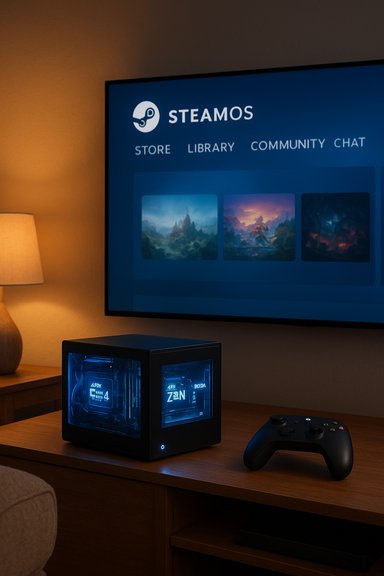
Valve’s new Steam Machine landing in the living room — a compact, SteamOS‑first mini‑PC that promises a plug‑and‑play console feel while keeping the openness of a PC — has sparked a serious reappraisal of whether Windows 11 can remain the default platform for mainstream PC gaming.
Background / Overview
The Steam Machine announced by Valve is not a nostalgic repeat of the 2013 “Steam Machines” experiment; it’s a modern, compact cube built around a semi‑custom AMD Zen 4 CPU and an RDNA 3‑derived GPU block, with 16 GB of DDR5, NVMe storage options and a design that targets 4K @ 60 fps via upscaling techniques such as FSR. Valve positions the device as an appliance‑style living‑room PC running the latest SteamOS and Proton stack — the same compatibility layer that has made the Steam Deck broadly capable of running Windows games on Linux. Independent hands‑on reporting and the specification brief confirm the 6‑core/12‑thread Zen 4 CPU, 28 compute‑unit RDNA 3 GPU, 512 GB / 2 TB NVMe choices and modular microSD expansion. Why this matters: the Steam Machine intends to be the most consumer‑friendly, SteamOS‑first device to date, aimed at households that want a “console” experience without giving up access to PC games, Steam features, cloud saves, mods and the open ecosystem. Valve’s message is explicit — deliver a TV‑centred Steam experience that reduces friction and licensing costs by shipping with SteamOS instead of Windows. That positioning raises two industry‑level questions: will the Steam Machine accelerate parity of anti‑cheat on Linux/Proton, and will Valve finally broaden official SteamOS support for desktop-style PCs? Both questions carry real implications for the viability of ditching Windows 11 for gaming.What Valve announced — the hardware and software reality
The hardware at a glance
The Steam Machine represents Valve’s pragmatic approach to the living‑room PC: mid‑range, power‑efficient silicon tuned for console‑style use.- CPU: Semi‑custom AMD Zen 4, 6 cores / 12 threads.
- GPU: Semi‑custom RDNA 3 block with 28 compute units, ~8 GB VRAM pool, clocked in the 2.4–2.5 GHz range.
- Memory: 16 GB DDR5 (SO‑DIMM), user‑replaceable with caveats.
- Storage: 512 GB or 2 TB NVMe (2230) with microSD expansion and an option to install a 2280 drive with effort.
- Power and IO: ~200 W internal power budget, DisplayPort 1.4, HDMI 2.0, Wi‑Fi 6E, 1 Gbps Ethernet, front/rear USB.
The software stack: SteamOS, Proton and Valve’s strategy
Valve ships the Steam Machine with SteamOS and Proton. Proton remains the “secret sauce” that allows many Windows titles to run on Linux with minimal developer effort, and Valve has continually expanded Proton’s feature set (including anti‑cheat and upscaling support where possible). The Steam Machine is a showcase for Valve’s vision: a TV‑centric UI, integrated streaming and controller UX, and the openness of a PC without a Windows license. Reviewers and Valve engineers emphasize that Proton and SteamOS constitute the core compatibility and UX layer for this product.The two big claims: anti‑cheat and full desktop SteamOS support
Claim 1 — The Steam Machine will force better anti‑cheat support for Linux/Proton
Why this matters: a persistent blocker for many Linux‑first gamers has been multiplayer titles that refuse to run because anti‑cheat middleware requires Windows kernel hooks or other platform‑specific drivers. Historically, Easy Anti‑Cheat (EAC) and BattlEye were significant roadblocks; Valve and partners have worked to bring EAC and BattlEye into the Proton ecosystem, but the outcome has been mixed — usable for some titles, opt‑in by developers, and still problematic for others. Valve’s 2021–2022 work with Epic/EAC and with BattlEye established the technical path: these anti‑cheat providers added Proton/SteamOS compatibility or options, but developers must enable and sometimes update their builds to take advantage.- What’s changed: Proton now supports many anti‑cheat configurations and Valve has documented workflows for partnering with anti‑cheat vendors so developers can enable Proton support without radical rewrites. That progress removed a large technical excuse for “why not.”
- Remaining gap: developer opt‑in, business decisions, and launcher ecosystems. Big publishers may still hesitate due to QA, liability, or the complexity of multi‑launcher ecosystems (Epic, EA, Rockstar and custom launchers), which complicate SteamOS deployments. In some cases, a publisher’s choice to integrate a new anti‑cheat build or a launcher update determines whether a title is playable on Proton. Community reports show titles moving back and forth between playable and blocked states as anti‑cheat versions change.
Claim 2 — Valve will broaden official SteamOS desktop PC support
This is the second pillar of the argument that you can “ditch Windows 11.” Enthusiasts have long used SteamOS on more than just the Deck, and community distros such as Bazzite (a Fedora‑based SteamOS‑like distribution) demonstrate demand for a SteamOS desktop experience. Bazzite and similar projects have aimed to provide SteamOS features for laptops and desktops where Valve’s official support has historically focused on built devices like the Deck.- What Valve might change: shipping a consumer Steam Machine, building out broader driver pipelines (particularly for Nvidia and Intel GPUs), and formalizing a “SteamOS Compatible” device program could lower the fragmentation that currently keeps many users on Windows for desktop gaming. Valve’s recent moves to recognize third‑party SteamOS devices (for handhelds) and to ship Arm‑based SteamOS hardware (Steam Frame headset) indicate a willingness to expand their hardware footprint and to treat SteamOS as a multi‑form factor OS, not just a Deck exclusive.
Critical analysis — strengths, limits, and risk areas
Strengths: where Steam Machine and a SteamOS push are convincing
- Productized experience: Valve learns from the Deck. Shipping a cohesive hardware + OS + UX package reduces variability and makes a Linux gaming alternative much easier to recommend to friends and family. A turnkey device lowers the support burden for mainstream consumers.
- Proton momentum: Proton’s steady technical improvements (including anti‑cheat and advanced runtime features) close many of the historical gaps that made Linux impractical for many players. Valve’s direct engineering investment accelerates compatibility across an increasingly wide portion of Steam’s catalog.
- OEM and community momentum: Third‑party handhelds and community distros (Bazzite, ChimeraOS, etc. show a thriving ecosystem that Valve can tap into to scale SteamOS beyond Deck users. This reduces the single‑vendor risk when pushing a new platform.
Limits and realistic caveats
- Anti‑cheat is partly a publisher choice: Although EAC and BattlEye added Proton support routes, developers frequently need to opt‑in or update integrations. Some publishers may delay or decline for QA, legal, or anti‑cheat efficacy reasons. Individual titles may remain Windows‑only for online modes. The Steam Machine increases pressure but does not guarantee parity.
- Launcher and DRM friction: Titles that depend on external launchers, bespoke DRM stacks, or closed proprietary components can be harder to make reliable on SteamOS. Valve can smooth some pathways but cannot force third‑party vendor cooperation.
- Driver and vendor support for desktop GPUs: Valve has strong ties to AMD and obvious advantages for AMD‑based APUs. Nvidia and Intel driver packaging across arbitrary desktop builds remains a work in progress. A desktop‑class SteamOS experience depends on robust vendor cooperation and curated driver bundles.
- User preferences and ecosystem lock‑in: Game Pass, Epic exclusives, and community habits are entrenched. Many PC users keep Windows for non‑gaming work, productivity tools, and titles not available or not well‑supported on SteamOS. The idea that everyone will “ditch Windows 11” for gaming is unlikely in the short term; a multi‑OS, dual‑boot, or device‑specific strategy is the more probable near‑term reality.
Potential risks for consumers and the industry
- Fragmentation risk: If Valve and multiple OEMs ship different SteamOS variants and driver stacks without clear “verified” compatibility guarantees, customers could face inconsistent experiences similar to early Android fragmentation. That will erode confidence more than a single, well‑supported reference device will restore.
- Security and anti‑cheat complexity: Anti‑cheat modules are not purely technical problems — they’re legal, security‑sensitive, and privacy‑impacting. Any move to standardize anti‑cheat on Proton must preserve robustness without degrading user privacy or OS security. That’s nontrivial.
- False expectations: Marketing multipliers like “6x faster than Steam Deck” are useful attention drivers, but buyers should wait for independent benchmarks that measure sustained performance, thermals and real‑world game lists. Treat early numbers as directional.
What this means if you’re considering ditching Windows 11 now
If the Steam Machine’s announced specs and Valve’s SteamOS strategy make you seriously consider leaving Windows 11 for gaming, here is a practical, pragmatic checklist.- Confirm what games you must have: list titles that require Windows‑only launchers, specific anti‑cheat modules, or third‑party DRM. These are the ones most likely to cause friction on SteamOS today.
- Test Proton compatibility today: use Proton Experimental and ProtonDB to evaluate your library. Many titles run perfectly; some still require work.
- Consider dual‑boot or dedicated device approaches: keep a Windows installation for problematic titles and use a SteamOS device (Deck, Steam Machine, or SteamOS PC) for the rest. This hedges risk while lowering daily friction.
- Watch vendor statements on anti‑cheat: track developer and anti‑cheat vendor updates for the titles you care about — these announcements determine whether your favourite multiplayer game becomes playable under Proton.
- Wait for independent reviews and compatibility lists before making a device purchase: prioritize verified compatibility lists and long‑session thermal tests to ensure the Steam Machine meets your expectations.
The verdict — cautious optimism, not inevitability
Valve’s Steam Machine and the company’s ongoing investments in SteamOS and Proton materially lower the barriers to moving a mainstream gaming experience off Windows 11. The device’s hardware and Valve’s software milestones are credible and meaningful: Proton now supports many previously problematic features, anti‑cheat vendors have created Proton‑compatible paths, and a thriving community of SteamOS derivatives proves demand for a non‑Windows gaming platform. However, the transition from “possible” to “practical for everyone” depends on several external actors — game developers, anti‑cheat vendors, launcher ecosystems and GPU driver vendors — making coordinated choices in response to commercial incentives. The Steam Machine amplifies that commercial signal, but cannot compel it. For competitive multiplayer players or users tied to specific Windows‑only launchers today, jumping ship will remain risky until a critical mass of titles and vendors commit to Proton support.What to watch next (short roadmap)
- Valve’s post‑launch field data and the first wave of independent benchmarks for the Steam Machine (thermals, sustained clocks, power draw).
- Which major publishers enable Proton/EAC or Proton/BattlEye opt‑ins for big multiplayer titles (this will be the clearest signal that anti‑cheat pain points are resolving).
- Valve announcements around broader SteamOS desktop support, verified OEM programs, and Nvidia/Intel driver packaging commitments.
- Community and vendor reports on Proton’s compatibility updates for advanced features like DLSS and other runtime accelerations — these determine the parity of experience versus Windows.
Conclusion
The Steam Machine is the most credible hardware push yet to make SteamOS a mainstream gaming platform in the living room. It leverages Valve’s proven software stack, the commercial heft of the Steam ecosystem, and recent advances in Proton compatibility. For gamers who have longed to “ditch Windows 11,” this device and Valve’s ecosystem updates significantly improve the case — but they do not yet make Windows‑free gaming inevitable for everyone.The shift is best framed as a market transition: Valve’s move increases pressure on publishers and middleware vendors, compresses the timeline for anti‑cheat and driver support changes, and makes SteamOS a realistic, convenient alternative for a larger slice of players. For early adopters and Steam‑centric households, switching to a SteamOS device will already be practical; for competitive multiplayer communities and users tied to non‑Steam launchers, a careful, staged approach (dual‑boot, keep a Windows machine, follow developer updates) remains the safest path.
Valve’s Steam Machine may not immediately end the era of Windows 11 for gaming, but it has turned the discussion from “could Linux someday be viable?” to “when will my favorite multiplayer title land on SteamOS?” — and that is a meaningful change in the market dynamic.
Source: TechRadar https://www.techradar.com/computing...nd-im-preparing-to-ditch-windows-11-for-good/