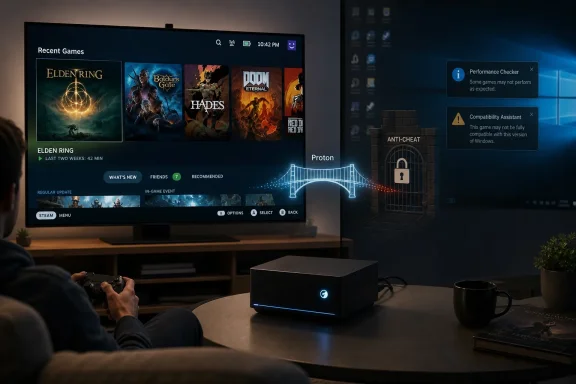
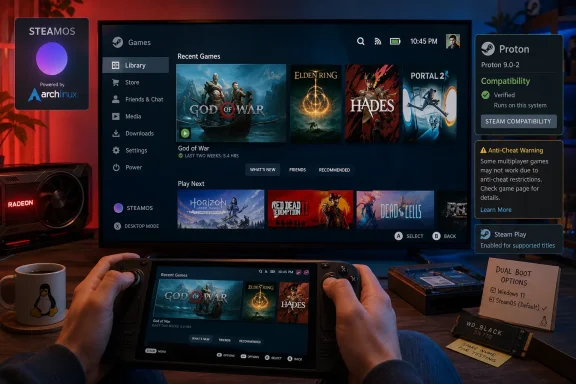
Valve’s new Steam Machine began shipping to selected buyers in late June 2026 as a $1,049-and-up living-room gaming PC, but the more consequential launch is SteamOS 3.8’s expansion beyond Valve’s own handhelds and into AMD-powered desktop hardware. The box is the headline because hardware is easy to photograph. The operating system is the strategy because it changes who gets to build the box. If Valve can turn SteamOS from a Steam Deck appliance into a credible Windows alternative for gaming PCs, the Steam Machine may matter most as a reference design rather than a mass-market console.
The problem with the Steam Machine is not that it is uninteresting. A compact, console-like PC that boots straight into Steam, plays a large chunk of the Windows game catalog through Proton, and avoids the clutter of a general-purpose Windows desktop has obvious appeal. The problem is that the machine arrives in the real world, where $1,049 is no longer an impulse buy and reservation queues turn enthusiasm into a lottery.
That makes SteamOS the more disruptive part of Valve’s announcement. A fixed-price device can be delayed, scalped, constrained by memory pricing, or outclassed by a new GPU cycle. An operating system that can move onto hardware people already own is harder to contain.
Valve has been here before, and badly. The first Steam Machines of the 2010s were a federation of living-room PCs with too little software gravity and too much confusion about what problem they solved. They ran Linux at a time when most PC games did not, and “console-like PC” was not enough to overcome the fact that Windows remained the practical home of PC gaming.
The difference in 2026 is that Valve is no longer asking developers to port the world to Linux before the user experience makes sense. Proton, the compatibility layer that translates Windows games for Linux, has turned the Steam Deck from a curiosity into a proof point. SteamOS now has a successful shipping product behind it, a mature controller-first interface, and a user base that has already accepted the idea that a Windows game does not necessarily need Windows.
That distinction matters. Windows remains the most flexible gaming platform because it is the default target for developers, anti-cheat vendors, launchers, mod tools, GPU drivers, and storefronts. But flexibility is not the same as elegance. A handheld that asks users to manage pop-up launchers, desktop windows, driver utilities, background services, and controller focus problems is still a PC squeezed into a console shape.
SteamOS works because it narrows the experience. It opens to a controller-friendly shell, manages sleep and resume in a way that feels closer to a console than a laptop, and hides the Linux desktop until the user asks for it. That is not a small software trick. It is a product philosophy.
Microsoft has noticed. The company’s newer full-screen gaming efforts and handheld-oriented Windows work are acknowledgments that the classic desktop is a poor default interface for couch and handheld play. But Microsoft is solving the problem from the wrong end: it is trying to make Windows less Windows-like in specific contexts. Valve is making Linux more console-like by default, then leaving the desktop available for users who need it.
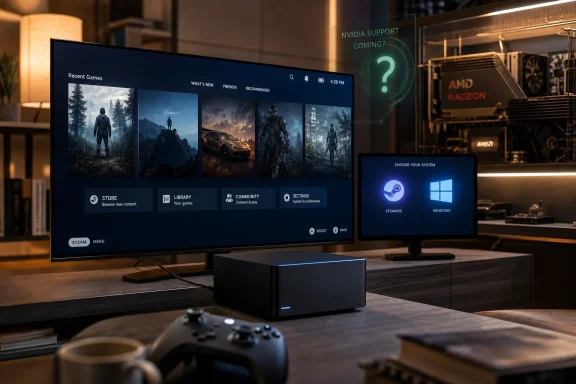
That caveat is not trivial. Nvidia remains enormously important in desktop PC gaming, and a gaming operating system that cannot smoothly support GeForce cards is not yet a Windows replacement for the mainstream enthusiast tower. Intel graphics support is improving, but it is also newer and less proven in this particular SteamOS context than AMD’s stack.
Still, the shift is real. Valve is no longer treating SteamOS as a sealed image for the Steam Deck. The company is talking about desktop compatibility, recent AMD and Intel platforms, third-party handhelds, and eventual Nvidia support. That is a different ambition from “here is the operating system for our handheld.” It is closer to “here is the gaming layer we want the PC industry to standardize around.”
The AMD-first path is also understandable. The Steam Deck, the new Steam Machine, and many handheld PCs already sit in AMD’s orbit. AMD’s open-source Linux graphics stack gives Valve more room to integrate, patch, and ship improvements without negotiating every piece of the driver puzzle through a proprietary vendor channel. In Linux gaming, boring driver plumbing is destiny.
Valve says it is working closely with Nvidia, and that is encouraging. But the difficulty is not just whether a driver can display frames. SteamOS is built around an appliance-like model, with predictable updates and a read-mostly system design that suits console-style stability. Nvidia’s traditional Linux driver model has not always fit as neatly into that world as AMD’s open Mesa-based path.
This is where the Steam Machine itself can help. Valve’s own hardware gives developers, driver teams, and users a known-good baseline. If SteamOS performs well there, the company has a reference point for what the broader ecosystem should feel like. But the reference point cannot become the ceiling.
For SteamOS to become a serious Windows competitor, Nvidia support must be boring. Not heroic, not experimental, not something that requires forum spelunking and command-line ritual. Boring is the standard Windows has set: install driver, launch game, complain about shader compilation instead.
Right now, the SteamOS installation experience is still too blunt for the audience Valve needs next. If installing SteamOS means wiping the target drive, giving up an existing Windows install, or navigating recovery-image assumptions that feel designed for Valve devices, most normal PC gamers will not do it. Enthusiasts will. YouTube experimenters will. The market will not.
Dual-boot support is the bridge. The practical future for many users is not a moral choice between Windows and Linux. It is a gaming PC that can boot into Windows when a particular anti-cheat, launcher, productivity app, or hardware utility requires it, and boot into SteamOS when the user wants the couch-friendly Steam experience.
Third-party projects such as Bazzite already understand this. They offer SteamOS-like gaming environments on a broader range of hardware, often with more flexible installation paths and support for Intel and Nvidia systems. That does not make them a threat to Valve so much as a preview of what users will expect from Valve’s official option.
Valve’s advantage is trust and distribution. Most PC gamers do not know what Bazzite is. They do know Steam. If Steam itself begins presenting SteamOS as an installable path for compatible machines, the conversion funnel changes overnight.
But it is just as easy to understate how much of Windows gaming’s dominance is inertia. Gamers use Windows because games work there. Developers target Windows because gamers use it. Hardware vendors prioritize Windows because that is where the customers are. That loop is powerful, but it is not sacred.
Valve’s move attacks the loop at the user-experience layer rather than the developer-relations layer alone. If SteamOS becomes the better way to use a gaming PC in the living room, bedroom, dorm, or handheld dock, then Windows becomes the compatibility fallback rather than the emotional center of the setup. That is a subtle but dangerous demotion for Microsoft.
The Steam Deck has already trained a generation of PC gamers to accept Linux without thinking much about Linux. They do not boot the Deck and say, “I am excited to use Arch-based software today.” They say, “I want to play Hades II on the couch.” That is exactly how platform transitions become real: the ideology disappears behind the use case.
SteamOS gives the living-room PC a coherent answer. It does not pretend to be a console exactly, because it still exposes PC flexibility when needed. But it starts from the assumption that the user wants to browse a library, launch a game, suspend play, resume later, and manage settings without touching a keyboard.
That is why the custom Steam Machine idea is more exciting than Valve’s own expensive box. Many PC gamers already have an older Ryzen desktop, a previous-generation Radeon GPU, or a small-form-factor machine that could become a dedicated SteamOS system. The value proposition changes dramatically when the question becomes “Should I repurpose hardware?” rather than “Should I spend more than a thousand dollars?”
The economics also matter for families and younger players. A used AMD gaming PC with SteamOS could become the closest thing to an open console: cheaper than a new high-end desktop, more flexible than a traditional console, and less annoying than Windows for controller-first play. That is not a niche if Valve packages it well.
The Steam Deck was not just a handheld; it was a developer kit for a new Linux gaming baseline. The Steam Machine can serve the same purpose for living-room PCs. The Steam Controller, sold separately, extends the idea further by making the input layer portable across machines.
That model looks less like a console war and more like a platform seeding strategy. Valve does not need every SteamOS device to be made by Valve. It needs enough SteamOS devices to make game developers, anti-cheat providers, accessory makers, and OEMs treat the platform as worth supporting.
This is where prebuilt alternatives matter. If PC manufacturers ship SteamOS-like or SteamOS-compatible systems, Valve gets distribution without carrying all the inventory risk. The company can focus on Steam, Proton, drivers, certification, and user experience, while hardware partners chase form factors and price points.
Handheld gaming PCs are one of those parts. Living-room gaming PCs could become another. Small-form-factor systems, console replacements, and secondary gaming machines are ideal SteamOS territory because they benefit most from a focused interface and suffer least from leaving general-purpose Windows habits behind.
If SteamOS wins those contexts, Microsoft faces a perception problem. Windows becomes the serious workhorse, the fallback for stubborn games, the place you go when something does not work elsewhere. SteamOS becomes the thing people actually enjoy using to play.
That is a dangerous split. Microsoft has spent years trying to make Windows the center of gaming through Game Pass, the Xbox app, DirectX, and deep hardware partnerships. Valve is countering with a simpler proposition: your Steam library, your PC hardware, fewer Windows-shaped distractions.
Launcher sprawl is another tax. The dream of SteamOS is that your Steam library simply works, but modern PC gaming is full of nested storefronts, third-party accounts, authentication windows, and update services. Proton can translate many Windows games, but it cannot always translate corporate stubbornness into a pleasant user experience.
This is where Valve’s leverage matters. Steam is not a hobbyist storefront; it is the center of PC game distribution. If SteamOS adoption grows, developers and publishers have stronger incentives to flip the switches, test the builds, and support the paths that make their games behave well.
Still, users should not confuse possibility with parity. SteamOS may already be better than Windows for certain gaming experiences, especially handheld and couch play. It is not yet universally better for every game, every accessory, every storefront, and every competitive ecosystem.
Valve’s wager is that the bargain can be rearranged. Keep the openness of PC hardware. Keep the upgrade path. Keep the huge Steam library. But replace the default Windows experience with something that behaves more like a gaming appliance when the user wants to play.
That is not anti-PC. It may be the most PC thing Valve has done. The company is not saying everyone must buy its box. It is saying the box is only one expression of the platform.
For WindowsForum readers, that distinction should ring loudly. The interesting question is not whether the Steam Machine beats a PlayStation, an Xbox, or a custom Windows desktop in a spec-sheet contest. The interesting question is whether SteamOS becomes a normal option in the mental checklist of a PC build.
The driver set covers the essentials needed to make Windows usable on the box, including graphics, wireless networking, and storage. That reinforces Valve’s “PC first” positioning for the Steam Machine: buyers are not locked to SteamOS, even if Valve clearly wants SteamOS to be the preferred living-room experience.
The important caveat is that this does not yet solve the dual-boot problem highlighted above. According to the report, installing Windows currently means wiping SteamOS, because Valve’s supported dual-boot installer is still not ready. Users who want to switch between SteamOS and Windows on the same machine should wait.
Valve is also treating the Windows driver package as a barebones, as-is release rather than a fully supported Windows configuration. For Windows users and admins, the practical takeaway is simple: Windows on Steam Machine is now officially possible, but not yet polished enough to be the low-risk fallback configuration SteamOS skeptics may want.

 www.notebookcheck.net
That means users attempting the switch should have wired Ethernet ready for initial setup, rather than assuming the box will get online wirelessly out of the gate. For a living-room device, that is a meaningful friction point.
The report also notes that the graphics driver does not appear to be AMD’s Adrenalin edition, which could matter for game-specific optimizations and performance tuning. That does not change the core conclusion: Windows is now possible on Steam Machine, but the current path remains rough, wipes SteamOS, lacks dual-boot, and is best treated as an early fallback option rather than a polished Windows configuration.
 Valve’s Box Is Expensive, but Its Software Is Suddenly Cheap
The problem with the Steam Machine is not that it is uninteresting. A compact, console-like PC that boots straight into Steam, plays a large chunk of the Windows game catalog through Proton, and avoids the clutter of a general-purpose Windows desktop has obvious appeal. The problem is that the machine arrives in the real world, where $1,049 is no longer an impulse buy and reservation queues turn enthusiasm into a lottery.That makes SteamOS the more disruptive part of Valve’s announcement. A fixed-price device can be delayed, scalped, constrained by memory pricing, or outclassed by a new GPU cycle. An operating system that can move onto hardware people already own is harder to contain.
Valve has been here before, and badly. The first Steam Machines of the 2010s were a federation of living-room PCs with too little software gravity and too much confusion about what problem they solved. They ran Linux at a time when most PC games did not, and “console-like PC” was not enough to overcome the fact that Windows remained the practical home of PC gaming.
The difference in 2026 is that Valve is no longer asking developers to port the world to Linux before the user experience makes sense. Proton, the compatibility layer that translates Windows games for Linux, has turned the Steam Deck from a curiosity into a proof point. SteamOS now has a successful shipping product behind it, a mature controller-first interface, and a user base that has already accepted the idea that a Windows game does not necessarily need Windows.
The Steam Deck Was the Trial Run Windows Should Have Feared
The Steam Deck’s biggest achievement was not raw performance. Plenty of Windows handhelds have shipped with faster chips, sharper screens, and more aggressive specifications. The Deck’s achievement was that it made PC gaming feel less like PC maintenance.That distinction matters. Windows remains the most flexible gaming platform because it is the default target for developers, anti-cheat vendors, launchers, mod tools, GPU drivers, and storefronts. But flexibility is not the same as elegance. A handheld that asks users to manage pop-up launchers, desktop windows, driver utilities, background services, and controller focus problems is still a PC squeezed into a console shape.
SteamOS works because it narrows the experience. It opens to a controller-friendly shell, manages sleep and resume in a way that feels closer to a console than a laptop, and hides the Linux desktop until the user asks for it. That is not a small software trick. It is a product philosophy.
Microsoft has noticed. The company’s newer full-screen gaming efforts and handheld-oriented Windows work are acknowledgments that the classic desktop is a poor default interface for couch and handheld play. But Microsoft is solving the problem from the wrong end: it is trying to make Windows less Windows-like in specific contexts. Valve is making Linux more console-like by default, then leaving the desktop available for users who need it.
SteamOS 3.8 Turns a Reference Platform Into a Moving Target
SteamOS 3.8 is important because it loosens the bond between SteamOS and Valve’s own hardware. At the moment, official support is still narrower than the phrase “install it on your PC” suggests. Valve’s installer and support matrix remain cautious, with the strongest path today centered on AMD hardware, especially AMD discrete graphics.That caveat is not trivial. Nvidia remains enormously important in desktop PC gaming, and a gaming operating system that cannot smoothly support GeForce cards is not yet a Windows replacement for the mainstream enthusiast tower. Intel graphics support is improving, but it is also newer and less proven in this particular SteamOS context than AMD’s stack.
Still, the shift is real. Valve is no longer treating SteamOS as a sealed image for the Steam Deck. The company is talking about desktop compatibility, recent AMD and Intel platforms, third-party handhelds, and eventual Nvidia support. That is a different ambition from “here is the operating system for our handheld.” It is closer to “here is the gaming layer we want the PC industry to standardize around.”
The AMD-first path is also understandable. The Steam Deck, the new Steam Machine, and many handheld PCs already sit in AMD’s orbit. AMD’s open-source Linux graphics stack gives Valve more room to integrate, patch, and ship improvements without negotiating every piece of the driver puzzle through a proprietary vendor channel. In Linux gaming, boring driver plumbing is destiny.
Nvidia Is the Wall Valve Still Has to Climb
The Nvidia question is the biggest technical and political test for SteamOS. Valve can make a strong enthusiast case today for AMD-based builds, but the broader PC gaming market is filled with Nvidia GPUs. If SteamOS becomes “great, unless your gaming PC has the most common enthusiast graphics brand,” Windows keeps its moat.Valve says it is working closely with Nvidia, and that is encouraging. But the difficulty is not just whether a driver can display frames. SteamOS is built around an appliance-like model, with predictable updates and a read-mostly system design that suits console-style stability. Nvidia’s traditional Linux driver model has not always fit as neatly into that world as AMD’s open Mesa-based path.
This is where the Steam Machine itself can help. Valve’s own hardware gives developers, driver teams, and users a known-good baseline. If SteamOS performs well there, the company has a reference point for what the broader ecosystem should feel like. But the reference point cannot become the ceiling.
For SteamOS to become a serious Windows competitor, Nvidia support must be boring. Not heroic, not experimental, not something that requires forum spelunking and command-line ritual. Boring is the standard Windows has set: install driver, launch game, complain about shader compilation instead.
The Installer Is Now the Product
The most important unfinished part of SteamOS may not be graphics support at all. It may be the installer.Right now, the SteamOS installation experience is still too blunt for the audience Valve needs next. If installing SteamOS means wiping the target drive, giving up an existing Windows install, or navigating recovery-image assumptions that feel designed for Valve devices, most normal PC gamers will not do it. Enthusiasts will. YouTube experimenters will. The market will not.
Dual-boot support is the bridge. The practical future for many users is not a moral choice between Windows and Linux. It is a gaming PC that can boot into Windows when a particular anti-cheat, launcher, productivity app, or hardware utility requires it, and boot into SteamOS when the user wants the couch-friendly Steam experience.
Third-party projects such as Bazzite already understand this. They offer SteamOS-like gaming environments on a broader range of hardware, often with more flexible installation paths and support for Intel and Nvidia systems. That does not make them a threat to Valve so much as a preview of what users will expect from Valve’s official option.
Valve’s advantage is trust and distribution. Most PC gamers do not know what Bazzite is. They do know Steam. If Steam itself begins presenting SteamOS as an installable path for compatible machines, the conversion funnel changes overnight.
Windows Is Still the Default, but Default Is Not the Same as Loved
It is easy to overstate SteamOS’s threat to Windows. Windows still has the broadest game compatibility, the deepest hardware ecosystem, the strongest vendor support, and the least friction for the widest range of PC uses. Competitive games with strict anti-cheat systems, niche peripherals, creator tools, mod managers, and publisher launchers all complicate any clean Linux victory lap.But it is just as easy to understate how much of Windows gaming’s dominance is inertia. Gamers use Windows because games work there. Developers target Windows because gamers use it. Hardware vendors prioritize Windows because that is where the customers are. That loop is powerful, but it is not sacred.
Valve’s move attacks the loop at the user-experience layer rather than the developer-relations layer alone. If SteamOS becomes the better way to use a gaming PC in the living room, bedroom, dorm, or handheld dock, then Windows becomes the compatibility fallback rather than the emotional center of the setup. That is a subtle but dangerous demotion for Microsoft.
The Steam Deck has already trained a generation of PC gamers to accept Linux without thinking much about Linux. They do not boot the Deck and say, “I am excited to use Arch-based software today.” They say, “I want to play Hades II on the couch.” That is exactly how platform transitions become real: the ideology disappears behind the use case.
The Living Room PC Finally Has a Reason to Exist
The “PC in the living room” has been promised for decades, usually by companies that underestimated how hostile the living room is to desktop conventions. A television is not a monitor. A sofa is not a desk. A controller is not a mouse. The tolerance for fiddling collapses when the machine is ten feet away and someone else in the room just wants the game to start.SteamOS gives the living-room PC a coherent answer. It does not pretend to be a console exactly, because it still exposes PC flexibility when needed. But it starts from the assumption that the user wants to browse a library, launch a game, suspend play, resume later, and manage settings without touching a keyboard.
That is why the custom Steam Machine idea is more exciting than Valve’s own expensive box. Many PC gamers already have an older Ryzen desktop, a previous-generation Radeon GPU, or a small-form-factor machine that could become a dedicated SteamOS system. The value proposition changes dramatically when the question becomes “Should I repurpose hardware?” rather than “Should I spend more than a thousand dollars?”
The economics also matter for families and younger players. A used AMD gaming PC with SteamOS could become the closest thing to an open console: cheaper than a new high-end desktop, more flexible than a traditional console, and less annoying than Windows for controller-first play. That is not a niche if Valve packages it well.
Valve’s Hardware Strategy Looks Less Like Apple and More Like Android
The Steam Machine’s role is often misunderstood because people instinctively compare platform hardware to Apple. Apple builds the hardware, software, services, and retail story into one controlled loop. Valve is doing something stranger. It builds hardware to prove the software experience, then leaves enough openings for the PC ecosystem to copy, remix, and undercut it.The Steam Deck was not just a handheld; it was a developer kit for a new Linux gaming baseline. The Steam Machine can serve the same purpose for living-room PCs. The Steam Controller, sold separately, extends the idea further by making the input layer portable across machines.
That model looks less like a console war and more like a platform seeding strategy. Valve does not need every SteamOS device to be made by Valve. It needs enough SteamOS devices to make game developers, anti-cheat providers, accessory makers, and OEMs treat the platform as worth supporting.
This is where prebuilt alternatives matter. If PC manufacturers ship SteamOS-like or SteamOS-compatible systems, Valve gets distribution without carrying all the inventory risk. The company can focus on Steam, Proton, drivers, certification, and user experience, while hardware partners chase form factors and price points.
Microsoft’s Risk Is Not Losing the Desktop Overnight
Windows 11 is not about to be evicted from gaming PCs en masse. The installed base is too large, the compatibility story too strong, and the alternatives still too uneven. But Microsoft does not need to lose everything for this to hurt. It only needs to lose the parts of PC gaming that define taste and momentum.Handheld gaming PCs are one of those parts. Living-room gaming PCs could become another. Small-form-factor systems, console replacements, and secondary gaming machines are ideal SteamOS territory because they benefit most from a focused interface and suffer least from leaving general-purpose Windows habits behind.
If SteamOS wins those contexts, Microsoft faces a perception problem. Windows becomes the serious workhorse, the fallback for stubborn games, the place you go when something does not work elsewhere. SteamOS becomes the thing people actually enjoy using to play.
That is a dangerous split. Microsoft has spent years trying to make Windows the center of gaming through Game Pass, the Xbox app, DirectX, and deep hardware partnerships. Valve is countering with a simpler proposition: your Steam library, your PC hardware, fewer Windows-shaped distractions.
The Anti-Cheat and Launcher Problem Has Not Magically Vanished
SteamOS still has a compatibility ceiling, and it is not only about GPU drivers. Anti-cheat remains one of Linux gaming’s recurring pain points. Some competitive games work; others do not; still others depend on publisher decisions that Valve cannot unilaterally fix.Launcher sprawl is another tax. The dream of SteamOS is that your Steam library simply works, but modern PC gaming is full of nested storefronts, third-party accounts, authentication windows, and update services. Proton can translate many Windows games, but it cannot always translate corporate stubbornness into a pleasant user experience.
This is where Valve’s leverage matters. Steam is not a hobbyist storefront; it is the center of PC game distribution. If SteamOS adoption grows, developers and publishers have stronger incentives to flip the switches, test the builds, and support the paths that make their games behave well.
Still, users should not confuse possibility with parity. SteamOS may already be better than Windows for certain gaming experiences, especially handheld and couch play. It is not yet universally better for every game, every accessory, every storefront, and every competitive ecosystem.
The Real Fight Is Over Who Defines the PC
The PC has always been a messy bargain between openness and inconvenience. You can build what you want, upgrade what you want, install what you want, and troubleshoot more than you want. Windows became the default operating system for that bargain because it absorbed the chaos better than anyone else.Valve’s wager is that the bargain can be rearranged. Keep the openness of PC hardware. Keep the upgrade path. Keep the huge Steam library. But replace the default Windows experience with something that behaves more like a gaming appliance when the user wants to play.
That is not anti-PC. It may be the most PC thing Valve has done. The company is not saying everyone must buy its box. It is saying the box is only one expression of the platform.
For WindowsForum readers, that distinction should ring loudly. The interesting question is not whether the Steam Machine beats a PlayStation, an Xbox, or a custom Windows desktop in a spec-sheet contest. The interesting question is whether SteamOS becomes a normal option in the mental checklist of a PC build.
The Steam Machine Is the Billboard; SteamOS Is the Road
The concrete picture is now clearer than the marketing haze around “console-like PC gaming” usually allows.- Steam Machine hardware is shipping, but its high starting price and limited reservation model make it a showcase product rather than an obvious mass-market purchase.
- SteamOS 3.8 meaningfully expands the platform’s ambitions by improving support for recent AMD and Intel hardware, with AMD discrete graphics as the most practical desktop path today.
- Nvidia support remains the decisive missing piece for mainstream gaming desktops, and Valve’s collaboration with Nvidia must become seamless before SteamOS can seriously challenge Windows across enthusiast PCs.
- The installer experience is now strategically important because ordinary users will not wipe a Windows machine just to experiment with SteamOS.
- Third-party Linux gaming distributions prove demand for a SteamOS-like experience beyond Valve hardware, but Valve has the brand, store, and ecosystem leverage to make the idea mainstream.
- Microsoft’s near-term risk is not losing all PC gaming, but losing the handheld and living-room contexts where Windows feels least natural.
Update: Valve releases official Windows drivers for Steam Machine (July 7, 2026)
Notebookcheck reports that Valve has now published its first official Windows driver package for the new Steam Machine, allowing owners to install Windows 10 or Windows 11 on the hardware instead of running the default SteamOS setup.The driver set covers the essentials needed to make Windows usable on the box, including graphics, wireless networking, and storage. That reinforces Valve’s “PC first” positioning for the Steam Machine: buyers are not locked to SteamOS, even if Valve clearly wants SteamOS to be the preferred living-room experience.
The important caveat is that this does not yet solve the dual-boot problem highlighted above. According to the report, installing Windows currently means wiping SteamOS, because Valve’s supported dual-boot installer is still not ready. Users who want to switch between SteamOS and Windows on the same machine should wait.
Valve is also treating the Windows driver package as a barebones, as-is release rather than a fully supported Windows configuration. For Windows users and admins, the practical takeaway is simple: Windows on Steam Machine is now officially possible, but not yet polished enough to be the low-risk fallback configuration SteamOS skeptics may want.
Steam Machine can now run Windows with official Valve drivers - Notebookcheck News
Valve's new Steam Machine drivers for Windows are now made official. The set includes drivers for all major components, and their release is in line with Valve's PC-first approach to gaming hardware.
www.notebookcheck.net
Update: Windows install caveats now include Ethernet-first setup and non-Adrenalin graphics driver (July 7, 2026)
Korben’s follow-up adds a few practical wrinkles to Valve’s new Windows driver release for Steam Machine owners. The driver bundle reportedly includes graphics, Wi-Fi, Bluetooth, and SD card reader support for 64-bit Windows 10 and Windows 11, but the Wi-Fi driver is not available during the Windows installation process itself.That means users attempting the switch should have wired Ethernet ready for initial setup, rather than assuming the box will get online wirelessly out of the gate. For a living-room device, that is a meaningful friction point.
The report also notes that the graphics driver does not appear to be AMD’s Adrenalin edition, which could matter for game-specific optimizations and performance tuning. That does not change the core conclusion: Windows is now possible on Steam Machine, but the current path remains rough, wipes SteamOS, lacks dual-boot, and is best treated as an early fallback option rather than a polished Windows configuration.
References
- Primary source: PCMag
Published: 2026-07-02T17:12:07.661490
Who Needs a Steam Machine? SteamOS Is Valve's Real Win for PC Gamers | PCMag
Why spend $1,049 on a Steam Machine when SteamOS can turn the gaming PC you already own into one?www.pcmag.com - Related coverage: gamesradar.com
Just in case the Steam Machine wasn't expensive enough, scalpers list Valve's new hardware for over $3,000 as the first wave starts shipping | GamesRadar+
Resellers have already managed to make sales at twice the asking pricewww.gamesradar.com - Related coverage: pcgamer.com
The latest SteamOS beta update includes a performance boost for GPUs with limited VRAM, though devices with iGPUs probably won't see any gains | PC Gamer
But if the device is a certain Machine, then this is definitely good news.www.pcgamer.com - Related coverage: tomsguide.com
Scalpers are already flipping Steam Machine reservations for double Valve's asking price | Tom's Guide
Though Valve's Steam Machine hasn't yet hit store shelves, scalpers are already jacking up the price by listing reservations slots on third-party platforms.www.tomsguide.com - Related coverage: tomshardware.com
Steam Machine scalping hits $3,000 on eBay as sellers list preorder reservations — scalpers already flipping queues for 2X the MSRP of the 2TB model | Tom's Hardware
Scalpers hijack Valve’s Steam Machine queue.www.tomshardware.com - Related coverage: windowscentral.com
Valve quietly drops Steam Machine's 4K 60 FPS claim after $1,049 machine falls short of expectations | Windows Central
Valve has quietly removed its earlier 4K 60 FPS claim for Steam Machine, replacing it with a more cautious description highlighting FSR 4.1 support.www.windowscentral.com
- Related coverage: siliconera.com
Valve’’s Steam Machine PC Pre-order Starts at $1,049 - Siliconera
Valve opened a registration list to pre-order and buy a Steam Machine PC model, with two variants available at launch.www.siliconera.com - Related coverage: techtimes.com
SteamOS NVIDIA Support Confirmed: Valve Has a Growing Team but AMD Builds Work Now
SteamOS NVIDIA support is officially confirmed: Valve says a dedicated and growing engineering team is collaborating directly with NVIDIA to integrate proprietary GPU drivers into SteamOS, though awww.techtimes.com - Related coverage: allthings.how
Steam Machine Price Starts at $1,049, With Reservations Opening June 25
Valve's living-room PC lands at four figures, climbing to $1,428 for the 2TB model bundled with a Steam Controller.allthings.how - Related coverage: techspot.com
Valve is working with Intel, AMD, and Nvidia to make SteamOS run on any PC hardware | TechSpot
SteamOS has spent most of its life as a closed ecosystem, optimized almost exclusively for Valve's own devices. That's beginning to change. The company recently updated its...www.techspot.com - Related coverage: gamespot.com
Valve Releases SteamOS So Anyone Can Make A Steam Machine Now - GameSpot
With SteamOS 3.8 out now, you can turn your existing PC into a Steam Machine.www.gamespot.com - Related coverage: arstechnica.com
Valve's Steam Machine ships June 29 for $1,049, but you probably won't be able to buy one yet - Ars Technica
Valve says it's using a randomized purchase queue to make the experience "less frustrating and more fair."arstechnica.com - Related coverage: dexerto.com
Steam Machine finally launches as Valve reveals $1,049 starting price - Dexerto
Valve has officially revealed pricing and availability details for the Steam Machine, its new living room-focused gaming PC, with pre-orders opening ahead of a June 29 launch.www.dexerto.com - Related coverage: lowyat.net
- Related coverage: techpulseglobe.com
Valve Is Bringing SteamOS to Intel and Nvidia Hardware | TechPulseGlobe
Valve confirms it's working with Intel and Nvidia to bring SteamOS to more GPUs and handhelds. SteamOS 3.8 already runs on Intel hardware and even desktop GPUs.techpulseglobe.com
Last edited: