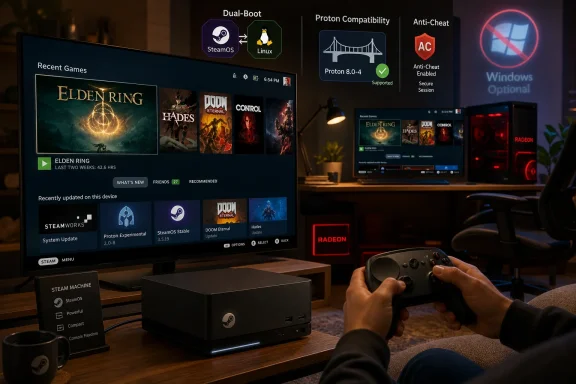
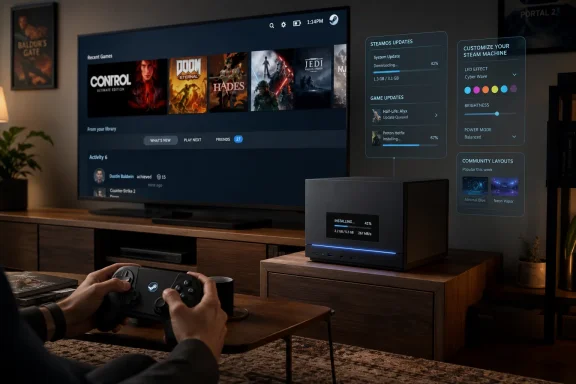
Valve’s $1,049 Steam Machine is scheduled to arrive in late June 2026 as a compact AMD-powered living-room gaming PC, but the more consequential story is Valve’s parallel expansion of SteamOS 3.8 beyond the Steam Deck and into user-built PCs. That shift matters more than the box itself because it turns SteamOS from a device feature into a platform strategy. The Steam Machine may sell to enthusiasts with money and patience; SteamOS is the thing that could finally make Windows feel optional for a meaningful slice of PC gaming.
The headline number is hard to ignore. A starting price of $1,049 puts Valve’s new Steam Machine in the same mental category as a decent gaming desktop, not a console impulse buy. Add storage, a controller, or the normal friction of launch availability, and the device becomes less a mass-market Trojan horse than a premium signal flare.
That price is not happening in a vacuum. PC component pricing has been distorted by the current memory and storage crunch, with RAM suppliers reportedly giving hardware makers little room to negotiate. Valve is not uniquely cursed here; it is building a small PC in a year when small PCs are expensive to build.
But that is exactly why the hardware should not be the center of the story. If Valve’s only pitch were “buy our little Linux console for more than a PlayStation or Xbox,” the company would be walking into a familiar wall. The original Steam Machines of the 2010s already proved that PC-console hybrids need more than clever industrial design and a logo on the boot screen.
The difference in 2026 is that Valve no longer needs every buyer to purchase its box. If SteamOS can run well on systems people already own, or on systems they build themselves with off-the-shelf parts, the Steam Machine becomes a reference design rather than the product strategy. The real move is not Valve selling one more PC. It is Valve trying to make the gaming PC’s operating system negotiable.
That matters because the first generation of Steam Machines failed at precisely this point. In 2013, Valve had a credible complaint about Windows, a grand vision for living-room PC gaming, and a network of hardware partners. What it did not have was a software stack that could make the average Steam library feel native on Linux.
Proton changed that equation. Valve’s compatibility layer, built on Wine and other open-source work, has made a vast number of Windows games playable on Linux without publishers doing bespoke Linux ports. It is not perfect, and anti-cheat remains a recurring pain point, but it has made Linux gaming feel less like a hobbyist bet and more like a practical option.
SteamOS 3.8 is important because it pushes that option beyond Valve’s own handheld. Valve says the new release improves compatibility with recent Intel and AMD platforms and adds beta support for other AMD-powered handhelds and systems with AMD discrete GPUs. That is still not “install it on anything,” but it is a much wider target than “buy a Steam Deck.”
The caveat is crucial. Today’s SteamOS expansion remains AMD-first, and the experience is still more constrained than a normal Windows install. Valve’s public posture is optimistic, but its support matrix tells the more sober story: this is a widening lane, not an open highway.
PC gamers already understand modularity. They swap GPUs, clone drives, repurpose old towers, and turn last-generation hardware into living-room rigs. If SteamOS can become a viable install target for those machines, Valve gets something far more valuable than a single hardware sale: it gets distribution through the instincts of the PC enthusiast market.
This is also where Microsoft should pay attention. Windows has dominated PC gaming partly because it was the default and partly because it was the only realistic choice. If a gamer wanted broad compatibility, driver support, storefront access, mod tools, Discord, capture utilities, and predictable launcher behavior, Windows was where the ecosystem lived.
Valve is not yet replacing that entire stack. But it is attacking the most emotionally important part of it: launching and playing games with less friction. On a Steam Deck, the argument for SteamOS is not ideological. It is experiential. The device wakes, updates, suspends, resumes, and navigates in ways Windows handhelds have struggled to match.
That experience can travel. A living-room PC that boots straight into Steam, handles controller input gracefully, sleeps and wakes reliably, and avoids the little indignities of desktop Windows on a television does not need to defeat Windows in every category. It only needs to be better at the job the user bought it to do.
But defaults are vulnerable when they stop feeling aligned with the user’s priorities. Windows 11 is a general-purpose operating system carrying decades of compatibility, enterprise policy, telemetry debates, AI ambitions, Microsoft account nudges, web-service integrations, and consumer upsell surfaces. For a gaming handheld or living-room PC, much of that feels like baggage.
Microsoft knows this. Its recent push toward a more console-like full-screen Xbox experience on Windows handhelds is an implicit admission that the desktop shell is a poor fit for controller-first devices. Windows can be made to behave better in that context, but it is still being adapted from the outside in.
SteamOS was shaped from the inside out for this use case. Its default mode is the game library, not the desktop. Its settings are framed around play, not office productivity. Its update model is closer to an appliance than a traditional PC. That does not make it universally superior, but it makes it coherent.
For years, Linux advocates argued from principle: openness, control, privacy, community development. Valve’s stronger argument is simpler and more dangerous to Microsoft: this feels better for gaming. If that sentence becomes true on desktops as well as handhelds, Windows loses one of its most defensible consumer moats.
AMD’s Linux graphics stack has been comparatively friendly terrain for Valve. The Steam Deck uses AMD silicon, the new Steam Machine uses AMD silicon, and many handheld PC makers have built around AMD APUs for power and performance reasons. Optimizing SteamOS around AMD lets Valve move faster and control more variables.
Nvidia is the uncomfortable part. A huge portion of desktop PC gamers use Nvidia GPUs, and no serious gaming OS can remain AMD-centric forever if it wants to challenge Windows on the desktop. Valve has said it is working closely with Nvidia and has a growing team focused on support, but even optimistic comments suggest this may not be solved immediately.
That creates a strange split market. The SteamOS-curious gamer building a new living-room box can choose AMD and have a plausible path. The gamer with an existing Nvidia system may have to wait, tinker, or choose a community distribution instead. For a platform trying to become mainstream, that is a major adoption tax.
Intel is another transitional case. SteamOS 3.8’s improved compatibility with recent Intel platforms is promising, especially for handhelds using Intel chips, but better support is not the same thing as polished parity. Valve’s challenge is not merely booting on more devices. It is making the experience boring enough that users stop thinking about the OS at all.
That matters because OS adoption often begins as a trial. Users install something on a spare SSD, dual-boot for a few months, and gradually decide whether the new system can replace the old one. If trying SteamOS feels like erasing Windows and hoping for the best, the audience collapses back to enthusiasts.
This is where community projects such as Bazzite are instructive. Bazzite is not SteamOS, but it understands the assignment: deliver a SteamOS-like gaming environment across a wider range of PC hardware, with a more approachable installation process and support for configurations Valve has not fully embraced. Its existence is both a compliment to Valve and a warning.
The compliment is that Valve has created enough demand for a SteamOS-style experience that others are rushing to fill the gaps. The warning is that users do not wait forever for official blessing. If Valve’s installer remains primitive while community distributions become easier and more flexible, SteamOS could lose mindshare among exactly the power users most likely to evangelize it.
Valve’s advantage, of course, is Steam itself. Most PC gamers do not know what Bazzite is. They do know the Steam client, the Steam Deck, cloud saves, Proton compatibility ratings, and the green “Play” button. If Valve can pair that brand trust with a safe installer, the ceiling changes.
That is the strategic genius of Proton. It converts Steam’s existing Windows catalog into leverage for a Linux platform. Instead of asking the market to start over, Valve lets users bring their libraries with them.
There are still sharp edges. Multiplayer games with kernel-level anti-cheat can be blocked. Launchers can break. New releases may need patches, driver updates, or Proton hotfixes. The experience is excellent often enough to be impressive, but inconsistent often enough to keep Windows relevant.
Yet inconsistency is not fatal if the trend line keeps moving. The Steam Deck trained players to check compatibility notes, accept the occasional unsupported title, and still enjoy a massive playable library. That behavior is a cultural change. Once users accept that Windows compatibility can be mediated by Valve rather than Microsoft, the operating-system hierarchy starts to wobble.
Valve also has incentives aligned with players in a way Microsoft sometimes does not. SteamOS exists to make Steam more valuable. If games fail to run, Valve feels that pain directly. Microsoft wants Windows to be many things at once: an enterprise platform, a developer platform, an AI surface, a security boundary, an ad channel, a cloud on-ramp, and a gaming environment. Valve’s focus is narrower, and in product design, narrower often wins.
Steam Big Picture mode helped, but it never fully erased Windows underneath. The illusion breaks whenever the OS reminds you that it was built around a monitor, mouse, keyboard, taskbar, and administrative model that predates modern console expectations. Living-room gaming does not tolerate that friction well.
SteamOS has an opening because the living-room PC is not really a productivity computer. It is an appliance with PC flexibility. Users want the performance and openness of a PC, but the session model of a console: pick up controller, wake device, choose game, play.
That is where the new Steam Machine still has value, even if its price is hard to love. It gives developers, accessory makers, and users a clear picture of what Valve thinks a living-room SteamOS PC should be. It also gives Valve a first-party target for optimization, which can then spill outward to custom AMD builds.
The box may not sell in console numbers. It does not have to. If it establishes SteamOS as the cleanest way to use a PC from a couch, the hardware has done its job.
Microsoft cannot. Consumer platform erosion rarely begins in the enterprise. It begins when one emotionally important use case peels away. For Apple, creative work and mobile integration became wedges. For ChromeOS, schools and low-maintenance web computing became wedges. For SteamOS, gaming is the wedge.
Gaming has long been one of the strongest reasons for consumers to keep a Windows PC in the house. macOS has its strengths, Linux has its advocates, and consoles have their simplicity, but Windows remained the place where the broadest PC game library lived. If Valve makes Linux good enough for enough Steam users, that logic weakens.
The effect would not be immediate. Windows will remain the default on most gaming laptops, prebuilts, and DIY rigs for the foreseeable future. Nvidia support, anti-cheat compatibility, modding tools, creator workflows, VR support, and non-Steam launchers all keep Microsoft in the game.
But defaults decay slowly and then visibly. If reviewers start recommending SteamOS for AMD living-room builds, if handheld makers ship it instead of Windows, if YouTubers publish “I switched my gaming PC to SteamOS” videos that do not end in disaster, the conversation changes. Microsoft does not need to lose the whole market to feel the pressure. It only needs to lose the aura of inevitability.
Valve still needs a cleaner installer, broader GPU support, better dual-boot safety, clearer recovery tools, stronger publisher cooperation on anti-cheat, and more transparent compatibility communication. It also needs to avoid assuming that Steam users are Linux users. Most are not, and most do not want to become system administrators just to play games.
There is also the storefront problem. Steam is dominant, but PC gaming is not only Steam. Epic Games Store, Xbox app titles, Battle.net, Ubisoft Connect, EA’s app, itch.io, GOG, mod managers, emulators, capture tools, and peripheral utilities all complicate the clean SteamOS story. Some can be made to work. Some require workarounds. Some will remain better on Windows.
That does not doom SteamOS. It defines its first mainstream target. Valve does not need to win every gamer. It needs to win the gamer whose library is mostly on Steam, whose hardware is compatible, whose tolerance for Windows friction is low, and whose use case is primarily gaming rather than general PC productivity.
That audience is not small. It includes Steam Deck owners who now trust Valve’s software, living-room PC builders who want a console-like shell, handheld buyers tired of Windows awkwardness, and enthusiasts who have been waiting for Linux gaming to become practical rather than performative.
Valve’s own hardware also gives cover to partners. Lenovo’s SteamOS-supported Legion Go S showed that the OS could move beyond the Deck. The Steam Machine reinforces that this is not a one-device project. If Valve continues broadening support, other vendors can imagine SteamOS handhelds, mini PCs, and living-room systems without feeling like they are betting against the platform owner.
This is the part Microsoft should find most annoying. Valve is not trying to build a Windows clone. It is defining a narrower category where Windows’ generality becomes a liability. The more successful that category becomes, the more Microsoft has to contort Windows into shapes it was not originally designed to hold.
Valve also benefits from patience. The company does not need SteamOS to dominate in 2026. It can improve Proton, expand hardware support, refine the installer, and let the Steam Deck’s user base normalize the idea of Linux gaming. Unlike a console generation, this is not a single launch window. It is a long campaign.
The $1,049 Steam Machine is therefore both important and oddly secondary. It is expensive, constrained, and likely to be judged harshly against conventional gaming PCs. But as a flag planted in the ground for SteamOS, it makes sense.
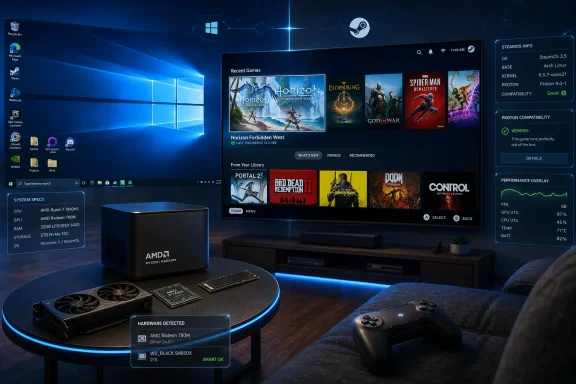 Valve’s Expensive Cube Is a Distraction From Its Platform Play
The headline number is hard to ignore. A starting price of $1,049 puts Valve’s new Steam Machine in the same mental category as a decent gaming desktop, not a console impulse buy. Add storage, a controller, or the normal friction of launch availability, and the device becomes less a mass-market Trojan horse than a premium signal flare.That price is not happening in a vacuum. PC component pricing has been distorted by the current memory and storage crunch, with RAM suppliers reportedly giving hardware makers little room to negotiate. Valve is not uniquely cursed here; it is building a small PC in a year when small PCs are expensive to build.
But that is exactly why the hardware should not be the center of the story. If Valve’s only pitch were “buy our little Linux console for more than a PlayStation or Xbox,” the company would be walking into a familiar wall. The original Steam Machines of the 2010s already proved that PC-console hybrids need more than clever industrial design and a logo on the boot screen.
The difference in 2026 is that Valve no longer needs every buyer to purchase its box. If SteamOS can run well on systems people already own, or on systems they build themselves with off-the-shelf parts, the Steam Machine becomes a reference design rather than the product strategy. The real move is not Valve selling one more PC. It is Valve trying to make the gaming PC’s operating system negotiable.
SteamOS Has Finally Outgrown the Steam Deck
The Steam Deck turned SteamOS from a Linux curiosity into a consumer product that ordinary players could understand. Valve’s trick was not merely getting games to run on Linux; it was hiding the parts of Linux most people did not want to manage. The Deck boots into a controller-first Steam interface, updates like an appliance, and drops into a desktop only when the user asks for it.That matters because the first generation of Steam Machines failed at precisely this point. In 2013, Valve had a credible complaint about Windows, a grand vision for living-room PC gaming, and a network of hardware partners. What it did not have was a software stack that could make the average Steam library feel native on Linux.
Proton changed that equation. Valve’s compatibility layer, built on Wine and other open-source work, has made a vast number of Windows games playable on Linux without publishers doing bespoke Linux ports. It is not perfect, and anti-cheat remains a recurring pain point, but it has made Linux gaming feel less like a hobbyist bet and more like a practical option.
SteamOS 3.8 is important because it pushes that option beyond Valve’s own handheld. Valve says the new release improves compatibility with recent Intel and AMD platforms and adds beta support for other AMD-powered handhelds and systems with AMD discrete GPUs. That is still not “install it on anything,” but it is a much wider target than “buy a Steam Deck.”
The caveat is crucial. Today’s SteamOS expansion remains AMD-first, and the experience is still more constrained than a normal Windows install. Valve’s public posture is optimistic, but its support matrix tells the more sober story: this is a widening lane, not an open highway.
The Best Steam Machine May Be the One Valve Never Ships
The most interesting Steam Machine is not the $1,049 cube. It is the one sitting under someone’s desk with an AMD Radeon GPU, a commodity motherboard, and a copy of SteamOS where Windows used to be. That is where Valve’s strategy starts to look less like a console launch and more like an operating-system insurgency.PC gamers already understand modularity. They swap GPUs, clone drives, repurpose old towers, and turn last-generation hardware into living-room rigs. If SteamOS can become a viable install target for those machines, Valve gets something far more valuable than a single hardware sale: it gets distribution through the instincts of the PC enthusiast market.
This is also where Microsoft should pay attention. Windows has dominated PC gaming partly because it was the default and partly because it was the only realistic choice. If a gamer wanted broad compatibility, driver support, storefront access, mod tools, Discord, capture utilities, and predictable launcher behavior, Windows was where the ecosystem lived.
Valve is not yet replacing that entire stack. But it is attacking the most emotionally important part of it: launching and playing games with less friction. On a Steam Deck, the argument for SteamOS is not ideological. It is experiential. The device wakes, updates, suspends, resumes, and navigates in ways Windows handhelds have struggled to match.
That experience can travel. A living-room PC that boots straight into Steam, handles controller input gracefully, sleeps and wakes reliably, and avoids the little indignities of desktop Windows on a television does not need to defeat Windows in every category. It only needs to be better at the job the user bought it to do.
Windows 11 Is Still the Default, but It No Longer Looks Inevitable
Windows 11 remains the safest operating system for the broadest possible PC gaming library. That is not a sentimental statement; it is an ecosystem fact. Some competitive games still depend on anti-cheat systems that do not behave well under Proton, some peripherals have better Windows utilities, and some publishers still treat Linux compatibility as accidental rather than supported.But defaults are vulnerable when they stop feeling aligned with the user’s priorities. Windows 11 is a general-purpose operating system carrying decades of compatibility, enterprise policy, telemetry debates, AI ambitions, Microsoft account nudges, web-service integrations, and consumer upsell surfaces. For a gaming handheld or living-room PC, much of that feels like baggage.
Microsoft knows this. Its recent push toward a more console-like full-screen Xbox experience on Windows handhelds is an implicit admission that the desktop shell is a poor fit for controller-first devices. Windows can be made to behave better in that context, but it is still being adapted from the outside in.
SteamOS was shaped from the inside out for this use case. Its default mode is the game library, not the desktop. Its settings are framed around play, not office productivity. Its update model is closer to an appliance than a traditional PC. That does not make it universally superior, but it makes it coherent.
For years, Linux advocates argued from principle: openness, control, privacy, community development. Valve’s stronger argument is simpler and more dangerous to Microsoft: this feels better for gaming. If that sentence becomes true on desktops as well as handhelds, Windows loses one of its most defensible consumer moats.
Valve’s AMD-First Path Is Pragmatic, Not Universal
SteamOS’s hardware story is still the weak link. Valve can talk about custom Steam Machines and broader compatibility, but the near-term reality is that AMD graphics remain the practical center of gravity. That makes sense technically, but it limits the scale of the threat.AMD’s Linux graphics stack has been comparatively friendly terrain for Valve. The Steam Deck uses AMD silicon, the new Steam Machine uses AMD silicon, and many handheld PC makers have built around AMD APUs for power and performance reasons. Optimizing SteamOS around AMD lets Valve move faster and control more variables.
Nvidia is the uncomfortable part. A huge portion of desktop PC gamers use Nvidia GPUs, and no serious gaming OS can remain AMD-centric forever if it wants to challenge Windows on the desktop. Valve has said it is working closely with Nvidia and has a growing team focused on support, but even optimistic comments suggest this may not be solved immediately.
That creates a strange split market. The SteamOS-curious gamer building a new living-room box can choose AMD and have a plausible path. The gamer with an existing Nvidia system may have to wait, tinker, or choose a community distribution instead. For a platform trying to become mainstream, that is a major adoption tax.
Intel is another transitional case. SteamOS 3.8’s improved compatibility with recent Intel platforms is promising, especially for handhelds using Intel chips, but better support is not the same thing as polished parity. Valve’s challenge is not merely booting on more devices. It is making the experience boring enough that users stop thinking about the OS at all.
The Installer Is Now the Product Bottleneck
The least glamorous part of SteamOS may be the most important: installation. At the moment, Valve’s official path is still rough compared with what mainstream users expect from Windows or even polished Linux distributions. The installer can overwrite the target machine, and there is not yet a consumer-friendly dual-boot flow that makes experimentation feel safe.That matters because OS adoption often begins as a trial. Users install something on a spare SSD, dual-boot for a few months, and gradually decide whether the new system can replace the old one. If trying SteamOS feels like erasing Windows and hoping for the best, the audience collapses back to enthusiasts.
This is where community projects such as Bazzite are instructive. Bazzite is not SteamOS, but it understands the assignment: deliver a SteamOS-like gaming environment across a wider range of PC hardware, with a more approachable installation process and support for configurations Valve has not fully embraced. Its existence is both a compliment to Valve and a warning.
The compliment is that Valve has created enough demand for a SteamOS-style experience that others are rushing to fill the gaps. The warning is that users do not wait forever for official blessing. If Valve’s installer remains primitive while community distributions become easier and more flexible, SteamOS could lose mindshare among exactly the power users most likely to evangelize it.
Valve’s advantage, of course, is Steam itself. Most PC gamers do not know what Bazzite is. They do know the Steam client, the Steam Deck, cloud saves, Proton compatibility ratings, and the green “Play” button. If Valve can pair that brand trust with a safe installer, the ceiling changes.
Proton Turned Linux Gaming From Theory Into Leverage
The most underappreciated part of Valve’s position is that SteamOS does not need developers to relive the Linux porting debates of 2013. The old Steam Machine strategy depended too heavily on native Linux support arriving because Valve wanted it. The modern strategy depends on compatibility getting good enough that many games work without publishers doing much of anything.That is the strategic genius of Proton. It converts Steam’s existing Windows catalog into leverage for a Linux platform. Instead of asking the market to start over, Valve lets users bring their libraries with them.
There are still sharp edges. Multiplayer games with kernel-level anti-cheat can be blocked. Launchers can break. New releases may need patches, driver updates, or Proton hotfixes. The experience is excellent often enough to be impressive, but inconsistent often enough to keep Windows relevant.
Yet inconsistency is not fatal if the trend line keeps moving. The Steam Deck trained players to check compatibility notes, accept the occasional unsupported title, and still enjoy a massive playable library. That behavior is a cultural change. Once users accept that Windows compatibility can be mediated by Valve rather than Microsoft, the operating-system hierarchy starts to wobble.
Valve also has incentives aligned with players in a way Microsoft sometimes does not. SteamOS exists to make Steam more valuable. If games fail to run, Valve feels that pain directly. Microsoft wants Windows to be many things at once: an enterprise platform, a developer platform, an AI surface, a security boundary, an ad channel, a cloud on-ramp, and a gaming environment. Valve’s focus is narrower, and in product design, narrower often wins.
The Living Room Is Where Windows Looks Most Out of Place
The desktop PC is Windows’ natural habitat. The living room is not. Anyone who has tried to use a Windows gaming PC from a couch knows the routine: Bluetooth hiccups, update prompts, tiny dialog boxes, launcher windows, focus problems, and the sudden need for a keyboard because some background process wants attention.Steam Big Picture mode helped, but it never fully erased Windows underneath. The illusion breaks whenever the OS reminds you that it was built around a monitor, mouse, keyboard, taskbar, and administrative model that predates modern console expectations. Living-room gaming does not tolerate that friction well.
SteamOS has an opening because the living-room PC is not really a productivity computer. It is an appliance with PC flexibility. Users want the performance and openness of a PC, but the session model of a console: pick up controller, wake device, choose game, play.
That is where the new Steam Machine still has value, even if its price is hard to love. It gives developers, accessory makers, and users a clear picture of what Valve thinks a living-room SteamOS PC should be. It also gives Valve a first-party target for optimization, which can then spill outward to custom AMD builds.
The box may not sell in console numbers. It does not have to. If it establishes SteamOS as the cleanest way to use a PC from a couch, the hardware has done its job.
Enterprise IT Will Not Care, but Windows Strategy Should
SteamOS is not about replacing Windows in offices, schools, hospitals, or regulated environments. It is not about Active Directory, Microsoft 365, endpoint management, or legacy Win32 business applications. Enterprise IT can safely ignore Valve’s operating system for now.Microsoft cannot. Consumer platform erosion rarely begins in the enterprise. It begins when one emotionally important use case peels away. For Apple, creative work and mobile integration became wedges. For ChromeOS, schools and low-maintenance web computing became wedges. For SteamOS, gaming is the wedge.
Gaming has long been one of the strongest reasons for consumers to keep a Windows PC in the house. macOS has its strengths, Linux has its advocates, and consoles have their simplicity, but Windows remained the place where the broadest PC game library lived. If Valve makes Linux good enough for enough Steam users, that logic weakens.
The effect would not be immediate. Windows will remain the default on most gaming laptops, prebuilts, and DIY rigs for the foreseeable future. Nvidia support, anti-cheat compatibility, modding tools, creator workflows, VR support, and non-Steam launchers all keep Microsoft in the game.
But defaults decay slowly and then visibly. If reviewers start recommending SteamOS for AMD living-room builds, if handheld makers ship it instead of Windows, if YouTubers publish “I switched my gaming PC to SteamOS” videos that do not end in disaster, the conversation changes. Microsoft does not need to lose the whole market to feel the pressure. It only needs to lose the aura of inevitability.
Valve Still Has to Earn the Right to Be the Default
There is a temptation among Windows-weary enthusiasts to declare victory too early. SteamOS is elegant on the Steam Deck, promising on AMD hardware, and strategically well positioned. That does not make it ready to replace Windows 11 for the average gaming desktop.Valve still needs a cleaner installer, broader GPU support, better dual-boot safety, clearer recovery tools, stronger publisher cooperation on anti-cheat, and more transparent compatibility communication. It also needs to avoid assuming that Steam users are Linux users. Most are not, and most do not want to become system administrators just to play games.
There is also the storefront problem. Steam is dominant, but PC gaming is not only Steam. Epic Games Store, Xbox app titles, Battle.net, Ubisoft Connect, EA’s app, itch.io, GOG, mod managers, emulators, capture tools, and peripheral utilities all complicate the clean SteamOS story. Some can be made to work. Some require workarounds. Some will remain better on Windows.
That does not doom SteamOS. It defines its first mainstream target. Valve does not need to win every gamer. It needs to win the gamer whose library is mostly on Steam, whose hardware is compatible, whose tolerance for Windows friction is low, and whose use case is primarily gaming rather than general PC productivity.
That audience is not small. It includes Steam Deck owners who now trust Valve’s software, living-room PC builders who want a console-like shell, handheld buyers tired of Windows awkwardness, and enthusiasts who have been waiting for Linux gaming to become practical rather than performative.
The Steam Machine’s Real Gift Is Permission
The new Steam Machine gives the market permission to think about SteamOS as a desktop-class gaming environment. That may sound abstract, but platform shifts often begin with permission. A first-party device tells users, developers, and OEMs that the experiment is no longer fringe.Valve’s own hardware also gives cover to partners. Lenovo’s SteamOS-supported Legion Go S showed that the OS could move beyond the Deck. The Steam Machine reinforces that this is not a one-device project. If Valve continues broadening support, other vendors can imagine SteamOS handhelds, mini PCs, and living-room systems without feeling like they are betting against the platform owner.
This is the part Microsoft should find most annoying. Valve is not trying to build a Windows clone. It is defining a narrower category where Windows’ generality becomes a liability. The more successful that category becomes, the more Microsoft has to contort Windows into shapes it was not originally designed to hold.
Valve also benefits from patience. The company does not need SteamOS to dominate in 2026. It can improve Proton, expand hardware support, refine the installer, and let the Steam Deck’s user base normalize the idea of Linux gaming. Unlike a console generation, this is not a single launch window. It is a long campaign.
The $1,049 Steam Machine is therefore both important and oddly secondary. It is expensive, constrained, and likely to be judged harshly against conventional gaming PCs. But as a flag planted in the ground for SteamOS, it makes sense.
The SteamOS Bet Comes Down to Five Practical Tests
SteamOS is no longer just the operating system inside Valve’s handheld; it is becoming the company’s best argument that PC gaming does not have to mean Windows gaming. The next phase will be decided less by ideology than by whether Valve can make the boring parts work for ordinary people.- SteamOS 3.8 meaningfully expands the platform beyond the Steam Deck, but AMD graphics remain the safest path for users building their own SteamOS machines today.
- The new Steam Machine’s $1,049 starting price makes it a difficult mainstream hardware pitch, especially during a memory and storage pricing crunch.
- Valve’s biggest near-term obstacle is not game compatibility alone, but installation safety, dual-boot convenience, and predictable recovery for users who are not Linux hobbyists.
- Nvidia support is essential if SteamOS is going to threaten Windows on mainstream gaming desktops rather than only selected handhelds and AMD builds.
- Microsoft’s risk is not that Windows disappears from gaming, but that SteamOS becomes the preferred interface for the fastest-growing categories of PC-like gaming devices.
- Community distributions such as Bazzite prove demand exists for a SteamOS-style experience, but Valve’s brand and Steam integration give the official OS a much larger potential audience.
References
- Primary source: PCMag Australia
Published: Fri, 26 Jun 2026 15:41:48 GMT
Forget the Steam Machine: SteamOS Is What PC Gamers Should Be Excited About
Valve's $1,049 Steam Machine isn't the real story. SteamOS is slowly expanding beyond the Steam Deck, bringing Valve one step closer to challenging Windows 11 on any gaming PC.au.pcmag.com - Related coverage: tomshardware.com
Valve opens Steam Machine reservations — details $1,049 starting price, randomized queue to stop scalpers, and limited inventory | Tom's Hardware
The company also gave its reasoning for not subsidizing the machine.www.tomshardware.com - Related coverage: techradar.com
'Going to make myself stick with SteamOS instead of slithering back to Windows': gamers get ready to abandon Windows 11, as Valve focuses on boosting SteamOS on the desktop | TechRadar
Is the latest version of SteamOS a turning point for Windows 11 defectors?www.techradar.com - Related coverage: pcgamer.com
Valve wasn't sure it was gonna have any Steam Machines to sell at the start of 2026: 'Things looked really dire' | PC Gamer
Another thing to thank the RAM crisis for.www.pcgamer.com - Related coverage: windowscentral.com
"The prices we're sharing today reflect the state of the world": Valve explains why the Steam Machine is so expensive, and yup, it's all AI's fault | Windows Central
Valve's Steam Machine is prohibitively expensive, and the RAM and storage crisis is to blame.www.windowscentral.com - Related coverage: techspot.com
Valve's Steam Machine is here: starts at $1,049 for 512GB or $1,349 for the 2TB version | TechSpot
Under the hood, the Steam Machine packs a semi-custom AMD platform: a 6-core, 12-thread Zen 4 CPU clocked up to 4.86GHz, an RDNA 3 GPU with 28...www.techspot.com
- Related coverage: phoronix.com
Steam Machine Launches, Priced $1049 To $1428 USD - Phoronix
Valve today finally revealed pricing on their SteamOS Linux-powered Steam Machine living room PCwww.phoronix.com
- Related coverage: gematsu.com
Steam Machine launches June 30, starting at $1,049 - Gematsu
Steam Machine will launch on June 30, Valve announced. The 512 gigabyte model without a controller will be priced at $1,049, while the two terabyte model with a…www.gematsu.com - Related coverage: arstechnica.com
Valve's Steam Machine ships June 29 for $1,049, but you probably won't be able to buy one yet - Ars Technica
Valve says it's using a randomized purchase queue to make the experience "less frustrating and more fair."arstechnica.com - Related coverage: techtimes.com
SteamOS NVIDIA Support Confirmed: Valve Has a Growing Team but AMD Builds Work Now
SteamOS NVIDIA support is officially confirmed: Valve says a dedicated and growing engineering team is collaborating directly with NVIDIA to integrate proprietary GPU drivers into SteamOS, though awww.techtimes.com - Related coverage: dexerto.com
Steam Machine finally launches as Valve reveals $1,049 starting price - Dexerto
Valve has officially revealed pricing and availability details for the Steam Machine, its new living room-focused gaming PC, with pre-orders opening ahead of a June 29 launch.www.dexerto.com - Related coverage: siliconera.com
Valve’’s Steam Machine PC Pre-order Starts at $1,049 - Siliconera
Valve opened a registration list to pre-order and buy a Steam Machine PC model, with two variants available at launch.www.siliconera.com - Related coverage: shacknews.com
Steam Machine price revealed, starting at $1049 | Shacknews
Steam Machine pricing has been revealed for a base 512GB version and a 2TB version that comes with a Steam Controller.www.shacknews.com - Related coverage: allthings.how
Steam Machine Price Starts at $1,049, With Reservations Opening June 25
Valve's living-room PC lands at four figures, climbing to $1,428 for the 2TB model bundled with a Steam Controller.allthings.how