

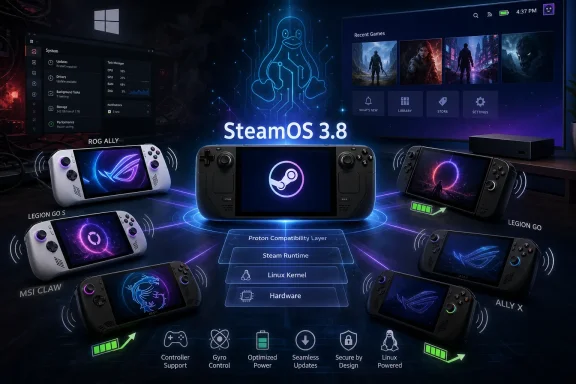
Valve released SteamOS 3.8 to the stable channel on June 18, 2026, expanding the Linux gaming OS beyond the Steam Deck with broader support for rival handheld PCs including the ROG Ally family, Lenovo Legion Go devices, and MSI Claw models. The update is less a routine Deck patch than a declaration that Valve now sees SteamOS as a portable gaming platform in its own right. Windows still owns compatibility, especially where anti-cheat and Game Pass are concerned, but Valve has found the place where Microsoft looks weakest: the small screen, the controller, and the battery meter.
The original Steam Machines were a bet placed too early. Valve had an operating system, a controller, and a theory that PC gaming could move into the living room, but it lacked the thing that mattered most: a reliable way to run the Windows games people already owned. Linux-native support was too thin, hardware partners were scattered, and the console pitch collapsed under the weight of its own compromises.
SteamOS 3.8 lands in a very different world. Proton is no longer a science project, the Steam Deck has trained developers and players to care about Linux compatibility, and handheld PCs have become a real category rather than a curiosity. That makes this release feel less like a version bump and more like the moment Valve’s decade-old platform strategy finally becomes credible.
The headline is third-party hardware. SteamOS is no longer merely the software skin over Valve’s own handheld; it is being adapted for devices Valve did not design, did not sell, and does not fully control. That is a much more ambitious move than shipping another Deck update.
It also changes the competitive frame. The fight is not Steam Deck versus ROG Ally, or Legion Go versus MSI Claw. The fight is increasingly SteamOS versus Windows on the same class of hardware.
One of the most important changes is input latency. Valve’s own notes describe a major reduction in handheld controller latency on supported third-party devices, moving from millisecond-scale lag into the hundreds-of-microseconds range. That kind of number will not matter equally in every game, but it matters symbolically because it shows Valve is working below the surface level of compatibility.
A Windows handheld running SteamOS has always been an appealing idea: better suspend-and-resume behavior, a controller-first interface, less desktop clutter, and a store-library-runtime stack that all points in one direction. The problem was the rough edge. Buttons did not always map cleanly, SD cards could misbehave, power controls were uneven, and firmware support depended on luck or community patchwork.
SteamOS 3.8 and the quick 3.8.11 follow-up suggest Valve understands that handheld support is won in the dull details. SD-card reliability, speaker support, TDP control, motion controls, RGB settings, boot behavior, and firmware update paths are not glamorous. They are the difference between an operating system an enthusiast tolerates and one an ordinary buyer can trust.
That distinction is not pedantry. A handheld OS has to manage more than CPU and GPU drivers. It has to know what the buttons are, how the gyro reports movement, how the fan curves behave, how the screen wakes, what happens when the machine sleeps, whether the SD reader is reliable, and how the device exposes power controls. On a desktop PC, imperfect support is an annoyance; on a handheld, it can break the entire console illusion.
The Legion Go S matters because it proves OEMs can ship SteamOS without asking buyers to become installers. It also gives Valve a non-Deck target to optimize against in public. Once one major third-party handheld carries SteamOS officially, every other Windows handheld maker has to ask whether it wants to leave that advantage to Lenovo.
The ROG Ally, ROG Ally X, ROG Xbox Ally family, original Legion Go, Legion Go 2, MSI Claw, GPD devices, OneXPlayer models, and smaller AMD-based handhelds now sit in the pressure zone. Some may run SteamOS well today; others may still require caveats. But Valve has made the direction clear: the SteamOS hardware map is expanding.
The problem is that handheld gaming exposes Windows at its least elegant. A desktop operating system designed for keyboards, mice, multi-window productivity, background services, and decades of legacy software does not naturally become a console just because it is squeezed behind a seven- or eight-inch touchscreen. Windows can run the game, but the path to the game often feels like work.
That is the opening Valve has exploited. SteamOS is not better because Linux is inherently magical; it is better because it is narrower. It boots into a gaming shell, treats the controller as the primary input device, and makes suspend-and-resume feel like part of the product rather than a gamble against the Windows power stack.
Microsoft knows this, which is why its Xbox-style full-screen experience for Windows handhelds matters. The company is trying to give Windows a console face without giving up the Windows substrate. That may improve first impressions, especially on devices sold with Xbox branding, but it does not automatically remove the background complexity that makes Windows feel heavy on handheld hardware.
Still, the direction of travel is hard to ignore. SteamOS often feels more efficient on handhelds because it is built around the gaming session rather than the full general-purpose PC session. Even modest improvements matter when the baseline is a device that may last only 90 minutes in a demanding game.
That is why Valve’s advantage is not purely technical. It is experiential. If one OS gives a player a cleaner path from sleep to game, fewer pop-ups, simpler performance controls, better controller behavior, and a little more battery, the player does not need a white paper. They feel it on a train, a couch, or a flight.
Windows handheld vendors have tried to cover the gap with overlays: Armoury Crate, Legion Space, MSI Center M, Xbox full-screen mode, and other shells that sit on top of Windows. Some are improving. But overlays are not the same as an OS whose assumptions begin with handheld gaming.
This is where Windows keeps its strongest hold. If your daily rotation includes games that refuse Proton or require anti-cheat configurations unsupported on Linux, SteamOS is not a replacement. It is a second environment, a dual-boot candidate, or a thing you admire from a distance.
That matters because live-service games are not a niche. They are some of the most-played, most-monetized, and most socially sticky games in the market. A player who mainly lives in single-player RPGs, indie games, emulation, and Steam Deck Verified titles may find SteamOS liberating. A player whose friends expect them in a Windows-only shooter every night may find it irrelevant.
Valve cannot solve this alone. It can improve Proton, court developers, document compatibility, and make the installed base too large to ignore. But anti-cheat support ultimately requires publisher and vendor cooperation, and those companies will move only when the audience is big enough or the pressure is loud enough.
A modern Steam Machine would not need to convince buyers that Linux gaming might become viable someday. It would arrive after years of Proton development, Deck Verified labeling, handheld optimization, and developer testing. That does not guarantee success, but it dramatically changes the starting position.
The bigger idea is a SteamOS family. Steam Deck is the reference handheld. Lenovo and other OEMs can fill out the third-party handheld tier. Steam Machine can take the same interface and compatibility layer to the TV. If Valve can keep those tiers aligned, it gets something console makers and Microsoft both understand: a platform that follows the user across devices.
That is why SteamOS on the ROG Ally or Legion Go is not merely a gift to tinkerers. Every successful install makes Steam more central and Windows less necessary. Valve does not need to sell every handheld if it can make every handheld more valuable when it boots into Steam.
SteamOS offers an alternative story. A vendor can sell a cheaper model without a Windows license, market a more console-like experience, and benefit from Valve’s software work. That does not mean every OEM will jump immediately; support obligations, storefront politics, driver maturity, and Microsoft relationships all complicate the decision.
But Lenovo’s SteamOS move gives the rest of the industry cover. If a major PC OEM can ship a Valve-powered handheld, Asus and MSI can at least evaluate the same path. Smaller handheld makers, which already live closer to enthusiast culture, may be even more willing to offer SteamOS-oriented configurations if the software continues to mature.
The uncomfortable question for Microsoft is whether Windows remains the default because it is best for handhelds or because there has not been a credible alternative. SteamOS 3.8 makes that question harder to avoid.
The recovery-image route is important because it seeds the market. Enthusiasts test devices, surface bugs, publish guides, compare power profiles, and tell OEMs where demand exists. But the real platform shift happens when buyers can choose SteamOS at checkout and receive firmware, support, and warranty assumptions built around that choice.
This is where Valve must be disciplined. If SteamOS becomes “that thing you can technically install but should not expect to work,” the momentum fades. If point releases keep closing device-specific gaps, the enhanced-support tier becomes a runway toward official configurations.
The 3.8.11 update is encouraging for exactly that reason. A point release aimed at SD-card behavior, charging limits, controller support, TDP controls, audio, and boot-menu behavior is not marketing theater. It is platform maintenance.
That is dangerous because SteamOS does not need inflated claims to matter. The verified facts are strong enough. Valve shipped a major stable update in June 2026. It expanded third-party handheld support. It followed quickly with device-specific fixes. It continues to prepare SteamOS for hardware beyond the Deck. Microsoft is responding with a more console-like Windows handheld experience.
The honest version is more interesting than the hype. SteamOS is not replacing Windows for every gamer. It is becoming good enough for a growing segment of handheld gamers to prefer it, and that is a much bigger problem for Microsoft than a theoretical Linux desktop revolution.
Windows can survive losing enthusiasts. It cannot ignore a hardware category where its own partners may decide the best user experience comes from someone else’s operating system.
 Valve Finally Builds the SteamOS It Promised in 2015
The original Steam Machines were a bet placed too early. Valve had an operating system, a controller, and a theory that PC gaming could move into the living room, but it lacked the thing that mattered most: a reliable way to run the Windows games people already owned. Linux-native support was too thin, hardware partners were scattered, and the console pitch collapsed under the weight of its own compromises.SteamOS 3.8 lands in a very different world. Proton is no longer a science project, the Steam Deck has trained developers and players to care about Linux compatibility, and handheld PCs have become a real category rather than a curiosity. That makes this release feel less like a version bump and more like the moment Valve’s decade-old platform strategy finally becomes credible.
The headline is third-party hardware. SteamOS is no longer merely the software skin over Valve’s own handheld; it is being adapted for devices Valve did not design, did not sell, and does not fully control. That is a much more ambitious move than shipping another Deck update.
It also changes the competitive frame. The fight is not Steam Deck versus ROG Ally, or Legion Go versus MSI Claw. The fight is increasingly SteamOS versus Windows on the same class of hardware.
SteamOS 3.8 Turns “It Boots” Into “It Belongs Here”
There is a large difference between an enthusiast forcing Linux onto a handheld and a platform vendor tuning an OS for that handheld’s controls, display, storage, power behavior, and firmware. SteamOS 3.8 moves Valve closer to the latter. The update includes a refreshed Linux base, newer graphics components, Desktop Mode improvements, controller work, and device-specific fixes aimed squarely at non-Valve machines.One of the most important changes is input latency. Valve’s own notes describe a major reduction in handheld controller latency on supported third-party devices, moving from millisecond-scale lag into the hundreds-of-microseconds range. That kind of number will not matter equally in every game, but it matters symbolically because it shows Valve is working below the surface level of compatibility.
A Windows handheld running SteamOS has always been an appealing idea: better suspend-and-resume behavior, a controller-first interface, less desktop clutter, and a store-library-runtime stack that all points in one direction. The problem was the rough edge. Buttons did not always map cleanly, SD cards could misbehave, power controls were uneven, and firmware support depended on luck or community patchwork.
SteamOS 3.8 and the quick 3.8.11 follow-up suggest Valve understands that handheld support is won in the dull details. SD-card reliability, speaker support, TDP control, motion controls, RGB settings, boot behavior, and firmware update paths are not glamorous. They are the difference between an operating system an enthusiast tolerates and one an ordinary buyer can trust.
The Legion Go S Is the Beachhead, Not the Finish Line
Valve’s official hierarchy still matters. The Steam Deck remains the reference device. The Lenovo Legion Go S is the important outsider because it ships in a SteamOS configuration with Valve’s blessing. Other devices may receive enhanced support, but “enhanced” is not the same thing as “guaranteed.”That distinction is not pedantry. A handheld OS has to manage more than CPU and GPU drivers. It has to know what the buttons are, how the gyro reports movement, how the fan curves behave, how the screen wakes, what happens when the machine sleeps, whether the SD reader is reliable, and how the device exposes power controls. On a desktop PC, imperfect support is an annoyance; on a handheld, it can break the entire console illusion.
The Legion Go S matters because it proves OEMs can ship SteamOS without asking buyers to become installers. It also gives Valve a non-Deck target to optimize against in public. Once one major third-party handheld carries SteamOS officially, every other Windows handheld maker has to ask whether it wants to leave that advantage to Lenovo.
The ROG Ally, ROG Ally X, ROG Xbox Ally family, original Legion Go, Legion Go 2, MSI Claw, GPD devices, OneXPlayer models, and smaller AMD-based handhelds now sit in the pressure zone. Some may run SteamOS well today; others may still require caveats. But Valve has made the direction clear: the SteamOS hardware map is expanding.
Microsoft’s Problem Is Not That Windows Cannot Game
Windows remains the most compatible PC gaming platform by a vast margin. It runs the launchers, the drivers, the anti-cheat systems, the weird old games, the mod tools, the peripherals, and the edge cases. No serious analysis should pretend SteamOS has erased that advantage.The problem is that handheld gaming exposes Windows at its least elegant. A desktop operating system designed for keyboards, mice, multi-window productivity, background services, and decades of legacy software does not naturally become a console just because it is squeezed behind a seven- or eight-inch touchscreen. Windows can run the game, but the path to the game often feels like work.
That is the opening Valve has exploited. SteamOS is not better because Linux is inherently magical; it is better because it is narrower. It boots into a gaming shell, treats the controller as the primary input device, and makes suspend-and-resume feel like part of the product rather than a gamble against the Windows power stack.
Microsoft knows this, which is why its Xbox-style full-screen experience for Windows handhelds matters. The company is trying to give Windows a console face without giving up the Windows substrate. That may improve first impressions, especially on devices sold with Xbox branding, but it does not automatically remove the background complexity that makes Windows feel heavy on handheld hardware.
Battery Life Is the Argument Users Actually Feel
The most aggressive battery-life claims around SteamOS should be treated carefully. Some community comparisons show dramatic improvements in specific games and settings, but sweeping claims of 20, 30, or 40 percent gains across the board are not a law of nature. Differences depend on the game, APU, wattage limit, frame cap, driver state, screen brightness, background workload, and whether the comparison is fair.Still, the direction of travel is hard to ignore. SteamOS often feels more efficient on handhelds because it is built around the gaming session rather than the full general-purpose PC session. Even modest improvements matter when the baseline is a device that may last only 90 minutes in a demanding game.
That is why Valve’s advantage is not purely technical. It is experiential. If one OS gives a player a cleaner path from sleep to game, fewer pop-ups, simpler performance controls, better controller behavior, and a little more battery, the player does not need a white paper. They feel it on a train, a couch, or a flight.
Windows handheld vendors have tried to cover the gap with overlays: Armoury Crate, Legion Space, MSI Center M, Xbox full-screen mode, and other shells that sit on top of Windows. Some are improving. But overlays are not the same as an OS whose assumptions begin with handheld gaming.
Anti-Cheat Is Still Windows’ Moat
SteamOS’s biggest weakness is not the average single-player Steam library. Proton has become good enough that many players can forget they are running Windows games on Linux at all. The weakness is competitive multiplayer, where kernel-level anti-cheat and publisher policy can stop a game long before performance becomes relevant.This is where Windows keeps its strongest hold. If your daily rotation includes games that refuse Proton or require anti-cheat configurations unsupported on Linux, SteamOS is not a replacement. It is a second environment, a dual-boot candidate, or a thing you admire from a distance.
That matters because live-service games are not a niche. They are some of the most-played, most-monetized, and most socially sticky games in the market. A player who mainly lives in single-player RPGs, indie games, emulation, and Steam Deck Verified titles may find SteamOS liberating. A player whose friends expect them in a Windows-only shooter every night may find it irrelevant.
Valve cannot solve this alone. It can improve Proton, court developers, document compatibility, and make the installed base too large to ignore. But anti-cheat support ultimately requires publisher and vendor cooperation, and those companies will move only when the audience is big enough or the pressure is loud enough.
The Steam Machine Line Is the Quiet Strategic Tell
SteamOS 3.8 also adds initial support for upcoming Steam Machine hardware, and that is not a throwaway changelog line. Valve is rebuilding the bridge between handheld and living-room PC that collapsed in the first Steam Machine era. This time, the bridge rests on the Steam Deck’s proven software stack rather than hope.A modern Steam Machine would not need to convince buyers that Linux gaming might become viable someday. It would arrive after years of Proton development, Deck Verified labeling, handheld optimization, and developer testing. That does not guarantee success, but it dramatically changes the starting position.
The bigger idea is a SteamOS family. Steam Deck is the reference handheld. Lenovo and other OEMs can fill out the third-party handheld tier. Steam Machine can take the same interface and compatibility layer to the TV. If Valve can keep those tiers aligned, it gets something console makers and Microsoft both understand: a platform that follows the user across devices.
That is why SteamOS on the ROG Ally or Legion Go is not merely a gift to tinkerers. Every successful install makes Steam more central and Windows less necessary. Valve does not need to sell every handheld if it can make every handheld more valuable when it boots into Steam.
OEMs Now Have a Way Around the Windows Default
For handheld makers, SteamOS creates both opportunity and discomfort. Windows is familiar, compatible, and commercially safe. It also adds licensing cost, interface baggage, and a dependency on Microsoft’s willingness to prioritize a relatively small hardware category.SteamOS offers an alternative story. A vendor can sell a cheaper model without a Windows license, market a more console-like experience, and benefit from Valve’s software work. That does not mean every OEM will jump immediately; support obligations, storefront politics, driver maturity, and Microsoft relationships all complicate the decision.
But Lenovo’s SteamOS move gives the rest of the industry cover. If a major PC OEM can ship a Valve-powered handheld, Asus and MSI can at least evaluate the same path. Smaller handheld makers, which already live closer to enthusiast culture, may be even more willing to offer SteamOS-oriented configurations if the software continues to mature.
The uncomfortable question for Microsoft is whether Windows remains the default because it is best for handhelds or because there has not been a credible alternative. SteamOS 3.8 makes that question harder to avoid.
The Installer Era Is a Bridge, Not the Destination
Today, many third-party SteamOS installs still rely on recovery images, USB drives, boot menus, and a willingness to erase or repartition storage. That is fine for WindowsForum readers. It is not fine for the mainstream buyer.The recovery-image route is important because it seeds the market. Enthusiasts test devices, surface bugs, publish guides, compare power profiles, and tell OEMs where demand exists. But the real platform shift happens when buyers can choose SteamOS at checkout and receive firmware, support, and warranty assumptions built around that choice.
This is where Valve must be disciplined. If SteamOS becomes “that thing you can technically install but should not expect to work,” the momentum fades. If point releases keep closing device-specific gaps, the enhanced-support tier becomes a runway toward official configurations.
The 3.8.11 update is encouraging for exactly that reason. A point release aimed at SD-card behavior, charging limits, controller support, TDP controls, audio, and boot-menu behavior is not marketing theater. It is platform maintenance.
The Numbers Matter Less Than the Direction
Some of the discourse around SteamOS has outrun the evidence. Compatibility percentages get repeated without clear methodology. Battery improvements from one title become generalized across a category. “Official support” and “enhanced support” are blurred until users believe every handheld is equally blessed.That is dangerous because SteamOS does not need inflated claims to matter. The verified facts are strong enough. Valve shipped a major stable update in June 2026. It expanded third-party handheld support. It followed quickly with device-specific fixes. It continues to prepare SteamOS for hardware beyond the Deck. Microsoft is responding with a more console-like Windows handheld experience.
The honest version is more interesting than the hype. SteamOS is not replacing Windows for every gamer. It is becoming good enough for a growing segment of handheld gamers to prefer it, and that is a much bigger problem for Microsoft than a theoretical Linux desktop revolution.
Windows can survive losing enthusiasts. It cannot ignore a hardware category where its own partners may decide the best user experience comes from someone else’s operating system.
The June 2026 SteamOS Map Has Winners, Caveats, and Warning Signs
SteamOS 3.8 is best understood as a platform expansion with uneven edges, not a magic compatibility wand. The practical picture is clear enough for buyers and admins watching the category.- Steam Deck owners get the safest version of the SteamOS experience because Valve’s own hardware remains the reference target.
- Lenovo’s Legion Go S is the most important third-party device because it proves SteamOS can ship as a first-class retail option rather than an after-market experiment.
- ROG Ally, Legion Go, MSI Claw, and smaller handhelds are moving from community curiosity toward practical support, but device-specific quirks still matter.
- Windows 11 remains the safer choice for Game Pass, non-Steam launchers, unusual peripherals, and multiplayer games blocked by anti-cheat on Linux.
- Microsoft’s Xbox-style full-screen mode improves the handheld Windows story, but it does not automatically erase the architectural weight that makes Windows feel awkward on small gaming devices.
- The next phase will be decided less by benchmark charts than by OEM preload deals, anti-cheat cooperation, and whether Valve keeps fixing the boring device-level problems.
References
- Primary source: tech-insider.org
Published: Wed, 24 Jun 2026 08:11:32 GMT
SteamOS 3.8 Lands on ROG Ally, Legion Go & Claw [2026]
SteamOS 3.8 (June 2026) brings Valve's OS to the ROG Ally, Legion Go and MSI Claw with longer battery life than Windows 11. What the move means.tech-insider.org - Related coverage: techradar.com
Valve releases SteamOS 3.8 — and it comes with the biggest hint yet that the Steam Machine is about to arrive | TechRadar
Initial support for Valve's inbound PC is now officially in SteamOSwww.techradar.com - Related coverage: pcgamer.com
Valve's latest SteamOS is out with 'initial support for upcoming Steam Machine hardware' | PC Gamer
And the OLED charging LED works like it should now.www.pcgamer.com - Related coverage: tomshardware.com
MSI's new Claw 8 EX AI+ handheld with an Intel Arc G3 Extreme and 32GB of RAM costs $1,799 — company says it'll be 'a tough year' with chances of 'another price hike' | Tom's Hardware
It's listed for $100 cheaper at other retailers.www.tomshardware.com - Related coverage: ultimaficha.com.br
SteamOS 3.8: Suporte oficial para ROG Ally e Legion Go lançado
SteamOS 3.8 traz suporte oficial para ASUS ROG Ally e Lenovo Legion Go. A atualização da Valve também traz suporte inicial para as novas Steam Machines.ultimaficha.com.br - Related coverage: techspot.com
SteamOS adds support for Lenovo Legion Go, Asus ROG Ally, and other AMD handheld PCs | TechSpot
Now available for installation, SteamOS 3.7.8 introduces official support for the Lenovo Legion Go S and improves compatibility with other handheld gaming PCs, including the Asus ROG...www.techspot.com
- Related coverage: decky.net
How to Install SteamOS on ROG Ally & Legion Go – decky.net
Valve provides an official SteamOS recovery image - here's how to install SteamOS on ROG Ally & Legion Go. Step-by-step, with prerequisites & FAQ. decky.net
- Related coverage: pcgameshardware.de
- Related coverage: windowscentral.com
Step-by-step instructions for downloading SteamOS on ROG Ally | Windows Central
After the long wait, SteamOS is now officially available for install on Windows gaming handhelds like ASUS ROG Ally and Lenovo Legion Go. Here's how to install it.www.windowscentral.com - Related coverage: techtimes.com
SteamOS Reaches Intel Arc: MSI Claw 8 AI+ Runs Valve OS, B580 Desktop Support Starts
SteamOS Intel Arc support arrived this week as Valve’s 3.8.7 beta officially covers MSI Claw 8 AI+ and community testing confirms the Arc B580 desktop GPU runs SteamOS. Mesa Xe driver immaturitywww.techtimes.com - Related coverage: ad-hoc-news.de
SteamOS 3.8: Valve bereitet neue Steam Machines vor
Valve veröffentlicht SteamOS 3.8 mit Linux-Kernel 6.16, erweitertem Handheld-Support und Vorbereitungen für neue Steam Machines.www.ad-hoc-news.de - Related coverage: technerdo.com
Best Gaming Handhelds 2026: Steam Deck, ROG Ally, Legion Go, and MSI Claw Compared | Technerdo
Comprehensive comparison of the best gaming handhelds in 2026. We benchmark the Steam Deck OLED, ROG Ally X, Lenovo Legion Go S, and MSI Claw 8 AI+ across performance, battery life, display, and value.www.technerdo.com - Related coverage: hwupgrade.it
SteamOS 3.8 esce dalla beta: supporto preliminare alle future Steam Machine e tanto altro | Hardware Upgrade
Valve ha pubblicato la versione stabile di SteamOS 3.8.10, introducendo il supporto preliminare alle future Steam Machine, il passaggio a Wayland come ambiente desktop predefinito e numerosi miglioramenti per Steam Deck e console portatili di terze parti. Aggiornati kernel Linux, driver grafici...www.hwupgrade.it - Related coverage: tomsguide.com
I just tested the MSI Claw 8 EX AI+ — it leaves ROG Xbox Ally in the dust with breakthrough Intel Arc G3 power | Tom's Guide
I just got an early hands-on with the MSI Claw 8 EX AI+. In short, believe the hype — Intel Arc G3 is the next generation of gaming on-the-go unlike anything you’ve seen before.www.tomsguide.com - Related coverage: techgenyz.com
SteamOS 3.8 Is Live With Big Steam Deck and Handheld Gaming Upgrades
SteamOS 3.8 is live with Linux kernel 6.16, KDE Plasma 6.4.3, Wayland by default, lower handheld input latency, and Steam Machine supporttechgenyz.com - Related coverage: pcgamesn.com
Seeing SteamOS run on a ROG Ally has me worried about the Steam Deck - PCGamesN
SteamOS has been tested on a Asus ROG Ally, and the results on the handheld gaming PC are remarkable, if a little shaky on performance.www.pcgamesn.com - Related coverage: howtogeek.com
How to Fix Slow SD Card Downloads on SteamOS
It doesn't have to be literally steam-powered. www.howtogeek.com
- Related coverage: kad8.com
SteamOS 3.8: Linux Gaming OS for Steam Machines · KAD
SteamOS 3.8 modernizes Valve’s Linux gaming stack with kernel 6.16, Wayland, ultra-low input latency, and support for next-gen Steam Machines.www.kad8.com - Related coverage: gamesradar.com
SteamOS now plays nice with Intel handhelds, and that could help a shunned portable become a solid Steam Deck alternative | GamesRadar+
Now that SteamOS is working and improving on Intel handheld gaming PCs, it could help the OG MSI Claw shine as a makeshift Steam Deck.www.gamesradar.com - Related coverage: tomshardware.fr
ROG Ally : Asus admet la surchauffe des cartes SD et prévoit un correctif
Dans une chronologie surprenante, l'entreprise a publié un premier correctif, puis un message annonçant que le problème était identifié et qu'il serait prochainement patché. Le remède consiste en des courbes de ventilation plus élevées afin d'améliorer le refroidissement des...www.tomshardware.fr - Related coverage: rog-forum.asus.com
Is the SD card issue being looked at? - Republic of Gamers Forum - 963407
So, I have read all over, on reddit, here, people having issues with the SD card reader, and it seems like since summer ASUS has gone dark - 963407rog-forum.asus.com - Related coverage: donweb.news
SteamOS 3.8: soporte Steam Machine y hardware ampliado
¿Pregunta qué? No, esperá — SteamOS 3.8: Valve suma soporte para más placas y equipos. Conocé la actualización SteamOS 3.8 y qué hardware nuevo es compatibledonweb.news
