

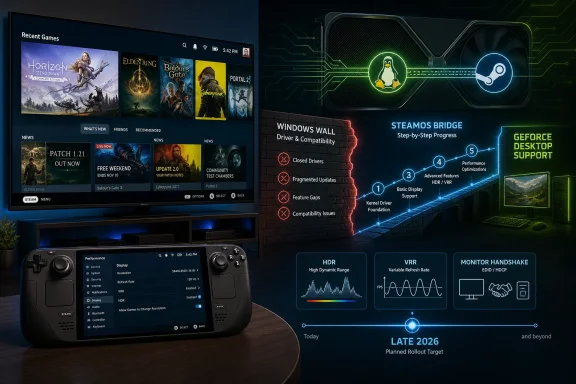
Valve is working directly with Nvidia on SteamOS graphics-driver support for Nvidia GPUs, according to comments from Valve engineer Pierre-Loup Griffais reported by PCWorld and The Verge on June 22, 2026, but an initial public driver stack may not arrive before late 2026. That single fact explains both the promise and the limit of Valve’s Windows alternative. SteamOS is no longer just the operating system inside the Steam Deck; it is becoming Valve’s answer to the living-room PC, the handheld boom, and the long-running complaint that Windows has become too heavy for gaming. But until SteamOS can run well on the graphics cards many desktop gamers actually own, Valve’s revolution still stops at the edge of Nvidia’s driver model.
SteamOS has always been a little more strategic than Valve likes to admit. The Steam Deck made it look like a product decision: build a handheld, ship a console-like interface, hide the Linux underpinnings, and let Proton do the difficult work of making Windows games behave. But the deeper play was obvious from the beginning. If Steam can sit on top of Linux and still run the bulk of a PC gaming library, then Windows becomes less of a platform requirement and more of a historical habit.
That is why Nvidia support matters far more than a routine driver compatibility note. SteamOS can thrive on AMD-based handhelds because Valve controls the target closely enough to make the experience feel appliance-like. It can stretch to Intel handhelds because the Linux graphics stack for Intel hardware is at least philosophically aligned with the open-driver world Valve has built around. Nvidia is different. Nvidia is the GPU company that dominates gaming desktops, ships proprietary Linux user-space components, and has spent years being the awkward guest at the Linux graphics table.
Valve can build a beautiful Steam Machine around AMD hardware and still leave the broader desktop market mostly untouched. The enthusiast PC world is full of GeForce cards, from older GTX 10-series systems still grinding away under desks to RTX 40- and 50-series rigs built for ray tracing, DLSS, streaming, AI workloads, and high-refresh gaming. If SteamOS cannot install cleanly and update predictably on those machines, then it remains a curated Valve ecosystem rather than a credible general-purpose gaming OS.
That is the strategic tension behind Griffais’ comment that Valve is collaborating closely with Nvidia. This is not just about making a driver load. It is about making SteamOS feel boring on hardware that has historically made Linux gaming anything but boring.
That invisibility is SteamOS’ greatest achievement. Linux gaming had improved for years before the Deck, but it still carried the cultural smell of tinkering. Valve’s move was to take the same technologies that hobbyists had been refining — Proton, DXVK, VKD3D-Proton, Mesa, Gamescope, Wine, and a modern AMD driver stack — and ship them as a product. The difference between “this can work” and “this is supported” is the difference between a forum thread and a platform.
On Deck-class AMD hardware, Valve could treat the device like a console while preserving PC flexibility. The APU was known, the display was known, the controls were known, and the update path was Valve’s. That allowed the company to make aggressive choices about power management, shader pre-caching, frame pacing, controller integration, and suspend behavior. It also meant Valve could fix failures in one place and have those fixes apply to millions of similar devices.
The desktop is the opposite problem. A gaming PC is a collision of motherboards, firmware versions, USB devices, capture cards, audio interfaces, displays, docks, controllers, overlays, RGB utilities, anti-cheat systems, and GPUs from vendors with radically different Linux postures. Windows absorbs that chaos because it has decades of vendor support, certification pressure, and painful backward compatibility. SteamOS cannot simply declare itself ready for desktops because the interface looks good on a TV.
Nvidia support is therefore the point where SteamOS stops being a handheld operating system and starts being tested as a PC platform.
This matters enormously for SteamOS because Valve is not trying to serve the traditional Linux desktop audience first. A Linux enthusiast will tolerate a driver branch mismatch, a kernel parameter, a DKMS rebuild, or a fallback session if the prize is worthwhile. A SteamOS user expects the machine to update, reboot, and play games. Once Valve invites ordinary desktop builders into the tent, every “just run this command” becomes a product failure.
The hard part is not only rendering frames. A credible SteamOS Nvidia stack has to survive suspend and resume. It has to handle HDR, VRR, multi-monitor setups, HDMI quirks, DisplayPort handshakes, controller overlays, capture workflows, flatpak applications, desktop mode, Game Mode, shader compilation, and the shifting needs of modern anti-cheat. It has to avoid breaking when the kernel updates. It has to behave inside Valve’s immutable-style OS model, where users are not expected to assemble their own driver stack by hand.
That is why the late-2026 caveat is credible. Valve is not merely waiting for Nvidia to drop a tarball. It is trying to industrialize a driver experience for hardware combinations it does not manufacture. The collaboration may be close, but the technical surface area is huge.
Nvidia has improved its Linux posture. Its open GPU kernel modules were a meaningful shift, and its more recent drivers have been friendlier to Wayland-era desktop assumptions than the old Linux grievances would suggest. But the kernel modules are only one part of the picture. The user-space stack, release cadence, packaging, power behavior, and integration expectations all still matter. SteamOS cannot be “mostly fine if you know what you’re doing.” It has to be boring.
That would be a real product, and possibly a very good one. But it would not, by itself, make SteamOS a desktop Windows alternative. It would make SteamOS the software layer for Valve-approved hardware. That distinction matters to PC gamers, because the PC’s great strength is not just performance; it is substitution. Users swap a GPU, replace a monitor, upgrade a cooler, clone a drive, or rebuild the machine around a sale price. A platform that works only when the bill of materials looks like Valve’s chosen box is not quite PC gaming. It is console thinking with a visible filesystem.
SteamOS 3.8’s support for upcoming Steam Machine hardware and broader non-Deck devices shows Valve understands that the operating system has to travel. The Lenovo Legion Go S and other handhelds have already made the point: Valve can let partners build the hardware while SteamOS supplies the console-like experience. That model scales nicely across handhelds because the hardware envelope is narrow. The desktop envelope is not narrow at all.
Nvidia support is the difference between “build your own Steam Machine” as a slogan and “install SteamOS on the PC you already own” as a realistic proposition. A gamer with a Ryzen CPU and a GeForce RTX card is not going to treat AMD-only support as a philosophical challenge. They are going to keep Windows, install Bazzite, dual-boot, or wait.
Valve can sell a Steam Machine without Nvidia. It cannot make SteamOS a mass-market desktop gaming OS without Nvidia.
Valve’s opportunity sits in that frustration. SteamOS says: here is a machine that boots into your games, updates like an appliance, and does not treat the desktop as a funnel into subscriptions. For handheld gaming, that pitch has already worked. For a living-room box, it may work even better, because the console experience is the benchmark and Windows remains clumsy from ten feet away.
But desktop Windows is entrenched for reasons that Valve cannot wave away. Windows remains the default target for game publishers, peripheral makers, anti-cheat vendors, launcher developers, GPU utilities, capture software, mod managers, and streaming tools. Even gamers who dislike Windows often depend on its ecosystem. The OS may be unloved, but it is deeply supported.
That is why Nvidia support is necessary but not sufficient. SteamOS on a GeForce desktop would remove one of the largest technical blockers, but it would not instantly solve every anti-cheat gap, every publisher launcher, every VR workflow, every modding tool, or every creator-side utility. A Windows alternative has to win through accumulated reliability, not one dramatic compatibility announcement.
Still, Microsoft should not be complacent. Platform shifts rarely begin with everyone leaving at once. They begin when a credible subset of users no longer has to care. The Steam Deck made a subset of PC games feel native on Linux. A Steam Machine could make a subset of living-room PC gaming feel better without Windows. Nvidia support could make a subset of existing desktops viable. Each subset makes the next one easier.
Valve’s preferred world is one where the OS image, the graphics stack, and the game runtime can be validated together. If an update causes regressions, Valve can roll it back, hotfix it, or route around the problem with known hardware in mind. That is much easier when the driver components are part of the same upstream ecosystem and can be patched, tested, and distributed with fewer contractual and architectural surprises.
Nvidia’s Linux driver world has historically been less comfortable for that style of platform ownership. Even when performance is strong, integration can depend on version alignment between the kernel, driver, compositor, display server, and user-space libraries. On a normal Linux distribution, that complexity is expected. On SteamOS, it threatens the central promise.
That promise is not “Linux can run this if configured correctly.” It is “press A.” The moment a user has to understand why a driver branch broke sleep, why a kernel update delayed a module, or why a compositor feature behaves differently from AMD, SteamOS has lost its console magic.
This is also why Valve’s collaboration with Nvidia may produce something narrower than enthusiasts hope at first. Initial support may target specific GPU generations, specific display paths, specific SteamOS branches, or a controlled installer flow. Valve would be wise to move conservatively. A bad first public Nvidia build would do more damage to SteamOS’ reputation than a delayed one.
Intel support is a useful midpoint. Intel’s Linux graphics drivers are not identical to AMD’s, and newer Arc hardware has had its own rough edges, but Intel participates in the open Linux graphics ecosystem in a way that fits Valve’s needs more naturally than Nvidia’s traditional model. Getting SteamOS to behave well on Intel handhelds teaches Valve about variation without forcing it into the hardest possible driver politics immediately.
The handheld market also gives Valve leverage. Manufacturers want the Steam Deck experience because Windows handhelds have often struggled to feel coherent. Windows can run more things, but it is awkward on small screens, inconsistent with controller-first navigation, and prone to desktop interruptions. SteamOS offers a cleaner story: fewer exposed seams, better suspend behavior, and a UI that understands a device held in two hands.
The desktop market is less forgiving. Windows is not elegant on a handheld, but it is familiar on a tower. SteamOS has to do more than be nicer; it has to be compatible enough that users do not feel trapped the first time a game, driver feature, or peripheral refuses to cooperate. Intel support proves the ambition. Nvidia support will test whether that ambition survives contact with the mainstream gaming PC.
Nvidia support does not solve that problem directly. A GeForce driver can render a game beautifully and still be irrelevant if the game refuses to launch under Proton or blocks Linux for security-policy reasons. That makes SteamOS’ desktop prospects uneven. It may be excellent for a user whose library is dominated by Steam Deck Verified games, indie titles, emulation, older PC games, and single-player blockbusters. It may be a nonstarter for someone whose week revolves around a particular competitive title with Windows-only anti-cheat enforcement.
This is where Valve’s influence matters. The more SteamOS devices exist, the more publishers have a reason to care. Steam Deck already forced many developers to think about controller layouts, Proton behavior, and graphics defaults. A successful Steam Machine would increase the incentive. A working Nvidia desktop path would increase it again, because the addressable audience would no longer be limited to AMD handhelds and Valve’s own box.
But this is a flywheel, not a switch. Publishers will not support SteamOS because Valve asks nicely. They will support it when enough customers show up, when support costs look manageable, and when anti-cheat vendors provide a path that does not terrify security teams. Nvidia support expands the potential audience, but Valve still has to turn that audience into leverage.
For WindowsForum readers, this distinction is important. SteamOS may become a plausible Windows replacement for some gaming PCs before it becomes a plausible replacement for all gaming PCs. The first wave of desktop SteamOS users will be self-selecting: people who know their libraries, accept gaps, and value the cleaner gaming environment more than universal compatibility.
That means hardware detection, disk partitioning, Secure Boot behavior, firmware updates, rollback, dual-boot caution, and recovery media all need to feel less like a hobbyist Linux distribution and more like a first-party platform. Valve has already proven it can design a polished user experience once the OS is running. The harder question is whether it can make the path onto arbitrary hardware equally calm.
Nvidia makes that installer problem worse. A clean AMD install can lean heavily on the kernel and Mesa world. An Nvidia install has to know which driver path to use, how to stage it, how to update it, and how to avoid leaving users at a black screen. If Valve wants SteamOS to be trusted by Windows refugees, the failure mode cannot be a terminal prompt and a wiki page.
The company’s likely solution is gradualism. First, support its own Steam Machine. Then broaden to known partner hardware. Then bless more desktop configurations. Then, eventually, make the installer widely available with clearer hardware expectations. That may frustrate enthusiasts, but it is how Valve avoids turning SteamOS into another Linux distro whose reputation depends on forum archaeology.
The paradox is that Valve’s credibility comes from not moving like a normal Linux project. SteamOS succeeds when it is opinionated, curated, and slow enough to protect the experience. Nvidia support is exciting precisely because it threatens to pull SteamOS into the chaotic desktop world. Valve has to enter that world without becoming consumed by it.
That leaves Valve in a difficult position. AMD may be the better fit for SteamOS architecturally, but Nvidia is the installed base Valve cannot ignore. A Windows alternative that requires users to rethink their next GPU purchase may influence new builds, but it will struggle to convert existing rigs. Most people do not replace a graphics card to try an operating system. They replace an operating system if it supports the graphics card they already own.
Nvidia also has incentives to cooperate now that were weaker a decade ago. Linux gaming is no longer a rounding error culturally, even if Windows still dominates. The Steam Deck made Linux visible to millions of mainstream players. GeForce Now on Steam Deck and broader Linux client work show Nvidia understands that gaming contexts are diversifying. And as Nvidia expands across Arm systems, AI workstations, cloud gaming, and hybrid devices, its old Windows-first consumer posture looks less complete than it once did.
Valve, meanwhile, has leverage of a different kind. Steam is the storefront and library layer that PC gamers actually use. If SteamOS grows, Nvidia benefits from having GeForce hardware work well there. Neither company needs to love the other’s architecture to see the mutual interest.
The result is not friendship. It is alignment. Valve wants Windows optionality. Nvidia wants its GPUs relevant wherever gamers go. SteamOS on Nvidia hardware is where those motives overlap.
Which Nvidia generations work? Does support include laptops with hybrid graphics, or only desktops with discrete GPUs? Does HDR work reliably? Does VRR work across common monitors? Does sleep resume without breaking audio, displays, or controllers? Can the system update across driver branches without manual repair? Are DLSS, Reflex-adjacent features, NVENC, and capture workflows exposed in ways users expect? Does Game Mode behave as well as Desktop Mode? Does Desktop Mode behave as well as Game Mode?
Those questions are not pedantic. They are the difference between a demo and a daily driver. Linux users often celebrate “it runs” as a milestone because, historically, it was. Windows users judge platforms by whether they can forget the platform exists. SteamOS must meet the second standard if it wants to win beyond enthusiasts.
The late-2026 timing also means expectations should be tempered. Even if an initial Nvidia driver path appears before the end of the year, “initial” is doing a lot of work. The first release may be valuable for testing, brave enough for enthusiasts, and still not something a cautious user should put on their only gaming PC. Valve’s reputation with SteamOS was built on polish, and polish takes time.
For sysadmins and IT-minded readers, the enterprise analogy is obvious. A platform migration does not become real when the vendor announces intent. It becomes real when the edge cases are boring, the rollback path is clear, and the support boundary is written down. SteamOS is moving in that direction, but Nvidia support will be one of its hardest certification tests.
For some users, that trust has already been earned. Steam Deck owners have seen years of steady updates, compatibility improvements, and quality-of-life work. Valve has shown unusual patience with the platform. It did not abandon the Deck after launch or treat SteamOS as a marketing layer. It kept improving the boring parts, which is exactly what operating systems require.
For other users, especially those with high-end Windows desktops, trust remains conditional. They need to know their expensive GPU will work. They need to know their games will launch. They need to know their headset, capture card, racing wheel, VR setup, ultrawide monitor, and Discord workflow will not become a weekend project. They need a platform that respects their time.
Nvidia support is therefore a trust-building exercise. It signals that Valve knows SteamOS cannot grow by pretending the desktop market looks like the Steam Deck. It also signals that Nvidia sees enough potential in SteamOS to put engineering weight behind the effort. Those signals matter, but the delivered experience will matter more.
If Valve gets this right, SteamOS could become the first serious consumer Linux gaming platform that does not sell itself as Linux. If it gets it wrong, it risks confirming the old Windows user suspicion that Linux is fine until your exact hardware enters the chat.
The practical read is narrower, but more useful:
Valve’s path forward is slow, technical, and unglamorous, which is exactly why it deserves attention. Windows will not be displaced by a manifesto, and Nvidia support will not arrive as a magic driver that turns every tower into a console overnight. But if Valve can make GeForce hardware boring under SteamOS, the center of gravity in PC gaming shifts a little further away from Windows by default and toward Windows by choice — and that would be the most important platform change PC gamers have seen in years.
 Valve Has Found the Wall Around Its Windows Alternative
SteamOS has always been a little more strategic than Valve likes to admit. The Steam Deck made it look like a product decision: build a handheld, ship a console-like interface, hide the Linux underpinnings, and let Proton do the difficult work of making Windows games behave. But the deeper play was obvious from the beginning. If Steam can sit on top of Linux and still run the bulk of a PC gaming library, then Windows becomes less of a platform requirement and more of a historical habit.That is why Nvidia support matters far more than a routine driver compatibility note. SteamOS can thrive on AMD-based handhelds because Valve controls the target closely enough to make the experience feel appliance-like. It can stretch to Intel handhelds because the Linux graphics stack for Intel hardware is at least philosophically aligned with the open-driver world Valve has built around. Nvidia is different. Nvidia is the GPU company that dominates gaming desktops, ships proprietary Linux user-space components, and has spent years being the awkward guest at the Linux graphics table.
Valve can build a beautiful Steam Machine around AMD hardware and still leave the broader desktop market mostly untouched. The enthusiast PC world is full of GeForce cards, from older GTX 10-series systems still grinding away under desks to RTX 40- and 50-series rigs built for ray tracing, DLSS, streaming, AI workloads, and high-refresh gaming. If SteamOS cannot install cleanly and update predictably on those machines, then it remains a curated Valve ecosystem rather than a credible general-purpose gaming OS.
That is the strategic tension behind Griffais’ comment that Valve is collaborating closely with Nvidia. This is not just about making a driver load. It is about making SteamOS feel boring on hardware that has historically made Linux gaming anything but boring.
The Steam Deck Made Linux Invisible, and That Was the Breakthrough
The Steam Deck did not win because Linux suddenly became glamorous. It won because Valve made Linux disappear. Most users never had to think about Mesa, kernels, compositor behavior, shader caches, prefix management, or the translation layer beneath their games. They saw a library, a compatibility badge, a suspend button, and a handheld that resumed Elden Ring on the train.That invisibility is SteamOS’ greatest achievement. Linux gaming had improved for years before the Deck, but it still carried the cultural smell of tinkering. Valve’s move was to take the same technologies that hobbyists had been refining — Proton, DXVK, VKD3D-Proton, Mesa, Gamescope, Wine, and a modern AMD driver stack — and ship them as a product. The difference between “this can work” and “this is supported” is the difference between a forum thread and a platform.
On Deck-class AMD hardware, Valve could treat the device like a console while preserving PC flexibility. The APU was known, the display was known, the controls were known, and the update path was Valve’s. That allowed the company to make aggressive choices about power management, shader pre-caching, frame pacing, controller integration, and suspend behavior. It also meant Valve could fix failures in one place and have those fixes apply to millions of similar devices.
The desktop is the opposite problem. A gaming PC is a collision of motherboards, firmware versions, USB devices, capture cards, audio interfaces, displays, docks, controllers, overlays, RGB utilities, anti-cheat systems, and GPUs from vendors with radically different Linux postures. Windows absorbs that chaos because it has decades of vendor support, certification pressure, and painful backward compatibility. SteamOS cannot simply declare itself ready for desktops because the interface looks good on a TV.
Nvidia support is therefore the point where SteamOS stops being a handheld operating system and starts being tested as a PC platform.
Nvidia Is Not Just Another Driver Checkbox
For years, Nvidia’s Linux story has been defined by power and friction. The hardware has often been excellent. The driver has often delivered strong performance. But the surrounding integration has been far messier than the AMD and Intel experience, because Nvidia’s stack has historically been more closed, more vendor-controlled, and slower to align with the plumbing used by modern Linux desktops.This matters enormously for SteamOS because Valve is not trying to serve the traditional Linux desktop audience first. A Linux enthusiast will tolerate a driver branch mismatch, a kernel parameter, a DKMS rebuild, or a fallback session if the prize is worthwhile. A SteamOS user expects the machine to update, reboot, and play games. Once Valve invites ordinary desktop builders into the tent, every “just run this command” becomes a product failure.
The hard part is not only rendering frames. A credible SteamOS Nvidia stack has to survive suspend and resume. It has to handle HDR, VRR, multi-monitor setups, HDMI quirks, DisplayPort handshakes, controller overlays, capture workflows, flatpak applications, desktop mode, Game Mode, shader compilation, and the shifting needs of modern anti-cheat. It has to avoid breaking when the kernel updates. It has to behave inside Valve’s immutable-style OS model, where users are not expected to assemble their own driver stack by hand.
That is why the late-2026 caveat is credible. Valve is not merely waiting for Nvidia to drop a tarball. It is trying to industrialize a driver experience for hardware combinations it does not manufacture. The collaboration may be close, but the technical surface area is huge.
Nvidia has improved its Linux posture. Its open GPU kernel modules were a meaningful shift, and its more recent drivers have been friendlier to Wayland-era desktop assumptions than the old Linux grievances would suggest. But the kernel modules are only one part of the picture. The user-space stack, release cadence, packaging, power behavior, and integration expectations all still matter. SteamOS cannot be “mostly fine if you know what you’re doing.” It has to be boring.
The Steam Machine Needs Nvidia Less Than SteamOS Does
Valve’s own hardware ambitions complicate the story. The new Steam Machine, like the Steam Deck, gives Valve a controlled path into the living room. If the box is built around AMD silicon, Valve can continue refining SteamOS on friendly terrain while positioning the device as a console-like PC that does not need Windows, Xbox Game Bar, driver pop-ups, OEM utilities, or the usual desktop cruft.That would be a real product, and possibly a very good one. But it would not, by itself, make SteamOS a desktop Windows alternative. It would make SteamOS the software layer for Valve-approved hardware. That distinction matters to PC gamers, because the PC’s great strength is not just performance; it is substitution. Users swap a GPU, replace a monitor, upgrade a cooler, clone a drive, or rebuild the machine around a sale price. A platform that works only when the bill of materials looks like Valve’s chosen box is not quite PC gaming. It is console thinking with a visible filesystem.
SteamOS 3.8’s support for upcoming Steam Machine hardware and broader non-Deck devices shows Valve understands that the operating system has to travel. The Lenovo Legion Go S and other handhelds have already made the point: Valve can let partners build the hardware while SteamOS supplies the console-like experience. That model scales nicely across handhelds because the hardware envelope is narrow. The desktop envelope is not narrow at all.
Nvidia support is the difference between “build your own Steam Machine” as a slogan and “install SteamOS on the PC you already own” as a realistic proposition. A gamer with a Ryzen CPU and a GeForce RTX card is not going to treat AMD-only support as a philosophical challenge. They are going to keep Windows, install Bazzite, dual-boot, or wait.
Valve can sell a Steam Machine without Nvidia. It cannot make SteamOS a mass-market desktop gaming OS without Nvidia.
Microsoft’s Opening Is Real, but It Is Not Automatic
The reason this story resonates with Windows users is not mysterious. Microsoft has spent the last few years turning Windows into a more assertive services platform. The OS still runs games extraordinarily well, but the surrounding experience has become harder to love: account nudges, ads in system surfaces, AI features many users did not ask for, heavier background behavior, and a growing sense that the desktop is being optimized for Microsoft’s roadmap as much as the user’s task.Valve’s opportunity sits in that frustration. SteamOS says: here is a machine that boots into your games, updates like an appliance, and does not treat the desktop as a funnel into subscriptions. For handheld gaming, that pitch has already worked. For a living-room box, it may work even better, because the console experience is the benchmark and Windows remains clumsy from ten feet away.
But desktop Windows is entrenched for reasons that Valve cannot wave away. Windows remains the default target for game publishers, peripheral makers, anti-cheat vendors, launcher developers, GPU utilities, capture software, mod managers, and streaming tools. Even gamers who dislike Windows often depend on its ecosystem. The OS may be unloved, but it is deeply supported.
That is why Nvidia support is necessary but not sufficient. SteamOS on a GeForce desktop would remove one of the largest technical blockers, but it would not instantly solve every anti-cheat gap, every publisher launcher, every VR workflow, every modding tool, or every creator-side utility. A Windows alternative has to win through accumulated reliability, not one dramatic compatibility announcement.
Still, Microsoft should not be complacent. Platform shifts rarely begin with everyone leaving at once. They begin when a credible subset of users no longer has to care. The Steam Deck made a subset of PC games feel native on Linux. A Steam Machine could make a subset of living-room PC gaming feel better without Windows. Nvidia support could make a subset of existing desktops viable. Each subset makes the next one easier.
The Proprietary Driver Problem Becomes a Product Problem
Linux users have argued about proprietary drivers for decades, but SteamOS reframes the debate in brutally practical terms. The issue is not whether proprietary software is ideologically acceptable. Steam itself is proprietary. Most games are proprietary. The issue is whether a closed or semi-closed driver stack can be made to fit the update, rollback, and support model of a consumer gaming appliance.Valve’s preferred world is one where the OS image, the graphics stack, and the game runtime can be validated together. If an update causes regressions, Valve can roll it back, hotfix it, or route around the problem with known hardware in mind. That is much easier when the driver components are part of the same upstream ecosystem and can be patched, tested, and distributed with fewer contractual and architectural surprises.
Nvidia’s Linux driver world has historically been less comfortable for that style of platform ownership. Even when performance is strong, integration can depend on version alignment between the kernel, driver, compositor, display server, and user-space libraries. On a normal Linux distribution, that complexity is expected. On SteamOS, it threatens the central promise.
That promise is not “Linux can run this if configured correctly.” It is “press A.” The moment a user has to understand why a driver branch broke sleep, why a kernel update delayed a module, or why a compositor feature behaves differently from AMD, SteamOS has lost its console magic.
This is also why Valve’s collaboration with Nvidia may produce something narrower than enthusiasts hope at first. Initial support may target specific GPU generations, specific display paths, specific SteamOS branches, or a controlled installer flow. Valve would be wise to move conservatively. A bad first public Nvidia build would do more damage to SteamOS’ reputation than a delayed one.
The Intel Detour Shows Valve’s Ambition Is Broader Than AMD
The Nvidia news arrives as SteamOS is already stretching beyond its original AMD comfort zone. Valve has been moving toward official support for third-party handhelds, including Intel-based devices. That matters because it shows Valve is not merely building a private OS for its own hardware line. It is trying to standardize a gaming experience across a messy set of PC-like devices.Intel support is a useful midpoint. Intel’s Linux graphics drivers are not identical to AMD’s, and newer Arc hardware has had its own rough edges, but Intel participates in the open Linux graphics ecosystem in a way that fits Valve’s needs more naturally than Nvidia’s traditional model. Getting SteamOS to behave well on Intel handhelds teaches Valve about variation without forcing it into the hardest possible driver politics immediately.
The handheld market also gives Valve leverage. Manufacturers want the Steam Deck experience because Windows handhelds have often struggled to feel coherent. Windows can run more things, but it is awkward on small screens, inconsistent with controller-first navigation, and prone to desktop interruptions. SteamOS offers a cleaner story: fewer exposed seams, better suspend behavior, and a UI that understands a device held in two hands.
The desktop market is less forgiving. Windows is not elegant on a handheld, but it is familiar on a tower. SteamOS has to do more than be nicer; it has to be compatible enough that users do not feel trapped the first time a game, driver feature, or peripheral refuses to cooperate. Intel support proves the ambition. Nvidia support will test whether that ambition survives contact with the mainstream gaming PC.
Anti-Cheat Remains the Shadow Platform
Every SteamOS optimism cycle eventually runs into anti-cheat. Proton compatibility is remarkably good for many single-player and cooperative games, and plenty of multiplayer titles work. But the games that do not work are often the exact games that keep users anchored to Windows: competitive shooters, large live-service titles, and games whose anti-cheat vendors or publishers are unwilling to support Linux paths.Nvidia support does not solve that problem directly. A GeForce driver can render a game beautifully and still be irrelevant if the game refuses to launch under Proton or blocks Linux for security-policy reasons. That makes SteamOS’ desktop prospects uneven. It may be excellent for a user whose library is dominated by Steam Deck Verified games, indie titles, emulation, older PC games, and single-player blockbusters. It may be a nonstarter for someone whose week revolves around a particular competitive title with Windows-only anti-cheat enforcement.
This is where Valve’s influence matters. The more SteamOS devices exist, the more publishers have a reason to care. Steam Deck already forced many developers to think about controller layouts, Proton behavior, and graphics defaults. A successful Steam Machine would increase the incentive. A working Nvidia desktop path would increase it again, because the addressable audience would no longer be limited to AMD handhelds and Valve’s own box.
But this is a flywheel, not a switch. Publishers will not support SteamOS because Valve asks nicely. They will support it when enough customers show up, when support costs look manageable, and when anti-cheat vendors provide a path that does not terrify security teams. Nvidia support expands the potential audience, but Valve still has to turn that audience into leverage.
For WindowsForum readers, this distinction is important. SteamOS may become a plausible Windows replacement for some gaming PCs before it becomes a plausible replacement for all gaming PCs. The first wave of desktop SteamOS users will be self-selecting: people who know their libraries, accept gaps, and value the cleaner gaming environment more than universal compatibility.
The Desktop Installer Is the Other Missing Product
There is another unglamorous question hiding beneath the driver news: how normal will installing SteamOS become? Steam Deck owners never had to think about it. Steam Machine buyers likely will not either. But the phrase “build your own Steam Machine” only becomes mainstream if Valve provides an installation and recovery process that ordinary PC builders can trust.That means hardware detection, disk partitioning, Secure Boot behavior, firmware updates, rollback, dual-boot caution, and recovery media all need to feel less like a hobbyist Linux distribution and more like a first-party platform. Valve has already proven it can design a polished user experience once the OS is running. The harder question is whether it can make the path onto arbitrary hardware equally calm.
Nvidia makes that installer problem worse. A clean AMD install can lean heavily on the kernel and Mesa world. An Nvidia install has to know which driver path to use, how to stage it, how to update it, and how to avoid leaving users at a black screen. If Valve wants SteamOS to be trusted by Windows refugees, the failure mode cannot be a terminal prompt and a wiki page.
The company’s likely solution is gradualism. First, support its own Steam Machine. Then broaden to known partner hardware. Then bless more desktop configurations. Then, eventually, make the installer widely available with clearer hardware expectations. That may frustrate enthusiasts, but it is how Valve avoids turning SteamOS into another Linux distro whose reputation depends on forum archaeology.
The paradox is that Valve’s credibility comes from not moving like a normal Linux project. SteamOS succeeds when it is opinionated, curated, and slow enough to protect the experience. Nvidia support is exciting precisely because it threatens to pull SteamOS into the chaotic desktop world. Valve has to enter that world without becoming consumed by it.
The Dragon Is Green Because the Market Made It That Way
It is fashionable in Linux circles to treat Nvidia as the villain, and there is history behind that resentment. But for gaming desktops, Nvidia’s position is not accidental. Gamers bought GeForce cards because they performed well, because features like DLSS mattered, because ray tracing performance mattered, because streaming and creator tooling mattered, and because the Windows ecosystem rewarded that choice. The market did not wait for Linux elegance.That leaves Valve in a difficult position. AMD may be the better fit for SteamOS architecturally, but Nvidia is the installed base Valve cannot ignore. A Windows alternative that requires users to rethink their next GPU purchase may influence new builds, but it will struggle to convert existing rigs. Most people do not replace a graphics card to try an operating system. They replace an operating system if it supports the graphics card they already own.
Nvidia also has incentives to cooperate now that were weaker a decade ago. Linux gaming is no longer a rounding error culturally, even if Windows still dominates. The Steam Deck made Linux visible to millions of mainstream players. GeForce Now on Steam Deck and broader Linux client work show Nvidia understands that gaming contexts are diversifying. And as Nvidia expands across Arm systems, AI workstations, cloud gaming, and hybrid devices, its old Windows-first consumer posture looks less complete than it once did.
Valve, meanwhile, has leverage of a different kind. Steam is the storefront and library layer that PC gamers actually use. If SteamOS grows, Nvidia benefits from having GeForce hardware work well there. Neither company needs to love the other’s architecture to see the mutual interest.
The result is not friendship. It is alignment. Valve wants Windows optionality. Nvidia wants its GPUs relevant wherever gamers go. SteamOS on Nvidia hardware is where those motives overlap.
Windows Users Should Watch the Support Matrix, Not the Hype Cycle
The next year of SteamOS news will probably be noisy. There will be preview builds, leaked compatibility notes, enthusiastic Reddit installs, angry bug reports, and videos declaring Windows dead for the seventeenth time. The smarter way to evaluate Valve’s progress is not by vibes, but by the support matrix.Which Nvidia generations work? Does support include laptops with hybrid graphics, or only desktops with discrete GPUs? Does HDR work reliably? Does VRR work across common monitors? Does sleep resume without breaking audio, displays, or controllers? Can the system update across driver branches without manual repair? Are DLSS, Reflex-adjacent features, NVENC, and capture workflows exposed in ways users expect? Does Game Mode behave as well as Desktop Mode? Does Desktop Mode behave as well as Game Mode?
Those questions are not pedantic. They are the difference between a demo and a daily driver. Linux users often celebrate “it runs” as a milestone because, historically, it was. Windows users judge platforms by whether they can forget the platform exists. SteamOS must meet the second standard if it wants to win beyond enthusiasts.
The late-2026 timing also means expectations should be tempered. Even if an initial Nvidia driver path appears before the end of the year, “initial” is doing a lot of work. The first release may be valuable for testing, brave enough for enthusiasts, and still not something a cautious user should put on their only gaming PC. Valve’s reputation with SteamOS was built on polish, and polish takes time.
For sysadmins and IT-minded readers, the enterprise analogy is obvious. A platform migration does not become real when the vendor announces intent. It becomes real when the edge cases are boring, the rollback path is clear, and the support boundary is written down. SteamOS is moving in that direction, but Nvidia support will be one of its hardest certification tests.
The SteamOS Story Is Now About Trust, Not Linux
The most interesting thing about SteamOS in 2026 is that the Linux branding is almost beside the point. Valve is not asking users to become Linux people. It is asking them to trust Valve more than they trust the current direction of Windows for gaming. That is a very different proposition.For some users, that trust has already been earned. Steam Deck owners have seen years of steady updates, compatibility improvements, and quality-of-life work. Valve has shown unusual patience with the platform. It did not abandon the Deck after launch or treat SteamOS as a marketing layer. It kept improving the boring parts, which is exactly what operating systems require.
For other users, especially those with high-end Windows desktops, trust remains conditional. They need to know their expensive GPU will work. They need to know their games will launch. They need to know their headset, capture card, racing wheel, VR setup, ultrawide monitor, and Discord workflow will not become a weekend project. They need a platform that respects their time.
Nvidia support is therefore a trust-building exercise. It signals that Valve knows SteamOS cannot grow by pretending the desktop market looks like the Steam Deck. It also signals that Nvidia sees enough potential in SteamOS to put engineering weight behind the effort. Those signals matter, but the delivered experience will matter more.
If Valve gets this right, SteamOS could become the first serious consumer Linux gaming platform that does not sell itself as Linux. If it gets it wrong, it risks confirming the old Windows user suspicion that Linux is fine until your exact hardware enters the chat.
The Concrete Meaning of Valve’s Nvidia Detour
Valve’s Nvidia work is easy to overstate and too important to dismiss. It is not the moment Windows loses PC gaming. It is not a guarantee that every RTX desktop becomes a SteamOS box next year. It is, however, the clearest sign yet that Valve understands the difference between a successful device OS and a real PC platform.The practical read is narrower, but more useful:
- Valve and Nvidia are collaborating on SteamOS driver support, but public availability appears unlikely to be immediate and may slip toward late 2026 or beyond.
- SteamOS can expand on AMD and Intel handhelds without solving Nvidia, but desktop adoption will remain capped until GeForce systems are supported cleanly.
- The first Nvidia support should be treated as an initial compatibility layer, not proof that every gaming desktop is ready to abandon Windows.
- Anti-cheat, peripheral software, capture tools, VR, HDR, VRR, and hybrid-graphics behavior will determine whether SteamOS feels like a daily driver rather than a successful boot test.
- Microsoft’s vulnerability is not that Windows suddenly became bad at games; it is that Valve is making a gaming-first OS feel increasingly credible on the hardware where Windows used to be unquestioned.
Valve’s path forward is slow, technical, and unglamorous, which is exactly why it deserves attention. Windows will not be displaced by a manifesto, and Nvidia support will not arrive as a magic driver that turns every tower into a console overnight. But if Valve can make GeForce hardware boring under SteamOS, the center of gravity in PC gaming shifts a little further away from Windows by default and toward Windows by choice — and that would be the most important platform change PC gamers have seen in years.
References
- Primary source: PCWorld
Published: Mon, 22 Jun 2026 19:21:00 GMT
Valve is working on Nvidia support for SteamOS, but don't expect it soon | PCWorld
A Valve engineer says the company is working with Nvidia on SteamOS driver support, but a release before end of 2026 isn't guaranteed.www.pcworld.com - Related coverage: pcgamer.com
Valve's latest SteamOS is out with 'initial support for upcoming Steam Machine hardware' | PC Gamer
And the OLED charging LED works like it should now.www.pcgamer.com - Related coverage: techradar.com
Valve releases SteamOS 3.8 — and it comes with the biggest hint yet that the Steam Machine is about to arrive | TechRadar
Initial support for Valve's inbound PC is now officially in SteamOSwww.techradar.com - Related coverage: tomshardware.com
Steam Controller interview full transcript — Valve programmer and engineer discuss design, latency, prototyping, and the joys of not having a kernel driver | Tom's Hardware
Valve's Pierre-Loup Griffais and Steve Cardinali talked with us about the design and philosophy behind the Steam Controller.www.tomshardware.com - Related coverage: tomsguide.com
Valve is 'hard at work' on Steam Deck 2, but Steam Machine and Steam Frame are held hostage by AI gold rush | Tom's Guide
Valve is 'hard at work' on the Steam Deck 2, but the Steam Machine and Steam Frame face a major roadblock. Here are my launch predictions, the 2026 hardware roadmap and how the global RAM crisis is shifting Valve's strategy.www.tomsguide.com - Related coverage: gamespot.com
Valve Says Steam Machine Has "Overlap" With Traditional Consoles, But It's Not One - GameSpot
"The Steam Machine is just one option in the ecosystem of gaming PCs out there."www.gamespot.com
- Related coverage: shacknews.com
Valve developers talk Steam Controller design and what they have learned from making hardware | Shacknews
Shacknews chatted with Valve devs Pierre-Loup Griffais and Jeff Mucha about the new Steam Controller.www.shacknews.com - Related coverage: windowscentral.com
Valve says it's working on Steam Deck 2, but that probably doesn't mean what you think — Could it have an ARM-based future? | Windows Central
Valve has confirmed the Steam Deck 2 is under development, and that leaves a lot of open possibilities.www.windowscentral.com - Related coverage: tweakers.net
- Related coverage: techtimes.com
SteamOS Reaches Intel Arc: MSI Claw 8 AI+ Runs Valve OS, B580 Desktop Support Starts
SteamOS Intel Arc support arrived this week as Valve’s 3.8.7 beta officially covers MSI Claw 8 AI+ and community testing confirms the Arc B580 desktop GPU runs SteamOS. Mesa Xe driver immaturitywww.techtimes.com - Related coverage: techspot.com
SteamOS update adds support for Steam Machine and other non-Valve hardware | TechSpot
Available now to Steam Deck Preview channel users, the update includes various fixes and improvements that appear aimed at addressing the Linux distro's weaknesses. Many of the...www.techspot.com - Related coverage: arstechnica.com
Major SteamOS update adds support for Steam Machine, even more third-party hardware - Ars Technica
Both AMD- and Intel-based hardware is getting better support in SteamOS 3.8.arstechnica.com - Related coverage: gamesradar.com
Valve says I'll have to wait until 2027 for my Steam Controller, so if you're grabbing the Steam Machine, make sure to grab the bundle | GamesRadar+
Valve is now showing clearer order windows for the Steam Controller, and some reservations won't be fulfilled until 2027.www.gamesradar.com - Related coverage: notebookcheck.org
SteamOS 3.8 ofrece nuevas pistas sobre las Steam Machines y prepara el sistema operativo de Valve para más dispositivos portátiles - NotebookCheck.org News
Valve ha lanzado SteamOS 3.8, una de las actualizaciones más importantes de su sistema operativo en los últimos años. Además de un nuevo núcleo de Linux, controladores gráficos actualizados y un modo de escritorio modernizado, hay un detalle en particular que está alimentando las especulaciones... www.notebookcheck.org
- Related coverage: phoronix.com
SteamOS 3.8 Preview Preps For Steam Machine, KDE Plasma Desktop With Wayland By Default - Phoronix
In addition to last night's Steam client beta with Steam Runtime container support for the client and that SteamRT3 client now a 64-bit build, Valve also released a big preview update to the forthcoming SteamOS 3.8www.phoronix.com
- Related coverage: notebookcheck.info
O SteamOS 3.8 traz novas dicas sobre o Steam Machine e prepara o sistema operacional da Valve para mais dispositivos portáteis - NotebookCheck.info News
A Valve lançou o SteamOS 3.8, uma das atualizações mais significativas do seu sistema operacional nos últimos anos. Além de um novo kernel do Linux, drivers gráficos atualizados e um modo de área de trabalho modernizado, um detalhe em particular está alimentando especulações: o SteamOS 3.8... www.notebookcheck.info
- Related coverage: 3djuegos.com
Valve da el paso definitivo para el lanzamiento de Steam Machine: SteamOS lanza la versión 3.8 con una gran cantidad de mejoras - PC - 3DJuegos
Valve acaba de lanzar SteamOS 3.8 como versión estable para todos los usuarios de Steam Deck, poniendo fin a meses de pruebas en los canales beta y de vista...www.3djuegos.com - Related coverage: pcgameshardware.de
- Related coverage: notebookcheck.it
SteamOS 3.8 offre nuovi indizi sulle Steam Machine e prepara il sistema operativo di Valve all’arrivo di ulteriori dispositivi portatili - NotebookCheck.it News
Valve ha rilasciato SteamOS 3.8, uno degli aggiornamenti più significativi del proprio sistema operativo degli ultimi anni. Oltre a un nuovo kernel Linux, a driver grafici aggiornati e a una modalità desktop modernizzata, un dettaglio in particolare sta alimentando le speculazioni: SteamOS 3.8... www.notebookcheck.it
- Related coverage: t3.com
Valve just gave everyone the best Steam Machine news – prepare for launch | T3
Valve's new console gets a release update, and it's great newswww.t3.com - Related coverage: docs.nvidia.com
- Related coverage: investor.nvidia.com
NVIDIA Corporation - NVIDIA Blackwell Architecture Comes to GeForce NOW
News Summary: The NVIDIA Blackwell architecture is coming to GeForce NOW in the platform’s biggest update yet, delivering NVIDIA GeForce RTX 5080-class GPUs to the cloud, including NVIDIA DLSS 4 Multi-Frame Generation for streaming up to 5K resolution at 120 frames per second, new AI-powered...investor.nvidia.com - Related coverage: developer.nvidia.com
NVIDIA Releases Open-Source GPU Kernel Modules | NVIDIA Technical Blog
The first open-source release of GPU kernel modules for the Linux community helps improve NVIDIA GPU driver quality and security.developer.nvidia.com
- Related coverage: blogs.nvidia.com
GeForce NOW Steam Deck App Arrives | NVIDIA Blog
The first GeForce NOW native app for Steam Deck is here. Stream it with the 6 new games available this week.blogs.nvidia.com
