

Valve’s SteamOS is now running on Intel-based handheld PCs and at least some Intel Arc desktop graphics systems in beta form as of June 2026, with early testing showing playable results on MSI’s Claw 8 AI+ but performance still trailing Windows in demanding games. That is a small technical milestone with a large strategic shadow. SteamOS is no longer just the Steam Deck’s operating system; it is becoming Valve’s answer to the question Windows has never comfortably solved: what should a PC feel like when it is shaped like a console?
The temptation is to treat this as a driver story, because in the narrowest sense that is what it is. Intel hardware boots, controllers mostly work, games run, sleep behaves, and Arc graphics are no longer an automatic barrier to Valve’s Linux gaming stack. But the larger story is that the handheld PC market is moving from a hardware arms race into an operating-system contest, and Microsoft’s default advantage is starting to look less automatic than it once did.
For most of the Steam Deck era, SteamOS compatibility had an unspoken footnote: bring AMD silicon. Valve’s handheld was built around a custom AMD APU, the Linux graphics stack was strongest on AMD, and the first credible wave of SteamOS-like alternatives gravitated toward Ryzen-based devices. That was not an ideological choice so much as a practical one. If you wanted the fewest headaches in Linux gaming, AMD was the known quantity.
Intel’s handheld push changed the stakes. MSI’s original Claw line proved that Windows handhelds could use Intel silicon, even if the first-generation experience struggled against AMD-powered rivals. The newer Claw 8 AI+ is a more serious machine, built around Intel’s Lunar Lake Core Ultra 7 258V and Arc 140V graphics, but it still ships into a market where Windows 11 is tolerated more than loved on small screens.
That is why SteamOS appearing on the Intel Claw matters. It does not mean Valve has certified every Intel handheld, nor does it mean MSI is about to replace Windows with SteamOS across the line. It means the old assumption that SteamOS is functionally an AMD-only platform is beginning to crack.
The reported installation path is still enthusiast territory. ETA Prime’s test involved a SteamOS beta install that was then updated forward, and Intel Arc desktop testing reportedly required a repair-image workaround and a GPU swap. Nobody should confuse this with the frictionless Steam Deck recovery process. But in platform terms, “it boots and games run” is often how the future starts.
SteamOS solves a different problem. It gives handheld PCs a purpose-built living-room interface, suspend-and-resume behavior that feels closer to a Nintendo Switch than a laptop, and a software update model that does not constantly remind the user that a full desktop is lurking underneath. Its biggest limitation has always been reach. Valve controlled the Deck, but the rest of the market ran Windows because Windows ran everywhere.
Intel support widens that reach. If SteamOS can run acceptably on Intel handhelds, then device makers are no longer trapped in a binary choice between Windows ubiquity and Steam Deck polish. They can at least imagine a world where the same hardware ships in Windows and SteamOS variants, or where enthusiasts install Valve’s OS without having to choose AMD first.
That shift is uncomfortable for Microsoft. The company has spent years promising better handheld experiences through Xbox app updates, compact modes, launcher tweaks, and OEM partnerships. Those improvements help, but they do not change the basic fact that Windows is still the thing under the couch cushions. Valve’s advantage is that SteamOS begins from the assumption that the user is holding a game machine, not a shrunken laptop.
That distinction matters. Linux gaming in 2026 is no longer defined by whether games launch. Proton has made that battle far less dramatic than it was a decade ago. The harder question is whether the platform manages power, drivers, frame pacing, and suspend states well enough to feel like an appliance rather than a science project.
On handhelds, power policy is performance. A desktop gaming PC can brute-force inefficient scheduling with a larger cooler and a wall socket. A handheld cannot. If SteamOS struggles to divide power cleanly between Intel’s CPU and GPU, the user experiences that as frame dips, heat, fan noise, or vanishing battery life.
That is why the low-TDP example is as important as the headline Cyberpunk figure. A machine reportedly delivering many hours of play in lighter games at 60fps tells us SteamOS can already do some of the things handheld owners actually care about. Not every portable session is a prestige ray-traced benchmark. Sometimes the win is opening a 2D game, suspending instantly, and not wondering why Windows Update woke the device in a bag.
The performance caveats are substantial. The Reddit testing described games running, but not performing as expected, with particularly poor results when resizable BAR was disabled. That should surprise no one who has followed Intel Arc on Windows. Arc has always depended heavily on platform configuration, driver maturity, and modern graphics APIs, and it has punished users who expected it to behave like a drop-in GeForce or Radeon card in every legacy scenario.
SteamOS adds another layer. Valve’s platform is built on Linux graphics drivers, Gamescope, Proton, Mesa, kernel support, and vendor firmware all working in concert. When AMD hardware shines there, it is because years of upstream work and Valve’s own priorities line up. Intel can get there, but “works” and “works well” are different milestones.
Still, desktop Arc support has symbolic weight. It suggests SteamOS may eventually become a more general gaming OS rather than a Deck recovery image that escaped containment. Valve has been careful about that transition, and for good reason. The moment SteamOS becomes something users expect to install on arbitrary PC hardware, Valve inherits a support matrix that looks a lot more like Microsoft’s world.
A console-like operating system depends on predictability. Steam Deck owners forgive some Linux weirdness because the overall hardware and software stack is controlled. Once SteamOS moves onto MSI, Lenovo, Asus, Acer, OneXPlayer, GPD, and desktop towers with unpredictable BIOS settings, docks, panels, controllers, storage devices, and GPUs, the polish problem multiplies.
Intel support is therefore a double-edged achievement. It makes SteamOS more relevant, but it also exposes Valve to the same fragmentation that makes Windows both powerful and frustrating. If a menu button fails on an MSI handheld, is that Valve’s bug, MSI’s firmware issue, an InputPlumber edge case, or a beta regression? Enthusiasts will troubleshoot. Mainstream buyers will blame the logo they see on boot.
That is why beta support should be read as a signal, not a promise. Valve is laying the plumbing for a broader ecosystem, but the company is unlikely to sacrifice the Steam Deck’s reputation for the thrill of letting everyone install an unfinished image on everything. The center of gravity remains controlled hardware; the expansion comes in rings around it.
Microsoft knows this. The company has spent the last several years trying to make Windows more acceptable on handheld PCs, including gaming-oriented interface changes and deeper Xbox integration. But it is fighting the architecture of its own success. Windows must remain a general-purpose OS for enterprise fleets, creative workstations, development machines, tablets, kiosks, and gaming rigs. SteamOS only has to make Steam games feel good on a couch, a train, or a hotel bed.
That narrower mission gives Valve leverage. The Steam Deck did not beat Windows handhelds on raw specs; it beat them on coherence. Users could press the power button, buy a game, suspend mid-session, resume later, and rarely touch the underlying desktop. That sounds basic until you compare it with the choreography of launchers, pop-ups, driver panels, overlays, login prompts, and touch targets that can define Windows handheld life.
If Intel handhelds can run SteamOS well enough, Microsoft’s problem becomes harder. OEMs will have more credible alternatives, reviewers will compare Windows and SteamOS on the same hardware, and users will start asking why the device with the theoretically broader OS feels less purpose-built.
But the Steam Deck has already changed how buyers think about compatibility. The question is no longer “does it run every PC game?” It is “does it run enough of the games I actually play, with less hassle?” That is a dangerous reframing for Windows, because it moves the debate from theoretical completeness to lived convenience.
SteamOS does not need to win every title to become the preferred handheld OS for many users. It needs to run the user’s core Steam library, handle suspend and updates cleanly, and avoid turning controller-driven play into a desktop-management session. Proton’s success means that bar is no longer fanciful.
Intel support strengthens that argument because it makes SteamOS less tied to one vendor’s hardware roadmap. If AMD has a weak generation, or Intel ships a compelling handheld chip, Valve does not want its OS strategy pinned to yesterday’s silicon. The operating system has to follow the market, not merely the original Deck’s bill of materials.
SteamOS gives the Claw a second narrative. Instead of being judged only as “the Intel Windows handheld,” it can become a test of whether Intel’s modern mobile graphics stack is ready for Valve’s console-like environment. That is a more interesting question, and potentially a more flattering one if the software matures.
The current evidence is mixed in precisely the way beta evidence usually is. Sleep mode reportedly works well, which is not a trivial achievement. Games run, but some controls and power tuning remain unfinished. Performance can be good, but Windows still wins in demanding scenarios. That is not a verdict. It is a development snapshot.
For MSI, official or semi-official SteamOS viability could eventually become a differentiator. For Intel, it is an opportunity to avoid being boxed out of the handheld market by AMD’s Linux-friendly reputation. For Valve, it is a way to make SteamOS feel less like a device feature and more like a platform.
That is harder than it sounds. The Deck’s magic is not just Proton or the Steam interface. It is the alignment between controls, display, APU, firmware, power profiles, shader caching, sleep behavior, repair tooling, and Valve’s storefront. Remove that alignment and SteamOS can quickly become “Linux with Big Picture Mode,” which is not the same proposition.
Intel compatibility is therefore a stress test of SteamOS as an ecosystem. Can Valve preserve the parts users love while broadening the hardware base? Can it support OEM-specific controls without letting every device become a special case? Can it expose useful tuning without recreating the clutter that makes Windows handhelds feel busy?
Those questions will define whether SteamOS becomes a true Windows alternative for handheld PCs or remains the best operating system for one family of devices. The Intel tests do not answer them. They make them unavoidable.
That is the achievement of boring infrastructure. Proton translates, Mesa evolves, kernel drivers improve, Gamescope smooths over display handling, and vendors increasingly understand that Linux gaming is not a hobbyist corner case. The visible product is a handheld UI. The real product is years of work that make a Windows game running on Linux feel ordinary.
Intel’s participation matters because it broadens the coalition. AMD’s Linux graphics story gave Valve a foundation. Intel’s improving support gives Valve optionality. Nvidia remains the most complicated piece in any dream of universal SteamOS PCs, but handhelds are not waiting for a perfect desktop GPU truce.
For Windows users, this is not a culture-war victory for Linux. It is market pressure. The better SteamOS gets, the more Microsoft and OEMs must justify Windows on devices where Windows’ traditional strengths are less visible and its annoyances are magnified.
That matters for sysadmins and IT pros too, even if handheld gaming is not an enterprise deployment category. The pattern is familiar: a platform expands beyond its reference hardware, community testing reveals hardware-specific gaps, vendors decide whether the opportunity justifies formal support, and users discover that “compatible” is not the same as “supported.”
SteamOS is especially sensitive to that distinction. A bad Windows driver experience is annoying but familiar. A bad SteamOS install on third-party hardware risks undermining the very simplicity that makes Valve’s platform appealing. Valve has to decide how fast it wants to widen the door.
The right read, then, is neither hype nor dismissal. Intel SteamOS support is not ready to dethrone Windows across handhelds tomorrow. It is also not a curiosity. It is the beginning of a credible software alternative arriving on hardware that was previously outside Valve’s comfort zone.
The temptation is to treat this as a driver story, because in the narrowest sense that is what it is. Intel hardware boots, controllers mostly work, games run, sleep behaves, and Arc graphics are no longer an automatic barrier to Valve’s Linux gaming stack. But the larger story is that the handheld PC market is moving from a hardware arms race into an operating-system contest, and Microsoft’s default advantage is starting to look less automatic than it once did.
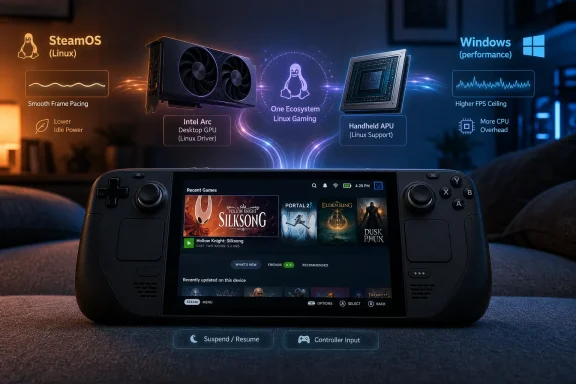 SteamOS Escapes the AMD Walled Garden
For most of the Steam Deck era, SteamOS compatibility had an unspoken footnote: bring AMD silicon. Valve’s handheld was built around a custom AMD APU, the Linux graphics stack was strongest on AMD, and the first credible wave of SteamOS-like alternatives gravitated toward Ryzen-based devices. That was not an ideological choice so much as a practical one. If you wanted the fewest headaches in Linux gaming, AMD was the known quantity.Intel’s handheld push changed the stakes. MSI’s original Claw line proved that Windows handhelds could use Intel silicon, even if the first-generation experience struggled against AMD-powered rivals. The newer Claw 8 AI+ is a more serious machine, built around Intel’s Lunar Lake Core Ultra 7 258V and Arc 140V graphics, but it still ships into a market where Windows 11 is tolerated more than loved on small screens.
That is why SteamOS appearing on the Intel Claw matters. It does not mean Valve has certified every Intel handheld, nor does it mean MSI is about to replace Windows with SteamOS across the line. It means the old assumption that SteamOS is functionally an AMD-only platform is beginning to crack.
The reported installation path is still enthusiast territory. ETA Prime’s test involved a SteamOS beta install that was then updated forward, and Intel Arc desktop testing reportedly required a repair-image workaround and a GPU swap. Nobody should confuse this with the frictionless Steam Deck recovery process. But in platform terms, “it boots and games run” is often how the future starts.
The Handheld PC Finally Gets an Operating-System Fight
Windows has won the PC handheld market by default, not by design. The Asus ROG Ally, Lenovo Legion Go, MSI Claw, and their peers all benefit from Windows’ enormous game compatibility, mature anti-cheat support, Game Pass access, and familiar driver model. They also inherit Windows’ talent for behaving like a desktop OS at the exact moment the user wants a console.SteamOS solves a different problem. It gives handheld PCs a purpose-built living-room interface, suspend-and-resume behavior that feels closer to a Nintendo Switch than a laptop, and a software update model that does not constantly remind the user that a full desktop is lurking underneath. Its biggest limitation has always been reach. Valve controlled the Deck, but the rest of the market ran Windows because Windows ran everywhere.
Intel support widens that reach. If SteamOS can run acceptably on Intel handhelds, then device makers are no longer trapped in a binary choice between Windows ubiquity and Steam Deck polish. They can at least imagine a world where the same hardware ships in Windows and SteamOS variants, or where enthusiasts install Valve’s OS without having to choose AMD first.
That shift is uncomfortable for Microsoft. The company has spent years promising better handheld experiences through Xbox app updates, compact modes, launcher tweaks, and OEM partnerships. Those improvements help, but they do not change the basic fact that Windows is still the thing under the couch cushions. Valve’s advantage is that SteamOS begins from the assumption that the user is holding a game machine, not a shrunken laptop.
Intel’s Real Test Is Power, Not Bootability
The early numbers are encouraging only if they are read with the right expectations. Cyberpunk 2077 reportedly ran around 40 frames per second at 720p using the Steam Deck graphics preset with a 17W power target on the MSI Claw 8 AI+. Raising the power envelope to 30W pushed performance toward 60fps at 1080p, but still below the same device’s Windows results.That distinction matters. Linux gaming in 2026 is no longer defined by whether games launch. Proton has made that battle far less dramatic than it was a decade ago. The harder question is whether the platform manages power, drivers, frame pacing, and suspend states well enough to feel like an appliance rather than a science project.
On handhelds, power policy is performance. A desktop gaming PC can brute-force inefficient scheduling with a larger cooler and a wall socket. A handheld cannot. If SteamOS struggles to divide power cleanly between Intel’s CPU and GPU, the user experiences that as frame dips, heat, fan noise, or vanishing battery life.
That is why the low-TDP example is as important as the headline Cyberpunk figure. A machine reportedly delivering many hours of play in lighter games at 60fps tells us SteamOS can already do some of the things handheld owners actually care about. Not every portable session is a prestige ray-traced benchmark. Sometimes the win is opening a 2D game, suspending instantly, and not wondering why Windows Update woke the device in a bag.
Arc on the Desktop Is a Warning Shot, Not a Product Plan
The reported Arc B580 desktop experiment is messier but arguably more interesting. SteamOS booting on an Intel desktop GPU suggests Valve’s hardware support work is not limited to handheld-specific quirks. It points toward broader Intel graphics compatibility inside the SteamOS stack, even if the current route involves workarounds no ordinary user should be asked to perform.The performance caveats are substantial. The Reddit testing described games running, but not performing as expected, with particularly poor results when resizable BAR was disabled. That should surprise no one who has followed Intel Arc on Windows. Arc has always depended heavily on platform configuration, driver maturity, and modern graphics APIs, and it has punished users who expected it to behave like a drop-in GeForce or Radeon card in every legacy scenario.
SteamOS adds another layer. Valve’s platform is built on Linux graphics drivers, Gamescope, Proton, Mesa, kernel support, and vendor firmware all working in concert. When AMD hardware shines there, it is because years of upstream work and Valve’s own priorities line up. Intel can get there, but “works” and “works well” are different milestones.
Still, desktop Arc support has symbolic weight. It suggests SteamOS may eventually become a more general gaming OS rather than a Deck recovery image that escaped containment. Valve has been careful about that transition, and for good reason. The moment SteamOS becomes something users expect to install on arbitrary PC hardware, Valve inherits a support matrix that looks a lot more like Microsoft’s world.
Valve Is Expanding Carefully Because Compatibility Is a Trap
Valve’s public posture around SteamOS has always been more cautious than the community’s imagination. The company has encouraged broader device support, worked with partners, and released images that make third-party installs possible, but it has not thrown open the gates with a universal “SteamOS for every PC” campaign. That restraint is not timidity. It is survival.A console-like operating system depends on predictability. Steam Deck owners forgive some Linux weirdness because the overall hardware and software stack is controlled. Once SteamOS moves onto MSI, Lenovo, Asus, Acer, OneXPlayer, GPD, and desktop towers with unpredictable BIOS settings, docks, panels, controllers, storage devices, and GPUs, the polish problem multiplies.
Intel support is therefore a double-edged achievement. It makes SteamOS more relevant, but it also exposes Valve to the same fragmentation that makes Windows both powerful and frustrating. If a menu button fails on an MSI handheld, is that Valve’s bug, MSI’s firmware issue, an InputPlumber edge case, or a beta regression? Enthusiasts will troubleshoot. Mainstream buyers will blame the logo they see on boot.
That is why beta support should be read as a signal, not a promise. Valve is laying the plumbing for a broader ecosystem, but the company is unlikely to sacrifice the Steam Deck’s reputation for the thrill of letting everyone install an unfinished image on everything. The center of gravity remains controlled hardware; the expansion comes in rings around it.
Microsoft’s Handheld Problem Is Now Strategic
For WindowsForum readers, the obvious angle is not simply “Linux got better.” It is that Windows’ dominance in PC gaming is being challenged at the edge of the form factor where Windows is weakest. On a desktop, Windows still makes sense. On a laptop, it is expected. On a seven- or eight-inch handheld with thumbsticks, it often feels like a compatibility layer wearing the wrong clothes.Microsoft knows this. The company has spent the last several years trying to make Windows more acceptable on handheld PCs, including gaming-oriented interface changes and deeper Xbox integration. But it is fighting the architecture of its own success. Windows must remain a general-purpose OS for enterprise fleets, creative workstations, development machines, tablets, kiosks, and gaming rigs. SteamOS only has to make Steam games feel good on a couch, a train, or a hotel bed.
That narrower mission gives Valve leverage. The Steam Deck did not beat Windows handhelds on raw specs; it beat them on coherence. Users could press the power button, buy a game, suspend mid-session, resume later, and rarely touch the underlying desktop. That sounds basic until you compare it with the choreography of launchers, pop-ups, driver panels, overlays, login prompts, and touch targets that can define Windows handheld life.
If Intel handhelds can run SteamOS well enough, Microsoft’s problem becomes harder. OEMs will have more credible alternatives, reviewers will compare Windows and SteamOS on the same hardware, and users will start asking why the device with the theoretically broader OS feels less purpose-built.
The Game Library Argument Is Getting Less Absolute
Windows still has the stronger compatibility story, especially for games with anti-cheat systems, kernel-level protections, launchers that dislike Proton, or storefront dependencies outside Steam. For many players, that remains decisive. If your library is split across Game Pass, Epic, Battle.net, Riot, Ubisoft, EA, and Steam, Windows is still the safer default.But the Steam Deck has already changed how buyers think about compatibility. The question is no longer “does it run every PC game?” It is “does it run enough of the games I actually play, with less hassle?” That is a dangerous reframing for Windows, because it moves the debate from theoretical completeness to lived convenience.
SteamOS does not need to win every title to become the preferred handheld OS for many users. It needs to run the user’s core Steam library, handle suspend and updates cleanly, and avoid turning controller-driven play into a desktop-management session. Proton’s success means that bar is no longer fanciful.
Intel support strengthens that argument because it makes SteamOS less tied to one vendor’s hardware roadmap. If AMD has a weak generation, or Intel ships a compelling handheld chip, Valve does not want its OS strategy pinned to yesterday’s silicon. The operating system has to follow the market, not merely the original Deck’s bill of materials.
MSI Becomes the Accidental Test Case
MSI’s Claw line is an appropriate place for this drama to unfold because it has already lived through the pain of being the non-AMD handheld. The first Claw arrived into a market that was impatient with driver excuses and quick to compare every number against Ryzen Z1 Extreme devices. Intel improved, MSI iterated, and the Claw 8 AI+ became a far more credible machine, but the brand still carries the burden of that first impression.SteamOS gives the Claw a second narrative. Instead of being judged only as “the Intel Windows handheld,” it can become a test of whether Intel’s modern mobile graphics stack is ready for Valve’s console-like environment. That is a more interesting question, and potentially a more flattering one if the software matures.
The current evidence is mixed in precisely the way beta evidence usually is. Sleep mode reportedly works well, which is not a trivial achievement. Games run, but some controls and power tuning remain unfinished. Performance can be good, but Windows still wins in demanding scenarios. That is not a verdict. It is a development snapshot.
For MSI, official or semi-official SteamOS viability could eventually become a differentiator. For Intel, it is an opportunity to avoid being boxed out of the handheld market by AMD’s Linux-friendly reputation. For Valve, it is a way to make SteamOS feel less like a device feature and more like a platform.
The Steam Deck Is No Longer the Whole SteamOS Story
The Steam Deck remains the reference point, but it is no longer the entire category. Valve’s original handheld proved that a Linux-based PC gaming console could work at scale. The next phase is proving that the experience can survive contact with other hardware.That is harder than it sounds. The Deck’s magic is not just Proton or the Steam interface. It is the alignment between controls, display, APU, firmware, power profiles, shader caching, sleep behavior, repair tooling, and Valve’s storefront. Remove that alignment and SteamOS can quickly become “Linux with Big Picture Mode,” which is not the same proposition.
Intel compatibility is therefore a stress test of SteamOS as an ecosystem. Can Valve preserve the parts users love while broadening the hardware base? Can it support OEM-specific controls without letting every device become a special case? Can it expose useful tuning without recreating the clutter that makes Windows handhelds feel busy?
Those questions will define whether SteamOS becomes a true Windows alternative for handheld PCs or remains the best operating system for one family of devices. The Intel tests do not answer them. They make them unavoidable.
The Linux Gaming Stack Has Quietly Become Boring, Which Is the Point
The most remarkable part of this story may be how unremarkable the basic claim now sounds. A few years ago, “a Windows handheld running Intel graphics can boot Valve’s Linux gaming OS and play Cyberpunk” would have required caveats in every clause. In 2026, the caveats are still there, but the premise is no longer absurd.That is the achievement of boring infrastructure. Proton translates, Mesa evolves, kernel drivers improve, Gamescope smooths over display handling, and vendors increasingly understand that Linux gaming is not a hobbyist corner case. The visible product is a handheld UI. The real product is years of work that make a Windows game running on Linux feel ordinary.
Intel’s participation matters because it broadens the coalition. AMD’s Linux graphics story gave Valve a foundation. Intel’s improving support gives Valve optionality. Nvidia remains the most complicated piece in any dream of universal SteamOS PCs, but handhelds are not waiting for a perfect desktop GPU truce.
For Windows users, this is not a culture-war victory for Linux. It is market pressure. The better SteamOS gets, the more Microsoft and OEMs must justify Windows on devices where Windows’ traditional strengths are less visible and its annoyances are magnified.
The Beta Label Is Doing Real Work
No one should install this expecting a retail console experience. The reported menu-button issue, missing power tuning, uneven performance, and desktop Arc workarounds are not cosmetic defects. They are reminders that SteamOS on Intel is still moving through the stage where enthusiasts create the evidence vendors later use to make decisions.That matters for sysadmins and IT pros too, even if handheld gaming is not an enterprise deployment category. The pattern is familiar: a platform expands beyond its reference hardware, community testing reveals hardware-specific gaps, vendors decide whether the opportunity justifies formal support, and users discover that “compatible” is not the same as “supported.”
SteamOS is especially sensitive to that distinction. A bad Windows driver experience is annoying but familiar. A bad SteamOS install on third-party hardware risks undermining the very simplicity that makes Valve’s platform appealing. Valve has to decide how fast it wants to widen the door.
The right read, then, is neither hype nor dismissal. Intel SteamOS support is not ready to dethrone Windows across handhelds tomorrow. It is also not a curiosity. It is the beginning of a credible software alternative arriving on hardware that was previously outside Valve’s comfort zone.
The Claw Test Narrows the Future to a Few Hard Facts
The useful lesson from this round of testing is not that Intel handhelds have suddenly become Steam Deck killers. It is that the walls around SteamOS are moving, and each movement puts more pressure on Windows to become a better handheld citizen. The next year of updates will matter more than the first boot screen.- SteamOS now appears capable of running on Intel-based handheld hardware in beta form, with the MSI Claw 8 AI+ serving as the most visible early example.
- Early gaming results are playable but uneven, with Windows still ahead in demanding titles on the same hardware.
- Power management is the central unfinished problem, because handheld performance depends as much on wattage allocation and frame pacing as on raw GPU capability.
- Intel Arc desktop compatibility is emerging, but the current evidence points to enthusiast experimentation rather than a polished install path.
- Microsoft’s challenge is not game compatibility alone; it is making Windows feel native on hardware that increasingly behaves like a console.
- Valve’s opportunity is to expand SteamOS without losing the controlled, appliance-like quality that made the Steam Deck compelling.
References
- Primary source: Club386
Published: 2026-06-15T16:10:08.220430
Look out Steam Deck, Intel handhelds are now running SteamOS | Club386
Valve's operating system now works on Intel hardware, including the Lunar Lake-powered MSI Claw 8 AI+ handheld and Arc B580 desktop GPU. www.club386.com
- Related coverage: techradar.com
Valve's latest SteamOS beta provides better Intel hardware compatibility — and that's great news for upcoming handhelds | TechRadar
SteamOS is the way to gowww.techradar.com - Related coverage: pcguia.pt
SteamOS Beta 3.8.7 Lança Suporte para MSI Claw e Intel
A Valve lançou a versão beta 3.8.7 do SteamOS, introduzindo suporte oficial para a consola MSI Claw e melhorando a compatibilidade com processadores Intel.www.pcguia.pt - Related coverage: videocardz.com
- Related coverage: tweaktown.com
YouTuber tests SteamOS on an Intel-based MSI Claw 8 AI+ handheld, SteamOS now supports Intel handheld gaming PCs in new beta
YouTuber tests SteamOS on an Intel Lunar Lake-based MSI Claw handheld showing good overall performance from the OS, save for one minor bug. www.tweaktown.com
- Related coverage: tomshardware.com
MSI Claw 8 EX AI+ brings Intel Arc G3 Extreme to handhelds — 8-inch, 120 Hz display and new ergonomic grips | Tom's Hardware
Any color you want, as long as it's 'Void Purple'www.tomshardware.com
- Related coverage: elchapuzasinformatico.com
SteamOS Beta prepara el terreno a las consolas portátiles con Intel
SteamOS comienza darle el merecido protagonismo a las consolas con hardware de Intel implementando mejoras y arreglos. elchapuzasinformatico.com
- Related coverage: windowscentral.com
MSI Claw 8 AI+ handheld price tag and features reviewed | Windows Central
Intel's "Lunar Lake" Core Ultra CPUs and Arc integrated graphics power the monstrous Claw A2VM, but it won't win the war.www.windowscentral.com - Related coverage: gamesradar.com
Turns out Intel's XeSS 3 upscaling works on MSI Claw handhelds, so I'd pop it on your portable ASAP for Multi-Frame Generation tomfoolery | GamesRadar+
Intel Arc users are adding XeSS 3 to GPUs like the B580 ahead of schedule, and it could be your ticket to Multi-Frame Generation on handhelds like the MSI Claw.www.gamesradar.com - Related coverage: notebookcheck.net
MSI unveils new Claw 8 handheld with Intel Arc G3 Extreme Panther Lake chip - Notebookcheck News
MSI has refreshed its Claw 8 handheld with Intel hardware mere months after its Ryzen Z2 Extreme-powered variant hit shelves last year. The new Claw 8 AI+ CG3EM is expected to hit shelves sometime in June 2026. www.notebookcheck.net
- Related coverage: community.intel.com
