

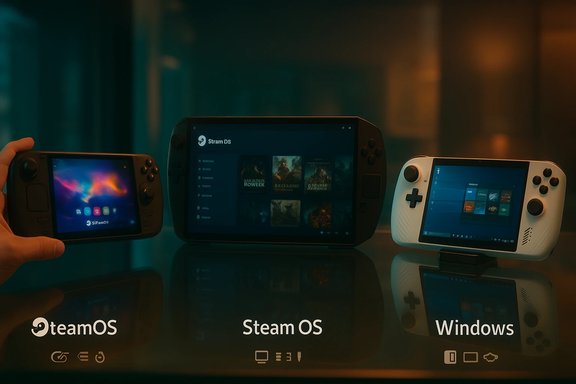
Valve’s Steam Deck remains the most balanced handheld for most players in 2026, but the market has widened into a clear hardware-versus-software split where Windows-first pocket PCs like the ROG Ally X chase raw frames and dockability while premium SteamOS alternatives — most notably Lenovo’s newly announced Legion Go 2 SteamOS edition — push console-like polish and better battery endurance. eld PC gaming is no longer a niche experiment: it’s a full product category with distinct design philosophies. Since the Steam Deck’s 2022 launch and Valve’s continued refinement with the OLED revision, OEMs have pursued two main strategies. One focuses on a tuned, controller-first OS (SteamOS) and efficiency-tuned silicon to maximize battery life and a pick-up-and-play experience. The other prioritizes Windows compatibility, Game Pass integration, and the flexibility to run any PC title or application — even if that comes at the cost of shorter unplugged sessions and heavier thermal management. These trends and buyer trade-offs are central to the market snapshot discussed in the user-provided coverage of the “best handheld gaming PCs for 2026.”
This piece synthesizifies technical claims against vendor specifications and independent reporting, and lays out a clear buying playbook for readers choosing a handheld in 2026.
The industry milestones that shaped this year’s handheld conversation are straightforward:
Practical bottom line:
Source: PCMag UK https://uk.pcmag.com/migrated-84555...nd-the-best-handheld-gaming-devices-for-2024]
This piece synthesizifies technical claims against vendor specifications and independent reporting, and lays out a clear buying playbook for readers choosing a handheld in 2026.
 Overview: Why 2026 feels different
The industry milestones that shaped this year’s handheld conversation are straightforward:- Valve’s Steam Deck OLED continues to be the default recommendation for Steam-first players who want long battery life, polished SteamOS integration, and a proven compatibility layer via Proton. Its core specs and battery claims are published on Valve’s site and match hands-on reporting.
- ASUS’s ROG Xbox Ally family — including the high-performance ROG Ally X — represents the Windows-first camp: high-refresh 1080p displays, larger batteries in premium SKUs, USB4 docking, and silicon that targets higher sustained TDPs for local performance. ASUS’s press materials document these specs and the product’s emphasis on Game Pass and desktop-like docking.
- OEMs are now shipping premium handheld hardware available in both OS images. Lenovo’s Legion Go 2 will ship with a SteamOS factory SKU in June 2026 — a high-profile example of hardware convergence where the OS is the primary differentiator between buyer experiences. Independent outlets confirm the timing, SKUs, and headline specs.
The main contenders: deep dive
Steam Deck OLED — the mature, balanced choice
Valve’s Steam Deck OLED remains the reference device for a seamless, controller-first experience. The OLED model updates the Deck’s display, memory, and thermal tuning while preserving the familiar SteamOS experience.- Key verified specs:
- 7.4" HDR OLED, 1280×800, up to 90Hz.
- Custom AMD APU built on a 6 nm process (Zen 2 CPU + RDNA2 GPU block).
- 50 Wh battery with quoted 3–12 hours of gameplay depending on load.
- Tri-band Wi‑Fi 6E, Bluetooth 5.3, USB-C with DisplayPort.
- Official SKUs: 512 GB and 1 TB OLED variants.
- Software polish matters. SteamOS’s controller-first UX, the Proton compatibility layer, and Valve’s ongoing verification system yield a predictable experience for many Steam titles.
- Battery per watt efficiency. The OLED SKU’s 50 Wh pack and updated power profile give the Deck consistent unplugged longevity for single-player and less GPU-bound games.
- Value and ecosystem. Valve’s return-to-basics approach keeps the Deck a practical buy for people whose libraries live in Steam. Independent reviews confirm the device’s endurance and usability improvements vs earlier LCD models.
- The Deck’s raw CPU/GPU ceiling is lower than the most powerful Windows handhelds. Expect lower framerates in heavy native PC titles at maximum settings.
- Anti-cheat and certain Windows-only middleware remain edge-case problems for some multiplayer titles, even though Proton and publisher support have improved.
ROG Xbox Ally X — Windows-first performance and docking
ASUS’s ROG Xbox Ally X represents the other pole: maximum local performance and full Windows compatibility. ASUS emphasizes high refresh rates, large RAM pools, USB4 docking, and integration with Xbox/Game Pass features.- Key verified specs (from official ASUS materials):
- 7" FHD (1920×1080) IPS touchscreen, 120Hz, 500 nits.
- AMD Ryzen AI Z2 Extreme (8-core/16-thread Zen 5 APU in press materials).
- Up to 24 GB LPDDR5X (some official listings say 24 GB or 24/32 GB variants depending on region).
- USB4 / DisplayPort 2.1 connectivity, Thunderbolt-compatibility claims in some regions.
- Larger 80 Wh battery for premium Ally X SKUs (ASUS press notes and product pages).
- Native Windows compatibility gives immediate access to Game Pass, Epic, EA, and third-party launchers, along with tools and workflows gamers may already use.
- Docking and desktop flexibility. USB4 and DisplayPort support let the Ally X act as a compact desktop replacement when docked.
- Performance headroom. Higher TDP ceilings and more RAM mean better sustained framerates in demanding titles, especially when docked to a power source.
- Battery and heat. The performance-first posture translates into shorter unplugged sessions and louder cooling under stress.
- Software polish at launch. Community testing shows Windows-based handhelds can ship with desktop artifacts (background services, overlays, driver roughness) that spoil the console-like immediacy some users want. ASUS has iterated via firmware and OS patches, but buyers should watch post-launch maturity closely.
Lenovo Legion Go 2 (SteamOS) — a litmus test for OS-first differentiation
Lenovo’s decision to ship a factory SteamOS SKU of the Legion Go 2 — a high-end handheld that also exists as a Windows device — is the clearest market signal that OS choice is now as important as hardware.- Headline verified specs for the Legion Go 2 family:
- 8.8" PureSight OLED, 1920×1200, up to 144Hz.
- Options up to AMD Ryzen Z2 Extreme APU (Z2 family designed for handhelds).
- Up to 32 GB LPDDR5X RAM, up to 2 TB M.2 NVMe (2242) storage.
- 74 Wh battery and detachable controllers with Hall-effect sticks.
- SteamOS SKU announced with June 2026 availability and a starting MSRP reported near $1,199.
- A direct A/B test. Shipping identical hardware with different OS images isolates the effects of software on battery life, sustained framerates, and UI experience.
- SteamOS scaling beyond Valve. A Lenovo-built SteamOS handheld helps normalize Proton and Valve’s verification program on non-Valve hardware.
- Premium hardware paired with a console-first UX. The Legion Go 2’s large OLED and high memory ceiling present the best-case scenario for SteamOS to deliver both visual fidelity and sustained performance.
- The SteamOS SKU’s real advantage depends heavily on Linux driver maturity for AMD’s Z2 silicon, anti-cheat compatibility for competitive titles, and synchronized firmware support between Lenovo and Valve. Independent testing is required to confirm Lenovo’s battery and framerate claims in day-to-day gaming. Early reporting is favorable but provisional.
Other notable devices and the long tail
A number of smaller brands and models remain relevant for specific buyer needs:- AYANEO, GPD, and ONEXPLAYER variants continue to exist for enthusiasts who want highly modular designs, niche input configurations, or more frequent hardware refresh cycles.
- Valve’s living-room Steam Machine and other dock-centric devices are also part of the broader ecosystem discussion, though their role is distinct from handheld-focused devices. Marketing claims for novel devices (for example, bold multipliers like “6x more powerful than the Deck”) should be treated with caution until independent benchmarks appear.
Software vs. silicon: the real battleground
One of 2026’s clearest lessons is that software posture matters as much as silicon on handheld PCs.- A lean, controller-first OS (SteamOS) can materially reduce background overhead, improve shader and compositing behavior, and squeeze out sustained performance and battery life from the same hardware.
- Windows provides unmatched compatibility and ecosystem access (Game Pass, anti-cheat compatibility for many multiplayer titles), but it brings desktop baggage that can work against the handheld UX unless est heavily in a handheld-optimized shell and driver stack.
- Community testing and third-party OS experiments show measurable improvements in frame pacing and runtime when devices run tuned Linux images, but they also expose compatibility and support trade-offs.
Practical buying checklist: how to choose the best handheld for you
- Confirm your primary titles and services.
- If your backlog lives on Steam and you play mostly single-player or non-anti-cheat multiplayer, lean SteamOS or Steam Deck.
- If you need Game Pass, Epic exclusives, or Windows-only tools, prioritize Windows handhelds like the ROG Ally X.
- Verify exact SKUs before purchase.
- Panel type (OLED vs LCD), RAM speed/capacity, SSD form factor, and APU SKU can change between SKUs and regions. Manufacturers sometimes ship different panels in the same chassis.
- Plan for accessories based on your use case.
- Docking and desktop use: get a USB4/DisplayPort-capable dock and a higher-wattage PD charger (especially for Ally X-type devices).
- Portability and long sessions: consider the Steam Deck OLED or OLED Legion Go 2 SteamOS variant for better unplugged life.
- Proton and Valve’s verification labels help identify which titles work reliably on SteamOS; if you play competitive titles, confirm anti-cheat compatibility before switching OS images.
- Expect firmware and driver updates.
- Early adopters of new handhelds may encounter rough edges; post-launch patches can materially change performance and UX.
- Consider a dual-boot or recovery strategy.
- If you want the best of both worlds, keep a Windows recovery drive handy — or buy a Windows unit and experiment with SteamOS on a secondary drive once compatibility is validated.
Risks, marketing claims, and verification
- Treat marketing multipliers and NPU/TOPS claims with skepticism. Vendors often highlight theoretical TOPS or NPU figures for AI features, but independent, reproducible gaming gains are rare on day one. AI upscalers and on-device NPUs can help, but they seldom replace raw GPU performance for modern AAA rendering without trade-offs in image quality or latency. ASUS’s marketing around Auto SR and NPUs is promising, but independent validation remains necessary.
- Beware of price-versus-value traps. Premium handhelds like Lenovo’s Legion Go 2 (SteamOS) at roughly $1,199 place heavy expectations on software maturity and cross-title compatibility to justify their price. Confirm independent long-session thermals and driver update cadences before committing.
- Anti-cheat remains the primary ecosystem risk for SteamOS devices. While Proton and major anti-cheat vendors have improved Linux support, some edge-case titles still require Windows-only middleware. For competitive online players, Windows is still the safer choice.
Ranked recommendations (reader profiles)
- Best for battery life and simple pick-up-and-play: Steam Deck OLED or any OLED SteamOS SKU from an OEM. The Deck’s tuned hardware + OS combo consistently delivers better unplugged endurance for many play styles.
- Best for raw local performance and docking: ROG Xbox Ally X. If you want the most powerful Windows handheld with USB4 docking and Game Pass integration, the Ally X is currently unmatched in sustained TDP headroom and desktop-like flexibility.
- Best for OLED, large screen, and a premium SteamOS experience: Lenovo Legion Go 2 (SteamOS SKU) — a good choice for Steam-first players who want an oversized, high-refresh OLED and are willing to pay a premium for the best portable display and memory/SSD ceilings. Confirm dch.
- Best for tinkerers who want flexibility: Windows handhelds with upgradeable SSDs (select GPD / AYANEO / ONEXPLAYER models). These are niche picks for enthusiasts who want unusual inputs or more modular internal options.
What to watch in 2026
- Independent benchmarks that compare the Legion Go 2 Windows vs SteamOS images across identical firmware. Those results will show whether software alone can yield decisive battery and frame-rate advantages in real-world play.
- Valve’s Steam Machine and how Verified badges translate to non-Deck hardware. Marketing claims about “6x more powerful” need careful ndent testing will confirm whether upscaling and driver tuning can deliver the promised living-room targets. Treat those claims as provisional until third-party reviews appear.
- Anti-cheat and publisher support. If major titles finalize Linux-compatible anti-cheat pathways, SteamOS handhelds will close a major gap in competitiveness with Windows machines.
Final analysis and buying verdict
The handheld wave of 2026 is not a single-device race — it’s a market-level debate about what handheld gaming should prioritize. If you value a curated, reliable, and battery-efficient experience, SteamOS devices (and the Steam Deck OLED in particular) remain the best single purchase. If you need full Windows access, Game Pass, and the option to dock into a desktop-like experience, a high-end Windows handheld like the ROG Ally X is the obvious choice. Lenovo’s Legion Go 2 SteamOS SKU is the most interesting middle path: identical premium hardware with two divergent OS experiences that will teach the market how much the OS really matters on handheld silicon.Practical bottom line:
- Match the OS to your library and habits.
- Confirm SKU details and verified game lists.
- Expect firmware updates and treat early benchmarks as decisive for launch-window buyers.
- Treat marketing multipliers and NPU claims as possible future advantages, but verify with independent testing before paying a premium.
Source: PCMag UK https://uk.pcmag.com/migrated-84555...nd-the-best-handheld-gaming-devices-for-2024]
