

Microsoft’s official Microsoft Store Awards 2025 announcement landed as a clear manifesto: this year’s winners were chosen and presented by Microsoft with an unmistakable emphasis on AI-driven apps — and the decision to skip a public nomination and community-voting phase has left developers, players, and Windows fans asking whether the Store’s curation priorities have shifted from community celebration to corporate strategy.
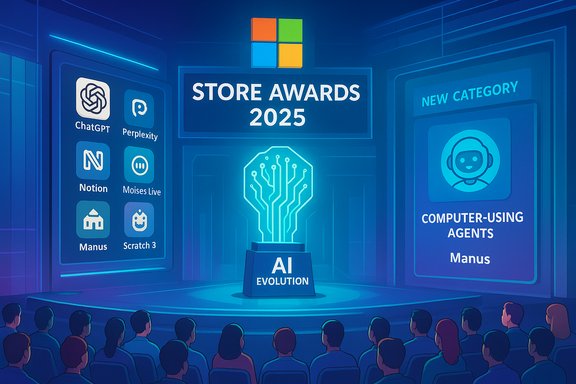
Microsoft published the Microsoft Store Awards 2025 winners in an official announcement from the Microsoft Store team. The list ranges across categories that include AI Assistants, Productivity, Music, Games, and a newly highlighted Computer‑Using Agents (CUA) category. Among the winners are recognizable names such as ChatGPT and Perplexity in a tied AI Assistants category, Notion for Productivity, Moises Live for Music, and Castle Craft as the Microsoft Store Game of the Year.
This year’s presentation differs from prior iterations of the Store Awards, which previously included community nomination phases and public voting in at least some categories. In 2023 the Store invited nominations and ran a Community Choice component; the 2025 rollout, by contrast, arrived as a curated announcement without a visible public nomination or voting window.
In 2025 there was no equivalent, public-facing nomination form or voting period announced. The awards arrived as a curated list from Microsoft rather than an outgrowth of community nominations. That shift matters because it changes the perception of the awards from a community celebration to a platform-level promotion.
But an awards program also functions as community currency. When that currency is perceived as issued by a closed editorial mint, it loses some of its value to the developer ecosystem it purports to celebrate.
The pragmatic path forward is straightforward: keep celebrating AI innovation, but bring back transparent nomination mechanics, clearly state category rules, and make selection rationales public. Doing so would preserve the benefits of Microsoft’s editorial influence — elevating technically excellent apps — while restoring the participatory spirit that has historically made the Store Awards feel like an authentic community moment.
The 2025 awards will be remembered less for any single winner and more for the narrative choice Microsoft made: amplify AI success stories, and accept the short-term cost of community disappointment. That tradeoff is defensible as a strategic pivot, but only sustainable if the Store simultaneously invests in transparency, fairness, and strong safeguards for the new class of agent-driven, AI-enabled applications it is now championing.
Recognition matters to developers and users alike. If Microsoft wants these awards to remain meaningful — both as a discovery engine and as a badge of community esteem — the Store must pair its platform priorities with open processes, clearly published criteria, and robust safeguards around AI-driven functionality. Only then can the Store strike a balance between strategic leadership and community trust, ensuring that future winners are seen as both innovative and legitimately earned.
Source: Windows Central https://www.windowscentral.com/soft...n-heavily-on-ai-and-community-voting-ditched/
 Background
Microsoft published the Microsoft Store Awards 2025 winners in an official announcement from the Microsoft Store team. The list ranges across categories that include AI Assistants, Productivity, Music, Games, and a newly highlighted Computer‑Using Agents (CUA) category. Among the winners are recognizable names such as ChatGPT and Perplexity in a tied AI Assistants category, Notion for Productivity, Moises Live for Music, and Castle Craft as the Microsoft Store Game of the Year.This year’s presentation differs from prior iterations of the Store Awards, which previously included community nomination phases and public voting in at least some categories. In 2023 the Store invited nominations and ran a Community Choice component; the 2025 rollout, by contrast, arrived as a curated announcement without a visible public nomination or voting window.
Quick snapshot: Microsoft Store Awards 2025 winners (high level)
- AI Assistants (tie): Perplexity; ChatGPT
- Productivity: Notion
- Music: Moises Live
- Computer-Using Agents (CUA): Manus
- Game: Castle Craft
- Developer Tools: ngrok
- Creativity: n-Track Studio
- Education: Scratch 3
- Business: Invoice Maker & Estimate Creator (Moon Invoice)
What changed this year: community voting was conspicuously absent
For several years the Microsoft Store Awards alternated between editorial selection and community-driven components. Microsoft previously ran a nomination form and a public Community Choice round, which made the awards feel participatory and gave indie and niche developers visibility.In 2025 there was no equivalent, public-facing nomination form or voting period announced. The awards arrived as a curated list from Microsoft rather than an outgrowth of community nominations. That shift matters because it changes the perception of the awards from a community celebration to a platform-level promotion.
- Why that matters: community nominations and voting had been a visibility lever for smaller developers and a recognition channel that rewarded apps with genuine grassroots enthusiasm. Removing that mechanism concentrates narrative control with the Store editors and brand managers.
- Impact on trust: when prize winners appear to align with a single thematic push — in this case, AI — developers and users may read awards as marketing rather than merit-based recognition.
The AI‑first theme: deliberate emphasis or predictable outcome?
A striking thread across winners is the role of AI, from ChatGPT and Perplexity in the assistant slot to Moises Live’s system-level, real‑time audio separation and Manus’s Computer‑Using Agent architecture. The Store Awards read like a roll call of Microsoft’s strategic priorities: put AI front-and-center on Windows.- What the winners show: Microsoft appears to be spotlighting apps that either showcase AI integration with Windows features (system-level audio processing, Alt+Space instant answers) or demonstrate new agent models that can automate complex, multi-step workflows.
- Why that’s not surprising: Microsoft has been pushing AI features across its ecosystem — from Windows system experiences to Microsoft 365 Copilot — so spotlighting AI-capable apps aligns the Store narrative with broader corporate messaging.
Computer‑Using Agents: what Manus winning means for Windows apps
The new Computer‑Using Agents (CUA) category — won by Manus — deserves a focused look because it signals Microsoft’s interest in agentized automation on Windows.- What a CUA is: these are software agents that can run sequences of actions on a device — from running code and controlling headless browsers to file management and multi-step data workflows — often inside sandboxes and with monitoring/steering interfaces.
- What Manus claims to do: Manus positions itself as an agent that executes complex tasks in a secure sandbox, supports multi-agent planning, and provides a “watch and guide” interface for users to oversee and pause actions.
- Why Microsoft would highlight it: CUAs map neatly onto enterprise productivity narratives — automating repetitive or multi-step knowledge workflows, integrating with corporate IT policy controls, and offering extensions to Copilot-style assistance.
- Security and containment: any agent capable of running scripts, controlling browsers, or manipulating files must be constrained by clear security boundaries, observability, and auditing. Without robust isolation and opt-in controls, agent tools risk introducing new attack surfaces.
- IT governance: enterprise adoption will hinge on how agents respect IT policies, permissions, data residency, and compliance regimes. The Store’s vetting process must weigh enterprise risk, not only innovation.
- Transparency and consent: users and organizations need clear explanations about what agents can access and why, plus easy ways to disable or audit automated behaviors.
The Castle Craft controversy: Game of the Year that many didn’t expect
Arguably the most contentious pick is Castle Craft as Microsoft Store Game of the Year. The selection provoked surprise because:- Castle Craft is a free-to-play simulation/merging game that was first released in 2024 and updated in 2025, rather than a big-budget, critically acclaimed launch like some other prominent PC games in the same year.
- Several major and widely praised titles that released or were updated in the same period — including high-profile indie and AA/AAA games available through the Microsoft Store — appear to have been overlooked.
- Timing and eligibility expectations: Game of the Year awards typically correlate with titles launched in the award year or that made a significant impact during that calendar year. Selecting a game released the previous year and playable in a browser blurred those lines.
- Perception of criteria: The Microsoft announcement frames winners as demonstrating “technical excellence, user satisfaction and transformative potential.” Observers questioned how Castle Craft best exemplified those categories compared with other contenders that won critical praise or commercial success.
- Store presentation inconsistencies: reports surfaced that Castle Craft’s Store metadata and award labelling had inconsistencies, including references to earlier award cycles — adding to confusion about eligibility and the selection process.
Community reaction: social media noise and developer unease
The announcement sparked visible reaction from the Windows community and developers. Popular social channels showed a mixture of disappointment, bemusement, and skepticism.- Common themes in the reaction:
- Concern that the awards prioritized AI optics over broader app quality or community favorites.
- Calls for a return of community nominations and voting to restore a sense of shared ownership.
- Specific puzzlement over the Game of the Year pick and the creation of narrowly defined categories (e.g., CUA).
- Why the voices matter: awards serve as both recognition and marketing. When the community feels excluded from the process, the awards lose a channel of legitimacy and may have less promotional impact for smaller developers.
The business angle: why AI winners align with Microsoft’s incentives
Microsoft’s Store curation has strategic implications beyond a list of winners. Several intersecting incentives help explain the AI tilt:- Ecosystem alignment: spotlighting AI-first apps reinforces Windows as a modern, capable OS for AI workloads — including native NPU acceleration on Copilot+ hardware.
- Platform differentiation: promoting apps that integrate Windows-specific features (system-level audio separation, quick-access assistant windows, sandboxed agents) distinguishes the Microsoft Store from generic app repositories and the web.
- Enterprise signalling: by highlighting apps with IT policy support and enterprise controls, Microsoft reinforces Windows as an enterprise-friendly platform for AI adoption.
Risks and downsides for Microsoft, developers, and users
The 2025 awards illuminate several practical risks:- Perceived bias and loss of trust: without transparent nomination and selection mechanics, the Store risks being seen as a mouthpiece for strategic priorities rather than a neutral curator that lifts deserving developers.
- Developer relations: indie and small-team developers relied on the Store Awards’ previous community-driven elements for discoverability. Centralized editorial picks reduce the number of exposure pathways.
- Security and privacy with AI agents: apps like Manus that run code and automate workflows can increase attack surface if sandboxing, permissions, and telemetry are not implemented and communicated robustly.
- Discoverability vs. platform promotion: elevating certain AI apps could overshadow other high-quality apps that are not AI-focused but still important to users (e.g., accessibility tools, performance utilities, niche productivity apps).
- Award credibility: picking a Game of the Year that many community members find surprising risks diminishing the overall perceived value of the awards going forward.
What Microsoft should do to restore balance and credibility
To preserve the Store Awards as a meaningful instrument for developer recognition and user discovery, Microsoft should consider concrete changes that restore transparency, fairness, and developer trust.- Reintroduce a visible nomination window and a public shortlist.
- Publish selection criteria and eligibility rules for each category, including cut-off dates for release or update windows.
- Separate “Editor’s Choice” or “Platform Spotlight” from “Community Choice” awards, making it clear when Microsoft is promoting strategic platform priorities.
- Provide an adjudication summary for contested categories (for example: why this game was chosen, what specific technical achievements were prioritized).
- Improve metadata hygiene for awarded apps (release dates, award year tags) so the Store pages reflect award context accurately.
- Require stronger privacy/security disclosures for agent-style apps and highlight enterprise policy features for business customers.
For developers: a practical playbook
If you’re a Windows app developer watching these shifts, here are defensive and proactive steps:- Keep Store metadata and update logs clear, including release dates and major update notes.
- If you build agent features or local AI processing, prioritize sandboxing, auditing, and user consent flows.
- Surface Windows integration features prominently (NPU acceleration, system audio routing, global keyboard shortcuts) — these are the capabilities the Store is currently spotlighting.
- Build direct communication channels with your users and the Windows developer relations staff so you’re not dependent on Store editorial cycles for discoverability.
- Prepare a short, public-facing dossier that explains why your app would be a strong awards candidate under objective criteria (technical excellence, user satisfaction, transformative potential).
Final analysis: awards as signal, not gospel
Microsoft’s Store Awards 2025 illustrate a tension every platform faces as it scales: balancing platform strategy with community credibility. The list of winners signals an intentional push to foreground AI-enabled Windows experiences — which has clear alignment with Microsoft’s broader product positioning. There are legitimate reasons to champion apps like Moises Live, Manus, and native AI assistants; they demonstrate what modern Windows devices can do when software and hardware are treated as a system.But an awards program also functions as community currency. When that currency is perceived as issued by a closed editorial mint, it loses some of its value to the developer ecosystem it purports to celebrate.
The pragmatic path forward is straightforward: keep celebrating AI innovation, but bring back transparent nomination mechanics, clearly state category rules, and make selection rationales public. Doing so would preserve the benefits of Microsoft’s editorial influence — elevating technically excellent apps — while restoring the participatory spirit that has historically made the Store Awards feel like an authentic community moment.
The 2025 awards will be remembered less for any single winner and more for the narrative choice Microsoft made: amplify AI success stories, and accept the short-term cost of community disappointment. That tradeoff is defensible as a strategic pivot, but only sustainable if the Store simultaneously invests in transparency, fairness, and strong safeguards for the new class of agent-driven, AI-enabled applications it is now championing.
Conclusion
The Microsoft Store Awards 2025 reveal a platform at a strategic inflection point. By emphasizing AI-first winners and introducing new categories like Computer‑Using Agents, Microsoft has sent a clear signal about where it wants the Windows app ecosystem to go. The absence of a public nomination and voting phase, however, left many stakeholders feeling sidelined and raised valid questions about transparency and the criteria behind awards.Recognition matters to developers and users alike. If Microsoft wants these awards to remain meaningful — both as a discovery engine and as a badge of community esteem — the Store must pair its platform priorities with open processes, clearly published criteria, and robust safeguards around AI-driven functionality. Only then can the Store strike a balance between strategic leadership and community trust, ensuring that future winners are seen as both innovative and legitimately earned.
Source: Windows Central https://www.windowscentral.com/soft...n-heavily-on-ai-and-community-voting-ditched/
