Suralink announced on June 3, 2026, from Salt Lake City that it is expanding its agentic AI platform for accounting firms with five new agents, a cloud testing suite, Workpaper Suite Intelligence, and native integrations with Microsoft Copilot and Anthropic’s Claude. The announcement is less about another AI feature drop than about where professional-services software is heading: away from passive workflow systems and toward domain-specific automation that tries to finish work before staff touch it. For WindowsForum readers, the Microsoft angle matters because Copilot is increasingly becoming the enterprise front door through which niche business systems must prove they can operate. The question is no longer whether accounting firms will use AI, but whether they will trust agents inside the messy, document-heavy workflows where audit risk actually lives.
The phrase agentic AI has been stretched nearly to breaking point by vendors that once sold autocomplete, then copilots, and now agents. Suralink’s announcement is notable because it is not centered on a general-purpose assistant sitting beside the user. It is centered on the repetitive, expensive handoff between clients and accounting firms: request documents, receive imperfect files, chase missing data, normalize the material, test it, and only then begin the higher-value review.
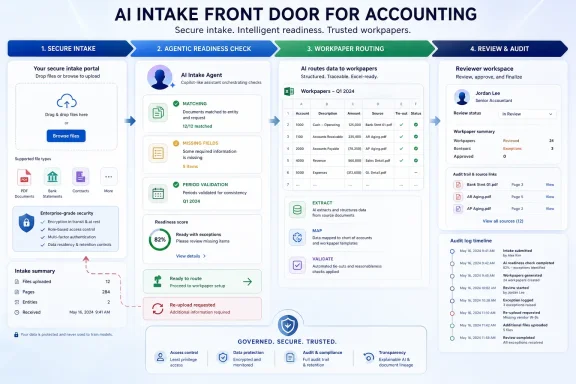
That workflow is a good candidate for automation because it is structured enough to model but chaotic enough to waste human time. Firms do not simply need an AI to summarize a PDF. They need a system that understands whether the right PDF arrived, whether it matches the request, whether the underlying data is complete, and whether the next test can be run without sending another email to the client.
Suralink is framing that bottleneck as the “Client Readiness Gap,” its term for the space between what firms need from clients and what clients actually provide. In plain English, it is the rework loop: accountants ask for information, clients upload something incomplete or inconsistent, staff inspect it, and the engagement slows down before professional judgment even begins. The company’s bet is that this is where AI produces measurable value, not in another side panel that writes polite follow-up messages.
That is a sharper proposition than much of the enterprise AI market has offered. It also raises the bar. If Suralink wants to claim the mantle of agentic automation, its agents must be judged not by demo fluency but by whether they reduce review cycles, lower write-offs, and make the audit trail more defensible.
The company says its expanded AI capabilities focus on the “Rework Cycle,” the recurring inefficiency caused when firms receive inaccurate or incomplete data from clients. This is a practical framing because it avoids the fantasy that AI simply replaces professional work. The real promise is narrower and more believable: stop bad inputs from spreading downstream.
That matters because bad client data becomes more expensive the later it is discovered. A missing support document at upload time is an annoyance. A missing support document after workpapers have been built, procedures drafted, and reviewers assigned becomes a schedule problem. If AI can flag or remediate those issues earlier, the productivity gain comes from preventing wasted motion rather than making accountants type faster.
The danger is that automation can also make bad assumptions travel faster. A prescreening agent that incorrectly blesses a weak document, or a testing agent that misclassifies a sample, could move flawed work forward with artificial confidence. In regulated professional environments, an agent’s output is only useful if the system preserves enough context for reviewers to understand what was checked, what was inferred, and what still requires human judgment.
The Document Prescreen Agent is meant to inspect client uploads at the time they arrive. In theory, that is exactly where automation belongs. It is far better to tell a client immediately that a file is wrong, incomplete, or mismatched than to let the engagement team discover the problem days later after the schedule has already absorbed the delay.
The Data Vouching Agent pushes further into the audit workflow. Vouching is not merely document handling; it is a procedure that links recorded transactions or balances to supporting evidence. Automating any part of that process invites a higher level of scrutiny because the agent is no longer just organizing work. It is participating in work that supports assurance conclusions.
Suralink’s Cloud Testing Suite is therefore the most consequential part of the announcement. If it performs well, it could turn the request-to-review process into something closer to a production line, where incoming client data is prescreened, structured, and initially tested before staff begin manual review. If it performs poorly, it risks becoming yet another layer that accountants must audit before they can audit the client.
The company is trying to answer that concern with a workflow-specific design. Rather than asking a general AI model to improvise over a pile of uploaded files, Suralink is embedding agents inside a platform that already knows the request list, the engagement context, and the expected evidence. That context is the difference between a useful accounting agent and a chatbot with a tax-season vocabulary.
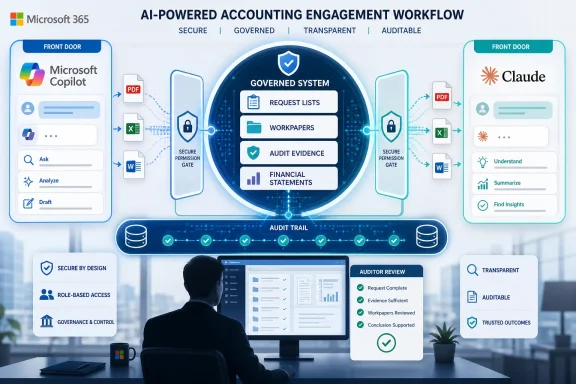
For accounting firms already standardized on Microsoft 365, Copilot is becoming a kind of command surface for work. If a partner, manager, or staff member can ask Copilot for engagement status, request gaps, testing progress, or next actions surfaced from Suralink, the portal becomes less of a destination and more of a system of record behind the assistant. That is the direction Microsoft has been pushing across the stack: agents that operate inside the flow of Word, Excel, Outlook, Teams, and enterprise data.
Suralink’s native Copilot connector is strategically important because professional-services firms are Microsoft-heavy environments. Excel remains the gravitational center of audit and advisory work, Outlook remains the operational bloodstream, and Teams has become the default collaboration layer for many firms. A Suralink integration that works naturally in that context is not cosmetic; it reduces the switching cost that often kills adoption.
But Copilot integration also creates dependency. If Microsoft changes licensing, governance controls, connector behavior, or model routing, vendors that lean heavily on Copilot must adapt quickly. For IT leaders, the question is not simply whether an integration exists. It is whether the integration respects identity, permissions, retention, audit logging, and data boundaries in a way that matches the firm’s risk posture.
That matters because agentic work is not a single-model problem. Different firms may have different governance rules, procurement agreements, data residency preferences, or comfort levels with model providers. A platform that can connect to both Microsoft Copilot and Claude is better positioned than one that assumes every customer will standardize on one assistant.
It also reflects a broader shift in the relationship between application vendors and foundation-model vendors. The most valuable software companies will not be the ones that merely pass prompts to a model. They will be the ones that bring proprietary workflow context, domain-specific controls, and reliable action layers. The AI model supplies reasoning and language capability; the business application supplies the map of what is allowed, expected, and auditable.
For Suralink, that means the Copilot and Claude integrations are only as useful as the underlying accounting platform. If the agent can see request status but cannot act safely, it is a dashboard. If it can act but cannot explain or constrain its actions, it is a liability. The winning version sits between those extremes: capable enough to remove repetitive work, bounded enough to satisfy reviewers and IT.
The practical challenge is that client data often arrives in unstructured or semi-structured formats: PDFs, exports, scanned documents, inconsistent spreadsheets, and support files that were never designed to feed an automated workflow. Suralink says Workpaper Suite Intelligence helps transform raw client data into engagement-ready workpapers, including AI-assisted extraction and linking. That is the kind of feature that either quietly saves hours or quietly creates cleanup work, depending on accuracy.
Excel integration is also where WindowsForum readers should pay attention to governance. Workpapers are not casual productivity artifacts. They contain client data, evidence, reviewer comments, and sometimes sensitive financial or personal information. Any AI-assisted process that reads, extracts, links, or tests that data must fit into document retention policies, access controls, and client confidentiality obligations.
The broader point is that AI in accounting will not be judged by how well it chats. It will be judged by whether it can survive contact with Excel, PDFs, portals, permissioning, and review notes. Suralink appears to understand that the battlefield is not an abstract AI workspace. It is the spreadsheet-heavy, evidence-driven workflow that firms already run.
If Suralink can prescreen documents at upload, automate initial testing, and deliver ready-to-review results, it moves from collaboration tool to operational control point. That is a valuable position. It is also one that comes with heavier expectations from customers, auditors, insurers, and regulators.
The front door cannot be a black box. Firms will need to know what the agent checked, what rules it applied, what exceptions it found, and which decisions remained untouched by automation. In some engagements, they may need to demonstrate that the AI did not alter evidence, overstep permissions, or expose client data to unauthorized systems.
That makes observability a central issue. Agentic AI vendors love to talk about autonomy, but enterprise buyers increasingly care about traceability. The agent that does less but logs its work clearly may be more valuable than the agent that does more but leaves reviewers guessing.
That does not mean every automation claim deserves belief. Accounting is full of edge cases masquerading as routine tasks. A bank statement, invoice, contract, or payroll report may look standard until the exception matters. AI systems that are impressive on typical documents can still stumble on low-quality scans, unusual formatting, nonstandard exports, or client-specific naming conventions.
Suralink’s strongest argument is that it is not arriving from outside the workflow. The company already sells into accounting firms and says it serves a substantial share of top firms. That installed context gives it a better shot than a generic AI startup at understanding what users actually need, where work stalls, and what firms will not tolerate.
Still, adoption will depend on proof rather than positioning. Firms will want evidence that these agents reduce cycle time without increasing review burden. They will want to know how exceptions are handled, how false positives and false negatives are measured, and how the system performs across different engagement types. The phrase ready-to-review is powerful only if reviewers agree.
That creates pressure on vertical SaaS vendors. A firm’s AI strategy cannot be a patchwork of isolated chatbots, each with its own permissions model and memory of work. IT leaders want agents that can be governed centrally, respect identity boundaries, and operate inside familiar productivity tools. Microsoft is trying to make Copilot that control plane.
For vendors like Suralink, integrating with Copilot is a way to avoid being marginalized by the productivity layer. If users increasingly ask Copilot to find, summarize, initiate, and route work, then line-of-business platforms must expose their workflows to that environment. Otherwise, they risk becoming databases that users touch only when the assistant cannot help.
The catch is that Microsoft’s platform ambitions can swallow partner differentiation. If Copilot becomes the interface, customers may attribute value to Microsoft even when the underlying domain intelligence comes from Suralink. That is the classic platform trade-off: distribution in exchange for some loss of foreground identity.
Accounting data is high-value data. It may include financial statements, tax information, payroll records, bank details, contracts, personally identifiable information, and confidential business documents. Connecting that data to agentic systems increases the importance of least-privilege access and clear retention policies.
The Copilot and Claude integrations also raise model-boundary questions. Firms will need to understand whether data is processed inside Suralink’s environment, through Microsoft-controlled services, through Anthropic-controlled services, or some combination. They will need contractual clarity on training use, data storage, logging, and incident response.
This is where vendor language often becomes too smooth. “Native integration” can mean many things, from a lightweight connector to deep workflow execution. IT buyers should press for architectural detail. The value of agentic AI rises when it can act, but so does the need to know exactly what action means.
That changes the sales conversation. Practice leaders will ask whether it reduces busy-season pain. IT will ask whether it fits identity and device policies. Security will ask whether client documents leave approved boundaries. Compliance leaders will ask how AI-assisted work is documented. Finance will ask whether the subscription cost is offset by realization gains.
Suralink’s claim that its customers grow faster than peers is exactly the kind of business outcome vendors want to put in front of managing partners. But operational lift is only half the story. The other half is whether the platform can pass the internal scrutiny that now follows any AI tool touching sensitive client data.
This is why Microsoft integration matters beyond convenience. Many firms already have Microsoft governance investments through Entra, Purview, Defender, Intune, and Microsoft 365 administration. If Suralink can align with that environment, it lowers the friction for approval. If the Claude integration can be governed with equal clarity, it broadens the platform’s appeal.
In accounting, that means understanding engagements, requests, evidence, testing procedures, reviewer expectations, and client collaboration patterns. A generic AI assistant can help a staff member write a follow-up message. A domain platform can know that the uploaded document does not satisfy the request, that the sample population is incomplete, or that a test cannot be completed without additional support.
That distinction will separate durable products from AI wrappers. The wrapper adds language to an existing interface. The durable product uses AI to change the workflow’s economics. Suralink is clearly claiming the second category.
The market will decide whether the claim holds. Competitors in audit, tax, document management, and practice management will not stand still. Expect every serious accounting platform to announce agents, copilots, or autonomous workflow features. The harder part will be proving that those features survive real engagements at scale.
 Suralink Is Selling an Agentic Accounting Stack, Not a Chatbot
The phrase agentic AI has been stretched nearly to breaking point by vendors that once sold autocomplete, then copilots, and now agents. Suralink’s announcement is notable because it is not centered on a general-purpose assistant sitting beside the user. It is centered on the repetitive, expensive handoff between clients and accounting firms: request documents, receive imperfect files, chase missing data, normalize the material, test it, and only then begin the higher-value review.That workflow is a good candidate for automation because it is structured enough to model but chaotic enough to waste human time. Firms do not simply need an AI to summarize a PDF. They need a system that understands whether the right PDF arrived, whether it matches the request, whether the underlying data is complete, and whether the next test can be run without sending another email to the client.
Suralink is framing that bottleneck as the “Client Readiness Gap,” its term for the space between what firms need from clients and what clients actually provide. In plain English, it is the rework loop: accountants ask for information, clients upload something incomplete or inconsistent, staff inspect it, and the engagement slows down before professional judgment even begins. The company’s bet is that this is where AI produces measurable value, not in another side panel that writes polite follow-up messages.
That is a sharper proposition than much of the enterprise AI market has offered. It also raises the bar. If Suralink wants to claim the mantle of agentic automation, its agents must be judged not by demo fluency but by whether they reduce review cycles, lower write-offs, and make the audit trail more defensible.
The Rework Cycle Is the Real Target
Accounting firms have spent years digitizing engagement management, but digitization has often meant moving friction from email into portals. A request list may be cleaner than an inbox, but it does not automatically make client data accurate, complete, or ready for testing. That distinction is where Suralink is trying to draw a line between workflow management and workflow execution.The company says its expanded AI capabilities focus on the “Rework Cycle,” the recurring inefficiency caused when firms receive inaccurate or incomplete data from clients. This is a practical framing because it avoids the fantasy that AI simply replaces professional work. The real promise is narrower and more believable: stop bad inputs from spreading downstream.
That matters because bad client data becomes more expensive the later it is discovered. A missing support document at upload time is an annoyance. A missing support document after workpapers have been built, procedures drafted, and reviewers assigned becomes a schedule problem. If AI can flag or remediate those issues earlier, the productivity gain comes from preventing wasted motion rather than making accountants type faster.
The danger is that automation can also make bad assumptions travel faster. A prescreening agent that incorrectly blesses a weak document, or a testing agent that misclassifies a sample, could move flawed work forward with artificial confidence. In regulated professional environments, an agent’s output is only useful if the system preserves enough context for reviewers to understand what was checked, what was inferred, and what still requires human judgment.
Five Agents Signal a Move From Portal to Production Line
Suralink says its new Agent Library includes five agents designed to help firm and client users complete engagements more efficiently. Two of them — Document Prescreen Agent and Data Vouching Agent — are combined into the company’s new Cloud Testing Suite. That pairing reveals the architecture of the pitch: first validate the incoming material, then automate an initial testing procedure.The Document Prescreen Agent is meant to inspect client uploads at the time they arrive. In theory, that is exactly where automation belongs. It is far better to tell a client immediately that a file is wrong, incomplete, or mismatched than to let the engagement team discover the problem days later after the schedule has already absorbed the delay.
The Data Vouching Agent pushes further into the audit workflow. Vouching is not merely document handling; it is a procedure that links recorded transactions or balances to supporting evidence. Automating any part of that process invites a higher level of scrutiny because the agent is no longer just organizing work. It is participating in work that supports assurance conclusions.
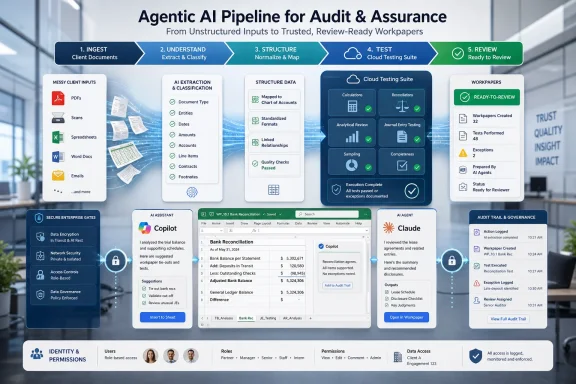
Suralink’s Cloud Testing Suite is therefore the most consequential part of the announcement. If it performs well, it could turn the request-to-review process into something closer to a production line, where incoming client data is prescreened, structured, and initially tested before staff begin manual review. If it performs poorly, it risks becoming yet another layer that accountants must audit before they can audit the client.
The company is trying to answer that concern with a workflow-specific design. Rather than asking a general AI model to improvise over a pile of uploaded files, Suralink is embedding agents inside a platform that already knows the request list, the engagement context, and the expected evidence. That context is the difference between a useful accounting agent and a chatbot with a tax-season vocabulary.
Copilot Integration Is a Distribution Strategy Disguised as a Feature
The Microsoft Copilot integration is the part of the announcement that will catch the eye of Windows and Microsoft 365 shops. It is also the part that says the most about the enterprise software market in 2026. Business applications increasingly have to meet users inside the productivity layer, not merely wait for them to log into another SaaS tab.For accounting firms already standardized on Microsoft 365, Copilot is becoming a kind of command surface for work. If a partner, manager, or staff member can ask Copilot for engagement status, request gaps, testing progress, or next actions surfaced from Suralink, the portal becomes less of a destination and more of a system of record behind the assistant. That is the direction Microsoft has been pushing across the stack: agents that operate inside the flow of Word, Excel, Outlook, Teams, and enterprise data.
Suralink’s native Copilot connector is strategically important because professional-services firms are Microsoft-heavy environments. Excel remains the gravitational center of audit and advisory work, Outlook remains the operational bloodstream, and Teams has become the default collaboration layer for many firms. A Suralink integration that works naturally in that context is not cosmetic; it reduces the switching cost that often kills adoption.
But Copilot integration also creates dependency. If Microsoft changes licensing, governance controls, connector behavior, or model routing, vendors that lean heavily on Copilot must adapt quickly. For IT leaders, the question is not simply whether an integration exists. It is whether the integration respects identity, permissions, retention, audit logging, and data boundaries in a way that matches the firm’s risk posture.
Claude Gives Suralink a Second Agentic Channel
Suralink’s Claude integration points to a parallel reality: enterprise AI is becoming multi-model by default. Microsoft may own the productivity surface in many firms, but Anthropic’s Claude has built a reputation in long-context, document-heavy, multi-step workflows — exactly the kind of terrain where accounting engagements live. Supporting Claude alongside Copilot gives Suralink optionality and gives customers a way to use the AI environment they already trust.That matters because agentic work is not a single-model problem. Different firms may have different governance rules, procurement agreements, data residency preferences, or comfort levels with model providers. A platform that can connect to both Microsoft Copilot and Claude is better positioned than one that assumes every customer will standardize on one assistant.
It also reflects a broader shift in the relationship between application vendors and foundation-model vendors. The most valuable software companies will not be the ones that merely pass prompts to a model. They will be the ones that bring proprietary workflow context, domain-specific controls, and reliable action layers. The AI model supplies reasoning and language capability; the business application supplies the map of what is allowed, expected, and auditable.
For Suralink, that means the Copilot and Claude integrations are only as useful as the underlying accounting platform. If the agent can see request status but cannot act safely, it is a dashboard. If it can act but cannot explain or constrain its actions, it is a liability. The winning version sits between those extremes: capable enough to remove repetitive work, bounded enough to satisfy reviewers and IT.
Excel Remains the Place Where AI Has to Prove Itself
Suralink’s Workpaper Suite Intelligence may be less flashy than agent names or Copilot connectors, but it may be more important to day-to-day users. The company has been building around Excel-based workpaper preparation, which is an acknowledgement of reality rather than nostalgia. Accounting firms do not abandon Excel just because vendors ask them to.The practical challenge is that client data often arrives in unstructured or semi-structured formats: PDFs, exports, scanned documents, inconsistent spreadsheets, and support files that were never designed to feed an automated workflow. Suralink says Workpaper Suite Intelligence helps transform raw client data into engagement-ready workpapers, including AI-assisted extraction and linking. That is the kind of feature that either quietly saves hours or quietly creates cleanup work, depending on accuracy.
Excel integration is also where WindowsForum readers should pay attention to governance. Workpapers are not casual productivity artifacts. They contain client data, evidence, reviewer comments, and sometimes sensitive financial or personal information. Any AI-assisted process that reads, extracts, links, or tests that data must fit into document retention policies, access controls, and client confidentiality obligations.
The broader point is that AI in accounting will not be judged by how well it chats. It will be judged by whether it can survive contact with Excel, PDFs, portals, permissioning, and review notes. Suralink appears to understand that the battlefield is not an abstract AI workspace. It is the spreadsheet-heavy, evidence-driven workflow that firms already run.
The “Front Door” Claim Cuts Both Ways
Suralink’s CEO Evan Fitzpatrick describes the platform as the “front door” for client data entering accounting firms. That is a strong claim and a useful one, because front doors are about control as much as convenience. The place where data first enters the firm is the place where quality, security, classification, and routing should begin.If Suralink can prescreen documents at upload, automate initial testing, and deliver ready-to-review results, it moves from collaboration tool to operational control point. That is a valuable position. It is also one that comes with heavier expectations from customers, auditors, insurers, and regulators.
The front door cannot be a black box. Firms will need to know what the agent checked, what rules it applied, what exceptions it found, and which decisions remained untouched by automation. In some engagements, they may need to demonstrate that the AI did not alter evidence, overstep permissions, or expose client data to unauthorized systems.
That makes observability a central issue. Agentic AI vendors love to talk about autonomy, but enterprise buyers increasingly care about traceability. The agent that does less but logs its work clearly may be more valuable than the agent that does more but leaves reviewers guessing.
The Accounting Market Is Ripe for AI, but Not for Hype
Accounting firms have a capacity problem that technology vendors are eager to solve. Talent shortages, compressed reporting timelines, increased client demands, and rising expectations around advisory services all push firms toward automation. The work is document-intensive, deadline-driven, and full of repeated patterns across engagements.That does not mean every automation claim deserves belief. Accounting is full of edge cases masquerading as routine tasks. A bank statement, invoice, contract, or payroll report may look standard until the exception matters. AI systems that are impressive on typical documents can still stumble on low-quality scans, unusual formatting, nonstandard exports, or client-specific naming conventions.
Suralink’s strongest argument is that it is not arriving from outside the workflow. The company already sells into accounting firms and says it serves a substantial share of top firms. That installed context gives it a better shot than a generic AI startup at understanding what users actually need, where work stalls, and what firms will not tolerate.
Still, adoption will depend on proof rather than positioning. Firms will want evidence that these agents reduce cycle time without increasing review burden. They will want to know how exceptions are handled, how false positives and false negatives are measured, and how the system performs across different engagement types. The phrase ready-to-review is powerful only if reviewers agree.
Microsoft’s Agent Push Is Becoming the Default Enterprise Weather
The timing of Suralink’s announcement is not accidental. Microsoft has spent 2026 pushing Copilot from assistant branding toward agentic infrastructure, with Microsoft 365, Copilot Studio, GitHub Copilot, Azure AI tooling, and governance layers all orbiting the same idea: AI systems should be able to take delegated work and operate across enterprise data.That creates pressure on vertical SaaS vendors. A firm’s AI strategy cannot be a patchwork of isolated chatbots, each with its own permissions model and memory of work. IT leaders want agents that can be governed centrally, respect identity boundaries, and operate inside familiar productivity tools. Microsoft is trying to make Copilot that control plane.
For vendors like Suralink, integrating with Copilot is a way to avoid being marginalized by the productivity layer. If users increasingly ask Copilot to find, summarize, initiate, and route work, then line-of-business platforms must expose their workflows to that environment. Otherwise, they risk becoming databases that users touch only when the assistant cannot help.
The catch is that Microsoft’s platform ambitions can swallow partner differentiation. If Copilot becomes the interface, customers may attribute value to Microsoft even when the underlying domain intelligence comes from Suralink. That is the classic platform trade-off: distribution in exchange for some loss of foreground identity.
IT Will Judge the Agents by Controls, Not Demos
For sysadmins and IT pros, the key questions around Suralink’s announcement are not whether the agents sound useful. They do. The questions are how they authenticate, what data they access, how actions are logged, and whether permissions follow the same model users already rely on.Accounting data is high-value data. It may include financial statements, tax information, payroll records, bank details, contracts, personally identifiable information, and confidential business documents. Connecting that data to agentic systems increases the importance of least-privilege access and clear retention policies.
The Copilot and Claude integrations also raise model-boundary questions. Firms will need to understand whether data is processed inside Suralink’s environment, through Microsoft-controlled services, through Anthropic-controlled services, or some combination. They will need contractual clarity on training use, data storage, logging, and incident response.
This is where vendor language often becomes too smooth. “Native integration” can mean many things, from a lightweight connector to deep workflow execution. IT buyers should press for architectural detail. The value of agentic AI rises when it can act, but so does the need to know exactly what action means.
The Buyer Is No Longer Just the Audit Team
One of the subtler implications of this announcement is that buying decisions for accounting technology are widening. A decade ago, a workflow tool might have been evaluated primarily by practice leaders and operations teams. An agentic automation platform with Copilot and Claude integrations now touches IT, security, compliance, procurement, and data governance.That changes the sales conversation. Practice leaders will ask whether it reduces busy-season pain. IT will ask whether it fits identity and device policies. Security will ask whether client documents leave approved boundaries. Compliance leaders will ask how AI-assisted work is documented. Finance will ask whether the subscription cost is offset by realization gains.
Suralink’s claim that its customers grow faster than peers is exactly the kind of business outcome vendors want to put in front of managing partners. But operational lift is only half the story. The other half is whether the platform can pass the internal scrutiny that now follows any AI tool touching sensitive client data.
This is why Microsoft integration matters beyond convenience. Many firms already have Microsoft governance investments through Entra, Purview, Defender, Intune, and Microsoft 365 administration. If Suralink can align with that environment, it lowers the friction for approval. If the Claude integration can be governed with equal clarity, it broadens the platform’s appeal.
The Competitive Bar Is Rising for Vertical SaaS
Suralink’s announcement is part of a larger pattern across business software: vertical SaaS vendors are being forced to prove that they have more than workflow screens. Once AI can draft, summarize, classify, and route information, the durable advantage shifts to vendors that own domain data models, trusted workflows, and embedded controls.In accounting, that means understanding engagements, requests, evidence, testing procedures, reviewer expectations, and client collaboration patterns. A generic AI assistant can help a staff member write a follow-up message. A domain platform can know that the uploaded document does not satisfy the request, that the sample population is incomplete, or that a test cannot be completed without additional support.
That distinction will separate durable products from AI wrappers. The wrapper adds language to an existing interface. The durable product uses AI to change the workflow’s economics. Suralink is clearly claiming the second category.
The market will decide whether the claim holds. Competitors in audit, tax, document management, and practice management will not stand still. Expect every serious accounting platform to announce agents, copilots, or autonomous workflow features. The harder part will be proving that those features survive real engagements at scale.
The Practical Read for Firms Watching Suralink’s Move
Suralink’s June 2026 announcement should be read as a sign that accounting AI is moving from assistant experiments into workflow automation. The firm that treats this as merely another software update may miss the governance and operating-model questions it raises. The firm that treats it as magic will be disappointed just as quickly.- Suralink is positioning its platform around reducing rework caused by incomplete or inaccurate client data, not simply adding a conversational AI layer.
- The new Cloud Testing Suite is the most ambitious piece because it combines document prescreening with data vouching before firm users begin deeper review.
- Native Microsoft Copilot integration matters because many accounting firms already live in Microsoft 365, Excel, Outlook, and Teams.
- Claude integration gives customers a second agentic channel and reflects the market’s move toward multi-model enterprise AI.
- IT and security teams should evaluate permissions, logging, data processing boundaries, retention, and exception handling before treating any agent as production-ready.
- The strongest business case will come from measurable reductions in review cycles, rework, and budget overruns, not from generic claims about AI productivity.
References
- Primary source: Bluefield Daily Telegraph
Published: Wed, 03 Jun 2026 11:02:34 GMT
Suralink Unveils Industry's Most Comprehensive Agentic AI Platform, Launches Microsoft Copilot & Claude Integrations
SALT LAKE CITY--(BUSINESS WIRE)--Jun 3, 2026--www.bdtonline.com
- Related coverage: techradar.com
50 Microsoft tools you can use for free just in time for Build 2026 | TechRadar
Free tools from across the Microsoft ecosystemwww.techradar.com - Related coverage: suralink.com

Client Readiness Gap
www.suralink.com
- Official source: blogs.microsoft.com
Introducing the First Frontier Suite built on Intelligence + Trust - The Official Microsoft Blog
Today Microsoft is announcing: Wave 3 of Microsoft 365 Copilot Expanded model diversity with Claude and next-gen OpenAI models available today General availability of Agent 365 on May 1 for $15 per user General availability of the new Microsoft 365 E7: The Frontier Suite on May 1 for $99 per...blogs.microsoft.com - Related coverage: go.suralink.com

Demo Workpaper Suite Intelligence
Introducing Workpaper Suite Intelligence from Suralink: Suralink’s AI-powered Workpaper Suite automates extraction and document querying taking away the 'grunt work.'
go.suralink.com
- Official source: news.microsoft.com
Microsoft kündigt neue agentische KI-Funktionen an - Source EMEA
 news.microsoft.com
- Related coverage: windowscentral.com
Microsoft Copilot Wave 3 adds AI agents and E7 Frontier Suite | Windows Central
Microsoft Copilot is rolling out more agentic AI control and model support in a new subscription tier for Microsoft 365.www.windowscentral.com - Related coverage: venturebeat.com
Microsoft announces Copilot Cowork with help from Anthropic — a cloud-powered AI agent that works across M365 apps | VentureBeat
Copilot Cowork operates in the cloud, inside Microsoft 365's infrastructure, and draws on something Claude Cowork simply cannot access: the full graph of a user's enterprise work data.venturebeat.com - Related coverage: ailearningguides.com
Microsoft 365 Copilot Wave 3 Adds Cowork With Anthropic - AI Learning Guides
Microsoft 365 Copilot Wave 3 just launched with Anthropic's Cowork tech, multi-model routing, and Agent Builder governance. What changed and how to use it.ailearningguides.com - Related coverage: itpro.com
Anthropic's Cowork tool is coming to Microsoft Copilot | IT Pro
The new Copilot Cowork tool will be made available through a new Microsoft 365 tier at the end of March.www.itpro.com - Related coverage: ia.acs.org.au
Microsoft adds Anthropic’s Claude to Copilot | Information Age | ACS
No longer an exclusive relationship with OpenAI.ia.acs.org.au