Surface Laptop Ultra: RTX Spark Superchip Brings Real Local AI Workstations to Windows

Microsoft announced the Surface Laptop Ultra at Computex 2026 in Taipei, a 15-inch professional Windows laptop built with Nvidia’s new RTX Spark superchip and scheduled to arrive this fall from Microsoft Surface and other PC makers. The machine is being pitched less as another premium notebook than as a mobile workstation for local AI, creative production, and developer workloads. That distinction matters because Microsoft and Nvidia are trying to move the “AI PC” story beyond neural-processing-unit checkboxes and into the heavier territory of large models, CUDA software, and unified memory. The bet is that Windows can become the natural home for personal AI computing — if buyers accept the price, thermals, battery claims, and software-transition risks that come with a first-generation platform.

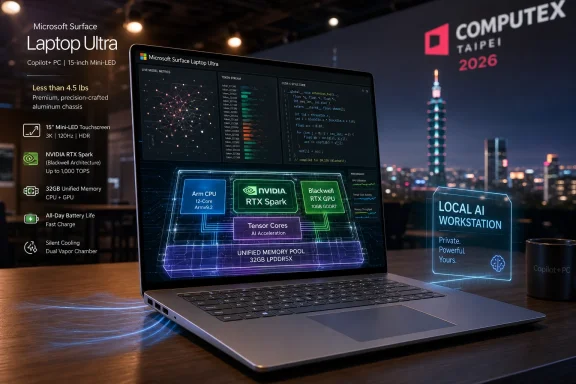
Promotional image of a Microsoft Surface Laptop Ultra with AI “local workstation” display over a city skyline.Microsoft Finally Puts Real Silicon Behind the AI PC Pitch​

For the last two years, the phrase AI PC has often meant a familiar laptop with an NPU, a marketing sticker, and a promise that Windows would eventually become more useful because some inference could run locally. Surface Laptop Ultra is a different sort of claim. Microsoft is not merely saying that the device can accelerate background effects or summarize a document; it is saying the laptop belongs in the same conversation as compact AI workstations.
That shift is enabled by Nvidia’s RTX Spark, a Windows-focused superchip derived from the Grace Blackwell lineage that already underpins Nvidia’s DGX Spark desktop-class system. The headline numbers are not subtle: up to one petaflop of FP4 AI performance, a 20-core Arm CPU, a Blackwell-generation RTX GPU, and configurations with up to 128GB of unified memory. Microsoft’s own positioning leans into those numbers with unusually grand language, describing the new Surface as a machine for “world makers.”
The phrase is florid, but the underlying strategy is straightforward. Microsoft has spent years trying to make Surface the place where Windows hardware feels coherent, aspirational, and tightly integrated. Nvidia has spent the same period turning CUDA, RTX, TensorRT, and its AI software stack into the default substrate for accelerated computing. Surface Laptop Ultra is what happens when those ambitions meet in a single portable machine.
It is also a tacit admission that the first wave of AI PCs was too modest to carry the whole story. NPUs are useful, and power-efficient local inference matters, but the developer and creator workloads Microsoft is invoking are not satisfied by small accelerators alone. If Windows is going to compete for serious local AI work, it needs memory capacity, GPU throughput, and software compatibility that feel closer to a workstation than a thin-and-light notebook.

The Surface Brand Moves From Showcase to Statement​

Surface has always been part product line, part argument. The original Surface tablets argued that Windows could be touch-first without surrendering productivity. The Surface Book argued that Microsoft could build premium hardware for creators. The Copilot+ era argued that Windows laptops could match the efficiency and instant-on polish that Apple Silicon made ordinary on the Mac.
Surface Laptop Ultra makes a more aggressive argument: Windows should not merely catch up to the MacBook Pro; it should claim the next performance category before Apple defines it. That is why the comparison many people will make is not to an ordinary Dell XPS or HP Spectre, but to high-memory MacBook Pro and Mac Studio configurations. Microsoft and Nvidia are aiming at the user who wants local model experimentation, GPU-accelerated creative tools, and a laptop that can plausibly replace a desktop workstation for a portion of the day.
The hardware design, at least in the announced outline, sounds conventional by Surface standards: a 15-inch laptop, a mini-LED display, a large touchpad, a professional port selection, and a weight under 4.5 pounds. That restraint is important. Microsoft is not showing a luggable science project; it is showing a Surface-shaped answer to a question many developers and creators are already asking: how much AI compute can fit in a machine that still looks like a laptop?
That also makes the product riskier. If a vendor ships a bulky workstation, customers expect noise, heat, compromises, and battery anxiety. If Microsoft ships a Surface, customers expect refinement. The promise of “all-day battery life” will be tested not by idle time or document editing, but by the first reviewer who loads a local model, renders a project, or pushes CUDA workloads long enough to discover where the performance curve bends.

RTX Spark Is the Real Product Launch​

The Surface announcement is the most visible part of the story, but Nvidia’s broader play is bigger than one laptop. RTX Spark is being positioned as a new class of Windows silicon for slim laptops and compact desktops, with systems expected from Microsoft Surface, ASUS, Dell, HP, Lenovo, MSI, and others. That breadth matters because Nvidia is not treating Spark as a boutique Surface experiment. It wants an ecosystem.
The architecture is the selling point. RTX Spark combines a high-performance Arm CPU with a Blackwell RTX GPU, fifth-generation Tensor Cores, FP4 support, and unified memory large enough to run models that would be awkward or impossible on mainstream laptops. The claim that these machines can run models in the 120-billion-parameter range locally is the sort of figure that changes the conversation from “AI feature” to “AI workstation.”
But the more consequential part may be CUDA. Windows on Arm has carried an obvious historical weakness: performance and compatibility gaps for existing x86 software. Nvidia’s presence changes the discussion because many of the workloads Microsoft wants to court are already organized around Nvidia’s developer ecosystem. If CUDA works well on RTX Spark laptops, Microsoft gets a bridge into serious AI and creative workflows that Qualcomm-only Windows Arm systems never fully possessed.
That does not erase the compatibility challenge. It reframes it. The Surface Laptop Ultra is not merely a Windows-on-Arm laptop; it is a Windows-on-Arm laptop that asks customers to believe Nvidia can bring enough of the accelerated software universe with it. For developers, that could be attractive. For IT departments, it could be another matrix of drivers, dependencies, virtualization assumptions, and application behavior to validate.

A Petaflop Sounds Simple Until Precision Enters the Room​

The one-petaflop figure is the sort of number that marketing departments love because it collapses complexity into a headline. It is also the sort of number that serious buyers immediately qualify. The performance claim is tied to FP4 AI compute, a low-precision format useful for certain inference workloads but not a universal substitute for FP16, BF16, FP32, or the varied precision requirements of training, simulation, rendering, and scientific computing.
That does not make the number meaningless. Low-precision inference is exactly where much of the current local AI excitement lives, particularly for quantized language models and agentic workflows that need to run persistently without sending every request to the cloud. If Surface Laptop Ultra can deliver a meaningful slice of that performance in real use, it will be one of the first portable Windows machines that makes large local AI feel native rather than experimental.
The memory story may be more important than the compute story. Up to 128GB of unified memory gives developers and AI hobbyists room to load larger models, keep complex pipelines resident, and avoid the constant compromises that come with conventional laptop VRAM limits. In the AI workstation world, memory capacity often determines what is possible before raw compute determines how fast it happens.
The catch is bandwidth, thermals, and software maturity. A compact superchip can be elegant, but large AI workloads are not gentle. Sustained performance in a laptop chassis depends on cooling, power delivery, firmware behavior, and whether applications are actually optimized for the platform. The gap between a keynote number and a long-running workload can be the difference between a category-defining machine and a very expensive demo box.

The Mac Comparison Is Inevitable, but Not Sufficient​

Every premium laptop announcement now invites the Apple Silicon comparison, and Surface Laptop Ultra practically begs for it. A high-memory, Arm-based, unified-memory laptop aimed at creators and developers is obviously entering MacBook Pro territory. Microsoft knows that, Nvidia knows that, and buyers know it too.
But the comparison can mislead if it stops at battery life and benchmark charts. Apple’s advantage is not just silicon; it is control. macOS, Apple’s chips, developer tools, media engines, and hardware design all move as one stack. That is why Apple can make difficult transitions look smoother than they are.
Microsoft’s advantage, if Surface Laptop Ultra succeeds, is breadth. Windows remains the default operating system for huge swaths of engineering, enterprise, gaming, and business software. Nvidia remains the default accelerator vendor for AI developers. A Windows laptop with modern Nvidia AI hardware and a credible battery profile could appeal to users who like Apple’s integrated model but cannot live inside Apple’s software world.
That is the strategic opening. Microsoft does not need every MacBook Pro buyer to switch. It needs to convince Windows professionals that they no longer have to choose between the software ecosystem they need and the efficient, unified-memory hardware they envy. Surface Laptop Ultra is the most direct version of that pitch Microsoft has made.

Local AI Is the Privacy Argument Microsoft Needed​

Cloud AI has a trust problem. Users and enterprises are increasingly aware that sending prompts, documents, code, logs, and internal data to remote systems creates governance questions even when vendors promise safeguards. Local AI does not solve every privacy or security problem, but it gives Microsoft and Nvidia a cleaner argument: more computation can happen on the device, under the customer’s control.
That argument lands especially well with regulated industries, developers working with proprietary code, and organizations that want AI assistance without turning every workflow into a cloud-compliance exercise. A laptop capable of running large models locally is not just a performance product; it is a policy product. It lets IT leaders ask whether some AI workloads can remain inside the endpoint boundary.
There is a practical side too. Local models reduce latency, work offline, and can be tuned around workflows that would be expensive or cumbersome to run continuously in the cloud. If Microsoft can pair RTX Spark hardware with Windows features that make local agents manageable, auditable, and useful, the AI PC finally gets a reason to exist beyond novelty.
The word if is doing real work there. Local AI can also mean local attack surface, local data leakage, unreviewed model behavior, and new questions about how agents interact with files, credentials, browsers, and enterprise systems. The more powerful the PC becomes, the more important Windows security boundaries become. Surface Laptop Ultra could make local AI more credible, but it also raises the stakes for endpoint management.

Enterprise IT Will See Both a Workstation and a Headache​

For sysadmins, Surface Laptop Ultra is not just a shiny device. It is a new class of endpoint that may blur the line between laptop, workstation, and AI development node. That can be useful, but it complicates procurement and support.
The first question is workload fit. A data scientist who needs to prototype models locally may be a good candidate. A video editor using RTX-accelerated tools may be another. A developer building agentic applications against local models could benefit immediately. But issuing this class of machine broadly because it has “AI” in the name would be the expensive version of repeating the Copilot+ confusion.
The second question is fleet manageability. Windows on Arm has improved, but enterprises still run long tails of VPN clients, endpoint agents, device-control tools, legacy utilities, custom applications, and hardware drivers. Nvidia’s involvement may solve many performance problems for accelerated workloads, but it does not automatically certify every enterprise dependency.
The third question is lifecycle discipline. If Surface Laptop Ultra lands in the fall as a premium, first-generation platform, IT leaders will want pilot programs rather than mass deployments. They will want to test imaging, enrollment, security baselines, driver updates, application compatibility, remote support, thermal behavior, and model-management policies. That is not skepticism; it is responsible adoption.
Microsoft’s opportunity is to make those pilots boring. If the company can integrate RTX Spark machines cleanly into Intune, Windows Update, Defender, developer tooling, and enterprise policy controls, the hardware becomes easier to justify. If the experience feels like a special case, Surface Laptop Ultra risks becoming another elite device that impresses reviewers while remaining rare in managed fleets.

Creators Get the Clearest Short-Term Benefit​

The most immediate audience may not be enterprise IT at all. It may be creators who already understand the value of Nvidia acceleration and already pay for high-end laptops. For them, the appeal is obvious: more memory, better AI acceleration, a premium display, and portable performance in a Surface chassis.
Adobe’s involvement is particularly important because creative professionals do not buy hardware for abstract compute. They buy it because Photoshop, Premiere, After Effects, Blender, DaVinci Resolve, Unreal Engine, or a similar tool runs better and saves time. If major creative applications are optimized for RTX Spark, Microsoft has a much easier sales pitch.
That is why Surface Laptop Ultra’s mini-LED display and professional design are not incidental. The machine must compete as a creator laptop even when nobody is running a 120-billion-parameter model. Color, brightness, ports, input quality, webcam behavior, speakers, thermals, storage speed, and display calibration will all matter. A portable AI supercomputer still has to be a good laptop.
Gaming is the wildcard. Nvidia’s RTX branding inevitably brings gaming expectations, but RTX Spark is being framed around AI, creation, and efficiency rather than as a simple GeForce replacement. If games run well, that helps. If compatibility or performance varies because of Arm, drivers, or translation layers, Microsoft will need to be precise about who the machine is really for.

The Price Silence Speaks Loudly​

The missing number in the announcement is price, and it may be the most important specification. A machine with an Nvidia Blackwell-class GPU, 128GB of unified memory, a mini-LED display, a premium chassis, and Surface branding is not going to be cheap. The question is whether it is expensive in the way a professional workstation is expensive, or expensive in the way a luxury experiment is expensive.
Microsoft can justify a high price if the performance is real and the target customer is narrow. Developers working with local models, creators billing by the hour, researchers prototyping on the road, and technical executives who need a portable demonstration machine may all tolerate workstation-class pricing. Consumers who were merely told they needed an AI PC will not.
The broader RTX Spark ecosystem may help here. If Dell, HP, Lenovo, ASUS, and MSI ship a range of laptops and compact desktops, Surface does not have to cover every price point. Microsoft can let Surface Laptop Ultra occupy the premium reference-design role while partners chase volume, specialized workstation configurations, and corporate purchasing channels.
That would be very Microsoft. Surface often works best when it defines the shape of a category rather than dominates it. The original Surface Pro did not single-handedly own the detachable market, but it forced PC makers to respond. Surface Laptop Ultra may be designed to do the same for AI workstations disguised as laptops.

Windows Gets Another Chance to Own the Developer Desk​

For developers, the historical gravitational pull of Nvidia hardware has been desktop Linux, cloud instances, and workstation towers. Windows has remained essential for many workflows, but serious AI development often required compromises, dual-boot arrangements, WSL, remote servers, or cloud notebooks. Microsoft wants to make that division feel outdated.
The company has already invested heavily in WSL, Windows Terminal, Dev Home, Visual Studio Code, and cloud-connected development environments. Surface Laptop Ultra gives that software story a hardware anchor. A developer could plausibly edit, build, run local inference, test agent workflows, and deploy to larger Nvidia infrastructure without leaving a portable Windows machine.
That last part is crucial. Nvidia’s pitch for DGX Spark has always included a path from local prototype to larger DGX systems and cloud infrastructure. RTX Spark on Windows extends that funnel into the mainstream PC market. If the local model, containers, drivers, and frameworks behave consistently across laptop, desktop, and data center, Nvidia gains another layer of lock-in and Microsoft gains a developer story that feels current.
There is a risk of overpromising. A laptop, even a remarkable one, is not a replacement for a cluster. Local development is not the same as production training. FP4 inference is not universal AI acceleration. But the machine does not have to replace the data center to matter. It only has to make the first mile of AI development faster, more private, and more accessible.

The AI PC Finally Becomes a Hardware Category With Teeth​

The most interesting thing about Surface Laptop Ultra is that it makes the AI PC debate less abstract. Until now, many AI PC announcements could be dismissed as future-facing platforms waiting for software. This one arrives with a clearer identity: local AI workstation, premium creator laptop, Nvidia software vehicle, and Windows-on-Arm stress test.
That clarity cuts both ways. A vague AI PC can survive on promise. A machine like Surface Laptop Ultra will be judged by workloads. Can it run large local models without turning into a space heater? Can it maintain useful battery life outside light productivity? Can professional apps exploit the hardware? Can Windows on Arm avoid the old trap of “mostly fine” compatibility? Can Microsoft explain who should buy it without pretending everyone needs it?
If the answer to those questions is mostly yes, the Surface Laptop Ultra could become the first AI PC that feels less like a branding exercise and more like a new workstation class. If the answer is no, it will still be useful as a signal: Microsoft and Nvidia know where they want Windows hardware to go, even if the first attempt is imperfect.
The timing helps. By fall 2026, AI fatigue will be real, but so will the demand for practical local tools. Developers are experimenting with local models because cloud costs and privacy constraints are real. Creators are adopting AI-assisted workflows because deadlines are real. Enterprises are looking for controlled deployment models because governance is real. A powerful local Windows machine speaks to all three pressures.
The Surface Ultra Story in Five Hard Edges​

The announcement is exciting precisely because it is not simple. Surface Laptop Ultra could be a milestone for Windows hardware, but only if Microsoft and Nvidia turn impressive silicon into a dependable daily machine.
  • Surface Laptop Ultra is Microsoft’s most ambitious Surface performance pitch yet, combining a 15-inch premium laptop design with Nvidia’s RTX Spark superchip and up to 128GB of unified memory.
  • Nvidia’s RTX Spark matters beyond Surface because it is planned for laptops and compact desktops from multiple major Windows PC makers this fall.
  • The one-petaflop AI claim is tied to low-precision FP4 workloads, so real-world value will depend on model type, software optimization, thermals, and sustained performance.
  • The strongest early audiences are likely to be AI developers, creators, researchers, and enterprise pilot groups rather than ordinary laptop buyers.
  • Windows on Arm compatibility, CUDA maturity, driver stability, and price will determine whether the platform becomes a workstation category or a premium curiosity.
  • The biggest strategic win for Microsoft would be making local AI feel like a normal Windows capability instead of a cloud feature squeezed awkwardly onto a laptop.
Surface Laptop Ultra is not important because every Windows user suddenly needs a portable AI supercomputer. It is important because Microsoft and Nvidia are drawing a line between the first marketing-heavy phase of AI PCs and a more serious hardware era where memory, GPU acceleration, local models, and software ecosystems matter. If the fall launch delivers on the promise without drowning users in first-generation compromises, Windows could regain something it has not owned for years: the sense that the most interesting personal computers are being built on its side of the aisle.

References​

  1. Primary source: Mashable
    Published: Mon, 01 Jun 2026 09:00:00 GMT
  2. Related coverage: nvidia.com
  3. Related coverage: gizmochina.com
  4. Related coverage: investor.nvidia.com
  5. Related coverage: windowscentral.com
  6. Related coverage: tomshardware.com
  1. Related coverage: windowslatest.com
  2. Related coverage: nvidia.cn
  3. Official source: blogs.windows.com
  4. Official source: microsoft.com
  5. Related coverage: notebookcheck.net
  6. Related coverage: theregister.com
  7. Related coverage: tdsynnex.com
  8. Related coverage: nvidianews.nvidia.com
  9. Related coverage: signal65.com
  10. Related coverage: docs.nvidia.com
 

Microsoft announced the Surface Laptop Ultra at Computex 2026 in Taipei on June 1, positioning it as a fall-shipping 15-inch Windows laptop built around Nvidia’s new RTX Spark superchip for local AI workloads. The headline is not that Surface is getting faster; Surface has been getting faster in predictable increments for more than a decade. The real story is that Microsoft is letting Nvidia define the most ambitious Windows PC of the AI era, and doing it in a form factor that looks less like a workstation and more like a premium laptop.
That makes Surface Laptop Ultra more than another halo device. It is a test of whether the “AI PC” can finally mean something beyond a Copilot key, a neural processing unit badge, and a few webcam tricks. If Microsoft and Nvidia are right, the next serious Windows machine is not merely cloud-connected; it is a local inference box with a keyboard.

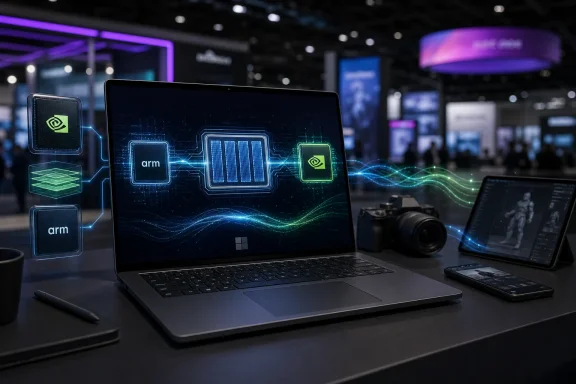
Laptop in a tech expo shows ARM chip circuitry graphics, with neon data lines behind in a blurred conference hall.Microsoft’s Most Interesting Surface Is Also Its Least Traditional One​

Surface began life as Microsoft’s argument about what Windows hardware should be. The first devices were not always loved, and they were not always commercially elegant, but they gave OEMs a shove: touch mattered, kickstands were not absurd, detachable keyboards could be better, and premium Windows hardware did not have to be a beige compromise.
Surface Laptop Ultra feels like a different kind of shove. This time Microsoft is not correcting the industrial design of Windows PCs. It is trying to redefine the performance center of gravity.
The reported configuration is deliberately extravagant: Nvidia RTX Spark silicon, a Blackwell-class GPU block, a 20-core Arm CPU, up to 128GB of unified memory, and roughly one petaflop of FP4 AI performance. Those numbers require interpretation, because AI marketing has become a swamp of precision formats, sparsity assumptions, and workload-specific boasts. Still, even with the usual caveats, this is not a normal laptop spec sheet.
The important phrase is unified memory. A traditional performance laptop typically separates system RAM from GPU VRAM, forcing developers and creative applications to live inside a split memory budget. A machine with 128GB of coherent memory shared across CPU and GPU changes the shape of local AI development, especially for large models that are memory-bound before they are compute-bound.
That is why Microsoft’s “portable AI supercomputer” language, while overcaffeinated, is not entirely nonsense. The Surface Laptop Ultra is not going to replace a cloud training cluster, and it is not going to make every developer a frontier-model lab. But it could make a class of AI work feel local, iterative, and private in a way that today’s mainstream laptops do not.

Nvidia Has Found a New Door Into Windows​

For decades, Nvidia’s role in Windows PCs has been obvious: the GPU vendor for games, workstations, rendering, CUDA acceleration, and, more recently, AI. The CPU belonged to someone else. Intel defined the mainstream PC. AMD fought its way into the same lane. Qualcomm tried to make Windows on Arm matter. Nvidia mostly lived beside the processor, not inside the definition of the PC itself.
RTX Spark changes that dynamic. It is not just “a GPU in a laptop.” It is Nvidia presenting a complete compute platform for Windows machines, one that combines Arm CPU cores, Blackwell GPU technology, tensor acceleration, and unified memory into a single design philosophy.
That matters because Microsoft has spent years trying to escape the gravitational pull of the classic x86 upgrade cycle. Windows on Arm has improved, but its public identity remains tangled in app compatibility, performance skepticism, and the long shadow of failed attempts. Qualcomm’s Snapdragon X generation gave Microsoft its best consumer-facing Arm moment in years, but Nvidia brings something different: not just battery life and thinness, but developer heat.
Nvidia’s pitch is simple and dangerous for the rest of the PC industry. If AI workloads are the new premium workload, and if those workloads care about GPU architecture, memory bandwidth, tensor performance, and software libraries, then Nvidia can claim the high ground. The company does not need to own every Windows PC. It only needs to own the machines that define what “serious” local AI computing looks like.
That is why the Surface branding matters. Microsoft could have left RTX Spark to Dell, HP, Lenovo, Asus, MSI, Acer, and Gigabyte. Instead, Surface is reportedly in the first wave. Microsoft is lending its own hardware badge to Nvidia’s claim that the future Windows PC is not an Intel notebook with a better NPU, but a different class of machine altogether.

The Petaflop Number Is Real Marketing, But the Memory Story Is Real Engineering​

“One petaflop” is the kind of number that makes readers either sit up or roll their eyes. Both reactions are justified. The figure refers to AI performance under particular low-precision conditions, not a universal promise that every workload suddenly runs like a data-center benchmark.
The more durable specification is the 128GB memory ceiling. Local AI has an appetite that ordinary laptops cannot satisfy. Many users have discovered that the bottleneck is not whether a model can technically run, but whether it runs fast enough, with a useful context window, while leaving the rest of the machine usable.
That is the distinction between a demo and a tool. A small model running locally on a thin laptop can be impressive for five minutes. A larger model running locally with enough memory to support real coding, document analysis, media workflows, and agentic automation is a different proposition.
Surface Laptop Ultra’s likely audience is not the average Word-and-browser customer. It is the developer fine-tuning a workflow, the researcher testing model behavior, the video professional using AI-assisted editing, the architect generating design variants, the security analyst processing sensitive data, and the enterprise team that wants AI capability without shipping every prompt to a cloud service.
Those users do not merely need “AI features.” They need local capacity. That is the argument Microsoft and Nvidia are making, and it is more persuasive than another round of animated Copilot demos.

The AI PC Has Been Waiting for a Workload That Justifies the Name​

The first wave of AI PCs was strangely underwhelming. The hardware vendors were not wrong that NPUs mattered, and Microsoft was not wrong that Windows needed a local AI story. But much of the initial pitch collapsed into background blur, live captions, image effects, and assistant integrations that did not require a new category of computer in the buyer’s mind.
The Surface Laptop Ultra is a reaction to that problem. It says, implicitly, that the AI PC cannot be sold only as a slightly smarter ultrabook. It has to become a machine that can run workloads people currently associate with cloud GPUs, lab desktops, or rented inference endpoints.
That shift makes the device easier to understand and harder to mainstream. A petaflop-class AI laptop with 128GB of memory will not be cheap, and Microsoft has not announced pricing. The company’s silence is its own signal. This is almost certainly a halo machine, not a volume play.
But halo machines shape expectations. The original MacBook Pro did not represent every Mac buyer, and Nvidia’s top-end GPUs do not represent every Steam user. They still define the aspirational edge of a platform. Surface Laptop Ultra may play the same role for Windows AI hardware.
If it succeeds, “AI PC” stops being a compliance label and starts describing a tiered market. At the bottom are everyday machines with NPUs for system features and battery-friendly acceleration. In the middle are creator laptops with discrete GPUs and local AI tools. At the top are unified-memory AI workstations pretending, with varying degrees of success, to be portable computers.

Surface Is Becoming a Reference Design Again​

Microsoft does not need Surface Laptop Ultra to sell in huge numbers for it to matter. Surface has often functioned as a reference design with a price tag, a public statement of where Microsoft wants OEMs to go. The RTX Spark partner list suggests that is exactly the role this launch is meant to play.
Dell, HP, Lenovo, Asus, MSI, Acer, and Gigabyte are not bit players. If RTX Spark machines arrive across laptops and compact desktops this fall, the Surface model becomes the cleanest expression of a broader platform shift rather than a one-off science project. Microsoft gets to say Windows is ready for personal AI hardware. Nvidia gets a Windows ecosystem for its local AI ambitions. OEMs get a new premium tier to sell into a PC market that still needs reasons to upgrade.
There is an echo here of the Ultrabook era, when Intel used hardware requirements and marketing pressure to drag Windows laptops toward thinner, better, more premium designs. The difference is that Nvidia’s lever is not thinness. It is local compute.
That changes the politics. Intel and AMD both have AI roadmaps. Qualcomm has an Arm-based Windows pitch centered on efficiency. Microsoft is now standing onstage with Nvidia for a device that points in a different direction: not merely “the laptop lasts longer,” but “the laptop can do work that used to live somewhere else.”
This is why enterprise buyers will watch closely, even if they do not buy version one. The question is not whether every employee needs a Surface Laptop Ultra. They do not. The question is whether certain high-value roles can justify a local AI workstation that travels.

Windows on Arm Gets a Strange but Powerful New Advocate​

If Surface Laptop Ultra uses Nvidia’s Arm-based Grace CPU cores as expected, it lands in the long, uneven story of Windows on Arm. That story has improved substantially, but it remains haunted by three letters: x86. Compatibility is better than it used to be, emulation is better than it used to be, and native Arm64 applications are more common than they used to be. “Better than it used to be,” however, is not the same as invisible.
This is where Nvidia’s software ecosystem could matter as much as its silicon. Developers working in AI already live in a world of CUDA, containers, Python environments, model runtimes, acceleration libraries, and hardware-specific tuning. If Nvidia can make RTX Spark feel like a first-class local AI target on Windows, it could pull the professional audience toward Arm for reasons that have nothing to do with battery-life charts.
That would be a major reversal. Windows on Arm has often been sold as a consumer convenience: thinner, quieter, longer-lasting. Surface Laptop Ultra would sell Arm as a workstation decision. That is a much more interesting argument.
The risk is fragmentation. Windows developers already have to think about x86, x64, Arm64, discrete GPUs, integrated GPUs, NPUs, DirectML, CUDA, ONNX Runtime, Copilot Runtime, and a growing set of model-serving layers. Adding a premium Nvidia Arm Windows class could energize the market, but it could also make software support more complicated.
Microsoft’s job is to make the complexity disappear. Historically, that has been easier said than done.

The Mac Comparison Is Unavoidable, and Microsoft Knows It​

The Mashable SEA report frames Surface Laptop Ultra’s local model capacity as comparable to a Mac mini with 128GB of memory. That comparison is telling, because Apple has spent the Apple Silicon era teaching buyers that unified memory is not a minor implementation detail. It is central to what the machine can do.
Apple’s advantage has been integration. The CPU, GPU, neural engine, memory system, operating system, developer tools, and industrial design all tell one story. Microsoft’s Windows ecosystem is messier, but also broader. It can absorb Nvidia, AMD, Intel, Qualcomm, and dozens of OEM designs. That flexibility is Windows’ strength and its tax.
Surface Laptop Ultra appears designed to answer Apple on Apple’s strongest terrain: premium mobile hardware with a large unified memory pool and creator-friendly performance. But Microsoft’s answer is not to copy the MacBook Pro exactly. It is to put Nvidia’s AI stack at the center and aim directly at people who care about local inference.
That could be smart. Apple is formidable in creative workflows and increasingly credible in local AI experimentation, but Nvidia remains the default language of modern AI development. If a buyer’s world revolves around CUDA-accelerated tooling, model deployment paths, and GPU-centric development habits, an Nvidia-based Windows machine has a native appeal Apple cannot easily duplicate.
The irony is that Microsoft’s most Mac-like Surface may be the one that succeeds by being least like a Mac internally.

The Missing Specs Are Not Footnotes​

For all the excitement, the unknowns are large. Microsoft has not disclosed pricing. Full battery-life details are missing. Thermal behavior is unproven. Storage configurations, memory bandwidth behavior under sustained load, repairability, enterprise manageability, Linux or container workflows, driver maturity, and app compatibility all matter more than the launch adjectives.
“All-day battery life” is especially slippery. A laptop can have all-day battery life while writing email and browsing the web, then burn through its charge rapidly under sustained local inference or rendering. That does not make the claim false, but it does make it incomplete.
Thermals may be the harder problem. A chip that looks spectacular in a compact desktop can behave very differently in a thin 15-inch chassis. Sustained performance is what separates a workstation from a benchmark theater. If Surface Laptop Ultra throttles aggressively under real AI loads, the marketing story will sour quickly among the people most likely to pay for it.
Pricing will determine whether this is a niche developer jewel or a credible fleet device for specialized enterprise roles. Nvidia’s DGX Spark desktop-class systems have already taught buyers that personal AI supercomputing is not a bargain-bin category. A Surface version with a premium display, battery, chassis, and Microsoft branding is unlikely to arrive gently.
That does not doom it. Professional machines can be expensive if they save time, protect data, or replace cloud spending. But Microsoft will need to explain the value in operational terms, not just superlatives.

Local AI Is Also a Security and Governance Argument​

The most interesting enterprise pitch for Surface Laptop Ultra may not be speed. It may be control. Running models locally can reduce the need to send sensitive prompts, documents, code, logs, or customer data to external services. For regulated industries, that is not a philosophical point; it is a procurement argument.
Local AI does not magically solve governance. A model running on a laptop can still leak data through bad workflows, insecure plugins, careless logging, poisoned inputs, or unmanaged output. IT departments will still need policy, auditing, endpoint protection, model provenance, and data-loss controls.
But the locality changes the conversation. Cloud AI centralizes compute and can simplify governance at scale, but it also creates dependency, latency, cost, and data-residency concerns. Local AI moves some of the risk and capability to the endpoint. That is both attractive and alarming.
Windows is already the enterprise endpoint battleground. If AI agents begin acting on files, apps, browser sessions, command lines, and enterprise data, the endpoint becomes even more important. Microsoft’s security story around Surface Laptop Ultra must therefore extend beyond “it runs models locally.” It has to address what those models are allowed to touch, how actions are mediated, and how administrators can prove what happened.
That is where Windows management tooling could become a differentiator. A powerful AI laptop without governance is a toy for enthusiasts. A powerful AI laptop with policy hooks, identity integration, endpoint controls, and auditable local inference could become a new class of professional device.

Developers Will Decide Whether This Is a Workstation or a Curiosity​

Hardware launches often assume software will arrive because the silicon is impressive. That assumption is dangerous. Developers adopt platforms when the platform reduces friction, reaches users, and improves their work.
For RTX Spark, the strongest path runs through the existing Nvidia ecosystem. If CUDA-oriented workloads, popular model runners, container workflows, AI coding tools, image and video generation pipelines, and inference frameworks behave predictably on Surface Laptop Ultra, the device has a plausible early audience. If setup is brittle, drivers lag, or Windows-specific oddities pile up, the machine becomes an expensive curiosity.
The Windows developer experience is better than its reputation in many areas, especially with WSL, modern terminal tooling, package managers, and improved virtualization. But AI development can be unforgiving. A missing library, unsupported wheel, driver mismatch, or memory allocation quirk can turn a premium machine into a troubleshooting weekend.
Microsoft and Nvidia must make the first-run experience boring. That means clean installers, clear documentation, stable drivers, supported runtimes, and realistic sample workflows. The buyer who spends workstation money should not have to become a forum archaeologist to run common models locally.
WindowsForum readers know this pattern well. Hardware potential is easy to announce. Driver maturity is earned over months.

The Consumer Story Is Gaming, Creation, and Bragging Rights​

Although Microsoft is talking about world makers and AI workers, Surface Laptop Ultra will inevitably be judged as a normal laptop too. It has a 15-inch form factor, a mini-LED display, lots of ports, an oversized touchpad, and a sub-4.5-pound target. That is premium laptop territory, not just lab equipment.
Gaming performance is an open question. Blackwell GPU cores and Nvidia branding invite gaming assumptions, but an AI-focused integrated superchip is not necessarily equivalent to a conventional high-wattage GeForce laptop GPU. Drivers, memory architecture, power limits, and graphics configurations will determine where it lands.
Creative performance may be more central. Video editing, 3D rendering, AI-assisted upscaling, image generation, local transcription, audio cleanup, and design iteration are workloads where GPU acceleration and memory capacity can produce obvious user value. These are the tasks that can make a machine feel magical without requiring the buyer to understand model parameter counts.
The bragging-rights crowd will exist, of course. Every halo laptop attracts buyers who want the fastest, strangest, most future-proof machine on the table. Microsoft will not mind. Enthusiasts often subsidize the early phase of a platform shift.
But Surface Laptop Ultra’s real consumer challenge is narrative. Microsoft has to explain why a user should buy this instead of a MacBook Pro, a traditional RTX gaming laptop, a Snapdragon ultrabook, or a compact desktop plus a cheaper laptop. The answer cannot be “AI” alone. It has to be which AI work, done where, with what advantage.

OEMs Get a New Premium Tier, but Also a New Headache​

The broader RTX Spark partner wave may be more important than the Surface model itself. If every major Windows PC maker ships Spark devices this fall, Microsoft and Nvidia are not launching a laptop; they are launching a category.
That category creates opportunity. PC makers have spent years trying to lift average selling prices with premium materials, OLED panels, gaming GPUs, creator branding, and enterprise security features. AI workstations give them another story to tell, one with obvious resonance in boardrooms and developer teams.
It also creates confusion. Buyers will have to parse NPU TOPS, GPU tensor performance, FP4 claims, unified memory capacity, model-size support, Copilot features, CUDA compatibility, and battery life. The PC market is already bad at simple naming. An AI hardware arms race could make it worse.
Microsoft should be careful here. If every OEM slaps “AI supercomputer” on machines with wildly different sustained performance and software readiness, the term will decay quickly. The company has already seen how “AI PC” can become background noise when buyers cannot connect it to concrete outcomes.
Surface Laptop Ultra can help by serving as a benchmark for what the top of the category should mean. But Microsoft will need restraint from its partners and clarity from Nvidia. Otherwise, the launch becomes another spec fog.

The Fall Window Sets Up a High-Stakes Windows Season​

A fall arrival gives Microsoft and Nvidia several months to turn an announcement into a platform. That timing matters. It allows developer tools, Windows updates, OEM designs, and enterprise messaging to converge before holiday buying and year-end procurement cycles.
It also gives competitors time to respond. Intel and AMD will not concede the AI PC narrative. Qualcomm will continue pressing the efficiency and Arm-native Windows story. Apple will keep improving local AI capabilities across Mac hardware. Cloud providers will argue that serious AI still belongs in scalable infrastructure, not on individual endpoints.
That competition is healthy, but it raises the bar. Surface Laptop Ultra cannot arrive as a beautiful machine with unfinished software. The first wave of buyers will be technically sophisticated, vocal, and unforgiving. They will test local LLMs, image models, developer stacks, battery drain, fan noise, thermals, virtualization, external monitor behavior, sleep reliability, and every driver edge case they can find.
If Microsoft delivers, it gets a new Surface legend. If it stumbles, the story becomes familiar: brilliant hardware idea, compromised by the realities of Windows platform complexity.
The stakes are higher because the AI PC market is still forming. Early impressions will shape whether buyers see local AI hardware as essential, premature, or simply overpriced.

The Surface Ultra Bet Comes Down to Five Concrete Tests​

The launch language is big, but the verdict will come from practical details. Surface Laptop Ultra will be judged less by whether it sounds like the future and more by whether it behaves like a tool people can trust.
  • Microsoft needs to prove that RTX Spark’s local AI performance holds up under sustained real workloads, not just short demonstrations and precision-specific peak numbers.
  • Nvidia needs to make the Windows software stack feel as dependable as its data-center reputation suggests, especially for developers using common AI frameworks and model runners.
  • The 128GB unified-memory option must translate into visibly better local model, creative, and engineering workflows than conventional premium laptops can offer.
  • Battery life and thermals must be honest enough that buyers understand the difference between everyday laptop use and workstation-class AI operation.
  • Enterprise adoption will depend on management, security, and governance features as much as raw performance.
  • Pricing will decide whether Surface Laptop Ultra is a rare halo machine or the first believable member of a new professional Windows category.
The useful way to read Surface Laptop Ultra is not as a miracle device, but as a line in the sand. Microsoft is saying that the next phase of Windows hardware will not be defined only by thinner chassis, better webcams, or cloud-connected assistants. Nvidia is saying that the PC’s AI future runs through its compute architecture, not merely through an NPU checkbox. If the machine that arrives this fall can turn those claims into reliable daily work, Surface will once again have done what Surface was built to do: show the Windows ecosystem what it should become next.

References​

  1. Primary source: Mashable SEA
    Published: Mon, 01 Jun 2026 09:21:09 GMT
  2. Related coverage: axios.com
  3. Related coverage: nvidia.com
  4. Related coverage: gizmochina.com
  5. Related coverage: investor.nvidia.com
  6. Related coverage: windowscentral.com
  1. Related coverage: tomshardware.com
  2. Related coverage: windowslatest.com
  3. Related coverage: nvidia.cn
  4. Related coverage: flopper.io
  5. Related coverage: 91mobiles.com
  6. Related coverage: dataconomy.com
  7. Related coverage: docs.nvidia.com
  8. Related coverage: techradar.com
  9. Related coverage: pcgamer.com
  10. Related coverage: tdsynnex.com
  11. Related coverage: intuitionlabs.ai
 

Microsoft announced the Surface Laptop Ultra globally on June 1, 2026, positioning the 15-inch Windows laptop as its most powerful Surface yet, with a mini-LED PixelSense Ultra display, NVIDIA RTX Spark silicon, up to 128GB of unified memory, and a repairable SSD design. The launch is not just another premium Surface refresh. It is Microsoft’s clearest attempt yet to make the Windows laptop feel like a first-class workstation for local AI, creator software, and GPU-heavy development. The gamble is that “AI PC” no longer means a modest NPU tucked beside a familiar processor, but a machine built around serious local compute.

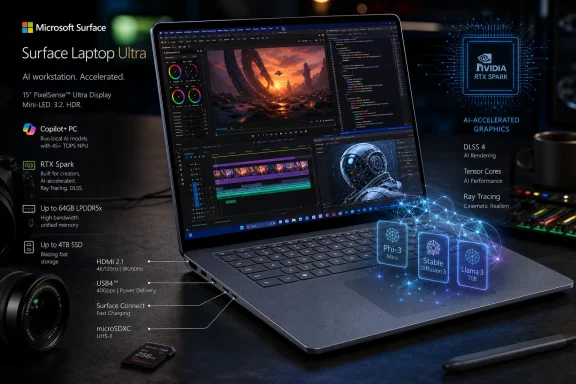
Microsoft Surface Laptop Ultra promotional image showing AI workstation features and NVIDIA RTX Spark graphics.Microsoft Finally Builds the Surface It Used to Only Hint At​

For more than a decade, Surface has been Microsoft’s argument about what Windows hardware should look like. Sometimes that meant kickstands, detachable keyboards, pen-first tablets, or ultrathin laptops with unusually tall screens. But the Surface line has often stopped short of raw performance leadership, leaving gaming laptops, mobile workstations, and Apple’s MacBook Pro to define the top end.
Surface Laptop Ultra changes the tone. Microsoft is no longer pitching elegance as a substitute for horsepower. The machine is still thin, still light for its class, and still recognizably Surface, but the center of gravity has shifted toward sustained GPU compute, local AI models, and creator workflows that previously made Surface feel like the wrong tool.
That matters because the Windows PC market has spent the last two years drowning in AI branding while giving buyers little reason to believe the hardware category had fundamentally changed. Copilot+ PCs brought NPUs and better efficiency, but the experience often depended on whether Windows and third-party apps actually used the silicon. Surface Laptop Ultra is a more aggressive proposition: instead of asking whether a laptop has an NPU, it asks whether the machine can run meaningful workloads locally without immediately retreating to the cloud.
The answer, at least on paper, is yes. Microsoft says the new NVIDIA chip delivers up to one petaflop of AI compute, and the company is pairing that claim with up to 128GB of unified memory. Those numbers are not aimed at people checking email in Outlook. They are aimed at developers, model tinkerers, video editors, 3D artists, game builders, and enterprise teams wondering whether “local AI” can be more than a demo.

NVIDIA Gives Surface a Different Kind of Brain​

The most consequential part of Surface Laptop Ultra is not the display, the finish, or the bigger haptic touchpad. It is the NVIDIA RTX Spark chip inside. Microsoft describes it as a new NVIDIA processor that combines an efficient CPU with an RTX GPU, uniting local AI agents, creation, and gaming in a single platform.
That phrasing is marketing, but the hardware direction is real. For years, Windows performance laptops have usually meant an Intel or AMD CPU paired with a discrete NVIDIA GPU. Surface Laptop Ultra moves toward a more integrated model, closer in spirit to Apple Silicon machines where CPU, GPU, and memory architecture are treated as one platform rather than a pile of parts.
The unified-memory approach is especially important for AI workloads. A machine with 128GB of unified memory is not automatically a datacenter in a backpack, but it changes what developers and creators can do locally. Larger models, bigger media projects, and heavier datasets become more plausible without round-tripping everything through a cloud endpoint.
That is the subtle strategic move here. Microsoft does not want Windows AI development to mean “write locally, run somewhere else.” It wants the PC itself to become a credible place for experimentation, inference, testing, and creative iteration. That is a much stronger pitch to professionals than another promise that a chatbot shortcut key will transform productivity.

The Display Is Not Just Decoration This Time​

Surface displays have long been among the line’s most defensible strengths, and the Surface Laptop Ultra continues that tradition with a 15-inch mini-LED PixelSense Ultra touchscreen. The 3:2 aspect ratio remains a productivity win, giving users more vertical room than a typical 16:9 laptop panel. The 262 PPI density and claimed 2000-nit peak HDR brightness put the display in territory meant for serious visual work, not merely spreadsheet comfort.
The mini-LED decision is important because Microsoft is clearly chasing creators who might otherwise default to a MacBook Pro. For video editors, photographers, motion designers, and game artists, display quality is not cosmetic. It changes how confidently they can judge exposure, color, and contrast on the same machine where they cut, grade, render, and review.
The touchscreen also keeps Surface from becoming a pure MacBook clone. Apple still does not offer touch on the Mac, and Microsoft continues to treat direct manipulation as part of the Windows laptop identity. Whether that matters depends on the user, but for pen-adjacent creative workflows, UI testing, and certain design apps, touch is not a gimmick.
The more interesting point is that Microsoft appears to understand that a professional AI laptop cannot look like a developer board with a keyboard attached. If Surface Laptop Ultra is going to sell the idea of local AI and creator-class Windows hardware, the panel has to be good enough that people want to do the final work on it. Specs alone do not make a workstation desirable.

The Return of Ports Is an Admission, Not a Regression​

The Surface Laptop Ultra’s port selection reads almost like a quiet apology for years of dongle dependency. Microsoft lists USB-C, USB-A, HDMI, a headphone jack, and a full-size SD card reader. For a device aimed at creators and professionals, that is not nostalgia. It is basic ergonomics.
The full-size SD card reader is the clearest signal. This is a machine that wants to live near cameras, field recorders, production sets, and studios. HDMI means conference rooms, client reviews, and external displays without rummaging through a bag. USB-A means older peripherals and enterprise hardware still exist, no matter how many spec sheets pretend otherwise.
This is where Surface Laptop Ultra feels unusually pragmatic. Microsoft has often tried to make Surface represent a cleaner future than the PC market actually inhabits. With this device, the company seems more willing to admit that professional users carry messy workflows. They plug into things. They inherit devices. They move files from cameras. They do not want a $3,000-class laptop that needs a hub before it can begin behaving like a tool.
The headphone jack also deserves more respect than it usually gets. Low-latency audio monitoring, quick troubleshooting, and compatibility with existing equipment still matter. Wireless audio is convenient; wired audio is dependable. Professional machines need both instincts.

Thermal Capacity Is Where the Marketing Meets Physics​

Microsoft says Surface Laptop Ultra has up to 2.5 times the thermal capacity of the 15-inch Surface Laptop 7th Edition. That claim may be less flashy than “one petaflop,” but it is arguably more important. Performance laptops are not judged by peak numbers alone; they are judged by what they can sustain after the first benchmark run has stopped flattering the silicon.
Surface has a complicated history here. The brand has produced beautiful machines that sometimes felt constrained by their thinness, fan behavior, or processor choices. A high-end NVIDIA-powered Surface cannot afford to be a burst-performance showcase that throttles when asked to compile code, render footage, run a model, and drive an external monitor at the same time.
The new thermal system is therefore a statement of intent. Microsoft knows that if Surface Laptop Ultra ships as a hot, loud, throttled status object, the professional audience will not forgive it. Engineers and creators are tolerant of fan noise when it buys them consistent throughput. They are much less tolerant of premium laptops that advertise workstation ambition and then behave like fashion devices under load.
Battery life remains the harder claim to judge. Microsoft says the laptop delivers all-day battery life and maintains performance while running on battery power, but final results will depend on workloads, software maturity, display brightness, and how aggressively Windows manages the NVIDIA silicon. AI compute and HDR displays are not free. The real test will be whether the machine can feel powerful unplugged without draining itself into irrelevance.

Local AI Is the Real Product Microsoft Is Selling​

The phrase “AI PC” has been stretched almost beyond usefulness. For some vendors, it means a keyboard key. For others, it means an NPU that accelerates a handful of effects. Microsoft’s Surface Laptop Ultra makes a more coherent argument: local AI becomes interesting when the machine has enough GPU compute and memory to run substantial tasks without defaulting to the cloud.
That does not mean cloud AI goes away. Microsoft is careful to frame local compute as complementary to frontier-scale cloud models. The local machine is for speed, privacy, iteration, lower latency, and cost control. The cloud remains the place for the largest models and collaborative services.
This hybrid model is probably the future Windows actually gets. Enterprises are not going to run every sensitive workflow through consumer-facing AI services, but they also are not going to abandon centralized governance, logging, and managed cloud infrastructure. A powerful local AI laptop gives IT another tier: some workloads stay on the device, some escalate to approved cloud services, and some never leave the company’s managed environment.
For developers, the appeal is more immediate. Local model testing, AI-assisted coding, image generation experiments, synthetic data workflows, and GPU-accelerated app features all become easier when the laptop itself has serious headroom. The Surface Laptop Ultra is not just a device for using AI apps. It is a device for building them.

Microsoft Is Chasing the MacBook Pro Without Saying the Quiet Part Too Loudly​

The comparison is unavoidable. A premium 15-inch creator laptop with a dense high-brightness display, unified memory, strong local AI performance, and a tightly integrated processor platform is clearly walking into MacBook Pro territory. Microsoft can describe Surface Laptop Ultra as a new category for “world makers,” but buyers will compare it to Apple’s best laptops anyway.
That is not a bad thing. The Windows ecosystem has needed a credible first-party answer to the MacBook Pro for years. Gaming laptops can outperform Apple machines in certain workloads, and mobile workstations can be configured into monsters, but they often sacrifice battery life, acoustic comfort, portability, or design cohesion. Surface Laptop Ultra tries to occupy the more difficult middle ground: polished enough for executives and creators, powerful enough for developers and artists.
The challenge is software. Apple’s advantage is not merely that its silicon is efficient; it is that developers have spent years optimizing professional apps for a smaller, more predictable target. Windows has broader hardware diversity, which is both a strength and a burden. If RTX Spark becomes a real platform across multiple OEMs, Microsoft and NVIDIA have a chance to create a meaningful optimization target. If it remains a boutique configuration, the software story becomes harder.
CUDA support and RTX branding help. NVIDIA’s developer ecosystem is one of the strongest assets in computing, especially for AI, rendering, simulation, and creative acceleration. If Microsoft can wrap that ecosystem in a Surface design that users actually want to carry, it has a stronger MacBook Pro counterargument than Windows-on-Arm machines have traditionally offered.

Repairability Becomes Part of the Professional Pitch​

The replaceable SSD is not the most glamorous specification, but it may be one of the most important for IT buyers. Microsoft says the Surface Laptop Ultra is designed with serviceability in mind, including internal wayfinding, repair guides, and replacement parts availability. That is a notable shift for a product family often criticized in earlier years for difficult repairs.
For individual users, a replaceable SSD means longevity and flexibility. Storage needs grow, especially for video, code repositories, datasets, virtual machines, and local AI models. A machine that can adapt after purchase is easier to justify at a premium price.
For enterprises, serviceability is about fleet economics. Downtime costs money. Devices that can be repaired, redeployed, and kept in service reduce friction for IT departments. A high-end Surface that acknowledges this reality is more credible than one that treats the entire machine as sealed luxury.
This also fits the broader sustainability story companies increasingly have to tell. Repairability does not automatically make a device green, and Microsoft should not get a free pass for simply allowing some components to be replaced. But a professional laptop designed to stay useful longer is better aligned with how businesses now think about procurement, compliance, and lifecycle management.

The Missing Details Will Decide Whether This Is a Breakthrough or a Showcase​

The launch gives us enough to understand Microsoft’s ambition, but not enough to fully judge the product. Pricing, exact configurations, availability by region, battery test details, real-world performance, fan noise, Linux compatibility, driver maturity, and app optimization will determine whether Surface Laptop Ultra becomes a category-defining machine or a fascinating halo product.
FCC authorization language also matters. Microsoft’s own product page notes that shipment is conditioned on successful equipment authorization. That is normal for pre-release hardware, but it reinforces that this is an announcement before broad user testing. Early claims should be treated as claims until reviewers and customers put the machine through real workloads.
The most interesting uncertainty is how Windows will expose this hardware advantage. If the experience is simply “fast GPU in a nice laptop,” that is useful but not transformative. If Windows, developer tools, creative apps, Copilot features, and enterprise management frameworks start treating local AI compute as a first-class resource, Surface Laptop Ultra becomes more than a spec-sheet flex.
That is the bar Microsoft has set for itself. It has spent years telling users that AI will reshape Windows. Now it is shipping hardware that suggests the old PC architecture was not enough for that promise. The software has to catch up quickly.

The Surface Bet Now Lives or Dies in Real Workloads​

Surface Laptop Ultra is the sort of product that makes sense only if buyers believe the next few years of computing will be more local, more GPU-heavy, and more AI-assisted than the last few. It is not a mainstream laptop with a fancy name. It is a wager that professionals will pay for local capability before the software ecosystem fully proves the return.
The most concrete points are already visible:
  • Microsoft has moved Surface into a higher-performance class with NVIDIA RTX Spark silicon and up to one petaflop of claimed AI compute.
  • The 15-inch mini-LED PixelSense Ultra display, 3:2 aspect ratio, and 2000-nit peak HDR brightness are aimed at creators, not casual laptop buyers.
  • The return of practical ports, including HDMI and a full-size SD card reader, acknowledges how professional workflows actually function.
  • The 2.5x thermal-capacity claim is central because sustained performance will matter more than peak benchmark numbers.
  • Up to 128GB of unified memory makes local AI experimentation and larger creative workloads more plausible on a Windows laptop.
  • The replaceable SSD and serviceability language suggest Microsoft is paying closer attention to enterprise lifecycle concerns.
None of that guarantees success. Premium Windows laptops have often looked compelling at launch and then faded into niche status because pricing, battery life, thermals, or software support failed to match the story. Surface Laptop Ultra has a better story than most, but it will still have to earn its place in bags, studios, labs, and IT fleets.
Microsoft’s most powerful Surface is therefore less a finish line than a challenge to the rest of the Windows ecosystem. If RTX Spark laptops become common, if developers optimize for them, and if Windows turns local AI compute into something users can feel every day, the Surface Laptop Ultra may be remembered as the moment the AI PC grew up. If not, it will be another beautiful Surface that showed the future slightly before the future was ready to run on battery power.

References​

  1. Primary source: TelecomTalk
    Published: Mon, 01 Jun 2026 11:22:55 GMT
  2. Related coverage: tomshardware.com
  3. Official source: microsoft.com
  4. Related coverage: gizmochina.com
  5. Related coverage: windowscentral.com
  6. Related coverage: windowslatest.com
 

Microsoft announced the Surface Laptop Ultra on May 31, 2026, ahead of Computex in Taipei, positioning the 15-inch Windows 11 machine as its first Surface built around NVIDIA’s new RTX Spark platform with Blackwell graphics, unified memory, CUDA support, and local AI workloads in mind. The device is not merely another premium Surface with a faster chip; it is Microsoft’s most direct attempt yet to give Windows a MacBook Pro-class flagship with a coherent silicon story. The interesting part is not that Microsoft wants to compete with Apple. It is that Microsoft appears to have decided it cannot do that with Intel, AMD, or Qualcomm alone.

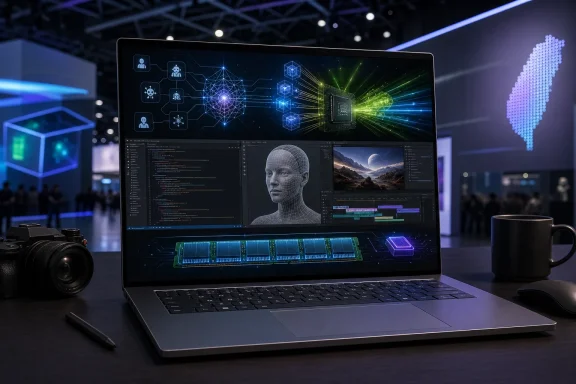
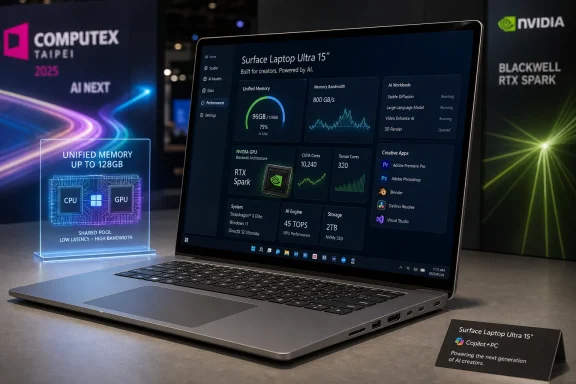
Microsoft Surface Laptop Ultra 15 with AI performance dashboard displayed at Computex Taipei 2025.Microsoft Finally Stops Pretending the Surface Laptop Is Enough​

For years, Surface has lived with an identity problem. It was aspirational enough to appear in coffee shops and developer demos, but rarely dominant enough to define the upper end of Windows laptops. Microsoft could set design trends, but Apple set the performance-per-watt narrative.
The Surface Laptop Ultra is an admission that the old playbook has run out of runway. A nice chassis, a clean Windows image, and a good keyboard are no longer sufficient when the buyer at the top of the market is asking whether a laptop can cut video, compile code, run models locally, survive a full workday, and stay quiet while doing it.
Microsoft’s pitch is unusually explicit. The company describes creators, developers, and AI builders dealing with “massive scenes, long compile cycles, local models and datasets,” and says the machine was built to meet that work “without flinching.” That is not the language of a lifestyle laptop. It is the language of a workstation trying very hard not to look like one.
The result is a Surface that sounds less like a Surface Laptop Studio successor and more like a declaration that Windows needs its own reference-class mobile workstation. Microsoft has spent the Copilot+ era talking about AI PCs as a category. Surface Laptop Ultra is the first time the company has made that category feel like it might have a serious high-end anchor.

RTX Spark Gives Windows the Silicon Story It Has Been Missing​

The headline component is NVIDIA RTX Spark, a new Arm-based “superchip” platform announced at Computex 2026 for laptops and compact desktops. NVIDIA’s pitch is blunt: RTX Spark combines a Blackwell RTX GPU, a high-performance Arm CPU, up to 128GB of unified memory, and full NVIDIA software-stack support in a package aimed at personal AI, creation, gaming, and workstation-class local workloads.
That matters because Windows laptops have historically been a federation of parts. The CPU came from one vendor, the GPU from another, the memory pool was split, the drivers were layered, and the software story depended on how well everyone had behaved that month. Apple’s advantage with the MacBook Pro was never just raw speed; it was that the CPU, GPU, memory, media engines, battery behavior, thermals, and developer framework all looked like one argument.
RTX Spark is NVIDIA’s attempt to make a similar argument for Windows, but with CUDA at the center. Microsoft’s Surface Laptop Ultra is the showcase device for that argument, offering a Blackwell RTX GPU, up to 128GB of unified memory, and full CUDA support. That last phrase is doing a lot of work.
CUDA remains one of NVIDIA’s strongest moats. For AI developers, scientific workloads, 3D rendering pipelines, and many local model workflows, “runs on CUDA” still means “runs where the tools already are.” Apple has Metal, and Apple Silicon is formidable, but the developer gravity around NVIDIA remains enormous.
The catch is that RTX Spark’s success will depend on whether NVIDIA and Microsoft can make the entire Windows experience feel integrated rather than merely powerful. A spec sheet can promise one petaflop of AI compute and local 120-billion-parameter models. A laptop that earns trust has to wake reliably, manage memory intelligently, handle drivers cleanly, and not turn a creative workflow into a thermal negotiation.

The MacBook Pro Comparison Is the Point, Even If Microsoft Won’t Say It Too Loudly​

Microsoft does not need to write “MacBook Pro rival” on the box for everyone to understand the target. A 15-inch premium creator laptop with unified memory, large local AI ambitions, serious GPU compute, a high-end display, a haptic trackpad, creator-friendly ports, and a tightly integrated silicon story is not aiming at a midrange Dell Inspiron. It is aiming directly at Apple’s most lucrative professional notebook narrative.
The MacBook Pro has become the benchmark because it solved the thing Windows vendors kept treating as optional: consistency. Apple’s machines are not always the fastest in every benchmark and not always the best value, but they are predictable. They offer a clear line from software to silicon to battery life to thermals, and that clarity has become a product feature.
Surface Laptop Ultra attacks that from a different angle. Instead of saying Windows can match Apple by becoming Apple, Microsoft is saying Windows can win by being the best host for NVIDIA’s accelerated computing ecosystem. That is a much more credible argument than simply claiming a thinner chassis or a brighter display.
It is also a risky one. Apple owns its silicon roadmap, its operating system, its laptop design, and its developer frameworks. Microsoft owns Windows and Surface, but NVIDIA owns the most important new ingredient in this machine. If RTX Spark works, Microsoft gets a MacBook Pro-class story almost overnight. If it stumbles, Surface becomes the premium wrapper around someone else’s first-generation experiment.
That dependency is not new for Windows. The platform has always thrived by absorbing partner hardware. What is new is that Microsoft is trying to use a partner’s silicon not just as a component, but as the defining feature of its flagship laptop.

Unified Memory Is the Real Flex, Not the Petaflop​

The “one petaflop” claim will get attention, because large numbers always do. But the more consequential specification is up to 128GB of unified memory. That is the part that explains why Microsoft and NVIDIA are talking about huge scenes, local models, long context windows, and simultaneous AI, rendering, and development workflows.
Traditional Windows laptops with discrete GPUs divide system memory and video memory. That model works fine for many games and conventional creator workloads, but it becomes awkward when data sets grow, scenes swell, and AI models need large contiguous pools of memory. Unified memory lets the CPU and GPU access a shared pool, reducing some of the gymnastics required to move data back and forth.
Apple has used unified memory as one of the pillars of Apple Silicon. NVIDIA is now bringing a similar concept into the Windows performance conversation, but with a CUDA-centric twist. That could matter enormously for developers who want to run inference locally, test agents, fine-tune models at the edge, or work with heavy media and 3D assets without immediately reaching for cloud compute.
Still, unified memory is not magic. Bandwidth, latency, allocation behavior, thermals, software support, and pricing will determine whether Surface Laptop Ultra feels like a breakthrough or just an impressive demo machine. A 128GB unified memory configuration will almost certainly be expensive, and the buyers who need it will be the same buyers least impressed by marketing shorthand.
The more interesting question is whether Microsoft will offer enough lower configurations to make the machine broadly desirable without diluting the point of the product. If the base model feels compromised, the Ultra name becomes branding. If the high-end model is priced into mobile workstation territory, Microsoft will need enterprise, developer, and creator buyers to believe this is more than a halo device.

CUDA on a Surface Changes the Developer Conversation​

For developers, the most important sentence in Microsoft’s announcement may be the one about full CUDA support. Surface has never been the obvious default for serious GPU compute. It has been elegant, portable, and Microsoft-approved, but not the machine you bought because your AI tooling, simulation pipeline, renderer, or research stack expected NVIDIA acceleration.
Surface Laptop Ultra could change that. If it delivers credible CUDA performance in a portable machine with a large unified memory pool, it becomes something Microsoft has not really had before: a first-party Windows laptop that can serve as a local AI development box without sounding like a compromise.
That is a strategic shift. Microsoft is trying to make Windows feel like the natural home for developers building AI agents and local model workflows, not merely the endpoint where cloud-backed Copilot features appear. The company’s broader AI strategy depends heavily on Azure, but developers do not live entirely in the cloud. They prototype locally, debug locally, test models locally, and often want to avoid sending sensitive data off-device until the workflow demands it.
NVIDIA benefits just as much. The company already dominates data-center AI acceleration, but RTX Spark gives it a way to push the same ecosystem down into personal computing. If the developer’s laptop, desktop, workstation, and cloud instance all speak NVIDIA fluently, the lock-in becomes less a contract and more a habit.
That is why this machine matters beyond Surface fans. It is a test of whether the Windows laptop can again become the most obvious computer for builders, not just the most compatible one.

The Ports Tell a Story Microsoft Used to Avoid​

Microsoft says Surface Laptop Ultra includes HDMI, USB-C, USB-A, an SD card slot, and a headphone jack. In 2026, that is almost a political statement. The modern premium laptop has spent a decade treating ports as evidence of moral weakness, forcing professionals into dongle chains while pretending minimalism was the same as progress.
The Surface Laptop Ultra reverses that posture. Microsoft says the ports creators need were “picked on purpose,” and that line is worth taking seriously. An SD card slot matters to photographers and videographers. HDMI matters in conference rooms, studios, classrooms, and production setups. USB-A still matters because the real world remains full of equipment that refuses to die on schedule.
This is another way Microsoft is chasing the MacBook Pro rather than the MacBook Air. Apple itself had to walk back the USB-C-only maximalism of the 2016 MacBook Pro era, restoring HDMI, MagSafe, and SD in later models because professional users were right all along. Microsoft appears to have learned that lesson without pretending it invented the answer.
The haptic touchpad, described as the largest ever placed on a Surface, is part of the same argument. Trackpads, ports, displays, and cooling are not side dishes in a professional laptop. They are the places where a premium device either earns its price every day or gradually becomes resented.
Microsoft also emphasizes repairability alongside performance and durability. That is a welcome phrase, but one that deserves skepticism until the hardware is in teardown hands. Surface devices have improved over time, but the line’s reputation was shaped by years of elegant machines that were difficult or impractical to service. If Surface Laptop Ultra genuinely balances high performance, thin design, and repairability, that would be a meaningful break from old Surface habits.

Windows on Arm Gets a Very Different Ambassador​

Surface Laptop Ultra also reframes Windows on Arm. Until now, the category’s mainstream story has largely been battery life, instant-on behavior, and compatibility gradually getting less annoying. Qualcomm’s Snapdragon X machines pushed Windows closer to Apple-like efficiency, but they did not fully answer the high-end GPU compute question.
RTX Spark changes the emphasis. This is not Arm as a lightweight alternative to x86. This is Arm as the CPU half of a workstation-class NVIDIA platform. That is a much more aggressive claim, and it puts pressure on Windows to behave like a mature Arm operating system across professional software, drivers, peripherals, development tools, and games.
The risks are obvious. Windows on Arm has made progress, but compatibility remains a lived concern for buyers who depend on niche tools, old plug-ins, hardware utilities, anti-cheat systems, device drivers, and enterprise software that was written for a different era. Emulation can be impressive and still not be the same as native reliability.
For Microsoft, Surface Laptop Ultra is therefore a confidence play. The company is not merely asking users to trust a new Surface. It is asking the most demanding users to trust Windows on Arm with workloads where failure is expensive, embarrassing, or both.
That makes software support just as important as the silicon. Adobe, Autodesk, Blender, Unreal Engine, Visual Studio, Docker workflows, local AI runtimes, game engines, media encoders, VPN clients, endpoint security agents, and enterprise management tools all become part of the review, whether Microsoft wants them to or not.

NVIDIA Is Not Just Supplying a Chip; It Is Moving Up the PC Stack​

The PC industry is used to NVIDIA as the GPU vendor. RTX Spark suggests NVIDIA wants to be something closer to a platform vendor for the AI PC era. That is a major shift, and it explains why the Surface Laptop Ultra announcement feels bigger than a normal component refresh.
NVIDIA’s modern advantage is not just silicon. It is CUDA, TensorRT, DLSS, OptiX, Reflex, broadcast tooling, developer libraries, AI frameworks, and years of software expectation. RTX Spark packages that into a form that can sit inside slim laptops and compact desktops, giving OEMs a more integrated story than “we added a discrete GPU.”
That is threatening to several incumbents at once. Intel and AMD have spent decades owning the CPU foundation of Windows PCs. Qualcomm has spent the past few years trying to make Arm-based Windows laptops feel inevitable. Apple has used vertical integration to make the Mac the aspirational professional notebook. RTX Spark barges into all three conversations.
For Microsoft, that is both opportunity and complication. The opportunity is obvious: a Windows flagship that can credibly talk about AI compute, gaming, creator workloads, and development using NVIDIA’s strongest brand assets. The complication is that the center of gravity in the PC may shift further away from Microsoft’s traditional CPU partners.
There is also a market-shaping effect. If ASUS, Dell, HP, Lenovo, MSI, and others ship RTX Spark systems later this year, Surface Laptop Ultra becomes the reference design rather than the only design. That is classic Microsoft: build the aspirational version, let partners flood the market, and hope the category lifts Windows as a whole.
But the Surface brand changes the stakes. If a third-party RTX Spark laptop has rough edges, it is one OEM’s problem. If Surface Laptop Ultra has rough edges, it becomes a Microsoft problem and a Windows-on-Arm problem and an AI-PC problem all at once.

Apple’s Advantage Is No Longer Untouchable, but It Is Still Real​

The temptation is to frame this as Microsoft finally building a MacBook Pro killer. That is emotionally satisfying and probably too simple. Apple’s advantage is not a single benchmark target; it is an ecosystem of trust built from years of consistent laptop execution.
MacBook Pro buyers know broadly what they are getting. They expect long battery life, excellent displays, strong speakers, quiet performance, good trackpads, tight integration with iPhone and iPad, strong media engines, and a software ecosystem that increasingly treats Apple Silicon as the default Mac. That expectation is hard to dislodge with one ambitious Surface.
Surface Laptop Ultra can win in places where Apple is less compelling. CUDA is the obvious one. Local AI developers who already live in NVIDIA tooling may find RTX Spark more useful than Apple’s neural and GPU stack, especially if workflows scale more naturally from laptop to desktop to cloud GPU. Windows also remains the broader gaming platform, the enterprise default in many sectors, and the place where countless legacy tools still live.
But Apple will not stand still. By the time Surface Laptop Ultra ships later this year, MacBook Pro comparisons will likely involve Apple’s current or next-generation silicon roadmap, not just today’s models. Microsoft and NVIDIA will need to beat the product people can buy, not the product that existed when the press release was written.
The more realistic goal is not to kill the MacBook Pro. It is to make the high-end Windows laptop feel like a first-choice machine again. That would be a major achievement by itself.

The Missing Details Are the Details That Decide Everything​

For all the excitement, Microsoft has not yet shared the two details that turn a concept into a buying decision: price and availability. The company says Surface Laptop Ultra is coming later this year, and other RTX Spark systems from major PC makers are expected in the same broad window. That is enough to start the hype cycle, not enough to close a purchase order.
Pricing will be especially delicate. A 128GB unified memory Surface with a new NVIDIA platform, premium display, large haptic touchpad, and creator-class port selection will not be cheap. If Microsoft prices it like a mobile workstation, it has to perform like one. If it prices it like a MacBook Pro, it has to feel as polished as one.
Availability outside core markets is another open question. The original htxt report rightly notes the uncertainty around an official South African launch. That matters because Surface distribution has long been uneven globally, and a halo device that only ships in a handful of regions cannot fully reshape the Windows laptop story.
Battery life is the other silence. NVIDIA and Microsoft can talk about efficiency, but professional buyers will wait for real measurements under real workloads. A machine that crushes local inference but drains rapidly under mixed creative use may still be valuable, but it will not occupy the same mental category as a MacBook Pro.
Then there is noise. Thin performance laptops often fail not because they are slow, but because they are fast in ways users do not want to live with. Fan behavior, skin temperature, sustained clocks, power profiles, sleep drain, and dock reliability are the mundane details that decide whether a laptop becomes beloved or merely benchmark-famous.

Enterprise IT Will See Promise Wrapped in Risk​

For IT departments, Surface Laptop Ultra is both intriguing and awkward. It promises a portable Windows machine capable of local AI and creator workloads that might otherwise require a workstation, cloud GPU instance, or specialized desktop. That could help organizations keep sensitive data local, reduce cloud costs for some workflows, and give developers more capable machines without leaving the managed Windows ecosystem.
But first-generation platforms are rarely easy sells in conservative environments. IT teams will want driver stability, firmware maturity, predictable imaging, endpoint security compatibility, long support windows, spare parts, repair channels, and clear procurement timelines. A beautiful flagship does not matter if it complicates the standard operating environment.
Windows on Arm adds another layer. Enterprises have x86 assumptions embedded everywhere: line-of-business apps, management scripts, VPN clients, DLP agents, authentication tools, printer drivers, security stacks, and obscure utilities known only to the one person who retired last year. Even if most things work, the exceptions can dominate deployment planning.
Still, the opportunity is real. Local AI is not just a consumer novelty. Regulated industries, design firms, engineering teams, legal departments, researchers, and software organizations all have reasons to experiment with on-device models. A powerful, manageable Windows laptop with CUDA support could become a compelling pilot device for exactly those groups.
Microsoft’s job is to make sure the word “pilot” does not become a polite synonym for “science project.”

The AI PC Finally Gets a Machine Worth Arguing About​

The “AI PC” label has often felt like a marketing department searching for a product. NPUs arrived, Copilot keys appeared, and vendors spent a year insisting that the next laptop refresh was historic because it could run background effects more efficiently. The result was technically important, but emotionally thin.
Surface Laptop Ultra gives the AI PC a more serious frame. Instead of treating AI as a feature sprinkled over the same laptop categories, it treats local AI as a workload that changes memory needs, software stacks, GPU design, thermal priorities, and developer expectations. That is a much stronger argument.
It also clarifies the split in the market. Some AI PCs are about making ordinary laptops more responsive, private, and efficient when running small on-device features. RTX Spark machines are about making local AI a primary workload. Those are different products for different buyers, and the industry would be better off admitting it.
The Surface Laptop Ultra sits at the expensive, ambitious end of that split. It is for people who might actually care about running large models locally, rendering complex scenes, editing heavy media, compiling substantial projects, or keeping multiple demanding workflows alive at once. Whether that audience is large enough for a major Surface line remains to be seen.
But at least the premise is coherent. For the first time in a while, Microsoft’s premium laptop story is not just “here is a nicer Windows machine.” It is “here is what a Windows machine can do when NVIDIA’s AI and graphics stack becomes the organizing principle.”

The Surface Ultra Bet Comes Down to Five Hard Tests​

Microsoft and NVIDIA have made the Surface Laptop Ultra sound like a turning point, but the market will judge it by less glamorous measures. The machine has to be fast, yes, but it also has to be boring in the best possible way: reliable, compatible, serviceable, and predictable under pressure.
  • Surface Laptop Ultra is Microsoft’s clearest attempt yet to build a first-party Windows alternative to the MacBook Pro rather than another premium general-purpose laptop.
  • RTX Spark’s unified memory and CUDA support are more important to the product’s identity than any single headline AI-performance number.
  • Windows on Arm will be judged by professional compatibility, not by how well the launch demos run.
  • The creator-friendly port selection suggests Microsoft is prioritizing practical workstation behavior over minimalist laptop fashion.
  • Price, battery life, fan noise, sustained performance, and global availability will determine whether this becomes a serious category shift or a polished halo product.
  • Enterprise buyers will be interested in local AI capability, but they will not forgive immature drivers, weak management support, or fragile software compatibility.
The most compelling version of Surface Laptop Ultra is not a MacBook Pro clone with an NVIDIA badge. It is a Windows machine that accepts Apple’s core lesson—that silicon, software, thermals, memory, and industrial design must be argued as one system—while refusing Apple’s answer to who should control that system. If Microsoft and NVIDIA can make that argument hold up outside a Computex demo, the Windows laptop may finally have a flagship that does more than look premium; it may have one that changes what premium Windows is supposed to mean.

References​

  1. Primary source: htxt.co.za
    Published: Mon, 01 Jun 2026 10:51:15 GMT
  2. Related coverage: investor.nvidia.com
  3. Related coverage: windowscentral.com
  4. Related coverage: windowslatest.com
  5. Related coverage: tomshardware.com
  6. Related coverage: axios.com
  1. Related coverage: notebookcheck.net
  2. Related coverage: ixbt.com
  3. Related coverage: phoronix.com
  4. Related coverage: 01net.com
  5. Related coverage: macrumors.com
  6. Related coverage: signal65.com
  7. Official source: news.microsoft.com
 

Microsoft and Nvidia announced at Computex 2026 in Taiwan that Microsoft’s new 15-inch Surface Laptop Ultra will use Nvidia’s RTX Spark platform, pairing Arm CPU cores, Blackwell-class graphics, unified memory, and local AI acceleration in a flagship Windows laptop aimed at developers, creators, and AI workloads. That is the clean factual version. The more interesting version is that Microsoft is no longer treating the AI PC as a slightly smarter ultrabook with a Copilot key. With Surface Laptop Ultra, it is testing whether Windows can finally have the kind of high-end, tightly integrated laptop story Apple has owned since the first M-series MacBook Pro.
This is not just another Surface refresh with a brighter screen and a bigger spec sheet. It is a strategic confession. Microsoft has spent years trying to make Windows on Arm feel inevitable, but Nvidia’s entrance gives that effort something it has often lacked: an obvious performance narrative, a developer constituency, and a reason for power users to care beyond battery life.

Futuristic laptop screen shows AI/biotech interface and neural circuits at a tech conference with camera and coffee nearby.Microsoft’s AI PC Story Finally Gets a Workstation-Shaped Body​

The first wave of AI PCs was sold largely on promise. Neural processing units arrived in thin laptops, Copilot became a fixture in the Windows experience, and vendors began attaching “AI” to machines whose day-to-day appeal still depended on familiar things: battery life, display quality, keyboard feel, thermals, and price. The silicon mattered, but the user-facing case was often vague.
Surface Laptop Ultra changes the pitch. Microsoft is not merely saying this PC can run AI features. It is saying this PC is built for local models, agentic workflows, creative production, and developer workloads that need memory as much as they need raw compute. That shifts the AI PC from a marketing category into something closer to a mobile workstation.
The claimed support for up to 128GB of memory is the tell. Ordinary consumers do not need that to summarize emails or remove a background from a photo. Developers, researchers, video editors, 3D artists, and machine-learning tinkerers might. Microsoft and Nvidia are aiming at the users who can imagine local AI as an actual tool rather than a floating sparkle icon in the taskbar.
That does not mean the machine will automatically justify itself. The market is littered with powerful Windows laptops that looked magnificent on paper and compromised too much in noise, heat, battery life, software compatibility, or price. But this is the first Surface in years that sounds less like a corporate procurement SKU and more like Microsoft trying to win an argument about the future of personal computing.

Nvidia Brings the Missing Ingredient: A Developer Gravity Well​

Nvidia’s role matters because AI hardware is not only a hardware problem. The company’s real advantage is the gravity of its software ecosystem. CUDA, RTX tooling, TensorRT, DLSS, creative-app acceleration, and a decade-plus of developer familiarity give Nvidia a kind of platform leverage that most PC chip vendors can only envy.
That is why RTX Spark is more consequential than a generic “AI accelerator.” If Nvidia can bring a credible slice of its GPU ecosystem into a slim Windows laptop built around unified memory and Arm CPU cores, Microsoft gets a machine that can speak to developers in terms they already understand. That is very different from asking developers to wait for an abstract future in which every Windows AI API becomes universal and every app is perfectly optimized.
The phrase agentic AI is doing a lot of work in the launch narrative. Vendors use it to describe systems that do not merely answer prompts but plan tasks, call tools, revise outputs, and keep working across multiple steps. Whether today’s agents deserve the hype is debatable, but the compute requirements are not imaginary. Long context windows, local inference, code assistance, media generation, and private document analysis all benefit from fast local memory and a capable GPU.
This is where Nvidia’s involvement gives Microsoft cover. Microsoft can talk about Windows as the place where AI agents run. Nvidia can talk about the silicon and acceleration stack that make those agents feel plausible. Together, they are trying to make the local AI PC sound less like a gimmick and more like the next serious developer workstation.

The MacBook Pro Comparison Is Inevitable, and Microsoft Invited It​

The Surface Laptop Ultra is being framed as a MacBook Pro rival because Microsoft and Nvidia clearly want it to be. The recipe is familiar: a premium 15-inch laptop, a high-quality mini-LED display, a large trackpad, serious memory configurations, creator-focused ports, and a processor architecture built around unified memory rather than the old CPU-plus-discrete-GPU split. Apple has spent years proving that this model works.
That comparison is useful, but it can also be misleading. Apple’s advantage is not just its silicon. It is the integration of hardware, operating system, developer tools, media engines, battery behavior, display calibration, and application support. The M-series MacBook Pro became the default machine for many developers and creators not because of one benchmark, but because the whole system felt coherent.
Microsoft has often struggled with that coherence. Surface hardware has produced moments of brilliance, but the broader Windows laptop ecosystem has remained fragmented. One machine has the screen, another has the GPU, another has the battery life, another has the ports, and the one that nearly has it all costs too much or spins its fans too often. Surface Laptop Ultra has to avoid becoming yet another Windows flagship that wins the launch event and loses the coffee shop.
Still, the ports matter. USB-A, USB-C, HDMI, and an SD card slot are not nostalgic extras for the target audience. They are evidence that Microsoft understands creators do not want to live entirely in dongle-land. If the machine is really meant for field photographers, video editors, engineers, and developers, those physical choices are not cosmetic.

Windows on Arm Gets Its Most Serious Test Yet​

The riskiest part of the Surface Laptop Ultra is not the display, the memory ceiling, or even the price. It is Windows on Arm. Microsoft has been trying to make Arm-based Windows devices work for many years, and the story has repeatedly improved without fully becoming boring. Boring, in this case, would be success: apps install, drivers work, peripherals behave, and users stop thinking about the architecture.
Qualcomm’s Snapdragon X machines helped move that story forward, especially on battery life and mainstream productivity. But high-end users are less forgiving. They are more likely to need obscure utilities, virtualization workflows, native developer tools, audio interfaces, external capture hardware, GPU-accelerated plug-ins, and old-but-essential applications that do not care about Microsoft’s roadmap.
Nvidia’s participation could help by giving the platform a clearer high-performance identity. But it also raises the bar. If Microsoft positions Surface Laptop Ultra as a creator and developer flagship, compatibility gaps become more damaging. A $999 laptop can be forgiven for being part of a transition. A premium “Ultra” machine cannot.
The best-case scenario is that Surface Laptop Ultra becomes the device that turns Windows on Arm from a battery-life story into a performance story. The worst-case scenario is that it becomes a gorgeous proof of concept for a future that still asks too many users to check too many compatibility lists.

Local AI Is the Justification, but Not Yet the Killer App​

The strongest argument for this machine is local AI. The weakest argument for this machine is also local AI. That is the strange tension at the heart of the Surface Laptop Ultra.
On paper, running large models locally has clear advantages. It can reduce latency, preserve privacy, lower dependence on cloud services, and allow users to keep working when connectivity is poor or when data cannot leave the device. For companies dealing with regulated information, legal discovery, confidential design files, or proprietary source code, local inference is not merely a convenience.
But the consumer pitch remains unsettled. Most people do not wake up wanting to run a 120-billion-parameter model on a laptop. They want their computer to be faster, quieter, longer-lasting, more reliable, and more useful. AI becomes compelling only when it disappears into workflows that save time without requiring users to become prompt engineers or model administrators.
That is why developers and creators are the right opening audience. They are more tolerant of rough edges and more likely to find uses for local compute before the mainstream does. A developer might use local models for code review, test generation, documentation, or private repo analysis. A video editor might use AI-assisted effects, transcription, tagging, and generation without sending sensitive footage to the cloud. A designer might iterate locally on assets while keeping client materials contained.
The danger is that Microsoft oversells the future before the present is ready. The AI PC market has already suffered from feature announcements that sound transformative in demos and feel optional in practice. Surface Laptop Ultra needs to prove that local AI is not a party trick. It needs workflows that are faster, private, repeatable, and obviously better because the hardware exists.

The Surface Brand Needed a Machine With an Edge Again​

Surface used to feel like Microsoft’s hardware argument for the future of Windows. The original Surface tablets, the Surface Pro line, the Surface Book, and the Surface Studio were not always perfect, but they were opinionated. They pushed form factors. They annoyed some people. They inspired others. They made Windows hardware feel less like a commodity.
In recent years, Surface has often felt more cautious. Business devices, iterative laptops, and familiar convertibles kept the brand alive, but not always exciting. That may have been rational. Enterprise buyers value predictability, and Microsoft does not need Surface to outsell every PC partner. But a platform owner still benefits from having a flagship that dramatizes where the platform is going.
Surface Laptop Ultra appears designed to do exactly that. It gives Microsoft a hero device for Windows AI, Windows on Arm, and high-end creator computing. It also gives PC partners permission to build more ambitious machines around Nvidia’s platform without Microsoft seeming like a bystander in its own ecosystem.
There is a delicate balance here. Microsoft cannot alienate Qualcomm, Intel, AMD, or its OEM partners by making Surface feel like the only “real” Windows AI PC. But it also cannot afford to make Surface dull. The Ultra branding suggests Microsoft is willing to draw a line above the mainstream Surface Laptop and say: this is the one for people who need the ceiling raised.

Price Will Decide Whether This Is a Product or a Poster​

The missing number is price, and it may determine how seriously the Surface Laptop Ultra is taken. A machine with Nvidia’s new platform, up to 128GB of memory, a mini-LED touchscreen, premium materials, and creator ports is not going to be cheap. The question is whether it lands as an expensive but rational workstation, or as a halo product most buyers admire from a distance.
Apple has trained the high-end laptop market to accept painful prices when the experience is consistent. Buyers may grumble about MacBook Pro configurations, but they understand the product ladder. Microsoft has less room for ambiguity. If Surface Laptop Ultra costs MacBook Pro money, it needs MacBook Pro confidence.
That means battery life cannot be merely acceptable. Fans cannot become the soundtrack of every AI demo. The display must justify the “brightest Surface” positioning. The trackpad and keyboard must be excellent. Sleep and wake must be boring. External monitor behavior must be boring. Driver support must be boring. Again, boring is the achievement.
There is also a psychological barrier. Windows buyers are accustomed to choice and discounting. A premium Surface priced like a top-tier MacBook Pro enters a market where some customers will immediately compare it with gaming laptops, mobile workstations, discounted Intel and AMD systems, and refurbished Macs. Microsoft has to sell integration, not just specifications.

Enterprise IT Will See Opportunity Wrapped in Governance Problems​

For IT departments, the Surface Laptop Ultra is both exciting and inconvenient. A powerful local AI workstation could reduce the need to send sensitive data to cloud models. It could allow developers, analysts, and security teams to run private workflows on-device. It could also complicate fleet management, procurement, compliance, and endpoint policy.
Local AI is not automatically safer than cloud AI. It changes the risk surface. Models running on endpoints can ingest sensitive documents, generate outputs that need auditing, and interact with local files and tools. If agentic workflows become real, administrators will need policies governing not just which apps can run, but which agents can act, what data they can touch, and how those actions are logged.
That is a Windows management challenge as much as a hardware challenge. Microsoft has the enterprise stack to address it: Intune, Entra, Defender, Purview, Windows security baselines, and Copilot governance hooks. But the operational model for fleets of AI-capable endpoints is still maturing. Many organizations are only beginning to understand how to classify and control AI usage in the cloud; local AI adds another layer.
The Surface Laptop Ultra may therefore land first in specialized roles rather than broad deployments. Developers, data scientists, media teams, executives working with sensitive materials, and security researchers are more obvious candidates than general office workers. If Microsoft wants broader enterprise adoption, it will need to make management and compliance as central to the story as TOPS, parameters, and memory bandwidth.

Nvidia’s PC Ambition Is Bigger Than One Surface​

The Surface announcement is also a statement about Nvidia’s ambitions in PCs. For years, Nvidia has been central to Windows performance through discrete GPUs, gaming laptops, creator workstations, and AI acceleration. RTX Spark suggests a deeper move: not just supplying the graphics component, but shaping the entire high-performance Windows platform around Nvidia silicon.
That should make Intel, AMD, and Qualcomm pay attention. Intel and AMD still own enormous advantages in compatibility, OEM relationships, and x86 software continuity. Qualcomm has done more than anyone recently to make Windows on Arm feel commercially serious. But Nvidia brings a different kind of force: it owns the AI developer imagination in a way no other PC silicon vendor does.
If RTX Spark succeeds, the PC market gets more interesting. Windows laptops could split into clearer categories: efficient mainstream Arm systems, x86 machines for compatibility and gaming breadth, and Nvidia-powered AI workstations for local models and creator workloads. That diversity is healthy, but it will also make buying a Windows laptop more complicated.
Microsoft’s job is to prevent that complexity from becoming chaos. Users should not have to decode five different AI acceleration stacks, three processor architectures, and a maze of app compatibility footnotes to buy a premium laptop. If Surface Laptop Ultra is meant to lead, it must clarify the market, not merely add another branch to it.

The Spec Sheet Is Loud, but the Software Must Answer​

Hardware launches are naturally front-loaded with numbers: core counts, memory ceilings, display technology, AI model sizes, and performance claims. Those numbers are useful, but they are not the product. The product is what a user can do on Tuesday afternoon that they could not do on Monday.
For Surface Laptop Ultra, the software proof points need to arrive quickly. Microsoft should show local Copilot workflows that are meaningfully better on this hardware. Nvidia should show developer tools that make local model work approachable. Adobe, Blackmagic, Blender, game engines, IDEs, and scientific tools should demonstrate why this platform is not just compatible, but preferable.
The device also needs a credible gaming story, even if gaming is not the main event. Nvidia’s RTX brand carries expectations. If RTX Spark can deliver strong gaming performance with better battery behavior than traditional discrete-GPU laptops, that becomes another reason the machine feels versatile. If gaming support is uneven because of Arm compatibility or driver limitations, the RTX badge may invite scrutiny instead.
The same applies to creative work. A mini-LED touchscreen and SD card slot tell creators they are welcome. But creators follow application performance, plug-in compatibility, color reliability, export times, and external storage behavior. Microsoft and Nvidia have to win those mundane battles.

The Surface Ultra Bet Comes Down to Five Practical Tests​

The launch story is dramatic, but the judgment will be practical. A premium AI workstation laptop cannot survive on future-tense language alone.
  • Surface Laptop Ultra must prove that Windows on Arm can handle demanding professional workflows without turning compatibility into a research project.
  • Nvidia’s RTX Spark platform must deliver sustained performance and battery life that feel fundamentally different from today’s hot, heavy, discrete-GPU laptops.
  • Microsoft must show local AI workflows that are useful enough to justify high memory configurations and premium pricing.
  • The machine must compete with MacBook Pro not only in benchmarks, but in polish, reliability, display quality, sleep behavior, and app support.
  • Enterprise adoption will depend on whether Microsoft can make local AI governable, auditable, and manageable through the tools IT departments already use.
  • The Surface brand will benefit only if this becomes a credible flagship product, not a beautiful Computex demo that ships into a narrow niche.
The Surface Laptop Ultra is the clearest sign yet that Microsoft wants the AI PC to become more than a slogan printed beside a processor badge. By tying Surface to Nvidia’s RTX Spark platform, it is betting that the next premium Windows laptop will be judged by what it can run locally, how much memory it can bring to bear, and whether developers and creators believe the platform is worth their time. The promise is large, the unresolved questions are larger, and that is exactly why this machine matters: it turns the AI PC debate from a branding exercise into a product test Windows can actually win or lose.

References​

  1. Primary source: pickr.com.au
    Published: Tue, 02 Jun 2026 10:24:39 GMT
  2. Related coverage: tomshardware.com
  3. Related coverage: pcgamer.com
  4. Related coverage: techspot.com
  5. Related coverage: gizmochina.com
  6. Related coverage: windowscentral.com
  1. Related coverage: nvidia.com
  2. Related coverage: windowslatest.com
  3. Related coverage: winbuzzer.com
  4. Related coverage: infocity.tech
  5. Related coverage: tuttotech.net
  6. Related coverage: axios.com
  7. Related coverage: arstechnica.com
  8. Related coverage: ubergizmo.com
  9. Related coverage: nvidianews.nvidia.com
  10. Official source: microsoft.com
  11. Official source: news.microsoft.com
 

Back
Top