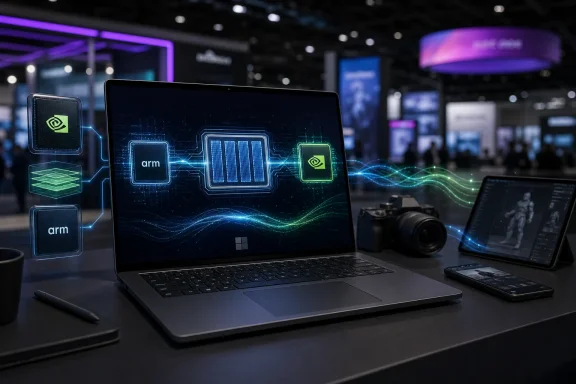
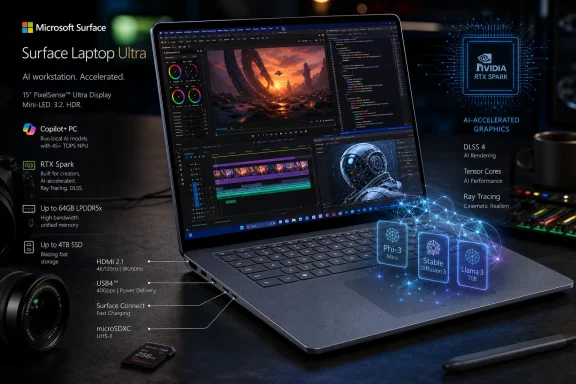
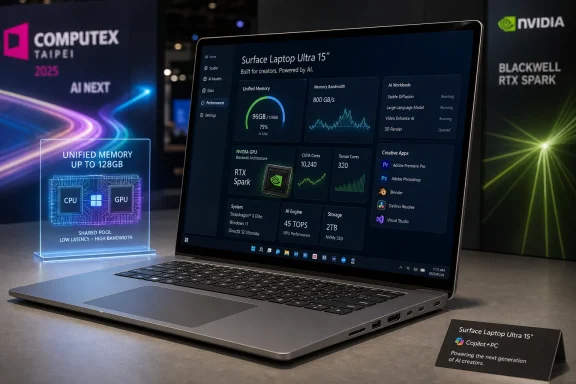
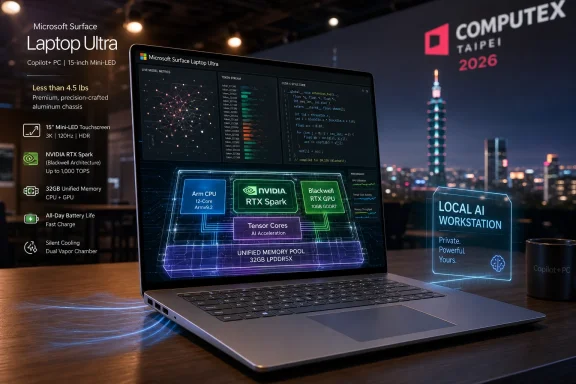
Microsoft announced the Surface Laptop Ultra at Computex 2026 in Taipei, a 15-inch professional Windows laptop built with Nvidia’s new RTX Spark superchip and scheduled to arrive this fall from Microsoft Surface and other PC makers. The machine is being pitched less as another premium notebook than as a mobile workstation for local AI, creative production, and developer workloads. That distinction matters because Microsoft and Nvidia are trying to move the “AI PC” story beyond neural-processing-unit checkboxes and into the heavier territory of large models, CUDA software, and unified memory. The bet is that Windows can become the natural home for personal AI computing — if buyers accept the price, thermals, battery claims, and software-transition risks that come with a first-generation platform.
For the last two years, the phrase AI PC has often meant a familiar laptop with an NPU, a marketing sticker, and a promise that Windows would eventually become more useful because some inference could run locally. Surface Laptop Ultra is a different sort of claim. Microsoft is not merely saying that the device can accelerate background effects or summarize a document; it is saying the laptop belongs in the same conversation as compact AI workstations.
That shift is enabled by Nvidia’s RTX Spark, a Windows-focused superchip derived from the Grace Blackwell lineage that already underpins Nvidia’s DGX Spark desktop-class system. The headline numbers are not subtle: up to one petaflop of FP4 AI performance, a 20-core Arm CPU, a Blackwell-generation RTX GPU, and configurations with up to 128GB of unified memory. Microsoft’s own positioning leans into those numbers with unusually grand language, describing the new Surface as a machine for “world makers.”
The phrase is florid, but the underlying strategy is straightforward. Microsoft has spent years trying to make Surface the place where Windows hardware feels coherent, aspirational, and tightly integrated. Nvidia has spent the same period turning CUDA, RTX, TensorRT, and its AI software stack into the default substrate for accelerated computing. Surface Laptop Ultra is what happens when those ambitions meet in a single portable machine.
It is also a tacit admission that the first wave of AI PCs was too modest to carry the whole story. NPUs are useful, and power-efficient local inference matters, but the developer and creator workloads Microsoft is invoking are not satisfied by small accelerators alone. If Windows is going to compete for serious local AI work, it needs memory capacity, GPU throughput, and software compatibility that feel closer to a workstation than a thin-and-light notebook.
Surface Laptop Ultra makes a more aggressive argument: Windows should not merely catch up to the MacBook Pro; it should claim the next performance category before Apple defines it. That is why the comparison many people will make is not to an ordinary Dell XPS or HP Spectre, but to high-memory MacBook Pro and Mac Studio configurations. Microsoft and Nvidia are aiming at the user who wants local model experimentation, GPU-accelerated creative tools, and a laptop that can plausibly replace a desktop workstation for a portion of the day.
The hardware design, at least in the announced outline, sounds conventional by Surface standards: a 15-inch laptop, a mini-LED display, a large touchpad, a professional port selection, and a weight under 4.5 pounds. That restraint is important. Microsoft is not showing a luggable science project; it is showing a Surface-shaped answer to a question many developers and creators are already asking: how much AI compute can fit in a machine that still looks like a laptop?
That also makes the product riskier. If a vendor ships a bulky workstation, customers expect noise, heat, compromises, and battery anxiety. If Microsoft ships a Surface, customers expect refinement. The promise of “all-day battery life” will be tested not by idle time or document editing, but by the first reviewer who loads a local model, renders a project, or pushes CUDA workloads long enough to discover where the performance curve bends.
The architecture is the selling point. RTX Spark combines a high-performance Arm CPU with a Blackwell RTX GPU, fifth-generation Tensor Cores, FP4 support, and unified memory large enough to run models that would be awkward or impossible on mainstream laptops. The claim that these machines can run models in the 120-billion-parameter range locally is the sort of figure that changes the conversation from “AI feature” to “AI workstation.”
But the more consequential part may be CUDA. Windows on Arm has carried an obvious historical weakness: performance and compatibility gaps for existing x86 software. Nvidia’s presence changes the discussion because many of the workloads Microsoft wants to court are already organized around Nvidia’s developer ecosystem. If CUDA works well on RTX Spark laptops, Microsoft gets a bridge into serious AI and creative workflows that Qualcomm-only Windows Arm systems never fully possessed.
That does not erase the compatibility challenge. It reframes it. The Surface Laptop Ultra is not merely a Windows-on-Arm laptop; it is a Windows-on-Arm laptop that asks customers to believe Nvidia can bring enough of the accelerated software universe with it. For developers, that could be attractive. For IT departments, it could be another matrix of drivers, dependencies, virtualization assumptions, and application behavior to validate.
That does not make the number meaningless. Low-precision inference is exactly where much of the current local AI excitement lives, particularly for quantized language models and agentic workflows that need to run persistently without sending every request to the cloud. If Surface Laptop Ultra can deliver a meaningful slice of that performance in real use, it will be one of the first portable Windows machines that makes large local AI feel native rather than experimental.
The memory story may be more important than the compute story. Up to 128GB of unified memory gives developers and AI hobbyists room to load larger models, keep complex pipelines resident, and avoid the constant compromises that come with conventional laptop VRAM limits. In the AI workstation world, memory capacity often determines what is possible before raw compute determines how fast it happens.
The catch is bandwidth, thermals, and software maturity. A compact superchip can be elegant, but large AI workloads are not gentle. Sustained performance in a laptop chassis depends on cooling, power delivery, firmware behavior, and whether applications are actually optimized for the platform. The gap between a keynote number and a long-running workload can be the difference between a category-defining machine and a very expensive demo box.
But the comparison can mislead if it stops at battery life and benchmark charts. Apple’s advantage is not just silicon; it is control. macOS, Apple’s chips, developer tools, media engines, and hardware design all move as one stack. That is why Apple can make difficult transitions look smoother than they are.
Microsoft’s advantage, if Surface Laptop Ultra succeeds, is breadth. Windows remains the default operating system for huge swaths of engineering, enterprise, gaming, and business software. Nvidia remains the default accelerator vendor for AI developers. A Windows laptop with modern Nvidia AI hardware and a credible battery profile could appeal to users who like Apple’s integrated model but cannot live inside Apple’s software world.
That is the strategic opening. Microsoft does not need every MacBook Pro buyer to switch. It needs to convince Windows professionals that they no longer have to choose between the software ecosystem they need and the efficient, unified-memory hardware they envy. Surface Laptop Ultra is the most direct version of that pitch Microsoft has made.
That argument lands especially well with regulated industries, developers working with proprietary code, and organizations that want AI assistance without turning every workflow into a cloud-compliance exercise. A laptop capable of running large models locally is not just a performance product; it is a policy product. It lets IT leaders ask whether some AI workloads can remain inside the endpoint boundary.
There is a practical side too. Local models reduce latency, work offline, and can be tuned around workflows that would be expensive or cumbersome to run continuously in the cloud. If Microsoft can pair RTX Spark hardware with Windows features that make local agents manageable, auditable, and useful, the AI PC finally gets a reason to exist beyond novelty.
The word if is doing real work there. Local AI can also mean local attack surface, local data leakage, unreviewed model behavior, and new questions about how agents interact with files, credentials, browsers, and enterprise systems. The more powerful the PC becomes, the more important Windows security boundaries become. Surface Laptop Ultra could make local AI more credible, but it also raises the stakes for endpoint management.
The first question is workload fit. A data scientist who needs to prototype models locally may be a good candidate. A video editor using RTX-accelerated tools may be another. A developer building agentic applications against local models could benefit immediately. But issuing this class of machine broadly because it has “AI” in the name would be the expensive version of repeating the Copilot+ confusion.
The second question is fleet manageability. Windows on Arm has improved, but enterprises still run long tails of VPN clients, endpoint agents, device-control tools, legacy utilities, custom applications, and hardware drivers. Nvidia’s involvement may solve many performance problems for accelerated workloads, but it does not automatically certify every enterprise dependency.
The third question is lifecycle discipline. If Surface Laptop Ultra lands in the fall as a premium, first-generation platform, IT leaders will want pilot programs rather than mass deployments. They will want to test imaging, enrollment, security baselines, driver updates, application compatibility, remote support, thermal behavior, and model-management policies. That is not skepticism; it is responsible adoption.
Microsoft’s opportunity is to make those pilots boring. If the company can integrate RTX Spark machines cleanly into Intune, Windows Update, Defender, developer tooling, and enterprise policy controls, the hardware becomes easier to justify. If the experience feels like a special case, Surface Laptop Ultra risks becoming another elite device that impresses reviewers while remaining rare in managed fleets.
Adobe’s involvement is particularly important because creative professionals do not buy hardware for abstract compute. They buy it because Photoshop, Premiere, After Effects, Blender, DaVinci Resolve, Unreal Engine, or a similar tool runs better and saves time. If major creative applications are optimized for RTX Spark, Microsoft has a much easier sales pitch.
That is why Surface Laptop Ultra’s mini-LED display and professional design are not incidental. The machine must compete as a creator laptop even when nobody is running a 120-billion-parameter model. Color, brightness, ports, input quality, webcam behavior, speakers, thermals, storage speed, and display calibration will all matter. A portable AI supercomputer still has to be a good laptop.
Gaming is the wildcard. Nvidia’s RTX branding inevitably brings gaming expectations, but RTX Spark is being framed around AI, creation, and efficiency rather than as a simple GeForce replacement. If games run well, that helps. If compatibility or performance varies because of Arm, drivers, or translation layers, Microsoft will need to be precise about who the machine is really for.
Microsoft can justify a high price if the performance is real and the target customer is narrow. Developers working with local models, creators billing by the hour, researchers prototyping on the road, and technical executives who need a portable demonstration machine may all tolerate workstation-class pricing. Consumers who were merely told they needed an AI PC will not.
The broader RTX Spark ecosystem may help here. If Dell, HP, Lenovo, ASUS, and MSI ship a range of laptops and compact desktops, Surface does not have to cover every price point. Microsoft can let Surface Laptop Ultra occupy the premium reference-design role while partners chase volume, specialized workstation configurations, and corporate purchasing channels.
That would be very Microsoft. Surface often works best when it defines the shape of a category rather than dominates it. The original Surface Pro did not single-handedly own the detachable market, but it forced PC makers to respond. Surface Laptop Ultra may be designed to do the same for AI workstations disguised as laptops.
The company has already invested heavily in WSL, Windows Terminal, Dev Home, Visual Studio Code, and cloud-connected development environments. Surface Laptop Ultra gives that software story a hardware anchor. A developer could plausibly edit, build, run local inference, test agent workflows, and deploy to larger Nvidia infrastructure without leaving a portable Windows machine.
That last part is crucial. Nvidia’s pitch for DGX Spark has always included a path from local prototype to larger DGX systems and cloud infrastructure. RTX Spark on Windows extends that funnel into the mainstream PC market. If the local model, containers, drivers, and frameworks behave consistently across laptop, desktop, and data center, Nvidia gains another layer of lock-in and Microsoft gains a developer story that feels current.
There is a risk of overpromising. A laptop, even a remarkable one, is not a replacement for a cluster. Local development is not the same as production training. FP4 inference is not universal AI acceleration. But the machine does not have to replace the data center to matter. It only has to make the first mile of AI development faster, more private, and more accessible.
That clarity cuts both ways. A vague AI PC can survive on promise. A machine like Surface Laptop Ultra will be judged by workloads. Can it run large local models without turning into a space heater? Can it maintain useful battery life outside light productivity? Can professional apps exploit the hardware? Can Windows on Arm avoid the old trap of “mostly fine” compatibility? Can Microsoft explain who should buy it without pretending everyone needs it?
If the answer to those questions is mostly yes, the Surface Laptop Ultra could become the first AI PC that feels less like a branding exercise and more like a new workstation class. If the answer is no, it will still be useful as a signal: Microsoft and Nvidia know where they want Windows hardware to go, even if the first attempt is imperfect.
The timing helps. By fall 2026, AI fatigue will be real, but so will the demand for practical local tools. Developers are experimenting with local models because cloud costs and privacy constraints are real. Creators are adopting AI-assisted workflows because deadlines are real. Enterprises are looking for controlled deployment models because governance is real. A powerful local Windows machine speaks to all three pressures.
 Microsoft Finally Puts Real Silicon Behind the AI PC Pitch
For the last two years, the phrase AI PC has often meant a familiar laptop with an NPU, a marketing sticker, and a promise that Windows would eventually become more useful because some inference could run locally. Surface Laptop Ultra is a different sort of claim. Microsoft is not merely saying that the device can accelerate background effects or summarize a document; it is saying the laptop belongs in the same conversation as compact AI workstations.That shift is enabled by Nvidia’s RTX Spark, a Windows-focused superchip derived from the Grace Blackwell lineage that already underpins Nvidia’s DGX Spark desktop-class system. The headline numbers are not subtle: up to one petaflop of FP4 AI performance, a 20-core Arm CPU, a Blackwell-generation RTX GPU, and configurations with up to 128GB of unified memory. Microsoft’s own positioning leans into those numbers with unusually grand language, describing the new Surface as a machine for “world makers.”
The phrase is florid, but the underlying strategy is straightforward. Microsoft has spent years trying to make Surface the place where Windows hardware feels coherent, aspirational, and tightly integrated. Nvidia has spent the same period turning CUDA, RTX, TensorRT, and its AI software stack into the default substrate for accelerated computing. Surface Laptop Ultra is what happens when those ambitions meet in a single portable machine.
It is also a tacit admission that the first wave of AI PCs was too modest to carry the whole story. NPUs are useful, and power-efficient local inference matters, but the developer and creator workloads Microsoft is invoking are not satisfied by small accelerators alone. If Windows is going to compete for serious local AI work, it needs memory capacity, GPU throughput, and software compatibility that feel closer to a workstation than a thin-and-light notebook.
The Surface Brand Moves From Showcase to Statement
Surface has always been part product line, part argument. The original Surface tablets argued that Windows could be touch-first without surrendering productivity. The Surface Book argued that Microsoft could build premium hardware for creators. The Copilot+ era argued that Windows laptops could match the efficiency and instant-on polish that Apple Silicon made ordinary on the Mac.Surface Laptop Ultra makes a more aggressive argument: Windows should not merely catch up to the MacBook Pro; it should claim the next performance category before Apple defines it. That is why the comparison many people will make is not to an ordinary Dell XPS or HP Spectre, but to high-memory MacBook Pro and Mac Studio configurations. Microsoft and Nvidia are aiming at the user who wants local model experimentation, GPU-accelerated creative tools, and a laptop that can plausibly replace a desktop workstation for a portion of the day.
The hardware design, at least in the announced outline, sounds conventional by Surface standards: a 15-inch laptop, a mini-LED display, a large touchpad, a professional port selection, and a weight under 4.5 pounds. That restraint is important. Microsoft is not showing a luggable science project; it is showing a Surface-shaped answer to a question many developers and creators are already asking: how much AI compute can fit in a machine that still looks like a laptop?
That also makes the product riskier. If a vendor ships a bulky workstation, customers expect noise, heat, compromises, and battery anxiety. If Microsoft ships a Surface, customers expect refinement. The promise of “all-day battery life” will be tested not by idle time or document editing, but by the first reviewer who loads a local model, renders a project, or pushes CUDA workloads long enough to discover where the performance curve bends.
RTX Spark Is the Real Product Launch
The Surface announcement is the most visible part of the story, but Nvidia’s broader play is bigger than one laptop. RTX Spark is being positioned as a new class of Windows silicon for slim laptops and compact desktops, with systems expected from Microsoft Surface, ASUS, Dell, HP, Lenovo, MSI, and others. That breadth matters because Nvidia is not treating Spark as a boutique Surface experiment. It wants an ecosystem.The architecture is the selling point. RTX Spark combines a high-performance Arm CPU with a Blackwell RTX GPU, fifth-generation Tensor Cores, FP4 support, and unified memory large enough to run models that would be awkward or impossible on mainstream laptops. The claim that these machines can run models in the 120-billion-parameter range locally is the sort of figure that changes the conversation from “AI feature” to “AI workstation.”
But the more consequential part may be CUDA. Windows on Arm has carried an obvious historical weakness: performance and compatibility gaps for existing x86 software. Nvidia’s presence changes the discussion because many of the workloads Microsoft wants to court are already organized around Nvidia’s developer ecosystem. If CUDA works well on RTX Spark laptops, Microsoft gets a bridge into serious AI and creative workflows that Qualcomm-only Windows Arm systems never fully possessed.
That does not erase the compatibility challenge. It reframes it. The Surface Laptop Ultra is not merely a Windows-on-Arm laptop; it is a Windows-on-Arm laptop that asks customers to believe Nvidia can bring enough of the accelerated software universe with it. For developers, that could be attractive. For IT departments, it could be another matrix of drivers, dependencies, virtualization assumptions, and application behavior to validate.
A Petaflop Sounds Simple Until Precision Enters the Room
The one-petaflop figure is the sort of number that marketing departments love because it collapses complexity into a headline. It is also the sort of number that serious buyers immediately qualify. The performance claim is tied to FP4 AI compute, a low-precision format useful for certain inference workloads but not a universal substitute for FP16, BF16, FP32, or the varied precision requirements of training, simulation, rendering, and scientific computing.That does not make the number meaningless. Low-precision inference is exactly where much of the current local AI excitement lives, particularly for quantized language models and agentic workflows that need to run persistently without sending every request to the cloud. If Surface Laptop Ultra can deliver a meaningful slice of that performance in real use, it will be one of the first portable Windows machines that makes large local AI feel native rather than experimental.
The memory story may be more important than the compute story. Up to 128GB of unified memory gives developers and AI hobbyists room to load larger models, keep complex pipelines resident, and avoid the constant compromises that come with conventional laptop VRAM limits. In the AI workstation world, memory capacity often determines what is possible before raw compute determines how fast it happens.
The catch is bandwidth, thermals, and software maturity. A compact superchip can be elegant, but large AI workloads are not gentle. Sustained performance in a laptop chassis depends on cooling, power delivery, firmware behavior, and whether applications are actually optimized for the platform. The gap between a keynote number and a long-running workload can be the difference between a category-defining machine and a very expensive demo box.
The Mac Comparison Is Inevitable, but Not Sufficient
Every premium laptop announcement now invites the Apple Silicon comparison, and Surface Laptop Ultra practically begs for it. A high-memory, Arm-based, unified-memory laptop aimed at creators and developers is obviously entering MacBook Pro territory. Microsoft knows that, Nvidia knows that, and buyers know it too.But the comparison can mislead if it stops at battery life and benchmark charts. Apple’s advantage is not just silicon; it is control. macOS, Apple’s chips, developer tools, media engines, and hardware design all move as one stack. That is why Apple can make difficult transitions look smoother than they are.
Microsoft’s advantage, if Surface Laptop Ultra succeeds, is breadth. Windows remains the default operating system for huge swaths of engineering, enterprise, gaming, and business software. Nvidia remains the default accelerator vendor for AI developers. A Windows laptop with modern Nvidia AI hardware and a credible battery profile could appeal to users who like Apple’s integrated model but cannot live inside Apple’s software world.
That is the strategic opening. Microsoft does not need every MacBook Pro buyer to switch. It needs to convince Windows professionals that they no longer have to choose between the software ecosystem they need and the efficient, unified-memory hardware they envy. Surface Laptop Ultra is the most direct version of that pitch Microsoft has made.
Local AI Is the Privacy Argument Microsoft Needed
Cloud AI has a trust problem. Users and enterprises are increasingly aware that sending prompts, documents, code, logs, and internal data to remote systems creates governance questions even when vendors promise safeguards. Local AI does not solve every privacy or security problem, but it gives Microsoft and Nvidia a cleaner argument: more computation can happen on the device, under the customer’s control.That argument lands especially well with regulated industries, developers working with proprietary code, and organizations that want AI assistance without turning every workflow into a cloud-compliance exercise. A laptop capable of running large models locally is not just a performance product; it is a policy product. It lets IT leaders ask whether some AI workloads can remain inside the endpoint boundary.
There is a practical side too. Local models reduce latency, work offline, and can be tuned around workflows that would be expensive or cumbersome to run continuously in the cloud. If Microsoft can pair RTX Spark hardware with Windows features that make local agents manageable, auditable, and useful, the AI PC finally gets a reason to exist beyond novelty.
The word if is doing real work there. Local AI can also mean local attack surface, local data leakage, unreviewed model behavior, and new questions about how agents interact with files, credentials, browsers, and enterprise systems. The more powerful the PC becomes, the more important Windows security boundaries become. Surface Laptop Ultra could make local AI more credible, but it also raises the stakes for endpoint management.
Enterprise IT Will See Both a Workstation and a Headache
For sysadmins, Surface Laptop Ultra is not just a shiny device. It is a new class of endpoint that may blur the line between laptop, workstation, and AI development node. That can be useful, but it complicates procurement and support.The first question is workload fit. A data scientist who needs to prototype models locally may be a good candidate. A video editor using RTX-accelerated tools may be another. A developer building agentic applications against local models could benefit immediately. But issuing this class of machine broadly because it has “AI” in the name would be the expensive version of repeating the Copilot+ confusion.
The second question is fleet manageability. Windows on Arm has improved, but enterprises still run long tails of VPN clients, endpoint agents, device-control tools, legacy utilities, custom applications, and hardware drivers. Nvidia’s involvement may solve many performance problems for accelerated workloads, but it does not automatically certify every enterprise dependency.
The third question is lifecycle discipline. If Surface Laptop Ultra lands in the fall as a premium, first-generation platform, IT leaders will want pilot programs rather than mass deployments. They will want to test imaging, enrollment, security baselines, driver updates, application compatibility, remote support, thermal behavior, and model-management policies. That is not skepticism; it is responsible adoption.
Microsoft’s opportunity is to make those pilots boring. If the company can integrate RTX Spark machines cleanly into Intune, Windows Update, Defender, developer tooling, and enterprise policy controls, the hardware becomes easier to justify. If the experience feels like a special case, Surface Laptop Ultra risks becoming another elite device that impresses reviewers while remaining rare in managed fleets.
Creators Get the Clearest Short-Term Benefit
The most immediate audience may not be enterprise IT at all. It may be creators who already understand the value of Nvidia acceleration and already pay for high-end laptops. For them, the appeal is obvious: more memory, better AI acceleration, a premium display, and portable performance in a Surface chassis.Adobe’s involvement is particularly important because creative professionals do not buy hardware for abstract compute. They buy it because Photoshop, Premiere, After Effects, Blender, DaVinci Resolve, Unreal Engine, or a similar tool runs better and saves time. If major creative applications are optimized for RTX Spark, Microsoft has a much easier sales pitch.
That is why Surface Laptop Ultra’s mini-LED display and professional design are not incidental. The machine must compete as a creator laptop even when nobody is running a 120-billion-parameter model. Color, brightness, ports, input quality, webcam behavior, speakers, thermals, storage speed, and display calibration will all matter. A portable AI supercomputer still has to be a good laptop.
Gaming is the wildcard. Nvidia’s RTX branding inevitably brings gaming expectations, but RTX Spark is being framed around AI, creation, and efficiency rather than as a simple GeForce replacement. If games run well, that helps. If compatibility or performance varies because of Arm, drivers, or translation layers, Microsoft will need to be precise about who the machine is really for.
The Price Silence Speaks Loudly
The missing number in the announcement is price, and it may be the most important specification. A machine with an Nvidia Blackwell-class GPU, 128GB of unified memory, a mini-LED display, a premium chassis, and Surface branding is not going to be cheap. The question is whether it is expensive in the way a professional workstation is expensive, or expensive in the way a luxury experiment is expensive.Microsoft can justify a high price if the performance is real and the target customer is narrow. Developers working with local models, creators billing by the hour, researchers prototyping on the road, and technical executives who need a portable demonstration machine may all tolerate workstation-class pricing. Consumers who were merely told they needed an AI PC will not.
The broader RTX Spark ecosystem may help here. If Dell, HP, Lenovo, ASUS, and MSI ship a range of laptops and compact desktops, Surface does not have to cover every price point. Microsoft can let Surface Laptop Ultra occupy the premium reference-design role while partners chase volume, specialized workstation configurations, and corporate purchasing channels.
That would be very Microsoft. Surface often works best when it defines the shape of a category rather than dominates it. The original Surface Pro did not single-handedly own the detachable market, but it forced PC makers to respond. Surface Laptop Ultra may be designed to do the same for AI workstations disguised as laptops.
Windows Gets Another Chance to Own the Developer Desk
For developers, the historical gravitational pull of Nvidia hardware has been desktop Linux, cloud instances, and workstation towers. Windows has remained essential for many workflows, but serious AI development often required compromises, dual-boot arrangements, WSL, remote servers, or cloud notebooks. Microsoft wants to make that division feel outdated.The company has already invested heavily in WSL, Windows Terminal, Dev Home, Visual Studio Code, and cloud-connected development environments. Surface Laptop Ultra gives that software story a hardware anchor. A developer could plausibly edit, build, run local inference, test agent workflows, and deploy to larger Nvidia infrastructure without leaving a portable Windows machine.
That last part is crucial. Nvidia’s pitch for DGX Spark has always included a path from local prototype to larger DGX systems and cloud infrastructure. RTX Spark on Windows extends that funnel into the mainstream PC market. If the local model, containers, drivers, and frameworks behave consistently across laptop, desktop, and data center, Nvidia gains another layer of lock-in and Microsoft gains a developer story that feels current.
There is a risk of overpromising. A laptop, even a remarkable one, is not a replacement for a cluster. Local development is not the same as production training. FP4 inference is not universal AI acceleration. But the machine does not have to replace the data center to matter. It only has to make the first mile of AI development faster, more private, and more accessible.
The AI PC Finally Becomes a Hardware Category With Teeth
The most interesting thing about Surface Laptop Ultra is that it makes the AI PC debate less abstract. Until now, many AI PC announcements could be dismissed as future-facing platforms waiting for software. This one arrives with a clearer identity: local AI workstation, premium creator laptop, Nvidia software vehicle, and Windows-on-Arm stress test.That clarity cuts both ways. A vague AI PC can survive on promise. A machine like Surface Laptop Ultra will be judged by workloads. Can it run large local models without turning into a space heater? Can it maintain useful battery life outside light productivity? Can professional apps exploit the hardware? Can Windows on Arm avoid the old trap of “mostly fine” compatibility? Can Microsoft explain who should buy it without pretending everyone needs it?
If the answer to those questions is mostly yes, the Surface Laptop Ultra could become the first AI PC that feels less like a branding exercise and more like a new workstation class. If the answer is no, it will still be useful as a signal: Microsoft and Nvidia know where they want Windows hardware to go, even if the first attempt is imperfect.
The timing helps. By fall 2026, AI fatigue will be real, but so will the demand for practical local tools. Developers are experimenting with local models because cloud costs and privacy constraints are real. Creators are adopting AI-assisted workflows because deadlines are real. Enterprises are looking for controlled deployment models because governance is real. A powerful local Windows machine speaks to all three pressures.
The Surface Ultra Story in Five Hard Edges
The announcement is exciting precisely because it is not simple. Surface Laptop Ultra could be a milestone for Windows hardware, but only if Microsoft and Nvidia turn impressive silicon into a dependable daily machine.- Surface Laptop Ultra is Microsoft’s most ambitious Surface performance pitch yet, combining a 15-inch premium laptop design with Nvidia’s RTX Spark superchip and up to 128GB of unified memory.
- Nvidia’s RTX Spark matters beyond Surface because it is planned for laptops and compact desktops from multiple major Windows PC makers this fall.
- The one-petaflop AI claim is tied to low-precision FP4 workloads, so real-world value will depend on model type, software optimization, thermals, and sustained performance.
- The strongest early audiences are likely to be AI developers, creators, researchers, and enterprise pilot groups rather than ordinary laptop buyers.
- Windows on Arm compatibility, CUDA maturity, driver stability, and price will determine whether the platform becomes a workstation category or a premium curiosity.
- The biggest strategic win for Microsoft would be making local AI feel like a normal Windows capability instead of a cloud feature squeezed awkwardly onto a laptop.
References
- Primary source: Mashable
Published: Mon, 01 Jun 2026 09:00:00 GMT
Nvidia's RTX Spark chip powers the Microsoft Surface Ultra AI laptop | Mashable
Microsoft's Surface Ultra is the most powerful Surface yet, and it comes with an Nvidia RTX Spark inside.mashable.com - Related coverage: nvidia.com
NVIDIA DGX Spark: AI Supercomputer on Your Desk
Build and run autonomous AI agents securely and locally with up to 200 billion parameters. 128GB of unified system memory. Preloaded with the NVIDIA AI software stack. On your desktop.www.nvidia.com - Related coverage: gizmochina.com
Microsoft announces Surface Laptop Ultra with NVIDIA RTX Spark and its brightest display yet
Microsoft Surface Laptop Ultra launches with 2000-nit display, NVIDIA RTX Spark, 128GB RAM, and big Windows 11 upgrades. www.gizmochina.com
- Related coverage: investor.nvidia.com
NVIDIA Corporation - NVIDIA and Microsoft Reinvent Windows PCs for the Age of Personal AI
RTX Spark — a 1-Petaflop Superchip, the Full CUDA and RTX Ecosystem, and Windows-Native Agents — a New Beginning for Personal Computers News Summary: NVIDIA RTX Spark powers the world’s first Windows PCs purpose-built for personal agents, featuring 1 petaflop of AI performance, industry-leading...investor.nvidia.com - Related coverage: windowscentral.com
Surface Laptop Ultra: Microsoft and NVIDIA reveal the 128GB RAM, mini‑LED, RTX Spark powerhouse redefining Windows on Arm | Windows Central
Uncompromising raw NVIDIA N1x power meets legendary Surface craft, but can people afford it?www.windowscentral.com - Related coverage: tomshardware.com
Nvidia unveils RTX Spark Superchip for laptops and desktop PCs at Computex 2026 – new platform promises to turn Windows into an agentic AI OS with Arm CPU, Blackwell GPU, and 128GB unified memory | Tom's Hardware
Over 30 laptops and 10 desktops coming this fall with "the most efficent platform ever built"www.tomshardware.com
- Related coverage: windowslatest.com
Microsoft builds its ultimate MacBook Pro rival with the NVIDIA powered Surface Laptop Ultra
Microsoft launches the Surface Laptop Ultra with an NVIDIA RTX Spark chip and 128GB unified memory to challenge Apple MacBook Pro dominance. www.windowslatest.com
- Related coverage: nvidia.cn
NVIDIA DGX Spark:桌面上的 AI 超级计算机
在本地安全构建并运行多达 2000 亿个参数的自主 AI 智能体。128GB 统一系统内存。预加载 NVIDIA AI 软件栈。桌面端电脑。www.nvidia.cn - Official source: blogs.windows.com
Introducing Surface Laptop Ultra: Made for world makers
The world is full of makers. Only a few make the world. Surface Laptop Ultra is for them. For those building the systems, the breakthroughs and the infrastructure the world runs on and gets changed by. The ones who see limits as flaws and have theblogs.windows.com - Official source: microsoft.com
Your Privacy Choices Opt-Out Icon
Discover the new Surface Laptop Ultra. Built for world makers and creative pros who require cutting-edge AI performance, power, and portability.www.microsoft.com - Related coverage: notebookcheck.net
Surface Laptop Ultra: Microsoft shows off powerful laptop with RTX Spark and mini-LED screen - Notebookcheck News
Microsoft has shown off its RTX Spark-powered Surface Laptop Ultra. It is expected to launch later this year with some impressive specifications. www.notebookcheck.net
- Related coverage: theregister.com
Nvidia's miniaturized Grace-Blackwell workstations are here
: Systems from Nvidia, Dell, and others available starting Oct. 15www.theregister.com - Related coverage: tdsynnex.com
- Related coverage: nvidianews.nvidia.com
- Related coverage: signal65.com
- Related coverage: docs.nvidia.com