

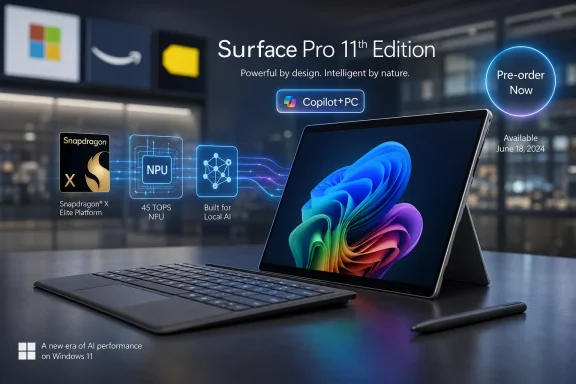
Microsoft opened preorders for the Surface Pro 11th Edition on May 20, 2024, through the Microsoft Store and major retailers including Amazon, Best Buy, and B&H Photo, with the first Snapdragon-powered Copilot+ Surface Pro configurations scheduled to ship on June 18, 2024. The shopping-page answer was simple; the industry answer was not. Microsoft was not merely putting another detachable tablet on preorder shelves. It was asking Windows buyers to treat Arm, local AI hardware, and the Surface Pro form factor as one bundled bet.
That is why the Surface Pro 11 mattered more than its preorder links. It arrived as Microsoft’s consumer-facing declaration that the Windows PC’s next phase would be sold through silicon requirements, AI branding, and a familiar kickstand rather than through the old Intel-versus-AMD spec-sheet fight. The device was a product launch, but it was also a test of whether Windows users would accept a new definition of what a “real PC” should be.
The Surface Pro has always been Microsoft’s preferred argument in hardware form. When the company wants to redefine Windows computing, it tends to do it with a machine that looks slightly too much like a tablet and slightly too much like a laptop, then waits for the rest of the industry to catch up. The 2024 Surface Pro followed that old script, but with a different protagonist: Qualcomm’s Snapdragon X platform.
That change mattered because Surface Pro buyers had been trained for more than a decade to think of the device as a premium Windows machine first and a detachable tablet second. The promise was compatibility, flexibility, and Microsoft’s own stamp of approval on what Windows hardware could be. Moving the flagship consumer Surface Pro to Snapdragon X Plus and Snapdragon X Elite processors was therefore not a side experiment. It was Microsoft putting its most recognizable hybrid PC behind Windows on Arm.
The timing sharpened the message. Microsoft announced the device on May 20, 2024, just ahead of Build, as part of the first Copilot+ PC wave. That branding turned a processor choice into a platform threshold. A Copilot+ PC was not merely a laptop with a Copilot key or some software shortcuts; it was a machine with a neural processing unit strong enough to run a new class of Windows AI features locally.
For consumers landing on a preorder article, that larger strategy could be easy to miss. The practical choice was between a $999.99 LCD model with Snapdragon X Plus and pricier configurations with Snapdragon X Elite and OLED. But Microsoft’s real sales pitch was that the old Surface Pro concept had finally found the silicon it had always been waiting for: thin, quiet, battery-conscious, and theoretically fast enough to stop requiring excuses.
The Type Cover problem became the Flex Keyboard problem. The optional Surface Pro Flex Keyboard, advertised as a major upgrade because it could work detached over Bluetooth, pushed the real cost of a laptop-like Surface experience higher. At around $450, it turned the headline $999.99 machine into a much more expensive daily driver before buyers even considered storage, RAM, pen input, or the OLED display.
That matters because the Surface Pro is not a conventional tablet purchase. Most people who buy one are not buying it as a couch device. They are buying it as a compact Windows computer that can impersonate a laptop, a note-taking slab, and a travel workstation. For that job, the keyboard is not an accessory in the way a sleeve or dock is an accessory. It is part of the computer.
The higher configurations made the split even clearer. The OLED and Snapdragon X Elite model started at $1,499.99, while the top configuration with 32GB of RAM and 1TB of storage reached roughly $2,099.99 before keyboard costs. At those prices, the Surface Pro stopped competing only with tablets and started competing with premium ultrabooks, MacBook Pros, business convertibles, and even some mobile workstations.
That is the recurring Surface tension. Microsoft sells minimalism, but the invoice sells modularity. The more compelling the Surface Pro becomes as an all-day Windows machine, the harder it is to ignore how much of that experience remains locked behind add-ons and configuration ladders.
The Snapdragon X Plus and X Elite chips were pitched as a break from the compromises that defined earlier Arm-based Windows PCs. Those earlier devices often promised long battery life and instant-on convenience, then ran into performance gaps, app compatibility friction, and the subtle annoyance of being good only until a user’s real workflow appeared. Microsoft’s 2024 message was that this generation would be different.
The company claimed major performance gains over earlier Surface models, including a headline figure of up to 90 percent faster performance versus the previous generation. Such claims always depend on workloads, configurations, and test conditions, but the direction was unmistakable. Microsoft wanted buyers to stop treating Arm as a lightweight branch of Windows and start treating it as a premium path.
That pitch was helped by the state of the PC market. By 2024, Apple had already spent several years showing what tightly integrated Arm-based laptop silicon could do for performance per watt. Windows OEMs could not simply keep replying with “compatibility” forever. Microsoft needed an answer that felt modern, not defensive.
Surface Pro 11 was that answer in its cleanest form. It was a Windows device designed to look familiar while changing the architecture underneath. That made it less risky to market and more risky to own, depending on how much of a buyer’s software stack still depended on old assumptions.
That distinction is crucial. Windows 11 could keep running on millions of existing PCs, but Microsoft could still reserve its most visible AI features for machines with sufficiently powerful NPUs. The Surface Pro 11 did not just launch alongside Copilot+ PCs; it helped define what Microsoft wanted that category to mean.
For Windows enthusiasts, this was both exciting and irritating. On one hand, local AI workloads benefit from dedicated hardware. If features such as on-device image generation, live translation, advanced camera effects, and semantic search are going to be responsive and power-efficient, the CPU and GPU cannot do all the work. On the other hand, the Copilot+ label created a new compatibility cliff inside the Windows 11 ecosystem.
That cliff was not about whether a PC could run Windows. It was about whether a PC could run the version of Windows Microsoft wanted to talk about onstage. The Surface Pro 11 therefore became a kind of showroom model for the AI PC era: buy this, and you are on the right side of the line.
The trouble with showroom models is that real users bring real workloads. IT departments ask whether VPN clients, endpoint agents, line-of-business applications, printer tools, browser extensions, plug-ins, and legacy installers behave correctly. Developers ask whether their toolchains run natively or tolerably under emulation. Power users ask whether the machine is fast in the messy middle, not just in demos.
That is where Copilot+ branding could not do all the work. It could define eligibility, but it could not guarantee satisfaction.
The backlash was immediate and predictable. Security researchers, privacy advocates, and enterprise admins focused on the risk of creating a searchable visual history of sensitive activity. Even if the feature was local, even if Microsoft argued that data stayed on the device, the premise forced users to ask uncomfortable questions about what their PC should record by default.
Microsoft eventually delayed and reworked Recall, moving toward stronger opt-in framing and additional security controls. That episode did not kill Copilot+ PCs, but it changed the emotional context around them. AI hardware went from “faster magic” to “new attack surface” in the minds of many Windows watchers.
For the Surface Pro 11, that mattered because the device’s identity was inseparable from Copilot+. The machine was not just a faster Surface. It was a launch vehicle for a category whose most famous feature became controversial before most buyers had the hardware in hand.
This is the part of the story that preorder coverage naturally underplays. Retail pages are built around availability, color, configuration, and shipping dates. But Microsoft’s AI PC push asked buyers to trust not only a device, but a roadmap of features that were still being reshaped under public pressure.
But the OLED model also highlighted Microsoft’s segmentation strategy. The best version of the Surface Pro 11 was not the starting model. The buyer who wanted the strongest chip and best panel had to move up the price ladder, and that ladder rose quickly. Microsoft was careful to keep the entry point psychologically accessible while reserving the most desirable experience for higher tiers.
The same was true of memory and storage. A 32GB RAM and 1TB storage configuration made sense for heavier multitaskers and professional users, but its price pushed the device into a market where buyers expect very few compromises. In that zone, every Arm compatibility hiccup feels more expensive.
The 5G story also fit the Surface Pro identity, even if it did not define the first wave for every buyer. A thin detachable Windows machine with cellular connectivity is exactly the kind of device Surface was meant to be. Field workers, frequent travelers, consultants, and executives can all make a credible case for it.
Still, the broader platform question remained larger than the hardware polish. A great display can make a device more pleasant. A better keyboard can make it more usable. But the move to Snapdragon determined whether the Surface Pro 11 felt like the future of Windows or another stylish machine carrying Microsoft’s hopes ahead of the ecosystem.
Bluetooth support changed that. Suddenly the Surface Pro could sit on a stand, a tray table, or a cramped desk while the keyboard remained in a more comfortable position. That made the device more flexible in precisely the way Surface marketing had always implied it should be.
It was also a tacit admission that the classic Surface Pro posture has limits. The kickstand-and-cover arrangement works beautifully on a desk and less beautifully on a lap. It is compact, clever, and iconic, but it is not always ergonomic. A detached keyboard gives users more options, especially in travel and presentation scenarios.
The problem is that Microsoft charged for that solution as a premium accessory. The Flex Keyboard did not merely improve the Surface Pro; it raised the cost of making the Surface Pro behave like the idealized version of itself. That is a subtle but important distinction.
For buyers, the question was not whether the Flex Keyboard was useful. It clearly was. The question was whether a device whose identity depends on keyboard flexibility should still make the best keyboard feel like a luxury upgrade.
That is the highest bar for the Surface Pro 11. If the machine succeeds, the buyer forgets that it is Arm-based. If it fails, every annoyance becomes evidence for a larger indictment.
Microsoft had made real progress by 2024. App compatibility was better, native Arm64 software was more common, and emulation had improved. The broader industry also had more incentive to support Arm because the Copilot+ PC category was not limited to one Microsoft device. Major OEMs were part of the same wave.
Even so, enterprise Windows environments are full of edge cases. Old installers, security products, drivers, macros, specialist utilities, and proprietary applications do not care about platform narratives. They either work or they do not. For sysadmins, “probably fine” is not a deployment strategy.
That is why Surface Pro 11 was easier to recommend to some buyers than others. A user living mostly in Microsoft 365, Edge, Teams, web apps, remote desktops, and mainstream creative tools had a much better shot at a smooth experience. A user with niche hardware, legacy x86 utilities, or demanding compatibility requirements had homework to do.
Microsoft’s challenge was not only technical. It was reputational. Windows users remember the difference between a promise and a platform. The Surface Pro 11 gave Windows on Arm its strongest mainstream vehicle yet, but the burden of proof remained with Microsoft and its partners.
That retail normality also helped Microsoft avoid making the Surface Pro 11 feel experimental. The company did not present it as a developer kit, a special edition, or a niche mobility device. It presented it as the new Surface Pro. That matters in consumer psychology.
The launch date, June 18, 2024, aligned with the first broader Copilot+ PC wave. Microsoft wanted shelves, reviews, OEM partner machines, and Windows AI messaging to arrive as one coordinated event. The goal was not to sell one Surface model in isolation. It was to create the impression that the Windows PC market had turned a page.
In practice, retail availability also created a comparison problem. Once Copilot+ PCs from other manufacturers hit the market, Surface had to justify its premium. Dell, HP, Lenovo, Samsung, Acer, and ASUS could all build Snapdragon machines with different tradeoffs. Some would be more laptop-like. Some would be cheaper. Some would have better port selections or more conventional ergonomics.
Surface Pro therefore had to win on design coherence, display quality, pen support, and Microsoft’s first-party polish. That has always been the Surface bargain. The buyer pays more not because the spec sheet is unbeatable, but because the hardware expresses Microsoft’s idea of Windows better than most third-party machines do.
That later expansion actually clarifies what Microsoft was doing in 2024. The Surface Pro 11 was not merely a product refresh; it was the flagship beachhead for a new Surface strategy. Once Copilot+ became the umbrella, Microsoft could stretch the lineup into smaller, cheaper, business-specific, and eventually refreshed variants.
The 12-inch Surface Pro moved the concept in a different direction. It suggested Microsoft saw room below the 13-inch flagship for a more compact Copilot+ detachable. That is a meaningful shift because Surface Go had occupied the small Surface space for years, usually with compromises that made it feel secondary. A smaller Copilot+ Surface Pro implied that even Microsoft’s lower-cost mobility devices would be pulled into the AI PC identity.
The 2026 business hardware adds another layer. Microsoft’s Surface for Business moves often reveal what the company thinks IT buyers need before consumer branding catches up. Business buyers care less about keynote magic and more about manageability, lifecycle, security, repairability, deployment predictability, and silicon choice. If Surface is going to remain credible in managed fleets, Microsoft must support both innovation and operational conservatism.
That is the balance the Surface Pro 11 began to expose. Microsoft wants to move Windows forward quickly, but its most loyal customers often move deliberately. The Copilot+ transition has to persuade both groups without pretending they have the same risk tolerance.
Those claims were plausible, but not identical. Snapdragon performance and battery life could be reviewed within weeks. Copilot+ value depended on a longer software arc. The Surface Pro form factor depended on personal tolerance for kickstands, detachable keyboards, and accessory pricing.
This is why the device was simultaneously exciting and difficult to recommend universally. It was one of the most interesting Windows PCs of its moment, but “interesting” is not the same as “safe.” Enthusiasts often enjoy being early. IT departments usually do not.
For a WindowsForum audience, that distinction is central. The Surface Pro 11 was not just a gadget to admire. It was a preview of the kinds of decisions admins and power users would increasingly face: whether to standardize on NPU-capable PCs, when to trust Arm devices, how to evaluate AI features, and how to explain to users why two Windows 11 machines may not receive the same headline capabilities.
The machine also showed how Microsoft’s consumer and enterprise stories can collide. Consumers hear “faster, smarter, longer battery life.” Administrators hear “new architecture, new feature gates, new privacy questions, new validation matrix.” Both reactions are rational.
But the more durable lesson is that Microsoft chose the Surface Pro to normalize a new kind of Windows PC. The company did not hide Copilot+ inside a low-volume device. It put the label on a marquee product, priced it like a premium machine, and asked the market to follow.
That bet carried advantages. Surface Pro’s portability made the battery-life and efficiency story intuitive. Its premium positioning made the OLED and Flex Keyboard upgrades easier to sell. Its first-party status made it a natural showcase for Windows features that Microsoft wanted reviewers and developers to notice.
The same bet carried risk. A premium Surface is judged harshly because it claims to represent Windows at its best. If app compatibility fails, if AI features disappoint, if privacy concerns linger, or if the accessory math feels punitive, the criticism lands not only on one device but on Microsoft’s broader strategy.
That is what made the Surface Pro 11 launch unusually consequential. It was not the first Surface Pro, not the first Windows on Arm machine, and not the only Copilot+ PC. It was the moment Microsoft tried to make all three stories converge into a mainstream purchase.
That is why the Surface Pro 11 mattered more than its preorder links. It arrived as Microsoft’s consumer-facing declaration that the Windows PC’s next phase would be sold through silicon requirements, AI branding, and a familiar kickstand rather than through the old Intel-versus-AMD spec-sheet fight. The device was a product launch, but it was also a test of whether Windows users would accept a new definition of what a “real PC” should be.
 Microsoft Used a Familiar Tablet to Sell an Unfamiliar PC Future
The Surface Pro has always been Microsoft’s preferred argument in hardware form. When the company wants to redefine Windows computing, it tends to do it with a machine that looks slightly too much like a tablet and slightly too much like a laptop, then waits for the rest of the industry to catch up. The 2024 Surface Pro followed that old script, but with a different protagonist: Qualcomm’s Snapdragon X platform.That change mattered because Surface Pro buyers had been trained for more than a decade to think of the device as a premium Windows machine first and a detachable tablet second. The promise was compatibility, flexibility, and Microsoft’s own stamp of approval on what Windows hardware could be. Moving the flagship consumer Surface Pro to Snapdragon X Plus and Snapdragon X Elite processors was therefore not a side experiment. It was Microsoft putting its most recognizable hybrid PC behind Windows on Arm.
The timing sharpened the message. Microsoft announced the device on May 20, 2024, just ahead of Build, as part of the first Copilot+ PC wave. That branding turned a processor choice into a platform threshold. A Copilot+ PC was not merely a laptop with a Copilot key or some software shortcuts; it was a machine with a neural processing unit strong enough to run a new class of Windows AI features locally.
For consumers landing on a preorder article, that larger strategy could be easy to miss. The practical choice was between a $999.99 LCD model with Snapdragon X Plus and pricier configurations with Snapdragon X Elite and OLED. But Microsoft’s real sales pitch was that the old Surface Pro concept had finally found the silicon it had always been waiting for: thin, quiet, battery-conscious, and theoretically fast enough to stop requiring excuses.
The Price Was the First Reality Check
The starting price looked defensible in isolation. At $999.99, the entry Surface Pro 11 sat in familiar premium-tablet territory and undercut some high-end laptop configurations. But Surface has always played a pricing game in which the sticker price is only the opening bid.The Type Cover problem became the Flex Keyboard problem. The optional Surface Pro Flex Keyboard, advertised as a major upgrade because it could work detached over Bluetooth, pushed the real cost of a laptop-like Surface experience higher. At around $450, it turned the headline $999.99 machine into a much more expensive daily driver before buyers even considered storage, RAM, pen input, or the OLED display.
That matters because the Surface Pro is not a conventional tablet purchase. Most people who buy one are not buying it as a couch device. They are buying it as a compact Windows computer that can impersonate a laptop, a note-taking slab, and a travel workstation. For that job, the keyboard is not an accessory in the way a sleeve or dock is an accessory. It is part of the computer.
The higher configurations made the split even clearer. The OLED and Snapdragon X Elite model started at $1,499.99, while the top configuration with 32GB of RAM and 1TB of storage reached roughly $2,099.99 before keyboard costs. At those prices, the Surface Pro stopped competing only with tablets and started competing with premium ultrabooks, MacBook Pros, business convertibles, and even some mobile workstations.
That is the recurring Surface tension. Microsoft sells minimalism, but the invoice sells modularity. The more compelling the Surface Pro becomes as an all-day Windows machine, the harder it is to ignore how much of that experience remains locked behind add-ons and configuration ladders.
Snapdragon X Made the Surface Pro More Than Another Annual Refresh
The most important spec in the Surface Pro 11 was not the OLED panel, the detachable Bluetooth keyboard, or even the battery-life claim. It was the shift to Snapdragon X processors. Microsoft and Qualcomm had been trying to make Windows on Arm feel inevitable for years, but the Surface Pro 11 was the first consumer Surface Pro where the effort felt less like a niche and more like a reset.The Snapdragon X Plus and X Elite chips were pitched as a break from the compromises that defined earlier Arm-based Windows PCs. Those earlier devices often promised long battery life and instant-on convenience, then ran into performance gaps, app compatibility friction, and the subtle annoyance of being good only until a user’s real workflow appeared. Microsoft’s 2024 message was that this generation would be different.
The company claimed major performance gains over earlier Surface models, including a headline figure of up to 90 percent faster performance versus the previous generation. Such claims always depend on workloads, configurations, and test conditions, but the direction was unmistakable. Microsoft wanted buyers to stop treating Arm as a lightweight branch of Windows and start treating it as a premium path.
That pitch was helped by the state of the PC market. By 2024, Apple had already spent several years showing what tightly integrated Arm-based laptop silicon could do for performance per watt. Windows OEMs could not simply keep replying with “compatibility” forever. Microsoft needed an answer that felt modern, not defensive.
Surface Pro 11 was that answer in its cleanest form. It was a Windows device designed to look familiar while changing the architecture underneath. That made it less risky to market and more risky to own, depending on how much of a buyer’s software stack still depended on old assumptions.
Copilot+ Was a Hardware Standard Disguised as an AI Brand
Microsoft’s Copilot+ PC label did two things at once. Publicly, it gave shoppers a simple badge for a new generation of AI-capable Windows PCs. Strategically, it created a hardware line that separated “new Windows” from “old Windows” without requiring a new operating system name.That distinction is crucial. Windows 11 could keep running on millions of existing PCs, but Microsoft could still reserve its most visible AI features for machines with sufficiently powerful NPUs. The Surface Pro 11 did not just launch alongside Copilot+ PCs; it helped define what Microsoft wanted that category to mean.
For Windows enthusiasts, this was both exciting and irritating. On one hand, local AI workloads benefit from dedicated hardware. If features such as on-device image generation, live translation, advanced camera effects, and semantic search are going to be responsive and power-efficient, the CPU and GPU cannot do all the work. On the other hand, the Copilot+ label created a new compatibility cliff inside the Windows 11 ecosystem.
That cliff was not about whether a PC could run Windows. It was about whether a PC could run the version of Windows Microsoft wanted to talk about onstage. The Surface Pro 11 therefore became a kind of showroom model for the AI PC era: buy this, and you are on the right side of the line.
The trouble with showroom models is that real users bring real workloads. IT departments ask whether VPN clients, endpoint agents, line-of-business applications, printer tools, browser extensions, plug-ins, and legacy installers behave correctly. Developers ask whether their toolchains run natively or tolerably under emulation. Power users ask whether the machine is fast in the messy middle, not just in demos.
That is where Copilot+ branding could not do all the work. It could define eligibility, but it could not guarantee satisfaction.
Recall Turned the AI PC Pitch Into a Trust Test
No feature better captured the early Copilot+ tension than Recall. Microsoft presented it as a way to search across a user’s past activity by capturing and indexing snapshots locally. In concept, it was the kind of feature that made the NPU pitch easier to understand: a PC that remembers what you saw, not just what files you saved.The backlash was immediate and predictable. Security researchers, privacy advocates, and enterprise admins focused on the risk of creating a searchable visual history of sensitive activity. Even if the feature was local, even if Microsoft argued that data stayed on the device, the premise forced users to ask uncomfortable questions about what their PC should record by default.
Microsoft eventually delayed and reworked Recall, moving toward stronger opt-in framing and additional security controls. That episode did not kill Copilot+ PCs, but it changed the emotional context around them. AI hardware went from “faster magic” to “new attack surface” in the minds of many Windows watchers.
For the Surface Pro 11, that mattered because the device’s identity was inseparable from Copilot+. The machine was not just a faster Surface. It was a launch vehicle for a category whose most famous feature became controversial before most buyers had the hardware in hand.
This is the part of the story that preorder coverage naturally underplays. Retail pages are built around availability, color, configuration, and shipping dates. But Microsoft’s AI PC push asked buyers to trust not only a device, but a roadmap of features that were still being reshaped under public pressure.
The OLED Upgrade Was Welcome, but the Platform Shift Was the Product
The optional OLED display gave the Surface Pro 11 a straightforward premium hook. Surface screens have generally been strong, and an OLED option made the device easier to compare against high-end tablets and laptops. For artists, media consumers, and anyone who spends long hours staring at a portable screen, the display upgrade was not trivial.But the OLED model also highlighted Microsoft’s segmentation strategy. The best version of the Surface Pro 11 was not the starting model. The buyer who wanted the strongest chip and best panel had to move up the price ladder, and that ladder rose quickly. Microsoft was careful to keep the entry point psychologically accessible while reserving the most desirable experience for higher tiers.
The same was true of memory and storage. A 32GB RAM and 1TB storage configuration made sense for heavier multitaskers and professional users, but its price pushed the device into a market where buyers expect very few compromises. In that zone, every Arm compatibility hiccup feels more expensive.
The 5G story also fit the Surface Pro identity, even if it did not define the first wave for every buyer. A thin detachable Windows machine with cellular connectivity is exactly the kind of device Surface was meant to be. Field workers, frequent travelers, consultants, and executives can all make a credible case for it.
Still, the broader platform question remained larger than the hardware polish. A great display can make a device more pleasant. A better keyboard can make it more usable. But the move to Snapdragon determined whether the Surface Pro 11 felt like the future of Windows or another stylish machine carrying Microsoft’s hopes ahead of the ecosystem.
The Flex Keyboard Solved One Old Complaint While Preserving Another
The Surface Pro Flex Keyboard was one of the more interesting pieces of the launch because it addressed a longstanding irritation in the Surface design. Previous Surface keyboards were physically tied to the tablet. Detach the keyboard, and you usually detached the laptop experience with it.Bluetooth support changed that. Suddenly the Surface Pro could sit on a stand, a tray table, or a cramped desk while the keyboard remained in a more comfortable position. That made the device more flexible in precisely the way Surface marketing had always implied it should be.
It was also a tacit admission that the classic Surface Pro posture has limits. The kickstand-and-cover arrangement works beautifully on a desk and less beautifully on a lap. It is compact, clever, and iconic, but it is not always ergonomic. A detached keyboard gives users more options, especially in travel and presentation scenarios.
The problem is that Microsoft charged for that solution as a premium accessory. The Flex Keyboard did not merely improve the Surface Pro; it raised the cost of making the Surface Pro behave like the idealized version of itself. That is a subtle but important distinction.
For buyers, the question was not whether the Flex Keyboard was useful. It clearly was. The question was whether a device whose identity depends on keyboard flexibility should still make the best keyboard feel like a luxury upgrade.
Windows on Arm Finally Had Its Best Chance — and Its Old Burden
By the time the Surface Pro 11 arrived, Windows on Arm no longer needed to prove that it could boot, browse, and survive a workday. It needed to prove that it could disappear. Users do not want to think about processor architecture when joining a meeting, installing a printer, running accounting software, opening a game launcher, or plugging in a weird USB device.That is the highest bar for the Surface Pro 11. If the machine succeeds, the buyer forgets that it is Arm-based. If it fails, every annoyance becomes evidence for a larger indictment.
Microsoft had made real progress by 2024. App compatibility was better, native Arm64 software was more common, and emulation had improved. The broader industry also had more incentive to support Arm because the Copilot+ PC category was not limited to one Microsoft device. Major OEMs were part of the same wave.
Even so, enterprise Windows environments are full of edge cases. Old installers, security products, drivers, macros, specialist utilities, and proprietary applications do not care about platform narratives. They either work or they do not. For sysadmins, “probably fine” is not a deployment strategy.
That is why Surface Pro 11 was easier to recommend to some buyers than others. A user living mostly in Microsoft 365, Edge, Teams, web apps, remote desktops, and mainstream creative tools had a much better shot at a smooth experience. A user with niche hardware, legacy x86 utilities, or demanding compatibility requirements had homework to do.
Microsoft’s challenge was not only technical. It was reputational. Windows users remember the difference between a promise and a platform. The Surface Pro 11 gave Windows on Arm its strongest mainstream vehicle yet, but the burden of proof remained with Microsoft and its partners.
Retail Availability Made the Launch Look Normal — That Was the Point
The Mashable preorder angle is almost mundane: here are the stores, here are the prices, here is the shipping date. But that ordinariness was part of Microsoft’s strategy. A platform transition feels less risky when it appears on Amazon, Best Buy, B&H Photo, and Microsoft’s own store with familiar configuration choices and normal delivery windows.That retail normality also helped Microsoft avoid making the Surface Pro 11 feel experimental. The company did not present it as a developer kit, a special edition, or a niche mobility device. It presented it as the new Surface Pro. That matters in consumer psychology.
The launch date, June 18, 2024, aligned with the first broader Copilot+ PC wave. Microsoft wanted shelves, reviews, OEM partner machines, and Windows AI messaging to arrive as one coordinated event. The goal was not to sell one Surface model in isolation. It was to create the impression that the Windows PC market had turned a page.
In practice, retail availability also created a comparison problem. Once Copilot+ PCs from other manufacturers hit the market, Surface had to justify its premium. Dell, HP, Lenovo, Samsung, Acer, and ASUS could all build Snapdragon machines with different tradeoffs. Some would be more laptop-like. Some would be cheaper. Some would have better port selections or more conventional ergonomics.
Surface Pro therefore had to win on design coherence, display quality, pen support, and Microsoft’s first-party polish. That has always been the Surface bargain. The buyer pays more not because the spec sheet is unbeatable, but because the hardware expresses Microsoft’s idea of Windows better than most third-party machines do.
The Newer Surface Lineup Makes the 2024 Launch Look Like a Foundation, Not a Finale
From the vantage point of 2026, calling the Surface Pro 11 Microsoft’s “newest” Surface Pro requires historical care. Microsoft has since expanded the Surface Copilot+ family, including a smaller 12-inch Surface Pro introduced in 2025 and newer business-focused Surface hardware in 2026. The 2024 Surface Pro 11 remains important, but it is no longer the full endpoint of the story.That later expansion actually clarifies what Microsoft was doing in 2024. The Surface Pro 11 was not merely a product refresh; it was the flagship beachhead for a new Surface strategy. Once Copilot+ became the umbrella, Microsoft could stretch the lineup into smaller, cheaper, business-specific, and eventually refreshed variants.
The 12-inch Surface Pro moved the concept in a different direction. It suggested Microsoft saw room below the 13-inch flagship for a more compact Copilot+ detachable. That is a meaningful shift because Surface Go had occupied the small Surface space for years, usually with compromises that made it feel secondary. A smaller Copilot+ Surface Pro implied that even Microsoft’s lower-cost mobility devices would be pulled into the AI PC identity.
The 2026 business hardware adds another layer. Microsoft’s Surface for Business moves often reveal what the company thinks IT buyers need before consumer branding catches up. Business buyers care less about keynote magic and more about manageability, lifecycle, security, repairability, deployment predictability, and silicon choice. If Surface is going to remain credible in managed fleets, Microsoft must support both innovation and operational conservatism.
That is the balance the Surface Pro 11 began to expose. Microsoft wants to move Windows forward quickly, but its most loyal customers often move deliberately. The Copilot+ transition has to persuade both groups without pretending they have the same risk tolerance.
Buyers Were Really Preordering Microsoft’s Confidence
A preorder is supposed to be a retail transaction, but early Surface Pro 11 buyers were also buying Microsoft’s confidence in three claims. First, that Qualcomm’s Snapdragon X chips could make Windows on Arm feel premium rather than conditional. Second, that Copilot+ hardware would age better than conventional PCs as Windows AI features expanded. Third, that the Surface Pro form factor still deserved flagship status in a market full of excellent laptops.Those claims were plausible, but not identical. Snapdragon performance and battery life could be reviewed within weeks. Copilot+ value depended on a longer software arc. The Surface Pro form factor depended on personal tolerance for kickstands, detachable keyboards, and accessory pricing.
This is why the device was simultaneously exciting and difficult to recommend universally. It was one of the most interesting Windows PCs of its moment, but “interesting” is not the same as “safe.” Enthusiasts often enjoy being early. IT departments usually do not.
For a WindowsForum audience, that distinction is central. The Surface Pro 11 was not just a gadget to admire. It was a preview of the kinds of decisions admins and power users would increasingly face: whether to standardize on NPU-capable PCs, when to trust Arm devices, how to evaluate AI features, and how to explain to users why two Windows 11 machines may not receive the same headline capabilities.
The machine also showed how Microsoft’s consumer and enterprise stories can collide. Consumers hear “faster, smarter, longer battery life.” Administrators hear “new architecture, new feature gates, new privacy questions, new validation matrix.” Both reactions are rational.
The Surface Pro 11 Was a Better Signal Than a Simple Shopping Deal
The concrete preorder facts were useful, especially in May 2024. Buyers could reserve the Surface Pro 11 from Microsoft’s store and large retailers, choose between Snapdragon X Plus and X Elite configurations, decide whether OLED was worth the jump, and plan around a June 18 launch. That information answered the immediate shopping question.But the more durable lesson is that Microsoft chose the Surface Pro to normalize a new kind of Windows PC. The company did not hide Copilot+ inside a low-volume device. It put the label on a marquee product, priced it like a premium machine, and asked the market to follow.
That bet carried advantages. Surface Pro’s portability made the battery-life and efficiency story intuitive. Its premium positioning made the OLED and Flex Keyboard upgrades easier to sell. Its first-party status made it a natural showcase for Windows features that Microsoft wanted reviewers and developers to notice.
The same bet carried risk. A premium Surface is judged harshly because it claims to represent Windows at its best. If app compatibility fails, if AI features disappoint, if privacy concerns linger, or if the accessory math feels punitive, the criticism lands not only on one device but on Microsoft’s broader strategy.
That is what made the Surface Pro 11 launch unusually consequential. It was not the first Surface Pro, not the first Windows on Arm machine, and not the only Copilot+ PC. It was the moment Microsoft tried to make all three stories converge into a mainstream purchase.
The Preorder Button Was Only the Start of the Copilot+ Contract
The practical lessons from the Surface Pro 11 launch are clearer now than they were on preorder day. The machine was a strong signal of where Microsoft wanted Windows hardware to go, but it also reminded buyers that platform transitions are measured in workflows, not slogans.- The Surface Pro 11th Edition went up for preorder on May 20, 2024, through Microsoft and major retailers, with launch shipments planned for June 18, 2024.
- The base $999.99 model made the device look approachable, but a keyboard, OLED display, extra memory, and more storage quickly pushed real-world pricing much higher.
- Snapdragon X processors made the Surface Pro 11 a serious Windows on Arm milestone, but buyers with legacy apps, drivers, or specialized workflows still needed to verify compatibility.
- Copilot+ branding created a new hardware threshold inside the Windows ecosystem, making NPU capability a practical purchasing consideration rather than a marketing footnote.
- The Recall controversy showed that local AI features could not be judged only by performance; privacy, security, defaults, and administrative control became part of the hardware value proposition.
- Later Surface releases made the 2024 Surface Pro look less like a one-off reboot and more like the foundation for Microsoft’s broader Copilot+ PC hardware strategy.
References
- Primary source: Mashable
Published: Thu, 11 Jun 2026 20:03:42 GMT
Where to pre-order the Microsoft Surface Pro 11th Edition | Mashable
As of May 20, the newest edition of the Microsoft Surface Pro is available for preorder. Here's what's new and where to get one.mashable.com - Official source: blogs.windows.com
Introducing all-new Surface Copilot+ PCs: The Surface Pro, 12-inch and Surface Laptop, 13-inch
Copilot+ PCs continue to define the next wave of personal computing — fast, long lasting, secure PCs that are purpose-built to unlock AI experiences that empower us to get more done. Today, Microsoft and Surface expand the Copilot+ PC family with tblogs.windows.com - Related coverage: techspot.com
Microsoft unveils thinner, lighter Surface Laptop and Surface Pro, starting at $799 | TechSpot
Microsoft has expanded its Copilot+ PC family with two new Surface devices: the 12-inch Surface Pro tablet and the 13-inch Surface Laptop. Powered by Qualcomm's Snapdragon X...www.techspot.com - Related coverage: surfacetip.com
Surface Pro 11 specs, features, and tips - SurfaceTip
Surface Pro 11 launched on May 20, 2024, with the new Snapdragon X processors, significantly improving performance, battery life, and more.surfacetip.com - Official source: news.microsoft.com
- Related coverage: windowscentral.com
Microsoft unveils world's first Copilot+ PC — The Surface Pro 11 with OLED and Snapdragon X is finally here | Windows Central
The Surface Pro finally gets an OLED screen, a wireless Type Cover, and all-day battery life thanks to the Snapdragon X.www.windowscentral.com
- Related coverage: gadgets360.com
Microsoft Surface Laptop 13-Inch, Surface Pro 12-Inch Copilot+ PCs With Snapdragon X Plus Processor Launched | Technology News
Microsoft just revealed two new Surface Copilot+ PCs. The Surface Laptop 13-inch and the Surface Pro 12-inch run on an octa-core Snapdragon X Plus processor. They include a dedicated NPU capable of delivering 45 TOPS.www.gadgets360.com - Official source: blogs.microsoft.com
Introducing Copilot+ PCs - The Official Microsoft Blog
An on-demand recording of our May 20 event is available. Today, at a special event on our new Microsoft campus, we introduced the world to a new category of Windows PCs designed for AI, Copilot+ PCs. Copilot+ PCs are the fastest, most intelligent Windows PCs ever built. With powerful new...blogs.microsoft.com - Related coverage: windowsblogitalia.com
[video] Microsoft presenta il nuovo Surface Pro 12" con Snapdragon X | Preordine
Microsoft ha presentato il nuovo Surface Pro Copilot+ PC con schermo da 12" e processore Snapdragon X. www.windowsblogitalia.com
- Related coverage: croma.com
Microsoft announces a new 12‑inch Surface Pro | Croma Unboxed
Microsoft's new Surface Pro laptop is a compact Copilot+ PC with 45 TOPs of NPU. Check its details on Croma Unboxed.www.croma.com - Related coverage: howtogeek.com
The New Surface Pro Swaps Intel CPUs for Snapdragon Chips
It has a new chipset, optional OLED screen, upgraded keyboard, and much more. www.howtogeek.com
- Related coverage: pcworld.com
Microsoft's new Surface laptops are bursting with AI power | PCWorld
Microsoft launched the new Copilot+ versions of the Surface Pro (2024) and the Surface Laptop (2024) with the Qualcomm Snapdragon X Elite processors inside, packed with AI power.www.pcworld.com - Official source: microsoft.com
- Related coverage: techradar.com
10 products that launched at Microsoft Build — and what happened to them | TechRadar
From Windows 8 to Copilot, here’s everything that was born at Buildwww.techradar.com - Related coverage: tomshardware.com
New Microsoft Surface for Business PCs pair Panther Lake chips with as little as 8GB of RAM — 13-inch Surface Laptop goes light on memory but still starts at $1,299 | Tom's Hardware
The AI gold rush crimps the local AI ambitions of the cheapest business-focused Surfacewww.tomshardware.com - Related coverage: pcgamer.com
Microsoft plans to launch a cheaper 8 GB Surface laptop later this year which won't meet the requirements of a Copilot+ PC | PC Gamer
How far we have fallen.www.pcgamer.com - Related coverage: itpro.com
Microsoft Surface Pro 12in review | IT Pro
The newest Surface Pro tablet is compact, light, powerful, and good value (on its own)www.itpro.com - Official source: cdn-dynmedia-1.microsoft.com
!! SpecificProject Only -MSSurface_Logo_horizontal_C-CoPilot Gray_RGB
PDF documentcdn-dynmedia-1.microsoft.com
- Related coverage: dandh.com
