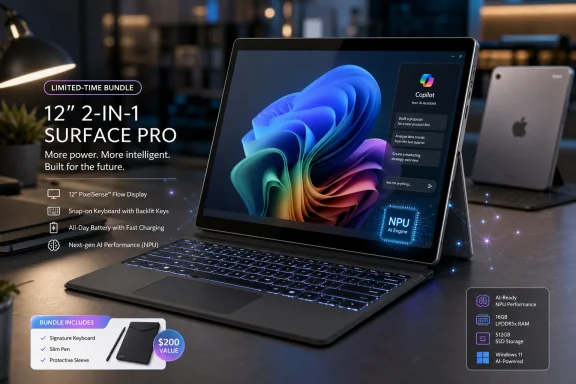
Microsoft is temporarily bundling a free Surface Pro 13-inch Keyboard with new Surface Pro 13-inch purchases in the United States from June 16 through June 30, giving buyers the accessory many users have long argued should have been included by default. The move is small, regional, and time-limited, but it lands on one of the longest-running complaints in Surface history. Microsoft has spent more than a decade selling the Surface Pro as a laptop-replacement idea while pricing one of the laptop-defining parts as an add-on. This promotion does not rewrite that strategy, but it does expose how awkward the old line has always been.
The Surface Pro has always lived in a marketing contradiction. Microsoft calls it a 2-in-1, reviewers test it like a compact Windows laptop, and customers often buy it to replace a notebook, but the keyboard has traditionally sat outside the base price like a luxury trim package. That made sense on a spec sheet and less sense in a checkout cart.
The Type Cover, Signature Keyboard, and now the newer Surface Pro keyboard family are not decorative accessories. They are the bridge between the Surface Pro as a capable tablet and the Surface Pro as the Windows productivity machine Microsoft wants people to imagine. Without one, a Surface Pro can still run Windows, launch desktop apps, and act as a portable slate, but the experience is fundamentally incomplete for the workloads that make Windows valuable.
That is why this limited offer feels more revealing than generous. Microsoft is not changing the Surface Pro business model permanently, at least not yet. It is testing how much better the pitch sounds when the product is sold the way most buyers already mentally assemble it.
But this is not Microsoft suddenly bundling its best keyboard. The included model is the basic Surface Pro 13-inch Keyboard, not the Surface Pro Flex Keyboard. That distinction matters because Microsoft has now split the Surface keyboard story into a standard “make it laptop-like” tier and a premium “make it feel like the best version of the concept” tier.
The free keyboard gets buyers the essential Surface Pro experience: typing, trackpad navigation, screen protection, and the familiar magnetic transformation from tablet to laptop-ish workstation. It does not get them the higher-end Flex Keyboard’s haptic trackpad, detached Bluetooth use, or built-in Surface Slim Pen charging. Microsoft is giving away the accessory necessary to make the product make sense, while continuing to charge handsomely for the accessory that makes the product feel luxurious.
That is not irrational. It is classic segmentation. The problem for Microsoft is that the lowest tier was never merely “basic”; it was the missing half of the device’s core identity.
That creates a trust problem at the exact moment Microsoft needs buyer enthusiasm. The Surface brand is not a bargain line. It is supposed to represent the best of Windows hardware: disciplined industrial design, tight OS integration, good displays, strong cameras, and a form factor that OEM partners can chase. When the final price rises meaningfully at checkout because the keyboard is separate, the customer does not feel like they are configuring a premium system. They feel like the base product was under-specified.
Apple gets criticized for similar accessory math with iPad Pro and Magic Keyboard pricing, but Microsoft’s situation is sharper because Windows remains a keyboard-and-pointer operating system at heart. Windows 11 is more touch-friendly than old Windows, but nobody seriously argues that Excel, PowerShell, Visual Studio Code, Remote Desktop, Teams multitasking, or legacy line-of-business software are better as pure touch experiences. The Surface Pro needs the keyboard not because users lack imagination, but because Windows’ greatest strengths still assume one.
The temporary bundle therefore works as a price correction. It makes the entry package feel more honest for two weeks. The question is why honesty has to expire on June 30.
Detached use matters because it changes the ergonomics. A Surface Pro with a keyboard attached works well on a desk but has always been more awkward on a lap than a traditional clamshell. A keyboard that can continue working over Bluetooth lets the tablet sit separately, higher, farther away, or beside another display. That is not a gimmick; it is a practical answer to one of the oldest compromises in the kickstand-tablet design.
The haptic trackpad also matters. Trackpads are one of those components that users notice most when they are bad. A better trackpad makes the device feel less like a clever tablet with compromises and more like a serious mobile computer. Add Slim Pen charging, and the Flex Keyboard becomes the accessory that finally makes Microsoft’s modular vision feel genuinely integrated.
That is precisely why Microsoft is not giving it away. The company can make the standard keyboard the promotion, protect the premium accessory margin, and still claim to be addressing the loudest complaint. It is a tidy commercial compromise, even if it leaves the philosophical issue unresolved.
That does not make it meaningless. Promotions are often how companies test demand without committing to permanent pricing changes. If attach rates, conversion rates, or average order values improve during the bundle window, Microsoft gets data it can use later. If the offer mostly pulls forward purchases from people who were already going to buy, Microsoft can chalk it up as a seasonal incentive and move on.
The timing also creates urgency without requiring a permanent price cut. A straight $170 discount would invite buyers to wait for the next sale. A keyboard bundle reframes the discount as completeness: buy now and get the “real” Surface Pro package. That language matters because it nudges buyers toward the idea that the keyboard is part of the device, even while Microsoft’s official pricing architecture still says otherwise.
For buyers outside the United States, the message is less satisfying. Surface has always been a global brand with regionally uneven offers, configurations, and availability. A limited U.S. bundle reinforces the sense that Microsoft is experimenting in its home market first rather than making a universal statement about what a Surface Pro should include.
That made the decision to sell keyboards separately feel strange from the beginning. The accessory was not a side story; it was the reveal. Microsoft trained customers to see the keyboard as inseparable from the Surface identity, then asked them to pay extra for it.
Over time, that contradiction became normalized. Reviewers would list the Surface Pro price and then immediately note the real-world cost with a keyboard. Buyers learned to mentally add the accessory tax. Retailers built bundles. Microsoft occasionally used promotions to soften the blow. But the official structure stayed intact: tablet first, keyboard extra.
The trouble is that the market has changed. Premium Windows laptops are thinner, lighter, and better than they were in 2012. ARM-based Windows PCs have improved. OLED screens, better webcams, neural processing units, and better battery life are now part of the competitive field. The Surface Pro can no longer rely on form-factor novelty alone; it has to win on value and coherence.
A keyboard bundle helps with both.
This is where Microsoft’s AI-era hardware story can become oddly fragile. A device may have an NPU, a premium display, and an ambitious software roadmap, but if the buyer feels nickel-and-dimed for a keyboard, the futuristic pitch loses altitude. Practical value still beats platform narrative at checkout.
For IT departments, bundles also simplify procurement. A Surface Pro without a keyboard is not usually a deployable laptop replacement. Someone has to specify the accessory, budget for it, track it, support it, and replace it when damaged. Bundling the keyboard reduces one point of friction, even if only for purchases made in a narrow window.
There is also a perception issue inside organizations. When employees receive a Surface Pro with a keyboard included, it feels like a complete device. When the keyboard is a separate line item, the hardware can look like a tablet being forced into a laptop role. That distinction may sound cosmetic, but IT adoption often turns on whether a device feels standard, supportable, and obvious.
A conventional laptop includes its keyboard because it cannot be otherwise. Its price is legible. Its ergonomics are familiar. Its performance and ports may be better at the same price. The Surface Pro wins when buyers value tablet mode, pen input, portability, detachable use, or the specific elegance of Microsoft’s hardware design.
But if the Surface Pro costs more once configured like a laptop, Microsoft has to make the trade-off feel intentional rather than punitive. A bundled standard keyboard shifts that balance. It does not make the Surface Pro cheap, but it removes the most obvious complaint before the shopper starts comparing processors, RAM, storage, and screens.
That matters in retail psychology. Customers tolerate expensive premium devices more readily than they tolerate feeling tricked. A high price can communicate quality. A missing essential accessory communicates accounting.
The less charitable read is that Microsoft is using a long-standing complaint as launch-season promotional fuel. By calling the bundle a limited-time hero offer, the company gets credit for generosity without accepting the structural implication. If the keyboard truly belongs with every Surface Pro, then June 30 is an arbitrary wall.
Both readings can be true. Hardware companies rarely change packaging philosophy in one dramatic turn. They move through bundles, promotions, education discounts, retail experiments, and quiet SKU adjustments. Today’s temporary offer may be tomorrow’s back-to-school bundle, then next year’s standard configuration, or it may disappear as soon as the launch window closes.
The risk for Microsoft is that once buyers experience the Surface Pro priced with a keyboard included, the old model looks worse by comparison. A promotion can reset expectations even if the company does not intend it to. That is the dangerous power of doing the obvious thing, even briefly.
That does not mean every buyer should rush. The included keyboard is the basic model, and users who care about detached typing, haptics, and pen charging may still prefer the Flex Keyboard. Businesses also need to check procurement channels, configuration availability, and whether consumer Microsoft Store promotions align with their purchasing rules.
Still, Microsoft has made the Surface Pro easier to recommend during this window. Not because the hardware changed, but because the package finally lines up more closely with the promise. The lesson is not that the keyboard is free. The lesson is that the Surface Pro makes more sense when Microsoft stops treating the keyboard as optional.
Here is what matters before the offer expires:
 Microsoft Finally Admits the Keyboard Was Never Optional in Spirit
The Surface Pro has always lived in a marketing contradiction. Microsoft calls it a 2-in-1, reviewers test it like a compact Windows laptop, and customers often buy it to replace a notebook, but the keyboard has traditionally sat outside the base price like a luxury trim package. That made sense on a spec sheet and less sense in a checkout cart.The Type Cover, Signature Keyboard, and now the newer Surface Pro keyboard family are not decorative accessories. They are the bridge between the Surface Pro as a capable tablet and the Surface Pro as the Windows productivity machine Microsoft wants people to imagine. Without one, a Surface Pro can still run Windows, launch desktop apps, and act as a portable slate, but the experience is fundamentally incomplete for the workloads that make Windows valuable.
That is why this limited offer feels more revealing than generous. Microsoft is not changing the Surface Pro business model permanently, at least not yet. It is testing how much better the pitch sounds when the product is sold the way most buyers already mentally assemble it.
The Free Keyboard Is a Discount Wearing a Product Philosophy Costume
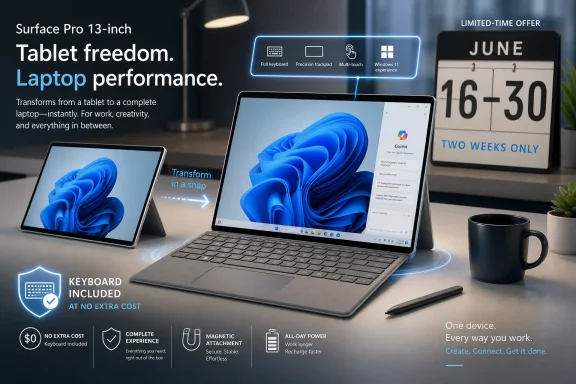
The offer itself is straightforward. Buy an eligible Surface Pro 13-inch through the Microsoft Store in the United States between June 16 and June 30, and Microsoft includes the standard Surface Pro 13-inch Keyboard at no extra cost. The accessory normally sits around the $170 mark, which is not a trivial amount when shoppers are already weighing premium tablet pricing, memory upgrades, storage tiers, and possibly a pen.But this is not Microsoft suddenly bundling its best keyboard. The included model is the basic Surface Pro 13-inch Keyboard, not the Surface Pro Flex Keyboard. That distinction matters because Microsoft has now split the Surface keyboard story into a standard “make it laptop-like” tier and a premium “make it feel like the best version of the concept” tier.
The free keyboard gets buyers the essential Surface Pro experience: typing, trackpad navigation, screen protection, and the familiar magnetic transformation from tablet to laptop-ish workstation. It does not get them the higher-end Flex Keyboard’s haptic trackpad, detached Bluetooth use, or built-in Surface Slim Pen charging. Microsoft is giving away the accessory necessary to make the product make sense, while continuing to charge handsomely for the accessory that makes the product feel luxurious.
That is not irrational. It is classic segmentation. The problem for Microsoft is that the lowest tier was never merely “basic”; it was the missing half of the device’s core identity.
Surface Pro Pricing Has Always Hidden the Real Cost of the Computer
The Surface Pro line has often looked better in headline pricing than in lived pricing. A tablet-only starting price lets Microsoft compete more cleanly against iPads, premium Windows convertibles, and thin-and-light laptops. But a Surface Pro buyer who actually wants to use the machine like the ads imply usually has to add a keyboard, and often a pen, before the package feels complete.That creates a trust problem at the exact moment Microsoft needs buyer enthusiasm. The Surface brand is not a bargain line. It is supposed to represent the best of Windows hardware: disciplined industrial design, tight OS integration, good displays, strong cameras, and a form factor that OEM partners can chase. When the final price rises meaningfully at checkout because the keyboard is separate, the customer does not feel like they are configuring a premium system. They feel like the base product was under-specified.
Apple gets criticized for similar accessory math with iPad Pro and Magic Keyboard pricing, but Microsoft’s situation is sharper because Windows remains a keyboard-and-pointer operating system at heart. Windows 11 is more touch-friendly than old Windows, but nobody seriously argues that Excel, PowerShell, Visual Studio Code, Remote Desktop, Teams multitasking, or legacy line-of-business software are better as pure touch experiences. The Surface Pro needs the keyboard not because users lack imagination, but because Windows’ greatest strengths still assume one.
The temporary bundle therefore works as a price correction. It makes the entry package feel more honest for two weeks. The question is why honesty has to expire on June 30.
The Flex Keyboard Remains the Real Upsell
Microsoft’s decision to exclude the Surface Pro Flex Keyboard is unsurprising, but it tells us where the company thinks the margin lives. The Flex Keyboard is expensive enough to provoke sticker shock even among buyers accustomed to premium accessories. It is also the keyboard that best advances the Surface Pro idea.Detached use matters because it changes the ergonomics. A Surface Pro with a keyboard attached works well on a desk but has always been more awkward on a lap than a traditional clamshell. A keyboard that can continue working over Bluetooth lets the tablet sit separately, higher, farther away, or beside another display. That is not a gimmick; it is a practical answer to one of the oldest compromises in the kickstand-tablet design.
The haptic trackpad also matters. Trackpads are one of those components that users notice most when they are bad. A better trackpad makes the device feel less like a clever tablet with compromises and more like a serious mobile computer. Add Slim Pen charging, and the Flex Keyboard becomes the accessory that finally makes Microsoft’s modular vision feel genuinely integrated.
That is precisely why Microsoft is not giving it away. The company can make the standard keyboard the promotion, protect the premium accessory margin, and still claim to be addressing the loudest complaint. It is a tidy commercial compromise, even if it leaves the philosophical issue unresolved.
The U.S.-Only Window Makes This a Campaign, Not a Conversion
The geography and timing are important. A U.S.-only offer running from June 16 through June 30 is not a broad rethinking of Surface packaging. It is a promotional burst, likely designed to create launch momentum, reduce purchase friction, and sharpen the value comparison during a narrow buying window.That does not make it meaningless. Promotions are often how companies test demand without committing to permanent pricing changes. If attach rates, conversion rates, or average order values improve during the bundle window, Microsoft gets data it can use later. If the offer mostly pulls forward purchases from people who were already going to buy, Microsoft can chalk it up as a seasonal incentive and move on.
The timing also creates urgency without requiring a permanent price cut. A straight $170 discount would invite buyers to wait for the next sale. A keyboard bundle reframes the discount as completeness: buy now and get the “real” Surface Pro package. That language matters because it nudges buyers toward the idea that the keyboard is part of the device, even while Microsoft’s official pricing architecture still says otherwise.
For buyers outside the United States, the message is less satisfying. Surface has always been a global brand with regionally uneven offers, configurations, and availability. A limited U.S. bundle reinforces the sense that Microsoft is experimenting in its home market first rather than making a universal statement about what a Surface Pro should include.
The Long Shadow of the 2012 Surface Launch
The keyboard argument goes all the way back to the original Surface. Microsoft’s first Surface devices were defined as much by their covers as by their tablets. The click-in keyboard was the commercial, the demo moment, and the physical metaphor for Microsoft’s pitch that tablets did not have to give up productivity.That made the decision to sell keyboards separately feel strange from the beginning. The accessory was not a side story; it was the reveal. Microsoft trained customers to see the keyboard as inseparable from the Surface identity, then asked them to pay extra for it.
Over time, that contradiction became normalized. Reviewers would list the Surface Pro price and then immediately note the real-world cost with a keyboard. Buyers learned to mentally add the accessory tax. Retailers built bundles. Microsoft occasionally used promotions to soften the blow. But the official structure stayed intact: tablet first, keyboard extra.
The trouble is that the market has changed. Premium Windows laptops are thinner, lighter, and better than they were in 2012. ARM-based Windows PCs have improved. OLED screens, better webcams, neural processing units, and better battery life are now part of the competitive field. The Surface Pro can no longer rely on form-factor novelty alone; it has to win on value and coherence.
A keyboard bundle helps with both.
Copilot+ PCs Make the Bundle More Than a Nice Gesture
The Surface Pro now sits inside Microsoft’s larger Copilot+ PC push, where the company is trying to convince consumers and businesses that a new generation of Windows hardware is worth buying. That pitch depends on performance, battery life, on-device AI features, and future-facing silicon. But it also depends on the old basics: typing comfortably, navigating reliably, joining meetings, and doing actual work.This is where Microsoft’s AI-era hardware story can become oddly fragile. A device may have an NPU, a premium display, and an ambitious software roadmap, but if the buyer feels nickel-and-dimed for a keyboard, the futuristic pitch loses altitude. Practical value still beats platform narrative at checkout.
For IT departments, bundles also simplify procurement. A Surface Pro without a keyboard is not usually a deployable laptop replacement. Someone has to specify the accessory, budget for it, track it, support it, and replace it when damaged. Bundling the keyboard reduces one point of friction, even if only for purchases made in a narrow window.
There is also a perception issue inside organizations. When employees receive a Surface Pro with a keyboard included, it feels like a complete device. When the keyboard is a separate line item, the hardware can look like a tablet being forced into a laptop role. That distinction may sound cosmetic, but IT adoption often turns on whether a device feels standard, supportable, and obvious.
The Better Comparison Is Not iPad, But the Windows Laptop Beside It
Surface Pro is often compared to iPad Pro because both are premium tablets with expensive keyboards. That comparison is useful, but incomplete. The more dangerous comparison for Microsoft is the Windows laptop sitting next to the Surface Pro in the same store.A conventional laptop includes its keyboard because it cannot be otherwise. Its price is legible. Its ergonomics are familiar. Its performance and ports may be better at the same price. The Surface Pro wins when buyers value tablet mode, pen input, portability, detachable use, or the specific elegance of Microsoft’s hardware design.
But if the Surface Pro costs more once configured like a laptop, Microsoft has to make the trade-off feel intentional rather than punitive. A bundled standard keyboard shifts that balance. It does not make the Surface Pro cheap, but it removes the most obvious complaint before the shopper starts comparing processors, RAM, storage, and screens.
That matters in retail psychology. Customers tolerate expensive premium devices more readily than they tolerate feeling tricked. A high price can communicate quality. A missing essential accessory communicates accounting.
Microsoft Is Protecting Margins While Testing a New Default
The charitable read is that Microsoft is listening. Customers and reviewers have said for years that Surface Pro keyboards should be included, and for two weeks, at least in the United States, Microsoft is doing that. It may be temporary, but it is still a concession.The less charitable read is that Microsoft is using a long-standing complaint as launch-season promotional fuel. By calling the bundle a limited-time hero offer, the company gets credit for generosity without accepting the structural implication. If the keyboard truly belongs with every Surface Pro, then June 30 is an arbitrary wall.
Both readings can be true. Hardware companies rarely change packaging philosophy in one dramatic turn. They move through bundles, promotions, education discounts, retail experiments, and quiet SKU adjustments. Today’s temporary offer may be tomorrow’s back-to-school bundle, then next year’s standard configuration, or it may disappear as soon as the launch window closes.
The risk for Microsoft is that once buyers experience the Surface Pro priced with a keyboard included, the old model looks worse by comparison. A promotion can reset expectations even if the company does not intend it to. That is the dangerous power of doing the obvious thing, even briefly.
Buyers Get the Best Surface Deal When Microsoft Stops Pretending
For anyone already planning to buy a Surface Pro 13-inch in the United States, the practical advice is simple: the bundle meaningfully improves the value equation if the eligible configuration and timing fit. A free standard keyboard is not a throwaway perk. It is the accessory that turns the Surface Pro into the machine most people think they are buying.That does not mean every buyer should rush. The included keyboard is the basic model, and users who care about detached typing, haptics, and pen charging may still prefer the Flex Keyboard. Businesses also need to check procurement channels, configuration availability, and whether consumer Microsoft Store promotions align with their purchasing rules.
Still, Microsoft has made the Surface Pro easier to recommend during this window. Not because the hardware changed, but because the package finally lines up more closely with the promise. The lesson is not that the keyboard is free. The lesson is that the Surface Pro makes more sense when Microsoft stops treating the keyboard as optional.
The June 30 Deadline Reveals the Real Surface Question
The concrete story is a two-week promotion. The larger story is whether Microsoft is willing to simplify the Surface Pro proposition as Windows hardware enters a more competitive AI PC cycle. A modular device can still be modular while shipping with the component that most users need on day one.Here is what matters before the offer expires:
- Microsoft is including the standard Surface Pro 13-inch Keyboard with eligible Surface Pro 13-inch purchases in the United States from June 16 through June 30.
- The bundle does not include the Surface Pro Flex Keyboard, which remains the premium option for buyers who want detached Bluetooth use, a haptic trackpad, and Slim Pen charging.
- The promotion effectively removes a roughly $170 accessory cost from the basic Surface Pro laptop-replacement setup.
- The deal improves the value argument most for buyers who only need a conventional keyboard and trackpad, not the full Flex Keyboard feature set.
- The limited timing suggests Microsoft is testing or stimulating demand rather than permanently changing the Surface Pro packaging model.
- Buyers who miss the window should assume the keyboard returns to being a paid add-on unless Microsoft extends or replaces the offer.
References
- Primary source: Windows Central
Published: Tue, 16 Jun 2026 13:00:00 GMT
Microsoft will finally include a keyboard with its new Surface Pro 12, but only for a limited time | Windows Central
After years of asking, Microsoft will throw in a Surface Pro keyboard for free if you order the new Surface Pro 12th-Gen before June 30.www.windowscentral.com - Official source: support.microsoft.com
Use Surface Pro 12-inch Keyboard | Microsoft Support
Learn how to set up and use the Surface Pro 12-inch Keyboard.support.microsoft.com - Official source: microsoft.com
- Official source: blogs.windows.com
Introducing all-new Surface Copilot+ PCs: The Surface Pro, 12-inch and Surface Laptop, 13-inch
Copilot+ PCs continue to define the next wave of personal computing — fast, long lasting, secure PCs that are purpose-built to unlock AI experiences that empower us to get more done. Today, Microsoft and Surface expand the Copilot+ PC family with tblogs.windows.com - Related coverage: techradar.com
I've been working on Microsoft's 13-inch Surface Pro 12th Gen for Business running Intel Core Ultra Series 3, and am surprised by its speed and battery life, but oh that fan | TechRadar
Intel Panther Lake impresseswww.techradar.com