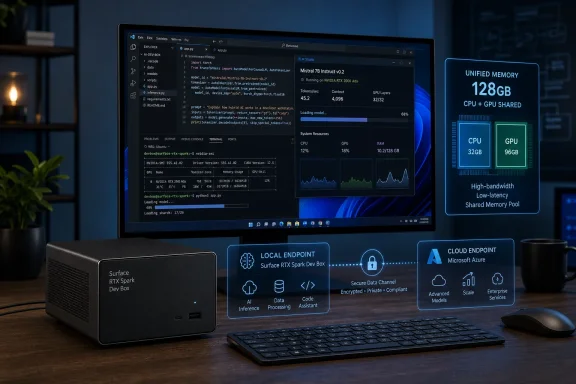
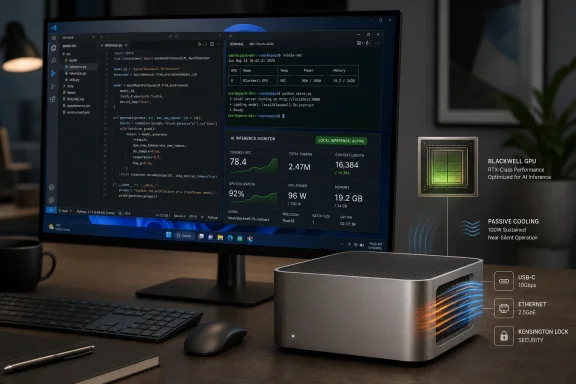
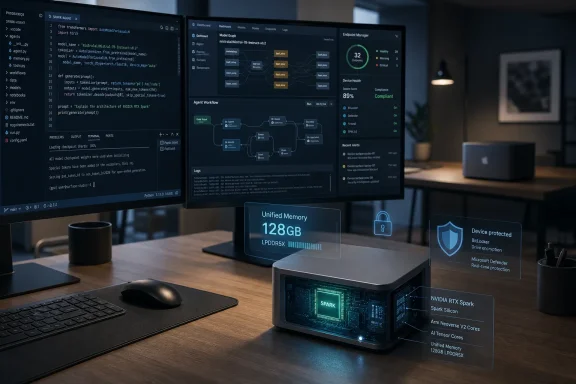
Microsoft announced the Surface RTX Spark Dev Box on June 2, 2026, as a Windows 11 developer workstation for local AI work, pairing NVIDIA’s RTX Spark architecture with up to one petaflop of AI compute, 128 GB of unified memory, and tooling for agents, containers, WSL, CUDA, and Copilot. The headline is not simply that Microsoft has another Surface box for developers. It is that Windows is being repositioned as a place where serious AI workloads can be built, tested, governed, and contained before they ever touch the cloud. That is a much bigger bet than a spec sheet.

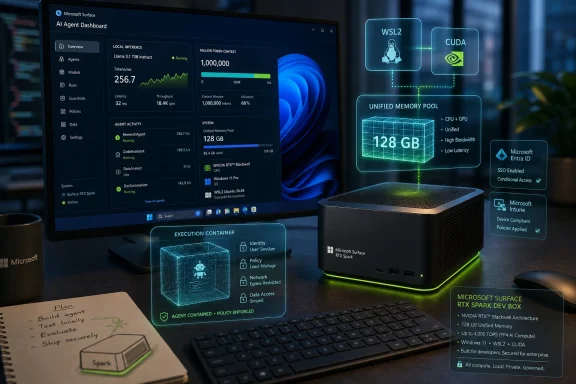
Microsoft AI Agent Dashboard on a monitor shows WSL2/CUDA setup and a 128GB unified memory pool powering a Surface RTX Spark dev box.Microsoft Wants the AI Workstation Back on the Desk​

For the last two years, the default answer to advanced AI development has been: rent the GPU, call the API, keep the local machine thin. Microsoft has profited handsomely from that model through Azure, GitHub, and Copilot. Yet the Surface RTX Spark Dev Box points in a different direction: a high-end local machine that treats the developer’s desk as part of the AI infrastructure stack.
That does not mean Microsoft is abandoning the cloud. It means the company sees a gap between lightweight AI PCs and datacenter-scale GPU clusters. Developers building agents, testing model behavior, fine-tuning domain-specific systems, or experimenting with long-context workflows often need something more capable than a laptop NPU but less bureaucratic than cloud GPU procurement.
The Dev Box is Microsoft’s answer to that middle layer. It is a machine for people who want to run larger models locally, iterate quickly, avoid uploading sensitive data during early development, and still stay inside the Windows, GitHub, Entra, Intune, and Azure orbit.
The interesting part is that Microsoft is not presenting this as a hobbyist local-LLM toy. It is selling the device as part of a managed, identity-aware, enterprise-governed developer platform. That framing matters because local AI has always had two personalities: freedom for developers, anxiety for administrators.

The Petaflop Number Is Flashy, but the Memory Pool Is the Real Story​

The one-petaflop claim will dominate the marketing because it is large, round, and easy to print on a slide. But for local AI development, the more consequential number is 128 GB of unified memory. That is what changes the class of models and workloads a developer can plausibly run on a desk-side system.
Traditional GPU workstations are often constrained less by total system RAM than by VRAM. A workstation can have plenty of CPU memory and still choke when the model, context window, weights, cache, and runtime all need to live close to the GPU. Unified memory does not magically erase every bottleneck, but it gives the CPU and GPU a shared pool large enough to make local work with far larger models less ridiculous.
Microsoft says the Surface RTX Spark Dev Box can run 120-billion-plus-parameter models locally, with million-token context support described as part of the platform’s ambition. That is the kind of claim that should be read carefully. The real-world experience will depend on quantization, model architecture, runtime, memory bandwidth, thermals, and whether the workload is inference, fine-tuning, retrieval-augmented generation, or some messy agent loop with tool calls.
Still, the direction is clear. Microsoft and NVIDIA are trying to normalize the idea that a Windows developer machine can be a credible local AI node. Not a replacement for a rack of accelerators, not a magic box for training frontier models, but a serious prototyping and execution environment.
The inclusion of WSL 2 with native GPU passthrough and CUDA support is equally important. AI developers have tolerated Windows when they had to, but many serious ML workflows have lived more naturally in Linux. A Windows box that arrives preconfigured for CUDA-backed Linux development under WSL is Microsoft acknowledging that Windows wins here only if it stops forcing developers to choose between the Windows desktop and the Linux AI toolchain.

Surface Becomes the Reference Design for a Different Kind of AI PC​

The phrase “AI PC” has been stretched almost beyond usefulness. In consumer marketing, it often means a laptop with an NPU and a few local effects: background blur, recall-like indexing, image generation at modest scale, or operating system features that may or may not justify the silicon. The Surface RTX Spark Dev Box belongs to a different lineage.
This is closer to a personal AI workstation than a conventional AI PC. The target user is not someone asking Copilot to summarize a meeting. It is the developer trying to build the thing that summarizes, acts, tests, retrieves, executes, and reports without leaking data or burning through cloud credits during every experiment.
That distinction matters because Microsoft has struggled to make the AI PC pitch feel essential to many professionals. NPUs are useful, but they rarely change a developer’s daily workflow in a dramatic way. A local box with enough memory and CUDA compatibility to run large models, test agents, and support long-running experiments is easier to understand.
Surface also plays a symbolic role. Microsoft often uses Surface to demonstrate what it wants the Windows ecosystem to become. The Surface Pro pushed detachable tablets. Surface Laptop pushed premium Windows notebooks. The Surface RTX Spark Dev Box is Microsoft’s attempt to show OEMs, developers, and enterprise buyers what a Windows-native AI development appliance should look like.
The device is not just competing with other Windows PCs. It is competing with Linux workstations, Mac Studio-style local AI setups, rented cloud GPUs, and NVIDIA’s own DGX Spark category. Microsoft’s advantage is integration. Its disadvantage is that serious AI developers are allergic to anything that feels like a locked-down corporate appliance.

The Developer Pitch Is Really a Platform Pitch​

Microsoft’s announcement wraps the Dev Box together with a broader set of Windows AI development updates: Microsoft Execution Containers, OpenClaw on Windows, a native GitHub Copilot app in preview, and Project Rayfin. That grouping is not accidental. The hardware gives Microsoft a performance story, but the surrounding software gives it a platform story.
The company is trying to make Windows into an agent-native operating environment. That phrase can sound like conference fog, but there is a concrete idea underneath it: agents are not just apps with chat boxes. They execute code, read and write files, call tools, invoke APIs, use credentials, and sometimes operate semi-autonomously across long sessions.
That makes them powerful and dangerous. A poorly bounded agent is not merely a buggy application. It is a process that may misunderstand intent, overreach its permissions, expose data, or make changes faster than a human can review them.
Microsoft Execution Containers are meant to address that problem by giving agents and AI applications isolated, policy-driven environments. Developers define requirements and constraints, and Windows enforces those boundaries at runtime. In theory, this reduces the amount of one-off security plumbing that every agent developer must build for themselves.
That is the right problem to attack. The industry has spent too much time marveling at agents that can do things and not enough time asking where, as whom, under which identity, against which files, with what audit trail, and with what blast radius.

Containers Are Microsoft’s Admission That Agents Need Seatbelts​

The most important sentence in Microsoft’s AI developer pitch is not about petaflops. It is the claim that Windows can assign identities, policies, and containment to agents. That is where the future of desktop AI will be won or lost.
The first wave of AI assistants mostly lived in text boxes. The next wave lives in terminals, editors, browsers, file systems, and ticket queues. Once an agent can modify a repository, run a build, test a patch, open a shell, query a database, or interact with enterprise systems, it becomes part of the security model.
Microsoft has spent decades learning how painful unmanaged code execution can be. Macros, scripts, unsigned binaries, lateral movement, credential abuse, and shadow IT are all old stories with new costumes. AI agents do not eliminate those risks. They can amplify them.
Execution containers are therefore not a nice-to-have feature. They are a prerequisite for enterprises that want agentic workflows without turning every developer workstation into an unmonitored automation island. If Microsoft can make MXC practical, observable, and manageable through familiar enterprise controls, Windows could have a real advantage over more ad hoc local agent setups.
But the word “preview” should do a lot of work here. Security architecture is not proven by announcement. It is proven by abuse, patching, telemetry, documentation, developer adoption, and the dull experience of admins discovering whether a feature behaves under pressure. MXC sounds strategically important, but it will need time outside the keynote.

OpenClaw Gives the Agent Story a Working Shape​

OpenClaw on Windows helps Microsoft make the agent runtime pitch less abstract. Instead of saying only that Windows can host secure AI agents, Microsoft can point to multi-step agent workflows running inside controlled environments.
That matters because the hardest part of the agent conversation is no longer imagination. Everyone can imagine an agent that checks an issue, edits a project, runs tests, and files a pull request. The hard part is making that workflow repeatable, governable, and safe enough to use on machines that contain real credentials and real source code.
OpenClaw also helps Microsoft avoid the trap of presenting Windows agent support as a purely proprietary Copilot story. Developers are already experimenting with many agent frameworks, CLIs, and model providers. If Windows wants to be the agent runtime, it cannot only be the runtime for Microsoft-branded agents.
The deeper play is interoperability under governance. Microsoft would like developers to bring the agents they want while enterprises retain the policy layer they need. That is a difficult balance, but it is exactly the kind of balance Windows has historically tried to strike: broad software compatibility wrapped in increasingly formal management controls.
The danger is complexity. If developers have to understand too many layers — Windows policies, MXC definitions, WSL boundaries, identity configuration, agent permissions, local model runtimes, cloud handoffs — the system may feel less like empowerment and more like compliance with a GPU attached.

Copilot Moves From Pair Programmer to Desktop Operator​

The new GitHub Copilot app in preview fits neatly into this strategy. GitHub Copilot began as an inline coding assistant. It then expanded into chat, pull request assistance, CLI workflows, and more agentic coding experiences. A native desktop app signals another shift: Copilot is becoming a place where developers manage work, not just receive suggestions.
That matters because agentic development is messy. A developer may want to start with an issue, ask an agent to explore the codebase, run a test suite, propose changes, start another session for documentation, and monitor both without losing context. The IDE alone is not always the best surface for that.
A desktop Copilot app gives Microsoft a command center for coding agents. It can coordinate sessions, track execution, surface diffs, handle updates, and connect into Windows in ways that a browser tab or editor extension cannot. Pair that with a local AI workstation, and Microsoft can argue that Windows is not merely hosting development; it is orchestrating it.
There is also a competitive reason for urgency. Developer workflows are fragmenting across Cursor, Claude Code, GitHub Copilot, terminal agents, browser-based tools, and bespoke internal systems. Microsoft owns GitHub and Visual Studio Code, but it cannot assume developers will stay inside its interfaces by inertia. It has to make the native experience meaningfully better.
The challenge is trust. Developers like automation until it becomes opaque. If Copilot sessions become too magical, too noisy, or too difficult to inspect, professionals will retreat to tools that make the agent’s actions more legible. Microsoft’s advantage is integration; its risk is over-automation.

Project Rayfin Is the Quietest Announcement With the Broadest Ambition​

Project Rayfin, now in preview, is described as a way to help developers turn ideas into apps by providing a managed backend that integrates with workflows. On paper, that sounds less dramatic than a petaflop Surface machine. In practice, it may be the piece that tells us where Microsoft thinks AI-assisted development is heading.
AI coding tools can already generate UI scaffolds, functions, tests, and documentation. But turning a prototype into a production application still requires identity, data storage, hosting, deployment, monitoring, compliance, and lifecycle management. The gap between “the agent made a demo” and “the business can run this” remains wide.
Rayfin appears aimed at shrinking that gap. If Microsoft can offer a managed backend that agents and developers can target consistently, then AI-assisted app creation becomes less of a parlor trick and more of a pipeline. That is a classic Microsoft move: abstract the messy infrastructure layer, then make the developer experience feel inevitable.
The risk is that this becomes another platform abstraction competing for attention in an already crowded Microsoft developer universe. Azure has many ways to host apps. GitHub has workflows. Visual Studio has project systems. Power Platform already targets rapid app development. Rayfin will need a clear identity or it will become one more preview name that developers vaguely remember from a Build keynote.
Its success will depend on whether it makes the agent-generated app lifecycle more coherent. If a developer can move from prompt to prototype to governed backend to production deployment with fewer handoffs, Rayfin could matter. If it is merely another managed service with AI branding, it will be ignored.

The Enterprise Angle Is Governance, Not Glamour​

For WindowsForum readers, the most consequential audience may not be the individual developer excited about local models. It may be the IT organization wondering how to let developers use AI without losing control of data, endpoints, and identities.
Microsoft is emphasizing chip-to-cloud security, Zero Trust alignment, Intune integration, and Entra ID governance because it knows exactly where enterprise objections will come from. Local AI boxes are attractive because they can keep sensitive data near the user. They are alarming because powerful local automation can also become harder to monitor than centralized cloud services.
That tension is not theoretical. Developers already download models, run local inference servers, install experimental CLIs, connect agents to repositories, and paste logs into AI tools. Many organizations are behind the reality of how quickly local AI workflows have spread. Microsoft is trying to make Windows the sanctioned path before the unsanctioned paths become entrenched.
Intune and Entra integration may sound dull compared with CUDA and 120B models, but dull is what enterprises buy. They need device inventory, conditional access, policy enforcement, identity attribution, auditability, and the ability to say which agent or user did what. Without that, local AI becomes another shadow IT headache.
The Dev Box therefore serves two purposes. It gives developers a powerful machine, and it gives IT a managed object. That second role may be the one that determines whether the device gets purchased in volume.

Local AI Does Not Kill the Cloud; It Changes the Boundary​

It would be easy to frame the Surface RTX Spark Dev Box as Microsoft moving AI away from Azure. That would be wrong. Microsoft’s strategy is more subtle: move enough work local to improve iteration, privacy, latency, and developer experience, while keeping cloud services central for scale, deployment, collaboration, and management.
The cloud remains essential for training large models, serving production workloads, handling enterprise-scale inference, and integrating with corporate data systems. But not every experiment needs a cloud GPU. Not every sensitive dataset should be uploaded during early development. Not every agent loop should depend on remote latency or metered API calls.
Local compute changes the economics of experimentation. A developer with a capable local box can try more ideas, run more tests, and fail more cheaply before escalating to cloud resources. That can make Azure more valuable later, not less, because the cloud becomes the place where refined workloads scale rather than the place where every half-formed idea burns budget.
This is also consistent with Microsoft’s broader hybrid instincts. The company has long sold a world where local PCs, on-prem systems, cloud services, and identity layers all participate in one managed estate. The Dev Box brings that old hybrid logic into the AI era.
The open question is price. Microsoft has not made the economic case until buyers know what the hardware costs, how it compares with cloud GPU spending, and how much administrative overhead comes with the platform. A workstation can be a bargain or a trophy depending on utilization.

Windows Has to Earn Back AI Developer Credibility​

The Surface RTX Spark Dev Box also reveals an uncomfortable truth: Windows is not the default emotional home for many AI developers. The tooling gravity has been Linux, CUDA, Python, containers, Jupyter, cloud notebooks, and increasingly Mac-based local experimentation for developers who value unified memory and quiet desktop hardware.
Microsoft has made real progress with WSL, Windows Terminal, Dev Drive, winget, Visual Studio Code, and GitHub integration. But AI development is unforgiving. If drivers break, CUDA support lags, WSL file I/O disappoints, container networking gets weird, or model runtimes behave differently than on Linux, developers will notice immediately.
That is why the preconfigured experience matters. Microsoft says the Dev Box will ship with a developer-optimized Windows 11 setup, WSL, PowerShell 7, Visual Studio Code, GitHub Copilot, and other tools ready to go. The pitch is less “you can make this work” and more “you can sign in and start building.”
The difference is enormous. AI developers already spend too much time wrestling with dependencies, GPU libraries, Python environments, model formats, and runtime compatibility. If Microsoft can remove even a meaningful fraction of that setup pain, the Dev Box becomes more than hardware.
But the standard will be high. A machine sold for advanced AI development cannot behave like a general-purpose PC with a few extras installed. It has to feel like a deliberately engineered environment where Windows, WSL, NVIDIA drivers, CUDA libraries, containers, and developer tools have been tested together.

NVIDIA Gets a New Route Into the Windows Developer Desk​

NVIDIA’s role in this story is just as important as Microsoft’s. RTX Spark extends NVIDIA’s AI stack into a class of Windows systems that sit below datacenter hardware but above conventional consumer GPUs. It gives NVIDIA a way to make CUDA, TensorRT, PyTorch acceleration, and local agent workloads part of the premium PC conversation.
That is strategically useful. Apple’s unified memory story has been compelling for local AI experimentation, even when NVIDIA’s CUDA ecosystem remains dominant in broader machine learning. RTX Spark is a response to that tension: keep the CUDA software advantage while making larger unified memory configurations available in Windows machines.
For Microsoft, NVIDIA supplies credibility with AI developers. For NVIDIA, Microsoft supplies the operating system, enterprise management channel, and Surface halo. The partnership is not surprising, but it is becoming more consequential as AI development moves from cloud-only workflows toward hybrid local-cloud systems.
The technical details will matter. Memory bandwidth, thermals, sustained performance, driver maturity, and software compatibility will determine whether RTX Spark machines feel like miniature AI workstations or overmarketed premium PCs. Developers will benchmark them mercilessly.
Still, the alignment is obvious. Microsoft wants Windows to be the trusted platform for AI development. NVIDIA wants its AI stack to define the next premium PC category. Surface RTX Spark Dev Box is where those ambitions meet.

The Security Promise Will Be Tested by the First Real Agents​

Microsoft’s security language is carefully chosen: chip-to-cloud, Zero Trust, identity, policy, isolation, governance. Those are the right words. But AI agents will test them in uncomfortable ways.
Traditional application security assumes a relatively stable set of behaviors. Agents are more fluid. They interpret instructions, generate code, call tools, chain actions, and sometimes behave unpredictably when context changes. The system has to protect not only against malicious actors but also against confused automation.
That makes auditability essential. Administrators will need to know whether an action was performed by a human, by a local agent, by a cloud agent, or by a tool invoked inside a container. Developers will need logs that explain what happened without drowning them in noise. Security teams will need controls that are granular enough to be useful and simple enough to be adopted.
Microsoft’s identity-centered approach is promising because Windows enterprises already understand Entra and Intune as control planes. If agent activity can be tied to identities and policies in a way that feels natural to existing admins, Microsoft may have a durable advantage.
But the edge cases will be brutal. What happens when an agent inside WSL invokes a Windows tool? How are secrets handled across container boundaries? Can local models access protected data through plugins? How does policy travel with an agent workflow that moves from local machine to cloud runner? These are the questions that will decide whether the platform is trusted.

The Windows 11 Timing Is No Accident​

Microsoft’s decision to frame this around Windows 11 is also telling. Windows 10 support has ended for most mainstream users, and Windows 11 is now the company’s mandatory foundation for its forward-looking client strategy. AI gives Microsoft a reason to make Windows 11 feel less like a requirement and more like a platform transition.
For years, many users saw Windows 11 as a redesign with stricter hardware requirements and uneven practical benefit. AI development is one of the areas where Microsoft can argue that the newer OS is not merely cosmetic. The kernel, security model, WSL improvements, UI modernization, and management hooks all become part of a larger pitch.
The Dev Box will not matter to ordinary Windows users directly. Most people will never buy one. But reference devices often influence the platform around them. Features built for high-end developer machines can trickle into mainstream Windows management, security, and developer tooling.
That is especially true for agents. If MXC, identity attribution, and secure agent execution mature on machines like the Dev Box, those concepts could eventually shape how Windows handles consumer and enterprise AI assistants more broadly. The workstation is the proving ground.
Microsoft’s problem is that Windows 11 still has to carry the weight of everyday trust. Users and admins who are irritated by ads, defaults, telemetry concerns, account pressure, or update disruptions may not be inclined to grant Microsoft a blank check for agentic computing. The company’s AI ambitions will inherit the goodwill and resentment attached to Windows itself.

The Announcement Is Big, but the Missing Details Still Matter​

The Surface RTX Spark Dev Box is compelling because it connects hardware, local AI, developer tools, agent containment, and enterprise governance into one story. But it remains an announcement, not a field report. Several details will determine whether it becomes a serious developer platform or a niche prestige machine.
Availability is one. Microsoft says the device is coming to US-based customers later this year. That leaves open questions about international rollout, supply, channel strategy, enterprise procurement, and whether the device will be sold like a Surface product, a developer kit, or a specialized workstation.
Pricing is another. A system with RTX Spark-class hardware, 128 GB unified memory, and Surface branding will not be cheap. The value proposition depends on how buyers compare it: against cloud GPU spend, against multi-GPU workstations, against Mac Studio setups, against NVIDIA DGX Spark-style systems, or against doing nothing and staying with remote APIs.
Performance transparency will be crucial. “Up to one petaflop” is a peak AI compute figure under particular assumptions. Developers will want real benchmarks: tokens per second on specific models, fine-tuning throughput, sustained thermals, memory bandwidth behavior, WSL overhead, container impact, and multi-agent workload performance.
Software maturity may be the biggest variable. Preview tools are not production guarantees. MXC, OpenClaw integration, Copilot app workflows, and Rayfin all need documentation, ecosystem support, and predictable behavior. Microsoft has announced many developer technologies over the years that sounded strategic and then faded when adoption lagged.

The Real Test Comes After the Keynote​

The Surface RTX Spark Dev Box should be read as a thesis about where Microsoft thinks development is going. The company believes developers will need local AI horsepower, agentic coding environments, secure execution boundaries, and enterprise-grade governance. It also believes Windows can be the operating system where those pieces come together.
That thesis is plausible. It is also not inevitable. Developers will choose the platforms that give them the least friction and the most control. Enterprises will choose the platforms they can govern without suffocating productivity. Microsoft has to satisfy both groups at once.
The Surface RTX Spark Dev Box has a better chance than a typical AI-branded PC because it is aimed at a real pain point. Developers do need better local AI machines. They do need CUDA-compatible environments. They do need secure agent sandboxes. IT departments do need ways to manage the resulting chaos.
The question is execution. If Microsoft ships a polished, fast, well-documented, manageable system, it could make Windows newly relevant to AI builders who had drifted elsewhere. If it ships a costly box wrapped in preview software and vague platform promises, it will become another impressive demo that serious developers admire from a distance.
The Surface AI Box Forces a Practical Checklist​

For all the strategic language, buyers should judge the Surface RTX Spark Dev Box by what it changes in daily work. The strongest case for the machine is not that it makes Windows sound futuristic. It is that it may reduce the distance between experiment, secure execution, and production workflow.
  • The Surface RTX Spark Dev Box is best understood as a local AI development workstation, not a mainstream AI PC.
  • The 128 GB unified memory configuration may matter more than the one-petaflop headline for practical local model work.
  • Microsoft Execution Containers are central to the announcement because agentic AI needs isolation, identity, and policy enforcement.
  • WSL 2 with GPU passthrough and CUDA support is essential if Microsoft wants serious AI developers to treat Windows as a first-class environment.
  • The GitHub Copilot app and Project Rayfin show Microsoft trying to control more of the path from coding session to deployable application.
  • Enterprise adoption will depend on price, performance transparency, Intune and Entra integration, and whether preview security features mature quickly.
The Surface RTX Spark Dev Box is not the end of cloud AI, and it is not proof that every developer needs a petaflop under the desk. It is a sign that Microsoft sees the next phase of AI development as hybrid, local, agentic, and governed — and that Windows 11 must become more than a client OS if it wants to stay central. The machine’s success will depend less on the drama of its launch than on whether developers and administrators discover, six months from now, that it quietly made their hardest AI workflows safer, faster, and easier to trust.

References​

  1. Primary source: Petri IT Knowledgebase
    Published: Tue, 02 Jun 2026 17:20:18 GMT
  2. Related coverage: windowscentral.com
  3. Related coverage: tomshardware.com
  4. Official source: blogs.windows.com
  5. Related coverage: aiweekly.co
  6. Official source: learn.microsoft.com
  1. Related coverage: completeaitraining.com
  2. Related coverage: kucoin.com
  3. Related coverage: letsdatascience.com
  4. Related coverage: anintent.com
  5. Related coverage: laxima.tech
  6. Related coverage: hub.tdsynnex.com
  7. Official source: microsoft.com
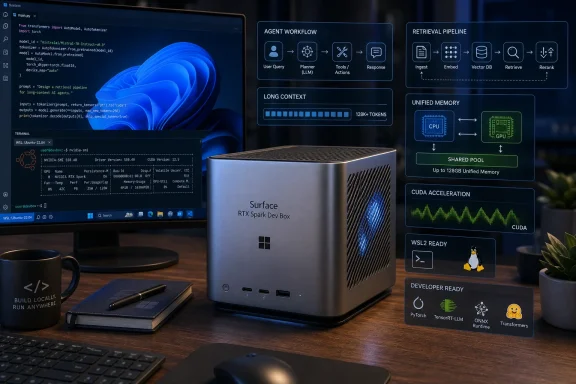
 

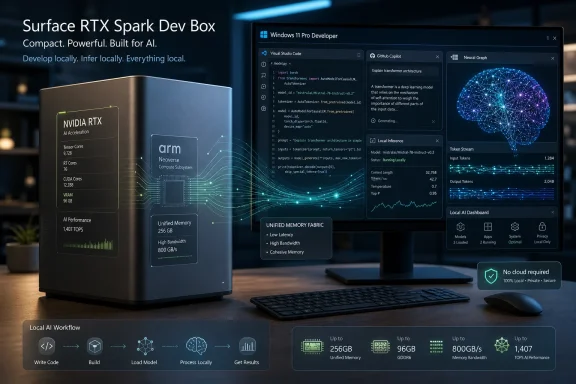
Microsoft introduced the Surface RTX Spark Dev Box at Build 2026 on June 2, pitching a compact Windows 11 Pro desktop with Nvidia RTX Spark silicon, 128GB of unified memory, and up to one petaflop of AI compute for local model development. The announcement is not just another Surface SKU with a faster accelerator inside. It is Microsoft admitting, in hardware, that the cloud-only story for AI development has started to creak under its own economics.
For Windows users and IT shops, the most important part of the machine is not the shiny Blackwell GPU or the small chassis. It is the business model implied by the box: Microsoft wants developers to treat local AI capacity as infrastructure they can own, manage, secure, and amortize, while reserving Azure and frontier APIs for the jobs that truly need them. That is a subtle but meaningful turn from the past three years of “send it to the cloud and meter it by the token.”

Laptop and AI desktop setup display GPU stats and unified memory 128GB on a monitor.Microsoft Puts a Price Tag on Escaping the Meter​

The AI boom was built on abstraction. Developers did not need to know where the GPUs lived, how models were scheduled, or what the data center looked like; they called an API, paid by usage, and shipped features at a pace that would have been impossible in the pre-ChatGPT era. That abstraction was liberating, until the bill arrived.
The Surface RTX Spark Dev Box is Microsoft’s answer to a problem that has moved from hacker-news gripe to budget line item. Inference is no longer a curiosity. Agentic coding tools, document workflows, internal search, customer support bots, test generation, and local data analysis can all produce large volumes of repeated calls. The meter that felt trivial during prototyping becomes a tax on iteration once developers begin looping through the same workloads dozens or hundreds of times a day.
Microsoft is not pretending the cloud goes away. That would be absurd from a company whose AI ambitions are welded to Azure. Instead, the pitch is that cloud AI should be used more selectively: frontier models for frontier tasks, local models for the grind of development, testing, experimentation, and private workflows. The Dev Box is therefore less an anti-cloud product than a cloud triage product.
That distinction matters. If Microsoft can persuade developers to build locally and deploy globally, it keeps the developer inside the Windows, GitHub, Visual Studio Code, Foundry, and Azure orbit. If it cannot, developers will continue drifting toward whatever stack offers the cheapest path between an open model and a working application. The Dev Box is a defensive move dressed as a workstation.

The 128GB Number Is the Product​

Consumer PC marketing has spent decades teaching buyers to stare at CPU names, GPU tiers, and benchmark bars. For local AI, the bottleneck is often less glamorous: memory capacity and how efficiently the system can expose it to the accelerator. Microsoft’s headline specification, 128GB of unified memory, is not a footnote. It is the reason the machine exists.
Large language models are greedy in ways that conventional desktop workloads are not. The model weights themselves consume memory, and useful context windows add more pressure through the key-value cache that lets a model track what it has already processed. A developer trying to run a large model with a meaningful context length can exhaust a high-end gaming GPU long before the GPU’s raw compute is the issue.
That is why the Dev Box’s architecture is more interesting than a simple “small PC with a fast GPU” description suggests. RTX Spark combines an Arm-based Nvidia Grace CPU with a Blackwell-generation RTX GPU and a unified memory pool shared between CPU and GPU. Instead of treating system RAM and graphics memory as separate territories, the system is designed around the premise that AI workloads need a larger common addressable space.
This is also where Microsoft’s Windows work becomes strategically important. Unified memory is only useful if the operating system and drivers can manage it without turning every serious workload into a paging disaster. Microsoft says the Surface RTX Spark Dev Box ships with Windows 11 Pro configured for development and tuned for this architecture, including GPU-aware memory behavior, WSL support, CUDA readiness, and the usual enterprise controls around identity and security.
The claim that the machine can handle models above 100 billion parameters locally will still need independent testing. Quantization choices, context length, framework support, thermals, storage speed, and actual sustained throughput all decide whether a workload feels practical or merely possible. But Microsoft has clearly identified the right pressure point: local AI development is constrained less by whether a desktop can touch a model than by whether it can keep the model resident long enough to be useful.

Windows on Arm Gets a New Reason to Exist​

Windows on Arm has spent years looking like a platform waiting for its application. It promised battery life, instant-on responsiveness, and cellular mobility, but it struggled against the inertia of x86 compatibility and the gravitational pull of Intel and AMD. Copilot+ PCs gave Windows on Arm a marketing reset, but many of those machines still felt like general-purpose laptops with an NPU story bolted on.
RTX Spark changes the conversation because it gives Windows on Arm a workload where the architecture’s usual anxieties matter less than the accelerator stack. Developers buying this box are not primarily asking whether a ten-year-old printer utility runs natively. They are asking whether PyTorch, CUDA, WSL, Visual Studio Code, containers, model conversion tools, and inference runtimes behave predictably.
That is Nvidia’s opening. CUDA remains the default dialect of serious AI acceleration, especially for developers who move between local experiments and cloud GPU instances. Apple’s unified memory architecture is elegant, and Apple Silicon has done more than any other consumer platform to make high-memory local compute feel normal. But the AI software ecosystem still overwhelmingly treats Nvidia as the path of least resistance.
Microsoft knows this. The Dev Box does not try to beat the Mac mini by being a nicer little desktop or a cheaper workstation. It tries to beat it by offering the AI developer something Apple cannot fully match today: a local Windows machine with CUDA-oriented workflows that resemble the cloud environments where many production models are ultimately trained, tested, or deployed.
That does not make Apple irrelevant. Apple’s high-end Mac Studio and MacBook Pro systems have become credible local AI machines for many developers, especially those working with smaller open models, creative tools, and Metal-optimized software. But Microsoft and Nvidia are aiming at the developer who wants local capacity without leaving the CUDA universe. For that audience, architectural purity matters less than ecosystem continuity.

The Dev Box Is Also a Confession About Developer PCs​

One of the least flashy parts of Microsoft’s announcement may be one of the most telling: the system ships with a developer-optimized Windows 11 Pro image. Visual Studio Code, GitHub Copilot integrations, WSL 2, PowerShell 7, Git, Python, Node.js, and GPU passthrough support are framed as ready on day one. That sounds like checklist marketing, but it points to a real failure in the Windows developer experience.
For years, setting up a serious Windows development machine has meant building your own workstation twice. First came the hardware selection, then came the ritual of uninstalling consumer clutter, enabling developer mode, configuring terminals, installing WSL, chasing driver compatibility, setting up package managers, syncing repositories, and hoping the GPU stack lined up with whatever framework the project required. Experienced developers can do this; they should not have to keep doing it.
The Dev Box borrows from the logic of cloud development environments. A good cloud dev box is valuable not merely because it has compute, but because it is reproducible. You can provision it, manage it, reset it, and hand it to another developer without turning setup into folklore. Microsoft is trying to bring some of that predictability back to physical hardware.
That is especially important for enterprises. A local AI workstation that cannot be enrolled, encrypted, patched, monitored, and governed is a science project, not an approved endpoint. Microsoft’s emphasis on Entra ID, Intune, Secured-core PC design, BitLocker, and Defender is not decorative. It is the difference between a developer buying a powerful toy and an organization deploying a sanctioned AI workbench.
There is a catch, of course. The more Microsoft makes the machine feel like an appliance, the more buyers will expect appliance-like reliability. If the CUDA stack breaks after a Windows update, if WSL GPU support becomes brittle, if model tooling demands too much manual repair, the whole “code on day one” story collapses. Developer trust is hard to win and easy to lose, especially among the very people most likely to notice when the abstraction leaks.

The Box on the Desk Is a Data-Governance Argument​

The cost story is obvious, but the privacy and governance story may be more durable. Many organizations are still uncomfortable sending sensitive prompts, source code, customer data, legal material, or internal documents to external AI services, even when vendors promise enterprise controls. Local inference does not eliminate governance problems, but it changes their shape.
A model running on a managed endpoint can be placed under familiar controls. Data can stay inside the organization’s device-management boundary. Logs, storage, encryption, access policies, and network restrictions can be handled using tools IT already understands. For regulated sectors, that may be more persuasive than any promise about lower per-token cost.
This is where the Surface branding carries weight. Microsoft is not simply saying “build your own Linux box with a big GPU.” It is saying Windows can be the managed local AI platform for organizations that want serious model work without abandoning endpoint discipline. That is a message aimed directly at sysadmins and security teams who have spent the last two years watching business units paste proprietary material into whatever AI tool happened to be fashionable that week.
Local AI also gives organizations a better way to classify workloads. A lightweight coding assistant, document summarizer, or internal retrieval workflow may not need a frontier model. A local 70B-class or 100B-class model may be good enough for the majority of repetitive tasks, while sensitive or strategically important jobs can be routed through approved cloud services. The point is not that local models are always superior. The point is that enterprises finally get another place to put the workload.
That said, local does not automatically mean safe. Models can leak data through logs, extensions, plugins, caches, and careless prompt handling. Developers can still install questionable packages. Local agents can still act on files they should not touch. A Dev Box reduces certain cloud-exposure risks, but it increases the importance of endpoint policy, software supply-chain hygiene, and observability on machines that may now be running far more autonomous workflows.

The Thermal Story Is Really About Trust​

Microsoft’s industrial-design details are easy to dismiss as launch-event theater. A compact aluminum chassis, a 3D-printed top panel, angled perforations, quiet operation, and a roughly 100-watt sustained thermal envelope are the kind of things hardware companies love to describe in close-up product videos. But for AI development, sustained thermals are not cosmetic.
A local AI box that performs well for a five-minute demo and throttles during an overnight run is worse than useless. It creates a false expectation and then fails at exactly the moment developers are relying on it. Training, fine-tuning, evaluation, batch inference, and agentic testing are not bursty office workloads. They are long, repetitive, heat-generating jobs.
That is why the chassis-as-heatsink approach matters. Microsoft appears to be designing the Dev Box as something that can sit on a desk and work continuously without sounding like a rack server. That matters in open offices, home offices, classrooms, labs, and small teams that do not have a machine room. The product category only works if the box can be close to the developer without becoming obnoxious.
The unanswered question is whether Microsoft can scale that design without either pricing the product into boutique territory or compromising the very thermals that make it credible. Metal 3D printing allows shapes that traditional manufacturing struggles to produce, but it also raises obvious questions about yield, cost, and repairability. Microsoft has made beautiful, difficult-to-service hardware before; developers will be less forgiving if the Dev Box becomes another elegant sealed object with workstation expectations and consumer-appliance repairability.
For WindowsForum readers, this is worth watching closely. The history of small powerful PCs is littered with systems that looked brilliant on paper and became frustrating in practice because heat, noise, dust, firmware, and component access were treated as secondary details. AI workloads punish that kind of optimism.

The Mac Mini Comparison Misses the Bigger Rival​

It is inevitable that the Surface RTX Spark Dev Box will be compared with the Mac mini, Mac Studio, and high-end compact workstations. Apple made unified memory mainstream, and the Mac mini’s small footprint and quiet operation set expectations for what a desktop can be. But Microsoft’s real rival here is not a specific Mac. It is the habit of not buying hardware at all.
For many teams, the easiest AI infrastructure decision has been to swipe a card for cloud credits. That is flexible, fast, and operationally convenient. It also keeps capital expenditure off the desk and turns capacity planning into a dashboard rather than a procurement cycle. The Dev Box asks organizations to remember an older discipline: buying machines for known workloads.
That will be a harder sell than Microsoft’s launch language implies. A developer may love the idea of unmetered local inference, but a finance team will ask how long the machine must be used before it beats cloud spending. An IT department will ask who owns the endpoint, how it is patched, how failures are handled, and whether the device creates a new class of privileged local compute that needs special policy. A security team will ask whether local models are approved, traceable, and auditable.
The answer will vary wildly. For a startup iterating constantly on open models, a local AI box could pay for itself quickly if the price lands in workstation territory rather than luxury-hardware territory. For an enterprise with negotiated cloud rates and strict data pipelines, the same box may be useful only for specialist teams. For a hobbyist, researcher, or independent developer, the purchase decision may hinge almost entirely on the final price.
Microsoft has not disclosed that price, and that omission is not incidental. Pricing will decide whether the Dev Box is a category-defining development machine or a keynote prop for well-funded AI teams. If it is too expensive, the “without cloud costs” pitch becomes weaker; buyers will simply be prepaying a different kind of bill.

Hybrid AI Becomes Real Only When Routing Gets Boring​

Microsoft’s broader strategy is not just to sell a fast local box. It wants to normalize hybrid AI: small on-device models for lightweight tasks, local workstation-class models for heavier development work, and cloud frontier models for jobs that need maximum capability. That architecture sounds sensible. The hard part is making it boring.
Developers should not have to manually decide every few minutes whether a task belongs on a local model, a workstation model, or a cloud model. The platform has to route work based on capability, cost, latency, privacy, and context. If the routing is clumsy, users will fall back to the simplest option, which is often the cloud API they already know.
This is why integrations such as GitHub Copilot CLI and Microsoft Foundry matter more than the hardware spec sheet. The hardware provides capacity, but the workflow decides whether anyone uses it. If a cloud-based agent can split a task plan and send suitable subtasks to a local model while reserving harder reasoning for a frontier model, hybrid AI becomes a real operating model rather than a whiteboard diagram.
The risk is that “hybrid” becomes another Microsoft complexity layer. Enterprises already juggle Azure services, Microsoft 365, Intune, Entra, Defender, GitHub, Windows management, and a growing menu of Copilot products. Adding local model routing, model catalogs, policy controls, and deployment pipelines could either simplify AI development or bury it under configuration.
The successful version is almost invisible. A developer writes code, runs tests, asks an agent to refactor a module, and the system quietly chooses the right compute target. The failed version is a new set of knobs that only platform teams understand, with developers once again waiting for someone else to provision intelligence.

Nvidia Gets the Desktop Beachhead Microsoft Needed​

The Surface RTX Spark Dev Box is also a reminder that Microsoft’s AI PC story has needed Nvidia more than Microsoft would probably like to admit. NPUs in Copilot+ PCs are useful for certain local tasks, but they are not a substitute for the GPU memory and software ecosystem needed to run large open models. Intel, AMD, and Qualcomm all have AI PC narratives. Nvidia has the developer mindshare.
RTX Spark lets Nvidia push deeper into Windows PCs without limiting itself to gaming, creator workloads, or cloud accelerators. The platform brings Blackwell-generation AI compute into slim laptops and compact desktops, giving OEMs a way to sell “AI PC” as something more substantial than a TOPS number in a marketing chart. Microsoft’s Surface entry gives that push a first-party Windows endorsement.
For Microsoft, that is both powerful and awkward. The company has spent heavily on its own AI infrastructure and has a complex set of partnerships across OpenAI, Azure, and silicon suppliers. Yet at the developer workstation level, Nvidia remains the common language of AI acceleration. The Dev Box leans into that reality rather than fighting it.
That is probably the right call. Developers do not reward platform purity for its own sake. They reward the stack that runs their tools, supports their libraries, and minimizes porting pain. If Windows wants to be the place where AI developers build locally, it needs CUDA compatibility, WSL maturity, and enough memory to run meaningful models. RTX Spark gives Microsoft a credible hardware foundation for that pitch.
The bigger question is how open the ecosystem feels once the devices arrive. If Surface RTX Spark Dev Box becomes a premium reference design that encourages a broader class of OEM systems, Windows developers win. If it becomes a narrow Microsoft-controlled island, the market will treat it as a curiosity while assembling cheaper alternatives elsewhere.

Local AI Will Not Save Everyone Money​

The most seductive phrase around this launch is “without cloud costs.” It is also the easiest to overread. Local AI does not abolish cost. It converts variable cost into fixed cost, and that only helps when utilization is high enough, workloads are suitable enough, and the hardware remains useful long enough.
A developer who occasionally runs a model will not automatically benefit from buying a powerful local box. A team that needs the newest frontier model for most of its work will still live in the cloud. A company that values elasticity above all else may prefer metered spending because it can scale up and down without owning idle hardware. The economics are not ideological; they are workload-specific.
There are also operational costs. Someone has to manage the device, patch the system, replace failed units, secure local data, approve models, and support developers when the stack breaks. Cloud bills are painful because they are visible. Local infrastructure costs are painful because they are distributed across procurement, IT, security, and lost developer time.
Still, fixed local capacity has a psychological benefit that spreadsheets often miss. Developers experiment more freely when every run does not feel like a chargeable event. Students, researchers, and small teams can iterate without asking permission from a budget owner. Organizations can run internal evaluations, red-team models, and prototype agents without sending every trial through a cloud meter.
That freedom is the real product. Microsoft is selling a box, but the box is a way to make AI experimentation feel less rented.

The Surface Dev Box Test Is Bigger Than Surface​

Microsoft has been here before in spirit, if not in silicon. The company has repeatedly tried to define developer hardware for Windows, from Arm developer kits to Surface-branded experiments to cloud-hosted Microsoft Dev Box services. Some efforts were useful; others became niche footnotes. The Surface RTX Spark Dev Box will be judged against that uneven history.
The difference this time is timing. Developers now have a concrete reason to want a local high-memory accelerator: open models are good enough for real work, cloud inference costs are noticeable, and enterprises are looking for ways to keep sensitive workflows closer to home. The machine is not trying to create demand from scratch. It is trying to catch a demand wave already forming.
But the launch also raises the bar. If Microsoft is serious about local-first AI development, it cannot treat this as a one-off hero device. It needs predictable driver support, clear lifecycle commitments, enterprise deployment guidance, transparent performance data, repair and replacement options, and a software stack that does not require constant heroic debugging. Developers will forgive missing RGB lighting. They will not forgive flaky compute.
The pricing silence remains the largest gap. A high-memory, Nvidia-backed, Surface-designed AI workstation was never going to be cheap. But there is a difference between expensive and impractical. Microsoft must land close enough to the workstation market that teams can justify the purchase against recurring cloud spend, not just admire it as an engineering object.
It also needs to show real workloads. Not just a model loading successfully, but fine-tuning runs, local agents, coding workflows, retrieval-augmented generation, model conversion, inference latency, power behavior, thermals, and failure modes. The AI hardware market has had enough “up to” claims. The Dev Box needs measured credibility.

The Windows AI Workbench Finally Has a Shape​

The practical consequences of the Surface RTX Spark Dev Box are clearer than the hype around “personal supercomputers” suggests. This is not a magic replacement for Azure, nor is it a consumer mini PC with a fashionable AI sticker. It is Microsoft’s first serious attempt to make the Windows desktop a managed local AI workbench.
  • The Surface RTX Spark Dev Box shifts part of AI development from metered cloud spending to fixed local capacity, which will matter most for teams with frequent iterative workloads.
  • The 128GB unified memory pool is the defining specification because it addresses the model-loading and context-window limits that constrain conventional GPU desktops.
  • The Nvidia CUDA ecosystem gives Microsoft a stronger developer argument than Windows on Arm has usually had, especially for teams moving between local prototypes and cloud GPU deployments.
  • Enterprise value will depend as much on management, security, and lifecycle support as on raw performance, because unmanaged AI workstations are a governance problem waiting to happen.
  • Pricing, sustained benchmarks, repairability, and software reliability will decide whether the machine becomes a real category or another impressive Surface experiment.
  • Hybrid AI will only work if Microsoft makes workload routing feel automatic, policy-aware, and boring enough that developers stop thinking about where each prompt runs.
Microsoft’s bet is that AI development will not settle into a single place. Some of it will live in the cloud, some of it will live on laptops, and a growing share may live on managed local boxes powerful enough to run models that recently felt data-center-only. If the Surface RTX Spark Dev Box delivers on its claims at a price teams can defend, it could mark the moment Windows stopped merely consuming AI services and started becoming a serious place to build them locally.

References​

  1. Primary source: VentureBeat
    Published: 2026-06-02T16:39:10.837504
  2. Independent coverage: PCMag
    Published: Tue, 02 Jun 2026 16:30:25 GMT
  3. Related coverage: tomshardware.com
  4. Related coverage: windowscentral.com
  5. Related coverage: axios.com
  6. Related coverage: pcgamer.com
  1. Official source: microsoft.com
  2. Official source: blogs.windows.com
  3. Related coverage: nvidianews.nvidia.com
  4. Related coverage: nvidia.com
  5. Official source: news.microsoft.com
  6. Related coverage: notebookcheck.net
  7. Official source: developer.microsoft.com
  8. Related coverage: anatoliapulse.com
  9. Related coverage: arstechnica.com
  10. Related coverage: techradar.com
  11. Related coverage: tdsynnex.com
  12. Related coverage: signal65.com
  13. Official source: cdn.techcommunity.microsoft.com
  14. Official source: info.microsoft.com
 

Microsoft introduced the Surface RTX Spark Dev Box at Build 2026 in San Francisco on June 2, positioning the compact Nvidia-powered desktop as a developer workstation for running large AI models, long jobs, and Windows-native tooling locally. The box is not a mainstream Surface PC in the old sense; it is Microsoft’s argument that the next Windows developer machine should look less like a laptop and more like a quiet, local AI appliance. That makes the inevitable Mac Studio comparison useful but incomplete. Apple sells a polished workstation for creative and technical users; Microsoft is trying to sell a beachhead for agentic Windows.

A laptop shows AI inference monitoring software while a desktop GPU server runs local blackwell performance.Microsoft’s Small Box Carries a Very Large Windows Bet​

The Surface RTX Spark Dev Box is built around Nvidia’s RTX Spark superchip, pairing a Blackwell-class GPU with a Grace CPU architecture and 128GB of unified memory. Microsoft says the system can deliver up to one petaflop of AI compute and run 120-billion-plus-parameter models with a million-token context locally, depending on workload and software stack. Those are the kinds of claims that would have sounded like cloud brochure copy only a few years ago.
The point is not merely that Microsoft has another Surface device. The point is that Surface, historically Microsoft’s way of telling the PC industry what “good” looks like, is now being used to define the AI development desktop. The Dev Box says the future Windows workstation is not just a CPU, GPU, and monitor; it is a preconfigured local inference and fine-tuning node with Microsoft’s tools already waiting at first boot.
That is a subtle but important shift. For years, Windows developer credibility depended on making the platform less hostile to modern workflows: better terminals, WSL, package management, container support, and better command-line ergonomics. Surface RTX Spark Dev Box tries to move past repair work and into agenda-setting.
Microsoft wants developers to think of Windows as the place where AI agents are built, tested, tuned, and eventually deployed. The hardware is the proof-of-concept.

The Mac Studio Comparison Is Obvious, but It Misses the Motive​

Calling the Surface RTX Spark Dev Box a Mac Studio rival is fair at the level of silhouette and audience. Both are compact desktops aimed at users who need more sustained performance than a laptop can comfortably deliver. Both wrap high-end silicon in a small enclosure and sell the idea that workstation-class capability no longer requires a tower under the desk.
But Microsoft is not simply chasing Apple’s industrial design playbook. Apple’s Mac Studio became compelling because Apple Silicon unified memory, media engines, and quiet thermals gave creators a cleaner alternative to noisy workstations. Microsoft’s machine is aiming at a different source of developer pain: the cost, latency, policy friction, and iteration tax of sending every serious AI workload to the cloud.
The distinction matters because it changes how the device should be judged. A Mac Studio buyer may ask how quickly it cuts video, compiles code, renders a scene, or trains a model. A Surface RTX Spark Dev Box buyer is more likely to ask whether a model can fit in memory, whether the Windows AI stack is mature enough, whether CUDA behaves predictably on Arm, and whether local inference actually speeds up the daily development loop.
That is why the Dev Box’s most interesting spec may be its 128GB of unified memory rather than the petaflop headline. Local AI development lives and dies by memory capacity, memory sharing, and the overhead of moving data between stages of a pipeline. If Microsoft and Nvidia can make that pool feel coherent and dependable under Windows, the machine becomes more than a benchmark toy.

Nvidia Gets a Windows Foothold That Qualcomm Never Quite Owned​

The Dev Box also reopens one of Windows’ longest-running hardware dramas: who gets to define Windows on Arm. Qualcomm spent years carrying that banner, with mixed results. Battery life improved, app compatibility became less frightening, and Copilot+ PCs gave the category a sharper identity, but Windows on Arm still struggled to shake its reputation as a compromise.
Nvidia changes the psychology. Developers are willing to tolerate architectural disruption when the reward is CUDA, AI throughput, and access to the tooling ecosystem that has become the default language of machine learning infrastructure. The RTX Spark platform gives Windows on Arm a new sales pitch: not merely thinner laptops and longer battery life, but a local AI workstation with a familiar GPU programming model.
That does not erase the risks. Arm Windows still has compatibility cliffs, especially around older developer dependencies, drivers, virtualization assumptions, and obscure tooling. The more specialized the workstation, the more painful a missing binary or unsupported extension becomes.
But Microsoft’s choice here is telling. Rather than wait for generic Arm PCs to win hearts one battery-life chart at a time, it is using an enthusiast and professional niche to prove that Arm Windows can be desirable because it enables something x86 laptops do not. That is the same kind of wedge Apple used, but with a very different software stack.

The Desktop Form Factor Is the Feature, Not the Compromise​

The Dev Box exists because laptops are bad at being workstations for hours at a time. They can sprint impressively, but thermal ceilings, acoustic limits, and battery-era design priorities eventually assert themselves. Microsoft’s Surface Laptop Ultra may be the glamorous sibling, but the Dev Box is the more honest expression of what sustained AI and development workloads demand.
A compact desktop can hold a higher sustained power target, shed heat more predictably, and avoid the compromises that come with putting a display, keyboard, trackpad, battery, and hinge into the same thermal envelope. The reported 100-watt design target is not outrageous by workstation standards, but in a passive or near-silent compact machine it becomes central to the story. Microsoft is selling steadiness more than peak drama.
That matters for developers because the work is rarely one heroic benchmark run. It is repeated compilation, container builds, model conversion, fine-tuning, evaluation, inference tests, and agent loops that run long enough to expose weak cooling and unstable software. A machine that performs consistently for six hours is more valuable than one that wins a five-minute chart and then backs off.
This is where the Mac Studio comparison becomes useful again. Apple taught the market that silence and sustained performance are not luxuries; they are part of the workstation experience. Microsoft now has to prove that a Windows AI box can do the same while carrying Nvidia’s stack, Microsoft’s developer tooling, and the messy reality of Windows hardware expectations.

Preconfigured Windows Is Microsoft’s Real Product​

Microsoft is emphasizing that Surface RTX Spark Dev Box ships with a developer-optimized Windows 11 Pro environment. That includes Visual Studio Code, GitHub Copilot in Windows Terminal, WSL, PowerShell 7, and AI-focused components such as Windows ML, TensorRT integration, Windows Copilot Runtime, and tooling for model conversion, fine-tuning, and evaluation. In other words, Microsoft does not want the first day with the box to be spent turning Windows into a development machine.
That preconfiguration is more important than it sounds. Developers are famously allergic to vendor-curated environments, yet they are equally tired of losing hours to driver mismatches, runtime setup, Python dependency churn, GPU library alignment, and documentation archaeology. If Microsoft can make the Dev Box land closer to “ready” than “blank slate,” it solves a problem developers actually have.
The risk is that “developer-optimized” becomes another OEM image with branding and assumptions baked in. The Windows developer audience is not monolithic. A .NET cloud engineer, a Python ML researcher, a game tools developer, and an enterprise automation specialist may all use Windows, but they do not want the same machine image.
Microsoft therefore has to walk a narrow line. The default experience must be opinionated enough to save time, but not so opinionated that it feels like a demo station. The most successful version of this device is one where Microsoft’s defaults disappear after doing their job.

Local AI Is a Cost Argument Wearing a Performance Jacket​

The industry loves to talk about local AI in terms of speed, privacy, and responsiveness. Those are real advantages, but for developers the most immediate argument is often simpler: cloud GPUs are expensive, rationed, and operationally annoying. Every experiment that can run locally is one fewer billing surprise, queue wait, quota request, or compliance discussion.
Microsoft’s Build framing leans into that reality. Local-first AI development does not mean the cloud disappears. It means the early iteration loop moves closer to the developer, while large-scale training, production deployment, and fleet inference still live where they make economic and operational sense.
That hybrid model is where the Dev Box could find its audience. A team may not need every engineer to have one, but an AI platform group, research pod, or enterprise prototyping team might justify local hardware if it reduces cloud churn and accelerates iteration. The box is less a replacement for Azure than a way to make Azure-bound work less wasteful before it gets there.
There is also a trust angle. Running models locally helps with sensitive data, early prototypes, and regulated workflows where sending everything to a hosted service is not acceptable. Microsoft will naturally connect that story to Windows security, Secured-core PC concepts, BitLocker, and Defender. IT departments will still ask harder questions about manageability, patch cadence, supply chain, and data governance, but the pitch starts in familiar territory.

The Software Stack Has to Be Better Than the Spec Sheet​

The Surface RTX Spark Dev Box will live or die on software maturity. Nvidia’s CUDA ecosystem is the gravity well of AI development, but Windows has historically been a more complicated place for some machine learning workflows than Linux. WSL helped enormously, yet “it works under WSL” is not the same thing as “the whole developer experience is seamless.”
Microsoft’s challenge is to make Windows feel native for AI development without pretending Linux workflows do not exist. That means WSL must be excellent, GPU acceleration must be boringly reliable, and common frameworks must not lag behind their Linux counterparts. It also means documentation, samples, and model tooling must be coherent enough that a buyer can reproduce Microsoft’s launch claims without summoning a solutions architect.
The million-token and 120-billion-parameter language is powerful marketing, but developers will ask more granular questions. What precision is being used? What are the latency and throughput characteristics? How much of the 128GB pool can be practically allocated to the GPU? What happens when multiple agents, IDE processes, containers, browsers, and data tools are all competing for memory?
Those are not gotchas. They are the difference between a platform and a press release. Microsoft knows this, which is why the Dev Box is being wrapped in a broader Windows developer story rather than sold as a raw mini-PC.

Surface Is Becoming a Reference Design for the AI PC Era​

Surface has always had two jobs. It is a product line, and it is a public memo to Microsoft’s hardware partners. The Surface Pro told OEMs that Windows tablets could be serious computers. Surface Laptop told them a clean Windows notebook did not need to be plastic, bloated, or apologetic. Surface Studio, whatever its commercial limits, told creative professionals that Microsoft still cared about form.
Surface RTX Spark Dev Box performs the same function for AI workstations. It tells Dell, HP, Lenovo, Asus, MSI, and others that Microsoft believes the AI PC category must include machines built for developers, not just consumer laptops with neural processing units and Copilot keys. The AI PC, in Microsoft’s telling, is not only about summarizing meetings or generating images in a local app. It is about creating the software that will define the next Windows experience.
That is a more credible use of the term than much of the AI PC marketing we have seen so far. NPUs are useful, but they have often been sold ahead of compelling everyday workloads. A developer workstation with Nvidia silicon and 128GB of unified memory at least has an obvious job: run big models and heavy pipelines locally.
Still, Surface as reference design only works if partners can follow. If the Dev Box remains a boutique Microsoft.com device with limited availability and vague pricing, it becomes a symbol rather than a category. If OEMs ship credible variants with clear service options, enterprise procurement paths, and predictable software support, it becomes the start of a workstation class.

The Port Selection Is a Small Rebellion Against Laptop Minimalism​

The reported I/O is not exotic: USB-C, USB-A, HDMI, Ethernet, and a headphone jack. Yet on a developer desktop, ordinary ports are part of the point. Microsoft appears to understand that a box meant to sit on a desk and run serious work should not require a necklace of dongles to connect a monitor, wired network, audio device, keyboard, storage, and debugging hardware.
This is one of the quiet ways the Dev Box separates itself from premium laptop culture. The last decade of notebook design treated ports as aesthetic liabilities and external adapters as the user’s problem. Developers, sysadmins, hardware tinkerers, and lab users never loved that bargain.
Ethernet is especially important. Cloud-connected development, large model downloads, internal artifact repositories, remote desktop sessions, and network storage all benefit from stable wired connectivity. Wi-Fi is fine until it becomes the invisible bottleneck in the middle of a build or model pull.
The headphone jack is similarly mundane but welcome. A workstation does not become more futuristic by deleting simple, reliable interfaces. In a category already asking buyers to trust new silicon, new Windows configurations, and new AI tooling, boring ports are a virtue.

Passive Cooling Would Be a Statement If Microsoft Can Deliver It​

Wccftech reports that the Surface RTX Spark Dev Box uses an anodized aluminum 3D-printed body with a vented grid and passive cooling. Microsoft’s own framing emphasizes an aluminum chassis engineered to act as a heatsink. If the machine can sustain demanding AI workloads quietly, that would be one of its strongest workstation credentials.
But passive cooling and sustained performance are uneasy partners. Heat does not vanish because a chassis looks clever; it moves through material, airflow, surface area, and ambient conditions. A fanless or effectively silent 100-watt-class device would be impressive, but reviewers will need to test it in real rooms, under long workloads, with desks, dust, summer heat, and multiple displays attached.
This is where Microsoft’s Surface brand helps and hurts. The company has a history of polished hardware, but also of devices where repairability, thermal behavior, or upgrade constraints raised fair complaints. A compact sealed workstation with unified memory will not satisfy users who want socketed RAM, replaceable GPUs, or traditional tower serviceability.
That tradeoff may be acceptable for the target market. Many developers would rather have a quiet, managed, predictable appliance than a self-built tower. Enterprise IT may prefer a fixed configuration if it simplifies support. But Microsoft should not pretend compact elegance is free.

Pricing Will Decide Whether This Is a Platform or a Trophy​

Microsoft has not announced pricing, and that omission matters. A device like this can be visionary at one price and absurd at another. The addressable market changes dramatically depending on whether it lands near high-end developer desktop territory, Mac Studio territory, or “ask your finance approver twice” workstation territory.
The presence of 128GB of unified memory, Nvidia Blackwell GPU technology, and a premium Surface chassis suggests it will not be cheap. Wccftech reports that pricing may sit above the Surface Laptop Ultra, but without official numbers, the range remains speculative. The risk for Microsoft is that the machine becomes an executive demo object rather than a tool teams can buy in meaningful quantities.
There is a real market for expensive developer workstations. Engineers already justify powerful Mac Studios, Threadripper towers, mobile workstations, and cloud GPU budgets. But the purchase logic has to be clear. If the Dev Box saves enough cloud spend, reduces iteration time, or enables workflows that otherwise require scarce shared infrastructure, it can make sense.
If the value proposition is mostly “look, a petaflop on your desk,” the audience narrows quickly. Developers are impressed by specs, but teams buy workflows. Microsoft’s launch story is strongest when it focuses on fewer setup steps, local model work, and sustained development loops rather than raw hero numbers.

Enterprise IT Will See Both Control and Another Endpoint to Govern​

For WindowsForum’s sysadmin readership, the Surface RTX Spark Dev Box is both exciting and exhausting. It promises local AI capability inside the Windows management universe, which is appealing for organizations that already live in Intune, Defender, Entra, and Windows security policy. It also adds a new class of high-value endpoint running sensitive models, local datasets, and powerful automation tooling.
That creates governance questions from day one. Who is allowed to run large local models? Which datasets can be copied to the device? How are model artifacts tracked? What happens when a developer fine-tunes something locally and then moves it into a production pipeline? Local AI reduces some cloud exposure, but it does not magically solve data leakage or auditability.
Security features such as BitLocker, Defender, and Secured-core design are necessary but not sufficient. The bigger challenge is operational: policy, inventory, update control, driver validation, and incident response for machines that may be doing unusual things at unusual hours. A compromised AI workstation with access to code, credentials, and internal data is not a normal desktop risk.
That does not argue against the Dev Box. It argues for treating it as infrastructure, not a fancy PC. If Microsoft wants enterprise adoption, it should publish clear guidance for management, compliance, and secure AI development workflows before the hardware ships widely.

Developers Will Judge the Box by the Friction It Removes​

The best case for Surface RTX Spark Dev Box is not that every developer needs one. Most do not. The best case is that some developers are currently trapped between underpowered laptops and overburdened cloud environments, and Microsoft can give them a machine that removes friction from the most expensive parts of AI iteration.
That audience includes AI application developers, model evaluation teams, enterprise prototypers, tool builders, and researchers who need to test locally before scaling up. It may also include Windows developers building the next wave of agent-aware apps, where access to local models and Microsoft’s Copilot Runtime becomes a competitive advantage. For them, the Dev Box is a lab bench.
The skeptical case is equally simple. If the software stack is brittle, if Windows-on-Arm compatibility surprises pile up, if real-world model performance disappoints, or if pricing floats into boutique territory, developers will keep assembling Linux towers, buying Macs, or renting GPUs by the hour. The hardware has to earn its place in a workflow that already has alternatives.
That is why the launch is both ambitious and precarious. Microsoft is not entering an empty category. It is trying to persuade a demanding audience that Windows can be the path of least resistance for AI development, not merely the corporate default.

The Fine Print Behind Microsoft’s AI Workstation Moment​

The Dev Box launch gives Microsoft a sharper AI PC story than consumer Copilot features alone ever could. Still, the concrete takeaways are narrower than the launch rhetoric, and that is not a criticism. It is the difference between a promising workstation and a revolution declared on stage.
  • Microsoft announced Surface RTX Spark Dev Box at Build 2026 as a compact Windows 11 Pro developer desktop built around Nvidia’s RTX Spark superchip.
  • The system is designed for sustained local AI work, including large-model inference, fine-tuning, and agentic development pipelines that would otherwise lean heavily on cloud GPUs.
  • The headline hardware includes 128GB of unified memory, a Blackwell-class Nvidia GPU, Grace CPU cores, and claimed performance of up to one petaflop of AI compute.
  • Microsoft is positioning the device as developer-ready from first boot, with Windows tooling such as VS Code, WSL, PowerShell 7, GitHub Copilot integration, and AI runtime components preconfigured.
  • Pricing has not been officially announced, and availability is expected later in 2026 in the United States through Microsoft’s own sales channel.
  • The biggest unresolved questions are real-world performance, Windows-on-Arm compatibility, thermal behavior, enterprise manageability, and whether the price will support team adoption rather than isolated experimentation.

The AI PC Finally Gets a Machine for the People Building AI​

For all the industry noise around AI PCs, many of the first wave devices felt like ordinary laptops waiting for software to justify the label. Surface RTX Spark Dev Box is different because its purpose is immediate and legible. It is a machine for building, testing, and tuning the AI systems that Microsoft expects Windows users to live with later.
That does not guarantee success. Microsoft has launched developer hardware before that made sense in strategy decks but struggled to become indispensable. Developers have long memories, and they will not grade this box on keynote ambition.
But the timing is right. The center of gravity in software development is moving toward agents, local context, model orchestration, and hybrid compute. If Microsoft can give developers a quiet box that runs real workloads locally, integrates cleanly with Windows and Linux tooling, and reduces dependence on cloud GPUs for everyday iteration, Surface RTX Spark Dev Box could become the first AI PC that earns the name by serving the people who actually make AI useful.

References​

  1. Primary source: Technetbook
    Published: 2026-06-03T00:46:10.625386
  2. Independent coverage: Wccftech
    Published: 2026-06-02T23:52:10.613416
  3. Related coverage: tomshardware.com
  4. Related coverage: axios.com
  5. Related coverage: windowscentral.com
  6. Related coverage: pcgamer.com
  1. Official source: blogs.windows.com
  2. Official source: microsoft.com
  3. Official source: blogs.microsoft.com
  4. Related coverage: nvidia.com
  5. Official source: news.microsoft.com
  6. Related coverage: thetechportal.com
  7. Related coverage: thewincentral.com
  8. Related coverage: nvidianews.nvidia.com
  9. Related coverage: pcworld.com
  10. Related coverage: docs.nvidia.com
  11. Related coverage: signal65.com
 

Microsoft unveiled the Surface RTX Spark Dev Box at Build 2026 in San Francisco on June 2, positioning a compact Windows 11 developer desktop with NVIDIA RTX Spark silicon, 128GB of unified memory, and local AI horsepower as a direct challenge to Apple’s Mac Studio. That comparison is obvious, but it is also a little too neat. Microsoft is not merely trying to build a prettier mini workstation; it is trying to make Windows feel like the natural home for local AI development again. The Dev Box is less a single product than a wager that developers will want cloud-class AI workflows sitting under a monitor, managed like a PC, and plugged into the Windows ecosystem.

Futuristic workstation with dual monitors showing code and dashboards, paired with an NVIDIA “VTX Spark” AI server.Microsoft Puts the AI Workstation Back on the Desk​

For the last two years, the AI developer machine has mostly been a cloud bill with a keyboard attached. Developers prototyping agents, retrieval systems, fine-tuning workflows, and multimodal apps have often bounced between local laptops for code and remote GPUs for the real work. Microsoft’s Surface RTX Spark Dev Box is an attempt to collapse that split.
The machine is built around NVIDIA’s RTX Spark platform, pairing a Grace-based Arm CPU with a Blackwell RTX GPU and 128GB of unified memory. Microsoft says the system can deliver up to one petaflop of AI compute and is designed for local-first AI development, including model experimentation and agentic workloads. That is the sort of specification that sounds inflated until you remember what the product is being asked to do: run modern AI software close enough to the developer that iteration feels immediate.
That immediacy is the whole pitch. Cloud GPUs remain the obvious destination for production-scale training and deployment, but local AI development has different priorities. Developers want fast feedback loops, predictable costs, and privacy boundaries that are not defined by a vendor console. Microsoft is betting that enough of them are tired of treating local hardware as a thin client for somebody else’s accelerator.
The Surface brand also matters here. This is not a random ODM box wearing a Windows sticker. Microsoft is putting its own industrial design and platform credibility behind a category it wants developers to take seriously, much as the old Windows Dev Kit 2023 tried to normalize Arm-native Windows development before the software ecosystem was fully ready.

The Mac Studio Comparison Is Useful, but It Hides the Real Fight​

The Mac Studio is the unavoidable reference point because Apple made the compact professional desktop fashionable again. It is small, quiet, expensive, and unapologetically aimed at people who know exactly why they need more memory bandwidth and GPU performance than a laptop can comfortably provide. Microsoft’s Dev Box walks into that room wearing a very familiar silhouette.
But the more interesting contest is not Windows aluminum versus Apple aluminum. It is CUDA versus Metal, local AI tooling versus creator workflows, and enterprise manageability versus tightly integrated consumer-pro hardware. Apple’s Mac Studio has been the obvious small workstation for video editors, developers, and machine-learning hobbyists who value power density. Microsoft’s box is aimed more narrowly at developers who need NVIDIA’s AI software stack and Windows as their daily platform.
That distinction is not cosmetic. NVIDIA’s CUDA ecosystem remains a gravitational force in AI development, and many frameworks, libraries, inference runtimes, and optimization paths still assume NVIDIA hardware as the best-supported route. Apple has made serious progress with local model execution on Apple silicon, but developers building for cross-platform AI services or enterprise Windows fleets may still find NVIDIA acceleration easier to operationalize.
Microsoft is therefore not just saying “we have a Mac Studio too.” It is saying the AI workstation should look less like a creator appliance and more like a managed development endpoint. That is a very Microsoft argument, and it is probably the right one for the audience Build is meant to reach.

Unified Memory Becomes the New Battleground​

The headline number is 128GB of unified memory, and for once the headline number is not just marketing decoration. Local AI workloads are often constrained less by raw compute than by whether the model, context, embeddings, tooling, and development environment can fit into memory without collapsing into swaps, compromises, or remote fallbacks. A machine with 128GB shared across CPU and GPU changes what feels plausible on a desk.
That does not mean every developer suddenly needs to run enormous models locally. It does mean the Dev Box can occupy a space between hobbyist GPUs and rented cloud accelerators. For teams building internal agents, experimenting with model distillation, validating privacy-sensitive workflows, or testing inference performance before deployment, a local box with large unified memory can become a practical lab instrument.
The Blackwell GPU is equally important, particularly because NVIDIA is emphasizing fifth-generation Tensor Cores and FP4 precision as part of the platform story. AI compute marketing is famously slippery, but the direction is clear enough: NVIDIA wants the PC to inherit more of the software assumptions from its data-center stack. Microsoft wants Windows to be the operating system where those assumptions become everyday developer workflows.
The risk is that unified memory sounds simpler than it behaves. Apple’s architecture has trained many users to think of unified memory as frictionless, but Windows on Arm with an NVIDIA superchip will have to prove itself across drivers, frameworks, developer tools, emulation layers, containers, virtualization, and legacy x86 assumptions. The hardware may be elegant; the ecosystem work will decide whether it feels elegant.

Windows on Arm Gets Its Most Serious Developer Test Yet​

Microsoft has tried to make Windows on Arm happen more than once. The early attempts were compromised by performance, app compatibility, and vague positioning. The more recent Copilot+ PC wave improved the story, but much of that effort focused on thin-and-light laptops, battery life, and neural processing units that were impressive on paper while still waiting for must-have software moments.
The Surface RTX Spark Dev Box moves the argument away from battery life and toward developer leverage. A desktop does not need to apologize for power draw in quite the same way a laptop does. It can run hotter, sustain more performance, and sit permanently attached to multiple displays, external storage, and wired networking. That makes it a cleaner test of whether Windows on Arm can become a serious professional platform rather than a portability experiment.
The Arm CPU side of RTX Spark reportedly offers up to 20 cores, which sounds formidable, but the real issue is not just core count. Developers will care about compilers, package managers, container images, virtualization support, native builds, and whether the tools they use all day behave predictably. If the machine constantly reminds them that they are using an unusual architecture, it loses.
This is where Microsoft’s timing is stronger than it was in 2023. The Windows Dev Kit 2023 was useful, but it arrived before the broader AI PC narrative had hardened and before the Arm Windows ecosystem had quite enough momentum. The Dev Box arrives into a market where developers already know why local acceleration matters, and where NVIDIA has every incentive to make its software stack feel first-class.

The Box Is Also a Message to Enterprise IT​

Microsoft’s most important audience may not be the individual developer who wants a new toy on the desk. It may be the IT department trying to decide whether local AI development is a security problem, a procurement headache, or a strategic necessity. The Dev Box gives Microsoft a way to answer: treat it like a managed Windows PC.
That matters because AI development is messy. Models get downloaded, prompts contain sensitive data, embeddings can leak business context, and developers often test with whatever tools are easiest to install. If organizations want local AI experimentation without losing control, they need endpoint security, identity, device management, and policy enforcement to travel with the hardware.
Microsoft is leaning into that angle by presenting the Dev Box as a secured-core Windows 11 PC compatible with tools like BitLocker, Microsoft Defender, Entra ID, and Intune. Those names will not thrill enthusiasts, but they will calm the people who approve purchases. A Mac Studio can be managed too, of course, but Microsoft’s argument is that a Windows AI workstation can drop into existing enterprise controls with less ceremony.
There is also a procurement psychology at work. Cloud AI costs are flexible until they become unpredictable. A physical workstation has an upfront price, depreciation schedule, asset tag, and location. For some teams, especially in regulated industries, that is not old-fashioned; it is governance.

Local AI Is Not a Rejection of the Cloud​

The marketing phrase local-first AI development can sound like a declaration of independence from cloud computing. It is not. Microsoft remains one of the companies most invested in cloud AI infrastructure, and Azure will continue to be where many models are trained, hosted, monitored, and scaled. The Dev Box is better understood as a way to move the earlier stages of AI development closer to the person doing the work.
That distinction is important. A developer might use the Dev Box to test prompts, evaluate model variants, prototype agents, run smaller fine-tunes, benchmark inference behavior, or validate an application before pushing workloads to Azure. The point is not that the desk replaces the data center. The point is that the desk becomes useful again.
This could change the rhythm of AI software work. Instead of waiting for remote resources, fighting quotas, or trimming experiments to avoid costs, developers could iterate locally and escalate only when necessary. That is how traditional software development already works: local build, local test, remote deploy. Microsoft and NVIDIA want AI development to feel more like that.
The open question is whether the machine’s performance lands in the sweet spot. If it is too slow for serious model work, it becomes an expensive curiosity. If it is too expensive, teams may decide cloud credits are still more rational. If it is priced and tuned correctly, it could become the kind of standard-issue workstation that changes habits quietly.

NVIDIA Gets a New Route Into the Windows PC​

NVIDIA has dominated discrete graphics and AI acceleration, but RTX Spark suggests a more ambitious move. This is not just a GPU sitting beside an Intel or AMD CPU. It is a platform play that ties NVIDIA CPU, GPU, memory architecture, AI software, and Windows integration into a single story.
For Microsoft, that is both an opportunity and a complication. Windows has always thrived on hardware diversity, but that diversity can also dilute platform narratives. Apple gets to say, “Here is the machine, here is the chip, here is the software.” Microsoft typically says, “Here is an ecosystem.” With Surface RTX Spark Dev Box, Microsoft gets something closer to Apple’s integrated pitch without abandoning its partner model.
NVIDIA, meanwhile, gets to place its AI stack at the center of a new class of Windows machines. The company’s messaging around agentic Windows, local AI, and CUDA-enabled development is not subtle. It wants developers to see the PC as another NVIDIA AI endpoint, not merely a consumer device that happens to have a GPU.
That has competitive consequences. Qualcomm’s Snapdragon X push made Windows on Arm feel credible for mainstream laptops. NVIDIA’s RTX Spark push makes Windows on Arm feel relevant to developers who care about AI throughput and software acceleration. Those are different beachheads, and Microsoft would like to hold both.

The Software Story Has to Be Better Than the Spec Sheet​

The danger for the Surface RTX Spark Dev Box is that it becomes a benchmark object rather than a development platform. Tech buyers love specifications, but developers remember friction. If Python packages break, if drivers lag, if containers behave strangely, if emulation causes subtle bugs, or if popular tools assume x86 in annoying ways, the machine will be judged by its irritations.
Microsoft appears to understand this, which is why the Build framing is broader than the device itself. The Dev Box is being introduced alongside a push for Windows as a trusted development platform for agents, local models, and AI-infused applications. The hardware is the visible object; the surrounding developer platform is the actual product.
That means the success metric is not whether the Dev Box wins a synthetic benchmark against a Mac Studio. It is whether developers can clone a repo, install dependencies, run a model, test an agent, debug an app, and deploy a workflow without constantly searching for architecture-specific workarounds. The best developer hardware disappears into the work.
Apple has an advantage here because its vertical integration reduces certain classes of chaos. Microsoft has a different advantage: the Windows development world is broader, messier, and deeply tied to enterprise software. If Microsoft can make AI development feel native inside that mess, the payoff could be larger than a boutique workstation win.

Price Is the Missing Specification​

Microsoft has not announced final pricing, and that omission is not incidental. The Surface RTX Spark Dev Box is clearly not aimed at the budget mini-PC market. With 128GB of unified memory, NVIDIA Blackwell graphics, Surface industrial design, and professional positioning, this is going to live in premium territory.
The question is which premium territory. If the price lands near high-end creator desktops, the Dev Box can be sold as a specialized workstation for teams that already understand the cost of AI infrastructure. If it drifts into exotic appliance pricing, it risks becoming a showcase device that generates headlines but not deployment volume.
The Mac Studio comparison will sharpen once pricing is real. Apple’s machine is expensive, but it has a mature identity and a clear buyer base. Microsoft’s Dev Box has to justify not only its cost but also the relative novelty of its architecture. For many organizations, unfamiliar hardware requires a stronger business case than familiar hardware.
There is also the matter of competing NVIDIA-based systems. RTX Spark compact desktops are expected from multiple PC manufacturers, not just Microsoft. That means Surface may not be the cheapest way into the platform. Microsoft will need to sell design, integration, support, and enterprise manageability, not merely silicon access.

The Mac Studio Rivalry Will Be Won by Workflows, Not Shape​

It is tempting to imagine a clean shootout: Surface RTX Spark Dev Box on one side, Mac Studio on the other, both running models and compiling code until one wins. That will make for entertaining charts, but it will not settle the market. These machines are optimized for different ecosystems and different assumptions about professional computing.
The Mac Studio is strongest for users who already live inside Apple’s hardware and software world. It is a compact powerhouse for creative workflows, native macOS development, and increasingly capable local AI experimentation. Its advantage is not just performance; it is the confidence that the machine will behave like other Apple silicon systems, only faster.
The Surface RTX Spark Dev Box is strongest where Windows, NVIDIA, and enterprise tooling intersect. It is meant for developers building AI applications that must coexist with Windows software, corporate identity systems, managed endpoints, and NVIDIA-accelerated frameworks. Its advantage is not just performance either; it is proximity to the deployment reality of many businesses.
That makes the “Mac Studio killer” framing both useful and misleading. The Surface box does not need to kill the Mac Studio to matter. It needs to make Windows developers feel that staying on Windows no longer means compromising on local AI hardware.

Microsoft’s Real Bet Is That Developers Want Their PCs Back​

The broader story here is the return of the personal workstation. For years, the direction of travel seemed obvious: thinner clients, bigger clouds, more browser-based tools, more rented infrastructure. AI complicated that trajectory by making local compute valuable again for latency, privacy, cost control, and experimentation.
Microsoft’s Dev Box embraces that reversal without pretending the cloud is going away. It says the developer PC should become more specialized, not less. It should have enough memory for serious models, enough GPU power for meaningful local inference, and enough enterprise integration to avoid becoming shadow IT.
That is a notable shift from the mainstream AI PC story, which has often leaned on small NPUs and consumer-facing features. Recall-style memory, background effects, and lightweight on-device assistants are not irrelevant, but they do not define the needs of AI developers. The Dev Box is aimed at the people building the next layer of software, not merely consuming it.
If the product succeeds, it could also clarify what the term AI PC should mean at the high end. Not a laptop with a badge. Not a desktop that runs a chatbot demo. A real AI PC should make new work practical on the local machine, and it should do so without forcing developers to abandon the tools and controls their organizations already use.

The Small Box Carries a Large Platform Risk​

There is a genuine risk that Microsoft is trying to solve too many problems at once. The Dev Box asks buyers to believe in Windows on Arm, NVIDIA’s new RTX Spark platform, local AI development, Surface desktop hardware, and Microsoft’s agentic Windows strategy. Each component is plausible. Combined, they create a lot of novelty in a small enclosure.
That novelty can excite early adopters, but it can slow enterprise adoption. IT departments prefer boring infrastructure for a reason. They want known failure modes, predictable support channels, clear lifecycle policies, stable drivers, and a vendor roadmap that survives the first wave of press coverage.
Microsoft also has a history problem. Developers remember abandoned Windows hardware experiments, shifting platform priorities, and promising dev kits that never quite became mainstream. The company will need to show that Surface RTX Spark Dev Box is not a one-off symbol for Build 2026, but part of a durable Windows hardware strategy.
NVIDIA’s involvement helps. The AI market’s center of gravity still bends toward NVIDIA, and developers have practical reasons to follow that stack. But Microsoft must ensure the Windows experience is not merely compatible with NVIDIA’s AI ambitions; it must feel intentionally designed around them.

The Dev Box Makes Sense Only If Microsoft Keeps Going​

The Surface RTX Spark Dev Box is compelling because it gives shape to an idea that has been floating around the Windows ecosystem: the PC should become an active AI development node. But hardware launches are easy compared with ecosystem maintenance. The next year will matter more than the announcement.
Microsoft needs strong documentation, reliable drivers, fast updates, sample projects, Visual Studio and VS Code integration, container guidance, model optimization paths, and clear enterprise deployment playbooks. It also needs third-party developers to treat RTX Spark Windows machines as worth targeting, testing, and supporting. Without that, the Dev Box becomes another impressive machine that depends on enthusiasts to make the software story whole.
The timing is favorable. AI development is moving fast enough that teams are still forming habits. If Microsoft can make local Windows AI development feel productive now, it can influence tooling choices before workflows calcify around cloud-only assumptions or macOS-first local experimentation.
The company also benefits from a market that is increasingly skeptical of pure cloud dependence. Costs, data exposure, latency, and availability all push some work back toward local machines. The Dev Box does not need to host every workload. It only needs to become the best place to begin.

The Surface Box Narrows the AI PC Argument to Five Concrete Tests​

The Surface RTX Spark Dev Box is not important because it is small, metallic, or easy to compare with an Apple desktop. It is important because it gives Microsoft’s AI PC strategy a machine that developers can judge by daily work instead of keynote language.
  • Microsoft has turned the AI PC pitch toward developers by pairing Windows 11, NVIDIA RTX Spark silicon, and 128GB of unified memory in a compact Surface desktop.
  • The Mac Studio comparison is directionally fair, but the Surface box is really competing on CUDA, Windows manageability, and local AI workflows rather than creator prestige alone.
  • The 128GB unified memory configuration is the most consequential specification because it determines what kinds of models, agents, and development environments can run locally without constant cloud fallback.
  • Windows on Arm will face a sharper credibility test here than on mainstream laptops because developers will notice every compatibility gap, toolchain flaw, and driver delay.
  • Pricing, sustained performance, and software support will decide whether the Dev Box becomes a serious workstation category or a premium showcase device.
  • The product’s enterprise value depends on whether Microsoft can make local AI experimentation manageable through familiar security, identity, and device-management controls.
Microsoft’s Surface RTX Spark Dev Box is the clearest sign yet that the Windows AI PC is growing out of its demo phase and into a more demanding professional argument. If Microsoft and NVIDIA can make the hardware feel boringly reliable while keeping the AI performance genuinely useful, the small desktop could become more than a Mac Studio rival; it could become the reference machine for a new class of local-first Windows development.

References​

  1. Primary source: Basic Tutorials
    Published: Wed, 03 Jun 2026 02:12:57 GMT
  2. Related coverage: tomshardware.com
  3. Related coverage: axios.com
  4. Related coverage: windowscentral.com
  5. Related coverage: pcgamer.com
  6. Official source: microsoft.com
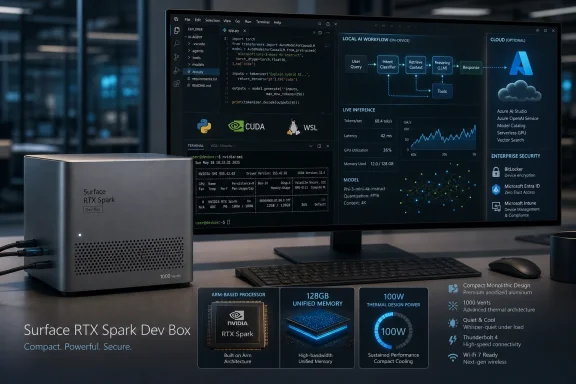
  1. Related coverage: nvidianews.nvidia.com
  2. Official source: blogs.windows.com
  3. Official source: news.microsoft.com
  4. Related coverage: thewincentral.com
  5. Related coverage: notebookcheck.com
  6. Related coverage: thetechportal.com
  7. Related coverage: anatoliapulse.com
  8. Related coverage: investor.nvidia.com
 

Microsoft introduced the Surface RTX Spark Dev Box on June 2, 2026 at Build as a compact Windows 11 Pro developer PC powered by NVIDIA’s RTX Spark silicon, promising up to one petaflop of AI compute and 128GB of unified memory for local AI workloads. The pitch is simple enough to fit on a keynote slide: stop renting every experiment from the cloud and put serious model iteration back on the desk. The more interesting story is that Microsoft is no longer treating local AI as a laptop feature or a Copilot flourish. It is building hardware for developers who need Windows to become a machine room, not merely a client OS.

A Surface RTX dev box beside a monitor showing code and AI pipeline diagrams with GPU acceleration icons.Microsoft Is Selling the Desk as the New AI Edge​

The Surface RTX Spark Dev Box is not a mainstream Surface in the familiar sense. It is not a tablet, not a convertible, and not a lifestyle PC chasing coffee-shop glamour. It is closer to a workstation appliance: small, dense, GPU-first, and meant to sit beside a monitor while developers build, test, and run models locally.
That shift matters because Microsoft’s AI strategy has spent the past few years leaning heavily on cloud-scale abstraction. Azure supplies the GPUs, Copilot supplies the interface, and users are encouraged to think less about where inference happens. The Dev Box reverses that mental model. It says the location of compute still matters, especially when cost, latency, data control, and iteration speed are all part of the development loop.
Microsoft’s own framing is careful but revealing. The company is not claiming that every developer can replace cloud training clusters with a shoebox-sized Surface. It is arguing that many AI development tasks do not need the most expensive remote GPU instance every time a prompt chain, agent workflow, retrieval pipeline, or model variant changes. That is a narrower claim, but it is also the one most likely to resonate with practical teams.
The old workstation bargain was that local hardware bought predictability. The new AI workstation bargain is that local hardware buys iteration without a meter running. That is the real product Microsoft is trying to sell.

The Petaflop Number Is a Signal, Not the Whole Story​

The headline spec is up to one petaflop of AI compute. That number will travel because it sounds absurdly large for a compact developer PC, but it should be read with the usual AI-hardware caution. This is not a universal one-petaflop computer in the old floating-point workstation sense; it is a peak AI performance figure tied to the precision formats and tensor hardware that modern model inference increasingly exploits.
The more consequential specification may be 128GB of unified memory. For local AI, memory capacity and memory architecture often matter as much as raw compute. A GPU that can theoretically process a model quickly is far less useful if the model, context, embeddings, runtime overhead, and tooling cannot comfortably fit.
RTX Spark combines a Blackwell-class NVIDIA GPU with a Grace Arm CPU design and a unified memory pool shared across CPU and GPU. That architecture is NVIDIA and Microsoft’s answer to the same pressure Apple has benefited from with its unified-memory Macs: large models are not just compute problems, they are data-movement problems. If the CPU and GPU can access a shared pool more efficiently, the machine becomes more flexible for local inference and developer experimentation.
Microsoft says the Dev Box is intended to run large AI models locally, including models with more than 120 billion parameters under certain conditions and long-context workloads up to a million tokens. Those claims will need independent testing, because quantization level, model architecture, context length, batch size, and runtime stack can all change the real experience dramatically. Still, the direction is clear: this is not a toy NPU designed to summarize emails. It is a CUDA-class local AI box aimed at developers who already know why VRAM ceilings hurt.

Windows on Arm Gets Its Most Serious Developer Test Yet​

The Surface RTX Spark Dev Box also pushes Windows further into a computing architecture Microsoft has chased for years with mixed results: Arm-based Windows PCs. Earlier Windows on Arm efforts were defined by battery life, thin devices, and the awkward gap between native apps and emulation. RTX Spark changes the conversation by bringing NVIDIA’s GPU ecosystem into the center of the platform.
That does not erase the compatibility question. Developers are conservative for good reason, and many depend on toolchains, extensions, drivers, containers, debuggers, and native libraries that are less forgiving than consumer apps. Microsoft can say Windows on Arm is ready, and NVIDIA can promise broad compatibility, but developers will judge the machine by whether their actual stack runs without turning the first week into archaeology.
Microsoft appears to understand that the hardware alone is not enough. The Dev Box is being pitched as a configured developer environment rather than a blank Windows installation with an impressive chip inside. Windows 11 Pro arrives with developer-oriented defaults, PowerShell 7 as the default shell, WSL 2 prepared for GPU passthrough and CUDA support, and common tools such as VS Code, GitHub Copilot, Git, Python, and Node.js preinstalled.
That out-of-box configuration is more than convenience. It is Microsoft admitting that AI development is now a systems problem. Developers are not merely opening an IDE; they are juggling Windows, Linux, CUDA, Python environments, package managers, local model runtimes, agent frameworks, source control, and cloud handoff points. The fewer hours spent making the machine become itself, the stronger the case for buying a purpose-built box.

The Cloud Is Still Necessary, but No Longer Sacred​

Microsoft is not abandoning Azure by selling a local AI development machine. If anything, the Dev Box may make Azure more useful by moving the messy exploratory work onto local hardware and reserving cloud resources for scale, collaboration, deployment, and production-grade workloads. The intended workflow is not local versus cloud. It is local first, cloud when justified.
That distinction is important because cloud AI bills are no longer a theoretical concern. A team iterating on agents can burn money through repeated inference calls, evaluation runs, long-context tests, retrieval experiments, and fine-tuning attempts that never make it near production. Even when each individual request looks small, the development pattern is repetitive by nature.
A local box changes the psychology of experimentation. Developers can run more failed attempts because failure does not immediately show up as another line item. They can test sensitive prompts or proprietary data without sending every iteration outside the building. They can work through network hiccups, service quotas, and procurement delays with less friction.
There is a catch: local hardware turns operating expense into capital expense. Someone still has to buy, secure, inventory, patch, and eventually replace the machine. If Microsoft prices the Surface RTX Spark Dev Box like a boutique workstation, its audience will be narrower than the keynote language suggests. But for teams already spending heavily on AI development cycles, predictable ownership may be easier to defend than unpredictable usage.

The Surface Brand Is Becoming a Developer Infrastructure Brand​

Surface began as Microsoft’s proof that Windows hardware could be aspirational. The Surface RTX Spark Dev Box uses that same brand for a different purpose: proving that Windows can be a serious local AI development platform. That is a notable expansion of what Surface means.
The industrial design reinforces the repositioning. The chassis is aluminum and designed to function as part of the thermal system, which is exactly the sort of detail that matters when a compact machine is expected to handle sustained inference, fine-tuning, or long-running agent workloads. AI hardware that performs well for a burst but throttles under real developer use will not survive contact with the intended audience.
The comparisons to a flattened Xbox Series X are amusing but not entirely frivolous. Microsoft has experience building compact, thermally disciplined boxes around powerful silicon. The Dev Box appears to borrow more from that appliance logic than from the traditional tower workstation. It is designed to be noticed less as a modular PC and more as a sealed, tuned platform.
That will split opinions. Some developers prefer open workstations with replaceable GPUs, expandable memory, and the ability to fix or upgrade parts as needs change. Others simply want a certified local AI node that works. Microsoft is betting that enough AI developers fall into the second camp, especially in organizations where standardized hardware is easier to approve than custom builds.

NVIDIA Gets a Windows Beachhead Beyond Gaming​

For NVIDIA, RTX Spark is a strategic widening of the Windows story. The company already owns much of the AI training and inference conversation in the data center, and its GeForce and RTX brands dominate large parts of PC graphics. A compact Windows AI workstation lets NVIDIA occupy the gap between gamer GPU, professional workstation, and cloud accelerator.
That gap has become more valuable as AI development moves closer to individual desks. Not every model experiment belongs on an H100 cluster, but many are too large or too slow for today’s typical AI PC NPU. RTX Spark gives NVIDIA and its partners a product class that says local AI is not just about small models sipping power in the background. It can also mean a serious GPU environment under Windows.
The CUDA angle is central. Many AI frameworks, libraries, and developer habits still orbit NVIDIA’s software stack. Microsoft’s embrace of RTX Spark therefore gives Windows developers a familiar acceleration path rather than asking them to wait for every workload to become NPU-friendly or every framework to treat generic accelerators equally.
That is also why the Dev Box is potentially uncomfortable for other silicon vendors in the Windows ecosystem. Microsoft has spent years promoting heterogeneous AI compute across CPUs, GPUs, and NPUs. But when it wants to court developers building the next wave of local agents, it is leading with NVIDIA GPU muscle and CUDA support. The message to the market is diplomatic; the message to developers is obvious.

Local AI Makes Security Both Easier and Harder​

Microsoft is also presenting the Dev Box as a safer place to work with confidential models, proprietary data, and valuable intellectual property. That argument has merit. Keeping models, prompts, evaluation data, and source material on local hardware can reduce exposure to third-party services, cross-border data questions, and accidental leakage through external APIs.
But local does not automatically mean secure. A powerful AI workstation becomes a high-value endpoint. It may store sensitive model weights, internal documents, training data, credentials, local vector databases, and experimental agents with broad file or network access. If compromised, it could reveal exactly the assets an organization hoped to protect by avoiding the cloud.
Microsoft’s use of Windows 11 Pro, Secured-core PC positioning, BitLocker, Defender, Entra ID, and Intune integration is therefore not cosmetic. Enterprises will not adopt a fleet of local AI boxes unless they can manage them like serious corporate endpoints. The Dev Box has to be powerful enough for developers and boring enough for security teams.
The agent angle raises the stakes further. Local AI agents that can inspect files, call tools, generate code, and act across a developer environment are useful precisely because they are close to valuable context. That proximity demands containment, identity controls, logging, and sane defaults. Microsoft’s challenge is to make the local-first AI workstation feel liberating without turning it into a privileged chaos engine.

The Real Rival Is Not Just the Mac Studio​

It is tempting to frame the Surface RTX Spark Dev Box as a Microsoft answer to Apple’s Mac Studio, and the comparison is not wrong. Both are compact, high-performance desktops with unified-memory ambitions and a professional audience. Both are meant for people who want serious compute without a tower under the desk.
But the deeper rivalry is with the idea that AI development should happen somewhere else. Apple sells local creative and development performance with a tight hardware-software stack. NVIDIA sells AI acceleration with a dominant developer ecosystem. Microsoft is trying to combine those arguments inside Windows and make the platform feel inevitable for AI agents.
That makes the Dev Box more than a workstation SKU. It is a reference point for what Microsoft thinks a Windows developer machine should become: Arm-based, GPU-rich, Linux-capable through WSL, cloud-connected when needed, and tuned for AI workflows from first boot. If that model works, Surface is only the first signal; OEMs will follow with variations.
If it fails, the reasons will probably be familiar. Price could be too high. Arm compatibility could still annoy the wrong users. Thermals could constrain sustained performance. AI software stacks could remain too fragmented. Or the local AI workloads Microsoft imagines may turn out to be more niche than its keynote suggested.
Yet even those risks show why the product is interesting. The Surface RTX Spark Dev Box is not chasing the average PC buyer. It is a wager that developers building AI systems need a new class of Windows machine before ordinary users know why.

The Spec Sheet Leaves the Hardest Questions Unanswered​

Microsoft’s announcement gives enough detail to define the category, but not enough to settle the purchase decision. Availability is described as later this year in the United States, and price remains the elephant in the room. Without price, it is impossible to know whether this is an accessible developer appliance or a halo product designed to shape the conversation.
Performance also needs independent measurement. One petaflop of AI compute is impressive, but developers will care about tokens per second, supported quantization formats, sustained thermals, memory bandwidth, model load times, power draw, noise, driver stability, and whether popular frameworks behave cleanly on Windows and WSL. The first reviews will matter more than the first demos.
Software maturity may be even more important than silicon. Local AI development is moving quickly, with runtimes, model formats, agent frameworks, evaluation tools, and orchestration layers changing month by month. A machine like this needs not just launch-day readiness but a maintenance story that keeps the stack coherent after the keynote glow fades.
Microsoft has been here before in spirit. The company has often used Surface hardware to push Windows partners toward a new design center. Sometimes that works; sometimes Surface becomes a beautiful argument that the broader ecosystem only partially adopts. RTX Spark gives the company a stronger technical foundation than many past experiments, but the platform burden is heavier.

The Box on the Desk Is a Budget Argument in Disguise​

The most persuasive audience for the Surface RTX Spark Dev Box may not be the lone developer who wants the newest gadget. It may be the engineering manager who needs to explain why AI experimentation costs are rising without producing proportional output. Local compute makes that conversation concrete.
A shared cloud bill can obscure which experiments are wasteful, which are necessary, and which are simply the cost of moving fast. A local development box does not eliminate waste, but it caps a meaningful slice of it. It also encourages teams to reserve premium cloud models and GPU instances for the jobs that actually require them.
That does not mean every organization should buy one. Teams working primarily with hosted frontier models, lightweight AI features, or strict centralized infrastructure may find the Dev Box unnecessary. Developers who need multi-GPU training or production-scale evaluation will still live in the cloud or the data center. The product’s sweet spot is the middle: workloads too serious for a conventional PC, too repetitive for constant cloud billing, and too sensitive or latency-dependent to outsource casually.
That middle is growing. Agent development, local retrieval, synthetic data experiments, model distillation, fine-tuning, and long-context evaluation all benefit from fast iteration near the developer. Microsoft is betting that this middle becomes large enough to justify a Surface category.

The Surface RTX Spark Dev Box Draws a Line Around Local AI​

The announcement is less about one compact PC than about Microsoft declaring that local-first AI development deserves first-class Windows hardware. The Surface RTX Spark Dev Box will live or die on price, thermals, software stability, and real model performance, but its strategic meaning is already visible.
  • Microsoft announced the Surface RTX Spark Dev Box at Build on June 2, 2026 as a compact Windows 11 Pro machine for local AI development.
  • The system uses NVIDIA RTX Spark silicon with a Blackwell-class GPU, Grace Arm CPU design, up to one petaflop of AI compute, and 128GB of unified memory.
  • Microsoft is positioning the device as a way to reduce dependence on cloud GPU instances for iterative development, agent testing, large local inference, and some fine-tuning workflows.
  • The preconfigured developer environment, including WSL 2 with GPU passthrough and CUDA support, is as important to the pitch as the hardware itself.
  • The machine’s enterprise appeal depends on whether Microsoft can make local AI development manageable, secure, and predictable rather than merely powerful.
  • The unanswered questions are price, availability details beyond later this year in the United States, sustained performance, Arm compatibility, and real-world software maturity.
Microsoft’s bet is that the AI PC story cannot end with background NPUs and Copilot buttons; developers need machines that can carry meaningful local workloads before users ever see the polished feature. The Surface RTX Spark Dev Box is the company’s clearest admission yet that the future of Windows AI will be built partly in the cloud, partly on the edge, and very often on a hot little box sitting on a developer’s desk.

References​

  1. Primary source: GIGAZINE
    Published: 2026-06-03T03:52:07.810157
  2. Related coverage: tomshardware.com
  3. Related coverage: axios.com
  4. Related coverage: windowscentral.com
  5. Related coverage: pcgamer.com
  6. Official source: microsoft.com
  1. Related coverage: techspot.com
  2. Official source: blogs.windows.com
  3. Official source: blogs.microsoft.com
  4. Related coverage: investor.nvidia.com
  5. Related coverage: technetbooks.com
  6. Related coverage: thewincentral.com
  7. Related coverage: banklesstimes.com
  8. Related coverage: notebookcheck.com
  9. Related coverage: engadget.com
  10. Related coverage: ltec-biz.com
  11. Related coverage: nvidianews.nvidia.com
  12. Related coverage: images.nvidia.com
 

Microsoft announced the Surface RTX Spark Dev Box on June 2, 2026, as a compact Windows 11 Pro developer desktop built with Nvidia’s Arm-based RTX Spark superchip, 128GB of unified memory, and enough local AI capacity to run very large models without defaulting to the cloud. That makes it less a quirky Surface accessory than a statement about where Microsoft thinks Windows development is headed. The company is betting that the next serious developer workstation is not just a PC with more RAM, but a tightly integrated AI appliance with Windows, CUDA, Copilot, security, and management all wired together. The risk is that Microsoft is also asking developers to believe, once again, that Windows on Arm is ready for the hard jobs.

NVIDIA RTX Spark dev box on a desk running local AI inference on-screen with performance stats.Microsoft Is Selling a Local AI Workstation, Not a Cute Mini PC​

The Surface RTX Spark Dev Box arrives at a moment when “AI PC” has become one of the most abused phrases in the industry. For the past two years, it has often meant a conventional laptop with an NPU, some webcam tricks, and a future-facing promise that more software will eventually know what to do with the hardware. Microsoft’s new box is different because it is aimed at developers who already know exactly what they want to do: load models, fine-tune them, test agents, run inference locally, and avoid shipping every experiment to a cloud GPU meter.
The specs Microsoft is willing to discuss tell the story. The system uses Nvidia’s RTX Spark superchip, pairing a Grace-class Arm CPU with a Blackwell RTX GPU and 128GB of unified memory. Microsoft and Nvidia are pitching up to one petaflop of AI compute and local execution for models as large as roughly 120 billion parameters, with the usual caveat that quantization and workload shape matter enormously.
That is not a mainstream desktop pitch. It is a pitch to the developer who has been using a gaming tower, a remote cloud instance, a Mac Studio, a Linux workstation, or some combination of all four to prototype AI software. Microsoft wants that developer to see Windows as the machine under the desk again.
The form factor matters because it signals intent. This is a compact aluminum block, apparently designed around sustained thermal output rather than bursty benchmark moments. Its 100-watt thermal envelope sits above the range expected for thinner RTX Spark laptops, and that matters for AI work because the enemy is not the 30-second demo — it is the two-hour run that slowly turns a sleek machine into a throttled one.

The 128GB Memory Figure Is the Product​

For traditional PC buyers, CPU model numbers and GPU tiers still carry the marketing weight. For local AI developers, memory capacity has become the blunt instrument of truth. A fast GPU that cannot hold the model, context, and working buffers is a fast GPU waiting for compromises.
That is why the 128GB unified memory figure dominates this announcement. Unified memory is not magic, and it does not make every workload faster by default. But for AI development, where model size, quantization level, context length, and framework overhead can turn a seemingly powerful system into a juggling act, a large shared pool is the difference between experimenting freely and constantly downsizing ambition.
Microsoft’s claim that the Dev Box can run models up to around 120 billion parameters locally is the kind of line that needs careful reading. It does not mean every 120B model will run at full precision, at high speed, with expansive context, while the developer casually keeps the rest of the machine busy. It means the box is intended to make workloads that were previously impractical on ordinary desktops at least plausible on a local Windows system.
That distinction matters for WindowsForum readers because many AI hardware announcements collapse under their own ambiguity. TOPS, petaflops, and parameter counts are often treated as interchangeable signs of greatness. In practice, developers care about whether their stack runs, whether memory pressure kills throughput, whether drivers behave, and whether the system remains responsive while doing real work.
The Dev Box’s most credible advantage is not that it will beat every workstation on raw performance. It is that Microsoft is building a known target: a fixed, supported configuration with enough memory to matter and a software stack intended to be ready when the machine comes out of the box.

Nvidia Gives Windows on Arm the Missing Developer Ingredient​

Windows on Arm has spent years living in a credibility gap. Battery life and instant-on behavior were never the hard part to explain. The hard part was convincing developers, IT departments, and power users that Arm Windows could handle the messy edge cases of real computing: drivers, virtualization, toolchains, native apps, emulation, peripherals, and performance under load.
Qualcomm’s Snapdragon X push improved that story, especially for thin-and-light laptops. But AI development has a different center of gravity. The developer tools that matter most in this space are tangled up with Nvidia’s CUDA ecosystem, model runtimes, GPU acceleration libraries, and a decade of accumulated muscle memory around Nvidia hardware.
That is what makes RTX Spark more interesting than another Arm PC platform. Nvidia is not merely lending Microsoft a faster chip; it is bringing Windows on Arm into contact with the GPU software ecosystem that many AI developers already treat as the default. If Microsoft wants Windows to be a first-class local AI development environment, Nvidia’s stack is the shortest route to credibility.
This also explains why the Surface RTX Spark Dev Box feels like a course correction after the canceled Snapdragon Dev Kit. Qualcomm’s Windows-on-Arm mini PC was supposed to give developers a low-friction path into the platform, but it never reached buyers after hardware quality problems. That left Microsoft with a familiar problem: it needed developers to target Windows on Arm, but it did not have the right developer box in circulation.
The RTX Spark Dev Box is not a simple replacement. It is more ambitious, more expensive-looking, and aimed at a different tier of developer. But strategically, it fills the same gap: Microsoft needs hardware that says, “Build here,” not just “test here if you have time.”

The Box Is Also an Operating System Argument​

One of the more revealing details in Microsoft’s pitch is not the silicon, but the image. The Dev Box ships with Windows 11 Pro configured for developers, including Visual Studio Code, GitHub Copilot, Developer Mode, PowerShell 7 as the default shell, a stripped-down taskbar, widgets disabled, Do Not Disturb enabled, and other settings designed to reduce setup friction.
On one level, this sounds trivial. Any competent developer can change a theme, install VS Code, and disable distractions. But product defaults are a form of editorial judgment, and Microsoft’s judgment here is that the developer PC should no longer arrive as a neutral consumer Windows install waiting to be tamed.
That is a quiet admission that modern Windows often works against the very audience Microsoft most wants to court. Developers routinely spend their first hours on a new Windows machine uninstalling distractions, changing defaults, configuring shells, enabling features, arranging package managers, installing Linux tooling, and reconciling corporate security controls with local experimentation. Microsoft is trying to compress that ritual into a first-boot promise.
The deeper play is that Microsoft wants the Surface RTX Spark Dev Box to feel less like a PC and more like a workstation appliance. Apple has long understood the value of selling developers and creators a whole environment rather than a parts list. Nvidia understands it too, which is why DGX systems are framed as platforms rather than boxes full of components.
Microsoft has historically been weaker at this. Windows is broad, flexible, backward-compatible, and endlessly configurable, which is another way of saying it can feel less curated than competitors’ platforms. With the Dev Box, Microsoft is trying to make Windows opinionated without making it closed.

The Cloud Is Still There, but Microsoft Is Admitting Local Matters​

Microsoft has every incentive to push AI workloads into Azure. Cloud GPUs are billable, scalable, centrally managed, and deeply aligned with Microsoft’s enterprise strategy. The mere existence of a local AI developer box therefore carries an implicit concession: not every AI workflow belongs in the cloud all the time.
There are obvious reasons for that. Developers may want lower latency, predictable costs, offline access, privacy around sensitive data, or the ability to iterate without provisioning infrastructure. Enterprise teams may want to prototype locally before moving models into governed cloud environments. Independent developers may simply be tired of watching experimental runs turn into recurring invoices.
The cloud will still dominate large-scale training and production deployment for many organizations. A 100-watt desktop box is not a substitute for a cluster. But local inference, fine-tuning experiments, agent prototyping, retrieval workflows, and model evaluation can all benefit from a machine that sits within arm’s reach.
This is where Microsoft’s positioning becomes more pragmatic than revolutionary. The company is not saying developers will abandon Azure. It is saying that the path to Azure may begin on a local Windows machine, with the same tools, the same identity plumbing, and eventually the same management story.
That is a familiar Microsoft maneuver. Win the endpoint, shape the workflow, and make the cloud feel like the next step rather than a separate decision.

Security and Manageability Are the Enterprise Hook​

For hobbyists, the headline is local model size. For enterprises, the headline may be that this is a secured-core Windows PC compatible with Microsoft’s existing security and management stack. BitLocker, Microsoft Defender, Entra ID, and Intune are not glamorous features, but they matter if a developer machine is going to touch proprietary data, internal code, or regulated workflows.
This is one reason a Surface-branded AI dev box is different from a generic mini workstation. Microsoft can present it as a managed corporate asset rather than a rogue lab machine. IT departments may not love the idea of employees running large models locally, but they will dislike it less if the hardware fits into familiar compliance and device-management channels.
There is also a shadow risk here. Local AI development can create new data-governance problems precisely because it is local. Models, prompts, embeddings, datasets, logs, and generated outputs can all live on the device. A powerful local box may reduce cloud exposure while increasing endpoint sensitivity.
That makes the Dev Box a test of whether Microsoft can make local AI feel enterprise-safe without suffocating the experimentation that developers want. If every interesting workflow requires a policy exception, the machine becomes shelfware. If the controls are too loose, it becomes another unmanaged data island.
The best version of this product gives organizations a middle path: developers get local horsepower, and IT gets identity, encryption, inventory, update control, and security telemetry. That is a very Microsoft bargain.

The Mac Studio Comparison Is Tempting but Incomplete​

The Surface RTX Spark Dev Box will inevitably be compared with Apple’s Mac Studio. Both are compact desktop workstations built around unified memory. Both speak to developers and creators who want serious local compute in a small footprint. Both are designed to make a traditional tower look ungainly.
But the comparison only goes so far. Apple’s advantage is platform coherence: macOS, Apple silicon, excellent media engines, strong developer hardware, and a mature unified-memory story. Microsoft and Nvidia’s advantage is the AI software ecosystem around CUDA and the gravitational pull of Windows in enterprise development.
For local AI, that distinction matters more than brand aesthetics. Apple’s machines can be excellent for certain machine-learning workflows, and the high-memory configurations are genuinely useful. But Nvidia remains the default target for a vast amount of AI tooling, optimization work, and developer expectation.
Microsoft’s challenge is that it must deliver coherence without owning the whole stack. The Surface team owns the hardware experience, Windows owns the OS layer, Nvidia owns much of the acceleration story, and developers bring their own frameworks and dependencies. Any weak link becomes the user’s problem.
That is why the Dev Box has to be judged less like a consumer Surface and more like a reference platform. If it works well, it gives OEMs and developers a model for what local AI development on Windows can look like. If it stumbles, it reinforces the suspicion that Windows on Arm and high-end AI development remain adjacent ambitions rather than a unified platform.

The Hardware Partner Ecosystem Makes This Bigger Than Surface​

Microsoft is not alone in the RTX Spark push. Nvidia has said RTX Spark will appear across laptops and compact desktops from major PC makers, including familiar names in the Windows ecosystem. That means the Surface RTX Spark Dev Box is less a one-off curiosity than Microsoft’s own stake in a broader platform launch.
This is important because Surface devices often play a dual role. They are products, but they are also signals to OEM partners. The original Surface Pro helped define the detachable 2-in-1 category. Surface Laptop clarified Microsoft’s taste in premium Windows notebooks. A Surface AI dev box is similarly a declaration that compact, managed, local AI workstations are now part of the Windows roadmap.
OEMs will likely experiment aggressively. Some will chase lower prices, some will build louder and faster boxes, some will target creators, and some will wrap the same platform in enterprise procurement language. Microsoft’s version does not need to be the volume leader to be influential.
The broader ecosystem also gives Microsoft a hedge. If the Surface model is expensive or supply-constrained, RTX Spark can still succeed through Dell, HP, Lenovo, ASUS, MSI, and others. If OEM designs are inconsistent, the Surface model can serve as the clean Microsoft-endorsed baseline.
That is the classic Windows hardware dynamic, now applied to AI workstations. Microsoft wants diversity without chaos. Nvidia wants scale without losing control of the software story. Developers want machines that work.

Price Is the Missing Fact That Could Change the Story​

Microsoft has not yet provided full specifications or pricing, and that omission is not a footnote. It is the difference between an exciting developer platform and a boutique machine for well-funded teams.
A 128GB unified-memory AI workstation with Nvidia silicon, premium thermal design, and a Surface badge is unlikely to be cheap. If the price lands near high-end workstations or Mac Studio configurations, Microsoft can argue that the Dev Box is specialized professional equipment. If it climbs too high, the audience narrows to enterprise labs, AI startups, and developers spending someone else’s budget.
There is also the question of what “full specifications” will reveal. Ports, storage options, external display support, networking, upgradeability, noise profile, repairability, and sustained performance will all matter. A developer box that cannot be easily expanded may still be acceptable if the base configuration is generous enough, but professionals will want to know where the walls are.
The Surface brand complicates expectations. Surface devices are usually polished, premium, and not especially friendly to tinkering. Developers, especially WindowsForum’s kind of developers, often care about the parts Microsoft would rather abstract away. They will want to know whether this machine is a sealed appliance or a workstation with room to grow.
That tension may define the product’s reception. Microsoft wants to sell simplicity. Power users want control. The Dev Box has to offer enough of both to avoid disappointing each side for opposite reasons.

Windows on Arm Still Has to Earn the Boring Wins​

The most dangerous problems for the Surface RTX Spark Dev Box are not the ones that show up in launch demos. Microsoft and Nvidia can almost certainly make selected AI workloads look impressive. The harder question is whether the system behaves predictably across the dull, jagged reality of developer life.
Windows on Arm compatibility has improved, but developers are professional edge-case generators. They use older tools, obscure dependencies, native extensions, local databases, container stacks, VPN clients, hardware dongles, shell scripts, emulators, and build systems assembled over years. One missing driver or incompatible binary can spoil an otherwise impressive machine.
Microsoft knows this, which is why a developer-focused launch is both smart and risky. Developers can help pull the ecosystem forward, but they are also the least forgiving audience when the basics fail. A consumer might tolerate an app running under emulation. A developer will file the machine under “not ready” if a toolchain breaks at 1 a.m.
Nvidia’s involvement helps, but it does not erase the platform burden. CUDA support and AI acceleration are necessary, not sufficient. The machine must also be a good Windows developer workstation when the user is not running a model.
That is the unglamorous standard the Dev Box must meet. It must make local AI feel special without making ordinary development feel compromised.

The Agentic Windows Pitch Needs Real Developer Hardware​

Microsoft and Nvidia are framing RTX Spark around the future of personal agents and AI-native PCs. That language can sound inflated, but there is a practical layer beneath it. If software is going to include more local agents, background reasoning, multimodal pipelines, and user-specific automation, developers need hardware that can run and test those experiences without pretending the cloud is always nearby.
This is where the Surface RTX Spark Dev Box becomes more than a workstation. It is a staging ground for the kind of Windows software Microsoft wants to exist. Developers cannot build convincing local AI apps if their own development machines lack the capacity to run the models, tools, and test environments those apps require.
The old PC development model assumed the developer machine was more powerful than the target machine, but not fundamentally different in kind. AI scrambles that assumption. A developer may need far more memory and acceleration than the eventual user device, especially when testing multiple models, larger prototypes, or agent orchestration logic.
The Dev Box gives Microsoft a way to seed that high end. It says: build the ambitious version here, then scale it down, specialize it, or offload parts of it later. That is a healthier developer story than asking everyone to rent cloud GPUs for every serious experiment.
Still, Microsoft must be careful with the word “agentic.” Developers have heard enough vague AI platform promises. The machine’s success will depend on concrete workflows: model serving, local inference, fine-tuning, retrieval, coding assistants, test harnesses, debugging tools, and deployment paths that make the hardware feel necessary rather than decorative.

Surface Becomes a Reference Design for the AI Workbench​

The most interesting thing about the Surface RTX Spark Dev Box is that it makes Surface feel experimental again. For years, Surface has oscillated between elegant mainstream hardware and cautious iteration. This machine is stranger, narrower, and more strategic.
That is good. The Windows ecosystem does not need Microsoft to make another generic mini PC. It needs Microsoft to show what a Windows AI workbench can be when the hardware, OS defaults, developer tools, GPU stack, and enterprise controls are designed together.
The aluminum enclosure doubling as a thermal element is a small but telling detail. The developer-friendly Windows image is another. The exclusive Microsoft Store launch in the United States suggests a controlled rollout rather than a mass-market blast. This is Microsoft testing a category, not flooding Best Buy.
If the test works, expect the idea to spread. There will be cheaper AI dev boxes, rack-friendly variants, creator-targeted versions, and corporate bundles. There will also be Linux comparisons, Mac comparisons, and complaints that Microsoft should have made the machine more open, more upgradeable, or less expensive.
Those debates are healthy because they mean the category is real. The worst outcome for Microsoft would be indifference.

The Spark Box Draws a Line Under Microsoft’s AI PC Ambitions​

The Surface RTX Spark Dev Box matters because it gives Microsoft’s AI PC story a machine with teeth. Instead of asking users to imagine future workloads for modest NPUs, Microsoft is putting a developer-class local AI box on the roadmap with a large memory pool, Nvidia acceleration, and a Windows image meant for work from first boot.
The practical implications are sharper than the marketing:
  • Microsoft is positioning local AI development as a first-class Windows workload rather than a cloud-only Azure story.
  • Nvidia’s RTX Spark gives Windows on Arm a more credible path into AI development because it brings the CUDA ecosystem along for the ride.
  • The 128GB unified memory configuration is the central feature because model capacity and memory pressure matter more than peak marketing numbers.
  • Enterprise adoption will depend as much on manageability, security, and policy fit as on raw AI performance.
  • Pricing, real-world compatibility, sustained thermals, and full specifications will determine whether this becomes a widely used developer platform or a prestige reference box.
  • The device’s larger purpose is to seed a new class of compact Windows AI workstations across Surface and the broader OEM ecosystem.
For Windows enthusiasts, the Surface RTX Spark Dev Box is the rare announcement that is both highly specific and strategically broad. It is a small desktop for a narrow audience, but it points toward a Windows future in which local compute, cloud services, Arm CPUs, Nvidia GPUs, and developer tooling are no longer separate stories. If Microsoft and Nvidia can make the boring parts work — drivers, thermals, compatibility, pricing, deployment, and day-two reliability — this could become the first serious Windows machine of the local AI era rather than just another impressive box announced before its ecosystem was ready.

References​

  1. Primary source: TechSpot
    Published: Wed, 03 Jun 2026 15:50:00 GMT
  2. Related coverage: tomshardware.com
  3. Related coverage: windowscentral.com
  4. Related coverage: axios.com
  5. Related coverage: pcgamer.com
  6. Official source: microsoft.com
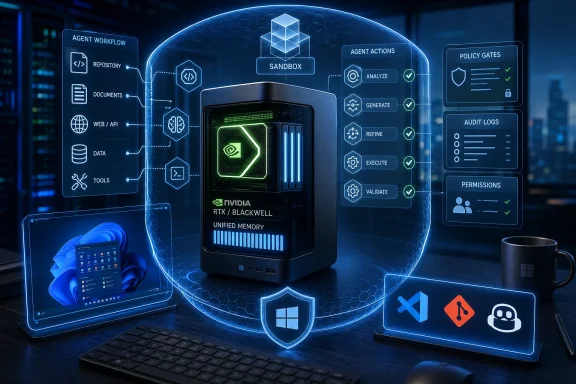
  1. Related coverage: nvidianews.nvidia.com
  2. Related coverage: notebookcheck.net
  3. Related coverage: technetbooks.com
  4. Related coverage: notebookcheck.com
  5. Official source: blogs.windows.com
  6. Related coverage: wccftech.com
  7. Related coverage: siliconangle.com
  8. Related coverage: thetechportal.com
  9. Related coverage: docs.nvidia.com
  10. Related coverage: signal65.com
 

Microsoft announced the Surface RTX Spark Dev Box on June 2, 2026, at Build as a compact Windows 11 Pro developer desktop for local AI work, pairing Nvidia’s RTX Spark silicon with up to one petaflop of AI compute and 128GB of unified memory.
That dry product description understates the strategic swing. Microsoft is not merely adding another oddball Surface to the lineup; it is trying to make the Windows desk relevant again in a world where AI development has been drifting toward rented GPUs, browser tabs, and cloud notebooks. The Dev Box is Microsoft’s argument that the next developer workstation should be local, managed, secure, and still deeply tied to the cloud.

Surface RTX Spark Dev Box with AI workflow software on screen, showing CUDA/WSL tools and live inference metrics.Microsoft Turns the AI Workstation Into a Surface Problem​

Surface has usually been Microsoft’s way of telling the PC industry what Windows hardware ought to look like. The Surface Pro pushed detachable tablets, the Surface Laptop defended premium Windows notebooks, and the Surface Studio tried to make an all-in-one feel like a creative instrument rather than an office appliance.
The Surface RTX Spark Dev Box plays a different role. It is not a mass-market PC, not a living-room mini desktop, and not a cute answer to the Mac mini. It is a developer appliance for the AI cycle: pull a model, tune it, test an agent, run inference, decide what belongs locally, and send the rest upstream.
That distinction matters because Microsoft’s AI PC messaging has been muddy for two years. Copilot+ PCs promised on-device AI, but the first wave was largely about NPUs, battery life, and consumer-facing features. The Dev Box is a more direct machine: less “your PC can blur a webcam background” and more “your desk can host real model work without lighting up a cloud meter every time you experiment.”
It also quietly acknowledges a weakness in the current Windows developer story. For many AI builders, the serious work already happens somewhere else: Linux servers, cloud GPU instances, managed notebooks, or expensive workstation towers. Microsoft wants Windows 11 to be the place where local-first AI feels native rather than tolerated.

Nvidia Supplies the Muscle, but Microsoft Supplies the Trapdoor​

The headline silicon is Nvidia’s RTX Spark, a new Arm-based platform built around a Blackwell RTX GPU, a Grace CPU, CUDA, TensorRT, and a large unified memory pool. Microsoft says the Surface box delivers up to one petaflop of AI compute and 128GB of unified memory shared across CPU and GPU. Nvidia has described RTX Spark systems as capable of running 120-billion-parameter models with long-context workloads locally, though that claim sits in the familiar vendor zone of “possible under the right model, precision, and optimization choices.”
Still, the practical point is clear. The bottleneck for local AI has often been memory, not enthusiasm. Consumer GPUs may be brutally fast, but VRAM limits decide which models you can load, how much context you can keep, and whether the workflow is a smooth loop or a ritual of quantization, swapping, and compromise.
Unified memory does not magically erase the physics of bandwidth, latency, thermals, or model quality. But 128GB in a small Windows desktop changes the conversation for developers who want to test agents, inference paths, retrieval workflows, and smaller fine-tuning jobs without treating every experiment as a cloud budget event.
The trapdoor is that Microsoft is not selling local AI as a rejection of cloud AI. It is selling local AI as the front room of Azure, GitHub, Windows ML, Windows Copilot Runtime, and Microsoft Foundry. The Dev Box is a machine for doing more on the desk, but it is also a funnel into Microsoft’s larger managed stack.

The 100-Watt Detail Is the Most Honest Spec on the Page​

The most revealing number may not be the petaflop claim. It may be the 100W thermal envelope.
Laptop AI performance is easy to advertise and hard to sustain. A system can spike impressively, then drop clocks, howl through its fans, or drain itself into irrelevance. Microsoft’s pitch for the Dev Box is explicitly about sustained workloads: long-running training jobs, agentic pipelines, local inference, and fine-tuning that belongs on a desk rather than in a backpack.
That is why the chassis matters. Microsoft describes a monolithic anodized aluminum body with a grid of 1,000 vents, a visual wink at 1,000 teraflops. The aluminum body doubles as part of the cooling system, and the port selection is deliberately boring in the best workstation sense: USB-C, USB-A, HDMI, Ethernet, and a headphone jack.
This is not Surface as fashion object, though Microsoft cannot quite resist making it one. It is Surface as thermal policy. The company is effectively saying that the AI developer PC cannot be judged like an ultrabook; it has to run jobs for hours, stay predictable, and fit into an office or lab without becoming a rack server.
That makes the Dev Box more interesting than the simultaneously teased RTX Spark laptops. The laptop story is easier to market because everyone understands a premium mobile workstation. But the desktop story may be more important, because serious local AI work rewards power stability, memory capacity, cooling, and networked manageability more than thinness.

Windows Wants to Be the Local Agent Runtime, Not Just the Shell​

The Dev Box lands inside a broader Build 2026 push to make Windows a trusted platform for agents. Microsoft and Nvidia are talking about identity, containment, policy, GPU acceleration, and local inference surfaces with the kind of seriousness that suggests agentic computing is no longer just a demo category.
That is the right place for skepticism. “Agentic” has become the most overworked adjective in enterprise technology, often meaning little more than a chatbot that can call a tool and occasionally apologize for calling the wrong one. But beneath the marketing is a real platform problem: if software agents are going to act across files, apps, terminals, browsers, and enterprise data, the operating system has to provide boundaries.
Microsoft knows this terrain. Windows became dominant not simply because it ran applications, but because it became the place where applications, drivers, identity, policy, deployment, security tools, and management practices converged. The company wants the same gravitational pull for agents.
That is why the Dev Box ships with Windows 11 Pro tuned for developers rather than a clean consumer image. Visual Studio Code, WSL 2, PowerShell 7, GitHub Copilot, Git, Python, Node.js, CUDA support, and GPU passthrough are not decorative preload items. They are Microsoft’s attempt to make the first boot feel less like buying hardware and more like joining a prescribed workflow.
There is a subtle fight here with Linux. Microsoft does not need to convince AI developers that Linux matters; WSL is practically an admission of that. Instead, it needs to convince them that Windows can be the managed host, the secure endpoint, the enterprise identity surface, and the place where Linux-based AI tooling runs without the developer abandoning the Windows ecosystem.

The Cloud-Cost Argument Is Real, but Not Universal​

Microsoft’s most persuasive claim is not privacy or performance. It is cost predictability.
Anyone experimenting with AI workloads knows the awkward economics of iteration. Cloud GPUs are wonderful when you need scale, burst capacity, or frontier-class hardware. They are less wonderful when a developer is debugging glue code, testing prompts, evaluating a smaller model, or accidentally leaving something expensive running overnight.
A local box changes the psychology of experimentation. It lets developers iterate without attaching a token counter or instance meter to every mistake. It makes failed tests feel like learning again rather than billing events.
But this argument has limits. A Surface RTX Spark Dev Box will not replace serious training clusters, nor will it make the cloud irrelevant for teams that need collaboration, governance, distributed workloads, or deployment parity. Local compute is not free; it arrives as capital expense, support burden, power draw, lifecycle management, and potential underutilization.
The interesting shift is not cloud versus local. It is tiering. Microsoft is trying to formalize a world in which everyday AI development happens locally, cloud models handle frontier reasoning or scale-out jobs, and enterprise platforms decide where each task belongs. That is a more credible vision than the magical claim that every PC becomes a private data center.

IT Departments Will See a Workstation, a Risk Surface, and a Governance Test​

For sysadmins, the Dev Box is less a gadget than a policy challenge. A machine that can run large local models and retain sensitive code, prompts, embeddings, and proprietary data is attractive precisely because it keeps work close. It is also risky for the same reason.
Microsoft is leaning hard on the language of secured-core PCs, BitLocker, Defender, Entra ID, and Intune. That is not filler. If local AI becomes part of everyday development, organizations will need to manage models the way they manage code, data, secrets, containers, and endpoint software.
The old question was whether developers were allowed to send company data to a cloud model. The new question is what happens when powerful models run on a managed endpoint, interact with local repositories, and call tools from a terminal. The security perimeter does not disappear; it moves closer to the keyboard.
This is where Windows has a plausible advantage. Enterprises already understand device compliance, identity enforcement, conditional access, endpoint detection, and configuration baselines. If Microsoft can extend that familiar machinery to local AI agents and model workflows, it can make Windows feel safer than a pile of bespoke Linux workstations under desks.
The danger is that management becomes theater. A secured-core badge and Intune enrollment do not automatically answer how models are sourced, how prompts are logged, how agents are permissioned, or how data leakage is prevented when local and cloud inference are blended. Microsoft has the ingredients, but the operational recipes will matter more than the launch copy.

The Mac Studio Comparison Is Tempting and Incomplete​

It is easy to call the Surface RTX Spark Dev Box a Mac Studio rival. Both are compact, premium desktops built around large unified memory pools and aimed at creators or technical professionals who want serious compute without a tower.
But the comparison can mislead. Apple’s workstation story is vertically integrated around macOS, Apple silicon, media engines, and creative software performance. Microsoft’s Dev Box is more explicitly about developers, CUDA, Windows tooling, WSL, local models, and enterprise management.
That CUDA point is not a footnote. Much of the modern AI software world has been optimized around Nvidia’s ecosystem. Apple has made real strides with Metal and local model tooling, but Nvidia’s advantage in developer mindshare remains formidable, especially for teams moving between local prototyping and cloud GPU deployments.
Microsoft is therefore not trying to beat Apple at Apple’s own workstation argument. It is trying to make a Windows desktop feel like the natural local node in an Nvidia-centered AI workflow. For WindowsForum readers, that is the more consequential move.
The open question is price. Microsoft has not made price the center of the announcement, and that matters because the Dev Box will live or die on whether teams see it as a rational alternative to cloud GPU spend, not merely as an impressive desk ornament. If it lands too high, it becomes a niche executive developer toy. If it lands in a range that teams can justify against recurring cloud costs, it becomes a procurement conversation.

Arm on Windows Gets Another High-Stakes Test​

RTX Spark also puts Windows on Arm back under the microscope, but in a different way from Qualcomm’s Snapdragon push. Qualcomm’s pitch has been efficiency, battery life, and a better everyday laptop. Nvidia’s pitch is local AI horsepower, CUDA, creator performance, and agent workloads.
That difference could help. Developers may tolerate architectural transition pains if the payoff is obvious and the tooling works. They will be far less forgiving if drivers, dependencies, container workflows, Python packages, or native extensions turn setup into archaeology.
Microsoft’s preconfigured image is meant to blunt that risk. WSL 2 with GPU passthrough and CUDA support is especially important because many AI developers live in a Linux-flavored toolchain even when their corporate endpoint is Windows. If that bridge is solid, the Arm detail becomes less scary. If it is brittle, the Dev Box becomes a handsome reminder that developer trust is earned in the terminal, not on the keynote stage.
There is also a broader ecosystem issue. Windows on Arm has improved, but compatibility is not a binary state. It is a long tail of tools, plugins, drivers, security agents, VPN clients, build systems, and corporate oddities. A developer box has to survive that long tail more than a consumer laptop does.
The good news for Microsoft is that AI development is already comfortable with containers, virtual environments, remote repositories, and abstraction layers. The bad news is that those layers often break in exquisitely specific ways. Surface RTX Spark Dev Box will be judged by the boring failures as much as the benchmark wins.

The Local AI PC Finally Has a Concrete Job​

The AI PC category has suffered from vagueness. Vendors promised intelligence, but often delivered a faster webcam effect, a few Copilot features, and a processor sticker. The Surface RTX Spark Dev Box is more credible because it has a job to do.
It is for developers who need to run models locally. It is for teams that want to fine-tune or evaluate without sending every iteration into the cloud. It is for agent workflows that need sustained local compute and access to Windows tools. It is for organizations that want endpoint governance around AI development rather than a shadow stack of personal GPUs and unmanaged scripts.
That does not make it mainstream. In fact, the Dev Box is valuable precisely because it is not pretending to be a mainstream family PC. It defines a sharper category: the local AI workstation as a managed Windows endpoint.
This is where Microsoft’s Surface branding helps. OEMs will build their own RTX Spark systems, and some may be cheaper, louder, faster, or more expandable. But a Surface device tells enterprise buyers and developers that Microsoft considers this workflow canonical enough to build hardware around it.
That signal matters to software vendors, too. If Microsoft and Nvidia can convince Adobe, agent developers, framework maintainers, and enterprise tooling companies that RTX Spark Windows machines are a real installed base, optimization follows. If not, the Dev Box risks becoming a boutique machine for people who like the idea of local AI more than the reality of maintaining it.

The Fine Print Will Decide Whether This Is a Platform or a Trophy​

The launch story is impressive, but the unresolved details are the ones that will determine whether the Dev Box becomes a serious developer platform. Microsoft says it will be available later this year in the United States through Microsoft.com, but price, final configurations, repairability, storage options, noise, real-world thermals, and model performance remain the practical questions.
Performance claims also need context. “One petaflop” in AI hardware marketing usually depends on low-precision math and sparsity assumptions. That can be meaningful for optimized inference, but it is not the same as a universal measure of how fast every developer workload will run. A WindowsForum reader should treat it as a class indicator, not a stopwatch.
The 120B-parameter local model claim deserves similar caution. Running a model, running it well, running it with useful context, and running it at interactive speeds are different claims. Quantization, memory bandwidth, model architecture, runtime support, and application design will decide the lived experience.
What makes the Dev Box promising is that Microsoft is at least aligning the stack. Hardware, Windows 11 Pro, WSL, CUDA, TensorRT, Windows ML, Copilot tooling, Foundry, Entra, and Intune all appear in the same product story. The risk is that alignment becomes dependency, and that the best experience assumes a Microsoft-shaped workflow from editor to cloud.
For some organizations, that is a feature. For others, it will look like another velvet rope around the AI toolchain. The Dev Box may be local-first, but it is not ideology-neutral. It is local-first on Microsoft’s terms.

The Specs Tell Developers Where Microsoft Thinks AI Work Is Going​

The most concrete read on the Surface RTX Spark Dev Box is that Microsoft expects AI development to become hybrid by default. Not cloud-only, not endpoint-only, and not merely a consumer Copilot button, but a layered workflow where local models handle more of the routine work and cloud systems handle scale, frontier capability, and production deployment.
That expectation has consequences.
  • The Surface RTX Spark Dev Box is a compact Windows 11 Pro developer desktop announced at Build 2026 for local AI workloads, not a general-purpose consumer Surface.
  • Its central promise is sustained local AI performance from Nvidia RTX Spark silicon, 128GB of unified memory, and a 100W thermal design.
  • Microsoft is positioning the machine as a way to reduce cloud dependence for prototyping, inference, agent pipelines, and some fine-tuning work.
  • The device ships with a developer-optimized Windows setup that includes WSL, CUDA support, VS Code, PowerShell 7, GitHub Copilot, Python, Node.js, and related tooling.
  • Enterprise appeal will depend as much on manageability, identity, security, and policy controls as on raw model performance.
  • The unanswered questions are price, availability timing, real-world performance, acoustics, repairability, and how smoothly Arm-based Windows handles the developer long tail.
The Surface RTX Spark Dev Box is Microsoft’s clearest admission yet that the AI PC needs more than a marketing badge: it needs memory, thermals, developer tools, security boundaries, and a reason to exist when cloud GPUs are a click away. If Microsoft and Nvidia can make the local loop fast enough, governed enough, and affordable enough, this little Surface could become the template for a new class of Windows workstation; if they cannot, it will still be useful as a marker of where the industry wanted the desktop to go next.

References​

  1. Primary source: WION
    Published: Wed, 03 Jun 2026 16:52:00 GMT
  2. Independent coverage: gsmarena.com
    Published: Wed, 03 Jun 2026 15:07:02 GMT
  3. Related coverage: tomshardware.com
  4. Related coverage: axios.com
  5. Related coverage: pcgamer.com
  6. Official source: microsoft.com
  1. Related coverage: windowscentral.com
  2. Official source: blogs.windows.com
  3. Official source: news.microsoft.com
  4. Related coverage: notebookcheck.net
  5. Related coverage: technetbooks.com
  6. Related coverage: nvidianews.nvidia.com
  7. Related coverage: techradar.com
  8. Official source: info.microsoft.com
 

Back
Top