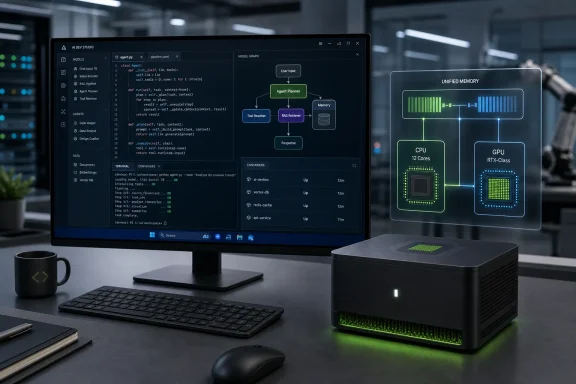
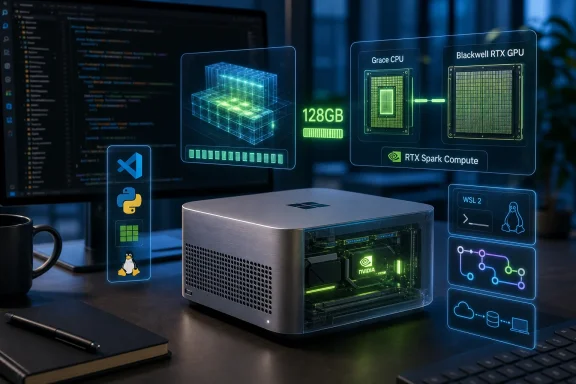
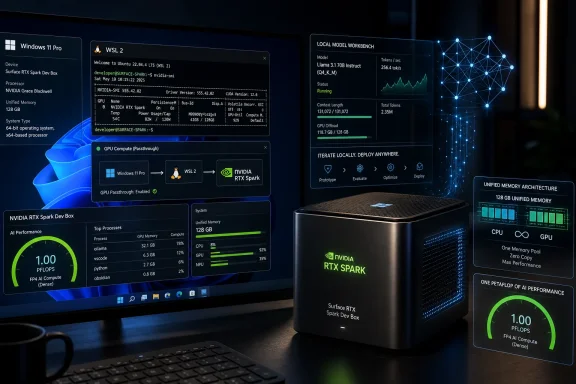
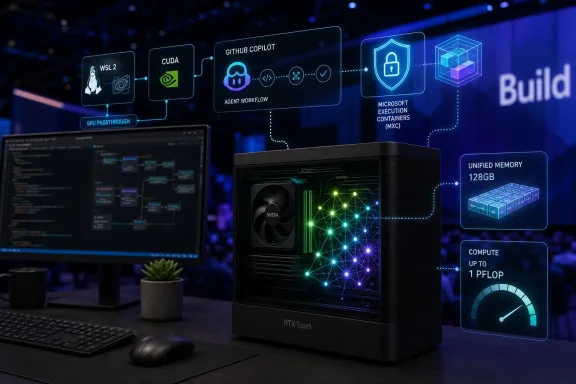
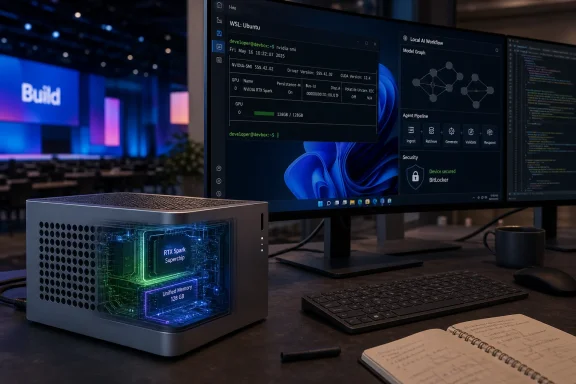
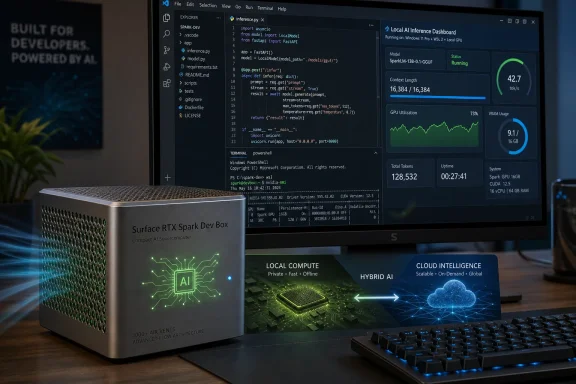
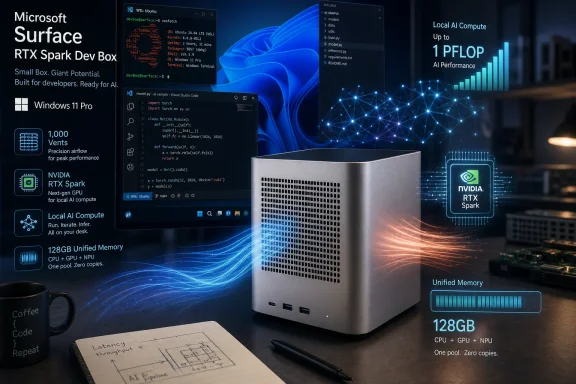
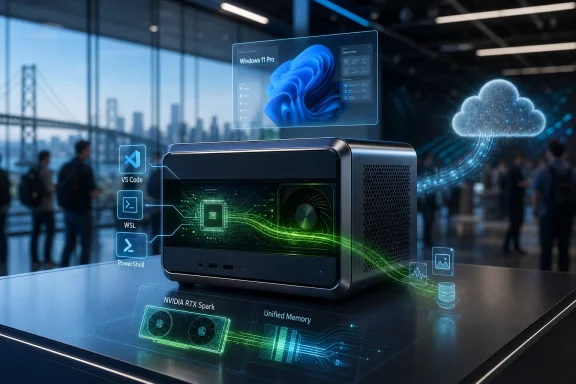
Microsoft announced the Surface RTX Spark Dev Box on June 2, 2026, a compact Windows 11 Pro developer PC for local AI and Arm-native software work, powered by Nvidia’s new RTX Spark platform and due later this year through Microsoft’s online store in the United States. The box matters less as another cute Surface object than as a declaration that Microsoft is tired of waiting for Windows on Arm to become real by accident. After Qualcomm’s canceled Snapdragon Dev Kit left developers without the obvious desktop target they had been promised, Microsoft is now trying to make the developer machine itself part of the argument. The pitch is simple: if Windows is about to become an agentic, local-AI platform, developers need hardware that behaves like the future before consumers are asked to buy into it.
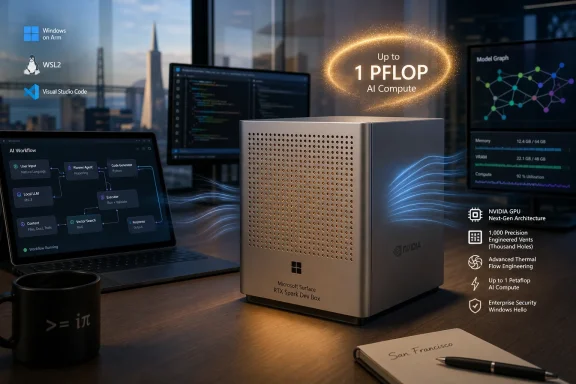
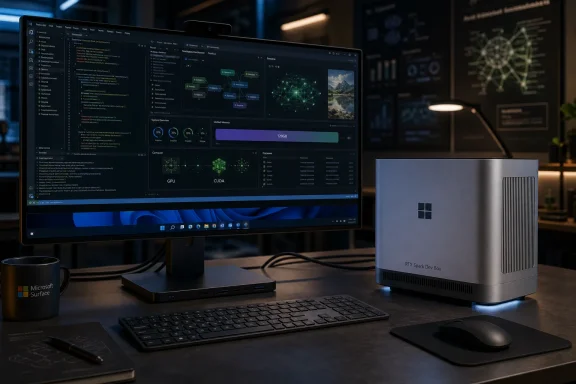
The most important fact about the Surface RTX Spark Dev Box is not its shape, though Microsoft’s small aluminum block inevitably invites comparisons to the top half of an Xbox Series X. It is that Microsoft is positioning it as a serious development target rather than a curiosity. The machine is meant to sit on a desk, run sustained workloads, and give developers a stable Windows-on-Arm environment with Nvidia’s AI and graphics stack close at hand.
That sounds obvious, but Windows on Arm has spent years suffering from a chicken-and-egg problem. Developers have been asked to optimize for a platform that often lacked widely available, compelling desktop hardware. Consumers were then asked to trust an app ecosystem that could not mature without those developers.
Qualcomm tried to address this gap with the Snapdragon Dev Kit, a small Windows on Arm desktop that was supposed to help developers port and test applications. That effort collapsed after delays and reported hardware-quality issues, leaving a visible hole in Microsoft’s platform story. The Surface RTX Spark Dev Box is Microsoft’s answer to that embarrassment, even if the company will not describe it that way.
The timing is not accidental. Microsoft and Nvidia are using Computex and Build week to present RTX Spark as a new Windows PC tier built for local AI agents, creative workloads, and Arm-native performance. The dev box is the least glamorous member of that pitch, but it may be the most strategically useful one.
That distinction matters for AI development. Local inference, model tuning, code-generation agents, image workflows, and test harnesses do not behave like a benchmark loop built for a press deck. They chew through memory, punish thermals, and quickly reveal whether a machine is built for demos or daily work.
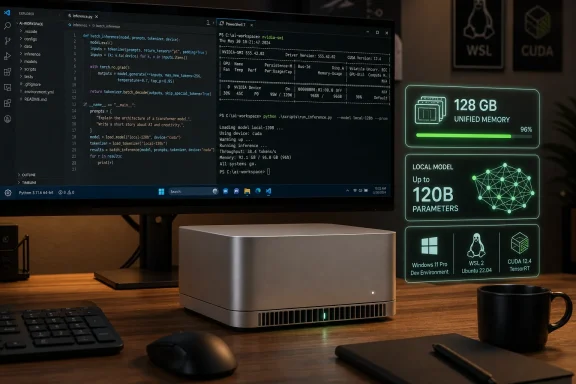
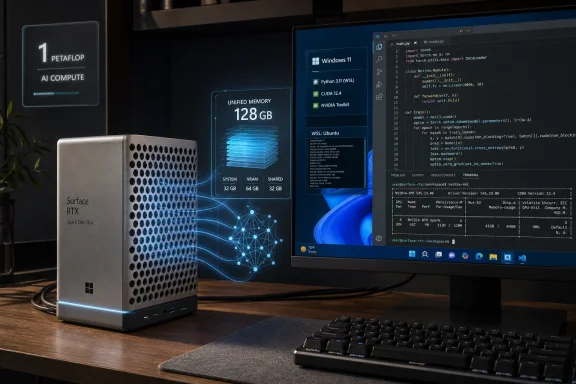
The headline spec is 128GB of unified memory, enough for Microsoft and Nvidia to claim support for running models as large as 120 billion parameters locally. As always, that claim deserves context: model size, quantization, context length, toolchain maturity, and actual latency will decide whether “can run” means “pleasant to use.” Still, the memory pool is large enough to move the conversation away from toy local models and toward serious experimentation.
This is where Microsoft’s Surface branding does real work. Surface devices have always been part product and part argument: a way for Microsoft to show OEMs what it thinks Windows hardware should become. The Surface RTX Spark Dev Box extends that habit into developer infrastructure. It says the future Windows workstation may be small, Arm-based, GPU-heavy, and optimized for local AI before it is optimized for spreadsheet nostalgia.
Qualcomm’s Snapdragon X push made Windows on Arm credible for battery life and general productivity. Nvidia’s entry asks a different question: what if the reason to buy Arm Windows hardware is not just efficiency, but access to a local accelerated AI workstation? That is a much more aggressive story, and it plays directly to developers, creators, and technical users who already understand Nvidia’s software gravity.
CUDA remains one of the most durable moats in modern computing. Microsoft can talk about Windows as a platform for AI, but developers go where their frameworks, libraries, drivers, and debugging paths are least painful. If RTX Spark gives Windows on Arm a first-class Nvidia stack, Microsoft gets a stronger argument than it had with CPU efficiency alone.
There is also a competitive subtext. Apple normalized high-memory unified architectures for creative and AI-adjacent workflows on the Mac. Microsoft and its partners have spent years responding with a mixture of Intel, AMD, Qualcomm, discrete GPUs, NPUs, and cloud services. RTX Spark is a cleaner counterpunch: a Windows machine where the CPU, GPU, memory model, and AI software story are presented as one platform.
That does not guarantee success. Windows on Arm still has to deal with compatibility drag, driver expectations, peripherals, enterprise validation, and the long tail of x86 software. But Nvidia gives Microsoft something it did not previously have in this space: a performance narrative that is not defensive.
That may sound like cosmetic tidying, but it points to a deeper shift. Microsoft is no longer treating the developer workstation as a generic Windows install waiting to be customized. It is treating the developer environment as a curated surface area, closer to how Apple presents Xcode on macOS or how Linux distributions pitch ready-made coding environments.
There is a risk here. Developers are famously allergic to vendor paternalism, and any “preconfigured for developers” machine can quickly become a bundle of assumptions. But Microsoft’s choices are revealing: remove distractions, privilege the shell, turn on developer features, and make AI assistance part of the baseline.
That baseline is also a statement about agentic Windows. Microsoft and Nvidia are not just selling faster local inference; they are preparing for a world where coding assistants, workflow agents, and model-driven tools are ordinary desktop processes. A developer box tuned for that world is a way to make the software ecosystem adapt before the average user ever sees the full experience.
Microsoft could have responded by waiting for OEMs to fill the gap. Instead, it is using Surface to seize the developer narrative. That matters because developer hardware is not simply about unit sales. It is about trust, documentation, reproducibility, and giving software teams a box they can standardize around.
The old Snapdragon Dev Kit story was about porting existing Windows apps to Arm. The Surface RTX Spark Dev Box story is broader and more ambitious: build apps for Arm, build local AI workflows, test Nvidia-accelerated software, and prepare for a version of Windows in which agents are treated as first-class workloads. That is a much bigger ask, but it also gives developers more reason to care.
It also neatly sidesteps one of Qualcomm’s constraints. Qualcomm had to prove that its silicon could carry Windows into a new era. Nvidia arrives with an installed developer mindshare that extends far beyond Windows laptops. If Microsoft can attach Windows on Arm to Nvidia’s AI ecosystem, it changes the emotional center of the platform from compromise to capability.
But local AI is only part of the story. The more consequential issue is whether Windows can become a coherent development platform across CPU architecture, GPU acceleration, AI runtimes, and security boundaries. That is what Microsoft has struggled to make feel inevitable.
The company’s broader RTX Spark messaging emphasizes Windows scheduler work, power and thermal management, app compatibility, Arm-native creative tools, Prism improvements, anti-cheat support, and agent containment primitives. In other words, the silicon announcement is inseparable from OS plumbing. Microsoft knows that a fast chip cannot rescue a platform that feels awkward under real workloads.
The Dev Box exists because developers will test those claims first. They will find the missing packages, the strange driver assumptions, the brittle build scripts, the tools that still expect x86, and the frameworks that behave differently outside the cloud. If Microsoft is serious, the dev box becomes both a product and a feedback trap.
That is where Microsoft’s Windows 11 Pro image and manageability story will matter. Enterprises are not short on AI pilots; they are short on AI pilots that fit cleanly into identity, endpoint management, data-loss prevention, auditability, and procurement rules. A box that runs large local models can be powerful precisely because it keeps data close, but that also means IT needs to know what those models can access and what agents are allowed to do.
Microsoft’s emphasis on OS-enforced identity, containment, and manageability is therefore not just marketing garnish. If agents are going to operate across files, apps, shells, and developer environments, they need boundaries that administrators can understand and enforce. Otherwise, local AI becomes another shadow-IT accelerant.
The hardware may also force organizations to rethink who gets workstation-class resources. In the old model, GPU workstations were for graphics, simulation, ML teams, or specialized engineering roles. In the agentic development model Microsoft is pushing, a broader set of developers may plausibly ask for local acceleration. That shift will make cost, availability, and lifecycle support just as important as raw specs.
Availability is also limited in the initial description. Microsoft says the Surface RTX Spark Dev Box will arrive later this year in the United States through its online store. That is a cautious channel strategy, not a mass-market launch. It suggests Microsoft wants the device in the hands of motivated developers before it tries to turn the category into a broader Surface line.
There are other unknowns. Storage options, ports, networking, serviceability, external display support, Linux and WSL behavior, firmware update cadence, driver delivery, and warranty terms will all shape whether this becomes a practical developer staple or a fascinating niche box. For WindowsForum readers, the port map may be almost as important as the AI claims.
The lack of pricing also makes comparisons difficult. If this lands near traditional mini-PC territory, it could become a compelling Arm and AI development target. If it lands closer to workstation pricing, it will be judged against GPU desktops, Mac Studios, cloud GPU instances, and Nvidia’s own compact AI systems.
The weakest version of the argument is that the industry has been here before. Developers have seen specialized dev kits, AI accelerators, Arm transition boxes, and platform promises arrive with fanfare and then fade into unsupported corners. Windows users in particular have learned to ask whether the third-party ecosystem is truly ready or merely announced.
That skepticism is healthy. The history of Windows on Arm includes genuine progress, but also enough compatibility caveats to make technical buyers cautious. Prism has improved. Native app support is broader. Qualcomm’s latest systems made Arm Windows laptops more credible. But “credible” is not the same as frictionless.
The Surface RTX Spark Dev Box is therefore a test of whether Microsoft can compress years of ecosystem work into a developer object that people actually want to use. If the machine becomes a reliable way to build, test, and optimize for RTX Spark Windows PCs, it will have done its job even if it never becomes a mainstream product.
 Microsoft Finally Builds the Arm Dev Box Windows Needed Two Years Ago
The most important fact about the Surface RTX Spark Dev Box is not its shape, though Microsoft’s small aluminum block inevitably invites comparisons to the top half of an Xbox Series X. It is that Microsoft is positioning it as a serious development target rather than a curiosity. The machine is meant to sit on a desk, run sustained workloads, and give developers a stable Windows-on-Arm environment with Nvidia’s AI and graphics stack close at hand.That sounds obvious, but Windows on Arm has spent years suffering from a chicken-and-egg problem. Developers have been asked to optimize for a platform that often lacked widely available, compelling desktop hardware. Consumers were then asked to trust an app ecosystem that could not mature without those developers.
Qualcomm tried to address this gap with the Snapdragon Dev Kit, a small Windows on Arm desktop that was supposed to help developers port and test applications. That effort collapsed after delays and reported hardware-quality issues, leaving a visible hole in Microsoft’s platform story. The Surface RTX Spark Dev Box is Microsoft’s answer to that embarrassment, even if the company will not describe it that way.
The timing is not accidental. Microsoft and Nvidia are using Computex and Build week to present RTX Spark as a new Windows PC tier built for local AI agents, creative workloads, and Arm-native performance. The dev box is the least glamorous member of that pitch, but it may be the most strategically useful one.
The Chassis Is Small Because the Bet Is Big
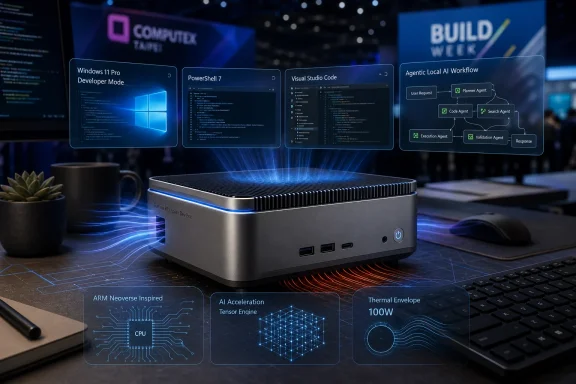
Microsoft says the Surface RTX Spark Dev Box uses an aluminum chassis that doubles as a heatsink, with a thermal envelope of 100 watts. That puts it above the 45-to-80-watt range associated with RTX Spark laptops and makes clear that this is not just a laptop motherboard stuffed into a novelty enclosure. It is designed for workloads that run long enough to expose the difference between burst performance and actual sustained throughput.That distinction matters for AI development. Local inference, model tuning, code-generation agents, image workflows, and test harnesses do not behave like a benchmark loop built for a press deck. They chew through memory, punish thermals, and quickly reveal whether a machine is built for demos or daily work.
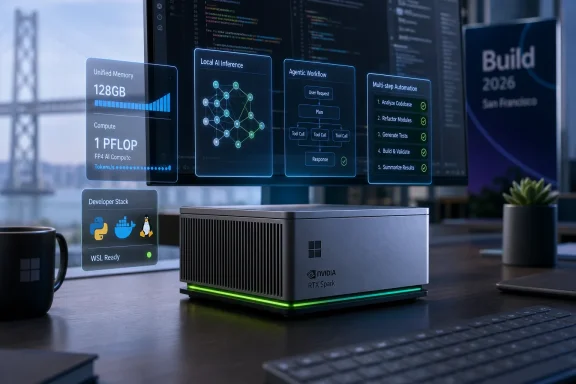
The headline spec is 128GB of unified memory, enough for Microsoft and Nvidia to claim support for running models as large as 120 billion parameters locally. As always, that claim deserves context: model size, quantization, context length, toolchain maturity, and actual latency will decide whether “can run” means “pleasant to use.” Still, the memory pool is large enough to move the conversation away from toy local models and toward serious experimentation.
This is where Microsoft’s Surface branding does real work. Surface devices have always been part product and part argument: a way for Microsoft to show OEMs what it thinks Windows hardware should become. The Surface RTX Spark Dev Box extends that habit into developer infrastructure. It says the future Windows workstation may be small, Arm-based, GPU-heavy, and optimized for local AI before it is optimized for spreadsheet nostalgia.
Nvidia’s PC Ambition Changes the Windows on Arm Equation
The RTX Spark platform is not merely another Arm chip entering the Windows ecosystem. Nvidia is bringing an Arm-based Grace CPU design, Blackwell-generation graphics, CUDA, RTX technologies, TensorRT, and a large unified memory architecture into a class of Windows machines that includes laptops and compact desktops. That package changes the political economy of Windows on Arm.Qualcomm’s Snapdragon X push made Windows on Arm credible for battery life and general productivity. Nvidia’s entry asks a different question: what if the reason to buy Arm Windows hardware is not just efficiency, but access to a local accelerated AI workstation? That is a much more aggressive story, and it plays directly to developers, creators, and technical users who already understand Nvidia’s software gravity.
CUDA remains one of the most durable moats in modern computing. Microsoft can talk about Windows as a platform for AI, but developers go where their frameworks, libraries, drivers, and debugging paths are least painful. If RTX Spark gives Windows on Arm a first-class Nvidia stack, Microsoft gets a stronger argument than it had with CPU efficiency alone.
There is also a competitive subtext. Apple normalized high-memory unified architectures for creative and AI-adjacent workflows on the Mac. Microsoft and its partners have spent years responding with a mixture of Intel, AMD, Qualcomm, discrete GPUs, NPUs, and cloud services. RTX Spark is a cleaner counterpunch: a Windows machine where the CPU, GPU, memory model, and AI software story are presented as one platform.
That does not guarantee success. Windows on Arm still has to deal with compatibility drag, driver expectations, peripherals, enterprise validation, and the long tail of x86 software. But Nvidia gives Microsoft something it did not previously have in this space: a performance narrative that is not defensive.
The Developer Image Is the Product Strategy in Miniature
Microsoft’s description of the Dev Box software image is unusually specific. Windows 11 Pro ships preconfigured for developers, with dark theme enabled, the taskbar simplified, Widgets removed, Do Not Disturb turned on, Developer Mode enabled, and PowerShell 7 set as the default shell. Visual Studio Code, GitHub Copilot, and other tools are part of the out-of-box positioning.That may sound like cosmetic tidying, but it points to a deeper shift. Microsoft is no longer treating the developer workstation as a generic Windows install waiting to be customized. It is treating the developer environment as a curated surface area, closer to how Apple presents Xcode on macOS or how Linux distributions pitch ready-made coding environments.
There is a risk here. Developers are famously allergic to vendor paternalism, and any “preconfigured for developers” machine can quickly become a bundle of assumptions. But Microsoft’s choices are revealing: remove distractions, privilege the shell, turn on developer features, and make AI assistance part of the baseline.
That baseline is also a statement about agentic Windows. Microsoft and Nvidia are not just selling faster local inference; they are preparing for a world where coding assistants, workflow agents, and model-driven tools are ordinary desktop processes. A developer box tuned for that world is a way to make the software ecosystem adapt before the average user ever sees the full experience.
Qualcomm’s Failure Became Microsoft’s Opening
The shadow hanging over this announcement is Qualcomm’s canceled Snapdragon Dev Kit. That machine was supposed to be the obvious low-cost, low-friction desktop for Windows on Arm development. Instead, it became a cautionary tale about how hard it is to build confidence in a platform when the basic hardware pipeline stumbles.Microsoft could have responded by waiting for OEMs to fill the gap. Instead, it is using Surface to seize the developer narrative. That matters because developer hardware is not simply about unit sales. It is about trust, documentation, reproducibility, and giving software teams a box they can standardize around.
The old Snapdragon Dev Kit story was about porting existing Windows apps to Arm. The Surface RTX Spark Dev Box story is broader and more ambitious: build apps for Arm, build local AI workflows, test Nvidia-accelerated software, and prepare for a version of Windows in which agents are treated as first-class workloads. That is a much bigger ask, but it also gives developers more reason to care.
It also neatly sidesteps one of Qualcomm’s constraints. Qualcomm had to prove that its silicon could carry Windows into a new era. Nvidia arrives with an installed developer mindshare that extends far beyond Windows laptops. If Microsoft can attach Windows on Arm to Nvidia’s AI ecosystem, it changes the emotional center of the platform from compromise to capability.
Local AI Is the Justification, Not the Whole Story
Microsoft and Nvidia are framing RTX Spark around local AI, and that framing is understandable. A compact box with 128GB of unified memory and enough AI performance to run very large models locally is far easier to explain in 2026 than a generic Arm developer machine. The phrase “local AI” also solves several anxieties at once: latency, privacy, cloud cost, and developer iteration speed.But local AI is only part of the story. The more consequential issue is whether Windows can become a coherent development platform across CPU architecture, GPU acceleration, AI runtimes, and security boundaries. That is what Microsoft has struggled to make feel inevitable.
The company’s broader RTX Spark messaging emphasizes Windows scheduler work, power and thermal management, app compatibility, Arm-native creative tools, Prism improvements, anti-cheat support, and agent containment primitives. In other words, the silicon announcement is inseparable from OS plumbing. Microsoft knows that a fast chip cannot rescue a platform that feels awkward under real workloads.
The Dev Box exists because developers will test those claims first. They will find the missing packages, the strange driver assumptions, the brittle build scripts, the tools that still expect x86, and the frameworks that behave differently outside the cloud. If Microsoft is serious, the dev box becomes both a product and a feedback trap.
Enterprise IT Will See Promise and a Procurement Headache
For sysadmins and enterprise architects, the Surface RTX Spark Dev Box is intriguing but not automatically easy to adopt. A compact local AI workstation could help teams prototype privately, test agents against sensitive internal workflows, or reduce dependence on metered cloud experimentation. It could also create a new class of endpoint that looks like a developer workstation, a GPU node, and a compliance question at the same time.That is where Microsoft’s Windows 11 Pro image and manageability story will matter. Enterprises are not short on AI pilots; they are short on AI pilots that fit cleanly into identity, endpoint management, data-loss prevention, auditability, and procurement rules. A box that runs large local models can be powerful precisely because it keeps data close, but that also means IT needs to know what those models can access and what agents are allowed to do.
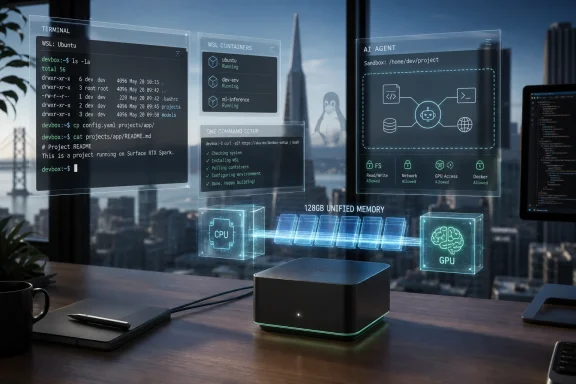
Microsoft’s emphasis on OS-enforced identity, containment, and manageability is therefore not just marketing garnish. If agents are going to operate across files, apps, shells, and developer environments, they need boundaries that administrators can understand and enforce. Otherwise, local AI becomes another shadow-IT accelerant.
The hardware may also force organizations to rethink who gets workstation-class resources. In the old model, GPU workstations were for graphics, simulation, ML teams, or specialized engineering roles. In the agentic development model Microsoft is pushing, a broader set of developers may plausibly ask for local acceleration. That shift will make cost, availability, and lifecycle support just as important as raw specs.
The Missing Price Tag Keeps the Hype in Check
Microsoft has not disclosed full specifications or pricing, and that omission matters. A miniature AI dev box can be a platform catalyst at one price and a boutique trophy at another. Developers may admire the idea, but organizations buy fleets according to budgets, support contracts, replacement cycles, and the dull arithmetic of ROI.Availability is also limited in the initial description. Microsoft says the Surface RTX Spark Dev Box will arrive later this year in the United States through its online store. That is a cautious channel strategy, not a mass-market launch. It suggests Microsoft wants the device in the hands of motivated developers before it tries to turn the category into a broader Surface line.
There are other unknowns. Storage options, ports, networking, serviceability, external display support, Linux and WSL behavior, firmware update cadence, driver delivery, and warranty terms will all shape whether this becomes a practical developer staple or a fascinating niche box. For WindowsForum readers, the port map may be almost as important as the AI claims.
The lack of pricing also makes comparisons difficult. If this lands near traditional mini-PC territory, it could become a compelling Arm and AI development target. If it lands closer to workstation pricing, it will be judged against GPU desktops, Mac Studios, cloud GPU instances, and Nvidia’s own compact AI systems.
Microsoft Is Selling a Future Windows Has Not Fully Earned Yet
The strongest version of Microsoft’s argument is that Windows needs local AI hardware to evolve beyond being a cloud-connected shell. If agents are going to summarize, code, search, manipulate apps, reason over local context, and preserve privacy, then endpoint hardware has to become more capable. RTX Spark gives Microsoft a way to say that the PC itself is still the center of gravity.The weakest version of the argument is that the industry has been here before. Developers have seen specialized dev kits, AI accelerators, Arm transition boxes, and platform promises arrive with fanfare and then fade into unsupported corners. Windows users in particular have learned to ask whether the third-party ecosystem is truly ready or merely announced.
That skepticism is healthy. The history of Windows on Arm includes genuine progress, but also enough compatibility caveats to make technical buyers cautious. Prism has improved. Native app support is broader. Qualcomm’s latest systems made Arm Windows laptops more credible. But “credible” is not the same as frictionless.
The Surface RTX Spark Dev Box is therefore a test of whether Microsoft can compress years of ecosystem work into a developer object that people actually want to use. If the machine becomes a reliable way to build, test, and optimize for RTX Spark Windows PCs, it will have done its job even if it never becomes a mainstream product.
The Surface Box Turns Microsoft’s AI Pitch Into Something Developers Can Touch
The practical read is that Microsoft is moving from platform rhetoric to platform provisioning. The Surface RTX Spark Dev Box gives developers a concrete target for the next phase of Windows on Arm, but it also exposes Microsoft to a simple test: whether the experience is good enough to make the ecosystem follow.- Microsoft is using Surface to replace the developer-hardware role Qualcomm failed to fill with the canceled Snapdragon Dev Kit.
- The 100-watt thermal envelope suggests Microsoft wants sustained desktop workloads, not merely laptop-class burst performance in a smaller shell.
- The 128GB unified memory configuration is the machine’s real differentiator because it makes large local AI experimentation plausible on a desk.
- The preconfigured Windows 11 Pro developer image shows Microsoft treating the development environment itself as part of the product.
- The unanswered questions around price, ports, storage, serviceability, and global availability will decide whether this is a useful platform tool or a premium niche device.
- The box’s success will depend less on its industrial design than on whether Windows on Arm, Nvidia’s stack, and Microsoft’s agent security model work cleanly under real developer pressure.
References
- Primary source: The Verge
Published: 2026-06-02T16:30:06.514399
Microsoft created the mini Surface dev box that Qualcomm couldn’t | The Verge
The Surface RTX Spark Dev Box is designed for local-first AI development.www.theverge.com
- Independent coverage: Tom's Hardware
Published: Tue, 02 Jun 2026 16:47:17 GMT
Microsoft debuts Surface RTX Spark Dev Box — Nvidia-powered mini-PC helps devs get ready for an agentic Windows | Tom's Hardware
It will have Visual Studio Code and GitHub Copilot preinstalled.www.tomshardware.com - Independent coverage: Engadget
Published: Tue, 02 Jun 2026 16:45:24 GMT
Microsoft's Surface RTX Spark Dev Box Will Handle Tougher AI Workloads
Microsoft is making a Surface AI dev desktop for people who don't want a laptop.www.engadget.com - Independent coverage: Windows Blog
Published: Tue, 02 Jun 2026 16:41:15 GMT
Building the next generation of devices for developers: Surface RTX Spark Dev Box
Software developers are some of the most ambitious makers we serve. They push devices harder, ask more of their tools and expect their environment to help define the pace of modern software creation. Development today means longer runninblogs.windows.com - Independent coverage: Let's Data Science
Published: Tue, 02 Jun 2026 16:34:42 GMT
Microsoft unveils Surface RTX Spark Dev Box for local AI | Let's Data Science
Microsoft has unveiled the Surface RTX Spark Dev Box, a compact desktop aimed at local-first AI development, according to Microsoft's devices blog and coverage from Tom's Hardware, VentureBeat, and TechSpot. The machine is built on Nvidia's RTX Spark superchip, which pairs a... letsdatascience.com
- Related coverage: windowscentral.com
Surface Laptop Ultra: Microsoft and NVIDIA reveal the 128GB RAM, mini‑LED, RTX Spark powerhouse redefining Windows on Arm | Windows Central
Uncompromising raw NVIDIA N1x power meets legendary Surface craft, but can people afford it?www.windowscentral.com
- Related coverage: pcgamer.com
Developers are creating Arm game ports, wholly Arm-native versions, and Prism-optimised updates for Nvidia's RTX Spark | PC Gamer
Nvidia's gaming relationships could push Arm gaming into the mainstream.www.pcgamer.com - Related coverage: arstechnica.com
Nvidia RTX Spark comes to Windows PCs with Arm CPU, RTX GPU, and unified memory - Ars Technica
Nvidia's new chips will power laptop workstations and mini desktop PCs at first.arstechnica.com - Related coverage: investor.nvidia.com
NVIDIA Corporation - NVIDIA and Microsoft Reinvent Windows PCs for the Age of Personal AI
RTX Spark — a 1-Petaflop Superchip, the Full CUDA and RTX Ecosystem, and Windows-Native Agents — a New Beginning for Personal Computers News Summary: NVIDIA RTX Spark powers the world’s first Windows PCs purpose-built for personal agents, featuring 1 petaflop of AI performance, industry-leading...investor.nvidia.com - Related coverage: axios.com
Microsoft debuts Nvidia-powered Microsoft Surface Ultra laptop
Microsoft is trying again to redefine the PC for the AI era.www.axios.com
- Related coverage: gadgetsnow.indiatimes.com
Microsoft Surface Laptop Ultra Debuts With NVIDIA RTX Spark And 128GB Unified Memory
gadgetsnow.indiatimes.com
- Related coverage: winbuzzer.com
Microsoft Unveils Surface Laptop Ultra With Nvidia RTX Spark Superchip
Microsoft has unveiled Surface Laptop Ultra with Nvidia RTX Spark, bringing up to 128GB RAM and local AI power to its flagship Windows on ARM laptops. winbuzzer.com
- Related coverage: techtickerblog.com
Nvidia introduces RTX Spark AI Superchip for Windows PCs | Tech Ticker
Nvidia and Microsoft have announced a partnership to launch Nvidia RTX Spark, a new superchip architecture designed to power local AI personal agents natively on Windows PCs. Unveiled at Computex 2026, the hardware platform combines Nvidia's graphics and AI computing ecosystem with new...techtickerblog.com - Related coverage: techtimes.com
Nvidia RTX Spark Superchip: Windows PC Chip With Full CUDA Stack Targets Dell, Microsoft This Fall
Nvidia RTX Spark Superchip launched at Computex 2026 as Nvidia’s first Windows PC processor, co-developed with Microsoft, pairing a Blackwell GPU with 6,144 CUDA cores and 128 GB unified memory in awww.techtimes.com - Related coverage: kucoin.com
Nvidia Launches RTX Spark AI Chip for PCs, Supports 120 Billion Parameter Models | KuCoin
Nvidia just did something it has never done before: build a complete chip for personal computers. The company that became the most valuable in the world by sellwww.kucoin.com - Official source: news.microsoft.com
- Related coverage: business-standard.com
Microsoft Build 2026: Microsoft may debut first reasoning-focused AI model and more at Build 2026
Microsoft Build 2026: Microsoft is reportedly preparing a range of AI and Windows-related announcements at Build 2026, including new models, developer tools, and RTX Spark integrationswww.business-standard.com - Related coverage: signal65.com
- Related coverage: docs.nvidia.com
- Related coverage: nvidianews.nvidia.com