

Synopsys has rolled out a cloud‑native, simulation‑driven framework that promises to bring high‑fidelity computational fluid dynamics (CFD) and factory‑scale digital twins into the operational tempo of the shop floor — a multi‑vendor architecture demonstrated with bottling‑line specialist Krones and showcased at Microsoft Ignite.
Manufacturing has long lived with a tension: engineering relies on time‑consuming, high‑fidelity simulations to understand fluid, thermal and mechanical behavior, while operations must make near‑term decisions on the factory floor. Turning CFD from an offline design tool into an online operational instrument can reduce waste, shorten changeover times and accelerate troubleshooting. The framework Synopsys unveiled stitches together four proven vectors — GPU‑native CFD, accelerated solver orchestration, OpenUSD/Omniverse visualization, and Azure cloud HPC — to close that gap.
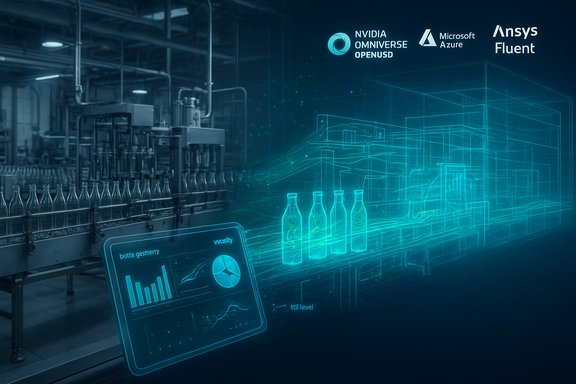
The public demonstration models entire bottle‑filling assembly lines as a physically accurate digital twin so teams can sweep parameters (bottle geometry, liquid viscosity, fill level, timing) and compare scenarios visually and numerically without interrupting live operations. Partners named in the rollout include Ansys (Fluent) for CFD, NVIDIA Omniverse / OpenUSD for scene composition and visualization, Microsoft Azure (including Ansys Access on Azure) for scalable GPU compute and orchestration, and specialist integrators CADFEM Germany and SoftServe for solver tuning and systems integration.
However, an independently published integrator case study for the Krones deployment (SoftServe’s fielded example) reports simulations running at roughly 30 minutes per cycle after a two‑month integration and solver tuning exercise. That figure is materially different from the sub‑5‑minute headline and is an important operational datapoint because it represents a reproducible, fielded outcome.
But the gulf between the headline “less than 5 minutes” claim and the integrator‑documented ~30‑minute field results is material for procurement and operational planning. Until vendors publish reproducible runbooks specifying mesh sizes, solver flags, GPU SKUs/counts, and whether reduced‑order models were used, treat the five‑minute figure as an aspirational target rather than a guaranteed production SLA. Require auditable benchmarks, clear fidelity error budgets and robust governance before allowing simulation outputs to drive automated actions on the plant floor.
The Synopsys announcement signals a turning point: the vendor ecosystem has marshalled the technical building blocks to make near‑real‑time, simulation‑driven manufacturing plausible. The next phase will be about repeatable engineering, trustworthy benchmarks, and disciplined operationalization — the hard work that turns demonstrations into dependable, plant‑floor capabilities.
Source: New Electronics Synopsys unveils real-time manufacturing optimisation with Digital Twin technology - New Electronics
 Background
Manufacturing has long lived with a tension: engineering relies on time‑consuming, high‑fidelity simulations to understand fluid, thermal and mechanical behavior, while operations must make near‑term decisions on the factory floor. Turning CFD from an offline design tool into an online operational instrument can reduce waste, shorten changeover times and accelerate troubleshooting. The framework Synopsys unveiled stitches together four proven vectors — GPU‑native CFD, accelerated solver orchestration, OpenUSD/Omniverse visualization, and Azure cloud HPC — to close that gap.The public demonstration models entire bottle‑filling assembly lines as a physically accurate digital twin so teams can sweep parameters (bottle geometry, liquid viscosity, fill level, timing) and compare scenarios visually and numerically without interrupting live operations. Partners named in the rollout include Ansys (Fluent) for CFD, NVIDIA Omniverse / OpenUSD for scene composition and visualization, Microsoft Azure (including Ansys Access on Azure) for scalable GPU compute and orchestration, and specialist integrators CADFEM Germany and SoftServe for solver tuning and systems integration.
What Synopsys and partners delivered — the Krones use case
The delivered capability, in practical terms
- A factory‑scale digital twin of a bottling/filling line where bottle shape, liquid properties and production timing can be parameterized.
- A scenario engine that sweeps parameter sets, dispatches GPU‑accelerated solver jobs, collects results and streams both analytics and 3D visualizations into an Omniverse scene for side‑by‑side comparison.
- A productionized pipeline combining Ansys Fluent (GPU‑enabled solver), Synopsys’ accelerated physics orchestration, NVIDIA Omniverse/OpenUSD for interoperability and rendering, and Azure for elastic GPU clusters and orchestration.
Who did what
- Synopsys positioned the accelerated physics/orchestration layer that manages solver workflows and integrates results into higher‑level pipelines.
- Ansys Fluent supplies the CFD backbone and recent GPU solver advancements that make GPU‑native runs feasible.
- NVIDIA Omniverse/OpenUSD supplies the neutral scene format and real‑time rendering and collaboration runtime so CAE outputs appear in a factory context.
- Microsoft Azure hosts the elastic GPU infrastructure and Ansys Access on Azure for simplified deployment and governance.
- CADFEM provided solver tuning and domain expertise. SoftServe implemented integration, delivery automation and the dashboarding used in the Krones pilot.
Why the Krones pilot matters
Krones’ deployment is the earliest public, fielded example of this exact stack. It demonstrates that the individual technologies — GPU‑accelerated CFD, OpenUSD interoperability and cloud HPC orchestration — can be combined into a deliverable solution for a production environment. The case shows how digital twins can be used not just for design or predictive maintenance, but for near‑operational decisioning across engineering and operations teams.Technical architecture — how the pieces fit
GPU‑native CFD: Ansys Fluent and solver considerations
At the core is Ansys Fluent configured for GPU acceleration and multi‑GPU scaling. Fluent’s GPU paths are production features intended to accelerate many classes of CFD workloads and have matured significantly in recent releases. That said, GPU speedups are highly case dependent: mesh size, multiphase physics, turbulence models and discrete particle methods can all influence how much of the solver benefits from GPU kernels. Achieving extreme wall‑clock reductions frequently requires careful solver flag choices, memory‑aware meshing and multi‑GPU topologies.Accelerated physics and orchestration
Synopsys describes an accelerated physics orchestration layer that schedules and optimizes solver runs across cloud GPU fleets, collects outputs and feeds them to the scenario engine. This orchestration is necessary to reduce job dispatch overhead, manage container spin‑up, and coordinate multi‑GPU jobs — all practical elements that influence end‑to‑end latency beyond raw solver performance.Visualization and interoperability: OpenUSD + Omniverse
Using OpenUSD (Universal Scene Description) as the canonical scene format allows CAD, CAE, MES and telemetry to be composed into a single digital twin. NVIDIA Omniverse provides the runtime for photoreal visualization, collaborative review and streaming of simulation overlays into an operator UI. This design lowers friction between engineering and operations by presenting CFD results in the context of conveyors, PLC telemetry and factory geometry.Cloud HPC and deployment: Microsoft Azure + Ansys Access
Azure supplies the elastic compute, autoscaling clusters and enterprise controls needed for production deployments. Ansys Access on Azure provides preconfigured Ansys images and management tooling to simplify cloud HPC deployment and governance. The choice of Azure also enables integration with enterprise identity, encryption and policy controls required for production plants.Performance claims — what was announced and what was observed
Synopsys’ announcement and many press syndications featured a headline claim: reduction of typical CFD runtimes “from 3–4 hours to less than 5 minutes.” That claim underpins the narrative that digital‑twin, minute‑scale simulations are now practical for factory decisioning.However, an independently published integrator case study for the Krones deployment (SoftServe’s fielded example) reports simulations running at roughly 30 minutes per cycle after a two‑month integration and solver tuning exercise. That figure is materially different from the sub‑5‑minute headline and is an important operational datapoint because it represents a reproducible, fielded outcome.
Why the numbers diverge (technical primer)
The achievable wall‑clock time for CFD depends on several non‑linear factors:- Mesh density and cell counts: run time often scales non‑linearly with mesh size; production‑grade multiphase meshes are expensive to solve.
- Physics fidelity: detailed multiphase and turbulence models cost more CPU/GPU time than simplified models or surrogate approximations.
- Solver feature support on GPUs: not every Fluent module or advanced model is equally GPU‑accelerated; some paths remain CPU‑bound.
- Compute footprint and topology: sub‑5‑minute runs often require high‑end multi‑GPU instances (H100/A100/MI300 class), fast NVMe storage and a topology that minimizes inter‑GPU bottlenecks.
- Use of reduced‑order models or AI surrogates: extreme speedups may rely on surrogate models that trade fidelity for latency; these need separate validation vs. full CFD.
Benefits that are practically achievable today
When the architecture is executed correctly and fidelity is preserved, the measurable benefits are compelling:- Faster, data‑driven decisions: side‑by‑side scenario comparisons enable engineers and operators to agree on parameter changes within a single shift cadence.
- Reduced waste and improved yield: validated adjustments to valve timing, fill levels and conveyor speeds reduce overfill/underfill scrap.
- Accelerated cross‑discipline collaboration: OpenUSD/Omniverse scenes present unified views for engineering, operations and R&D, shortening feedback cycles.
- Scalable compute model: Azure orchestration lets teams burst GPU capacity for periodic sweeps instead of requiring large on‑prem HPC investments.
Risks, caveats and vendor diligence
Fidelity vs. speed tradeoffs
Faster runs can mean simplified physics or surrogate models. Organizations must request error budgets and confidence intervals that quantify the difference between accelerated outputs and full‑fidelity CFD solutions. Without that, automated actions based solely on a fast simulation risk operational mistakes.Cloud cost and run‑rate economics
Running minute‑scale or frequent tens‑of‑minutes‑scale CFD across multiple lines requires sustained GPU hours and high‑performance storage. Procurement decisions must model ongoing cloud costs (compute, storage, egress), not just one‑time integration fees.Security and IP governance
Shipping detailed machine geometry, toolchain data and process recipes to the cloud raises intellectual property and regulatory concerns. Enterprises must insist on tenant isolation, end‑to‑end encryption, strong identity controls and supply‑chain attestations.Operational safety and automation governance
Any production control action driven by a simulation must pass through safety interlocks, human‑in‑the‑loop sign‑offs and rollback thresholds. Simulations should provide advisories, not automatic commands, until proven and audited.Marketing vs. fielded metrics
As the Krones example shows, vendor PR can differ from integrator‑documented results. Require auditable, reproducible benchmarks that specify the exact runbook used to produce headline numbers: mesh sizes, solver flags, GPU SKUs and counts, convergence criteria, and any surrogate model descriptions.Practical pilot checklist (how to evaluate the framework in your plant)
- Define 2–3 clear KPIs (waste reduction percentage, throughput gain, mean time to changeover) tied to simulation outputs.
- Scope a bounded pilot: one filling line, limited parameter sweep (e.g., 3 bottle geometries × 2 viscosity profiles).
- Require the integrator’s runbook: mesh size/cell counts, solver flags, turbulence/multiphase models, GPU type and count, storage topology and measured time‑to‑solution. Demand this in writing.
- Run side‑by‑side validations: full‑fidelity Fluent runs vs. the accelerated pipeline vs. any surrogate outputs; quantify differences and present error bounds.
- Produce a cost model: per‑cycle compute cost at required cadence, storage and data egress, platform engineering and runbook maintenance. Include sensitivity analysis for scale.
- Define governance: human sign‑off thresholds, automatic rollback rules for any PLC/actuator changes, and policy for who can authorize automated recommendations.
- Insist on a contract clause for reproducible benchmark demonstrations before acceptance and for periodic re‑validation if models or code paths change.
Procurement and contracting guidance
- Ask for partner specializations and Partner Center evidence when vendors claim ecosystem credentials; validate partner IDs and specializations.
- Require an auditable benchmark and a runbook as part of the Statement of Work (SoW). If vendors advertise “under 5 minutes,” require the exact lab steps and hardware profile used to produce that number.
- Negotiate cost‑sharing or trial credit for cloud GPU hours during pilot phases to validate sustained economics.
- Define IP and data governance in the contract (who stores meshes, telemetry retention, encryption at rest/in transit, code provenance).
Strategic implications — where this could lead the industry
If reproducible, minutes‑scale high‑quality CFD becomes routine, simulation moves from retrospective engineering to active operational control. That unlocks:- Continuous improvement loops where the digital twin learns from telemetry and proposes immediate optimizations.
- Democratization of simulation: validated surrogates and operator‑facing UIs could enable non‑CAE staff to run scenario tests safely.
- Verticalized simulation‑as‑service offerings in industries where fluid/thermal behavior matters (food & beverage, pharmaceuticals, chemicals, semiconductors).
Final assessment
Synopsys’ framework is a credible, well‑architected blueprint that unites mature pieces — Ansys Fluent GPU solvers, NVIDIA Omniverse/OpenUSD interoperability, and Microsoft Azure cloud orchestration — into a compelling approach for bringing simulation into factory decision loops. The Krones pilot and SoftServe’s documented results show the concept works and yields operational benefits: faster iteration, lower waste and better collaboration.But the gulf between the headline “less than 5 minutes” claim and the integrator‑documented ~30‑minute field results is material for procurement and operational planning. Until vendors publish reproducible runbooks specifying mesh sizes, solver flags, GPU SKUs/counts, and whether reduced‑order models were used, treat the five‑minute figure as an aspirational target rather than a guaranteed production SLA. Require auditable benchmarks, clear fidelity error budgets and robust governance before allowing simulation outputs to drive automated actions on the plant floor.
The Synopsys announcement signals a turning point: the vendor ecosystem has marshalled the technical building blocks to make near‑real‑time, simulation‑driven manufacturing plausible. The next phase will be about repeatable engineering, trustworthy benchmarks, and disciplined operationalization — the hard work that turns demonstrations into dependable, plant‑floor capabilities.
Source: New Electronics Synopsys unveils real-time manufacturing optimisation with Digital Twin technology - New Electronics
