

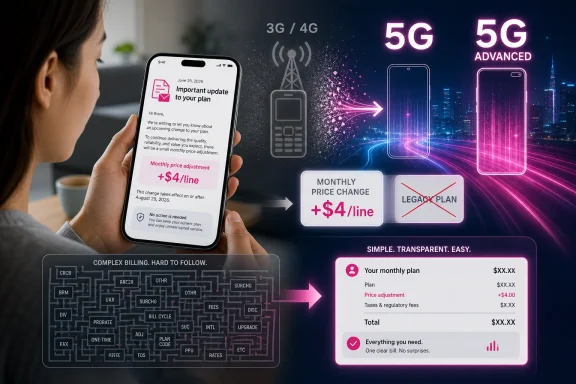
T-Mobile is notifying some U.S. wireless customers on older 3G- and 4G-era rate plans on June 29, 2026, that their plans are being retired and that they will be moved to newer 5G-oriented plans, with some customers facing price increases of about $4 per line. The company’s public argument is that legacy billing and network restrictions are preventing customers from getting the full benefit of its current 5G and emerging 5G Advanced network. The practical effect is simpler: T-Mobile is ending a long-running bargain with its most stubborn, price-sensitive customers. The carrier that built a decade of goodwill by telling subscribers they could keep the deal they liked is now saying the network has outgrown that promise.
The most important part of T-Mobile’s move is not the extra $4 per line some customers will see. It is the company’s decision to treat old rate plans as a technical liability rather than a customer choice.
That framing matters because T-Mobile is not merely nudging subscribers toward newer options with better perks. According to the company’s own description, the affected plans are being retired. Customers may be able to discuss alternative modern plans with customer service, but the old plan itself is not coming back.
T-Mobile’s Chief Marketing Officer Allan Samson has presented the migration as a necessary modernization step. Some customers, he said, are on plans so old that they cannot experience the full capabilities of T-Mobile’s 5G and 5G Advanced network. The pitch is that everyone affected will get more: better streaming, more hotspot data, broader international features, and fewer invisible restrictions between the device in their hand and the network T-Mobile wants to sell.
That may be true in a narrow product-management sense. A 15-year-old plan can carry all kinds of provisioning baggage, and wireless plans have always been more than marketing names. They are bundles of network permissions, throttling rules, roaming allowances, hotspot limits, video policies, promotional hooks, taxes-and-fees treatment, and customer-care scripts. A carrier’s billing system is not a brochure; it is a maze of codes with consequences.
But T-Mobile’s problem is that customers do not experience that maze as technical debt. They experience it as their bill.
That identity had real value. It helped T-Mobile punch above its spectrum position before the Sprint merger and helped turn its network improvement story into a brand story. Customers who stuck with older Simple Choice, ONE, Magenta, Sprint-era, or other legacy variants often did so not because they misunderstood new plans, but because they understood their own plans very well.
For those customers, an old plan is not a museum piece. It is the result of years of discounts, line promos, taxes-included pricing, international habits, streaming add-ons, and family math. A newer plan may include more nominal benefits, but the household calculation is rarely clean. The plan that looks “better” in a comparison table may be worse for a family that does not need more hotspot data, does not travel internationally, and mainly wants the monthly charge to stay predictable.
That is why the word retired lands differently from upgraded. T-Mobile can argue that it is retiring outdated rate-plan codes. Customers will hear that the company is retiring a deal.
Samson’s explanation acknowledges the tension without resolving it. T-Mobile long cultivated the idea that only the customer changed the rate plan. Now the company is saying some plans are too old and too restricted to keep alive. That may be contractually defensible in many cases, but consumer trust is not litigated in footnotes.
A $4-per-line increase may sound modest in isolation. On a four-line family account, it is $16 a month, or $192 a year, before considering tax treatment, perk changes, lost discounts, or plan-specific quirks. For a customer who deliberately stayed on an old plan to avoid creeping wireless costs, that is not a rounding error. It is the exact thing T-Mobile trained them to believe it would not do.
The company’s strongest defense is that a “very big portion” of affected customers will not see a price increase. That helps, but it does not solve the reputational problem. If a migration is mandatory, the central issue is control. A no-increase forced move still tells customers that the carrier, not the subscriber, ultimately owns the plan relationship.
From that angle, legacy-plan cleanup is rational. T-Mobile says it has roughly 1,100 product and rate-plan codes in its billing systems, and that this effort will cut the number to fewer than 100. That is a major simplification. Every new app feature, promotion, upgrade path, or network capability becomes harder to deploy when it must be tested against a sprawling back catalog of inherited plan logic.
There is also a Sprint-merger shadow here. T-Mobile did not merely grow organically; it absorbed a rival with its own billing history, customer promises, plan names, device financing structures, and provisioning assumptions. The company’s internal desire to compress all that into a cleaner catalog is understandable. Technical complexity has a cost, and eventually that cost shows up in product delays, customer-service mistakes, and inconsistent eligibility rules.
Still, the convenience of the 5G explanation is hard to miss. If the problem were only network capability, T-Mobile could preserve base pricing while modernizing backend provisioning. If the goal were only customer experience, it could offer an opt-out for customers willing to keep old limits. By making retirement mandatory and allowing some bills to rise, T-Mobile is doing more than clearing technical brush. It is also moving revenue.
That distinction is crucial. A customer on an old plan may be restricted from higher-resolution streaming or richer hotspot allowances, but those restrictions may be part of why the plan remained valuable. Not every customer wants the richest version of a wireless plan. Some want a cheap, predictable one.
T-Mobile’s position is that customers will receive more benefits and more network capability. The missing question is whether they asked for them. In consumer technology, forced upgrades often fail not because the new thing is bad, but because the vendor substitutes its definition of value for the customer’s.
Windows users know this dynamic well. Microsoft may describe a migration, redesign, or account integration as a path to a safer, more capable, more modern experience. That does not mean every user appreciates losing a local workflow, a familiar setting, or a cost-free option. The same principle applies here: modernization is easiest to defend when users can choose it.
That is the kind of number that makes operations teams cheer and longtime customers nervous. It suggests a company trying to turn a historically messy carrier business into a more standardized software-and-services platform. Fewer codes mean fewer edge cases, faster testing, cleaner app flows, easier promotion design, and less customer-care confusion. They also mean fewer exceptions for customers whose accounts are valuable precisely because they are exceptions.
For sysadmins, the analogy is obvious. Nobody wants to support a decade-old fleet of custom images, undocumented registry tweaks, expired group policies, and one-off application dependencies. At some point, standardization becomes a prerequisite for security and speed. But every forced standardization project has casualties, and they are usually the users whose edge cases were once treated as commitments.
T-Mobile is effectively telling customers that its internal complexity has become their problem. That may be a reasonable business decision. It is not a customer-friendly one.
That capacity story is one of T-Mobile’s strongest strategic assets. The Sprint merger gave the company a deep mid-band spectrum position, and T-Mobile has spent years turning that into a coverage and performance narrative. Its home internet business depends on the idea that there is enough usable network headroom to sell broadband without wrecking mobile service.
But capacity also sharpens the consumer question. If T-Mobile has enough spectrum and headroom to support nearly 9 million fixed wireless customers and is targeting 15 million by 2030, customers may wonder why old mobile plans must be retired so abruptly. The answer may lie less in raw capacity and more in control: control over how features are provisioned, how plans are marketed, and how revenue per account evolves.
That does not make the move illegitimate. It does make the “better 5G experience” explanation feel incomplete.
That kind of roadmap hates legacy fragmentation. If T-Mobile wants to launch a feature nationally, it does not want to ask whether it works on Plan Code A from 2011, Sprint Add-On B from 2016, Magenta Variant C from 2019, and a dozen promotional exceptions layered on top. It wants a modern catalog where eligibility, upsell paths, device offers, and network capabilities are predictable.
This is where the story becomes bigger than T-Mobile. Telecom companies increasingly want to behave like software platforms. They want cleaner SKUs, app-first customer management, automated support, targeted offers, and fast-moving service bundles. The messy historical reality of wireless billing is an obstacle to that model.
Customers, meanwhile, often prefer the mess because the mess contains their savings. A legacy plan is not elegant, but it can be cheap. The carrier wants a cleaner future; the customer wants the grandfathered past. T-Mobile has decided the cleaner future wins.
That is especially true because the U.S. wireless market is mature. Carriers can still grow through business lines, home internet, wholesale, fiber partnerships, and connected devices, but the core smartphone market is no longer an easy land grab. In that environment, improving revenue from existing accounts becomes tempting. Legacy-plan migrations are one way to do it while wrapping the change in a modernization narrative.
The risk is that T-Mobile’s brand has less insulation than it once did. The John Legere-era Un-carrier swagger made customers believe T-Mobile was on their side against the industry. The post-merger T-Mobile is bigger, more profitable, more sophisticated, and less able to play insurgent. When a company with that history forces customers into newer plans, it does not look like rebellion. It looks like convergence.
For competitors, the opportunity is obvious. Any rival or MVNO that can promise predictable pricing, simple plans, and no forced migration will have a ready-made talking point. Whether those promises last is another matter, but consumer anger has a way of creating marketing openings.
Customers should compare the old and new plans in dollars, not adjectives. “More benefits” is not the same as “better value.” If the new plan adds international calling, streaming perks, or hotspot data that the household will never use, those benefits should not be treated as compensation for a higher bill.
They should also watch for the less obvious changes. Taxes and fees may be handled differently depending on the plan. Promotional device credits may have eligibility conditions. Line-level discounts, free-line promotions, or old add-ons may not map neatly to modern plan structures. A $4-per-line headline increase can be only part of the account-level effect.
And customers with any form of past price-lock or Un-contract language should preserve screenshots, bills, emails, and plan documents before the migration occurs. That does not guarantee a reversal, especially if T-Mobile’s current position is that the old plan is being retired. But in disputes, records matter more than memory.
That is why this story will generate more anger than a routine price adjustment. It sits at the intersection of three sensitive issues: rising household bills, distrust of corporate fine print, and frustration with forced modernization. A carrier can survive any one of those. Combining all three is more dangerous.
The company is betting that customers will accept the trade once they see the added benefits. Some will. If their bill stays flat and their hotspot bucket grows, the migration may feel like a harmless cleanup. Others will decide that the benefits are irrelevant and that the forced move breaks the emotional contract that kept them loyal.
The key point is that both reactions can be rational. A customer who gets more for the same price is not wrong to shrug. A customer who loses a carefully preserved grandfathered deal is not wrong to feel burned.
The company can reduce the damage by being unusually clear. It should show old price, new price, tax treatment, lost features, gained features, hotspot changes, streaming changes, roaming changes, and promotion impacts in one account-specific comparison. It should avoid hiding behind generic “more benefits” language when the actual household bill changes. It should also give frontline support enough authority to move customers into the least harmful modern equivalent.
What T-Mobile should not do is pretend the backlash is only confusion. Some of it will be confusion, because wireless billing is confusing by design and by history. But much of it will be disagreement. Customers may understand the offer perfectly and still reject the premise.
That is the hard part about retiring old plans. The carrier can end the code. It cannot force the customer to agree that the code deserved to die.
 T-Mobile Turns a Network Upgrade Into a Billing Reset
The most important part of T-Mobile’s move is not the extra $4 per line some customers will see. It is the company’s decision to treat old rate plans as a technical liability rather than a customer choice.That framing matters because T-Mobile is not merely nudging subscribers toward newer options with better perks. According to the company’s own description, the affected plans are being retired. Customers may be able to discuss alternative modern plans with customer service, but the old plan itself is not coming back.
T-Mobile’s Chief Marketing Officer Allan Samson has presented the migration as a necessary modernization step. Some customers, he said, are on plans so old that they cannot experience the full capabilities of T-Mobile’s 5G and 5G Advanced network. The pitch is that everyone affected will get more: better streaming, more hotspot data, broader international features, and fewer invisible restrictions between the device in their hand and the network T-Mobile wants to sell.
That may be true in a narrow product-management sense. A 15-year-old plan can carry all kinds of provisioning baggage, and wireless plans have always been more than marketing names. They are bundles of network permissions, throttling rules, roaming allowances, hotspot limits, video policies, promotional hooks, taxes-and-fees treatment, and customer-care scripts. A carrier’s billing system is not a brochure; it is a maze of codes with consequences.
But T-Mobile’s problem is that customers do not experience that maze as technical debt. They experience it as their bill.
The Old Un-carrier Bargain Finally Meets the Spreadsheet
T-Mobile’s “Un-carrier” era was built on a simple emotional contrast: the other guys were the confusing ones. Contracts, device subsidies, overage fees, and surprise charges belonged to the bad old wireless industry. T-Mobile would be the carrier that simplified things, talked like a challenger, and let customers feel they had outsmarted the incumbents.That identity had real value. It helped T-Mobile punch above its spectrum position before the Sprint merger and helped turn its network improvement story into a brand story. Customers who stuck with older Simple Choice, ONE, Magenta, Sprint-era, or other legacy variants often did so not because they misunderstood new plans, but because they understood their own plans very well.
For those customers, an old plan is not a museum piece. It is the result of years of discounts, line promos, taxes-included pricing, international habits, streaming add-ons, and family math. A newer plan may include more nominal benefits, but the household calculation is rarely clean. The plan that looks “better” in a comparison table may be worse for a family that does not need more hotspot data, does not travel internationally, and mainly wants the monthly charge to stay predictable.
That is why the word retired lands differently from upgraded. T-Mobile can argue that it is retiring outdated rate-plan codes. Customers will hear that the company is retiring a deal.
The Price-Lock Problem Is Bigger Than the Price Increase
The obvious flashpoint is T-Mobile’s history of price guarantees. The company has used several overlapping promises over the years, including “Un-contract,” “Price Lock,” and more recent guarantee language. Those programs are not all identical, and the fine print varies by activation date, plan, and promotion. That complexity now cuts directly against T-Mobile’s own simplicity brand.Samson’s explanation acknowledges the tension without resolving it. T-Mobile long cultivated the idea that only the customer changed the rate plan. Now the company is saying some plans are too old and too restricted to keep alive. That may be contractually defensible in many cases, but consumer trust is not litigated in footnotes.
A $4-per-line increase may sound modest in isolation. On a four-line family account, it is $16 a month, or $192 a year, before considering tax treatment, perk changes, lost discounts, or plan-specific quirks. For a customer who deliberately stayed on an old plan to avoid creeping wireless costs, that is not a rounding error. It is the exact thing T-Mobile trained them to believe it would not do.
The company’s strongest defense is that a “very big portion” of affected customers will not see a price increase. That helps, but it does not solve the reputational problem. If a migration is mandatory, the central issue is control. A no-increase forced move still tells customers that the carrier, not the subscriber, ultimately owns the plan relationship.
The 5G Argument Is Plausible, but Convenient
T-Mobile’s network case deserves more than a cynical shrug. Wireless networks are not static pipes, and modern 5G features can depend on policy controls that old plan structures were never designed to handle. Video quality, hotspot behavior, roaming, standalone 5G access, network slicing preparation, quality-of-service treatment, and future 5G Advanced features all have to be expressed somewhere in the carrier’s operational systems.From that angle, legacy-plan cleanup is rational. T-Mobile says it has roughly 1,100 product and rate-plan codes in its billing systems, and that this effort will cut the number to fewer than 100. That is a major simplification. Every new app feature, promotion, upgrade path, or network capability becomes harder to deploy when it must be tested against a sprawling back catalog of inherited plan logic.
There is also a Sprint-merger shadow here. T-Mobile did not merely grow organically; it absorbed a rival with its own billing history, customer promises, plan names, device financing structures, and provisioning assumptions. The company’s internal desire to compress all that into a cleaner catalog is understandable. Technical complexity has a cost, and eventually that cost shows up in product delays, customer-service mistakes, and inconsistent eligibility rules.
Still, the convenience of the 5G explanation is hard to miss. If the problem were only network capability, T-Mobile could preserve base pricing while modernizing backend provisioning. If the goal were only customer experience, it could offer an opt-out for customers willing to keep old limits. By making retirement mandatory and allowing some bills to rise, T-Mobile is doing more than clearing technical brush. It is also moving revenue.
Legacy Customers Are Not Anti-5G Luddites
The carrier’s rhetoric risks painting affected customers as people clinging to obsolete technology. That is too neat. Many legacy-plan customers already have 5G phones, use T-Mobile’s 5G network, and understand perfectly well that their plan may not include every current perk. They are not necessarily asking for 5G Advanced bells and whistles. They are asking to keep the service-price bargain they already had.That distinction is crucial. A customer on an old plan may be restricted from higher-resolution streaming or richer hotspot allowances, but those restrictions may be part of why the plan remained valuable. Not every customer wants the richest version of a wireless plan. Some want a cheap, predictable one.
T-Mobile’s position is that customers will receive more benefits and more network capability. The missing question is whether they asked for them. In consumer technology, forced upgrades often fail not because the new thing is bad, but because the vendor substitutes its definition of value for the customer’s.
Windows users know this dynamic well. Microsoft may describe a migration, redesign, or account integration as a path to a safer, more capable, more modern experience. That does not mean every user appreciates losing a local workflow, a familiar setting, or a cost-free option. The same principle applies here: modernization is easiest to defend when users can choose it.
Billing-Code Cleanup Is the Quiet Center of the Story
The most revealing detail in T-Mobile’s explanation is not 5G Advanced. It is the reduction from about 1,100 product and rate-plan codes to fewer than 100.That is the kind of number that makes operations teams cheer and longtime customers nervous. It suggests a company trying to turn a historically messy carrier business into a more standardized software-and-services platform. Fewer codes mean fewer edge cases, faster testing, cleaner app flows, easier promotion design, and less customer-care confusion. They also mean fewer exceptions for customers whose accounts are valuable precisely because they are exceptions.
For sysadmins, the analogy is obvious. Nobody wants to support a decade-old fleet of custom images, undocumented registry tweaks, expired group policies, and one-off application dependencies. At some point, standardization becomes a prerequisite for security and speed. But every forced standardization project has casualties, and they are usually the users whose edge cases were once treated as commitments.
T-Mobile is effectively telling customers that its internal complexity has become their problem. That may be a reasonable business decision. It is not a customer-friendly one.
The Capacity Boast Sets a Trap
T-Mobile’s network leadership says the company has plenty of capacity, pointing to its fixed wireless access growth as evidence. That argument is designed to reassure customers that this migration will not degrade service. If T-Mobile can serve millions of home internet customers using excess wireless capacity, the thinking goes, it can certainly give legacy mobile users richer 5G features.That capacity story is one of T-Mobile’s strongest strategic assets. The Sprint merger gave the company a deep mid-band spectrum position, and T-Mobile has spent years turning that into a coverage and performance narrative. Its home internet business depends on the idea that there is enough usable network headroom to sell broadband without wrecking mobile service.
But capacity also sharpens the consumer question. If T-Mobile has enough spectrum and headroom to support nearly 9 million fixed wireless customers and is targeting 15 million by 2030, customers may wonder why old mobile plans must be retired so abruptly. The answer may lie less in raw capacity and more in control: control over how features are provisioned, how plans are marketed, and how revenue per account evolves.
That does not make the move illegitimate. It does make the “better 5G experience” explanation feel incomplete.
T-Life, AI, and 5G Advanced Need a Cleaner Customer Base
T-Mobile’s future product strategy is not just faster radio access. The company wants to push more customer interactions through digital channels, especially its T-Life app, and it wants to attach new services to the network layer. It also wants to talk about AI, AI RAN, and 5G Advanced as more than engineering acronyms.That kind of roadmap hates legacy fragmentation. If T-Mobile wants to launch a feature nationally, it does not want to ask whether it works on Plan Code A from 2011, Sprint Add-On B from 2016, Magenta Variant C from 2019, and a dozen promotional exceptions layered on top. It wants a modern catalog where eligibility, upsell paths, device offers, and network capabilities are predictable.
This is where the story becomes bigger than T-Mobile. Telecom companies increasingly want to behave like software platforms. They want cleaner SKUs, app-first customer management, automated support, targeted offers, and fast-moving service bundles. The messy historical reality of wireless billing is an obstacle to that model.
Customers, meanwhile, often prefer the mess because the mess contains their savings. A legacy plan is not elegant, but it can be cheap. The carrier wants a cleaner future; the customer wants the grandfathered past. T-Mobile has decided the cleaner future wins.
The Industry Will Be Watching the Backlash
T-Mobile is not the only carrier with old plans, old promises, and aging billing systems. AT&T and Verizon have their own long tails of grandfathered accounts, promotional exceptions, device-payment histories, and plan families. If T-Mobile can migrate a meaningful number of legacy customers with limited churn, the industry will take note.That is especially true because the U.S. wireless market is mature. Carriers can still grow through business lines, home internet, wholesale, fiber partnerships, and connected devices, but the core smartphone market is no longer an easy land grab. In that environment, improving revenue from existing accounts becomes tempting. Legacy-plan migrations are one way to do it while wrapping the change in a modernization narrative.
The risk is that T-Mobile’s brand has less insulation than it once did. The John Legere-era Un-carrier swagger made customers believe T-Mobile was on their side against the industry. The post-merger T-Mobile is bigger, more profitable, more sophisticated, and less able to play insurgent. When a company with that history forces customers into newer plans, it does not look like rebellion. It looks like convergence.
For competitors, the opportunity is obvious. Any rival or MVNO that can promise predictable pricing, simple plans, and no forced migration will have a ready-made talking point. Whether those promises last is another matter, but consumer anger has a way of creating marketing openings.
Customers Need to Read the Notice Like a Contract Change
For affected customers, the first practical step is not outrage. It is documentation. T-Mobile says each customer will receive a message with a link explaining their exact situation. That notice matters because the impact will vary widely by plan, line count, discounts, taxes, perks, device promotions, and account history.Customers should compare the old and new plans in dollars, not adjectives. “More benefits” is not the same as “better value.” If the new plan adds international calling, streaming perks, or hotspot data that the household will never use, those benefits should not be treated as compensation for a higher bill.
They should also watch for the less obvious changes. Taxes and fees may be handled differently depending on the plan. Promotional device credits may have eligibility conditions. Line-level discounts, free-line promotions, or old add-ons may not map neatly to modern plan structures. A $4-per-line headline increase can be only part of the account-level effect.
And customers with any form of past price-lock or Un-contract language should preserve screenshots, bills, emails, and plan documents before the migration occurs. That does not guarantee a reversal, especially if T-Mobile’s current position is that the old plan is being retired. But in disputes, records matter more than memory.
The Real Migration Is From Trust to Terms
T-Mobile’s decision is a reminder that consumer tech promises age differently from consumer tech systems. A rate plan can live in a billing database long after the executives who marketed it have moved on. The customer remembers the promise; the company inherits the implementation.That is why this story will generate more anger than a routine price adjustment. It sits at the intersection of three sensitive issues: rising household bills, distrust of corporate fine print, and frustration with forced modernization. A carrier can survive any one of those. Combining all three is more dangerous.
The company is betting that customers will accept the trade once they see the added benefits. Some will. If their bill stays flat and their hotspot bucket grows, the migration may feel like a harmless cleanup. Others will decide that the benefits are irrelevant and that the forced move breaks the emotional contract that kept them loyal.
The key point is that both reactions can be rational. A customer who gets more for the same price is not wrong to shrug. A customer who loses a carefully preserved grandfathered deal is not wrong to feel burned.
The Fine Print Now Has to Carry the Brand
T-Mobile’s public messaging has to do a difficult job. It must persuade customers that a forced plan retirement is really an upgrade, that a price increase is not the main event, and that old promises still mean whatever the company says they mean under current terms. That is a lot of weight for a notification text and a customer-service script.The company can reduce the damage by being unusually clear. It should show old price, new price, tax treatment, lost features, gained features, hotspot changes, streaming changes, roaming changes, and promotion impacts in one account-specific comparison. It should avoid hiding behind generic “more benefits” language when the actual household bill changes. It should also give frontline support enough authority to move customers into the least harmful modern equivalent.
What T-Mobile should not do is pretend the backlash is only confusion. Some of it will be confusion, because wireless billing is confusing by design and by history. But much of it will be disagreement. Customers may understand the offer perfectly and still reject the premise.
That is the hard part about retiring old plans. The carrier can end the code. It cannot force the customer to agree that the code deserved to die.
A Forced 5G Upgrade Leaves Customers With a Short Checklist
T-Mobile’s migration is not just a carrier-policy story; it is a household-budget story with network engineering attached. The affected customers should treat the notice as a decision point, not as a marketing announcement.- Customers should save their current bill, plan description, discounts, and any past price-lock or Un-contract language before the migration takes effect.
- Customers should compare the new plan’s total monthly cost against the old bill after taxes, fees, line discounts, device credits, and add-ons are included.
- Customers should value new benefits only if they will actually use them, because more hotspot data or international features do not offset a higher bill for every household.
- Customers should ask support about alternative modern plans if the assigned replacement does not fit their usage or budget.
- Customers should compare competing carriers and MVNOs before accepting a higher monthly cost as inevitable.
- Customers should watch the first two bills after migration, because plan changes often reveal their real impact only after promotions, fees, and prorated charges settle.
References
- Primary source: Fierce Network
Published: 2026-06-29T11:01:18.426760
T-Mobile says older-plan customers need 5G refresh
Some T-Mobile customers are being notified today that they’re getting moved to newer, sometimes pricier, rate plans.www.fierce-network.com - Related coverage: t-mobile.com
Price Lock: Frequently Asked Questions (FAQs) | T-Mobile
Get the answers to the most frequently asked questions about T-Mobile's Price Lock guarantee today.www.t-mobile.com - Related coverage: app.dealroom.co
T-Mobile raises FWA target to 15M customers by 2030 amid rising churn and profit decline | Dealroom.co
T-Mobile has raised its fixed wireless access target to 15 million customers by 2030, up from a previous goal of 12 million by 2028, CEO Srini Gopalan announced during the company's Capital Markets Day. The company reported 10% service revenue growth, though net income fell 29.5%...app.dealroom.co - Related coverage: marketbeat.com
T-Mobile US Q4 Earnings Call Highlights | MarketBeat
T-Mobile US (NASDAQ:TMUS) used its year-end earnings call and Capital Markets Day update in New York to highlight what CEO Srini Gopalan described as a “halftime check-in” against the company’s September 2024 targets, pointing to continued outperformance in growth, profitability and cash generation,www.marketbeat.com
- Related coverage: lightreading.com
T-Mobile says FWA is here to stay and eyes more fiber M&A
T-Mobile counts on FWA and fiber broadband to boost customer and service revenue growth with switch to customer account reporting.www.lightreading.com - Related coverage: sdxcentral.com
T-Mobile targets 15 million fiber premises by 2030 - SDxCentral
The carrier has outlined a big focus on fiber this yearwww.sdxcentral.com
- Related coverage: megamobilecontent.com
- Related coverage: techyorker.com
[Updated] T-Mobile’s ‘Un-carrier’ Era Is Over—Legacy Plan Ho
T-Mobile legacy plan price hike: learn how to check your exact plan and rate in Billing, see who’s affected, and avoid unexpected bill increases. techyorker.com
- Related coverage: t-mobile.cz
