
Target said on June 18, 2026 that it is expanding conversational AI shopping across Google Search and Gemini, Microsoft Copilot, and ChatGPT after first-quarter AI-driven traffic to Target rose 2,000% year over year, far above Adobe’s reported 393% increase for U.S. retail sites. The announcement is not merely another retailer bolting a chatbot onto a website. It is a sign that the front door to online shopping is moving away from the retailer’s own search box and toward AI platforms that can shape intent before a customer ever lands on Target.com. Target’s bet is that if the shopping journey is going to be mediated by assistants, the retailer would rather help define the rules than wait for them to harden.
For two decades, retailers fought to control the digital storefront: homepage, search bar, product page, cart, checkout. Target’s announcement quietly concedes that a growing share of shopping intent now begins somewhere else. The consumer does not necessarily start with a category page; she starts with a conversational prompt about a vacation bag, a table lamp, a weeknight appliance, or a basket of groceries.
That shift matters because retail discovery has always been about placement. In physical stores, the fight was over endcaps, seasonal displays, and shelf position. On the web, it became search ranking, sponsored listings, recommendation modules, and app notifications. In conversational AI, placement becomes something stranger and more powerful: inclusion in the answer.
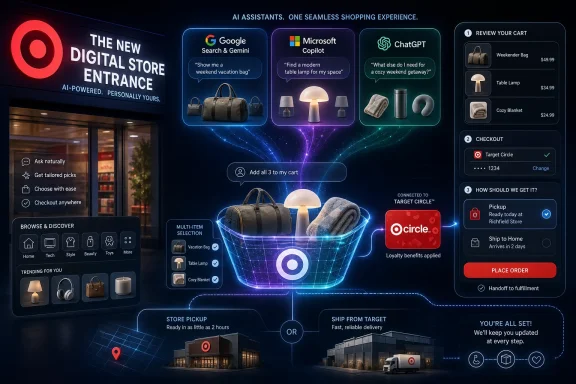
Target is trying to make sure it is not merely linked as an afterthought. The company says its products can be browsed, recommended, collected into baskets, and purchased through three major AI environments: Google Search and Gemini, Microsoft Copilot, and ChatGPT. That is a broad platform strategy, and it reads less like experimentation than insurance.
The numbers give Target cover for moving early. A 2,000% jump in AI-driven traffic sounds enormous because it almost certainly starts from a small base, but the direction is the point. Adobe’s broader retail figure suggests the trend is not Target-specific hype. Consumers are clicking from AI-generated recommendations to retail sites in increasing numbers, and retailers can no longer pretend chat-based discovery is just a novelty layer sitting outside commerce.
That does not mean Target is surrendering the transaction. The company repeatedly stresses that the guest controls the purchase decision, signs into Target accounts where needed, and confirms checkout. But the interface around that decision is changing. The assistant becomes the concierge, the filter, and sometimes the cart builder.
This is why conversational commerce should not be confused with voice shopping’s false dawn. A decade ago, the idea was that people would reorder paper towels through smart speakers. That was convenient, but narrow. Generative AI shopping is broader because it can handle messy intent: “I need a gift for a 10-year-old who likes science,” or “Build me a dorm room starter kit under $300,” or “Find snacks for a gluten-free party.”
Retailers that can answer those prompts with structured inventory, pricing, delivery options, account benefits, and checkout support have a better chance of being selected. Retailers that cannot may find their products absent from the conversation, even if they remain technically available on the open web.
For Google, the incentive is obvious. Search has long been the connective tissue between consumer intent and merchant websites. But if AI Mode and Gemini answer shopping queries directly, Google needs a commerce layer that keeps merchants participating rather than feeling scraped, displaced, or commoditized. Target’s participation gives Google a recognizable retailer at the table as it tries to make AI shopping feel less like a demo and more like infrastructure.
For Target, Google is also the least optional partner. If product discovery increasingly happens inside search results, AI summaries, and Gemini conversations, Target cannot afford to wait until those surfaces are fully mature. By joining early, it can test how its catalog appears, how promotions are represented, how cart transfer works, and how much control it can retain over the experience.
The initial Google experience appears to focus on single-item purchase, with multi-item purchasing coming later. That limitation is revealing. Conversational discovery is easy to imagine; commerce is harder to execute. Real shopping carts involve substitutions, inventory status, shipping eligibility, loyalty logic, payment handling, returns, fraud controls, and customer support. The assistant can sound effortless, but the plumbing underneath is anything but.
That matters because loyalty is one of the retailer’s few defenses against becoming a faceless supplier behind an AI answer. If a chatbot says three retailers sell a lamp, the user may choose the cheapest or fastest option. If the chatbot knows the user has Target Circle benefits, stored preferences, free shipping eligibility, or a payment relationship, Target has a stronger claim on the transaction.
Microsoft’s role is also notable for WindowsForum readers because Copilot is not just another website. Microsoft has been steadily embedding Copilot across Windows, Edge, Bing, Microsoft 365, and its consumer services. Even when individual integrations vary by region and rollout stage, the direction is unmistakable: Microsoft wants Copilot to become an ambient assistant across work and personal computing.
That creates a retail implication. If a Windows user can ask Copilot for a product recommendation while browsing, planning, writing, or searching, the assistant becomes a commercial gateway layered into the operating environment. The traditional boundary between browser search, retail site, and productivity assistant starts to blur.
This is where Target’s physical footprint becomes an advantage. Conversational AI can recommend products, but fulfillment determines whether the experience feels magical or frustrating. A grocery order, a same-day pickup, or a drive-up handoff requires local inventory, store operations, substitution logic, and time-slot reliability. Those are boring systems until they become the reason a consumer trusts the assistant.
The ChatGPT integration also shows why retailers are not all playing the same game. A marketplace can optimize for selection. A grocery chain can optimize for perishables and local availability. A mass retailer like Target can combine household goods, apparel, electronics, beauty, baby products, food, and same-day fulfillment. That breadth makes it well suited to conversational prompts that do not fit neatly into one category.
The risk, of course, is that the AI interface gets credit for the convenience while the retailer inherits the operational pain. If an assistant builds a cart that includes out-of-stock items, awkward substitutions, or a pickup window the customer misunderstands, Target will own much of the disappointment. Conversational commerce raises the ceiling for convenience, but it also raises the cost of being wrong.
Adobe’s 393% figure for retail sites overall provides useful context but not a complete map. AI-driven traffic can include users who click from chatbots, AI search experiences, or other assistant-style tools. That captures referral growth, not necessarily the full influence of AI on purchases. A shopper may ask an assistant for ideas, search separately, and then buy through the Target app without the AI system receiving attribution.
Still, the direction is difficult to dismiss. Retailers care about traffic quality as much as traffic volume, and AI referrals may arrive with more specific intent than casual browsing. A user who asks for “a carry-on bag that works with brown boots and fits a sweater” has already expressed constraints that a standard keyword search might not capture. By the time that user clicks, the funnel may be narrower.
The more important metric will be repeat behavior. If consumers use AI once for inspiration and then return to normal browsing, this remains an acquisition channel. If they begin to expect assistants to build carts, compare benefits, and manage checkout, it becomes a platform shift. Target’s announcement is a bet on the second outcome.
That is powerful because language can bundle intent across categories. A prompt about hosting a backyard birthday party might include paper plates, sunscreen, drinks, a Bluetooth speaker, decorations, a cooler, allergy-friendly snacks, and a gift. A search box typically handles that as multiple queries. A conversational assistant can treat it as a project.
For Target, this aligns neatly with its brand. The company has long positioned itself as a place for affordable style, seasonal discovery, and convenient errand consolidation. AI shopping lets Target translate that identity into recommendations rather than page layouts. The assistant can curate an outfit, a room, a meal plan, or a back-to-school basket in one flow.
But that also means the retailer must feed the assistant better data than a conventional website requires. Product descriptions, availability, images, sizing, dietary attributes, compatibility, pickup eligibility, promotions, loyalty benefits, and return rules all need to be legible to machines. The future of online merchandising may depend as much on catalog hygiene as on creative campaigns.
Consumers are used to retail websites being commercial spaces. They understand that endcaps, ads, and recommendations are not neutral. Conversational AI feels different because it speaks in the grammar of assistance. A recommendation delivered as a helpful answer may carry more authority than a sponsored tile, even when commerce incentives sit behind it.
That is why account linking deserves scrutiny. Linking Target Circle inside Copilot or using Target accounts through ChatGPT may improve personalization and benefits, but it also expands the data choreography among platforms. Users will want clear boundaries around what is shared, what is retained, and how recommendations are influenced by loyalty status, prior purchases, or paid placement.
Security-minded readers should also watch the authentication and authorization model. Any system that lets a user browse, build baskets, apply benefits, and purchase through a conversational interface needs strong controls against accidental orders, session confusion, prompt manipulation, and misleading third-party surfaces. The industry is still learning how to make agentic workflows safe enough for ordinary consumers.
That trajectory raises familiar platform questions. If Copilot becomes a shopping intermediary, how will Microsoft rank merchants? How transparent will sponsored results be? Will enterprise administrators get meaningful controls over consumer commerce features on managed devices? Will Edge, Windows, Bing, and Copilot share signals in ways that users can understand and disable?
In corporate environments, the immediate impact may be limited. Many organizations already manage consumer account access, browser sign-ins, and shopping activity through policy. But the larger pattern matters. AI assistants are being designed to collapse search, recommendation, transaction, and account action into one interface. That is convenient for consumers and messy for administrators.
The administrative challenge will be distinguishing harmless assistance from risky automation. A chatbot that recommends a desk lamp is one thing. An assistant that can sign into accounts, apply benefits, and complete transactions is another. As AI agents gain more capabilities, policy controls will need to become more granular than a simple allow-or-block toggle.
That is not a great bargain unless the retailer can preserve brand, loyalty, and economics. Target’s language about experiences feeling “unmistakably Target” is doing real strategic work. The company wants its identity to survive inside platforms it does not control. That is harder than it sounds.
The web already taught retailers this lesson through search and marketplaces. A product page can be optimized, but a search results page still mediates discovery. A marketplace can generate sales, but it can also compress brand differentiation. AI assistants could intensify both dynamics by summarizing choices into a handful of recommendations.
The countermeasure is integration deep enough that the retailer contributes more than a product listing. Target can bring loyalty benefits, pickup options, fresh food, store inventory, promotions, and brand-specific merchandising logic. The more of that context the assistant can use, the less Target looks like a generic seller.
Standards, however, are never neutral. Whoever shapes them influences what kinds of merchants thrive, how fees are handled, how user consent works, how returns are represented, and how promotions appear. An “open” commerce protocol can still encode assumptions that favor large platforms, large retailers, or particular payment systems.
Target’s participation suggests major retailers do not want AI platforms to define those assumptions alone. That is sensible. If conversational assistants become a meaningful shopping layer, the protocol beneath them will matter as much as search engine optimization once did. It will determine what information is available to the AI, what actions it can take, and where the user is handed off.
The open question is whether smaller merchants can keep up. Target has the engineering resources and platform relationships to join early launches with Google, Microsoft, and OpenAI. A local retailer or niche e-commerce brand may not. If AI shopping becomes a standards-driven game before the standards are widely accessible, the early advantage may accrue to companies that already have scale.
The most concrete lessons are already visible:
 Target Is Treating AI as the New Store Entrance
For two decades, retailers fought to control the digital storefront: homepage, search bar, product page, cart, checkout. Target’s announcement quietly concedes that a growing share of shopping intent now begins somewhere else. The consumer does not necessarily start with a category page; she starts with a conversational prompt about a vacation bag, a table lamp, a weeknight appliance, or a basket of groceries.That shift matters because retail discovery has always been about placement. In physical stores, the fight was over endcaps, seasonal displays, and shelf position. On the web, it became search ranking, sponsored listings, recommendation modules, and app notifications. In conversational AI, placement becomes something stranger and more powerful: inclusion in the answer.
Target is trying to make sure it is not merely linked as an afterthought. The company says its products can be browsed, recommended, collected into baskets, and purchased through three major AI environments: Google Search and Gemini, Microsoft Copilot, and ChatGPT. That is a broad platform strategy, and it reads less like experimentation than insurance.
The numbers give Target cover for moving early. A 2,000% jump in AI-driven traffic sounds enormous because it almost certainly starts from a small base, but the direction is the point. Adobe’s broader retail figure suggests the trend is not Target-specific hype. Consumers are clicking from AI-generated recommendations to retail sites in increasing numbers, and retailers can no longer pretend chat-based discovery is just a novelty layer sitting outside commerce.
The Retailer Is No Longer the Only Interface
The most important sentence in Target’s fact sheet may be the least glamorous one: more of the shopping journey can happen directly inside conversational experiences. That includes browsing, discovery, building multi-item baskets, and linking Target Circle loyalty accounts. In plain English, Target is allowing major AI platforms to host parts of the customer journey that retailers used to guard jealously.That does not mean Target is surrendering the transaction. The company repeatedly stresses that the guest controls the purchase decision, signs into Target accounts where needed, and confirms checkout. But the interface around that decision is changing. The assistant becomes the concierge, the filter, and sometimes the cart builder.
This is why conversational commerce should not be confused with voice shopping’s false dawn. A decade ago, the idea was that people would reorder paper towels through smart speakers. That was convenient, but narrow. Generative AI shopping is broader because it can handle messy intent: “I need a gift for a 10-year-old who likes science,” or “Build me a dorm room starter kit under $300,” or “Find snacks for a gluten-free party.”
Retailers that can answer those prompts with structured inventory, pricing, delivery options, account benefits, and checkout support have a better chance of being selected. Retailers that cannot may find their products absent from the conversation, even if they remain technically available on the open web.
Google Gets the Agentic Commerce Experiment
Target’s Google integration is the most structurally ambitious part of the announcement because it involves the Universal Commerce Protocol, or UCP. Target describes UCP as an open standard for agentic commerce, intended to create a common language between AI agents and commerce systems. The phrase agentic commerce is still doing a lot of marketing work, but the underlying concept is clear enough: AI systems need a reliable way to discover products, understand merchant rules, initiate carts, apply benefits, and pass users into purchase flows.For Google, the incentive is obvious. Search has long been the connective tissue between consumer intent and merchant websites. But if AI Mode and Gemini answer shopping queries directly, Google needs a commerce layer that keeps merchants participating rather than feeling scraped, displaced, or commoditized. Target’s participation gives Google a recognizable retailer at the table as it tries to make AI shopping feel less like a demo and more like infrastructure.
For Target, Google is also the least optional partner. If product discovery increasingly happens inside search results, AI summaries, and Gemini conversations, Target cannot afford to wait until those surfaces are fully mature. By joining early, it can test how its catalog appears, how promotions are represented, how cart transfer works, and how much control it can retain over the experience.
The initial Google experience appears to focus on single-item purchase, with multi-item purchasing coming later. That limitation is revealing. Conversational discovery is easy to imagine; commerce is harder to execute. Real shopping carts involve substitutions, inventory status, shipping eligibility, loyalty logic, payment handling, returns, fraud controls, and customer support. The assistant can sound effortless, but the plumbing underneath is anything but.
Copilot Makes Loyalty the Real Checkout Feature
The Microsoft Copilot integration is narrower but strategically interesting because Target is emphasizing loyalty account linking. Guests can browse in Copilot, connect a Target account, and use Target Circle benefits during checkout. Target Circle Card users can also receive the familiar extra 5% savings, subject to the usual program restrictions.That matters because loyalty is one of the retailer’s few defenses against becoming a faceless supplier behind an AI answer. If a chatbot says three retailers sell a lamp, the user may choose the cheapest or fastest option. If the chatbot knows the user has Target Circle benefits, stored preferences, free shipping eligibility, or a payment relationship, Target has a stronger claim on the transaction.
Microsoft’s role is also notable for WindowsForum readers because Copilot is not just another website. Microsoft has been steadily embedding Copilot across Windows, Edge, Bing, Microsoft 365, and its consumer services. Even when individual integrations vary by region and rollout stage, the direction is unmistakable: Microsoft wants Copilot to become an ambient assistant across work and personal computing.
That creates a retail implication. If a Windows user can ask Copilot for a product recommendation while browsing, planning, writing, or searching, the assistant becomes a commercial gateway layered into the operating environment. The traditional boundary between browser search, retail site, and productivity assistant starts to blur.
ChatGPT Gives Target the Richest Basket
Target’s ChatGPT experience appears to be the most complete of the three described integrations. The company says shoppers can use the Target app in ChatGPT to request recommendations, browse across Target’s assortment, build multi-item baskets, buy fresh food, and choose fulfillment options such as Drive Up, Order Pickup, or shipping. That is a much deeper retail workflow than a simple product referral.This is where Target’s physical footprint becomes an advantage. Conversational AI can recommend products, but fulfillment determines whether the experience feels magical or frustrating. A grocery order, a same-day pickup, or a drive-up handoff requires local inventory, store operations, substitution logic, and time-slot reliability. Those are boring systems until they become the reason a consumer trusts the assistant.
The ChatGPT integration also shows why retailers are not all playing the same game. A marketplace can optimize for selection. A grocery chain can optimize for perishables and local availability. A mass retailer like Target can combine household goods, apparel, electronics, beauty, baby products, food, and same-day fulfillment. That breadth makes it well suited to conversational prompts that do not fit neatly into one category.
The risk, of course, is that the AI interface gets credit for the convenience while the retailer inherits the operational pain. If an assistant builds a cart that includes out-of-stock items, awkward substitutions, or a pickup window the customer misunderstands, Target will own much of the disappointment. Conversational commerce raises the ceiling for convenience, but it also raises the cost of being wrong.
The Numbers Are Big Because the Baseline Was Small
Target’s 2,000% figure will attract attention, and it should. But percentage growth in a new channel can mislead if readers treat it like mature traffic share. A tiny number multiplied by 21 is still a tiny number. Target did not disclose the absolute volume of AI-driven visits, their conversion rate, average order value, or share of total digital sales.Adobe’s 393% figure for retail sites overall provides useful context but not a complete map. AI-driven traffic can include users who click from chatbots, AI search experiences, or other assistant-style tools. That captures referral growth, not necessarily the full influence of AI on purchases. A shopper may ask an assistant for ideas, search separately, and then buy through the Target app without the AI system receiving attribution.
Still, the direction is difficult to dismiss. Retailers care about traffic quality as much as traffic volume, and AI referrals may arrive with more specific intent than casual browsing. A user who asks for “a carry-on bag that works with brown boots and fits a sweater” has already expressed constraints that a standard keyword search might not capture. By the time that user clicks, the funnel may be narrower.
The more important metric will be repeat behavior. If consumers use AI once for inspiration and then return to normal browsing, this remains an acquisition channel. If they begin to expect assistants to build carts, compare benefits, and manage checkout, it becomes a platform shift. Target’s announcement is a bet on the second outcome.
The Assistant Becomes the New Merchandiser
Retail merchandising has always combined persuasion and logistics. Stores do not simply stock products; they arrange them, pair them, promote them, and make some choices feel obvious. Conversational AI turns that merchandising layer into language.That is powerful because language can bundle intent across categories. A prompt about hosting a backyard birthday party might include paper plates, sunscreen, drinks, a Bluetooth speaker, decorations, a cooler, allergy-friendly snacks, and a gift. A search box typically handles that as multiple queries. A conversational assistant can treat it as a project.
For Target, this aligns neatly with its brand. The company has long positioned itself as a place for affordable style, seasonal discovery, and convenient errand consolidation. AI shopping lets Target translate that identity into recommendations rather than page layouts. The assistant can curate an outfit, a room, a meal plan, or a back-to-school basket in one flow.
But that also means the retailer must feed the assistant better data than a conventional website requires. Product descriptions, availability, images, sizing, dietary attributes, compatibility, pickup eligibility, promotions, loyalty benefits, and return rules all need to be legible to machines. The future of online merchandising may depend as much on catalog hygiene as on creative campaigns.
Trust Is the Checkout Layer Nobody Can Skip
Target’s executives emphasize that the guest remains in control, and that language is not accidental. AI shopping raises obvious trust questions: who recommended the product, why it appeared, whether the price is current, whether sponsored placement is involved, and what data is shared between retailer and platform. The smoother the experience becomes, the more important those questions get.Consumers are used to retail websites being commercial spaces. They understand that endcaps, ads, and recommendations are not neutral. Conversational AI feels different because it speaks in the grammar of assistance. A recommendation delivered as a helpful answer may carry more authority than a sponsored tile, even when commerce incentives sit behind it.
That is why account linking deserves scrutiny. Linking Target Circle inside Copilot or using Target accounts through ChatGPT may improve personalization and benefits, but it also expands the data choreography among platforms. Users will want clear boundaries around what is shared, what is retained, and how recommendations are influenced by loyalty status, prior purchases, or paid placement.
Security-minded readers should also watch the authentication and authorization model. Any system that lets a user browse, build baskets, apply benefits, and purchase through a conversational interface needs strong controls against accidental orders, session confusion, prompt manipulation, and misleading third-party surfaces. The industry is still learning how to make agentic workflows safe enough for ordinary consumers.
Windows Users Should Watch Copilot’s Commerce Ambitions
For Windows enthusiasts and IT pros, the Target story is not just a retail story. It is another example of Microsoft trying to make Copilot a general-purpose action layer. Today that might mean summarizing a document or answering a web query; tomorrow it might mean buying a lamp, checking loyalty benefits, or arranging pickup.That trajectory raises familiar platform questions. If Copilot becomes a shopping intermediary, how will Microsoft rank merchants? How transparent will sponsored results be? Will enterprise administrators get meaningful controls over consumer commerce features on managed devices? Will Edge, Windows, Bing, and Copilot share signals in ways that users can understand and disable?
In corporate environments, the immediate impact may be limited. Many organizations already manage consumer account access, browser sign-ins, and shopping activity through policy. But the larger pattern matters. AI assistants are being designed to collapse search, recommendation, transaction, and account action into one interface. That is convenient for consumers and messy for administrators.
The administrative challenge will be distinguishing harmless assistance from risky automation. A chatbot that recommends a desk lamp is one thing. An assistant that can sign into accounts, apply benefits, and complete transactions is another. As AI agents gain more capabilities, policy controls will need to become more granular than a simple allow-or-block toggle.
Retailers Are Racing to Avoid Becoming Inventory Feeds
Target’s early partnerships also reveal a defensive motive. In an AI-mediated shopping world, retailers risk being reduced to structured inventory feeds behind someone else’s assistant. The platform owns the conversation, the user relationship, and the top-level recommendation. The retailer supplies price, availability, fulfillment, and customer service.That is not a great bargain unless the retailer can preserve brand, loyalty, and economics. Target’s language about experiences feeling “unmistakably Target” is doing real strategic work. The company wants its identity to survive inside platforms it does not control. That is harder than it sounds.
The web already taught retailers this lesson through search and marketplaces. A product page can be optimized, but a search results page still mediates discovery. A marketplace can generate sales, but it can also compress brand differentiation. AI assistants could intensify both dynamics by summarizing choices into a handful of recommendations.
The countermeasure is integration deep enough that the retailer contributes more than a product listing. Target can bring loyalty benefits, pickup options, fresh food, store inventory, promotions, and brand-specific merchandising logic. The more of that context the assistant can use, the less Target looks like a generic seller.
The Standards Fight Is Just Beginning
The Universal Commerce Protocol is worth watching because retail AI cannot scale on one-off integrations forever. Every merchant, platform, payment provider, and loyalty system has its own rules. Without common protocols, agentic commerce becomes a pile of brittle partnerships and special cases.Standards, however, are never neutral. Whoever shapes them influences what kinds of merchants thrive, how fees are handled, how user consent works, how returns are represented, and how promotions appear. An “open” commerce protocol can still encode assumptions that favor large platforms, large retailers, or particular payment systems.
Target’s participation suggests major retailers do not want AI platforms to define those assumptions alone. That is sensible. If conversational assistants become a meaningful shopping layer, the protocol beneath them will matter as much as search engine optimization once did. It will determine what information is available to the AI, what actions it can take, and where the user is handed off.
The open question is whether smaller merchants can keep up. Target has the engineering resources and platform relationships to join early launches with Google, Microsoft, and OpenAI. A local retailer or niche e-commerce brand may not. If AI shopping becomes a standards-driven game before the standards are widely accessible, the early advantage may accrue to companies that already have scale.
The Bullseye Moves Closer to the Prompt
Target’s announcement is best read as a map of where consumer retail is headed, not proof that the destination has arrived. The company is spreading its bets across three AI ecosystems while trying to keep account identity, loyalty, fulfillment, and brand experience attached to the transaction. That is the right strategic shape for a market where no one yet knows which assistant will become the default shopping companion.The most concrete lessons are already visible:
- Target says AI-driven traffic to its site rose 2,000% year over year in the first quarter of 2026, compared with Adobe’s reported 393% increase for U.S. retail sites overall.
- Target is making shopping experiences available through Google Search and Gemini, Microsoft Copilot, and ChatGPT rather than betting on a single AI platform.
- Google’s integration is tied to the Universal Commerce Protocol, an attempt to standardize how AI agents and commerce systems interact.
- Microsoft Copilot’s Target experience emphasizes account linking and Target Circle loyalty benefits during checkout.
- The ChatGPT experience appears to support the richest Target workflow, including multi-item baskets, fresh food, and fulfillment choices such as Drive Up, Order Pickup, and shipping.
- The practical risks are not theoretical; authentication, data sharing, recommendation transparency, inventory accuracy, and administrative controls all become more important as assistants move closer to purchase.
References
- Primary source: Target
Published: 2026-06-18T11:50:08.029390
Target Shopping Experiences in Conversational AI
Learn how Target is powering new shopping experiences with AI.corporate.target.com
- Related coverage: harianbasis.co
AI Driven Shopping Traffic Surges Nearly 400 Percent in Early 2026
Adobe Analytics reports a 393 percent increase in AI-driven retail traffic for Q1 2026, with referred shoppers spending more than traditional visitors.www.harianbasis.co - Related coverage: business.adobe.com
- Related coverage: sumsub.com
AI Shopping Traffic Rises 393% as AI Referrals Outperform Traditional Shoppers
A new report from Adobe Digital Insights has shown a sharp increase in AI-driven traffic to US retail sites in the first quarter of 2026.sumsub.com - Related coverage: techbuzz.ai
AI Shopping Bots Drive 393% Traffic Surge to US Retailers | The Tech Buzz
Adobe data shows AI traffic jumped 393% in Q1 with higher conversions than human shopperswww.techbuzz.ai - Related coverage: news.adobe.com
