

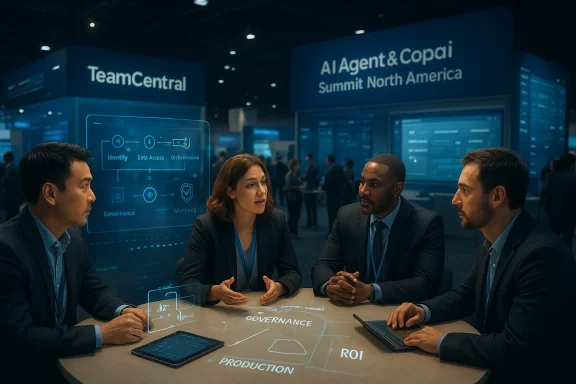
The appearance of TeamCentral at the AI Agent & Copilot Summit North America underscores how quickly the Microsoft-adjacent AI ecosystem is maturing from demo-heavy excitement into an implementation market. According to the LinkedIn post highlighted by TipRanks, the company was actively engaging attendees at Table 19 in San Diego and framing the conversation around what it really takes to move Copilot and AI agents into production environments. That emphasis matters because enterprise buyers are no longer just asking what AI can do; they are asking how to secure it, govern it, integrate it, and prove ROI.
The AI Agent & Copilot Summit has become one of the more visible gathering points for the Microsoft-centric applied AI community, especially for companies building around Copilot Studio, Microsoft 365 Copilot, and the broader ecosystem of enterprise automation tools. Public posts around the event show a clear theme: speakers and sponsors are leaning into practical sessions about declarative agents, real-world deployment, and production readiness rather than speculative futurism. In that sense, TeamCentral’s presence fits neatly into the event’s own positioning as a forum for working AI rather than abstract AI.
That context matters because the enterprise AI market in 2026 is increasingly shaped by a simple but expensive reality: many pilots are easy, but scaled deployments are hard. The gap between a proof of concept and a production workload involves identity controls, access management, connector reliability, data quality, monitoring, and user adoption. Vendors that can help organizations bridge that gap are often better positioned than those that only offer flashy front-end experiences.
Microsoft’s ecosystem has also become a natural battleground for this debate. Copilot has expanded awareness of generative AI across the installed base of Microsoft customers, but enterprises still need tooling and services that translate that awareness into governed use cases. That creates a favorable backdrop for consultancies, ISVs, and infrastructure vendors that can speak credibly about deployment patterns, agent orchestration, and operational risk.
The summit itself appears designed to attract exactly that audience. Publicly available event posts emphasize practical applications, real-world use cases, and lessons learned, which suggests the organizers understand a key market truth: the next phase of enterprise AI will be won by companies that can make the technology dependable. For TeamCentral, visibility in that environment is less about brand theater and more about signaling relevance to buyers who are actively budgeting for implementation help.
In investor terms, this kind of conference presence often serves as a leading indicator rather than a trailing one. It does not prove revenue, but it can point to sales motion, partner-building, and pipeline cultivation. For a company positioning itself in applied AI infrastructure, being present where decision-makers are debating deployment blockers is strategically sensible.
For TeamCentral, the value of participating in such an event is tied to audience quality. A niche summit can be more useful than a broad technology conference because attendees are already pre-qualified around the relevant problem set. They are likely to care about production deployment, agent governance, integration architecture, and Microsoft ecosystem alignment—all of which are areas where implementation-focused vendors can win attention.
The conference setting reinforces that urgency. The expo hall closing at 1 p.m. on the final day may sound mundane, but it also signals a compressed window for high-intent conversations. In many cases, those last hours are where vendors turn casual curiosity into follow-up meetings.
The focus on production environments also hints at a consulting-adjacent go-to-market motion. Companies in this category often make money not only from software licenses but also from design workshops, integration services, and implementation support. In practice, this can make the business model more resilient if the offering is tied to ongoing deployment needs rather than one-off experimentation.
If TeamCentral can credibly address those layers, it may be able to stand out in a crowded field. The category is becoming saturated with vendors who describe themselves as AI-ready, but buyers are increasingly skeptical of high-level promises. They want evidence, not just enthusiasm.
This is where applied AI vendors gain an opening. They can help enterprises move from generic productivity features to tailored workflows that actually fit business needs. That may include custom agents, connectors, orchestration logic, and monitoring layers that make the system trustworthy.
That distinction matters because enterprise adoption is much less forgiving. If a consumer chatbot hallucinates, a user may shrug. If an enterprise agent mishandles a workflow or exposes the wrong data, the consequences can include reputational damage, compliance issues, and internal backlash.
At a summit like this, the conversation likely revolves around the hidden complexity beneath the AI interface. That includes identity and access management, data retrieval permissions, prompt orchestration, response validation, and integration with systems of record. Many organizations underestimate these issues when they begin their first pilot.
That is why practical vendors have a chance to differentiate themselves. If TeamCentral can explain how to manage these dependencies without overwhelming customer teams, it can position itself as a bridge between experimentation and enterprise adoption.
The competitive challenge is that many firms now speak the language of AI deployment. The real differentiator is whether they can show repeatable frameworks, domain expertise, and a path to measurable outcomes. If TeamCentral can do that, it may be able to carve out a defensible niche.
This is often where smaller firms can thrive. Large platforms set the boundaries, but they do not always solve the last mile. The last mile is where buyers need help turning broad functionality into a usable business system.
Investor readers should be careful not to over-interpret a single LinkedIn post. Conference presence does not automatically translate into revenue, and many companies attend events primarily for brand exposure. Still, in the enterprise software world, targeted community presence often precedes commercial activity.
A useful way to think about the situation is to ask whether TeamCentral is building a pipeline or merely building visibility. In practice, the answer may be both, but the balance between them will determine how meaningful the summit appearance is. If the company can convert conversations into pilots, the event may prove strategically valuable.
This is particularly relevant in the Microsoft ecosystem, where Copilot acts as both an adoption catalyst and a complexity amplifier. Once users get a taste of AI-assisted workflows, they begin asking for more customization. That raises demand for implementation partners and deployment tooling.
This also means competition will intensify. As more firms reposition themselves as AI agents and Copilot experts, the winner will be the vendor that can combine technical credibility with operational clarity. That is a high bar, but also a valuable moat if achieved.
The bigger industry story is that enterprise AI is entering a more disciplined era. The market is moving from “Can we build it?” to “Can we run it safely?” That shift favors vendors that can explain the operational realities of Copilot and AI agents in terms business leaders understand.
The broader lesson for the sector is clear: the winners in enterprise AI will not be the loudest companies, but the ones that can make advanced tools operational, governable, and useful every day. TeamCentral’s summit presence suggests it understands that reality, and in this market, understanding the problem is often the first step toward building a durable business.
Source: TipRanks TeamCentral Showcases Applied AI Capabilities at AI Agent & Copilot Summit - TipRanks.com
 Background
The AI Agent & Copilot Summit has become one of the more visible gathering points for the Microsoft-centric applied AI community, especially for companies building around Copilot Studio, Microsoft 365 Copilot, and the broader ecosystem of enterprise automation tools. Public posts around the event show a clear theme: speakers and sponsors are leaning into practical sessions about declarative agents, real-world deployment, and production readiness rather than speculative futurism. In that sense, TeamCentral’s presence fits neatly into the event’s own positioning as a forum for working AI rather than abstract AI.That context matters because the enterprise AI market in 2026 is increasingly shaped by a simple but expensive reality: many pilots are easy, but scaled deployments are hard. The gap between a proof of concept and a production workload involves identity controls, access management, connector reliability, data quality, monitoring, and user adoption. Vendors that can help organizations bridge that gap are often better positioned than those that only offer flashy front-end experiences.
Microsoft’s ecosystem has also become a natural battleground for this debate. Copilot has expanded awareness of generative AI across the installed base of Microsoft customers, but enterprises still need tooling and services that translate that awareness into governed use cases. That creates a favorable backdrop for consultancies, ISVs, and infrastructure vendors that can speak credibly about deployment patterns, agent orchestration, and operational risk.
The summit itself appears designed to attract exactly that audience. Publicly available event posts emphasize practical applications, real-world use cases, and lessons learned, which suggests the organizers understand a key market truth: the next phase of enterprise AI will be won by companies that can make the technology dependable. For TeamCentral, visibility in that environment is less about brand theater and more about signaling relevance to buyers who are actively budgeting for implementation help.
In investor terms, this kind of conference presence often serves as a leading indicator rather than a trailing one. It does not prove revenue, but it can point to sales motion, partner-building, and pipeline cultivation. For a company positioning itself in applied AI infrastructure, being present where decision-makers are debating deployment blockers is strategically sensible.
Why the Summit Matters
The AI Agent & Copilot Summit is important because it sits at the intersection of hype and execution. The broader market has moved past the question of whether enterprises will adopt AI tools; the urgent question is how they will do so without creating security, compliance, or cost problems. That is exactly the kind of environment where specialized vendors can differentiate themselves.For TeamCentral, the value of participating in such an event is tied to audience quality. A niche summit can be more useful than a broad technology conference because attendees are already pre-qualified around the relevant problem set. They are likely to care about production deployment, agent governance, integration architecture, and Microsoft ecosystem alignment—all of which are areas where implementation-focused vendors can win attention.
Practical Buyer Intent
The language around “what it actually takes” to move agents into production is especially telling. Buyers who use that phrasing are usually beyond the idea stage and are now wrestling with operational details. That includes how to define boundaries for agents, how to connect them to business systems, and how to prevent them from becoming ungoverned shadow AI.The conference setting reinforces that urgency. The expo hall closing at 1 p.m. on the final day may sound mundane, but it also signals a compressed window for high-intent conversations. In many cases, those last hours are where vendors turn casual curiosity into follow-up meetings.
- The event appears centered on real implementation problems.
- The audience is likely composed of enterprise decision-makers and solution builders.
- The timing creates a short but focused opportunity for business development.
- The Microsoft ecosystem context makes the event especially relevant for Copilot-related offerings.
TeamCentral’s Positioning
TeamCentral’s messaging suggests it wants to be seen as more than a software vendor. By emphasizing applied AI capabilities, it is signaling that its value lies in helping customers convert ambition into operational systems. That positioning is attractive in a market where many firms can prototype a chatbot but far fewer can make one reliable inside a regulated enterprise.The focus on production environments also hints at a consulting-adjacent go-to-market motion. Companies in this category often make money not only from software licenses but also from design workshops, integration services, and implementation support. In practice, this can make the business model more resilient if the offering is tied to ongoing deployment needs rather than one-off experimentation.
From Concept to Workflow
The phrase “what it actually takes” is more than marketing polish; it reflects a market shift. Enterprises are starting to understand that the hard part of AI is not generating text, but managing the full lifecycle of a use case. That includes workflow design, change management, exception handling, observability, and governance.If TeamCentral can credibly address those layers, it may be able to stand out in a crowded field. The category is becoming saturated with vendors who describe themselves as AI-ready, but buyers are increasingly skeptical of high-level promises. They want evidence, not just enthusiasm.
- Production readiness is now a core selling point.
- Governance and integration are likely central to the pitch.
- The company’s message is aligned with enterprise buyer concerns.
- Credibility will depend on demonstrable deployments, not slogans.
The Copilot Opportunity
Microsoft Copilot has created a broad market opening, but it has also raised expectations. Once organizations start experimenting with Copilot, they quickly discover that the technology’s value depends heavily on data access, permissions, and the quality of the underlying business processes. That leaves a large and still-under-served space for tools and services that can make Copilot usable at scale.This is where applied AI vendors gain an opening. They can help enterprises move from generic productivity features to tailored workflows that actually fit business needs. That may include custom agents, connectors, orchestration logic, and monitoring layers that make the system trustworthy.
Enterprise vs. Consumer AI
The consumer AI story is mostly about convenience and novelty. The enterprise AI story is about control, repeatability, and measurable outcomes. TeamCentral’s summit messaging appears aimed squarely at the second category, where the stakes are higher and the sales cycles are longer.That distinction matters because enterprise adoption is much less forgiving. If a consumer chatbot hallucinates, a user may shrug. If an enterprise agent mishandles a workflow or exposes the wrong data, the consequences can include reputational damage, compliance issues, and internal backlash.
- Consumer AI rewards speed and polish.
- Enterprise AI rewards stability, auditability, and integration depth.
- Copilot expands the market but does not solve deployment complexity.
- Vendors that reduce operational friction are likely to be favored.
What “Production” Really Means
The word production carries a lot of weight in enterprise AI, and often for good reason. It means the system must work consistently, handle failure gracefully, and fit into established controls. It also means the organization can support it operationally without creating a support nightmare for IT or security teams.At a summit like this, the conversation likely revolves around the hidden complexity beneath the AI interface. That includes identity and access management, data retrieval permissions, prompt orchestration, response validation, and integration with systems of record. Many organizations underestimate these issues when they begin their first pilot.
The Hidden Stack
The real stack behind an AI agent is broader than most users realize. There is the model layer, the retrieval layer, the orchestration layer, the identity layer, and the monitoring layer. Each of those layers can become a point of failure if not planned carefully.That is why practical vendors have a chance to differentiate themselves. If TeamCentral can explain how to manage these dependencies without overwhelming customer teams, it can position itself as a bridge between experimentation and enterprise adoption.
- Identity determines who can ask and who can act.
- Data access determines what the agent can safely use.
- Orchestration determines how actions are sequenced.
- Monitoring determines whether the system can be trusted over time.
Competitive Implications
TeamCentral’s summit presence should also be viewed through a competitive lens. The applied AI and Copilot ecosystem is becoming crowded with consultancies, Microsoft partners, boutique integration firms, and software vendors all trying to claim a slice of the opportunity. In that environment, visibility at the right event can help a smaller player look materially more established.The competitive challenge is that many firms now speak the language of AI deployment. The real differentiator is whether they can show repeatable frameworks, domain expertise, and a path to measurable outcomes. If TeamCentral can do that, it may be able to carve out a defensible niche.
Against Larger Platforms
Against Microsoft itself, the opportunity is not to compete head-on but to complement. Microsoft will continue to own the platform layer, while partners and specialist vendors compete for the layers above and around it. That includes implementation, customization, governance, and industry-specific solutions.This is often where smaller firms can thrive. Large platforms set the boundaries, but they do not always solve the last mile. The last mile is where buyers need help turning broad functionality into a usable business system.
- Platform vendors own the ecosystem.
- Specialist vendors own the implementation conversation.
- The highest-margin opportunities often sit in the gaps between them.
- Buyers prefer vendors who reduce integration burden.
Investor Takeaways
From an investor perspective, the most interesting part of this story is not the summit itself but what it implies about go-to-market activity. Event participation suggests TeamCentral is actively pursuing enterprise relationships and trying to align itself with one of the most visible technology trends in the Microsoft stack. That can be a useful signal, especially for a private company where public operating data may be limited.Investor readers should be careful not to over-interpret a single LinkedIn post. Conference presence does not automatically translate into revenue, and many companies attend events primarily for brand exposure. Still, in the enterprise software world, targeted community presence often precedes commercial activity.
What to Look For
The next evidence points will matter more than the event recap. Investors should watch for customer references, product announcements, partner integrations, and repeated appearances in Microsoft-adjacent forums. Those are the signs that a marketing moment is turning into a repeatable business motion.A useful way to think about the situation is to ask whether TeamCentral is building a pipeline or merely building visibility. In practice, the answer may be both, but the balance between them will determine how meaningful the summit appearance is. If the company can convert conversations into pilots, the event may prove strategically valuable.
- Look for proof-of-concept wins tied to Copilot or AI agents.
- Watch for partner ecosystem expansion with Microsoft-related channels.
- Monitor whether the company begins using more specific deployment language.
- Pay attention to case studies that show measurable business outcomes.
- Track whether the company appears at additional enterprise AI events.
Ecosystem Timing
The timing of TeamCentral’s visibility is also notable because the market is still in the middle of a major adoption curve. Enterprises are not abandoning AI interest; they are refining their expectations. That creates a tailwind for companies that can help them navigate the transition from experimentation to controlled deployment.This is particularly relevant in the Microsoft ecosystem, where Copilot acts as both an adoption catalyst and a complexity amplifier. Once users get a taste of AI-assisted workflows, they begin asking for more customization. That raises demand for implementation partners and deployment tooling.
Why Timing Matters
Timing matters because buying behavior changes as markets mature. Early adopters buy novelty, but later adopters buy reliability. TeamCentral’s emphasis on production readiness suggests it understands that shift and is trying to meet the market where it is now.This also means competition will intensify. As more firms reposition themselves as AI agents and Copilot experts, the winner will be the vendor that can combine technical credibility with operational clarity. That is a high bar, but also a valuable moat if achieved.
- Market maturity is shifting demand toward trusted execution.
- Copilot awareness is creating a larger addressable audience.
- Buyers now want answers, not just demos.
- The most successful vendors will be those that can standardize implementation.
Strengths and Opportunities
TeamCentral’s summit activity shows that the company is already speaking the language of enterprise buyers, which is a meaningful advantage in a crowded market. It is easier to move a conversation forward when the company is aligned with the buyer’s real operational pain points rather than abstract AI enthusiasm.- Alignment with production deployment concerns.
- Exposure to a highly relevant Microsoft-centric audience.
- Potential to build credibility in applied AI infrastructure.
- Opportunity to generate qualified enterprise leads.
- Strong fit for buyers seeking Copilot implementation support.
- Ability to differentiate through practical guidance rather than hype.
- Potential to convert visibility into pilot programs and long-term engagements.
Risks and Concerns
The main risk is that event visibility may not translate into measurable business traction. Many companies attend conferences, post on LinkedIn, and still struggle to create repeatable sales motion. In a competitive category, attention can be fleeting unless backed by strong product-market fit.- Summit presence may produce awareness without revenue.
- The market is crowded with similar AI positioning.
- Enterprises may remain cautious about production AI risk.
- Microsoft may continue to absorb much of the value at the platform layer.
- Without proof points, claims about applied AI can feel generic.
- Implementation-heavy offerings can be services-intensive and harder to scale.
- Buyers may delay commitments until governance standards are clearer.
Looking Ahead
The next phase will likely be defined by how well TeamCentral converts summit conversations into concrete follow-up. If the company can secure pilots, partners, or recurring implementation work, the event will have served as an effective business development channel. If not, it will remain a useful but limited visibility exercise.The bigger industry story is that enterprise AI is entering a more disciplined era. The market is moving from “Can we build it?” to “Can we run it safely?” That shift favors vendors that can explain the operational realities of Copilot and AI agents in terms business leaders understand.
What to Watch Next
- Additional customer or partner announcements tied to Copilot or AI agents.
- New product or service language focused on governance and production readiness.
- Repeat appearances at Microsoft ecosystem events.
- Evidence of sector-specific use cases rather than generic AI messaging.
- Any sign that the company is expanding from awareness-building into structured commercial traction.
The broader lesson for the sector is clear: the winners in enterprise AI will not be the loudest companies, but the ones that can make advanced tools operational, governable, and useful every day. TeamCentral’s summit presence suggests it understands that reality, and in this market, understanding the problem is often the first step toward building a durable business.
Source: TipRanks TeamCentral Showcases Applied AI Capabilities at AI Agent & Copilot Summit - TipRanks.com
