

Teamflect announced on May 26, 2026, that its new Teamflect Enterprise plan adds customer-managed encryption keys, dedicated cloud infrastructure, and customer-selectable Microsoft Azure data residency to its performance management platform for Microsoft Teams and Outlook. The company is pitching the launch as a category-first move in HR technology, but the more interesting story is not the marketing trophy. It is that performance management software is finally being treated like the sensitive enterprise system it always was. HR data has crossed into security’s blast radius, and vendors that cannot answer hard questions about keys, isolation, logs, and geography are about to find procurement much less forgiving.
Performance management tools used to arrive in companies through the language of culture. They promised better feedback cycles, cleaner review forms, more frequent check-ins, and less awkward annual appraisal theatre. Security reviewed the contract, legal checked the privacy wording, HR got its workflows, and the tool joined the SaaS sprawl.
That was never a very realistic model. A performance platform can hold compensation conversations, disciplinary context, succession planning, manager notes, goal history, peer feedback, and sometimes the raw emotional texture of 1:1 meetings. If an attacker wanted material for extortion, insider profiling, executive targeting, or labor-relations chaos, this is not a peripheral dataset.
The timing matters because enterprises have spent the last decade hardening identity, endpoint, cloud infrastructure, and financial systems while quietly allowing collaboration-adjacent HR applications to behave like lighter-weight engagement tools. That gap is now closing. The CISO is no longer a late-stage blocker in HR software purchases; in larger organizations, security is becoming one of the buyers.
Teamflect’s Enterprise plan is therefore less a feature bundle than a signal. The company is betting that performance management platforms will be judged by the same controls that already shape enterprise decisions around data warehouses, customer support systems, code repositories, and regulated workloads. That may sound obvious to IT readers, but it is a meaningful shift in a category that has often sold usability first and security assurances second.
The company says Enterprise customers can choose data residency in any Microsoft Azure region where Azure operates a datacenter. That is a practical pitch to multinational companies that must reconcile internal policies, customer commitments, employment law, and regional privacy expectations. The value is not merely that the data sits “in the cloud,” but that buyers can ask where it sits and receive a concrete answer.
The Microsoft alignment also makes Teamflect’s pitch more plausible for WindowsForum’s core audience. If a company already uses Entra ID, Microsoft Teams, Outlook, Sentinel, Power BI, and Azure governance tooling, a performance management platform that speaks that operational language has a shorter route through enterprise review. It does not eliminate vendor risk, but it reduces the number of conceptual translations IT must perform.
There is a commercial calculation here as well. HR software vendors that live outside the Microsoft ecosystem often sell breadth, polish, or specialization. Teamflect is arguing that proximity to the Microsoft stack can itself become a security and deployment advantage. For organizations already paying for Microsoft as their productivity, identity, and cloud backbone, that is a serious argument.
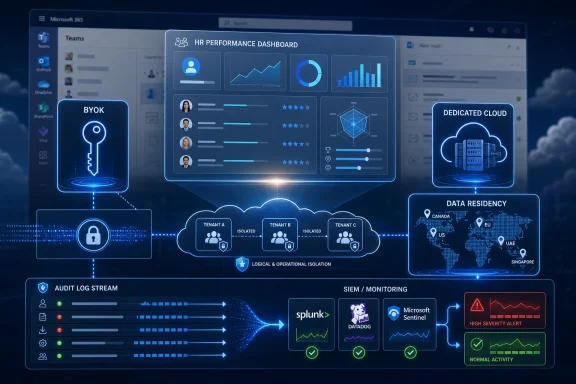
That changes the psychology of the security review. Standard SaaS encryption at rest is now table stakes, but it often means the vendor manages the operational reality of encryption. BYOK gives the customer more control over one of the most sensitive failure domains in the system.
It is not magic. Customer-managed keys do not make a SaaS product immune to application-layer compromise, bad permissions, malicious insiders, insecure integrations, or poor administrative hygiene. If a user with legitimate access exports sensitive review data, encryption at rest is not the control that saves you.
But BYOK matters because it creates a stronger answer to a specific enterprise concern: what happens if the customer needs to terminate access, rotate cryptographic material after an incident, or satisfy a regulator that key control is not merely a vendor promise? In regulated sectors, the ability to point to customer-side control can move a product from “interesting but risky” to “possible with conditions.”
For HR platforms, that is a significant elevation. The category has long asked buyers to trust vendor attestations, certifications, and privacy language. Teamflect is adding a control that security teams can map more directly to their own governance model.
Multi-tenancy is not inherently insecure. Properly designed, monitored, and tested, shared SaaS architecture can be secure and highly resilient. Many of the world’s most critical business applications run this way, and dedicated infrastructure can introduce its own complexity, cost, and operational burden.
Still, dedicated infrastructure has become a powerful enterprise buying signal because it addresses the uncomfortable edge cases. Security teams worry about tenant isolation bugs, noisy-neighbor performance issues, shared-component compromise, and the difficulty of proving exactly how one customer’s data is separated from another’s. For high-sensitivity HR data, those concerns are easier to dismiss in a slide deck than in a risk committee.
Teamflect’s dedicated infrastructure promise appears designed for exactly those committees. Separate database, separate application layer, and no shared components are the kinds of phrases that translate cleanly into procurement questionnaires. They also give Teamflect a way to sell into enterprises that may previously have considered performance management tools too soft, too shared, or too dependent on generic SaaS controls.
The catch is that dedicated infrastructure raises expectations. Once a vendor offers isolation as a premium feature, customers will ask how patching works, how incident response differs, how monitoring is segmented, how backups are handled, and whether dedicated really means dedicated across every meaningful control plane. The feature opens doors, but it also invites deeper scrutiny.
For HR data, geography is especially charged. Employee records are not just business data; they are personal data about people who may live under different regulatory regimes from the company headquarters. A U.S.-based multinational, a European works council, a Canadian public-sector buyer, and a Middle Eastern enterprise may all ask different questions about where employee data is stored and processed.
Teamflect’s promise to support residency across Azure regions, including regions such as the United States, European Union, Canada, Singapore, and the United Arab Emirates, is therefore more than a hosting preference. It is an attempt to make performance management software fit into regional compliance architectures that are already being built around cloud platforms.
The Azure angle matters because Microsoft has invested heavily in selling geography, sovereignty, and compliance as cloud features. Teamflect is not trying to build a global datacenter footprint from scratch. It is packaging Azure’s regional presence into an HR software control that customers can select during deployment.
That is smart, but it also requires precision. Data residency is not the same as data sovereignty, and neither term automatically answers every question about support access, telemetry, backups, disaster recovery, AI processing, or cross-border transfers. If Teamflect wants this control to stand up under enterprise scrutiny, customers will expect documentation that distinguishes the marketing phrase from the operational reality.
Security teams do not merely want vendors to promise that access is controlled. They want to see who accessed what, when, from where, and under which administrative context. They want unusual data access to trigger investigation. They want configuration changes to land in the same operational pipeline as identity events, endpoint alerts, and cloud activity.
This is especially important in HR software because misuse is not always external. Sensitive employee data can be exposed through overbroad administrator privileges, careless exports, curious managers, compromised HR accounts, or poorly governed integrations. An audit trail does not prevent every abuse, but it creates accountability after the fact and enables earlier detection when paired with a mature SOC.
The integration targets are telling. Splunk and Datadog appeal to organizations with broader observability and security analytics investments, while Microsoft Sentinel fits the Microsoft-first customers Teamflect is already courting. If Teamflect can make HR activity visible inside existing security operations workflows, it reduces one of the classic problems of departmental SaaS: important events happening in a place security never watches.
Granular role-based permissions, IP allowlisting, and custom retention policies round out this story. They are not glamorous controls, but they are the daily machinery of enterprise governance. In practice, these may matter more to administrators than the headline features because they shape how safely the platform can be operated after launch.
The risk is not simply that an AI feature might leak data. The larger issue is that HR data becomes more extractable. A pile of 1:1 notes, goals, survey responses, and performance reviews is already sensitive; an AI layer that can summarize sentiment, identify flight risks, or map leadership concerns turns that pile into an analytical asset.
That changes the governance burden. Enterprises will want to know not only where the data resides and who holds the keys, but how AI features process the data, whether prompts and outputs are retained, whether model providers receive any training rights, and how administrators can disable or scope AI functionality. For HR, “AI convenience” and “employee surveillance” can sit uncomfortably close together.
Teamflect’s Microsoft Azure orientation may help here, particularly if customers already have internal standards for Azure-hosted AI services. But the standard will keep rising. A serious enterprise HR platform will need security controls, privacy controls, AI governance controls, and defensible administrative boundaries.
This is where Teamflect’s move looks less like a one-off premium plan and more like the beginning of a category reset. The more performance tools automate interpretation, the less credible it becomes to treat them as ordinary workflow software.
This pattern is familiar across enterprise software. Features that begin as bespoke requests from regulated or high-scale customers eventually become standard requirements. Single sign-on, SCIM provisioning, audit logs, customer-managed keys, data residency, and retention policies all followed some version of this path in different SaaS categories.
HR technology is simply catching up. Once a product becomes embedded in employee lifecycle decisions, compensation context, management behavior, and internal mobility, it stops being a nice-to-have HR app and starts behaving like a system of record. Procurement notices. Security notices. Legal notices.
The interesting tension is that HR buyers still want fast deployment and high adoption. Security teams want isolation, logs, retention controls, key management, and regional choice. Finance wants predictable cost. Employees want a tool that does not feel like corporate surveillance. The winning products will be the ones that can satisfy these groups without making the platform unusable.
Teamflect’s Microsoft Teams and Outlook integration is a useful advantage in that balancing act. Meeting users where they already work reduces adoption friction. But enterprise controls are now part of the adoption story, not a separate appendix.
That distinction matters. The point is not whether a competitor can find a narrow counterexample. The point is that Teamflect has put a stake in the ground and dared the rest of the category to answer. If buyers start adding BYOK, dedicated infrastructure, and region selection to RFPs, the marketing claim becomes less important than the new baseline.
This is how enterprise software changes. One vendor turns a premium capability into a sales weapon. Competitors dismiss it as overkill, then add a roadmap item, then ship a partial version, then pretend it was always inevitable. Buyers, meanwhile, quietly update their questionnaires.
For Windows admins and Microsoft 365-focused IT teams, the lesson is practical. HR software should no longer be reviewed as a departmental convenience tool. It should be assessed like any other sensitive SaaS platform that touches identity, personal data, executive information, and compliance workflows.
That means asking about tenant isolation, encryption key control, retention, export controls, admin roles, logging, SIEM integration, data residency, AI processing, and incident notification. It also means refusing to accept “we use Azure” as a complete security answer. Azure can provide strong primitives, but the SaaS vendor’s architecture and operations determine how those primitives are actually used.
Customer-managed keys create edge cases. What happens if a customer misconfigures access, rotates a key incorrectly, or revokes access during an investigation? How quickly can service be restored? What data becomes unreadable, and what metadata remains available? These are not reasons to avoid BYOK, but they are reasons to document it carefully.
Dedicated infrastructure creates its own questions. Customers will ask whether upgrades are simultaneous or staged, whether dedicated instances lag behind shared environments, and how vulnerability remediation works across isolated deployments. If every enterprise customer has a more bespoke footprint, support excellence becomes a security feature.
Data residency adds another layer. Regional deployment is valuable only if backups, replicas, logs, support access, and subprocessors are handled consistently with the residency promise. Enterprises will expect diagrams, policies, and contractual clarity, not just a region dropdown.
This is why Teamflect’s white-glove implementation and advisory services are not an afterthought. A high-control enterprise tier cannot rely entirely on self-service onboarding. The more a product lets customers shape infrastructure, residency, integrations, retention, and reporting, the more the vendor must behave like a deployment partner rather than a simple SaaS checkout page.
 HR Software Has Outgrown Its Soft Perimeter
Performance management tools used to arrive in companies through the language of culture. They promised better feedback cycles, cleaner review forms, more frequent check-ins, and less awkward annual appraisal theatre. Security reviewed the contract, legal checked the privacy wording, HR got its workflows, and the tool joined the SaaS sprawl.That was never a very realistic model. A performance platform can hold compensation conversations, disciplinary context, succession planning, manager notes, goal history, peer feedback, and sometimes the raw emotional texture of 1:1 meetings. If an attacker wanted material for extortion, insider profiling, executive targeting, or labor-relations chaos, this is not a peripheral dataset.
The timing matters because enterprises have spent the last decade hardening identity, endpoint, cloud infrastructure, and financial systems while quietly allowing collaboration-adjacent HR applications to behave like lighter-weight engagement tools. That gap is now closing. The CISO is no longer a late-stage blocker in HR software purchases; in larger organizations, security is becoming one of the buyers.
Teamflect’s Enterprise plan is therefore less a feature bundle than a signal. The company is betting that performance management platforms will be judged by the same controls that already shape enterprise decisions around data warehouses, customer support systems, code repositories, and regulated workloads. That may sound obvious to IT readers, but it is a meaningful shift in a category that has often sold usability first and security assurances second.
Teamflect Chooses the Microsoft Stack as Its Enterprise Wedge
Teamflect’s product positioning has always been unusually Microsoft-centric. The platform is built for Microsoft Teams and Outlook, which gives it a natural path into organizations already standardized on Microsoft 365. That matters because the new Enterprise tier leans heavily on Microsoft Azure as the substrate for its security promises.The company says Enterprise customers can choose data residency in any Microsoft Azure region where Azure operates a datacenter. That is a practical pitch to multinational companies that must reconcile internal policies, customer commitments, employment law, and regional privacy expectations. The value is not merely that the data sits “in the cloud,” but that buyers can ask where it sits and receive a concrete answer.
The Microsoft alignment also makes Teamflect’s pitch more plausible for WindowsForum’s core audience. If a company already uses Entra ID, Microsoft Teams, Outlook, Sentinel, Power BI, and Azure governance tooling, a performance management platform that speaks that operational language has a shorter route through enterprise review. It does not eliminate vendor risk, but it reduces the number of conceptual translations IT must perform.
There is a commercial calculation here as well. HR software vendors that live outside the Microsoft ecosystem often sell breadth, polish, or specialization. Teamflect is arguing that proximity to the Microsoft stack can itself become a security and deployment advantage. For organizations already paying for Microsoft as their productivity, identity, and cloud backbone, that is a serious argument.
The Key Question Is Who Holds the Keys
The most consequential control in Teamflect Enterprise is customer-managed encryption keys, often described as bring your own key or BYOK. In plain English, the customer controls the cryptographic keys used to protect its data rather than leaving that control entirely with the SaaS provider. Teamflect says customers will be able to rotate keys, revoke access, and audit key operations through their own key management service.That changes the psychology of the security review. Standard SaaS encryption at rest is now table stakes, but it often means the vendor manages the operational reality of encryption. BYOK gives the customer more control over one of the most sensitive failure domains in the system.
It is not magic. Customer-managed keys do not make a SaaS product immune to application-layer compromise, bad permissions, malicious insiders, insecure integrations, or poor administrative hygiene. If a user with legitimate access exports sensitive review data, encryption at rest is not the control that saves you.
But BYOK matters because it creates a stronger answer to a specific enterprise concern: what happens if the customer needs to terminate access, rotate cryptographic material after an incident, or satisfy a regulator that key control is not merely a vendor promise? In regulated sectors, the ability to point to customer-side control can move a product from “interesting but risky” to “possible with conditions.”
For HR platforms, that is a significant elevation. The category has long asked buyers to trust vendor attestations, certifications, and privacy language. Teamflect is adding a control that security teams can map more directly to their own governance model.
Dedicated Infrastructure Is a Rejection of SaaS Minimalism
Teamflect’s second headline control is dedicated cloud infrastructure with no shared components between customers. That is a direct challenge to the default economics of multi-tenant SaaS, where many customers share the same application and database layers while logical controls keep data separated.Multi-tenancy is not inherently insecure. Properly designed, monitored, and tested, shared SaaS architecture can be secure and highly resilient. Many of the world’s most critical business applications run this way, and dedicated infrastructure can introduce its own complexity, cost, and operational burden.
Still, dedicated infrastructure has become a powerful enterprise buying signal because it addresses the uncomfortable edge cases. Security teams worry about tenant isolation bugs, noisy-neighbor performance issues, shared-component compromise, and the difficulty of proving exactly how one customer’s data is separated from another’s. For high-sensitivity HR data, those concerns are easier to dismiss in a slide deck than in a risk committee.
Teamflect’s dedicated infrastructure promise appears designed for exactly those committees. Separate database, separate application layer, and no shared components are the kinds of phrases that translate cleanly into procurement questionnaires. They also give Teamflect a way to sell into enterprises that may previously have considered performance management tools too soft, too shared, or too dependent on generic SaaS controls.
The catch is that dedicated infrastructure raises expectations. Once a vendor offers isolation as a premium feature, customers will ask how patching works, how incident response differs, how monitoring is segmented, how backups are handled, and whether dedicated really means dedicated across every meaningful control plane. The feature opens doors, but it also invites deeper scrutiny.
Data Residency Has Become a Board-Level Conversation
Customer-selectable Azure data residency is the third piece of Teamflect’s category-first claim, and it may be the one that resonates most with global enterprises. Data residency used to be treated as a legal checkbox. Today it is a strategic concern shaped by privacy law, geopolitics, customer contracts, AI governance, and regional employee expectations.For HR data, geography is especially charged. Employee records are not just business data; they are personal data about people who may live under different regulatory regimes from the company headquarters. A U.S.-based multinational, a European works council, a Canadian public-sector buyer, and a Middle Eastern enterprise may all ask different questions about where employee data is stored and processed.
Teamflect’s promise to support residency across Azure regions, including regions such as the United States, European Union, Canada, Singapore, and the United Arab Emirates, is therefore more than a hosting preference. It is an attempt to make performance management software fit into regional compliance architectures that are already being built around cloud platforms.
The Azure angle matters because Microsoft has invested heavily in selling geography, sovereignty, and compliance as cloud features. Teamflect is not trying to build a global datacenter footprint from scratch. It is packaging Azure’s regional presence into an HR software control that customers can select during deployment.
That is smart, but it also requires precision. Data residency is not the same as data sovereignty, and neither term automatically answers every question about support access, telemetry, backups, disaster recovery, AI processing, or cross-border transfers. If Teamflect wants this control to stand up under enterprise scrutiny, customers will expect documentation that distinguishes the marketing phrase from the operational reality.
Audit Logs Turn HR Platforms Into Observable Systems
Teamflect Enterprise also includes real-time audit logs and granular access controls, with logs streamed to platforms such as Splunk, Datadog, Microsoft Sentinel, and other SIEM tools. That may sound less dramatic than BYOK or dedicated infrastructure, but for defenders it is often the difference between a system that can be governed and a system that must simply be trusted.Security teams do not merely want vendors to promise that access is controlled. They want to see who accessed what, when, from where, and under which administrative context. They want unusual data access to trigger investigation. They want configuration changes to land in the same operational pipeline as identity events, endpoint alerts, and cloud activity.
This is especially important in HR software because misuse is not always external. Sensitive employee data can be exposed through overbroad administrator privileges, careless exports, curious managers, compromised HR accounts, or poorly governed integrations. An audit trail does not prevent every abuse, but it creates accountability after the fact and enables earlier detection when paired with a mature SOC.
The integration targets are telling. Splunk and Datadog appeal to organizations with broader observability and security analytics investments, while Microsoft Sentinel fits the Microsoft-first customers Teamflect is already courting. If Teamflect can make HR activity visible inside existing security operations workflows, it reduces one of the classic problems of departmental SaaS: important events happening in a place security never watches.
Granular role-based permissions, IP allowlisting, and custom retention policies round out this story. They are not glamorous controls, but they are the daily machinery of enterprise governance. In practice, these may matter more to administrators than the headline features because they shape how safely the platform can be operated after launch.
The AI Era Makes Old HR Data Riskier
Teamflect’s announcement is not framed primarily as an AI story, but it lands in an AI-shaped market. Performance management platforms increasingly want to summarize meetings, draft feedback, identify themes, recommend goals, and surface organizational patterns. Those features can be useful, but they also make the underlying data more valuable and more sensitive.The risk is not simply that an AI feature might leak data. The larger issue is that HR data becomes more extractable. A pile of 1:1 notes, goals, survey responses, and performance reviews is already sensitive; an AI layer that can summarize sentiment, identify flight risks, or map leadership concerns turns that pile into an analytical asset.
That changes the governance burden. Enterprises will want to know not only where the data resides and who holds the keys, but how AI features process the data, whether prompts and outputs are retained, whether model providers receive any training rights, and how administrators can disable or scope AI functionality. For HR, “AI convenience” and “employee surveillance” can sit uncomfortably close together.
Teamflect’s Microsoft Azure orientation may help here, particularly if customers already have internal standards for Azure-hosted AI services. But the standard will keep rising. A serious enterprise HR platform will need security controls, privacy controls, AI governance controls, and defensible administrative boundaries.
This is where Teamflect’s move looks less like a one-off premium plan and more like the beginning of a category reset. The more performance tools automate interpretation, the less credible it becomes to treat them as ordinary workflow software.
Procurement Is Becoming the New Product Manager
One of the more revealing parts of Teamflect’s announcement is the company’s explanation for why it built the Enterprise tier. According to the company, large customers kept asking the same questions: where the data lives, who holds the keys, and what happens when an employee leaves. That is procurement acting as product management.This pattern is familiar across enterprise software. Features that begin as bespoke requests from regulated or high-scale customers eventually become standard requirements. Single sign-on, SCIM provisioning, audit logs, customer-managed keys, data residency, and retention policies all followed some version of this path in different SaaS categories.
HR technology is simply catching up. Once a product becomes embedded in employee lifecycle decisions, compensation context, management behavior, and internal mobility, it stops being a nice-to-have HR app and starts behaving like a system of record. Procurement notices. Security notices. Legal notices.
The interesting tension is that HR buyers still want fast deployment and high adoption. Security teams want isolation, logs, retention controls, key management, and regional choice. Finance wants predictable cost. Employees want a tool that does not feel like corporate surveillance. The winning products will be the ones that can satisfy these groups without making the platform unusable.
Teamflect’s Microsoft Teams and Outlook integration is a useful advantage in that balancing act. Meeting users where they already work reduces adoption friction. But enterprise controls are now part of the adoption story, not a separate appendix.
Category-First Claims Matter Less Than Category Direction
Teamflect says its Enterprise plan makes it the first performance management platform to offer customer-held encryption keys, dedicated cloud infrastructure, and customer-selectable Azure data residency. Category-first claims are difficult to verify perfectly because vendors define categories, tiers, and availability differently. The safer conclusion is that Teamflect is among the first in its segment to package these controls so explicitly.That distinction matters. The point is not whether a competitor can find a narrow counterexample. The point is that Teamflect has put a stake in the ground and dared the rest of the category to answer. If buyers start adding BYOK, dedicated infrastructure, and region selection to RFPs, the marketing claim becomes less important than the new baseline.
This is how enterprise software changes. One vendor turns a premium capability into a sales weapon. Competitors dismiss it as overkill, then add a roadmap item, then ship a partial version, then pretend it was always inevitable. Buyers, meanwhile, quietly update their questionnaires.
For Windows admins and Microsoft 365-focused IT teams, the lesson is practical. HR software should no longer be reviewed as a departmental convenience tool. It should be assessed like any other sensitive SaaS platform that touches identity, personal data, executive information, and compliance workflows.
That means asking about tenant isolation, encryption key control, retention, export controls, admin roles, logging, SIEM integration, data residency, AI processing, and incident notification. It also means refusing to accept “we use Azure” as a complete security answer. Azure can provide strong primitives, but the SaaS vendor’s architecture and operations determine how those primitives are actually used.
The Enterprise Tier Will Test Teamflect’s Operational Maturity
The hard part begins after the announcement. BYOK, dedicated infrastructure, and customer-selectable residency are not brochure features that can be bolted onto a platform without operational consequences. They affect provisioning, support, monitoring, disaster recovery, compliance documentation, customer success, and pricing.Customer-managed keys create edge cases. What happens if a customer misconfigures access, rotates a key incorrectly, or revokes access during an investigation? How quickly can service be restored? What data becomes unreadable, and what metadata remains available? These are not reasons to avoid BYOK, but they are reasons to document it carefully.
Dedicated infrastructure creates its own questions. Customers will ask whether upgrades are simultaneous or staged, whether dedicated instances lag behind shared environments, and how vulnerability remediation works across isolated deployments. If every enterprise customer has a more bespoke footprint, support excellence becomes a security feature.
Data residency adds another layer. Regional deployment is valuable only if backups, replicas, logs, support access, and subprocessors are handled consistently with the residency promise. Enterprises will expect diagrams, policies, and contractual clarity, not just a region dropdown.
This is why Teamflect’s white-glove implementation and advisory services are not an afterthought. A high-control enterprise tier cannot rely entirely on self-service onboarding. The more a product lets customers shape infrastructure, residency, integrations, retention, and reporting, the more the vendor must behave like a deployment partner rather than a simple SaaS checkout page.
The New HR Security Bar Is Written in Keys, Regions, and Logs
Teamflect’s launch is best read as a preview of the procurement checklist that will define serious HR software over the next few years. The individual controls matter, but the larger shift is that HR platforms are being pulled into the same governance model as the rest of the enterprise stack.- Enterprises should treat performance management data as high-sensitivity employee data, not as lightweight engagement content.
- Customer-managed encryption keys give security teams a stronger answer to questions about cryptographic control, revocation, and auditability.
- Dedicated cloud infrastructure can reduce shared-tenant concerns, but it also requires mature operations, patching, monitoring, and incident response.
- Azure data residency is valuable for global organizations, but buyers should distinguish region selection from broader sovereignty, support-access, and replication guarantees.
- Real-time audit logs and SIEM integration are essential because HR systems need to be observable by security teams, not merely administered by HR.
- Teamflect’s Microsoft-first positioning makes the Enterprise plan especially relevant for organizations already standardized on Microsoft 365, Teams, Outlook, Entra ID, Sentinel, and Power BI.
References
- Primary source: HRTech Series
Published: 2026-05-26T14:05:08.092536

Amid Tightening Enterprise Security Demands on HR Software, Teamflect Sets a New Security Standard with Three Category-First Controls
Performance management platforms used to sit in a quiet corner of the enterprise software stack. they hold some of the most sensitive employee data an organization owns: compensation discussions techrseries.com
- Related coverage: teamflect.com

Teamflect Enterprise Plan: Security, Compliance & White-Glove Service
The new Teamflect for Enterprises plan brings enterprise-grade infrastructure, security, and implementation support to large global organizations. teamflect.com
- Related coverage: help.teamflect.com
Teamflect AI Policy FAQ | Teamflect Help Center
Teamflect ensures AI-driven services on Azure with robust data privacy, security, and compliance measures.help.teamflect.com
- Related coverage: windowsforum.com

Teamflect Enterprise Adds BYOK, Dedicated Infrastructure, and Azure Residency for HR Security
Teamflect announced on May 26, 2026, that its new Teamflect Enterprise plan adds customer-managed encryption keys, dedicated cloud infrastructure, and customer-selectable Microsoft Azure data residency to its performance management platform for Microsoft Teams and Outlook. The company is framing... windowsforum.com
- Related coverage: docs.azure.cn
Azure data encryption at rest - Azure Security
This article provides an overview of Azure data encryption at rest, the overall capabilities, and general considerations.docs.azure.cn - Official source: learn.microsoft.com
Controls and principles in Sovereign Public Cloud
Foundational controls and principles guiding the Sovereign Public Cloud.learn.microsoft.com
- Related coverage: g2.com
- Related coverage: teamblee.blob.core.windows.net
