

Microsoft 365 Roadmap item 164871 still shows a September 2026 rollout start for Interactive Agents in Teams meetings and 1:1 calls, but IT should not treat September as a committed deployment date. Build a minimum viable governance baseline now, restrict initial access to a controlled group, and wait for Microsoft to resolve the roadmap entry’s contradictory statement that it is “not able to continue rolling this out at this time.”
The distinction matters because the roadmap specifies a rollout start, not a standard-release or general-availability completion date. As of July 18, 2026, Microsoft has not supplied enough confirmed information in the entry to establish tenant prerequisites, a completion schedule, or a dependable production-readiness date.
Microsoft describes Interactive Agents as bringing agents directly into Teams meetings and 1:1 calls. Participants would be able to interact with them privately or as a group, use zero-state prompts, and access history support.
The roadmap’s status language undercuts the apparent certainty of the September date. The same entry that lists September 2026 says Microsoft cannot continue the rollout “at this time,” leaving administrators with a material conflict rather than an actionable release commitment.
That should change how the feature is entered into internal calendars. September belongs in the risk register and roadmap watchlist, but not in an approved production change request, user communication, or training schedule that assumes availability.
Microsoft also draws an important boundary around session support. Only agents built on Copilot are described as remembering context from earlier interactions within the same session; custom agents do not yet support sessions. Administrators should therefore avoid writing one policy for “Teams agents” as though every agent will retain, expose, or discard conversational context in the same way.
The difference affects testing as well as disclosure. A Copilot-based agent’s behavior may depend on what was said or requested earlier in the meeting, while a custom agent without session support may respond without that continuing context. Test scripts must identify the agent type rather than treating the meeting surface as the sole unit of control.
A practical pre-release checklist should contain these seven steps:
That existing control is the logical starting point for a pilot, although Microsoft has not confirmed in the roadmap entry exactly how Interactive Agents will appear within the administrative experience. IT should verify the exposed controls in its own tenant before assuming the built-in-agent page will provide every required restriction.
WindowsForum’s recent coverage of the July 2026 Teams admin center changes reached the same broader conclusion: controls that default toward availability require administrators to make deliberate assignments before adoption outruns governance. The Interactive Agents roadmap conflict makes that preparation more urgent, not less.
A compact decision matrix can prevent organizers from improvising those rules during a live call:
This is an organizational baseline, not a substitute for applicable legal or contractual review. Consent and notice requirements vary by jurisdiction, workforce policy, customer agreement, and the functions an agent performs.
Private agent interactions deserve particular scrutiny. If a participant can communicate with an agent privately during a group meeting, other attendees may not have a complete view of the prompts being submitted or the outputs being generated. The roadmap’s reference to group and private interactions therefore creates a governance question even before Microsoft publishes the final interface.
Session history adds another layer. IT should test whether notices remain visible throughout a meeting, how users distinguish private from shared interaction, and whether outputs make their context clear. Because custom agents currently lack session support, the same test must also confirm what users experience when continuity is unavailable.
That is a valuable safeguard, particularly for external transcription and note-taking services, but it should not be mistaken for comprehensive control over Interactive Agents. The policy addresses detected external bots; the roadmap item concerns agents integrated into Teams meetings and calls. IT should not assume that every internal, built-in, Copilot-based, or custom agent will encounter the same lobby checkpoint.
Organizer approval also transfers a security decision to a person who may be concentrating on the meeting rather than validating an automated participant. Administrators should define who is allowed to admit bots and train organizers to reject unfamiliar entries rather than treating the lobby label as proof that a tool is approved.
The safest baseline is to retain Microsoft’s approval requirement for detected external bots while creating a separate allowlist and access group for sanctioned Teams agents. One control governs entry into hosted meetings; the other governs whether users can access an approved agent in the first place.
Post-rollout checks should confirm that pilot membership has not expanded informally, that each enabled agent still has an active owner, and that meeting scenarios remain within the approved scope. Reviewers should also examine support cases and organizer feedback for unexpected private interactions, confusing context behavior, unauthorized use, or failures in participant notice.
Exceptions need expiration dates and accountable approvers. A permanent exception created to unblock one meeting can quietly become an alternative policy path unless it is reviewed and closed.
The kill switch must be operational rather than aspirational. Before the first pilot meeting, Teams administrators should prove that they can change a built-in agent’s availability to no one or remove the relevant users and groups, then document who can authorize that action outside normal change windows.
Evidence retention completes the control loop. Keep the configuration state, approval record, test population, exception decisions, incident history, and go-or-no-go outcome according to the organization’s established retention requirements. If Microsoft changes the roadmap date or session model, that evidence shows which assumptions must be retested.
Microsoft needs to clarify whether Roadmap ID 164871 has resumed, which tenants and release channels receive it first, what prerequisites apply, how administrators control it, and when broader availability is expected. It also needs to reconcile the scheduled rollout start with the statement that rollout cannot continue.
Until then, IT should place Interactive Agents in a controlled pre-release workstream: establish ownership, restrict availability, classify meetings, define notice and consent handling, separate recording and transcription decisions, test the shutdown mechanism, and retain evidence. The organizations best prepared for September will be those ready to govern the feature—but equally ready for September to pass without a production rollout.
The distinction matters because the roadmap specifies a rollout start, not a standard-release or general-availability completion date. As of July 18, 2026, Microsoft has not supplied enough confirmed information in the entry to establish tenant prerequisites, a completion schedule, or a dependable production-readiness date.
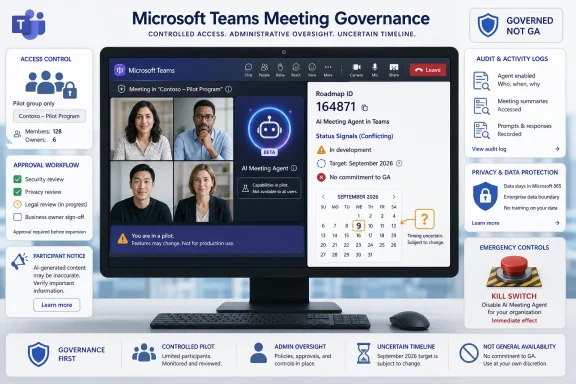 September Is a Planning Marker, Not a Change Window
Microsoft describes Interactive Agents as bringing agents directly into Teams meetings and 1:1 calls. Participants would be able to interact with them privately or as a group, use zero-state prompts, and access history support.The roadmap’s status language undercuts the apparent certainty of the September date. The same entry that lists September 2026 says Microsoft cannot continue the rollout “at this time,” leaving administrators with a material conflict rather than an actionable release commitment.
That should change how the feature is entered into internal calendars. September belongs in the risk register and roadmap watchlist, but not in an approved production change request, user communication, or training schedule that assumes availability.
Microsoft also draws an important boundary around session support. Only agents built on Copilot are described as remembering context from earlier interactions within the same session; custom agents do not yet support sessions. Administrators should therefore avoid writing one policy for “Teams agents” as though every agent will retain, expose, or discard conversational context in the same way.
The difference affects testing as well as disclosure. A Copilot-based agent’s behavior may depend on what was said or requested earlier in the meeting, while a custom agent without session support may respond without that continuing context. Test scripts must identify the agent type rather than treating the meeting surface as the sole unit of control.
Build the Minimum Governance Baseline Before Preview Access Appears
Organizations do not need Microsoft’s final rollout schedule to decide who owns agent admission, participant notification, evidence retention, and emergency suspension. Those controls should be settled before an agent can become another participant in a meeting.A practical pre-release checklist should contain these seven steps:
- Assign an accountable service owner. Give one named Teams or Microsoft 365 service owner authority over availability, rollout rings, exceptions, suspension, and communication.
- Create an initial access group. Limit the first deployment population to designated testers rather than relying on tenant-wide availability. Include representatives from Teams administration, security, compliance, privacy, support, and the business units expected to use agents.
- Classify approved meeting scenarios. Decide whether agents may be used in ordinary internal meetings, 1:1 calls, externally attended meetings, meetings involving restricted information, or sessions subject to recording and transcription controls.
- Define participant-notice requirements. Specify who must announce the agent, when notice must occur, what the notice must explain, and what happens if a participant objects or cannot consent under organizational policy.
- Separate agent interaction from recording decisions. Do not assume permission to use an agent automatically authorizes recording, transcription, retention, or reuse of meeting content. Each capability needs an explicit decision and owner.
- Document the shutdown path. Record how administrators will change availability to no one, remove a pilot group, suspend an individual agent, and notify meeting organizers if unexpected behavior appears.
- Set an evidence standard for the pilot. Retain the approvals, policy configuration, test results, exceptions, incident records, and final decision showing why broader deployment was accepted or rejected.
That existing control is the logical starting point for a pilot, although Microsoft has not confirmed in the roadmap entry exactly how Interactive Agents will appear within the administrative experience. IT should verify the exposed controls in its own tenant before assuming the built-in-agent page will provide every required restriction.
WindowsForum’s recent coverage of the July 2026 Teams admin center changes reached the same broader conclusion: controls that default toward availability require administrators to make deliberate assignments before adoption outruns governance. The Interactive Agents roadmap conflict makes that preparation more urgent, not less.
Meeting Policy Must Follow the Data, Not the Feature Name
The difficult question is not simply whether an agent can enter a meeting. It is what the organization permits the agent to receive, remember, produce, and potentially pass into another workflow.A compact decision matrix can prevent organizers from improvising those rules during a live call:
| Meeting condition | Baseline decision before pilot use |
|---|---|
| Internal meeting with routine business information | Permit only for the approved test group, with participant notice and a named organizer responsible for the agent. |
| 1:1 call | Require explicit notice because private interaction and session history may be less visible to the other participant. |
| Meeting with external participants | Require organizer review and a defined method for handling objections before agent interaction begins. |
| Meeting involving restricted or sensitive material | Block by default until security, privacy, and compliance owners approve a documented exception. |
| Recording or transcription is enabled | Confirm separately whether agent use, recording, transcription, and resulting artifacts are each permitted. |
| Agent behavior or ownership cannot be verified | Do not admit or enable the agent until its owner, purpose, and approved data use are established. |
Private agent interactions deserve particular scrutiny. If a participant can communicate with an agent privately during a group meeting, other attendees may not have a complete view of the prompts being submitted or the outputs being generated. The roadmap’s reference to group and private interactions therefore creates a governance question even before Microsoft publishes the final interface.
Session history adds another layer. IT should test whether notices remain visible throughout a meeting, how users distinguish private from shared interaction, and whether outputs make their context clear. Because custom agents currently lack session support, the same test must also confirm what users experience when continuity is unavailable.
External Bot Approval Is a Guardrail, Not a Universal Agent Switch
Microsoft’s current external-bot meeting policy defaults to requiring organizer approval when Teams detects an external bot. Detected bots are placed in the lobby and must be admitted before entering a meeting hosted by the organization.That is a valuable safeguard, particularly for external transcription and note-taking services, but it should not be mistaken for comprehensive control over Interactive Agents. The policy addresses detected external bots; the roadmap item concerns agents integrated into Teams meetings and calls. IT should not assume that every internal, built-in, Copilot-based, or custom agent will encounter the same lobby checkpoint.
Organizer approval also transfers a security decision to a person who may be concentrating on the meeting rather than validating an automated participant. Administrators should define who is allowed to admit bots and train organizers to reject unfamiliar entries rather than treating the lobby label as proof that a tool is approved.
The safest baseline is to retain Microsoft’s approval requirement for detected external bots while creating a separate allowlist and access group for sanctioned Teams agents. One control governs entry into hosted meetings; the other governs whether users can access an approved agent in the first place.
The Pilot Needs Audits, Exceptions, and a Real Kill Switch
A pilot is not controlled merely because it starts small. Administrators need a recurring review that compares approved agents and users with what is actually available, used, reported, and excepted.Post-rollout checks should confirm that pilot membership has not expanded informally, that each enabled agent still has an active owner, and that meeting scenarios remain within the approved scope. Reviewers should also examine support cases and organizer feedback for unexpected private interactions, confusing context behavior, unauthorized use, or failures in participant notice.
Exceptions need expiration dates and accountable approvers. A permanent exception created to unblock one meeting can quietly become an alternative policy path unless it is reviewed and closed.
The kill switch must be operational rather than aspirational. Before the first pilot meeting, Teams administrators should prove that they can change a built-in agent’s availability to no one or remove the relevant users and groups, then document who can authorize that action outside normal change windows.
Evidence retention completes the control loop. Keep the configuration state, approval record, test population, exception decisions, incident history, and go-or-no-go outcome according to the organization’s established retention requirements. If Microsoft changes the roadmap date or session model, that evidence shows which assumptions must be retested.
Microsoft Still Owes Administrators a Deployable Schedule
The September 2026 marker remains useful because it sets a near-term deadline for governance preparation. It is not yet reliable enough to anchor production deployment.Microsoft needs to clarify whether Roadmap ID 164871 has resumed, which tenants and release channels receive it first, what prerequisites apply, how administrators control it, and when broader availability is expected. It also needs to reconcile the scheduled rollout start with the statement that rollout cannot continue.
Until then, IT should place Interactive Agents in a controlled pre-release workstream: establish ownership, restrict availability, classify meetings, define notice and consent handling, separate recording and transcription decisions, test the shutdown mechanism, and retain evidence. The organizations best prepared for September will be those ready to govern the feature—but equally ready for September to pass without a production rollout.