

Teramind’s new platform arrives at an inflection point: enterprises are no longer asking whether they should use AI agents — they are asking how to control, audit, and insure them when they act faster than humans and beyond traditional security tooling.
The rapid adoption of generative models and autonomous agents across enterprises has created a glaring visibility gap that legacy security and DLP tools were never designed to close. Workers copy-and-paste proprietary data into chat windows, developer tools refactor code autonomously, and “agentic” systems execute hundreds of commands in seconds — all while traditional monitoring only sees network flows, application installs, or human keystrokes. Teramind’s freshly announced offering positions itself as a single control plane to reclaim that blind spot: an AI visibility and policy enforcement platform that treats AI tools and agents as first‑class objects in the enterprise security stack.
At its core the product promises three linked capabilities: discover and log every AI interaction, capture visual and command-level evidence from endpoints, and enforce existing security policies against AI-driven activity. Those capabilities aim to answer questions that matter right now for CISOs, compliance officers, and engineering leaders: Which models are being used? What prompts were sent? Did an agent act on sensitive data? Who authorized those actions?
Strength: This is pragmatic and robust for client-side tools where screen artifacts are the sole evidence of model outputs.
Limitation: UI-driven capture is brittle for headless or cloud-only agents that never render suggestions locally. It also raises storage and privacy concerns if screenshots or transcriptions are retained long-term.
Strength: Precise chain-of-actions for developers, useful for incident response and rollbacks.
Limitation: It assumes the agent executes on monitored endpoints; containerized or cloud-hosted agents may evade such capture unless additional instrumentation (Kubernetes runtime hooks, cloud audit logs) is integrated.
Strength: Harder for adversaries or curious employees to bypass by renaming processes.
Limitation: High sensitivity risks false positives (e.g., legitimate CI/CD jobs or scripted builds). Attackers may adapt by throttling or batching actions, reducing detection efficacy.
Strength: Extends current DLP policy scope to a new class of clients, preserving organizational guardrails.
Limitation: Enforcement at the endpoint/network level may interfere with legitimate productivity, and opaque decisions (automated blocking) can create support churn if not tuned carefully.
That said, governance is not solved by a single product. The platform must be deployed thoughtfully to manage privacy and data-protection obligations, to reduce false positives, and to integrate with cloud-side controls where agents execute remotely. Organizations should treat Teramind as an essential layer in a broader defense-in-depth strategy that includes identity governance, cloud telemetry, model provenance, and cryptographic attestation where appropriate.
If agents represent a new form of workforce, then enterprises need both audit trails and humane policies: the technical capability to see what agents did, and the organizational frameworks to decide what agents should be allowed to do. Teramind provides critical lenses; the responsibility for thoughtful policy, legal compliance, and careful operationalization remains squarely with enterprise leadership.
Source: SiliconANGLE Teramind launches agentic AI visibility and policy platform for AI tools - SiliconANGLE
 Background / Overview
The rapid adoption of generative models and autonomous agents across enterprises has created a glaring visibility gap that legacy security and DLP tools were never designed to close. Workers copy-and-paste proprietary data into chat windows, developer tools refactor code autonomously, and “agentic” systems execute hundreds of commands in seconds — all while traditional monitoring only sees network flows, application installs, or human keystrokes. Teramind’s freshly announced offering positions itself as a single control plane to reclaim that blind spot: an AI visibility and policy enforcement platform that treats AI tools and agents as first‑class objects in the enterprise security stack.At its core the product promises three linked capabilities: discover and log every AI interaction, capture visual and command-level evidence from endpoints, and enforce existing security policies against AI-driven activity. Those capabilities aim to answer questions that matter right now for CISOs, compliance officers, and engineering leaders: Which models are being used? What prompts were sent? Did an agent act on sensitive data? Who authorized those actions?
What Teramind Announces
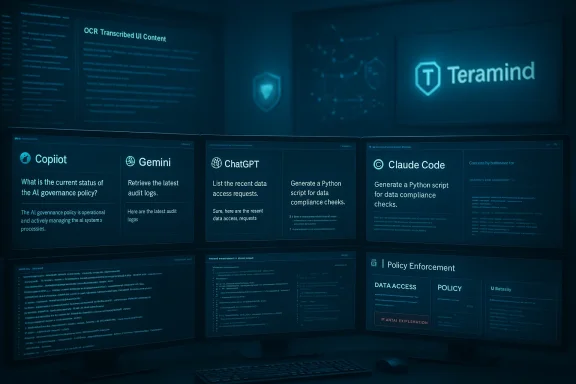
Teramind’s product announcement — framed as an “AI Governance” or “AI Agent Monitoring & Governance” suite — bundles several discrete capabilities under a single operational umbrella:- Prompt and response capture: Every interaction with supported LLMs (the vendor highlights Microsoft Copilot, Google Gemini, ChatGPT, Claude Code, and more) is logged so prompts and returned content are auditable.
- Screen recording + OCR for visual evidence: Because modern copilots and coding assistants surface suggestions in side panels, Teramind captures the UI and runs OCR to persist the model’s reasoning and output as it appeared to the user.
- Console/Command logging for autonomous execution: When an agent executes terminal commands (for example, code generation tools that actually run builds or scripts), Teramind records full shell transcripts to show what changed on the system.
- Behavioral detection of shadow AI: Rather than relying solely on signatures, the platform detects agentic behavior by velocity — patterns like hundreds of commands in seconds — and anomalous network activity.
- Policy enforcement and DLP integration: Existing URL restrictions, DLP rules, and network layer blocks can be extended to AI-driven sessions so that agents cannot exfiltrate data to unsanctioned models.
- Cross-platform coverage with minimal new infra: The vendor claims visibility from “Day One” without additional infrastructure, because the approach centers on endpoint instrumentation and integration with existing telemetry.
Why this matters now: The operational reality of agentic AI
Enterprises face three simultaneous forces that make this product category urgent:- Speed and scale of agents: Agentic systems can act at machine pace — executing multi-step workflows that previously required human orchestration. That multiplies both productivity gains and risk exposure.
- Shadow AI proliferation: Employees and developer teams routinely adopt external tools (public LLMs, browser extensions, or bespoke agents) to accelerate work. These tools may be unsanctioned and opaque to central controls.
- Regulatory pressure and auditability: With regulators focusing on explainability, provenance, and data handling, organizations need granular records showing what data was accessed, when, and by which agents.
Technical anatomy: how Teramind proposes to see and control agents
The platform’s telemetry and enforcement model rests on several practical techniques that are worth unpacking:Endpoint-first evidence capture
Teramind uses endpoint agents to capture UI views, keystrokes, clipboard transfers, and process behavior. The key innovation is visual evidence capture plus OCR: recording the exact panel text returned by a copilot and converting it to searchable text. For agentic browser or IDE integrations (the place many assistants run), that solves the challenge of non-API outputs — if the suggestion was visible to the user, it becomes recoverable as evidence.Strength: This is pragmatic and robust for client-side tools where screen artifacts are the sole evidence of model outputs.
Limitation: UI-driven capture is brittle for headless or cloud-only agents that never render suggestions locally. It also raises storage and privacy concerns if screenshots or transcriptions are retained long-term.
Command-line and filesystem forensics
When agents act in terminals or run scripts, Teramind records full shell transcripts and file-system touches. This provides an audit trail where human typing is absent and is essential for reconstructing what a code-refactoring or automated deployment actually did.Strength: Precise chain-of-actions for developers, useful for incident response and rollbacks.
Limitation: It assumes the agent executes on monitored endpoints; containerized or cloud-hosted agents may evade such capture unless additional instrumentation (Kubernetes runtime hooks, cloud audit logs) is integrated.
Behavioral velocity detection and fingerprinting
Rather than trusting process names, the platform looks at execution patterns (e.g., hundreds of commands in 30 seconds) and network characteristics (unusual ports, handshake signatures) to identify “shadow” or renamed agents.Strength: Harder for adversaries or curious employees to bypass by renaming processes.
Limitation: High sensitivity risks false positives (e.g., legitimate CI/CD jobs or scripted builds). Attackers may adapt by throttling or batching actions, reducing detection efficacy.
Policy enforcement integration
The platform claims to enforce existing URL and content policies even when an agent attempts to ingest or exfiltrate data. For Microsoft Copilot Edge Mode, Teramind suggests blocking or auto-mitigating at the network layer.Strength: Extends current DLP policy scope to a new class of clients, preserving organizational guardrails.
Limitation: Enforcement at the endpoint/network level may interfere with legitimate productivity, and opaque decisions (automated blocking) can create support churn if not tuned carefully.
What Teramind gets right — strengths and opportunities
- Visibility where it counts: Most security platforms focus on the model provider or the server-side model. Teramind’s endpoint-centric stance addresses the real-world intersection of people, data, and AI — where information leaves the organization.
- Practical audit trails for compliance: For regulated industries that demand demonstrable provenance of decisions or data handling, screen capture + OCR plus shell transcripts produce human-readable evidence that auditors can inspect.
- Behavioral detection is an important shift: Relying on signatures alone is insufficient; pattern-based detection catches renamed or bespoke agent runtimes that would otherwise slip through.
- Ecosystem play: The product integrates with common LLM surfaces (Copilot, Gemini, ChatGPT, Claude Code), meaning organizations can get multi-vendor coverage from a single policy plane.
- Low friction pitch: The claim of “no new infrastructure” and fast time-to-value is attractive to overstretched SOC teams who don’t want yet another cloud pipeline to manage.
Caveats, risks, and open questions
No single product can remove all agentic AI risk. Below are the key limitations and operational risks that organizations must weigh before large-scale adoption.1. Privacy, surveillance, and legal risk
Capturing prompts, responses, screen content, and full shell transcripts is powerful — and potentially intrusive. If monitoring records personal data or private conversations, organizations face legal restrictions (e.g., workplace privacy laws across jurisdictions) and employee trust erosion.- Enterprises must define strict retention policies, role-based access to logs, and purpose-limiting controls to avoid mission creep.
- Unionized workforces or privacy-focused regions may require explicit consent or narrower monitoring scopes.
2. Data protection and storage concerns
Large volumes of screen captures and transcript logs can create a new sensitive datastore. That recording may itself contain regulated data, meaning DLP and encryption policies must extend to the governance logs.- Who has access to the evidence store? How long is it retained? Where is it hosted? These are critical questions that must be resolved and audited.
3. Coverage gaps for cloud-native agents
Agents that run entirely in the cloud (server-side orchestrators, agent farms in the vendor network) or that interact with enterprise resources via API-based connectors may not render UI artifacts on endpoints, limiting Teramind’s visibility to network-level telemetry.- Complementary instrumentation (cloud audit logs, API gateway tracing, MCP-style connectors) is required for full coverage.
4. False positives and operational noise
Behavioral detectors tuned to flag “hundreds of commands in seconds” may generate false alerts for legitimate automation (nightly jobs, build systems). Without careful rule tuning and integration with change windows, SOC teams risk alert fatigue.5. Adversarial evasion and the cat-and-mouse game
As defenders build behavioral signatures, attackers will adapt with throttling, randomized timing, or by moving critical steps off monitored endpoints. A long-running, multi-stage exfiltration strategy can evade velocity-based rules.6. Interpretability and provenance limits
Capturing what appeared on a screen or a sequence of shell commands provides what happened but not always why or which model internals led to the action. For deep model governance (e.g., proving absence of bias or model provenance), additional model-level artifacts are necessary.7. Single-vendor lock-in risk
Relying on a single observability vendor for auditability creates concentration risk. Organizations should demand open export formats and policy-as-code compatibility to avoid vendor lock-in.How to operationalize AI governance: recommended deployment pattern
Teramind’s tooling can be an important part of an enterprise’s agentic AI governance program, but practical success requires a phased, risk-oriented approach. Here’s a recommended roadmap:- Inventory and prioritize
- Identify business workflows where agents interact with sensitive data (finance approvals, code deploys, legal drafts).
- Target high‑risk groups first (developers with write access, customer data teams, R&D).
- Deploy in monitoring-only mode
- Start with passive capture and observation to build a baseline and reduce false positives.
- Work with legal and HR to define acceptable monitoring boundaries.
- Tune behavioral detectors and policies
- Differentiate legitimate automation (CI/CD, scheduled jobs) from agentic behaviors by tagging known automation.
- Adjust thresholds to balance sensitivity and specificity.
- Introduce policy enforcement in controlled waves
- Begin by blocking only the highest-risk actions (clipboard paste to public LLMs, upload of regulated data).
- Gradually enforce more policies as confidence grows.
- Integrate with SIEM, SOAR, and identity governance
- Feed agent activity into the SIEM for correlation with other telemetry.
- Orchestrate automated containment via SOAR playbooks when an agent exhibits malicious or risky actions.
- Red-team and adversarial testing
- Simulate prompt injection, exfiltration via agents, and renamed process evasion to test detection and response workflows.
- Policy-as-code and auditability
- Codify AI policies and retention rules so that audits are mechanical and reproducible.
- Human-in-the-loop controls for critical decisions
- Require explicit human approval for destructive or high-value actions initiated by agents.
Where governance needs to go next: industry-level gaps and technical research
Teramind’s offering is a step toward practical governance, but long-term enterprise assurance will require new primitives beyond endpoint monitoring:- Agent identity and non-human identity (NHI): Treating agents as identities (with lifecycle, credentials, and privileges) is a necessary evolution. Identity-based controls — where an agent has a verifiable principal — make least-privilege and accountability tractable.
- Authenticated workflows and cryptographic attestation: Recent research suggests the need for cryptographic proof that an operation was authorized and executed by a given identity under certain policies. This shifts governance from observation (see what happened) to enforcement with cryptographic evidence (prove what happened and why).
- Standardized AI audit artifacts: Exportable, interoperable artifacts (prompt hashes, model provenance metadata, policy decisions) will help auditors and regulators verify compliance without sifting through raw screen recordings.
- Runtime, system-level observability: eBPF-style tracing that correlates network flows, process activity, and semantic intent (prompts) offers richer detection without heavy UI capture.
- Cross-domain collaboration: Governance must stitch together endpoint logs, cloud audit records, API gateway traces, and model-provider logs. No single vendor can own all of that without standardization and interop.
Competitive context: not the only answer — but a necessary layer
Teramind’s platform joins a growing market of vendors addressing agentic AI risk from different angles. Some players focus on identity and non-human identity discovery, others on data-centric governance, and others on cloud-side policy enforcement.- Identity-first vendors treat agents as principals that can be discovered and given least-privilege access.
- Data-centric vendors map sensitive data to models and track which AI systems touch specific data types.
- Cloud-native vendors provide agent lifecycle and policy orchestration within the cloud control plane.
Practical verdict: who should consider Teramind, and when
Teramind’s product is especially compelling for organizations that:- Have wide adoption of vendor copilots (Copilot, Gemini, ChatGPT) and lack a clear way to audit what those assistants do.
- Run developer workflows where agents can execute commands that touch production systems.
- Operate in regulated industries where an auditable trail of decisions and data handling is required for compliance.
- Want quick wins by extending existing DLP and endpoint controls to an emergent threat class without wholesale infrastructure overhaul.
Final analysis — balancing promise and reality
Teramind’s launch fills a glaring operational gap. The company’s focus on visual capture, shell transcripts, and behavioral detection directly addresses the place where AI, people, and enterprise data converge. For security, compliance, and engineering teams wrestling with the speed, opacity, and reach of agentic AI, this kind of endpoint-centric governance is a necessary and pragmatic tool.That said, governance is not solved by a single product. The platform must be deployed thoughtfully to manage privacy and data-protection obligations, to reduce false positives, and to integrate with cloud-side controls where agents execute remotely. Organizations should treat Teramind as an essential layer in a broader defense-in-depth strategy that includes identity governance, cloud telemetry, model provenance, and cryptographic attestation where appropriate.
If agents represent a new form of workforce, then enterprises need both audit trails and humane policies: the technical capability to see what agents did, and the organizational frameworks to decide what agents should be allowed to do. Teramind provides critical lenses; the responsibility for thoughtful policy, legal compliance, and careful operationalization remains squarely with enterprise leadership.
Source: SiliconANGLE Teramind launches agentic AI visibility and policy platform for AI tools - SiliconANGLE
