

Tesco is preparing a major rollout of Hanshow electronic shelf labels across its store estate after a 2025 pilot, while Hanshow is separately pitching xPilot, a Microsoft Azure-based AI store-execution assistant, as the next layer above digitised shelf infrastructure in physical retail. That combination matters because electronic labels are no longer just about replacing paper tickets. They are becoming the visible edge of a larger retail operating system: prices, stock signals, planograms, staff tasks, footfall, energy use, and eventually AI-directed interventions. For shoppers, it will look like a small screen on a shelf; for IT teams, it is another distributed endpoint estate with cloud dependencies, data governance questions, and a new blast radius.
The supermarket shelf has always been a surprisingly awkward computing problem. It is where inventory, pricing, promotions, supplier funding, merchandising rules, food waste, labour planning, and customer trust all collide in a space measured in centimetres. Paper labels were cheap, legible, and resilient, but they were also slow: every price change became a human workflow, every promotion carried a risk of mismatch, and every missed update became a complaint at the till.
Electronic shelf labels solve the obvious part first. They let a retailer update shelf-edge prices centrally and push changes across a store without printing, cutting, sorting, walking, peeling, and replacing thousands of bits of paper. That alone is attractive in grocery, where promotions churn constantly and labour is both expensive and scarce.
But the Tesco-Hanshow story is larger than price tags. Hanshow’s newer pitch, especially around xPilot, treats shelf labels and other in-store devices as sensors and execution points in a bigger digital twin of the store. Once that language enters the conversation, the label stops being a peripheral and becomes part of the nervous system.
That is why this rollout deserves attention beyond the retail trade press. Grocery chains are not casually adding a gadget; they are industrialising a layer of real-time store infrastructure. The same forces that pushed warehouses, logistics networks, and online storefronts into cloud-managed automation are now moving down the aisle.
Pilots in retail are easy to announce and hard to scale. A few aisles in a controlled store can flatter almost any technology: the Wi-Fi is tuned, staff are briefed, vendors are on hand, and the project team is watching the dashboards. Rolling the same system into a messy national estate is a different test entirely.
Tesco’s estate is not a boutique environment. It spans large stores, convenience formats, different local operating rhythms, legacy systems, intense promotional cycles, and a customer base that notices even minor pricing confusion. If electronic shelf labels move widely into that environment, they will have to function as boring infrastructure, not as a showroom demo.
That is where Hanshow’s moment becomes interesting. The company is not presenting electronic shelf labels as an isolated cost-saving product. It is positioning them as part of an intelligent store stack, with xPilot sitting above smart shelves, smart carts, in-store robotics, operational systems, and other IoT touchpoints. In other words: get the shelf edge digitised, then connect the shelf edge to the rest of the store.
For Tesco, the near-term business case is likely practical. Fewer manual label changes, better price accuracy, faster promotion execution, and less staff time lost to repetitive shelf-edge maintenance are tangible benefits. But the strategic case is more ambitious: a digital shelf estate gives the retailer a physical-world surface that can be updated, monitored, and eventually orchestrated.
That is a tidy Microsoft story. Fabric is being pushed as the place where enterprise data becomes usable across analytics and AI, while Foundry gives organisations a managed environment for building and orchestrating AI agents. Hanshow’s retail pitch maps neatly onto that: gather the store signals, join them with commercial data, reason over the combined picture, and turn the answer into a task or automated action.
The promised use cases are familiar to anyone who has watched retail operations from the inside. A gap appears on a shelf. A planogram is not being followed. A promotion is live in the pricing system but not correctly reflected in the aisle. A high-traffic area is under-staffed. A refrigerated zone is consuming more energy than expected. Each of those problems has traditionally depended on a mixture of periodic checks, staff experience, manual reporting, and after-the-fact analysis.
xPilot’s pitch is that those conditions can be detected and acted on in something closer to real time. The system is described as offering visibility into shelf availability, planogram compliance, operational alerts, and live heatmaps covering sales, traffic, conversion, labour, and energy usage. The language is ambitious, but the direction is plausible: retail wants to shrink the time between sensing a problem and doing something about it.
Rainbow Department Store in China is among the early live deployments, according to Hanshow. That matters because it gives the company a showcase for the digital twin story outside the controlled environment of a conference booth. Still, early deployments are not proof of broad maturity. They are proof that the model is commercially presentable and technically deployable somewhere.
Retail has long been one of Microsoft’s more strategically useful battlegrounds. The sector has enormous data volumes, hybrid infrastructure, dispersed physical sites, thin margins, and deep suspicion of giving too much control to platforms that also compete in commerce. Microsoft can argue that it is not the retailer’s rival in the way some other technology giants might be perceived. That has made Azure, Microsoft 365, Dynamics, Power Platform, Fabric, and now Foundry easier to position as neutral infrastructure for retailers trying to modernise without empowering a direct marketplace competitor.
xPilot fits that playbook. It does not ask a retailer merely to buy AI as a chatbot. It asks the retailer to adopt Microsoft cloud services as the control plane for operational intelligence. The agent is the glossy front end; the durable business is compute, data integration, identity, governance, and workflow.
That is why WindowsForum readers should care even if they never manage a supermarket. The same enterprise pattern keeps repeating. A physical process gets instrumented. The signals move into a cloud data platform. AI agents are layered on top. Human approvals remain for some actions, but the direction of travel is toward recommendations, prioritisation, and eventually partial automation.
For IT departments, the question is not whether the word “AI” appears in the vendor deck. It is whether the resulting system can be governed like production infrastructure. In retail, production infrastructure is not abstract. If it breaks, prices are wrong, shelves are empty, staff are misdirected, and customers lose trust at the point of purchase.
A centralised label system can make that complexity more manageable. If the price database is the source of truth, the shelf can reflect it quickly and consistently. In theory, that reduces disputes and saves staff from fixing outdated paper tickets during peak trading.
But the same capability also triggers anxiety about dynamic pricing. Shoppers are accustomed to online prices changing frequently, but many still expect the physical supermarket shelf to have a slower rhythm and a stronger sense of public fairness. If a digital label can change in seconds, customers will ask whether prices might rise during busy periods, vary by location, or react to demand in ways that feel opportunistic.
Retailers will insist that electronic shelf labels are about efficiency, accuracy, and waste reduction, not surge pricing for bread and milk. In many grocery contexts, that is probably true. Food retailers already operate under reputational, regulatory, and competitive constraints that make aggressive real-time price manipulation risky.
Still, the concern is not irrational. Technology changes what is operationally possible, and once something becomes easy to do, business pressure tends to explore it. The important distinction is between dynamic execution of planned prices and dynamic exploitation of customer moments. The first is operational hygiene; the second is where public trust starts to fray.
Tesco, like any major grocer, will need to manage that perception carefully. The shelf edge is a public interface. If shoppers believe the system is there to make prices clearer, it will be accepted. If they suspect it is there to make prices slippery, every label becomes a tiny billboard for distrust.
But fewer paper label tasks does not automatically mean fewer people in a simple one-for-one way. Grocery stores are full of work that is irregular, physical, local, and hard to automate cleanly. Staff might spend less time on tickets and more time filling shelves, helping customers, checking dates, picking online orders, or resolving exceptions generated by the very systems meant to streamline the store.
The more interesting labour shift is managerial. If xPilot-style systems mature, store colleagues may increasingly receive prioritised tasks from an AI-mediated workflow rather than from a supervisor’s walkaround, a printed report, or accumulated local knowledge. That changes how work is allocated and how performance is measured.
There are benefits. A good system can surface the most urgent problem first, reduce wasted walks, and prevent quiet failures from hiding until the end of the day. A poor system can bury staff in alerts, misread context, and turn store work into a queue of algorithmic nags.
This is where retail AI faces its hardest cultural test. Store teams already operate under pressure. If the technology is framed as assistance, tuned carefully, and allowed to learn from human correction, it may be welcomed. If it arrives as surveillance plus unrealistic tasking, it will become another source of attrition.
Retail sits somewhere between those extremes. A store is not a jet engine, but it is a complex physical system with products, people, sensors, fridges, tills, promotions, deliveries, and local quirks. Modelling that system well enough to guide action is valuable. Modelling it badly can produce confident nonsense.
The challenge is data fidelity. Smart shelves can detect some conditions, but not every reason behind them. A product may be absent because demand spiked, a case is in the back room, the supplier shorted the delivery, the shelf is blocked, the planogram changed, or the product was moved by a customer. Computer vision may see a gap, but action still depends on operational context.
That is where unifying sensing data with business data becomes more than a technical slogan. A useful assistant needs inventory records, delivery schedules, price files, promotion calendars, planograms, staff rosters, footfall patterns, and perhaps energy telemetry. It also needs to understand which data is stale, which system wins during a conflict, and which recommendation should be suppressed because the store cannot act on it.
Microsoft Fabric is a plausible foundation for that kind of work because it is aimed at bringing data domains into a governed platform rather than scattering them across isolated reporting stacks. But the platform does not magically fix retail data quality. It gives the retailer a place to do the hard work.
The threat model is not limited to Hollywood-style price hacking. More realistic risks include misconfiguration, failed updates, stale labels, device enrolment errors, compromised management consoles, vendor access weaknesses, and integration bugs between pricing systems and label systems. The operational damage may be mundane, but mundane damage across hundreds or thousands of stores can become expensive quickly.
An AI execution layer adds another dimension. If agents can recommend or trigger staff tasks, update workflows, or initiate automated actions, then identity, authorisation, audit logging, rollback, and human approval paths become central. The system must answer basic questions: who or what made this recommendation, what data did it use, who approved it, and how can the action be reversed?
Microsoft’s enterprise stack is built to talk about those controls. Identity passthrough, role-based access, governance, auditability, and tenant boundaries are all part of the official AI-agent architecture story. But deploying them well is not automatic, especially when store operations vendors, retail IT, cloud teams, security teams, and business units all share the system.
For sysadmins, the lesson is familiar. The moment a device estate becomes business-critical, procurement questions turn into lifecycle questions. Who patches it? Who monitors it? What happens during a network outage? Can the store trade if the cloud control plane is degraded? How long can labels operate offline? Where is the emergency override?
A future Tesco store with electronic shelf labels, IoT sensors, smart shelves, staff devices, cameras, robotics, and cloud-linked AI workflows is an edge environment by any practical definition. Some decisions can be centralised, but many failures must be handled locally. Stores need degraded modes, local caches, clear fallback procedures, and staff who understand what to do when the automation stops being helpful.
That matters because grocery runs on thin margins and relentless rhythm. A store cannot simply pause trading because the label management platform is unavailable. Promotions still start. Deliveries still arrive. Customers still ask why the price on the shelf is not the price at the till.
The best version of this architecture will be boringly resilient. Labels will update when they should, remain readable when networks wobble, reconcile cleanly after outages, and expose enough telemetry for central teams to spot failing devices before stores complain. The worst version will create a new class of intermittent, hard-to-diagnose retail incidents that bounce between vendor support, network teams, store operations, and application owners.
This is why the Tesco rollout, if it proceeds at scale, will be judged less by launch-day excitement than by its second Christmas trading period. Retail infrastructure proves itself during peak load, bad weather, supplier disruption, staff shortages, and promotion chaos. Anything can work on a quiet Tuesday.
The risk is that digital labels become visually noisy. A supermarket shelf is already an overloaded information surface, full of prices, unit costs, loyalty offers, dietary markers, promotions, supplier branding, and legal requirements. If electronic labels add flashing cues, dense icons, QR codes, or inconsistent layouts, they may make the aisle feel more like an app than a shop.
Accessibility will matter. Labels need to be legible from realistic distances, under uneven lighting, at awkward shelf heights, and for shoppers with impaired vision. The shift from paper to electronic displays should not become an excuse to shrink type, hide unit pricing, or privilege loyalty mechanics over plain price clarity.
There is also a psychological dimension. Paper labels feel static even when they are frequently changed. Digital labels remind shoppers that the shelf is connected to a system. That can be reassuring if the system is transparent and accurate, but unsettling if it appears too clever.
Tesco has spent years making Clubcard Prices central to its value proposition. Electronic shelf labels could make those offers easier to manage and display, but they could also sharpen the divide between headline prices and loyalty prices. The more dynamic the shelf becomes, the more important clarity becomes.
The reason is obvious. Hardware margins alone are not the dream. The recurring value sits in software, cloud services, analytics, AI workflows, device management, and integrations with merchandising and supply chain systems. Once a retailer standardises on a shelf-edge platform, switching becomes harder because the labels become entangled with store processes.
That does not make the technology bad. It means buyers need to treat it as a platform commitment from the beginning. A digital label rollout is not comparable to buying new printers. It is closer to adopting a store-wide execution layer whose value depends on integration and whose risks depend on governance.
Hanshow’s open architecture language is therefore important, but it will need scrutiny in real deployments. Retailers will want integrations with merchandising systems, ERP, workforce management, supply chain platforms, customer engagement tools, and perhaps media networks. Open architecture can mean healthy interoperability, or it can mean “we have APIs if you pay and wait.”
For Tesco, bargaining power helps. Large retailers can force vendors to meet enterprise requirements that smaller chains cannot. But scale also increases dependency. Once millions of labels and thousands of workflows sit on a vendor platform, the relationship becomes strategic.
A store-execution assistant has to deal with constraints that a pure knowledge worker chatbot can avoid. It must understand physical availability, staff capacity, store layout, promotion timing, customer traffic, and the cost of interruption. It must also know when not to act.
That last point is crucial. A good retail agent should not simply generate more work. It should suppress low-value alerts, bundle tasks intelligently, avoid sending staff on pointless walks, and escalate only when the likely benefit is real. If every shelf gap, temperature fluctuation, planogram variance, and traffic spike becomes a notification, the system will train staff to ignore it.
The hard product question is whether xPilot can turn signal abundance into useful prioritisation. Retailers already have more data than they can act upon. The promise of AI is not another dashboard; it is better judgment at the point where action is possible.
Microsoft and Hanshow are using the right language for that promise: unified data, agents, workflows, real-time action. The burden now shifts from vocabulary to proof. Store managers will not judge the system by whether it uses Fabric or Foundry. They will judge it by whether shelves are fuller, prices are right, teams are less frazzled, and customers complain less.
That does not mean Tesco should avoid the rollout. In many ways, the move is overdue. Discounters and international retailers have already shown that electronic shelf labels can become normal in everyday shopping environments. Grocery’s paper-heavy back office feels increasingly anachronistic in a world where prices, promotions, and supply conditions move faster than staff can relabel by hand.
But Tesco will need to over-communicate the boring benefits. Price accuracy, faster promotion changes, reduced paper waste, and freeing staff from repetitive administration are easy to understand. AI-driven store execution, digital twins, and real-time operational intelligence are less likely to reassure the average shopper.
The trust issue is not solved by saying “we do not use surge pricing.” It is solved by consistent behaviour over time. If shoppers see stable, clear, accurate labels, the technology fades into the background. If they see confusing changes, mismatches, or loyalty-price opacity, the technology becomes the culprit whether or not it caused the problem.
The same applies internally. If store colleagues see electronic labels as a tool that removes drudgery, adoption will be easier. If they see them as a prelude to headcount pressure or algorithmic micromanagement, resistance will be rational.
 The Shelf Edge Is Becoming the Store’s Operating System
The supermarket shelf has always been a surprisingly awkward computing problem. It is where inventory, pricing, promotions, supplier funding, merchandising rules, food waste, labour planning, and customer trust all collide in a space measured in centimetres. Paper labels were cheap, legible, and resilient, but they were also slow: every price change became a human workflow, every promotion carried a risk of mismatch, and every missed update became a complaint at the till.Electronic shelf labels solve the obvious part first. They let a retailer update shelf-edge prices centrally and push changes across a store without printing, cutting, sorting, walking, peeling, and replacing thousands of bits of paper. That alone is attractive in grocery, where promotions churn constantly and labour is both expensive and scarce.
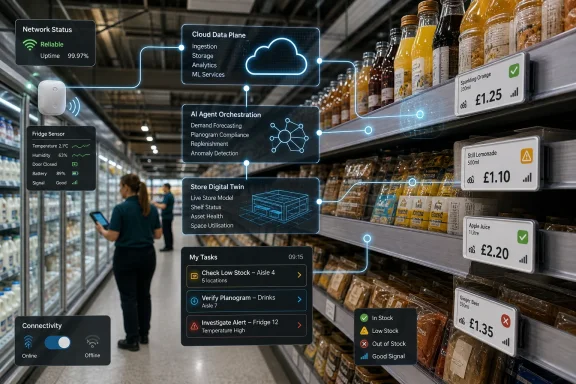
But the Tesco-Hanshow story is larger than price tags. Hanshow’s newer pitch, especially around xPilot, treats shelf labels and other in-store devices as sensors and execution points in a bigger digital twin of the store. Once that language enters the conversation, the label stops being a peripheral and becomes part of the nervous system.
That is why this rollout deserves attention beyond the retail trade press. Grocery chains are not casually adding a gadget; they are industrialising a layer of real-time store infrastructure. The same forces that pushed warehouses, logistics networks, and online storefronts into cloud-managed automation are now moving down the aisle.
Tesco’s Pilot Has Graduated Into a Platform Decision
Tesco’s reported move follows a 2025 pilot with Hanshow electronic shelf labels and now appears to be heading toward a wider deployment across the retailer’s estate. The crucial point is not merely that one of the UK’s biggest grocers likes digital labels. It is that a pilot has apparently crossed the line from experiment to infrastructure programme.Pilots in retail are easy to announce and hard to scale. A few aisles in a controlled store can flatter almost any technology: the Wi-Fi is tuned, staff are briefed, vendors are on hand, and the project team is watching the dashboards. Rolling the same system into a messy national estate is a different test entirely.
Tesco’s estate is not a boutique environment. It spans large stores, convenience formats, different local operating rhythms, legacy systems, intense promotional cycles, and a customer base that notices even minor pricing confusion. If electronic shelf labels move widely into that environment, they will have to function as boring infrastructure, not as a showroom demo.
That is where Hanshow’s moment becomes interesting. The company is not presenting electronic shelf labels as an isolated cost-saving product. It is positioning them as part of an intelligent store stack, with xPilot sitting above smart shelves, smart carts, in-store robotics, operational systems, and other IoT touchpoints. In other words: get the shelf edge digitised, then connect the shelf edge to the rest of the store.
For Tesco, the near-term business case is likely practical. Fewer manual label changes, better price accuracy, faster promotion execution, and less staff time lost to repetitive shelf-edge maintenance are tangible benefits. But the strategic case is more ambitious: a digital shelf estate gives the retailer a physical-world surface that can be updated, monitored, and eventually orchestrated.
Hanshow’s xPilot Shows Where the Label Business Is Heading
Hanshow announced xPilot as a real-time store execution AI assistant built on Microsoft Azure, using Microsoft Fabric to unify in-store sensing data with retailer business data and Microsoft Foundry-powered agents to translate signals into actions. Strip away the launch-event vocabulary and the architecture is clear enough: Fabric becomes the data plane, Foundry becomes the agent layer, and Hanshow’s store devices become the physical context.That is a tidy Microsoft story. Fabric is being pushed as the place where enterprise data becomes usable across analytics and AI, while Foundry gives organisations a managed environment for building and orchestrating AI agents. Hanshow’s retail pitch maps neatly onto that: gather the store signals, join them with commercial data, reason over the combined picture, and turn the answer into a task or automated action.
The promised use cases are familiar to anyone who has watched retail operations from the inside. A gap appears on a shelf. A planogram is not being followed. A promotion is live in the pricing system but not correctly reflected in the aisle. A high-traffic area is under-staffed. A refrigerated zone is consuming more energy than expected. Each of those problems has traditionally depended on a mixture of periodic checks, staff experience, manual reporting, and after-the-fact analysis.
xPilot’s pitch is that those conditions can be detected and acted on in something closer to real time. The system is described as offering visibility into shelf availability, planogram compliance, operational alerts, and live heatmaps covering sales, traffic, conversion, labour, and energy usage. The language is ambitious, but the direction is plausible: retail wants to shrink the time between sensing a problem and doing something about it.
Rainbow Department Store in China is among the early live deployments, according to Hanshow. That matters because it gives the company a showcase for the digital twin story outside the controlled environment of a conference booth. Still, early deployments are not proof of broad maturity. They are proof that the model is commercially presentable and technically deployable somewhere.
Microsoft Gets Another Front Door Into Physical Retail
Microsoft’s role is easy to underestimate if the shelf label is treated as the headline object. Azure is not supplying the screen on the shelf. It is supplying the enterprise cloud fabric beneath the operational story, and that is the more valuable layer.Retail has long been one of Microsoft’s more strategically useful battlegrounds. The sector has enormous data volumes, hybrid infrastructure, dispersed physical sites, thin margins, and deep suspicion of giving too much control to platforms that also compete in commerce. Microsoft can argue that it is not the retailer’s rival in the way some other technology giants might be perceived. That has made Azure, Microsoft 365, Dynamics, Power Platform, Fabric, and now Foundry easier to position as neutral infrastructure for retailers trying to modernise without empowering a direct marketplace competitor.
xPilot fits that playbook. It does not ask a retailer merely to buy AI as a chatbot. It asks the retailer to adopt Microsoft cloud services as the control plane for operational intelligence. The agent is the glossy front end; the durable business is compute, data integration, identity, governance, and workflow.
That is why WindowsForum readers should care even if they never manage a supermarket. The same enterprise pattern keeps repeating. A physical process gets instrumented. The signals move into a cloud data platform. AI agents are layered on top. Human approvals remain for some actions, but the direction of travel is toward recommendations, prioritisation, and eventually partial automation.
For IT departments, the question is not whether the word “AI” appears in the vendor deck. It is whether the resulting system can be governed like production infrastructure. In retail, production infrastructure is not abstract. If it breaks, prices are wrong, shelves are empty, staff are misdirected, and customers lose trust at the point of purchase.
Price Accuracy Is the Friendly Face of a Harder Debate
Electronic shelf labels have an obvious consumer-friendly argument: they can reduce mismatches between shelf prices and checkout prices. Anyone who has challenged a receipt knows why that matters. Grocery pricing is already complicated by loyalty schemes, multi-buy offers, temporary promotions, local markdowns, and supplier-funded campaigns.A centralised label system can make that complexity more manageable. If the price database is the source of truth, the shelf can reflect it quickly and consistently. In theory, that reduces disputes and saves staff from fixing outdated paper tickets during peak trading.
But the same capability also triggers anxiety about dynamic pricing. Shoppers are accustomed to online prices changing frequently, but many still expect the physical supermarket shelf to have a slower rhythm and a stronger sense of public fairness. If a digital label can change in seconds, customers will ask whether prices might rise during busy periods, vary by location, or react to demand in ways that feel opportunistic.
Retailers will insist that electronic shelf labels are about efficiency, accuracy, and waste reduction, not surge pricing for bread and milk. In many grocery contexts, that is probably true. Food retailers already operate under reputational, regulatory, and competitive constraints that make aggressive real-time price manipulation risky.
Still, the concern is not irrational. Technology changes what is operationally possible, and once something becomes easy to do, business pressure tends to explore it. The important distinction is between dynamic execution of planned prices and dynamic exploitation of customer moments. The first is operational hygiene; the second is where public trust starts to fray.
Tesco, like any major grocer, will need to manage that perception carefully. The shelf edge is a public interface. If shoppers believe the system is there to make prices clearer, it will be accepted. If they suspect it is there to make prices slippery, every label becomes a tiny billboard for distrust.
The Labour Story Is More Complicated Than “Automation Replaces People”
Retail technology announcements often flatten labour into a single metric: hours saved. Electronic shelf labels certainly reduce the time staff spend changing tickets. In a large grocery store, that can be significant, especially during promotion changeovers or seasonal resets.But fewer paper label tasks does not automatically mean fewer people in a simple one-for-one way. Grocery stores are full of work that is irregular, physical, local, and hard to automate cleanly. Staff might spend less time on tickets and more time filling shelves, helping customers, checking dates, picking online orders, or resolving exceptions generated by the very systems meant to streamline the store.
The more interesting labour shift is managerial. If xPilot-style systems mature, store colleagues may increasingly receive prioritised tasks from an AI-mediated workflow rather than from a supervisor’s walkaround, a printed report, or accumulated local knowledge. That changes how work is allocated and how performance is measured.
There are benefits. A good system can surface the most urgent problem first, reduce wasted walks, and prevent quiet failures from hiding until the end of the day. A poor system can bury staff in alerts, misread context, and turn store work into a queue of algorithmic nags.
This is where retail AI faces its hardest cultural test. Store teams already operate under pressure. If the technology is framed as assistance, tuned carefully, and allowed to learn from human correction, it may be welcomed. If it arrives as surveillance plus unrealistic tasking, it will become another source of attrition.
The Digital Twin Is Useful Only If the Real Store Behaves
The phrase digital twin has travelled from engineering into every corner of enterprise software. In its strongest form, it means a live model of a physical environment that can be queried, simulated, and acted upon. In its weakest form, it means a dashboard with a 3D metaphor and a marketing budget.Retail sits somewhere between those extremes. A store is not a jet engine, but it is a complex physical system with products, people, sensors, fridges, tills, promotions, deliveries, and local quirks. Modelling that system well enough to guide action is valuable. Modelling it badly can produce confident nonsense.
The challenge is data fidelity. Smart shelves can detect some conditions, but not every reason behind them. A product may be absent because demand spiked, a case is in the back room, the supplier shorted the delivery, the shelf is blocked, the planogram changed, or the product was moved by a customer. Computer vision may see a gap, but action still depends on operational context.
That is where unifying sensing data with business data becomes more than a technical slogan. A useful assistant needs inventory records, delivery schedules, price files, promotion calendars, planograms, staff rosters, footfall patterns, and perhaps energy telemetry. It also needs to understand which data is stale, which system wins during a conflict, and which recommendation should be suppressed because the store cannot act on it.
Microsoft Fabric is a plausible foundation for that kind of work because it is aimed at bringing data domains into a governed platform rather than scattering them across isolated reporting stacks. But the platform does not magically fix retail data quality. It gives the retailer a place to do the hard work.
The Security Model Now Extends to the Shelf
Every digitised shelf label is not a PC, but it belongs to an endpoint estate. It communicates wirelessly, depends on gateways or access points, receives updates from central systems, and represents a piece of information customers rely on. At national scale, that is not a novelty; it is infrastructure.The threat model is not limited to Hollywood-style price hacking. More realistic risks include misconfiguration, failed updates, stale labels, device enrolment errors, compromised management consoles, vendor access weaknesses, and integration bugs between pricing systems and label systems. The operational damage may be mundane, but mundane damage across hundreds or thousands of stores can become expensive quickly.
An AI execution layer adds another dimension. If agents can recommend or trigger staff tasks, update workflows, or initiate automated actions, then identity, authorisation, audit logging, rollback, and human approval paths become central. The system must answer basic questions: who or what made this recommendation, what data did it use, who approved it, and how can the action be reversed?
Microsoft’s enterprise stack is built to talk about those controls. Identity passthrough, role-based access, governance, auditability, and tenant boundaries are all part of the official AI-agent architecture story. But deploying them well is not automatic, especially when store operations vendors, retail IT, cloud teams, security teams, and business units all share the system.
For sysadmins, the lesson is familiar. The moment a device estate becomes business-critical, procurement questions turn into lifecycle questions. Who patches it? Who monitors it? What happens during a network outage? Can the store trade if the cloud control plane is degraded? How long can labels operate offline? Where is the emergency override?
The Store Network Becomes the New Edge
Enterprise IT has spent years talking about edge computing in factories, hospitals, logistics hubs, and energy networks. Grocery stores deserve a place on that list. They are distributed, bandwidth-sensitive, physically exposed, and commercially intolerant of downtime.A future Tesco store with electronic shelf labels, IoT sensors, smart shelves, staff devices, cameras, robotics, and cloud-linked AI workflows is an edge environment by any practical definition. Some decisions can be centralised, but many failures must be handled locally. Stores need degraded modes, local caches, clear fallback procedures, and staff who understand what to do when the automation stops being helpful.
That matters because grocery runs on thin margins and relentless rhythm. A store cannot simply pause trading because the label management platform is unavailable. Promotions still start. Deliveries still arrive. Customers still ask why the price on the shelf is not the price at the till.
The best version of this architecture will be boringly resilient. Labels will update when they should, remain readable when networks wobble, reconcile cleanly after outages, and expose enough telemetry for central teams to spot failing devices before stores complain. The worst version will create a new class of intermittent, hard-to-diagnose retail incidents that bounce between vendor support, network teams, store operations, and application owners.
This is why the Tesco rollout, if it proceeds at scale, will be judged less by launch-day excitement than by its second Christmas trading period. Retail infrastructure proves itself during peak load, bad weather, supplier disruption, staff shortages, and promotion chaos. Anything can work on a quiet Tuesday.
Shoppers Will Notice the Interface Before They Notice the Architecture
For customers, the first visible change is simple: shelf edges will look different. Small electronic displays will replace paper tickets, and in some sections that may feel cleaner, sharper, and more modern. In fresh, chilled, and promotional areas, the benefit may be especially noticeable if labels can reflect changes quickly and reduce clutter.The risk is that digital labels become visually noisy. A supermarket shelf is already an overloaded information surface, full of prices, unit costs, loyalty offers, dietary markers, promotions, supplier branding, and legal requirements. If electronic labels add flashing cues, dense icons, QR codes, or inconsistent layouts, they may make the aisle feel more like an app than a shop.
Accessibility will matter. Labels need to be legible from realistic distances, under uneven lighting, at awkward shelf heights, and for shoppers with impaired vision. The shift from paper to electronic displays should not become an excuse to shrink type, hide unit pricing, or privilege loyalty mechanics over plain price clarity.
There is also a psychological dimension. Paper labels feel static even when they are frequently changed. Digital labels remind shoppers that the shelf is connected to a system. That can be reassuring if the system is transparent and accurate, but unsettling if it appears too clever.
Tesco has spent years making Clubcard Prices central to its value proposition. Electronic shelf labels could make those offers easier to manage and display, but they could also sharpen the divide between headline prices and loyalty prices. The more dynamic the shelf becomes, the more important clarity becomes.
Vendors Are Selling Execution, Not Just Efficiency
Hanshow is not alone in seeing the shelf edge as a gateway to a broader retail platform. The electronic shelf label market has moved beyond monochrome tags and price-update software into colour displays, sensor integration, battery optimisation, computer vision tie-ins, and analytics. Competitors are making similar arguments: digitise the store surface, then monetise the data and workflows above it.The reason is obvious. Hardware margins alone are not the dream. The recurring value sits in software, cloud services, analytics, AI workflows, device management, and integrations with merchandising and supply chain systems. Once a retailer standardises on a shelf-edge platform, switching becomes harder because the labels become entangled with store processes.
That does not make the technology bad. It means buyers need to treat it as a platform commitment from the beginning. A digital label rollout is not comparable to buying new printers. It is closer to adopting a store-wide execution layer whose value depends on integration and whose risks depend on governance.
Hanshow’s open architecture language is therefore important, but it will need scrutiny in real deployments. Retailers will want integrations with merchandising systems, ERP, workforce management, supply chain platforms, customer engagement tools, and perhaps media networks. Open architecture can mean healthy interoperability, or it can mean “we have APIs if you pay and wait.”
For Tesco, bargaining power helps. Large retailers can force vendors to meet enterprise requirements that smaller chains cannot. But scale also increases dependency. Once millions of labels and thousands of workflows sit on a vendor platform, the relationship becomes strategic.
The AI Agent Hype Finally Meets the Aisle
AI agents have been promised as the next great enterprise interface: systems that do not just answer questions but plan, decide, and act. Much of that discussion has felt abstract, trapped inside productivity suites and developer tools. Retail gives the agent story a more physical test.A store-execution assistant has to deal with constraints that a pure knowledge worker chatbot can avoid. It must understand physical availability, staff capacity, store layout, promotion timing, customer traffic, and the cost of interruption. It must also know when not to act.
That last point is crucial. A good retail agent should not simply generate more work. It should suppress low-value alerts, bundle tasks intelligently, avoid sending staff on pointless walks, and escalate only when the likely benefit is real. If every shelf gap, temperature fluctuation, planogram variance, and traffic spike becomes a notification, the system will train staff to ignore it.
The hard product question is whether xPilot can turn signal abundance into useful prioritisation. Retailers already have more data than they can act upon. The promise of AI is not another dashboard; it is better judgment at the point where action is possible.
Microsoft and Hanshow are using the right language for that promise: unified data, agents, workflows, real-time action. The burden now shifts from vocabulary to proof. Store managers will not judge the system by whether it uses Fabric or Foundry. They will judge it by whether shelves are fuller, prices are right, teams are less frazzled, and customers complain less.
Tesco’s Rollout Will Be a Public Test of Trust
The UK grocery market is brutally competitive, and Tesco’s size makes every operational change politically visible. When a smaller chain experiments with digital labels, it is a technology story. When Tesco does it, it becomes part of a national conversation about food prices, retail jobs, loyalty schemes, and automation.That does not mean Tesco should avoid the rollout. In many ways, the move is overdue. Discounters and international retailers have already shown that electronic shelf labels can become normal in everyday shopping environments. Grocery’s paper-heavy back office feels increasingly anachronistic in a world where prices, promotions, and supply conditions move faster than staff can relabel by hand.
But Tesco will need to over-communicate the boring benefits. Price accuracy, faster promotion changes, reduced paper waste, and freeing staff from repetitive administration are easy to understand. AI-driven store execution, digital twins, and real-time operational intelligence are less likely to reassure the average shopper.
The trust issue is not solved by saying “we do not use surge pricing.” It is solved by consistent behaviour over time. If shoppers see stable, clear, accurate labels, the technology fades into the background. If they see confusing changes, mismatches, or loyalty-price opacity, the technology becomes the culprit whether or not it caused the problem.
The same applies internally. If store colleagues see electronic labels as a tool that removes drudgery, adoption will be easier. If they see them as a prelude to headcount pressure or algorithmic micromanagement, resistance will be rational.
The Practical Meaning of Tesco’s Digital Shelf Bet
The immediate story is a retailer preparing to scale electronic shelf labels after a pilot, but the more durable story is the convergence of shelf-edge hardware, cloud data platforms, and AI-assisted store operations. That convergence will not arrive all at once, and not every promised feature will survive contact with operational reality. But the direction is now clear.- Tesco’s reported Hanshow rollout should be read as an infrastructure programme, not a cosmetic shelf upgrade.
- Electronic shelf labels are likely to deliver their first value through price accuracy, faster promotion execution, and reduced manual label work.
- Hanshow’s xPilot shows how ESL vendors are moving up the stack into digital twins, AI agents, and store-execution workflows.
- Microsoft’s Azure, Fabric, and Foundry role makes physical retail another proving ground for enterprise agent architecture.
- The main risks are not science-fiction price hacking but governance, resilience, data quality, staff acceptance, and customer trust.
- The technology will succeed only if it becomes boringly reliable during the busiest and messiest moments of store operations.
References
- Primary source: Retail Technology Innovation Hub
Published: 2026-06-15T04:30:23.128694
Tesco preps major Hanshow electronic shelf labels roll-out across store estate following 2025 pilot — Retail Technology Innovation Hub
Tesco is set to roll-out electronic shelf labels across its stores over the next two years. It is teaming with Chinese firm Hanshow on this. This builds on a proof of concept in 2025 with VusionGroup and Hanshow to evaluate ESLs in select stores, with the aim of reducing labour costs and enhancing pretailtechinnovationhub.com
- Related coverage: hanshow.com
Hanshow Launches New ESL Series to Elevate In-Store Digitalization and Sustainability at Albert Heijn | Hanshow
Get updated with our Hanshow Launches New ESL Series to Elevate In-Store Digitalization and Sustainability at Albert Heijn. Contact Hanshow for more.www.hanshow.com
- Related coverage: prnewswire.com
Hanshow Launches xPilot in Collaboration with Microsoft, an AI-Powered Real-Time Store Execution Assistant at NRF 2026 APAC
/PRNewswire/ -- Hanshow, a global leader in digital store solutions, announced the launch of xPilot, a real-time store execution AI Assistant powered by... www.prnewswire.com
- Related coverage: bakermckenzie.com
- Related coverage: storage.hanshow.com
- Related coverage: tescoplc.com
- Related coverage: scrapehero.com
Number of Tesco locations in the UK in 2026 | ScrapeHero
There are 3,004 Tesco locations in the United Kingdom as of June 01, 2026. The state/territory with the most number of Tesco locations in the UK is England with 2,582 locations, which is 85% of all Tesco locations in the UK.www.scrapehero.com - Related coverage: statista.com
- Related coverage: investegate.co.uk
Preliminary Results 2025/26 | Company Announcement | Investegate
Investegate announcements from Preliminary Results 2025/26www.investegate.co.uk - Related coverage: marketscreener.com
- Related coverage: uk.marketscreener.com
- Related coverage: investing.com
Tesco FY 2025/26 slides: market share hits decade high on customer focus By Investing.com
Tesco FY 2025/26 slides: market share hits decade high on customer focuswww.investing.com - Related coverage: directorstalkinterviews.com
Tesco Posts Higher Profit, Cash Flow And Dividend In Preliminary 2025/26 Results
In its preliminary results for the 53 weeks ended 28 February 2026, Tesco reported statutory revenue of £73.7bn, operating profit of £3.0bn and diluted EPS of 27.1p. On a comparable 52-week basis, the retailer said sales and adjusted EPS increased, supported by market share gains, online growth...www.directorstalkinterviews.com - Related coverage: retaileconomics.co.uk
Retailer Results: Tesco | Retail Economics
Our Retailer Results Quick Response Service provides our subscribers with the latest results for Tescowww.retaileconomics.co.uk
